
Overview Manuscript Preparation 1 2 3 Organization The

- Slides: 30
Overview - Manuscript Preparation 1. 2. 3. Organization The process Matters of style
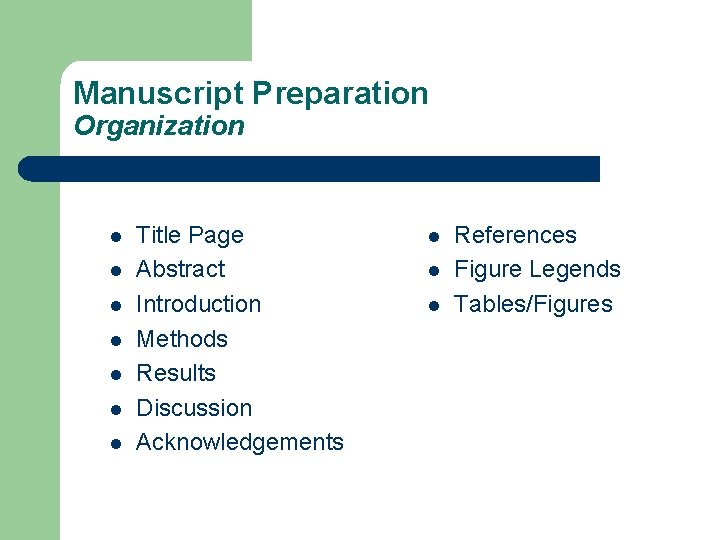
Manuscript Preparation Organization l l l l Title Page Abstract Introduction Methods Results Discussion Acknowledgements l l l References Figure Legends Tables/Figures
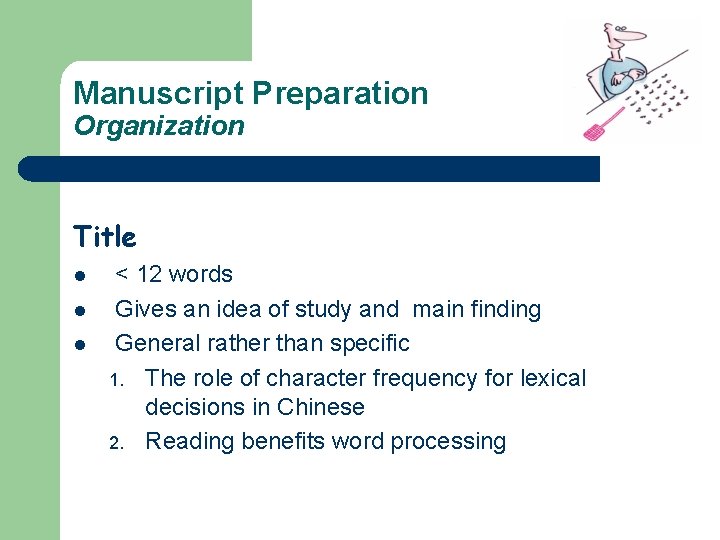
Manuscript Preparation Organization Title l l l < 12 words Gives an idea of study and main finding General rather than specific 1. The role of character frequency for lexical decisions in Chinese 2. Reading benefits word processing
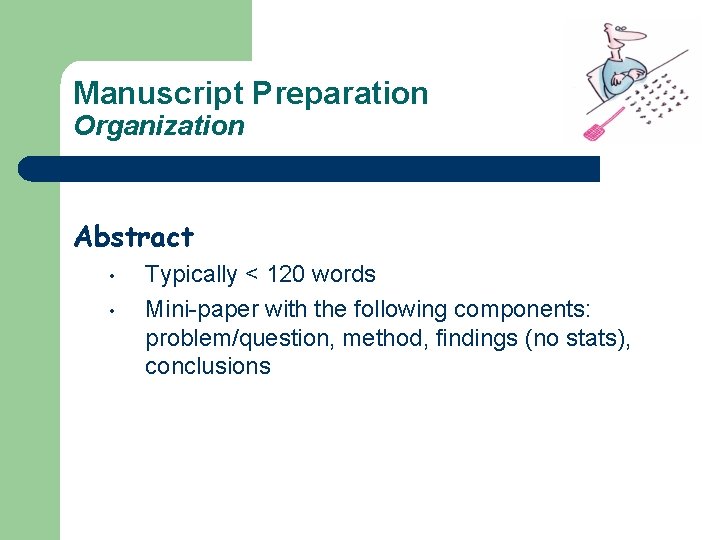
Manuscript Preparation Organization Abstract • • Typically < 120 words Mini-paper with the following components: problem/question, method, findings (no stats), conclusions
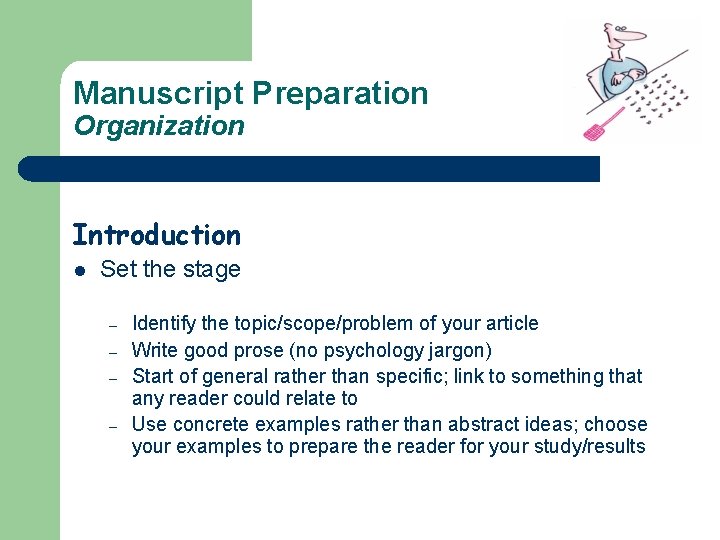
Manuscript Preparation Organization Introduction l Set the stage – – Identify the topic/scope/problem of your article Write good prose (no psychology jargon) Start of general rather than specific; link to something that any reader could relate to Use concrete examples rather than abstract ideas; choose your examples to prepare the reader for your study/results
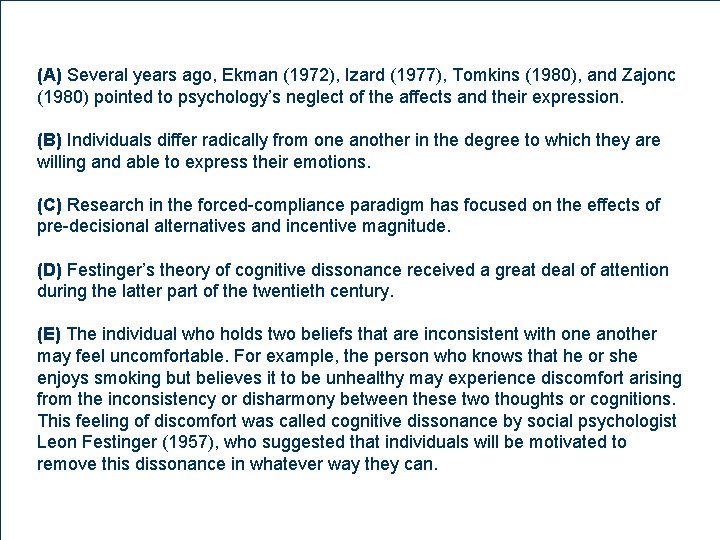
(A) Several years ago, Ekman (1972), Izard (1977), Tomkins (1980), and Zajonc (1980) pointed to psychology’s neglect of the affects and their expression. Manuscript Preparation Organization (B) Individuals differ radically from one another in the degree to which they are willing and able to express their emotions. (C) Research in the forced-compliance paradigm has focused on the effects of pre-decisional alternatives and incentive magnitude. (D) Festinger’s theory of cognitive dissonance received a great deal of attention during the latter part of the twentieth century. (E) The individual who holds two beliefs that are inconsistent with one another may feel uncomfortable. For example, the person who knows that he or she enjoys smoking but believes it to be unhealthy may experience discomfort arising from the inconsistency or disharmony between these two thoughts or cognitions. This feeling of discomfort was called cognitive dissonance by social psychologist Leon Festinger (1957), who suggested that individuals will be motivated to remove this dissonance in whatever way they can.
Manuscript Preparation Organization Introduction l l Set the stage Review the literature – – What work has been done on the problem? What are current theories?
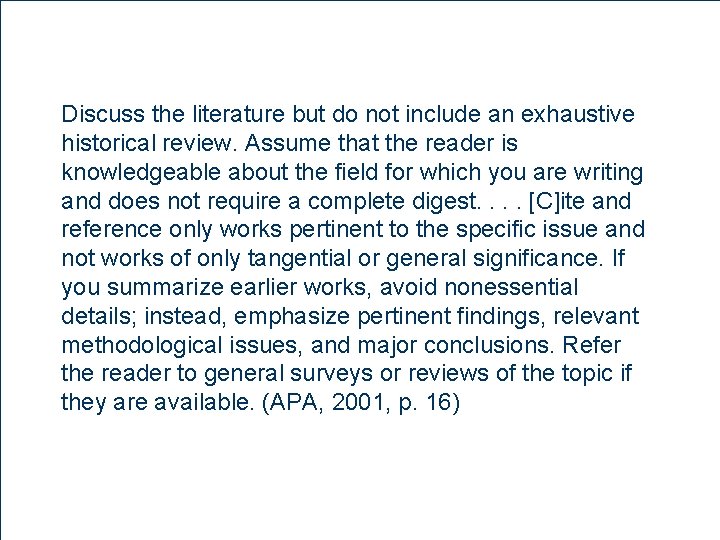
Manuscript Preparation Discuss the literature but do not include an exhaustive Organization historical review. Assume that the reader is knowledgeable about the field for which you are writing and does not require a complete digest. . [C]ite and reference only works pertinent to the specific issue and not works of only tangential or general significance. If you summarize earlier works, avoid nonessential details; instead, emphasize pertinent findings, relevant methodological issues, and major conclusions. Refer the reader to general surveys or reviews of the topic if they are available. (APA, 2001, p. 16)
Manuscript Preparation Organization Introduction 1. 2. 3. 4. Set the stage Review the literature Identify the gap! What is missing from the existing body of work and why does this need addressing? Shortly sketch your study and detail your hypotheses
Manuscript Preparation Organization Methods l Give enough detail for potential replication of your study (see APA guidelines) – Participants l l l Number/sample recruited Discuss drop out criteria and number of drop-outs Age, sex, other information relevant for your study of the remaining participants
Manuscript Preparation Organization Methods l Give enough detail for potential replication of your study (see APA guidelines) – Participants – Material – Procedure
Manuscript Preparation Organization l Procedure – – Walk the reader through one trial/session from the participants perspective Introduce easy labels for groups, variables, or conditions and use them throughout l l NPC/SPC vs neutral prosody/sad prosody High/low incentive group vs $1/$20 group
Manuscript Preparation Organization Methods l Give enough detail for potential replication of your study (see APA guidelines) – Participants – Stimuli – Procedure – Data analysis
Manuscript Preparation Organization Results l l Present results in a logical order (e. g. , control variables first; from interaction to individual comparison) Do appropriate statistics (e. g. , multifactorial design) Adhere to the journal standard of reporting statistical results (F(1, 25)=24. 1, p<. 0001) Present main points in tables/figures
Manuscript Preparation Organization Discussion l l l Summarize study question and results Indicate the structure of your discussion (e. g. , brain structures, tasks, conditions) Use subheadings if appropriate Discuss your results in reference to other work Use minor points of your results to support your argument (ie, don’t turn them into major points)
Manuscript Preparation Organization Discussion - continued l l Concluding paragraph: summarize main points from discussion, link back to intro, state significance Concluding sentence: – – “Further research will be needed to determine the mechanism by which the amygdala supports emotion recognition. ” “Thus, our results mark the amydgala as a structure that critically supports emotion recognition thereby contributing to our ability to successfully interact with other humans.
Manuscript Preparation The Process l l Before you begin to write, discuss your results with colleagues and develop a “story” Be sure to have all the stats done to support your story Begin writing by drafting methods/results Write an outline for Intro/Discussion
Manuscript Preparation The Process l Outline for Intro/Discussion – – What are the main points you want to make? What does the reader need to know in order to understand your main points? Which points do you need to support with references? Which aspects of your results are still unclear?
Manuscript Preparation The Process l Outline for Intro/Discussion – – Start writing an outline for Intro/Discussion in point form Sort your points such that they fall into a logical order Decide which points should go into one paragraph and derive a heading (not to be used in the final document) for that paragraph. Each paragraph should convey a main thought/idea. Restrict your Intro to what is relevant for understanding the motivation for your study; keep the rest for the Discussion
Manuscript Preparation The Process l l l Start formulating paragraphs (don’t worry about formulations, get your argument flowing) Do something else for a few days Go back to your paper and see whether you – – – still like the structure notice gaps in your argumentation can improve your style
Manuscript Preparation The Process l l l Write your abstract (check word limit; compare with conclusions) Find someone to proof-read (e. g. , co-authors) Appreciate the comments from others!
Manuscript Preparation Matters of Style l l Don’t write for a specialized audience; assume your reader to be intelligent and broadly educated – no more Avoid jargon and acronyms Omit needless words Make the structure of your text explicit (e. g. , There are three possible explanations for these results. First, … Second, … Finally…) l Give numbers where appropriate (i. e. , “First, …” )
Manuscript Preparation Matters of Style l l l Use repetition and parallel constructions to facilitate reading. Voice: trend goes to “I” and “We”. Avoid passive constructions. Tense: Use past tense when describing your work and that of others. Use present or future tense where appropriate. Don’t call your participants “subjects”. Use spell/grammar checks. Be meticulous.
Manuscript Preparation Matters of Style l Common grammatical errors: – – Data is plural “Different from” vs “different than” “Since” vs “because” “That” vs “which” Graduate modules, which are listed in your handout, are open to all students enrolled into the graduate program. The graduate modules that are listed in your handout differ from those published on IVLE.
Manuscript Preparation Matters of Style l Common grammatical errors: – Data is plural – “Different from” vs “different than” – “Since” vs “because” – “That” vs “which” – “While” vs “Although” While graduate school is time consuming, (at the same time) it offers …
Common Misconceptions about Psychology Papers (Sternberg, 2002) l l Writing is the most routine – least creative aspect of the research process. The important thing is what you say and not how you say it. Longer papers are better papers. The main purpose of a psychology paper is the presentation of facts.
Common Misconceptions about Psychology Papers (Sternberg, 2002) l l l The purpose of scientific writing is to inform whereas the purpose of advertising/propaganda is to persuade. A good way to gain acceptance of your theory is to refute someone else’s theory. Negative results that fail to support your hypothesis are as valuable as positive results that support your hypothesis.
Common Misconceptions about Psychology Papers (Sternberg, 2003) l The logical development of ideas in a paper reflects the development of ideas in the psychologist’s head.
References Bem, D. (2003) Writing the Empirical Journal Article, http: //www. dbem. ws/online_pubs. html#writing. Sternberg, R. (2003) The Psychologist’s Companion: A Guide to Scientific Writing for Students and Researchers. Cambridge: Cambridge University Press. Dupre, L. (1998) Bugs in Writing: A Guide to Debugging Your Prose. Reading, MA: Addison-Wesley. Gelfand, H. & Walker, C. J. (2001) Mastering APA Style: Student’s Workbook and Training Guide. Washington, DC: American Psychological Association.
Manuscript Preparation Organization A good writer has many readers!