
Overview Joints articulations the meeting places between 2

Overview • Joints (articulations) = the meeting places between 2 or more bones – They give the skeleton mobility and hold it together • Body movements happen when muscles contract across joints, moving one bone toward another • Important connective tissues: – Ligaments: attach bones to bones – Tendons: attach muscles to bones • Joints can be classified by structure or function
Functional Classification • Based on what they do and how much movement they allow – Note: The less movable the joint, the more stable it is • 3 Types: – Synarthroses = Non-moving joints • Ex. The part of the skull that protects the brain = cranium – Amphiarthroses = Slightly-moving joints • Ex. Where pubic bones meet in the pelvis – Diarthroses = Freely moving joints • Ex. Like knee and elbow joints, mainly in our limbs
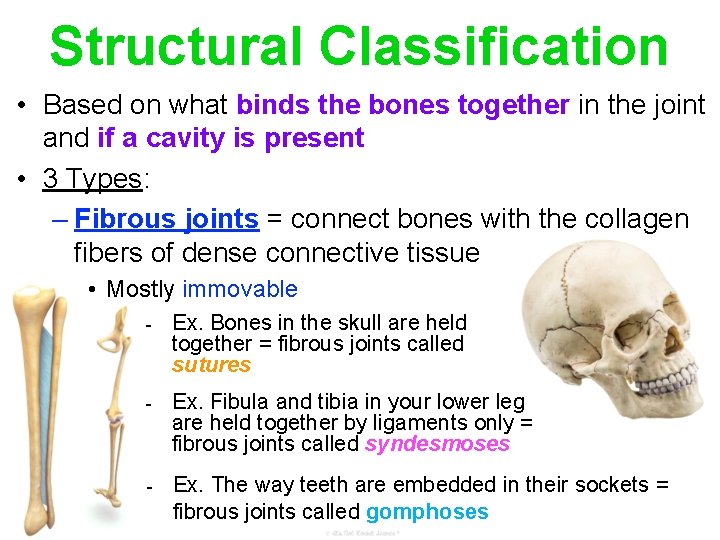
Structural Classification • Based on what binds the bones together in the joint and if a cavity is present • 3 Types: – Fibrous joints = connect bones with the collagen fibers of dense connective tissue • Mostly immovable - Ex. Bones in the skull are held together = fibrous joints called sutures - Ex. Fibula and tibia in your lower leg are held together by ligaments only = fibrous joints called syndesmoses - Ex. The way teeth are embedded in their sockets = fibrous joints called gomphoses
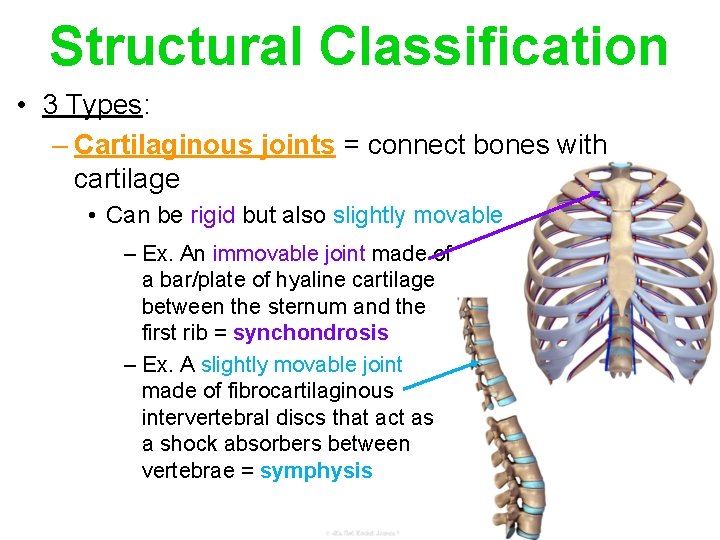
Structural Classification • 3 Types: – Cartilaginous joints = connect bones with cartilage • Can be rigid but also slightly movable – Ex. An immovable joint made of a bar/plate of hyaline cartilage between the sternum and the first rib = synchondrosis – Ex. A slightly movable joint made of fibrocartilaginous intervertebral discs that act as a shock absorbers between vertebrae = symphysis
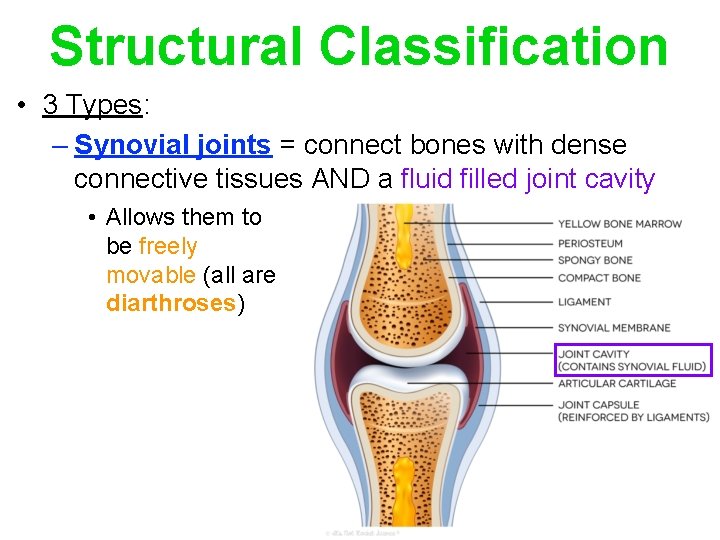
Structural Classification • 3 Types: – Synovial joints = connect bones with dense connective tissues AND a fluid filled joint cavity • Allows them to be freely movable (all are diarthroses)

Synovial Joints • 6 Special Features: – Articular cartilage that covers the opposing bone surfaces – Joint (articular) cavity – A fibrous joint (articular) capsule that encloses the cavity
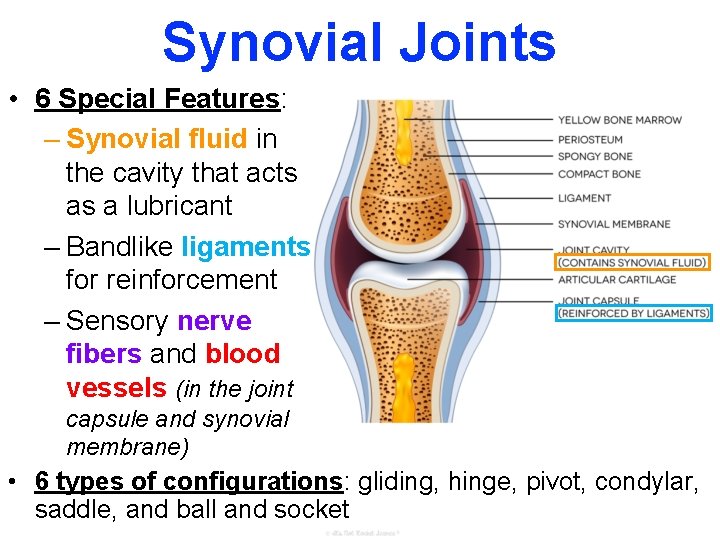
Synovial Joints • 6 Special Features: – Synovial fluid in the cavity that acts as a lubricant – Bandlike ligaments for reinforcement – Sensory nerve fibers and blood vessels (in the joint capsule and synovial membrane) • 6 types of configurations: gliding, hinge, pivot, condylar, saddle, and ball and socket
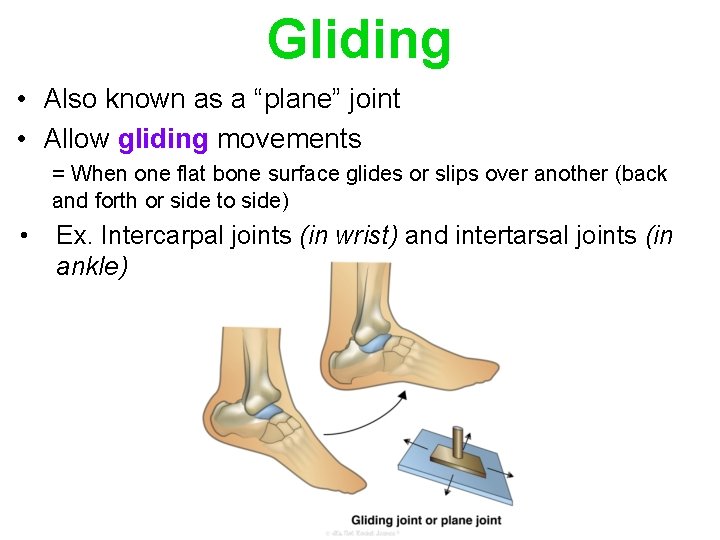
Gliding • Also known as a “plane” joint • Allow gliding movements = When one flat bone surface glides or slips over another (back and forth or side to side) • Ex. Intercarpal joints (in wrist) and intertarsal joints (in ankle)
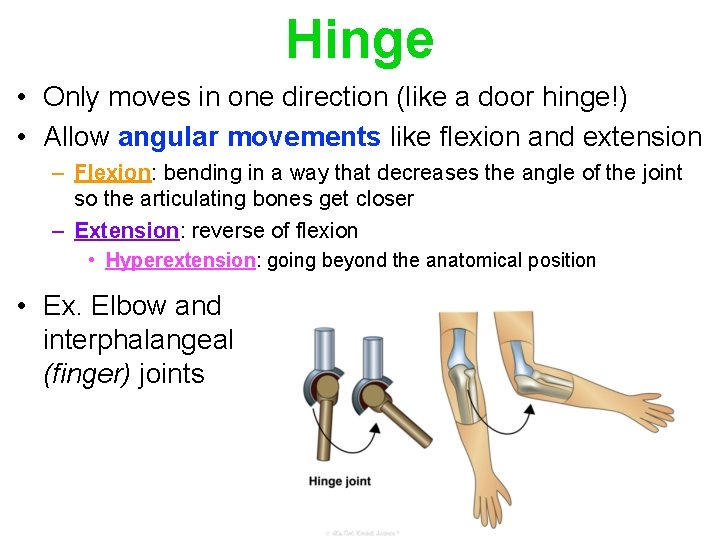
Hinge • Only moves in one direction (like a door hinge!) • Allow angular movements like flexion and extension – Flexion: bending in a way that decreases the angle of the joint so the articulating bones get closer – Extension: reverse of flexion • Hyperextension: going beyond the anatomical position • Ex. Elbow and interphalangeal (finger) joints
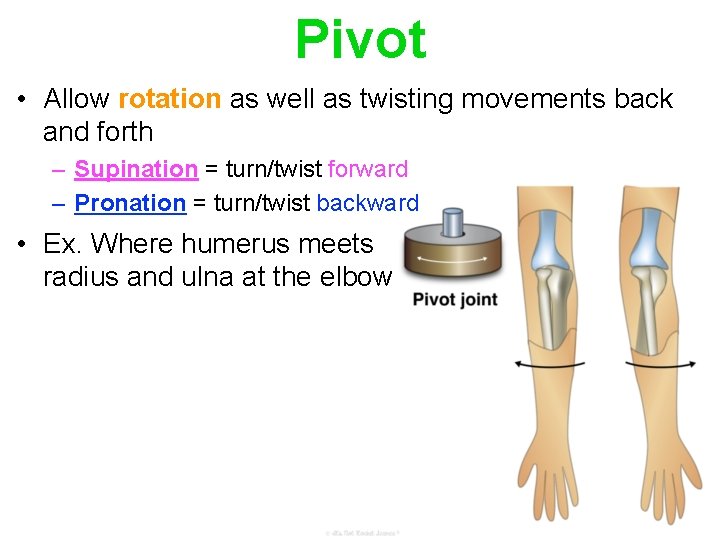
Pivot • Allow rotation as well as twisting movements back and forth – Supination = turn/twist forward – Pronation = turn/twist backward • Ex. Where humerus meets radius and ulna at the elbow
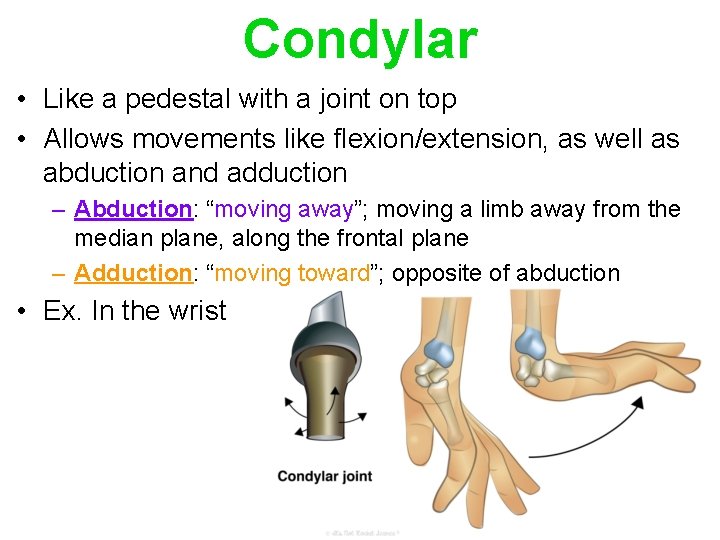
Condylar • Like a pedestal with a joint on top • Allows movements like flexion/extension, as well as abduction and adduction – Abduction: “moving away”; moving a limb away from the median plane, along the frontal plane – Adduction: “moving toward”; opposite of abduction • Ex. In the wrist
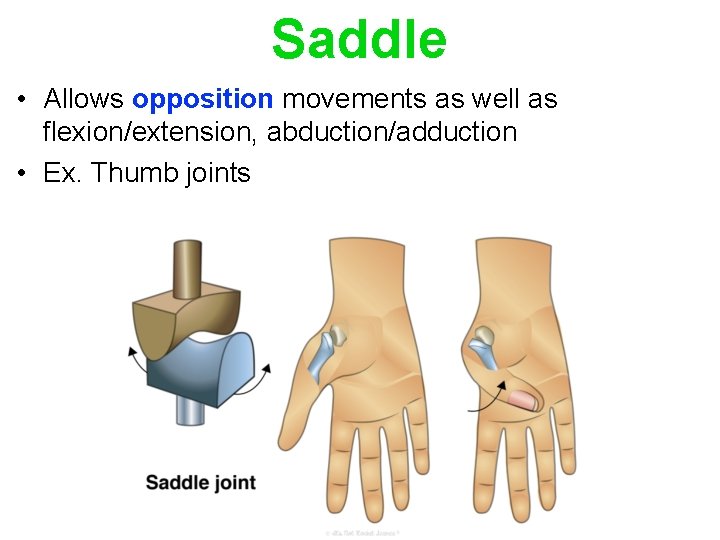
Saddle • Allows opposition movements as well as flexion/extension, abduction/adduction • Ex. Thumb joints
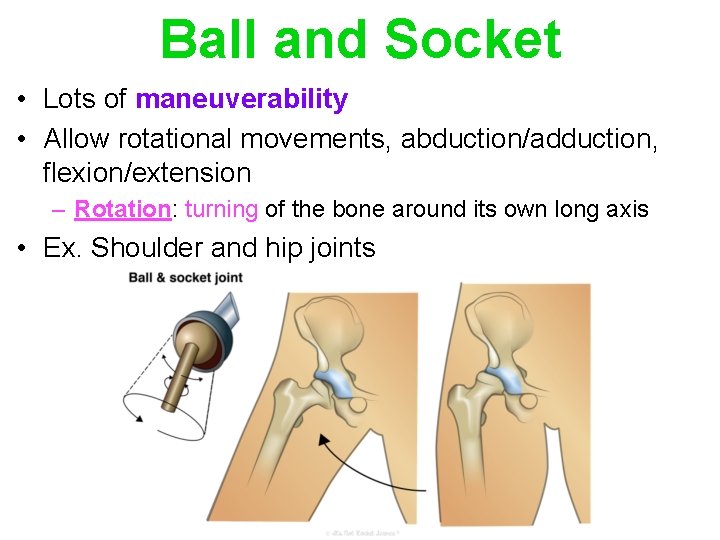
Ball and Socket • Lots of maneuverability • Allow rotational movements, abduction/adduction, flexion/extension – Rotation: turning of the bone around its own long axis • Ex. Shoulder and hip joints
Other Types of Movements at different joints • Circumduction: moving limb in a circle; Ex. Making circles with arms • Elevation and depression: lifting (then lowering) a body part superiorly; Ex. Shrugging your shoulders, jaw dropping • Protraction and retraction: Ex. Sticking jaw out (to make an under bite) and back in • Dorsiflexion and plantar flexion: Lifting foot up and down at the ankle • Inversion and eversion: Ex. Turning the foot inward (to be pigeon toed) and outward
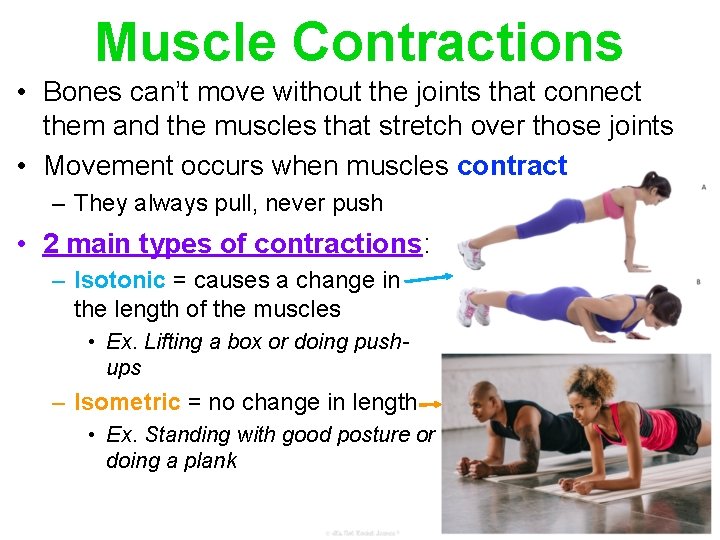
Muscle Contractions • Bones can’t move without the joints that connect them and the muscles that stretch over those joints • Movement occurs when muscles contract – They always pull, never push • 2 main types of contractions: – Isotonic = causes a change in the length of the muscles • Ex. Lifting a box or doing pushups – Isometric = no change in length • Ex. Standing with good posture or doing a plank
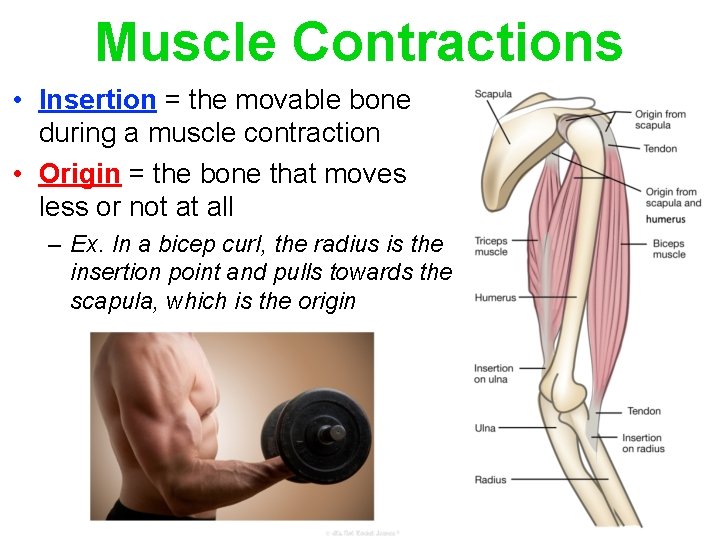
Muscle Contractions • Insertion = the movable bone during a muscle contraction • Origin = the bone that moves less or not at all – Ex. In a bicep curl, the radius is the insertion point and pulls towards the scapula, which is the origin
- Slides: 17