
Overview Introduction History Why electric car Different parts




- Slides: 18
Overview �Introduction �History �Why electric car? �Different parts �Motor �Controller �Batteries used in electric cars �Obstacles �Future �References 1
Introduction �An electric is a car powered by an electric motor. �Creates less pollution than gasoline car �It consists of a motor, a controller and batteries. �An electric motor gets power from controller which is energized by battery. 2
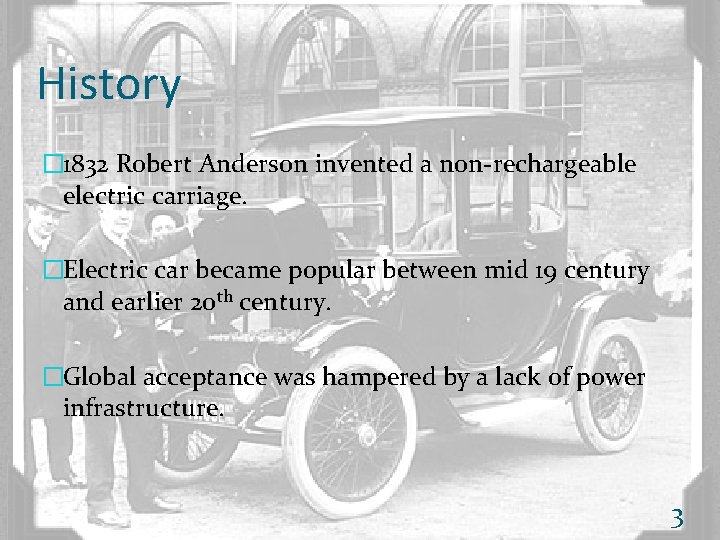
History � 1832 Robert Anderson invented a non-rechargeable electric carriage. �Electric car became popular between mid 19 century and earlier 20 th century. �Global acceptance was hampered by a lack of power infrastructure. 3
Why electric car? �Inadequacy of fossil fuels. �Eco-friendly. �Cost is less per mile. �It produces no pollution at the tailpipe. 4
Different parts An electric car comprises: � Electric motor �Controller �Batteries 5
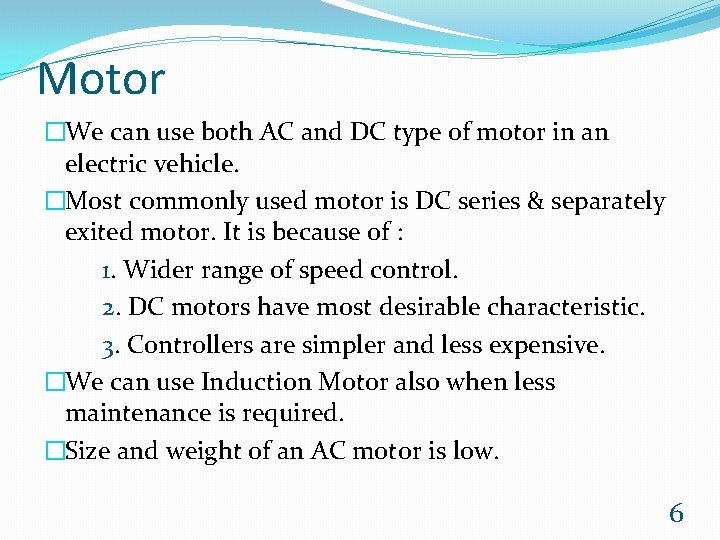
Motor �We can use both AC and DC type of motor in an electric vehicle. �Most commonly used motor is DC series & separately exited motor. It is because of : 1. Wider range of speed control. 2. DC motors have most desirable characteristic. 3. Controllers are simpler and less expensive. �We can use Induction Motor also when less maintenance is required. �Size and weight of an AC motor is low. 6
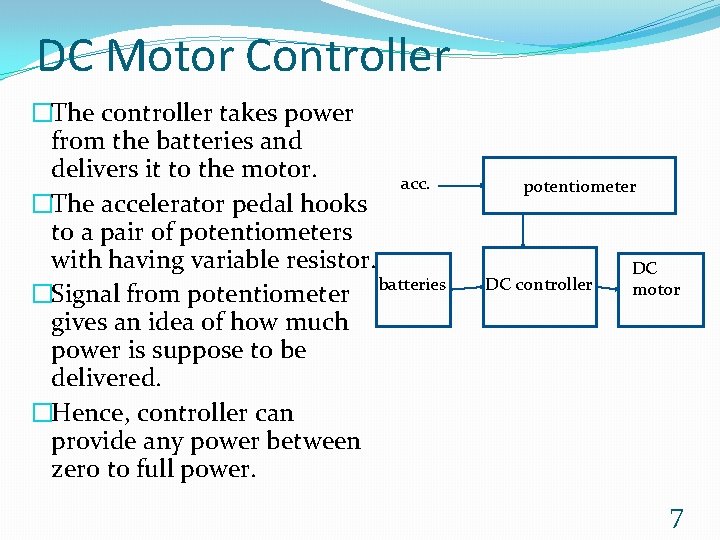
DC Motor Controller �The controller takes power from the batteries and delivers it to the motor. acc. �The accelerator pedal hooks to a pair of potentiometers with having variable resistor. �Signal from potentiometer batteries gives an idea of how much power is suppose to be delivered. �Hence, controller can provide any power between zero to full power. potentiometer DC controller DC motor 7
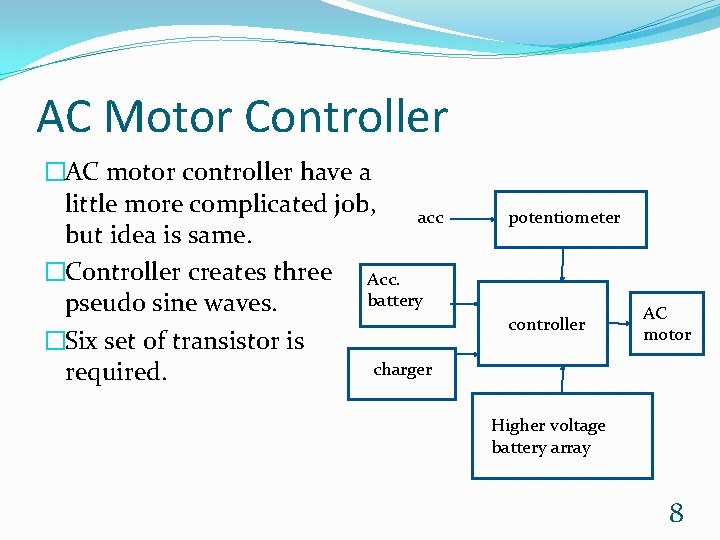
AC Motor Controller �AC motor controller have a little more complicated job, acc but idea is same. �Controller creates three Acc. battery pseudo sine waves. �Six set of transistor is charger required. potentiometer controller AC motor Higher voltage battery array 8
Batteries used in Electric Cars ØLead-acid (mostly used) ØNi-Cd ØNi-Zn ØNi-MH Ølithium-ion ØLi-ion polymer, and ØLithium-iron phosphate 9
�Batteries are the major drawback in an electric car. �They are heavy and bulky. �Short life span. (typically 3 -4 years). �Limited capacity (battery of 15 k. Wh stands for 50 miles). �Expensive. 10
Charging System for batteries A charging system has two objectives : Ø To pump electricity into the batteries as quickly as possible. Ø To monitor the batteries and avoid damaging them during the charging process 11
�Batteries must be periodically charged. �In home, power such as roof top photovoltaic solar cell panels can be used to charge batteries. �Some advanced power station can charge a battery within an hour. �Fast charging methods can be used. Contd…. 12
13
Obstacles �Lithium Ion battery costs �Range concerns �Price and consumer acceptance �Market 14
Future �Strictly depends upon cost and availability of batteries fulfilling all the requirements. �Li-ion, Li-poly and zinc-air batteries will be used. �Fuel cell will be used. �They will be lighter, smaller and high reliable. �Super capacitors will be used. 15
References � Brain, Marshall. "How Electric Cars Work. " 27 March 2002. How. Stuff. Works. com. <http: //auto. howstuffworks. com/electric car. htm> 26 August 2009. � W. F. Hamilton, “Electric Automobile”; Mc. Graw. Hill, Hightstown, NJ; September, 1979 � B. Berman and G. H. Gelb, “Propulsion systems for electric cars”; IEEE Trans. , vol. VT 23, pp. 61 -72; 1974 � S. A. Nasar and L. E. Unnewehr, “Electric vehicle technology”; John Wiley, New York; 1979 � A. J. Graumilch and C. V. Kern, “Battery power small off-highway vehicles”; SAE paper#740730; September, 1974 16
Thank you! 17
Queries? ? 18