
Overview Introduction and background Categories of Artificial Intelligence
Overview • Introduction and background. • Categories of Artificial Intelligence (AI) technologies and a brief history of AI. • Commercialization of AI and state of the practice platforms. • Example applications of AI in transportation systems management and operations (TSMO). • Considerations for use of AI technologies for TSMO. This webinar will raise your awareness of the potential for AI in TSMO. 1
Disclaimer The U. S. Government does not endorse products or manufacturers. Trademarks or manufacturers’ names appear in this presentation only because they are considered essential to the objective of the presentation. They are included for informational purposes only and are not intended to reflect a preference, approval, or endorsement of any one product or entity. 2
AI and Transportation Operations AI has potential for the next generation of transportation system management and operations. • AI technologies are maturing as commercially-available software services. • AI can provide enhancements to many different TSMO applications and functions. • Potential for automated vehicles and unmanned aerial systems in TSMO functions. • Two important considerations for AI for agencies: – Can AI enhance current capabilities? – Can AI enable new capabilities? 3
Improving Existing Capabilities with AI • Incident detection and management. • Traffic image analysis. • Traffic signal timing optimization. • Freeway ramp metering. • Natural language decision support. • Analysis of data from different sources. 4
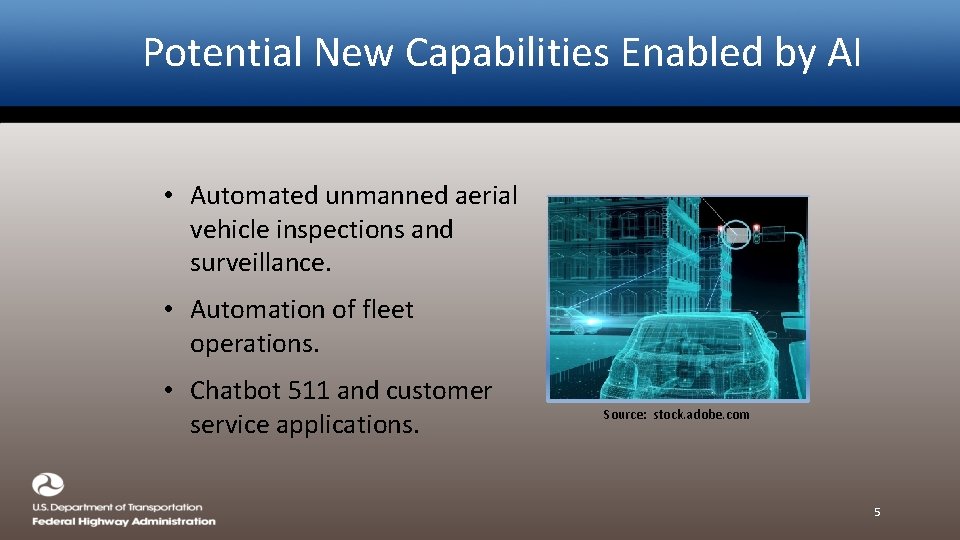
Potential New Capabilities Enabled by AI • Automated unmanned aerial vehicle inspections and surveillance. • Automation of fleet operations. • Chatbot 511 and customer service applications. Source: stock. adobe. com 5
What is Artificial Intelligence (AI)? The term "artificial intelligence" is often used to describe machines (or computers) that mimic "cognitive" functions that humans associate with the human mind. The traditional problems (or goals) of AI research include reasoning, knowledge representation, planning, learning, natural language processing, perception and the ability to move and manipulate objects. 6
What is Artificial Intelligence (AI)? (continued) • As machines become increasingly capable, tasks considered to require "intelligence" are often removed from the definition of AI. • Tesler's Theorem: “Intelligence is whatever machines haven’t done yet”. – Larry Telser is the godfather of the modern graphical user interface (GUI) at Xerox in the 1970 s and AI researcher in the late 1960 s. • Optical Character Recognition (OCR) was once “AI”. Now it can be purchased as part of a multi-function printer/copier/scanner for $40. 7
AI: Strong and Weak • “Strong” AI: mimicking human cognitive functions to a degree generally considered indistinguishable from a human, i. e. “self aware”. – Terminator, Blade Runner, Her, Age of Ultron, The Matrix, etc. – No system or technology is close to this yet, but many groups are chipping away at the building blocks. • Turing Test: If an AI cannot be distinguished from a human person in general conversation the artificial entity is considered “intelligent”. – Chatbot agents creep closer by the year (Alexa, Dr. QA, Google Assistant, etc. ). 8
AI: Strong and Weak (continued) • “Weak” or narrow AI: performing a specific function to a meeting or exceeding (and often vastly exceeding) human competency. – – – – Playing Jeopardy. Playing Atari games, Chess, Go, Do. TA 2 (Dawn of the Ancients). Translating human speech to text. Recognizing objects in images. Driving on freeways and city streets. Translating from one language to another. Classifying and clustering data. 9
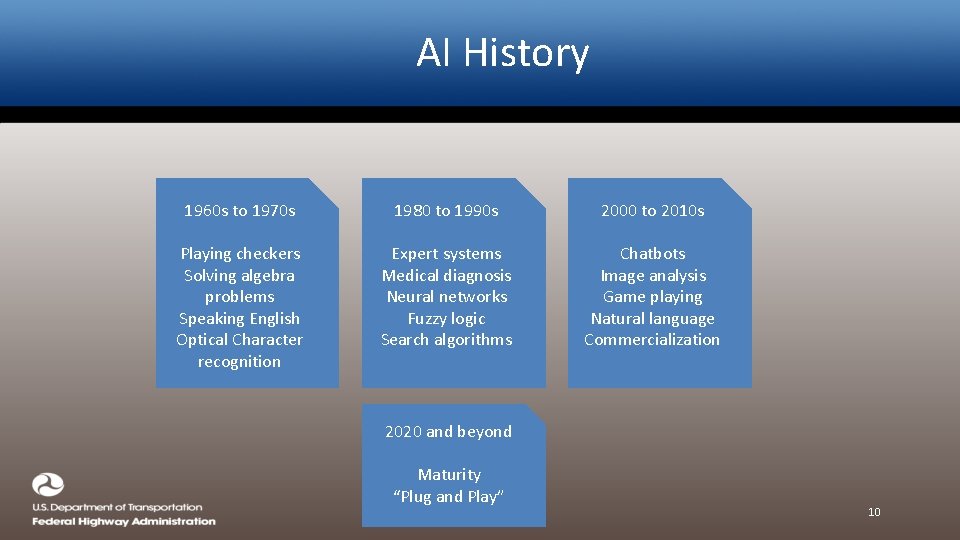
AI History 1960 s to 1970 s 1980 to 1990 s 2000 to 2010 s Playing checkers Solving algebra problems Speaking English Optical Character recognition Expert systems Medical diagnosis Neural networks Fuzzy logic Search algorithms Chatbots Image analysis Game playing Natural language Commercialization 2020 and beyond Maturity “Plug and Play” 10
Key AI Technologies for TSMO • Neural networks. • Imagery analysis systems. • Chatbots. • Natural language processing. • Structured Query Language (SQL) query generation. • Question-answering systems. • Self-driving and self-flying systems. 11
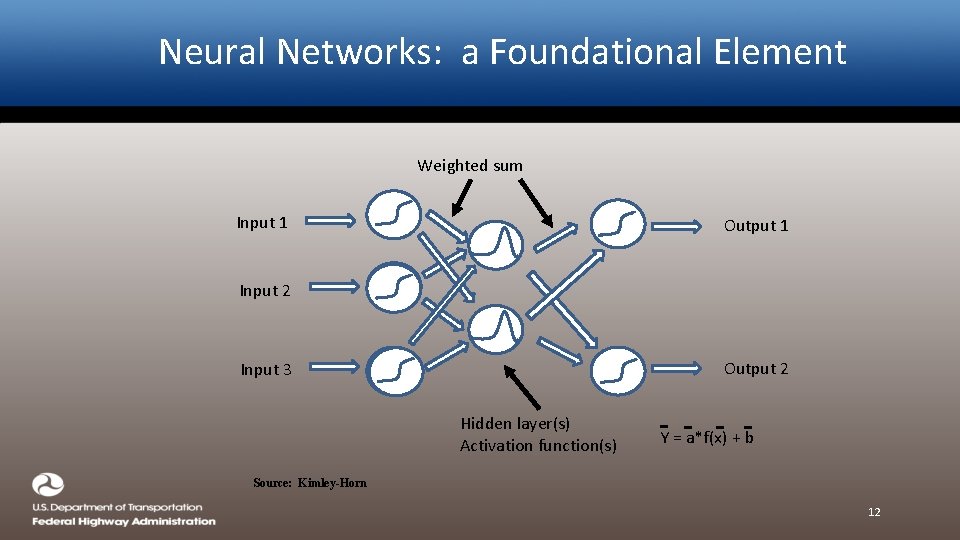
Neural Networks: a Foundational Element Weighted sum Input 1 Output 1 Input 2 Output 2 Input 3 Hidden layer(s) Activation function(s) Y = a*f(x) + b Source: Kimley-Horn 12
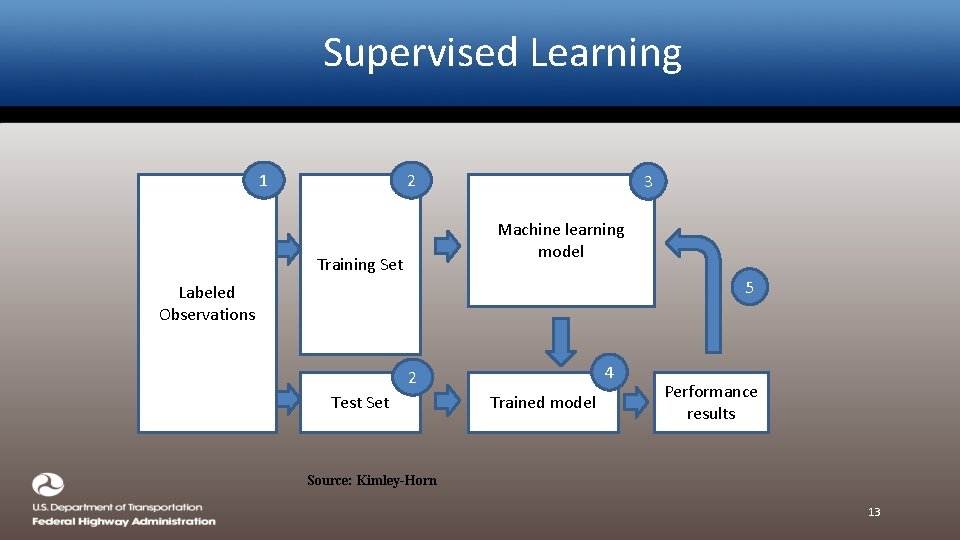
Supervised Learning 1 2 3 Machine learning model Training Set 5 Labeled Observations 4 2 Test Set Trained model Performance results Source: Kimley-Horn 13
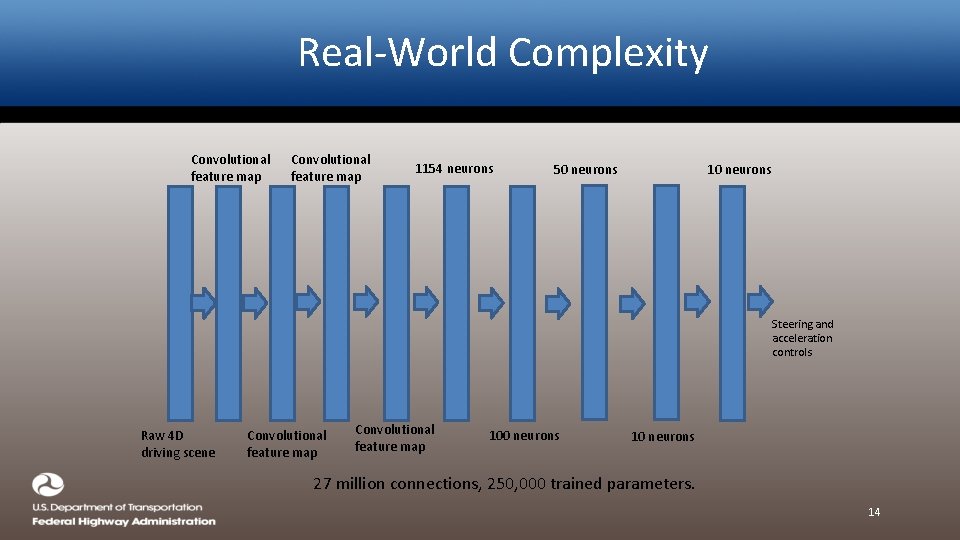
Real-World Complexity Convolutional feature map 1154 neurons 50 neurons 10 neurons Steering and acceleration controls Raw 4 D driving scene Convolutional feature map 100 neurons 10 neurons 27 million connections, 250, 000 trained parameters. 14
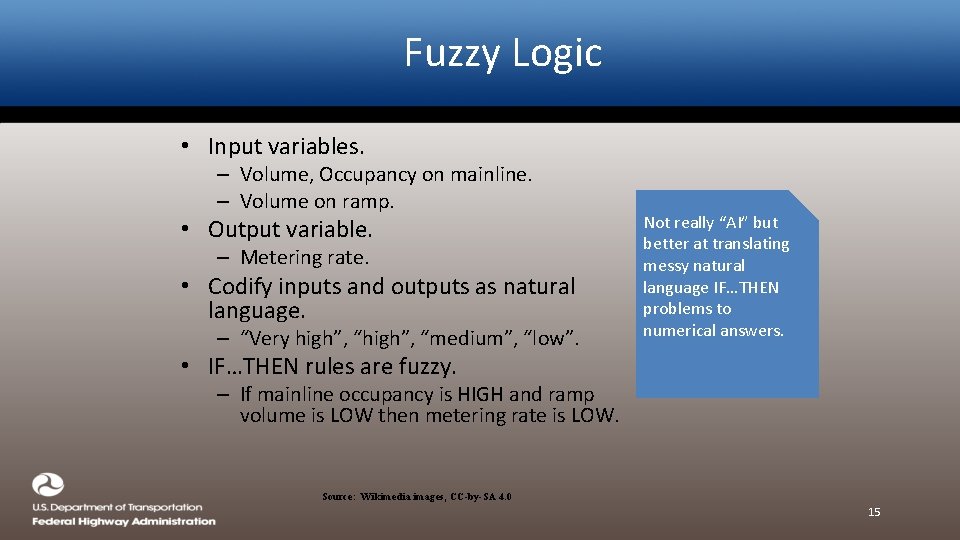
Fuzzy Logic • Input variables. – Volume, Occupancy on mainline. – Volume on ramp. • Output variable. – Metering rate. • Codify inputs and outputs as natural language. – “Very high”, “medium”, “low”. Not really “AI” but better at translating messy natural language IF…THEN problems to numerical answers. • IF…THEN rules are fuzzy. – If mainline occupancy is HIGH and ramp volume is LOW then metering rate is LOW. Source: Wikimedia images, CC-by-SA 4. 0 15
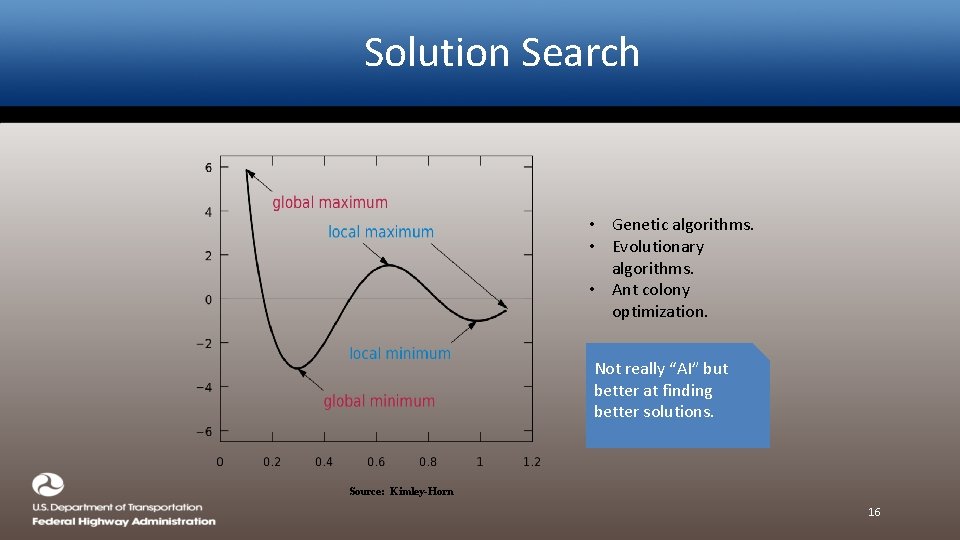
Solution Search • Genetic algorithms. • Evolutionary algorithms. • Ant colony optimization. Not really “AI” but better at finding better solutions. Source: Kimley-Horn 16
Solution Search (continued) • Solution search is sometimes referred to as machine learning or training. • IBM Deep. Blue chess-playing computer is an example of a purpose-built weak-AI computer for doing one thing very well. • Neural network parameters are trained by use of solution search methods generally called “back propagation”. 17
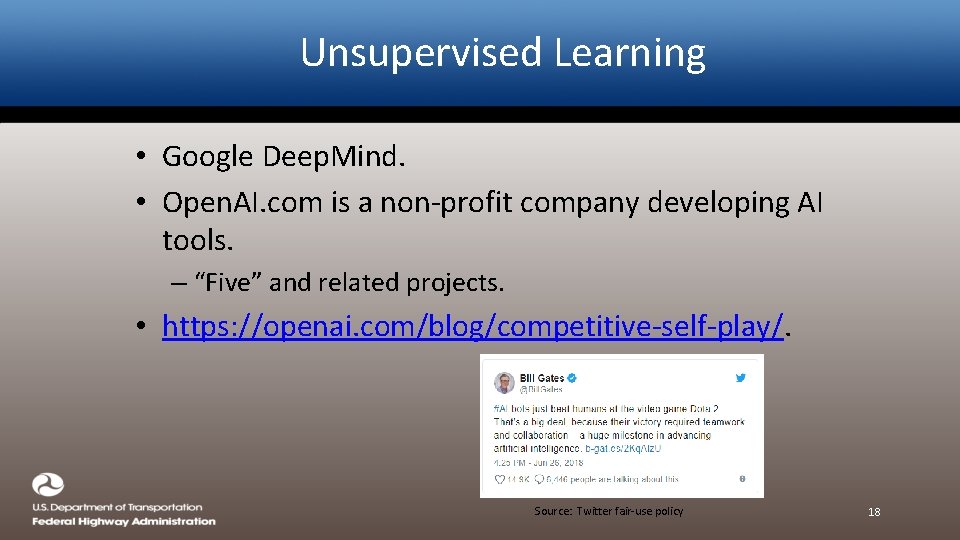
Unsupervised Learning • Google Deep. Mind. • Open. AI. com is a non-profit company developing AI tools. – “Five” and related projects. • https: //openai. com/blog/competitive-self-play/. Source: Twitter fair-use policy 18
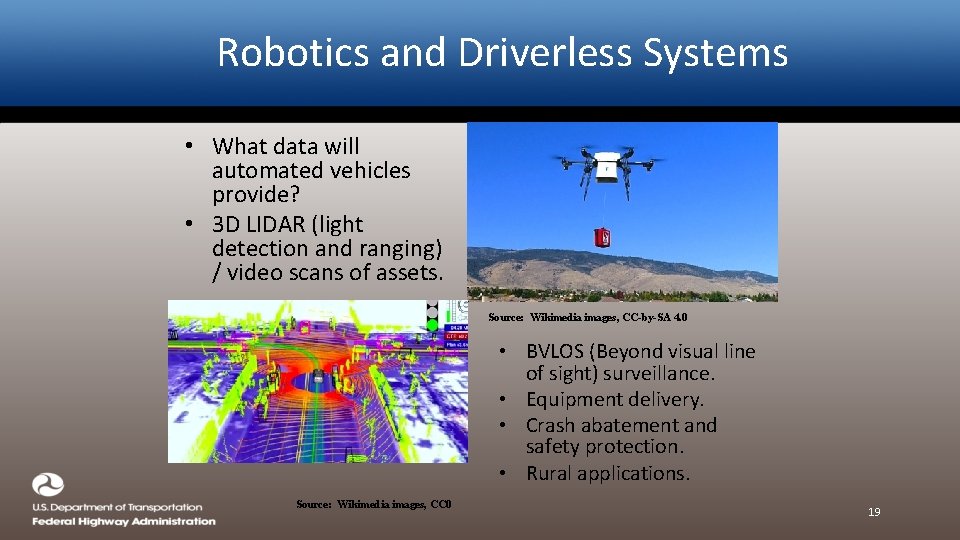
Robotics and Driverless Systems • What data will automated vehicles provide? • 3 D LIDAR (light detection and ranging) / video scans of assets. Source: Wikimedia images, CC-by-SA 4. 0 • BVLOS (Beyond visual line of sight) surveillance. • Equipment delivery. • Crash abatement and safety protection. • Rural applications. Source: Wikimedia images, CC 0 19
Computer Vision Processing • Computer vision process is becoming a semimature market with many companies entering the space to provide services for TSMO. • Some providers require their own cameras. • Some providers can use “any camera”. • Likely that “any camera” solutions will continue to mature since replacement of cameras is not trivial and expensive for IOOs (Infrastructure Owner. Operators). 20
Commercialization • More than 1, 000 companies are involved in various aspects of AI. • Providing AI capabilities now is like providing Big Data capabilities five years ago. • Widespread use of AI chatbots (Alexa, Google Assistant, Dr. QA). • All major cloud service providers have AI suites. 21
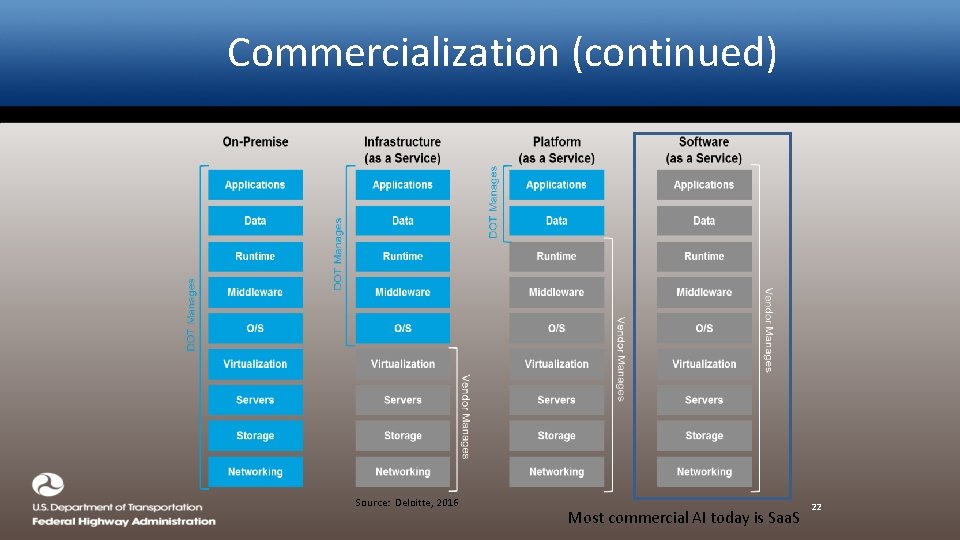
Commercialization (continued) Source: Deloitte, 2016 Most commercial AI today is Saa. S 22
Google Cloud AI • Tensor. Flow – neural network development and training. • Cloud Auto. ML – neural network architecture. • Dialog. Flow – chatbots. • Actions – chatbots. • Firebase – databases. • Duplex – context-sensitive conversations. • Temporal Action Localization – assigning meaning/intent to video. 23
Microsoft Azure AI • • “Cognitive Services”. Neural networks training/development. AI chatbots (Cortana). Pre-built neural networks for common apps. – Object recognition in images. 24
Microsoft Azure AI (continued) • “Labs” – alpha tools currently pre-release. • Project knowledge exploration. – Turning natural language questions into SQL queries. • Project anomaly finder. – Analyzing and reporting problems/anomalies in data streams without extensive coding. 25
Amazon AI Lex – Alexa. Polly – Alexa. Rekognition – imagery analysis. Sage. Maker – neural network construction, training, etc. • Preview services. • • – Forecast: “deploy neural networks and machine learning with no expertise”. 26
Procuring AI • Not easy to determine what something will cost to build or use long-term. • More likely that AI applications and services will be purchased from a vendor/developer/university. – They build the apps you want on top of services and tech from Google, Amazon, Microsoft, others. • Purchased “as a service”. 27
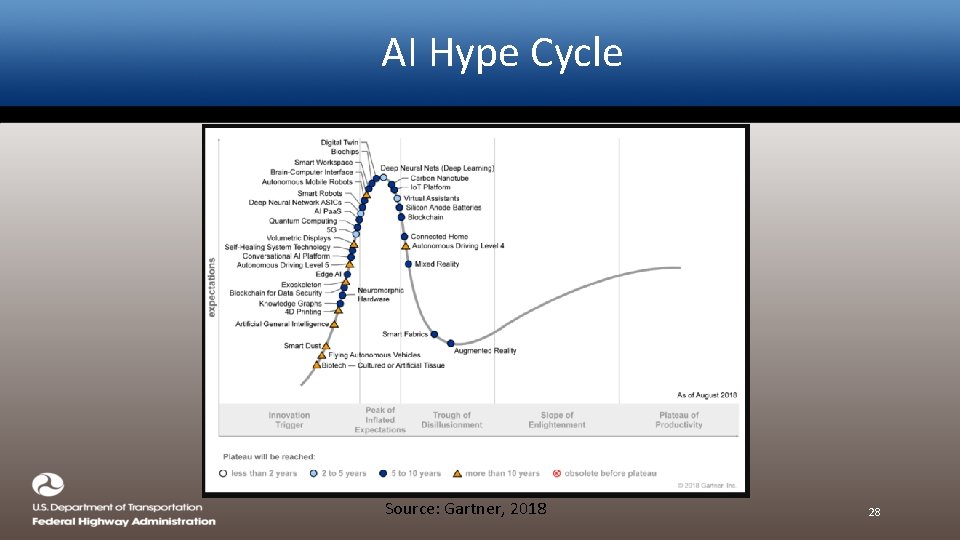
AI Hype Cycle Source: Gartner, 2018 28
Future of Commercial AI • Hype in AI is at a peak. • General future trends: – AI-specific hardware/chips (ex: Telsa). – Migration of centralized machine learning to edge Io. T (internet of things) devices. – Interoperability of NN models - Open Neural Network Exchange (ONNX). – Automation of the process of NN training. – Increasing capabilities of chatbots. – Consumer-ready driverless services/vehicles. – Democratization of AI services to non-professionals (software, database, and statistics experts). – Automated unmanned aerial vehicles. 29
Example AI applications in TSMO AI for incident detection. AI (fuzzy logic) for ramp metering. Chatbots for question and answering. Traffic prediction & integrated corridor management (ICM). • Signal timing plan optimization. • • 30
Incident Detection • Nevada Department of Transportation (DOT) and Florida DOT. – Waycare. – Reported improvements using neural networks to analyze and detect incident conditions. • Iowa DOT. – Iowa State University (TIMELI). – Rural detection. – Currently in pilot implementation. – Positive feedback from Iowa DOT staff. 31
Ramp Metering • Washington State DOT. – Has used fuzzy logic for more than 15 years. – More than 200 ramp meters use the fuzzy logic system. – Reduced software coding of calibration parameters, traffic modeling, error/anomaly handling. • Caltrans District 4 (Bay Area). – I-80 ATM (Active Traffic Management). – Benefits or comparison with traditional ramp metering algorithms has not been evaluated (or released publicly at time of report). 32
Chatbot question and answering • MTC (Metropolitan Transportation Commission) 511 (Bay area). – Invoke 511 through Alexa. – Standard 511 queries as calling 511 through phone. • Virginia DOT “hackathon”. – “Talk DOT” app: Alexa Skill to ask questions of the Virginia DOT database as if you were using the Web interface. • Surprise, AZ / Kimley-Horn. – Google Assistant app to query the Kadence adaptive control system of current or past performance (ATSPMs – automated traffic signal performance measures) of individual signals or arterials. 33
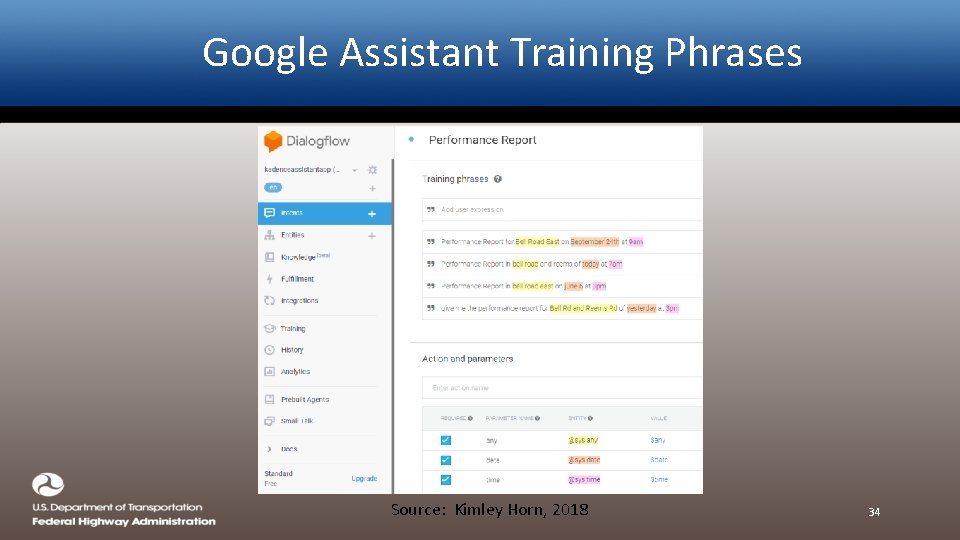
Google Assistant Training Phrases Source: Kimley Horn, 2018 34
Unmanned Aerial Vehicles (UAV) • 35 of 50 State DOTs now have a UAV program as of March 2018. • 20 active and 15 in research phase. • Piloted UAVs for asset surveillance. • North Carolina DOT/North Carolina Highway Patrol. – Crash reconstruction data collection. – Reduced costs from $13, 000 to $4, 000. – Reduced time from two hours to 30 minutes. – Alpha research phase. 35
Considering AI in TSMO • Identify clear objectives for AI applications. • Thorough research of systems and technology required. • Evaluate staffing and organization needs for project deployment. • Evaluate how AI will modify business processes. • Identify collaboration with other agencies/divisions/departments that can reduce costs and increase value. 36
Considering AI in TSMO (continued) • Big-brother privacy and security issues and policy. • Short supply of highly-skilled personnel to implement AI applications (public-private partnerships). • Ownership of data (particularly with public-private partnerships). 37
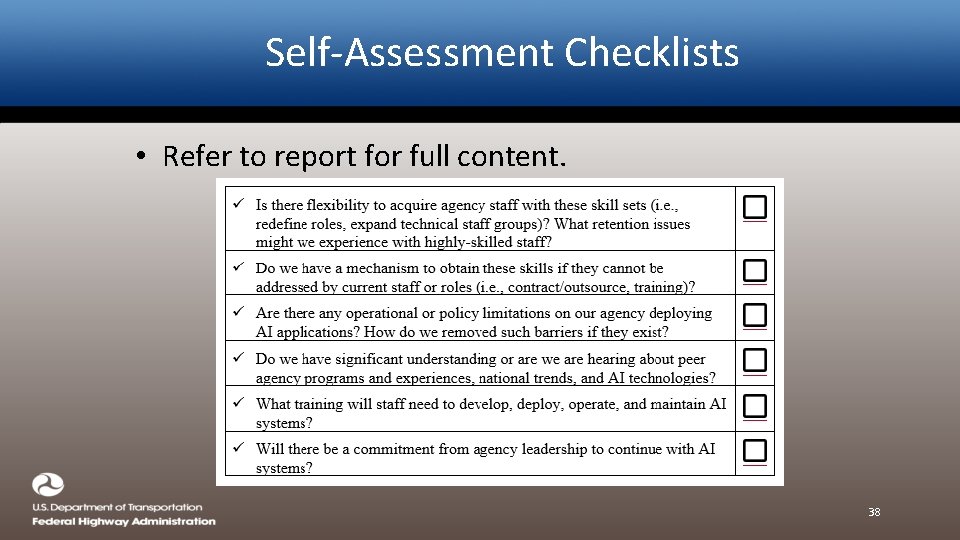
Self-Assessment Checklists • Refer to report for full content. 38
Where to Start? • Interdepartmental workshop on AI. • Determine a short-list of high-priority applications that meet regional goals. • Develop a program plan for research, development, and implementation. • Consider connections of AI apps with automated and connected vehicle programs. 39
Raising Awareness Document Raising Awareness of Artificial Intelligence for Transportation Systems Management and Operations September 2019 FHWA-HOP-19 -052 Available in National Transportation Library soon. 40
- Slides: 40