
Overview Evidencebased Health Promotion and Disease Management Programs
Overview: Evidence-based Health Promotion and Disease Management Programs
What are Evidence-based Health Promotion Programs? § A process of planning, implementing, and evaluating programs adapted from tested models or interventions § Uses an epidemiologic perspective that focuses on populations rather than individuals § It emphasizes both prevention and treatment.
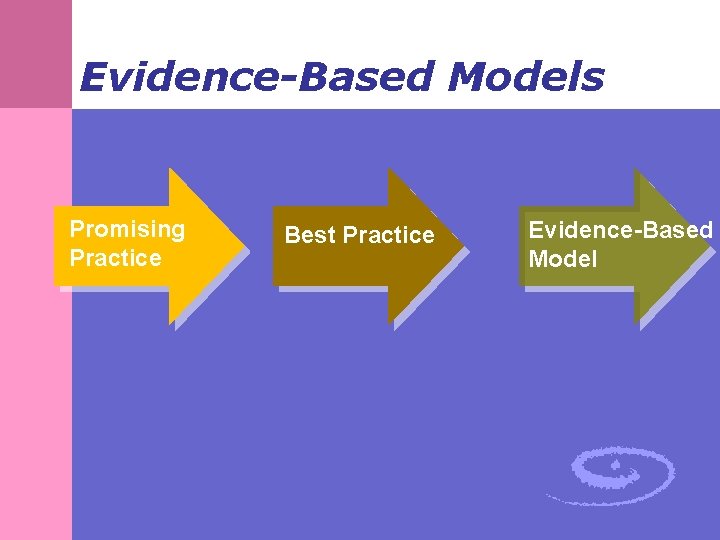
Evidence-Based Models Promising Practice Best Practice Evidence-Based Model
Ao. A Tiered Levels of EBHP § Minimal § Intermediate § Highest
Translating “The Evidence” into Community-based Programs § Challenge: translate the intervention from its original application under controlled “laboratory-like” settings with tightly monitored protocols § Understand the core elements of the intervention that made it work
Evidence-based Evaluation § Occurs at two levels • Implementation (process evaluation) • Effects (outcomes evaluation) § Measure outcomes at both individual and community levels: • Assess changes in program participants’ learning, health behaviors, and health status • the effects of the program on community health status
“Fidelity” in EBHP § Process of faithfully and accurately adhering to the core elements of an intervention § Fidelity, or the preservation of the evidence base, is central to evidencebased health promotion.
EBHP in Practice Tasks § To identify an important health issue and the population at risk § Identify effective intervention(s) § Establish broad-based partnerships § Select an intervention § Translate the intervention into a program § Evaluate the program § Sustain the program
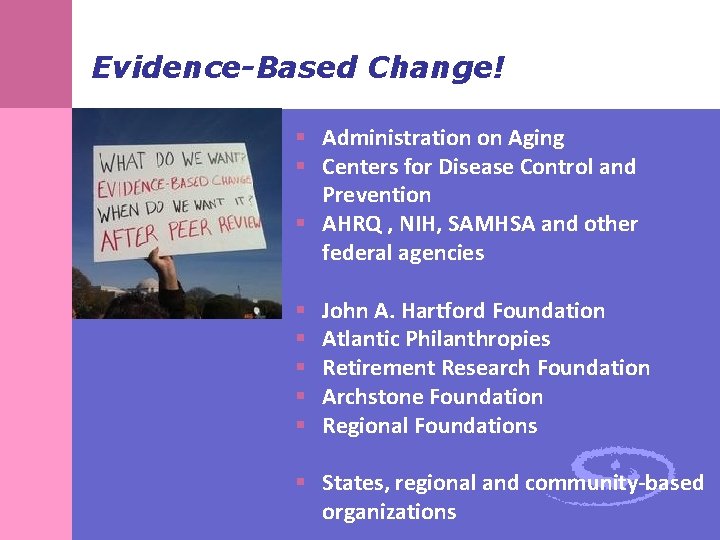
Evidence-Based Change! § Administration on Aging § Centers for Disease Control and Prevention § AHRQ , NIH, SAMHSA and other federal agencies § § § John A. Hartford Foundation Atlantic Philanthropies Retirement Research Foundation Archstone Foundation Regional Foundations § States, regional and community-based organizations
National Council on Aging (NCOA) § NCOA is a national network founded in 1950 § Over 3, 800 members § Voluntary leadership network § Home of the Center for Healthy Aging
The EBHP “Movement” § 2001: Demonstration projects (4) § 2003: Model projects (14) served 5, 000 people § 2006: “Choices for Independence”– 24 states § 2007: Challenge grants (4 more states) § 2010: Ao. A ARRA Projects: 48 states/territories § 2013: Ao. A Empowering Older People– 22 states
The Aging Network as the Delivery System § Federal Partnership-DHHS (Ao. A, CMS, CDC, HRSA) § Nationwide systems approach § Strategic framework to strengthen coordinated efforts for optimum health and quality of life
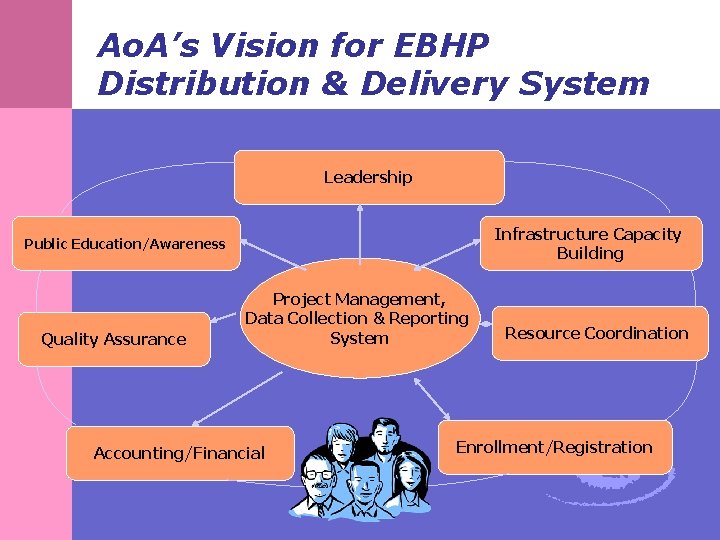
Ao. A’s Vision for EBHP Distribution & Delivery System Leadership Infrastructure Capacity Building Public Education/Awareness Quality Assurance Project Management, Data Collection & Reporting System Accounting/Financial Resource Coordination Enrollment/Registration
Recovery Act CDSMP Goals § Reach 50, 000 completers § March 31, 2010 - March 30, 2012 § Establish sustainable program delivery system
Prevention and Public Health Fund CDSME Initiative § Build on success of ARRA initiative § $8. 5 million awarded to 22 states § Two goals § Significantly increase the number of older and/or disabled adults who complete CDSME programs § Strengthen and expand integrated, sustainable service systems to provide access to CDSME programs
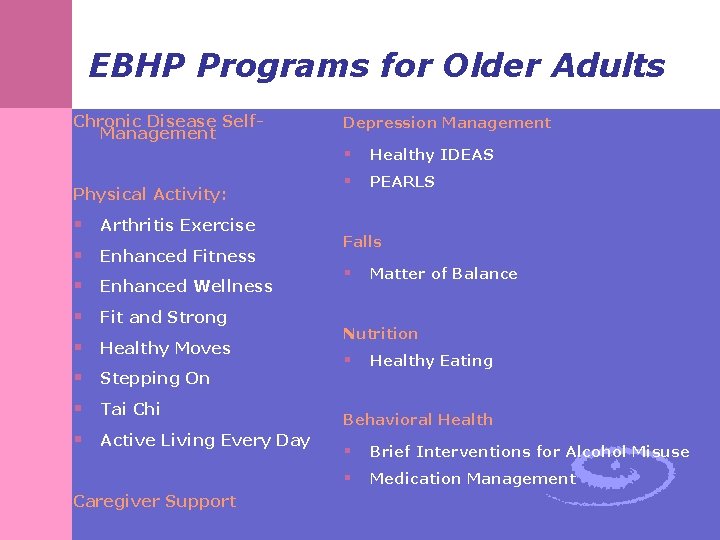
EBHP Programs for Older Adults Chronic Disease Self. Management Physical Activity: § Arthritis Exercise § Enhanced Fitness § Enhanced Wellness § Fit and Strong § Healthy Moves § Stepping On § Tai Chi § Active Living Every Day Caregiver Support Depression Management § § Healthy IDEAS PEARLS Falls § Matter of Balance Nutrition § Healthy Eating Behavioral Health § § Brief Interventions for Alcohol Misuse Medication Management
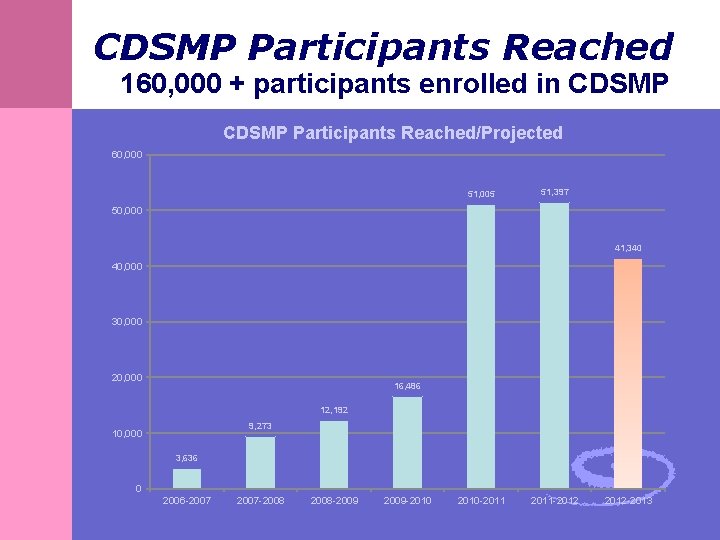
CDSMP Participants Reached 160, 000 + participants enrolled in CDSMP Participants Reached/Projected 60, 000 51, 005 51, 397 50, 000 41, 340 40, 000 30, 000 20, 000 16, 486 12, 192 9, 273 10, 000 3, 636 0 2006 -2007 -2008 -2009 -2010 -2011 -2012 -2013
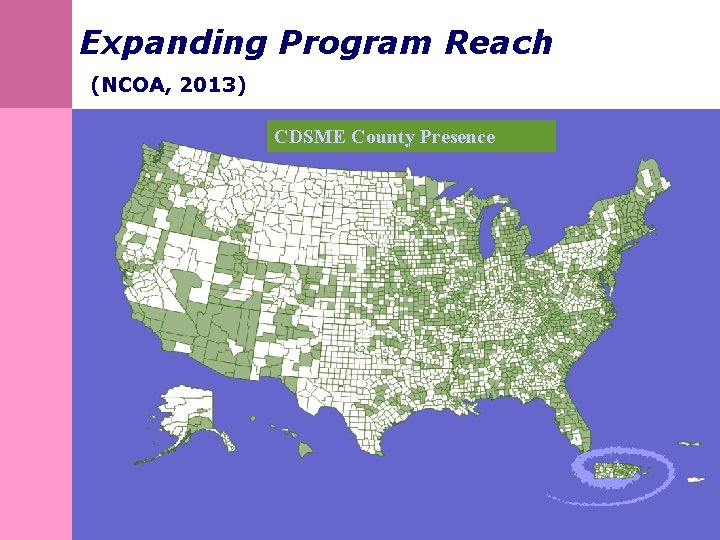
Expanding Program Reach (NCOA, 2013) CDSME County Presence
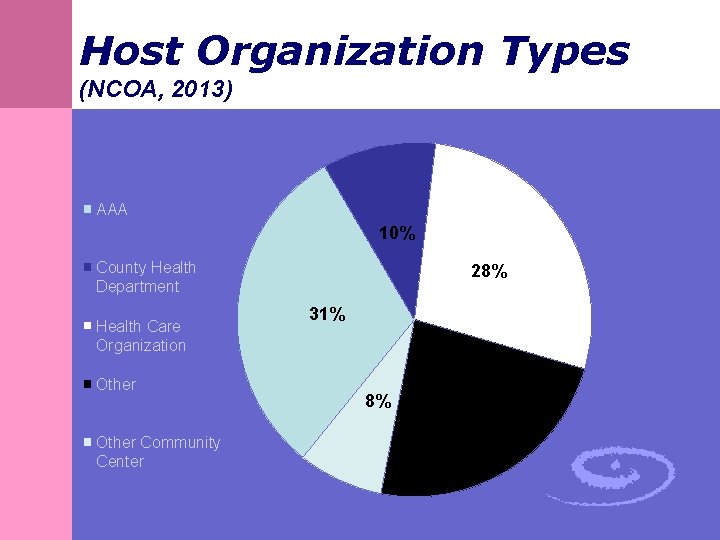
Host Organization Types (NCOA, 2013) AAA 10% County Health Department Health Care Organization Other Community Center 28% 31% 8% 23%
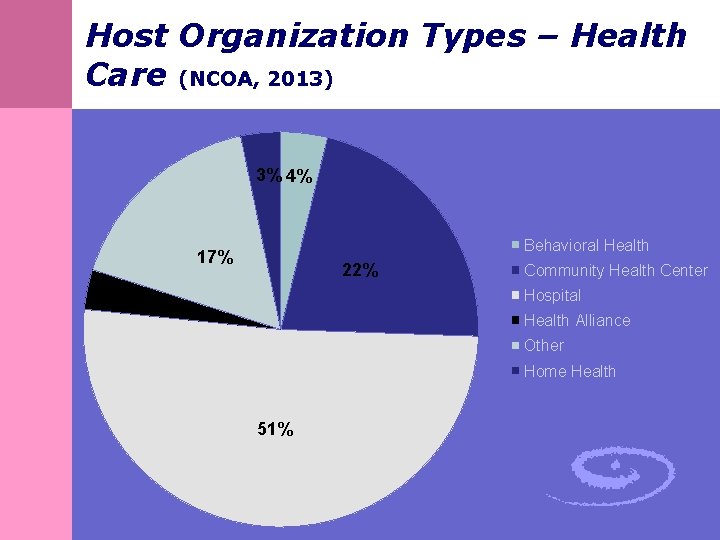
Host Organization Types – Health Care (NCOA, 2013) 3% 4% Behavioral Health 17% 22% Community Health Center Hospital 3% Health Alliance Other Home Health 51%
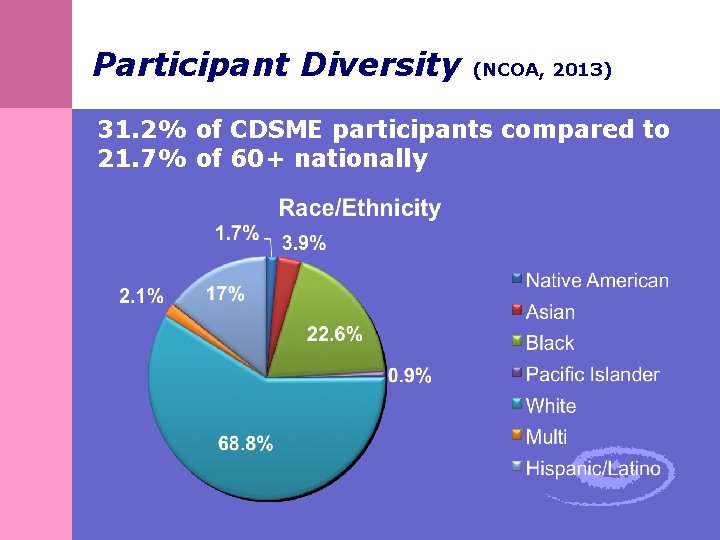
Participant Diversity (NCOA, 2013) 31. 2% of CDSME participants compared to 21. 7% of 60+ nationally
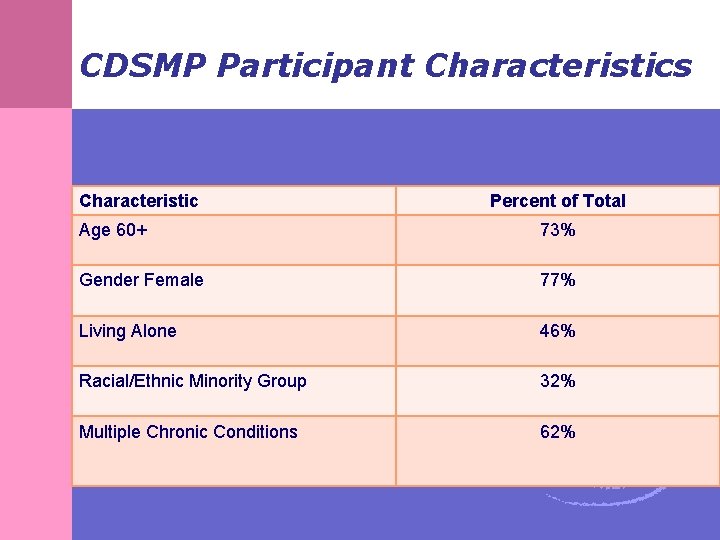
CDSMP Participant Characteristics Characteristic Percent of Total Age 60+ 73% Gender Female 77% Living Alone 46% Racial/Ethnic Minority Group 32% Multiple Chronic Conditions 62%
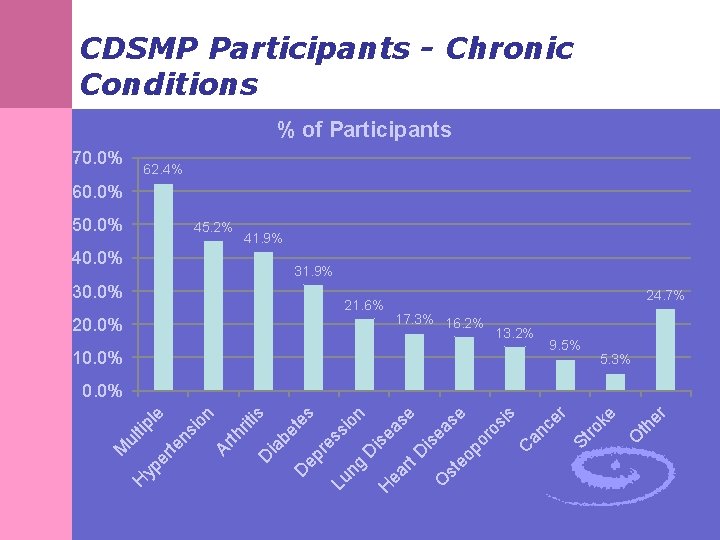
CDSMP Participants - Chronic Conditions % of Participants 70. 0% 62. 4% 60. 0% 50. 0% 45. 2% 41. 9% 40. 0% 31. 9% 30. 0% 21. 6% 20. 0% 10. 0% 24. 7% 17. 3% 16. 2% 13. 2% 9. 5% 5. 3% is H ea ea se rt D is ea O st se eo po ro si s C an ce r St ro ke O th er Lu n g D si on re s es D ep be t is D ia th rit Ar on ns i er te H yp M ul ti pl e 0. 0%
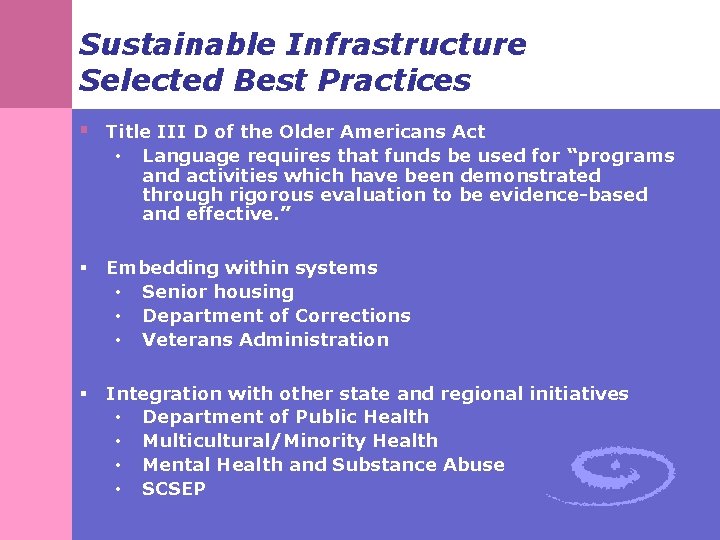
Sustainable Infrastructure Selected Best Practices § Title III D of the Older Americans Act • Language requires that funds be used for “programs and activities which have been demonstrated through rigorous evaluation to be evidence-based and effective. ” § Embedding within systems • Senior housing • Department of Corrections • Veterans Administration § Integration with other state and regional initiatives • Department of Public Health • Multicultural/Minority Health • Mental Health and Substance Abuse • SCSEP
Sustainable Infrastructure Selected Best Practices (cont. ) § Partnerships with health care providers/systems • State Health Insurance Assistance Program • Federally Qualified Health Centers • Care Transitions Initiatives • Patient-Centered Medical Homes • Other ACA Initiatives
It’s all about Systems Change Strategies § Broadly disseminate available EBHP § Dissemination best practices: • Build infrastructure through partnerships • • Develop staffing capacity • Embed EBHP into health care delivery • Institute quality assurance systems • Focus on program sustainability
- Slides: 26