
Overview Current Context CDBG Performance Assessment Rating Tool
Overview • Current Context – CDBG Performance Assessment Rating Tool (PART) and Follow-Up • Measuring Performance and Successful Strategies • Summary
Past Efforts • The Federal government spends over $2 trillion a year on approximately 1, 000 Federal programs. What are we getting for this money? • GPRA (1993) – Agencies report annually on their short and long term goals. • Need to develop report useful to citizens, grantees, HUD, and Congress that show the program addresses the problem.
Current Environment • “Federal programs should receive taxpayer dollars only when they prove they achieve results…. In most cases, we do not know what we are getting for our money. This is simply unacceptable. ” – ’ 04 Budget. • “A program whose managers fail year after year to put in place measures to test its performance ulitmately fails the test just as surely as the program that is demonstrably falling short of success. ” – ’ 04 Budget • “The measure of compassion is more than good intentions, it is good results. Sympathy is not enough. ” – Bush quote.
A Challenge: “The relative paucity of data and research on community development programs has limited the ability to fully demonstrate their impact and credibly differentiate those that are successful from those that are ineffective. ” --Fed Chairman, Alan Greenspan, March 28, 2003
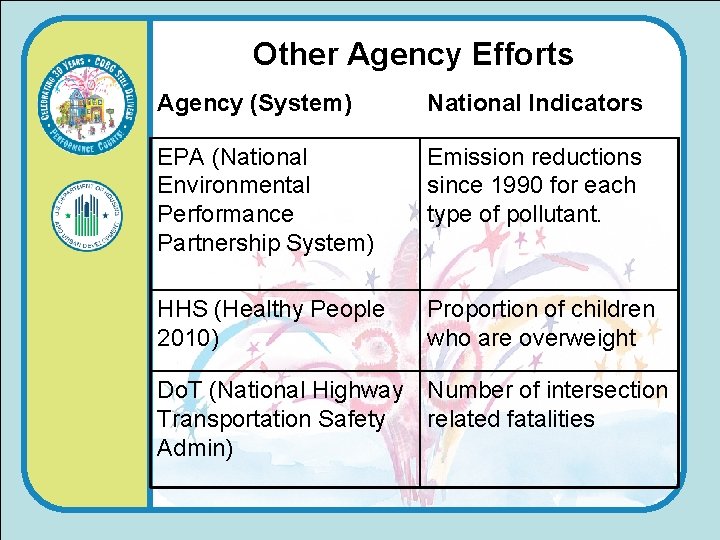
Other Agency Efforts Agency (System) National Indicators EPA (National Environmental Performance Partnership System) Emission reductions since 1990 for each type of pollutant. HHS (Healthy People 2010) Proportion of children who are overweight Do. T (National Highway Number of intersection Transportation Safety related fatalities Admin)
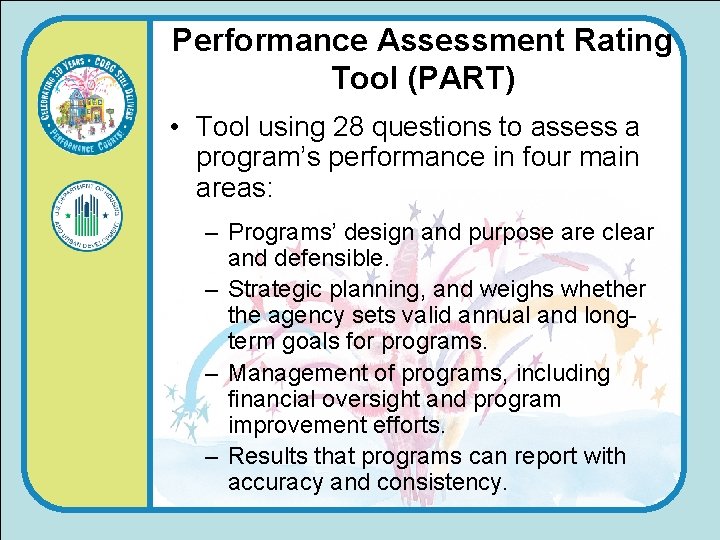
Performance Assessment Rating Tool (PART) • Tool using 28 questions to assess a program’s performance in four main areas: – Programs’ design and purpose are clear and defensible. – Strategic planning, and weighs whether the agency sets valid annual and longterm goals for programs. – Management of programs, including financial oversight and program improvement efforts. – Results that programs can report with accuracy and consistency.
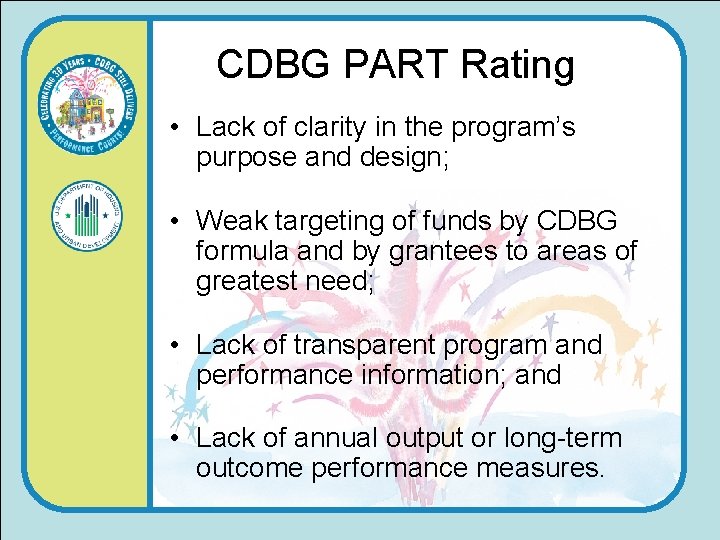
CDBG PART Rating • Lack of clarity in the program’s purpose and design; • Weak targeting of funds by CDBG formula and by grantees to areas of greatest need; • Lack of transparent program and performance information; and • Lack of annual output or long-term outcome performance measures.
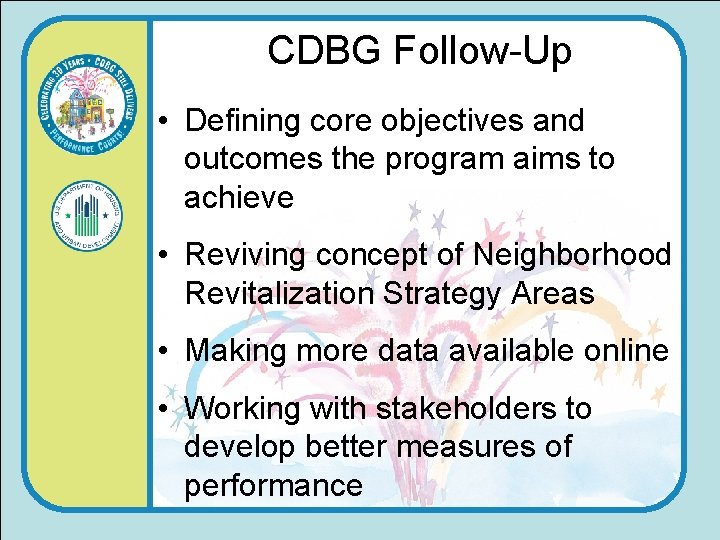
CDBG Follow-Up • Defining core objectives and outcomes the program aims to achieve • Reviving concept of Neighborhood Revitalization Strategy Areas • Making more data available online • Working with stakeholders to develop better measures of performance
Activity: Job Creation OUTPUT – # of jobs created OUTCOME – health benefits as a result of employment TRACKING INDICATOR – Employment rate of an area.
Activity: Business Assistance OUTPUT – # businesses assisted OUTCOME – % of businesses assisted that remain viable three years after assistance TRACKING INDICATOR – Total business sales (Dun & Bradstreet) or small business loans in an area (CRA).
Activity: Housing Rehab OUTPUT – # housing units rehabbed OUTCOME – Bringing a unit up to code or increasing its value TRACKING INDICATOR – Average home sale price of neighborhood (HMDA)
Activity: Homeownership Assistance OUTPUT – # homeowners assisted OUTCOME -- % of homeowners assisted that remain homeowners one year after assistance. TRACKING INDICATOR – Homeownership rate of neighborhood (Census).
Case Study: Savannah, GA Showed project could produce a return on HUD investment. • Goal: Renovate 7 properties on single block with 23 properties; increase property values in block and area. • Inputs: total project cots $873, 000 (acquisition + rehab), including CDBG/HOME funds ($128, 000 in grants and $147, 000 in loans). • Findings: 1) Net subsidy could be recaptured by the city via increases in the renovated houses assessed property tax values in about 7. 5 years. 2) If include the projected tax increases of the surrounding neighborhood “investment” could be recouped in 15 months.
Case Study – Richmond, VA • Targeted Resources: – The City Council worked with neighborhood assoc. to select six target neighborhoods, based on neighborhood condition and revitalization potential. • Focused on Results: – Safe Neighborhood – 17 -percent drop in crime from 2000 -2002 (versus 5 percent for the rest of the city). – Increased Property Values – 44 -percent increase in assessed real estate values from 1998 to 2002. – Safe Housing – 68 -percent decrease in properties with code violations from 1999 to 2002.
Benefits • Strengthens Local programs – More strategic allocation of resources – Better communicate accomplishments with citizens and other stakeholders – Justify programs as investment with quantifiable returns – not just spending – Strengthens sub-recipients’ ability to attract other funds. • It’s a new reality in grant making – not just in Federal government, but for State, local, and private foundations. – Need to demonstrate we can effectively solve problems.
Challenges • Timing – report annual outputs while waiting for long-term outcomes to become measurable; • Identifying Measures – Reach agreement on indicators that are good measures of goal (e. g. , proxies); • Data sources –variety of local thirdparty and other administrative data sources, national sources (HUD); • Cost – Identify accessible data. Ensure all data reported is used in a meaningful way.
Opportunities • Build local capacity to analyze impact • Empower community residents and organizations to determine priorities and how they are measured • Generate new and better information that contributes to more effective programs • Demonstrate the value and impact of housing and community development to affect change
Some Notable Agency Efforts • • HHS’ “Tracking Healthy People 2010” EPA “Core Performance Measures” Nat’l Highway Traffic Safety Admin. Maternal Child and Health Bureau “ 18 National Performance Measures” • HHS CSBG’s “Results Oriented Management & Accountability (ROMA)” • TANF “High Performance Bonus Measures” • HOME “Snapshots”
National Data Sites with Neighborhood Data • Data clearing houses: www. econdata. com www. ffiec. gov • Home Mortgage Disclosure Act (HMDA) -www. ffiec. gov/hmda_rpt/agg_welcome. htm • Community Reinvestment Act (CRA)— www. ffiec. gov/webcraad/craaggr. htm • Census www. ffiec. gov/webcensus/ffieccensus. htm • Dun & Bradstreet (pay site) -- www. dandb. com • HUD State of the Cities Database http: //socds. huduser. org/ • CAP Index Crime Data (pay site) – http: //www. capindex. com/
- Slides: 19