
Overview Class 6 Tues Feb 4 Begin deformable
Overview Class #6 (Tues, Feb 4) • • Begin deformable models!! Background on elasticity Elastostatics: generalized 3 D springs Boundary integral formulation of linear elasticity (from ARTDEFO (SIGGRAPH 99))
Equations of Elasticity • Full equations of nonlinear elastodynamics • Nonlinearities due to • geometry (large deformation; rotation of local coord frame) • material (nonlinear stress-strain curve; volume preservation) • Simplification for small-strain (“linear geometry”) • Dynamic and quasistatic cases useful in different contexts • Very stiff almost rigid objects • Haptics • Animation style

Deformation and Material Coordinates • w: undeformed world/body material coordinate • x=x(w): deformed material coordinate • u=x-w: displacement vector of material point x u w Body Frame
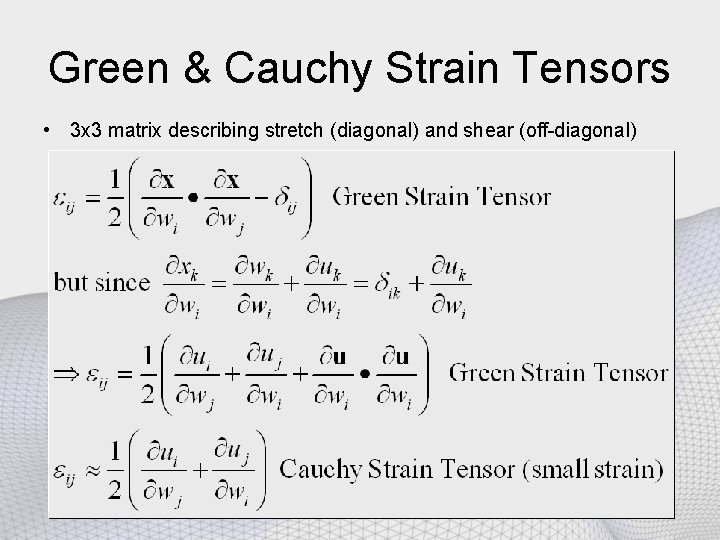
Green & Cauchy Strain Tensors • 3 x 3 matrix describing stretch (diagonal) and shear (off-diagonal)
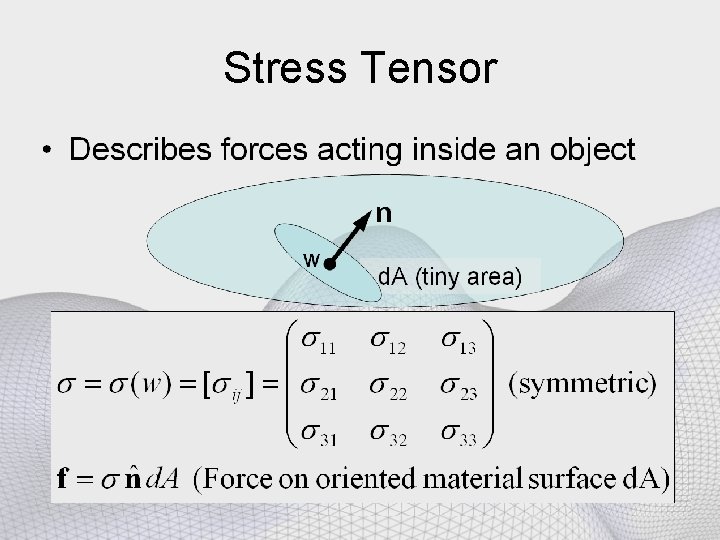
Stress Tensor • Describes forces acting inside an object n w d. A (tiny area)
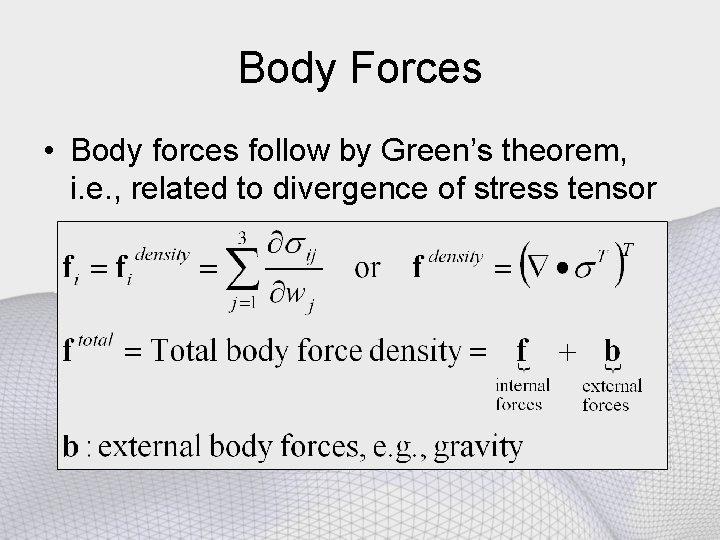
Body Forces • Body forces follow by Green’s theorem, i. e. , related to divergence of stress tensor
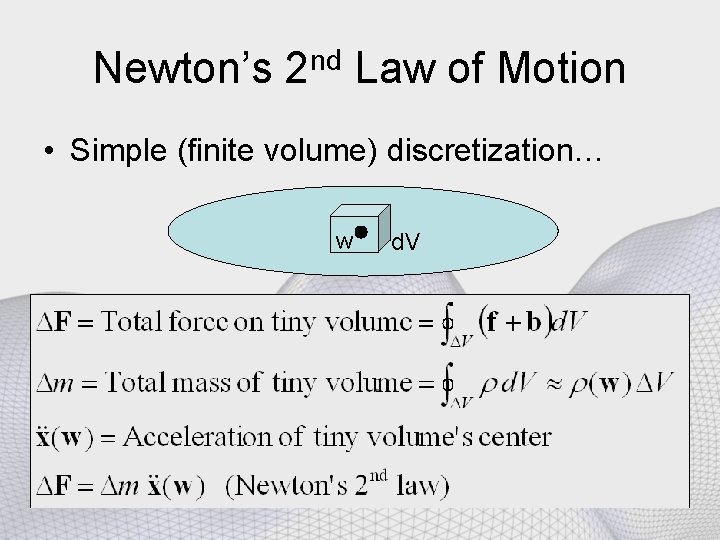
Newton’s 2 nd Law of Motion • Simple (finite volume) discretization… w d. V
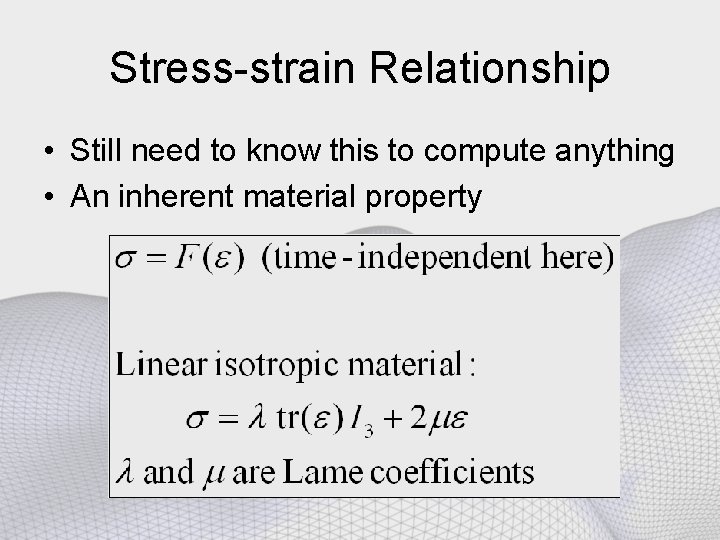
Stress-strain Relationship • Still need to know this to compute anything • An inherent material property
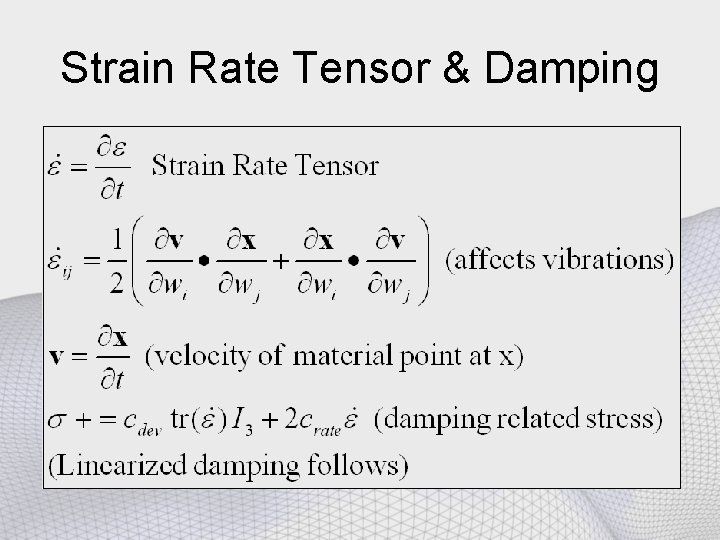
Strain Rate Tensor & Damping
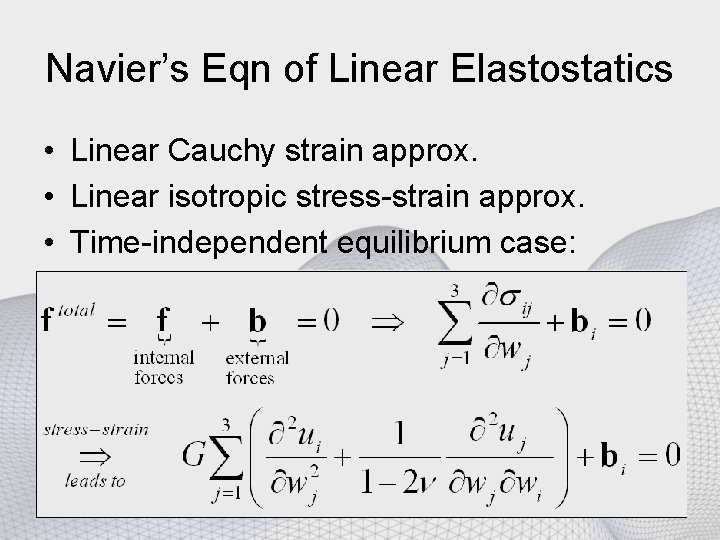
Navier’s Eqn of Linear Elastostatics • Linear Cauchy strain approx. • Linear isotropic stress-strain approx. • Time-independent equilibrium case:
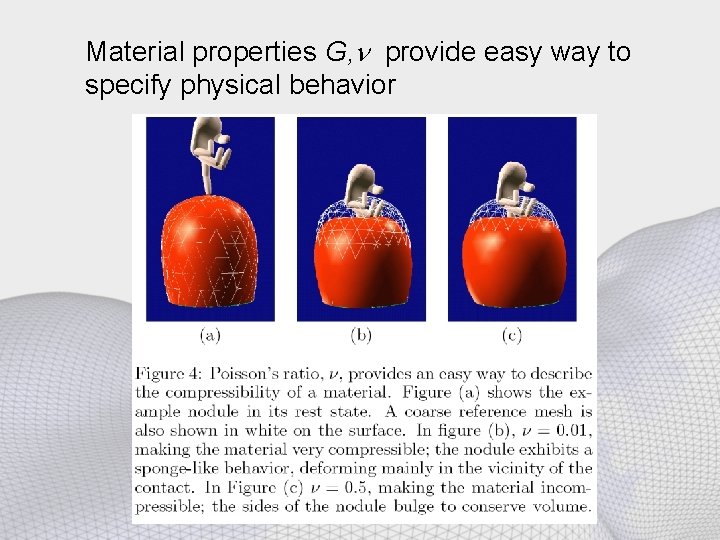
Material properties G, n provide easy way to specify physical behavior

Solution Techniques • Many ways to approximation solutions to Navier’s (and full nonlinear) equations • Will return to this later. • Detour: Art. Defo paper – Art. Defo - Accurate Real Time Deformable Objects Doug L. James, Dinesh K. Pai. Proceedings of SIGGRAPH 99. pp. 65 -72. 1999.
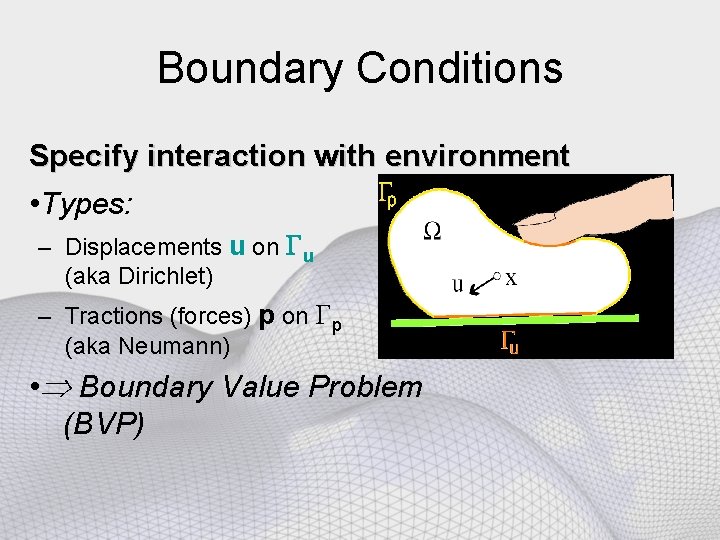
Boundary Conditions Specify interaction with environment • Types: – Displacements u on Gu (aka Dirichlet) – Tractions (forces) p on Gp (aka Neumann) • Boundary Value Problem (BVP)
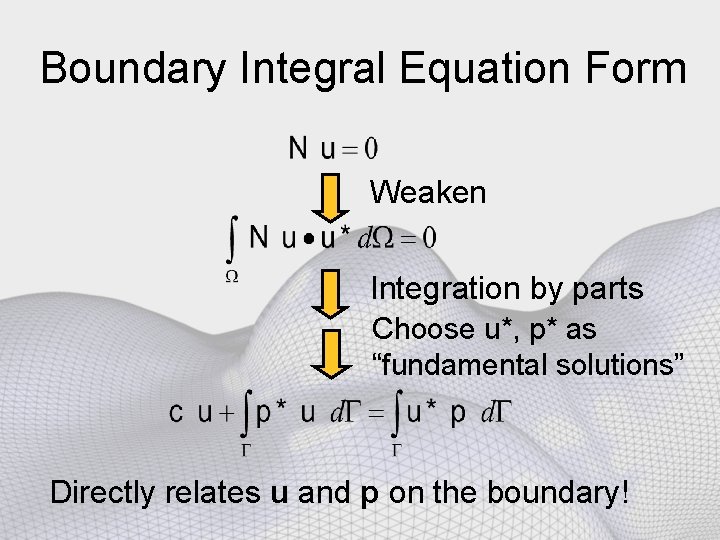
Boundary Integral Equation Form Weaken Integration by parts Choose u*, p* as “fundamental solutions” Directly relates u and p on the boundary!
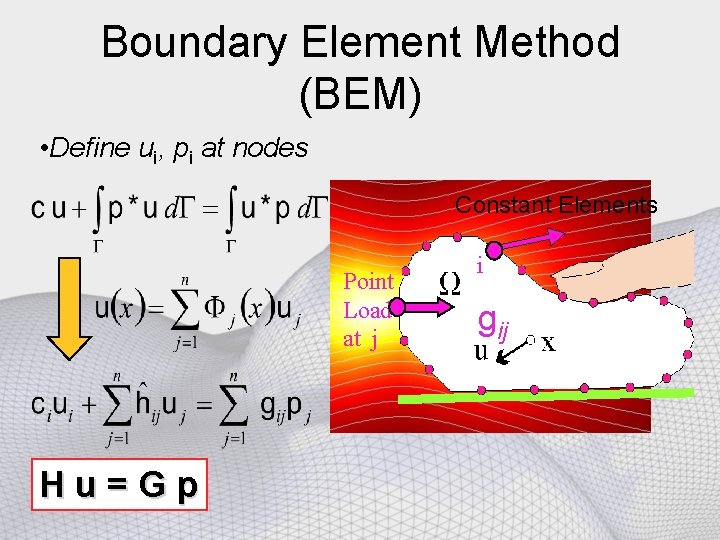
Boundary Element Method (BEM) • Define ui, pi at nodes Constant Elements Point Load at j Hu=Gp i gij
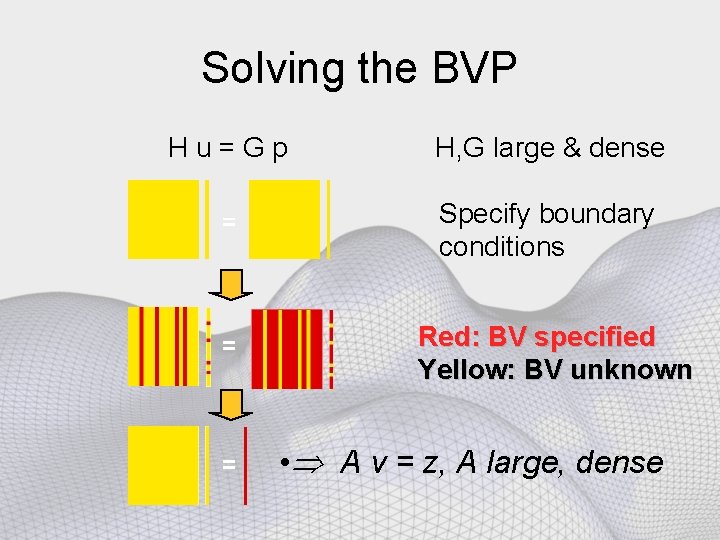
Solving the BVP Hu=Gp H, G large & dense Specify boundary conditions Red: BV specified Yellow: BV unknown • A v = z, A large, dense
BIE, BEM and Graphics +No interior meshing +Smaller (but dense) system matrices +Sharp edges easy with constant elements +Easy tractions (for haptics) +Easy to handle mixed and changing BC (interaction) -More difficult to handle complex inhomogeneity, non-linearity

Art. Defo Movie Preview
- Slides: 18