
Overview Atomic structure and the periodic table Atoms
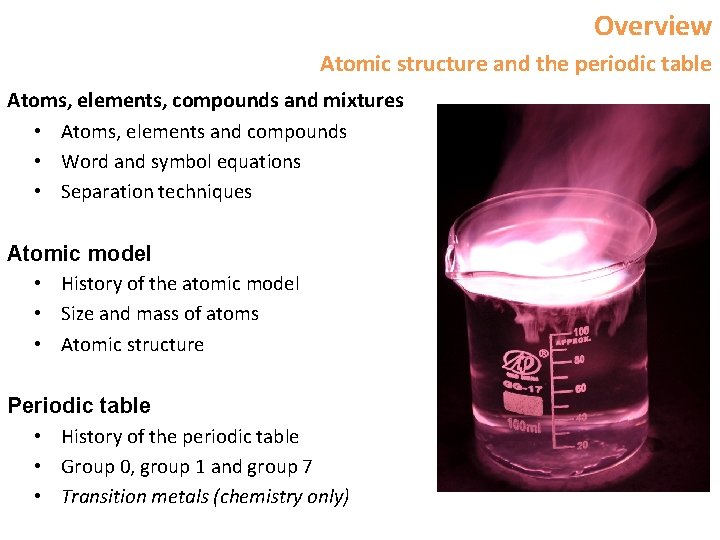
Overview Atomic structure and the periodic table Atoms, elements, compounds and mixtures • Atoms, elements and compounds • Word and symbol equations • Separation techniques Atomic model • History of the atomic model • Size and mass of atoms • Atomic structure Periodic table • History of the periodic table • Group 0, group 1 and group 7 • Transition metals (chemistry only)

Atoms, elements, compounds and mixtures - PART 1 All substances are made of atoms that cannot be chemically broken down. It is the smallest part of an element. There about 100 different elements Elements are made of only one type of atom. Each element has its own symbol. e. g. Na is sodium. Compounds contain more than one type of atom. They are formed from elements by chemical reactions, which always involve the formation of one or more new substance, often involving an energy change. You need to: • Know the names and symbols for the first 20 elements and all of group 1, 7 and 0 • Name compounds when given the formulae or symbol equations Mg. Cl The components of a compound cannot magnesium be separated by physical means. They can 2 be separated only by chemical means. Magnesium chloride chlorine
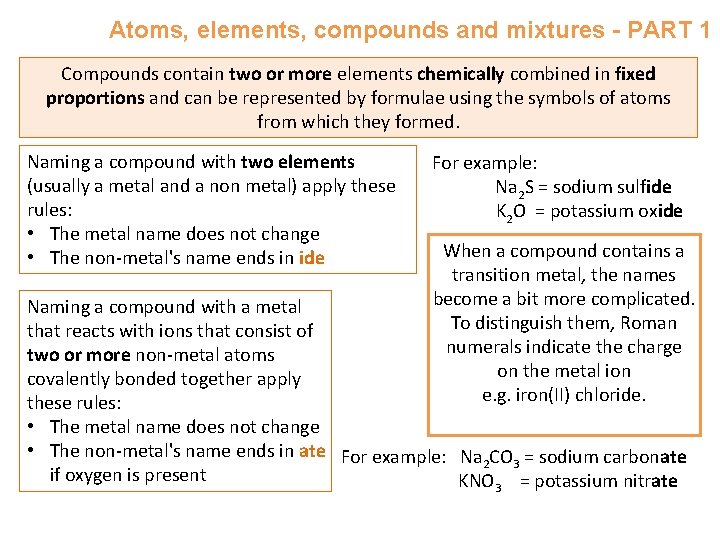
Atoms, elements, compounds and mixtures - PART 1 Compounds contain two or more elements chemically combined in fixed proportions and can be represented by formulae using the symbols of atoms from which they formed. Naming a compound with two elements For example: (usually a metal and a non metal) apply these Na 2 S = sodium sulfide rules: K 2 O = potassium oxide • The metal name does not change When a compound contains a • The non-metal's name ends in ide transition metal, the names become a bit more complicated. Naming a compound with a metal To distinguish them, Roman that reacts with ions that consist of numerals indicate the charge two or more non-metal atoms on the metal ion covalently bonded together apply e. g. iron(II) chloride. these rules: • The metal name does not change • The non-metal's name ends in ate For example: Na CO = sodium carbonate 2 3 if oxygen is present KNO 3 = potassium nitrate
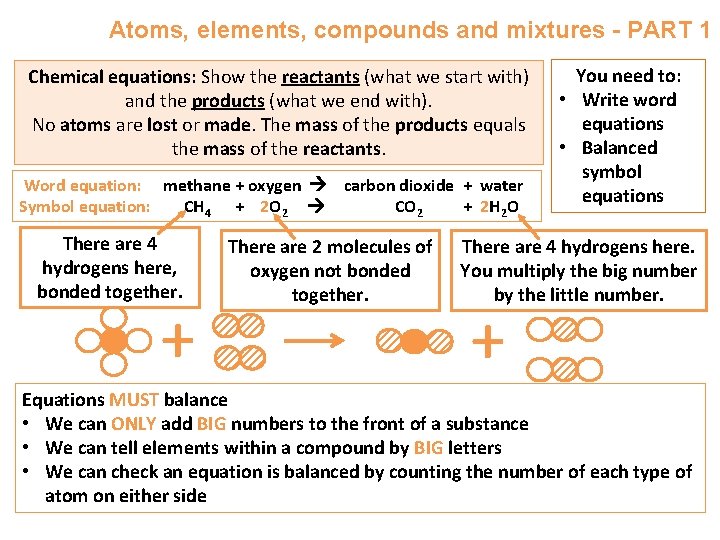
Atoms, elements, compounds and mixtures - PART 1 Chemical equations: Show the reactants (what we start with) and the products (what we end with). No atoms are lost or made. The mass of the products equals the mass of the reactants. Word equation: methane + oxygen carbon dioxide + water Symbol equation: CH 4 + 2 O 2 CO 2 + 2 H 2 O There are 4 hydrogens here, bonded together. + There are 2 molecules of oxygen not bonded together. You need to: • Write word equations • Balanced symbol equations There are 4 hydrogens here. You multiply the big number by the little number. + Equations MUST balance • We can ONLY add BIG numbers to the front of a substance • We can tell elements within a compound by BIG letters • We can check an equation is balanced by counting the number of each type of atom on either side
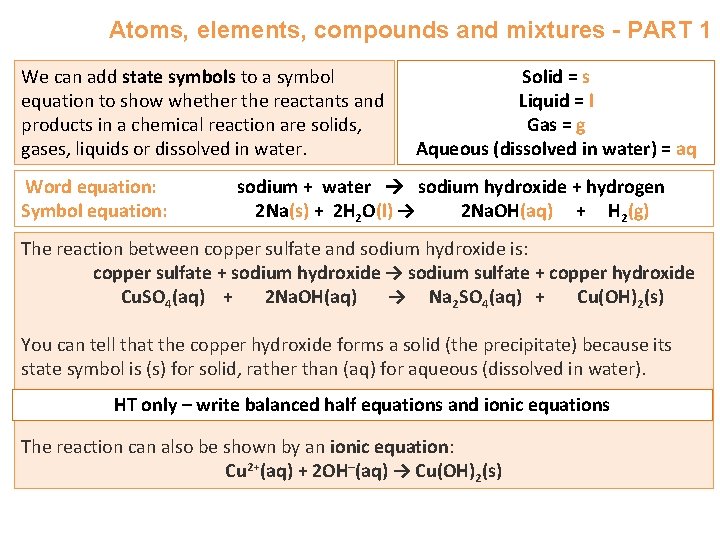
Atoms, elements, compounds and mixtures - PART 1 We can add state symbols to a symbol equation to show whether the reactants and products in a chemical reaction are solids, gases, liquids or dissolved in water. Word equation: Symbol equation: Solid = s Liquid = l Gas = g Aqueous (dissolved in water) = aq sodium + water sodium hydroxide + hydrogen 2 Na(s) + 2 H 2 O(l) → 2 Na. OH(aq) + H 2(g) The reaction between copper sulfate and sodium hydroxide is: copper sulfate + sodium hydroxide → sodium sulfate + copper hydroxide Cu. SO 4(aq) + 2 Na. OH(aq) → Na 2 SO 4(aq) + Cu(OH)2(s) You can tell that the copper hydroxide forms a solid (the precipitate) because its state symbol is (s) for solid, rather than (aq) for aqueous (dissolved in water). HT only – write balanced half equations and ionic equations The reaction can also be shown by an ionic equation: Cu 2+(aq) + 2 OH–(aq) → Cu(OH)2(s)
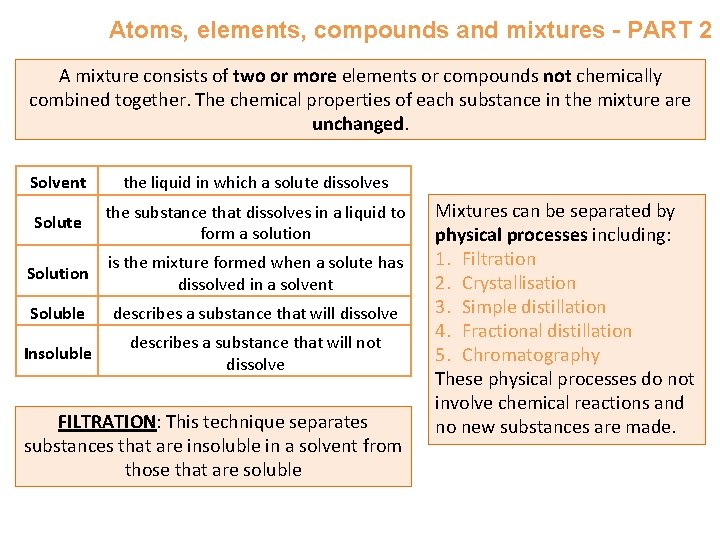
Atoms, elements, compounds and mixtures - PART 2 A mixture consists of two or more elements or compounds not chemically combined together. The chemical properties of each substance in the mixture are unchanged. Solvent the liquid in which a solute dissolves Solute the substance that dissolves in a liquid to form a solution Solution is the mixture formed when a solute has dissolved in a solvent Soluble describes a substance that will dissolve Insoluble describes a substance that will not dissolve FILTRATION: This technique separates substances that are insoluble in a solvent from those that are soluble Mixtures can be separated by physical processes including: 1. Filtration 2. Crystallisation 3. Simple distillation 4. Fractional distillation 5. Chromatography These physical processes do not involve chemical reactions and no new substances are made.
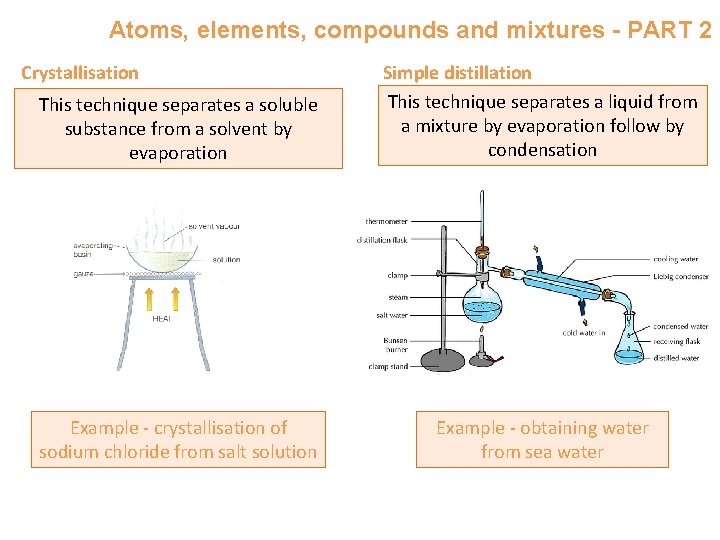
Atoms, elements, compounds and mixtures - PART 2 Crystallisation Simple distillation This technique separates a liquid from This technique separates a soluble a mixture by evaporation follow by substance from a solvent by condensation evaporation Example - crystallisation of sodium chloride from salt solution Example - obtaining water from sea water
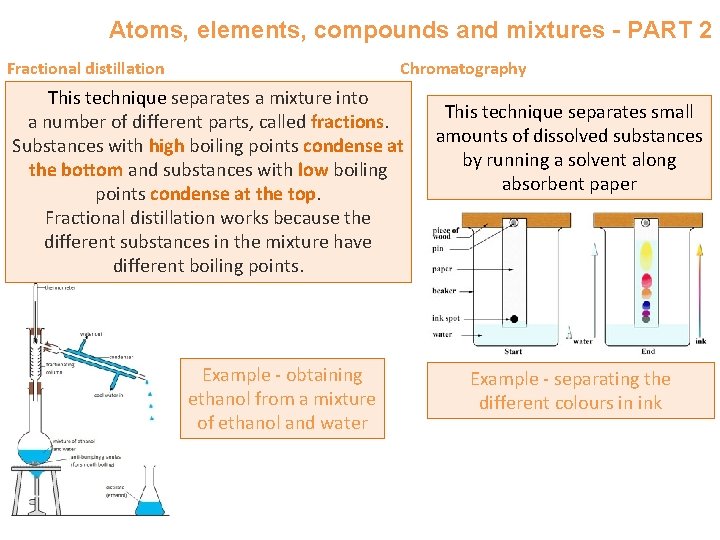
Atoms, elements, compounds and mixtures - PART 2 Fractional distillation Chromatography This technique separates a mixture into a number of different parts, called fractions. Substances with high boiling points condense at the bottom and substances with low boiling points condense at the top. Fractional distillation works because the different substances in the mixture have different boiling points. Example - obtaining ethanol from a mixture of ethanol and water This technique separates small amounts of dissolved substances by running a solvent along absorbent paper Example - separating the different colours in ink
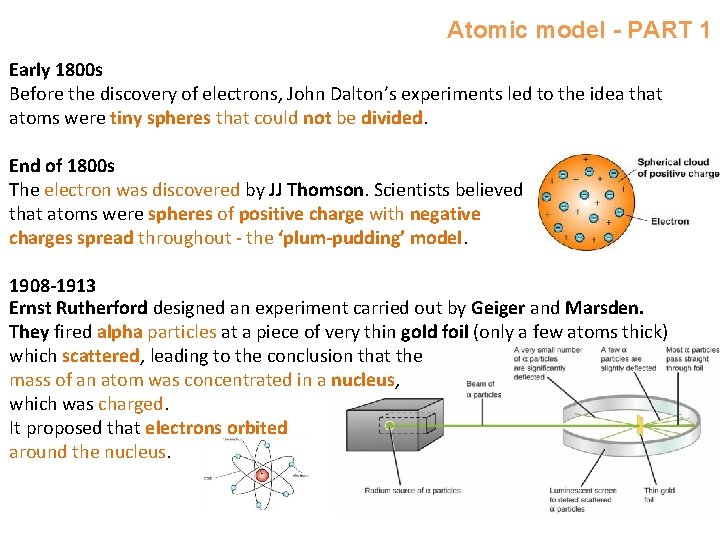
Atomic model - PART 1 Early 1800 s Before the discovery of electrons, John Dalton’s experiments led to the idea that atoms were tiny spheres that could not be divided. End of 1800 s The electron was discovered by JJ Thomson. Scientists believed that atoms were spheres of positive charge with negative charges spread throughout - the ‘plum-pudding’ model. 1908 -1913 Ernst Rutherford designed an experiment carried out by Geiger and Marsden. They fired alpha particles at a piece of very thin gold foil (only a few atoms thick) which scattered, leading to the conclusion that the mass of an atom was concentrated in a nucleus, which was charged. It proposed that electrons orbited around the nucleus.
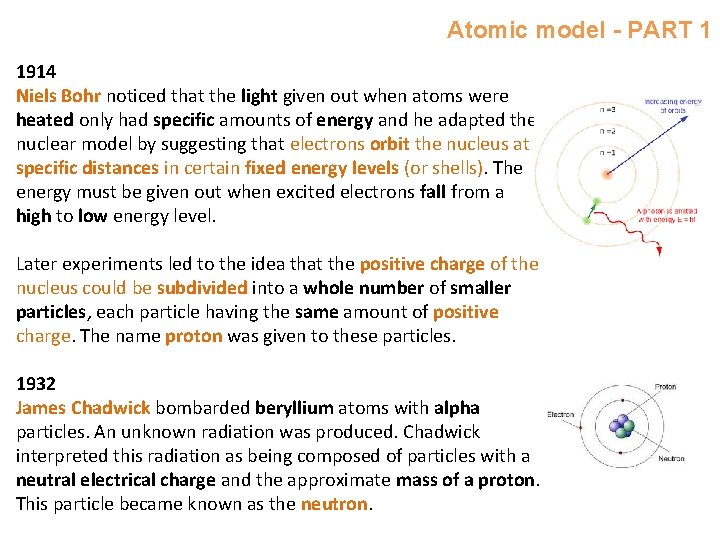
Atomic model - PART 1 1914 Niels Bohr noticed that the light given out when atoms were heated only had specific amounts of energy and he adapted the nuclear model by suggesting that electrons orbit the nucleus at specific distances in certain fixed energy levels (or shells). The energy must be given out when excited electrons fall from a high to low energy level. Later experiments led to the idea that the positive charge of the nucleus could be subdivided into a whole number of smaller particles, each particle having the same amount of positive charge. The name proton was given to these particles. 1932 James Chadwick bombarded beryllium atoms with alpha particles. An unknown radiation was produced. Chadwick interpreted this radiation as being composed of particles with a neutral electrical charge and the approximate mass of a proton. This particle became known as the neutron.
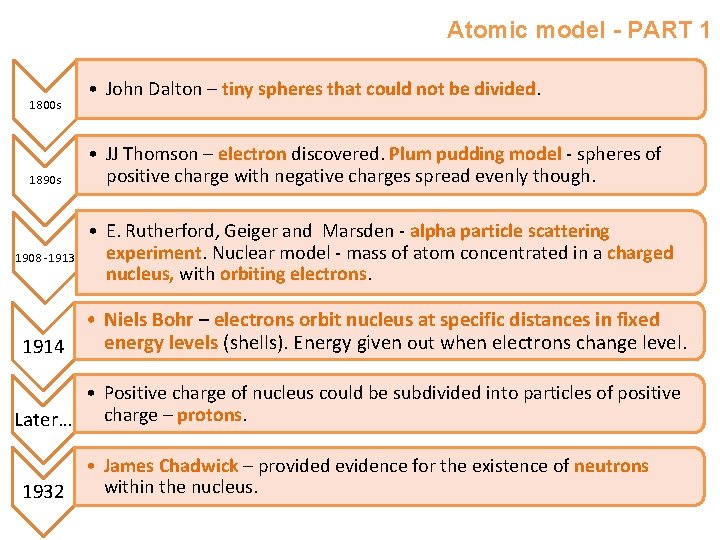
Atomic model - PART 1 1800 s 1890 s 1908 -1913 1914 • John Dalton – tiny spheres that could not be divided. • JJ Thomson – electron discovered. Plum pudding model - spheres of positive charge with negative charges spread evenly though. • E. Rutherford, Geiger and Marsden - alpha particle scattering experiment. Nuclear model - mass of atom concentrated in a charged nucleus, with orbiting electrons. • Niels Bohr – electrons orbit nucleus at specific distances in fixed energy levels (shells). Energy given out when electrons change level. • Positive charge of nucleus could be subdivided into particles of positive Later… charge – protons. 1932 • James Chadwick – provided evidence for the existence of neutrons within the nucleus.
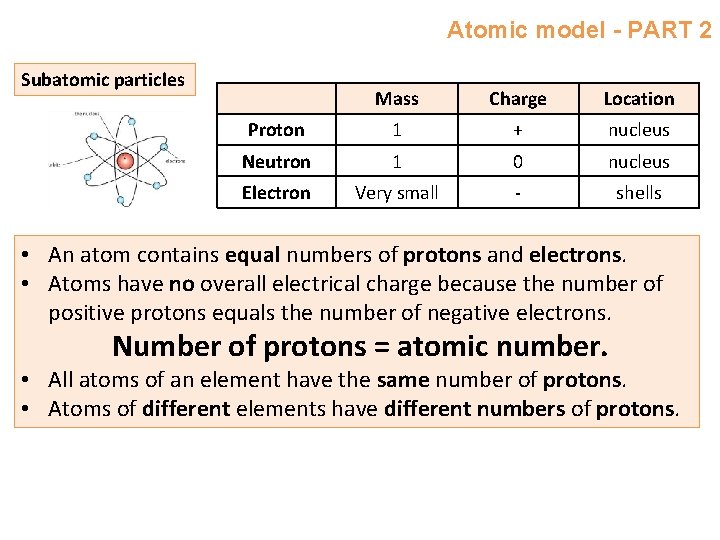
Atomic model - PART 2 Subatomic particles Mass Charge Location Proton 1 + nucleus Neutron 1 0 nucleus Electron Very small - shells • An atom contains equal numbers of protons and electrons. • Atoms have no overall electrical charge because the number of positive protons equals the number of negative electrons. Number of protons = atomic number. • All atoms of an element have the same number of protons. • Atoms of different elements have different numbers of protons.
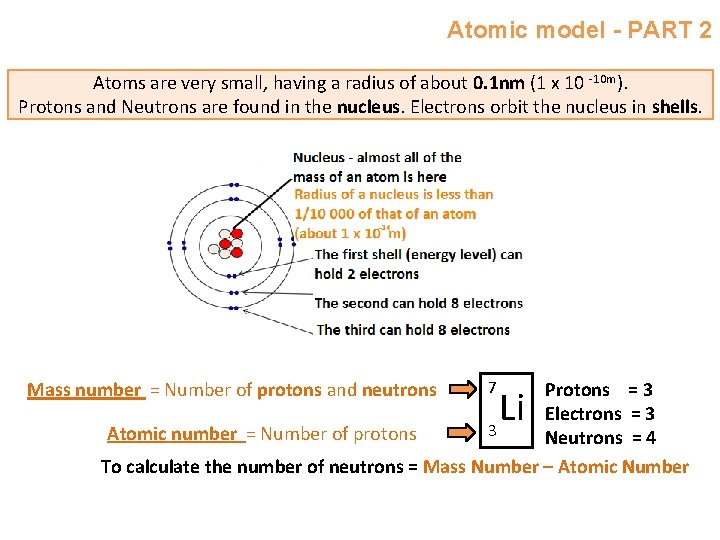
Atomic model - PART 2 Atoms are very small, having a radius of about 0. 1 nm (1 x 10 -10 m). Protons and Neutrons are found in the nucleus. Electrons orbit the nucleus in shells. Mass number = Number of protons and neutrons 7 Protons = 3 Electrons = 3 3 Atomic number = Number of protons Neutrons = 4 To calculate the number of neutrons = Mass Number – Atomic Number Li
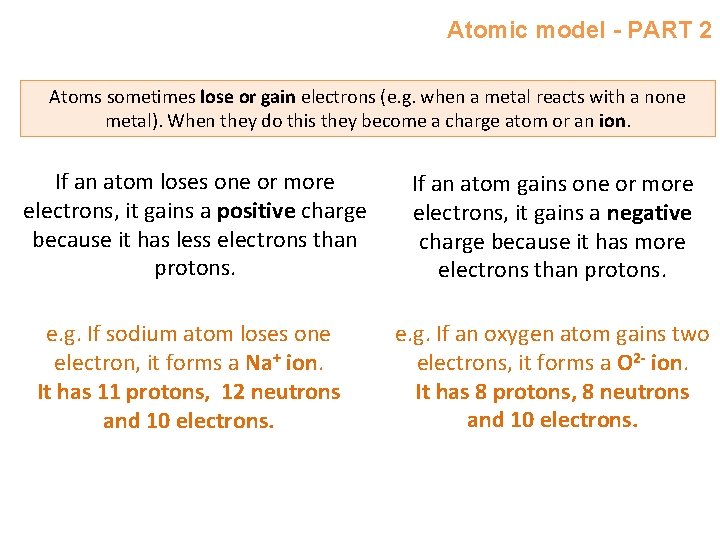
Atomic model - PART 2 Atoms sometimes lose or gain electrons (e. g. when a metal reacts with a none metal). When they do this they become a charge atom or an ion. If an atom loses one or more electrons, it gains a positive charge because it has less electrons than protons. If an atom gains one or more electrons, it gains a negative charge because it has more electrons than protons. e. g. If sodium atom loses one electron, it forms a Na+ ion. It has 11 protons, 12 neutrons and 10 electrons. e. g. If an oxygen atom gains two electrons, it forms a O 2 - ion. It has 8 protons, 8 neutrons and 10 electrons.
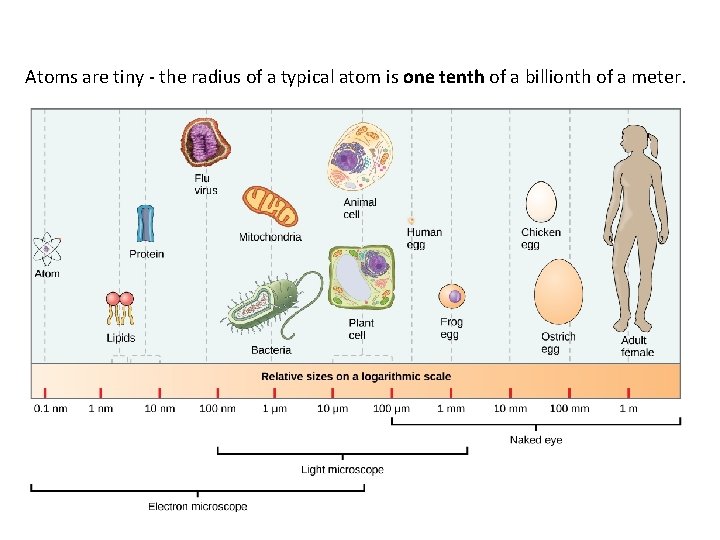
Atoms are tiny - the radius of a typical atom is one tenth of a billionth of a meter.
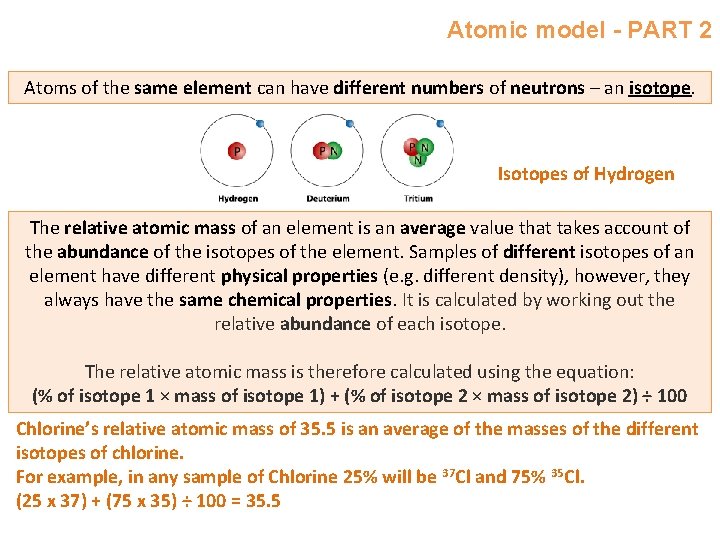
Atomic model - PART 2 Atoms of the same element can have different numbers of neutrons – an isotope. Isotopes of Hydrogen The relative atomic mass of an element is an average value that takes account of the abundance of the isotopes of the element. Samples of different isotopes of an element have different physical properties (e. g. different density), however, they always have the same chemical properties. It is calculated by working out the relative abundance of each isotope. The relative atomic mass is therefore calculated using the equation: (% of isotope 1 × mass of isotope 1) + (% of isotope 2 × mass of isotope 2) ÷ 100 Chlorine’s relative atomic mass of 35. 5 is an average of the masses of the different isotopes of chlorine. For example, in any sample of Chlorine 25% will be 37 Cl and 75% 35 Cl. (25 x 37) + (75 x 35) ÷ 100 = 35. 5
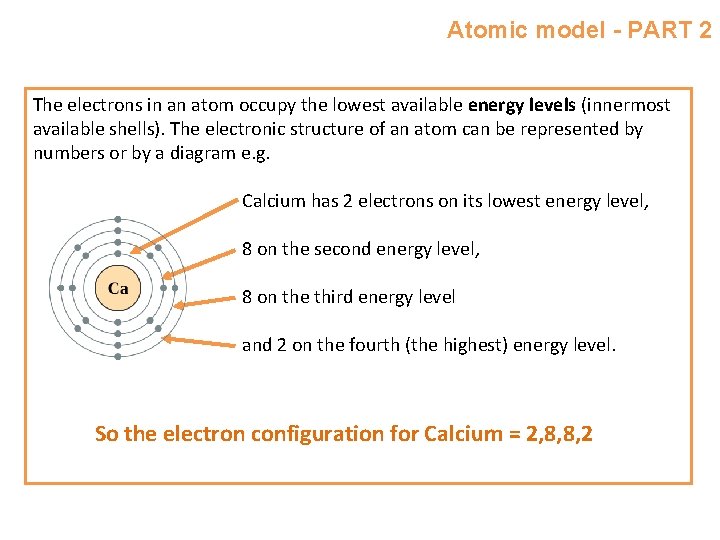
Atomic model - PART 2 The electrons in an atom occupy the lowest available energy levels (innermost available shells). The electronic structure of an atom can be represented by numbers or by a diagram e. g. Calcium has 2 electrons on its lowest energy level, 8 on the second energy level, 8 on the third energy level and 2 on the fourth (the highest) energy level. So the electron configuration for Calcium = 2, 8, 8, 2

Periodic table - PART 1 The elements are arranged in order of increasing atomic number. Elements with similar properties are in columns, known as groups. Elements in the same group have the same number of electrons in their outer shell. The rows in the table are called periods Group = electrons in outer shell Period = number of shells It is called a periodic table because similar properties occur at regular intervals Group = 7 Period = 3
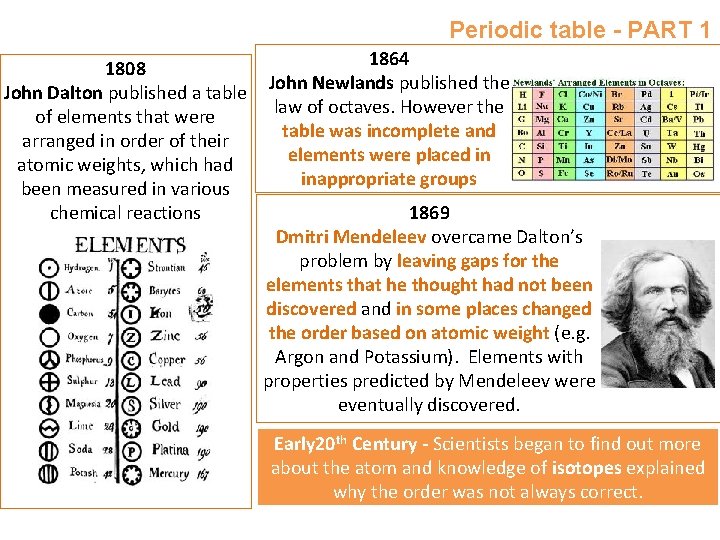
Periodic table - PART 1 1864 1808 John Newlands published the John Dalton published a table law of octaves. However the of elements that were table was incomplete and arranged in order of their elements were placed in atomic weights, which had inappropriate groups been measured in various 1869 chemical reactions Dmitri Mendeleev overcame Dalton’s problem by leaving gaps for the elements that he thought had not been discovered and in some places changed the order based on atomic weight (e. g. Argon and Potassium). Elements with properties predicted by Mendeleev were eventually discovered. Early 20 th Century - Scientists began to find out more about the atom and knowledge of isotopes explained why the order was not always correct.
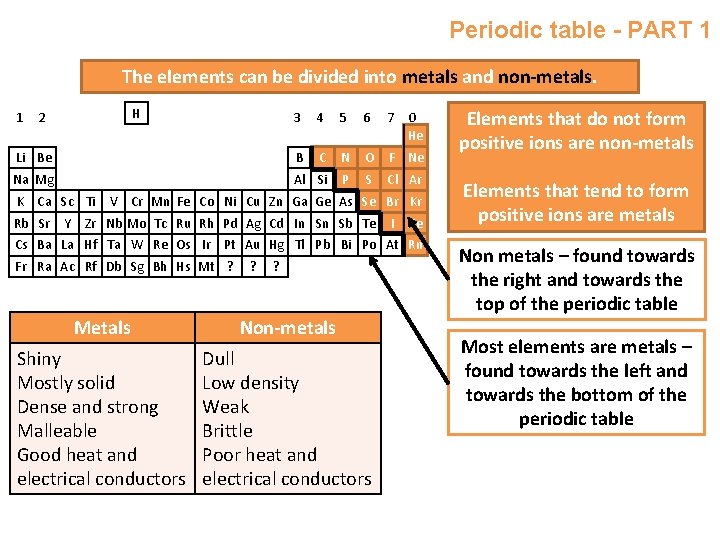
Periodic table - PART 1 The elements can be divided into metals and non-metals. 1 H 2 3 4 5 6 7 Li Be B C N O F Ne Na Mg Al Si P S Cl Ar K Ca Sc Ti Rb Sr Y 0 He V Cr Mn Fe Co Ni Cu Zn Ga Ge As Se Br Kr Zr Nb Mo Tc Ru Rh Pd Ag Cd In Sn Sb Te I Xe Cs Ba La Hf Ta W Re Os Ir Pt Au Hg Tl Pb Bi Po At Rn Fr Ra Ac Rf Db Sg Bh Hs Mt ? ? ? Metals Non-metals Shiny Mostly solid Dense and strong Malleable Good heat and electrical conductors Dull Low density Weak Brittle Poor heat and electrical conductors Elements that do not form positive ions are non-metals Elements that tend to form positive ions are metals Non metals – found towards the right and towards the top of the periodic table Most elements are metals – found towards the left and towards the bottom of the periodic table
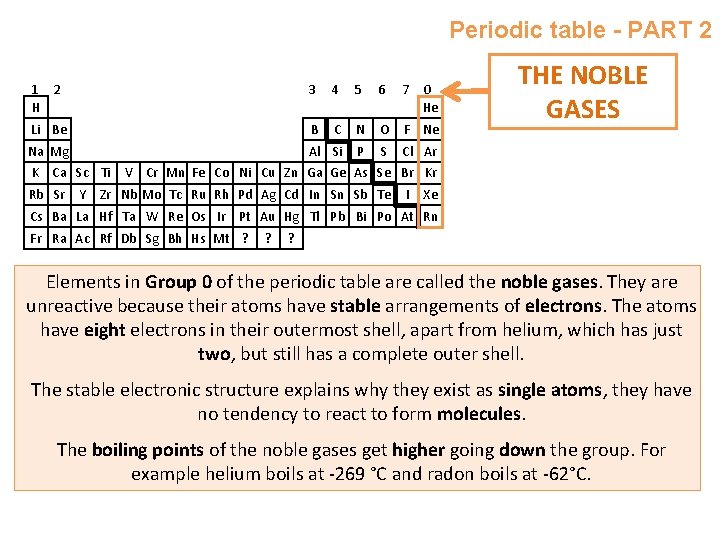
Periodic table - PART 2 1 2 H 3 4 5 6 7 Li Be B C N O F Ne Na Mg Al Si P S Cl Ar K Ca Sc Ti Rb Sr Y 0 He THE NOBLE GASES V Cr Mn Fe Co Ni Cu Zn Ga Ge As Se Br Kr Zr Nb Mo Tc Ru Rh Pd Ag Cd In Sn Sb Te I Xe Cs Ba La Hf Ta W Re Os Ir Pt Au Hg Tl Pb Bi Po At Rn Fr Ra Ac Rf Db Sg Bh Hs Mt ? ? ? Elements in Group 0 of the periodic table are called the noble gases. They are unreactive because their atoms have stable arrangements of electrons. The atoms have eight electrons in their outermost shell, apart from helium, which has just two, but still has a complete outer shell. The stable electronic structure explains why they exist as single atoms, they have no tendency to react to form molecules. The boiling points of the noble gases get higher going down the group. For example helium boils at -269 °C and radon boils at -62°C.
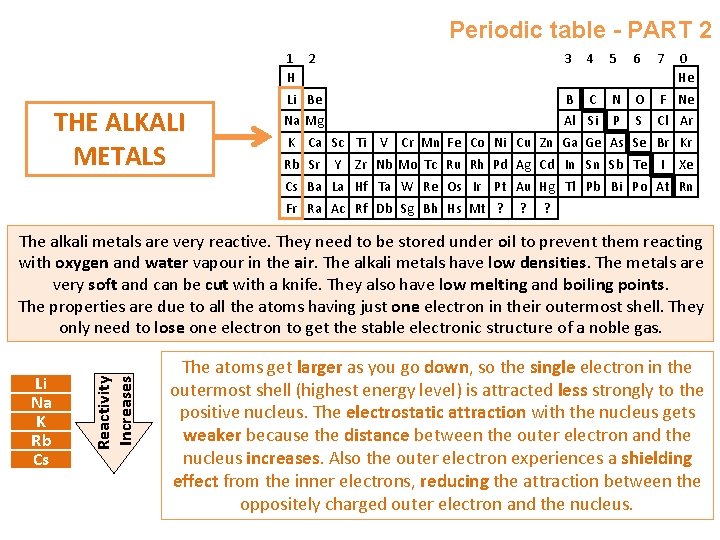
Periodic table - PART 2 THE ALKALI METALS 1 2 H 3 4 5 6 7 Li Be B C N O F Ne Na Mg Al Si P S Cl Ar K Ca Sc Ti Rb Sr Y 0 He V Cr Mn Fe Co Ni Cu Zn Ga Ge As Se Br Kr Zr Nb Mo Tc Ru Rh Pd Ag Cd In Sn Sb Te I Xe Cs Ba La Hf Ta W Re Os Ir Pt Au Hg Tl Pb Bi Po At Rn Fr Ra Ac Rf Db Sg Bh Hs Mt ? ? ? Li Na K Rb Cs Reactivity Increases The alkali metals are very reactive. They need to be stored under oil to prevent them reacting with oxygen and water vapour in the air. The alkali metals have low densities. The metals are very soft and can be cut with a knife. They also have low melting and boiling points. The properties are due to all the atoms having just one electron in their outermost shell. They only need to lose one electron to get the stable electronic structure of a noble gas. The atoms get larger as you go down, so the single electron in the outermost shell (highest energy level) is attracted less strongly to the positive nucleus. The electrostatic attraction with the nucleus gets weaker because the distance between the outer electron and the nucleus increases. Also the outer electron experiences a shielding effect from the inner electrons, reducing the attraction between the oppositely charged outer electron and the nucleus.
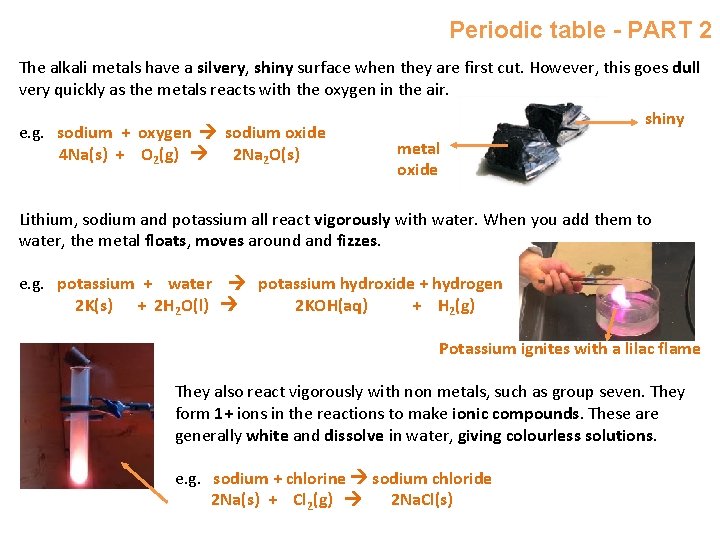
Periodic table - PART 2 The alkali metals have a silvery, shiny surface when they are first cut. However, this goes dull very quickly as the metals reacts with the oxygen in the air. e. g. sodium + oxygen sodium oxide 4 Na(s) + O 2(g) 2 Na 2 O(s) shiny metal oxide Lithium, sodium and potassium all react vigorously with water. When you add them to water, the metal floats, moves around and fizzes. e. g. potassium + water potassium hydroxide + hydrogen 2 K(s) + 2 H 2 O(l) 2 KOH(aq) + H 2(g) Potassium ignites with a lilac flame They also react vigorously with non metals, such as group seven. They form 1+ ions in the reactions to make ionic compounds. These are generally white and dissolve in water, giving colourless solutions. e. g. sodium + chlorine sodium chloride 2 Na(s) + Cl 2(g) 2 Na. Cl(s)
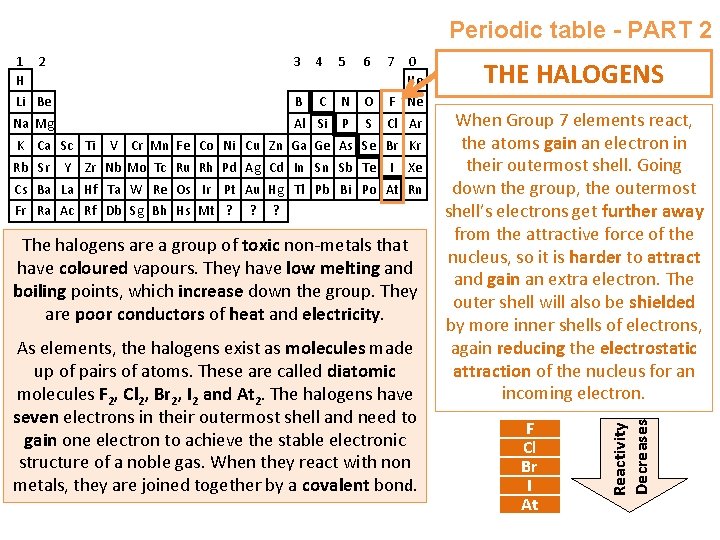
Periodic table - PART 2 3 4 5 6 7 Li Be B C N O F Ne Na Mg Al Si P S Cl Ar K Ca Sc Ti Rb Sr Y 0 He V Cr Mn Fe Co Ni Cu Zn Ga Ge As Se Br Kr Zr Nb Mo Tc Ru Rh Pd Ag Cd In Sn Sb Te I Xe Cs Ba La Hf Ta W Re Os Ir Pt Au Hg Tl Pb Bi Po At Rn Fr Ra Ac Rf Db Sg Bh Hs Mt ? ? ? The halogens are a group of toxic non-metals that have coloured vapours. They have low melting and boiling points, which increase down the group. They are poor conductors of heat and electricity. As elements, the halogens exist as molecules made up of pairs of atoms. These are called diatomic molecules F 2, Cl 2, Br 2, I 2 and At 2. The halogens have seven electrons in their outermost shell and need to gain one electron to achieve the stable electronic structure of a noble gas. When they react with non metals, they are joined together by a covalent bond. THE HALOGENS When Group 7 elements react, the atoms gain an electron in their outermost shell. Going down the group, the outermost shell’s electrons get further away from the attractive force of the nucleus, so it is harder to attract and gain an extra electron. The outer shell will also be shielded by more inner shells of electrons, again reducing the electrostatic attraction of the nucleus for an incoming electron. F Cl Br I At Reactivity Decreases 1 2 H
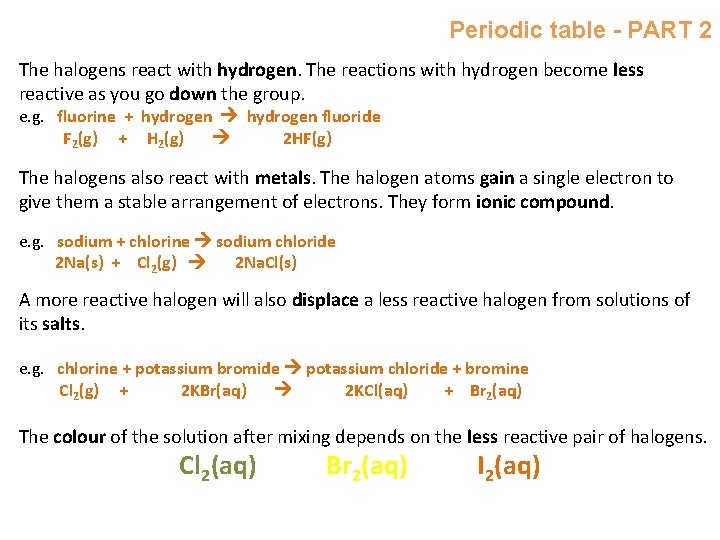
Periodic table - PART 2 The halogens react with hydrogen. The reactions with hydrogen become less reactive as you go down the group. e. g. fluorine + hydrogen fluoride F 2(g) + H 2(g) 2 HF(g) The halogens also react with metals. The halogen atoms gain a single electron to give them a stable arrangement of electrons. They form ionic compound. e. g. sodium + chlorine sodium chloride 2 Na(s) + Cl 2(g) 2 Na. Cl(s) A more reactive halogen will also displace a less reactive halogen from solutions of its salts. e. g. chlorine + potassium bromide potassium chloride + bromine Cl 2(g) + 2 KBr(aq) 2 KCl(aq) + Br 2(aq) The colour of the solution after mixing depends on the less reactive pair of halogens. Cl 2(aq) Br 2(aq) I 2(aq)
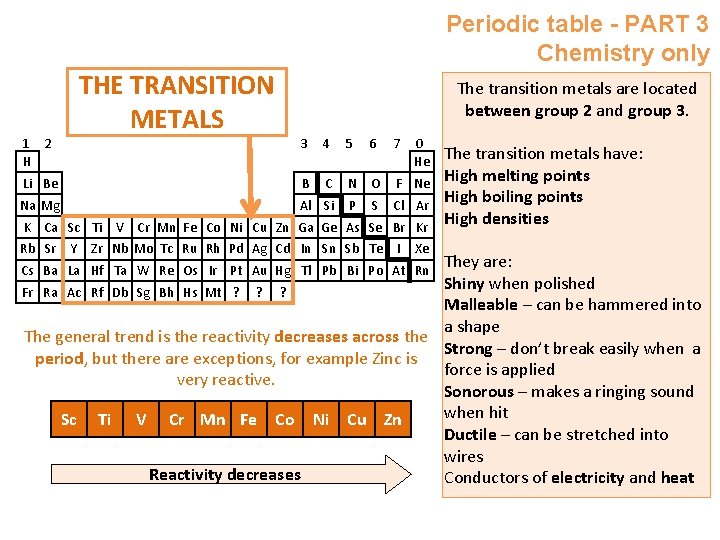
Periodic table - PART 3 Chemistry only THE TRANSITION METALS 1 2 H The transition metals are located between group 2 and group 3. 3 4 5 6 7 Li Be B C N O F Ne Na Mg Al Si P S Cl Ar K Ca Sc Ti Rb Sr Y 0 He V Cr Mn Fe Co Ni Cu Zn Ga Ge As Se Br Kr Zr Nb Mo Tc Ru Rh Pd Ag Cd In Sn Sb Te I Xe The transition metals have: High melting points High boiling points High densities They are: Shiny when polished Fr Ra Ac Rf Db Sg Bh Hs Mt ? ? ? Malleable – can be hammered into a shape The general trend is the reactivity decreases across the Strong – don’t break easily when a period, but there are exceptions, for example Zinc is force is applied very reactive. Sonorous – makes a ringing sound when hit Sc Ti V Cr Mn Fe Co Ni Cu Zn Ductile – can be stretched into wires Reactivity decreases Conductors of electricity and heat Cs Ba La Hf Ta W Re Os Ir Pt Au Hg Tl Pb Bi Po At Rn
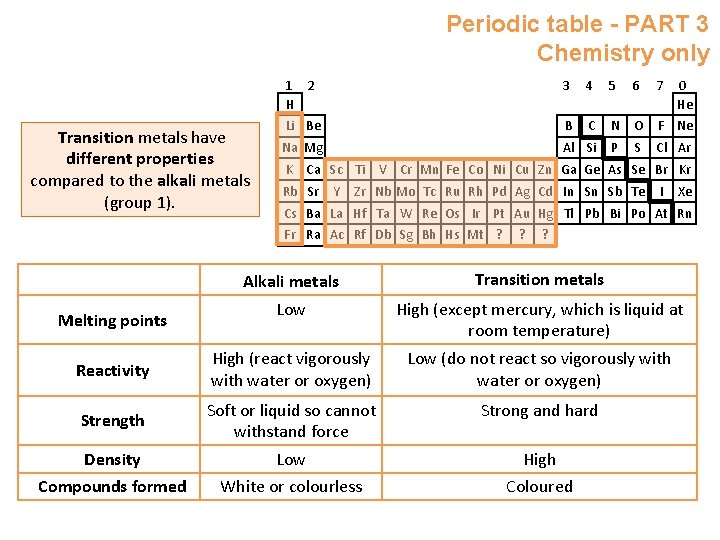
Periodic table - PART 3 Chemistry only Transition metals have different properties compared to the alkali metals (group 1). 1 2 H 3 4 5 6 7 Li Be B C N O F Ne Na Mg Al Si P S Cl Ar K Ca Sc Ti Rb Sr Y 0 He V Cr Mn Fe Co Ni Cu Zn Ga Ge As Se Br Kr Zr Nb Mo Tc Ru Rh Pd Ag Cd In Sn Sb Te I Xe Cs Ba La Hf Ta W Re Os Ir Pt Au Hg Tl Pb Bi Po At Rn Fr Ra Ac Rf Db Sg Bh Hs Mt ? ? ? Alkali metals Transition metals Low High (except mercury, which is liquid at room temperature) Reactivity High (react vigorously with water or oxygen) Low (do not react so vigorously with water or oxygen) Strength Soft or liquid so cannot withstand force Strong and hard Density Low High Compounds formed White or colourless Coloured Melting points
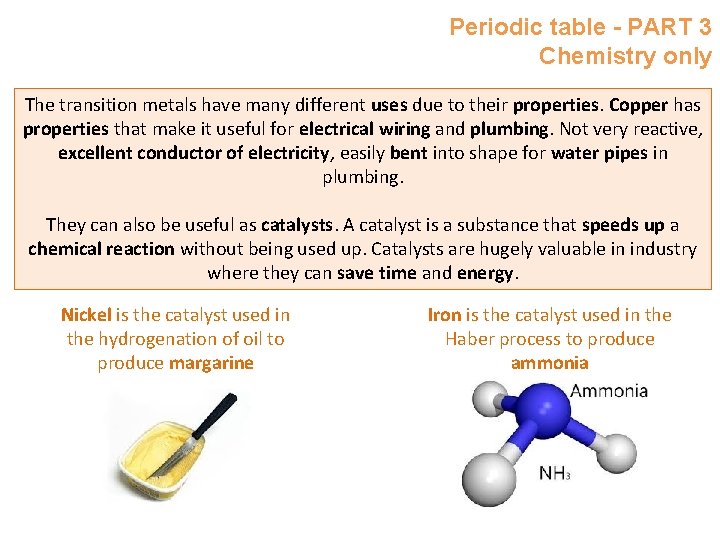
Periodic table - PART 3 Chemistry only The transition metals have many different uses due to their properties. Copper has properties that make it useful for electrical wiring and plumbing. Not very reactive, excellent conductor of electricity, easily bent into shape for water pipes in plumbing. They can also be useful as catalysts. A catalyst is a substance that speeds up a chemical reaction without being used up. Catalysts are hugely valuable in industry where they can save time and energy. Nickel is the catalyst used in the hydrogenation of oil to produce margarine Iron is the catalyst used in the Haber process to produce ammonia
- Slides: 28