
Overview Anisotropic diffusion occurs in many different physical
- Slides: 9
Overview Anisotropic diffusion occurs in many different physical systems and applications. In magnetized plasmas, thermal conduction can be much more rapid along the magnetic field line than across it, this will cause behavioral difference between the case of isothermal and thermal conductive situations in astrophysics when the magnetic field is present. While the diffusion behavior along and across the magnetic field lines can be physically complicated, we use simple assumptions (usually analytic expressions for the conductivity) in developing our code.
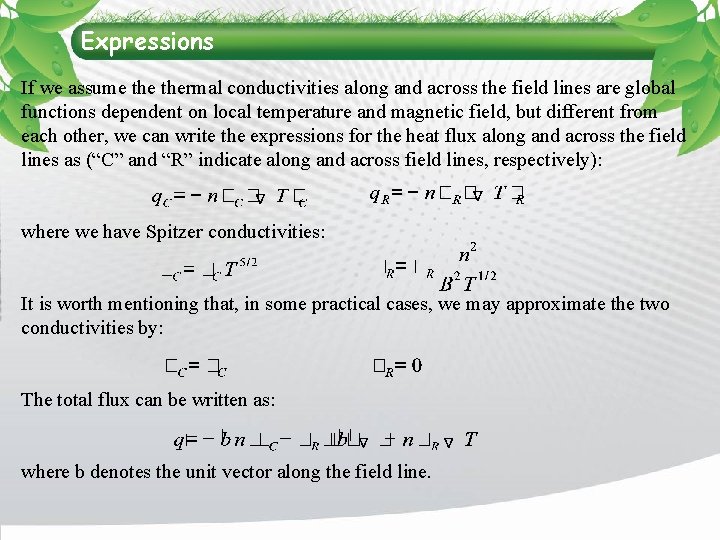
Expressions If we assume thermal conductivities along and across the field lines are global functions dependent on local temperature and magnetic field, but different from each other, we can write the expressions for the heat flux along and across the field lines as (“C” and “R” indicate along and across field lines, respectively): where we have Spitzer conductivities: It is worth mentioning that, in some practical cases, we may approximate the two conductivities by: The total flux can be written as: where b denotes the unit vector along the field line.
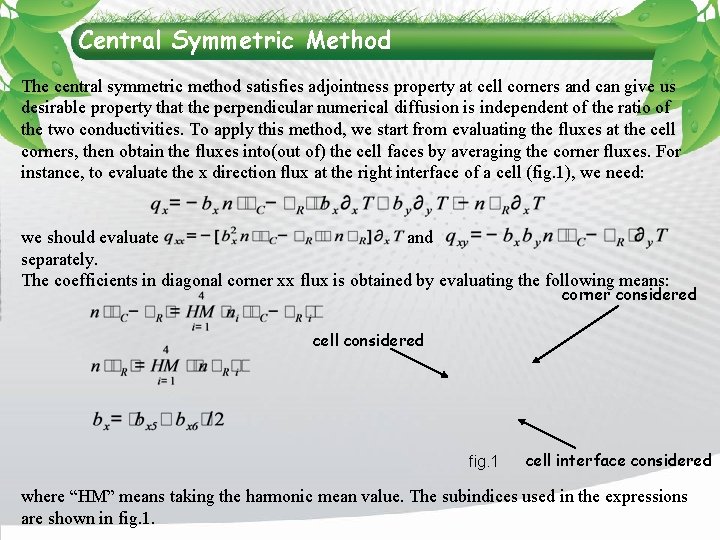
Central Symmetric Method The central symmetric method satisfies adjointness property at cell corners and can give us desirable property that the perpendicular numerical diffusion is independent of the ratio of the two conductivities. To apply this method, we start from evaluating the fluxes at the cell corners, then obtain the fluxes into(out of) the cell faces by averaging the corner fluxes. For instance, to evaluate the x direction flux at the right interface of a cell (fig. 1), we need: we should evaluate and separately. The coefficients in diagonal corner xx flux is obtained by evaluating the following means: corner considered cell considered fig. 1 cell interface considered where “HM” means taking the harmonic mean value. The subindices used in the expressions are shown in fig. 1.
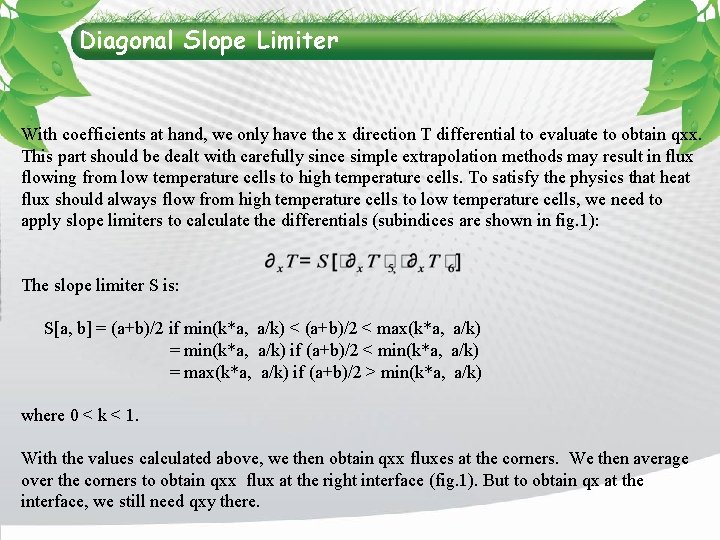
Diagonal Slope Limiter With coefficients at hand, we only have the x direction T differential to evaluate to obtain qxx. This part should be dealt with carefully since simple extrapolation methods may result in flux flowing from low temperature cells to high temperature cells. To satisfy the physics that heat flux should always flow from high temperature cells to low temperature cells, we need to apply slope limiters to calculate the differentials (subindices are shown in fig. 1): The slope limiter S is: S[a, b] = (a+b)/2 if min(k*a, a/k) < (a+b)/2 < max(k*a, a/k) = min(k*a, a/k) if (a+b)/2 < min(k*a, a/k) = max(k*a, a/k) if (a+b)/2 > min(k*a, a/k) where 0 < k < 1. With the values calculated above, we then obtain qxx fluxes at the corners. We then average over the corners to obtain qxx flux at the right interface (fig. 1). But to obtain qx at the interface, we still need qxy there.
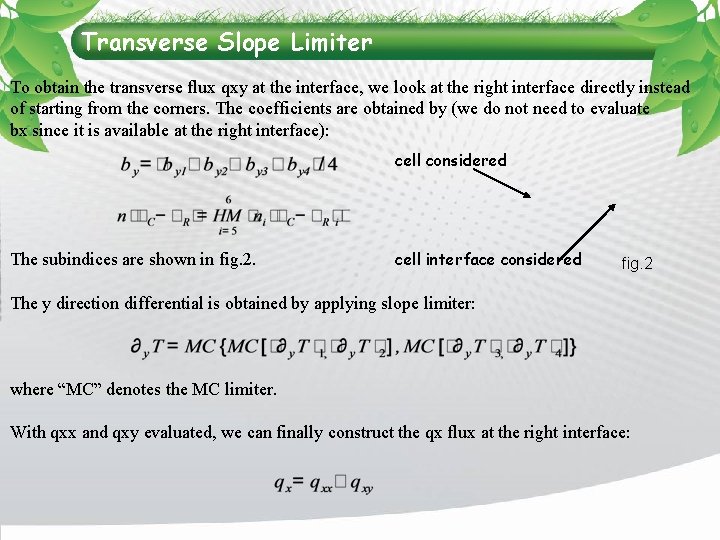
Transverse Slope Limiter To obtain the transverse flux qxy at the interface, we look at the right interface directly instead of starting from the corners. The coefficients are obtained by (we do not need to evaluate bx since it is available at the right interface): cell considered The subindices are shown in fig. 2. cell interface considered fig. 2 The y direction differential is obtained by applying slope limiter: where “MC” denotes the MC limiter. With qxx and qxy evaluated, we can finally construct the qx flux at the right interface:
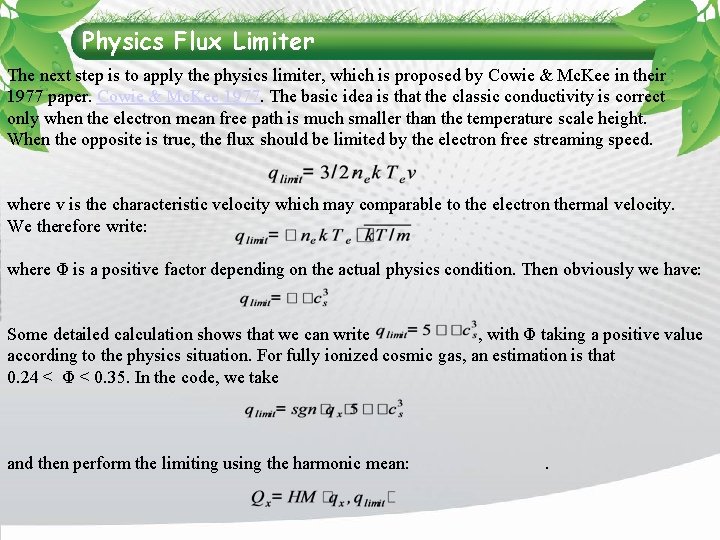
Physics Flux Limiter The next step is to apply the physics limiter, which is proposed by Cowie & Mc. Kee in their 1977 paper. Cowie & Mc. Kee 1977. The basic idea is that the classic conductivity is correct only when the electron mean free path is much smaller than the temperature scale height. When the opposite is true, the flux should be limited by the electron free streaming speed. where v is the characteristic velocity which may comparable to the electron thermal velocity. We therefore write: where Φ is a positive factor depending on the actual physics condition. Then obviously we have: Some detailed calculation shows that we can write , with Φ taking a positive value according to the physics situation. For fully ionized cosmic gas, an estimation is that 0. 24 < Φ < 0. 35. In the code, we take and then perform the limiting using the harmonic mean: .
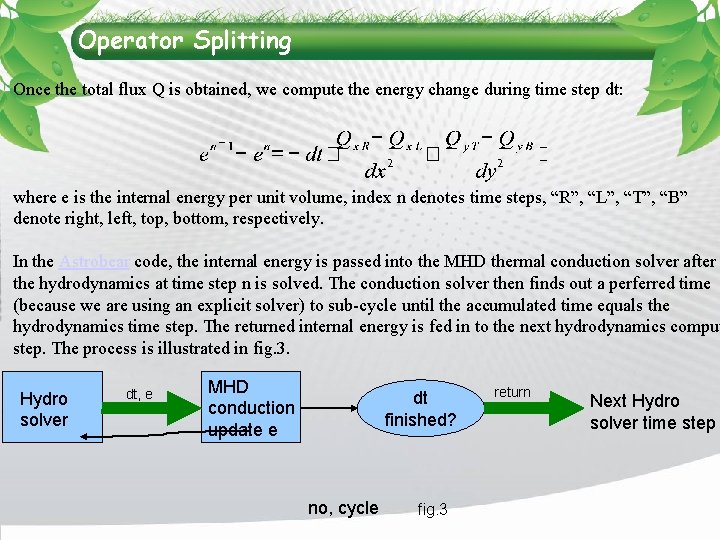
Operator Splitting Once the total flux Q is obtained, we compute the energy change during time step dt: where e is the internal energy per unit volume, index n denotes time steps, “R”, “L”, “T”, “B” denote right, left, top, bottom, respectively. In the Astrobear code, the internal energy is passed into the MHD thermal conduction solver after the hydrodynamics at time step n is solved. The conduction solver then finds out a perferred time (because we are using an explicit solver) to sub-cycle until the accumulated time equals the hydrodynamics time step. The returned internal energy is fed in to the next hydrodynamics comput step. The process is illustrated in fig. 3. Hydro solver dt, e MHD conduction update e dt finished? no, cycle fig. 3 return Next Hydro solver time step
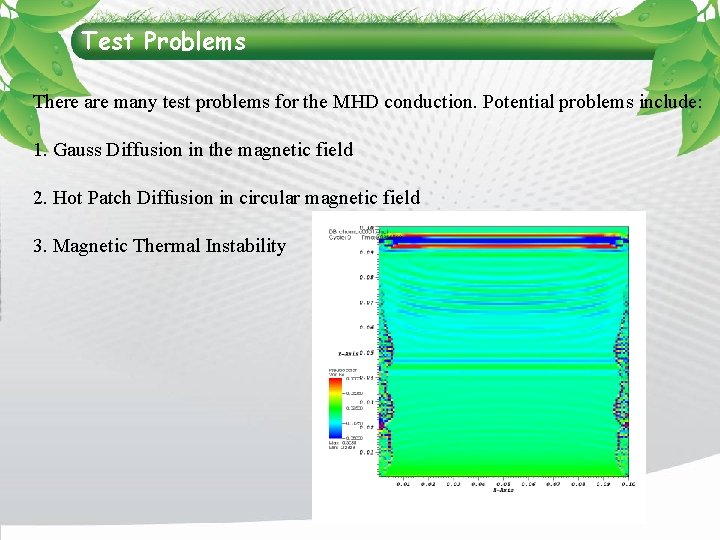
Test Problems There are many test problems for the MHD conduction. Potential problems include: 1. Gauss Diffusion in the magnetic field 2. Hot Patch Diffusion in circular magnetic field 3. Magnetic Thermal Instability
Future Works 1. 3 D AMR 2. Time Stepping Method 3. Coupling to Hypre