
Overview and current status of the Mersea project
- Slides: 13
Overview and current status of the Mersea project and system Eric Dombrowsky - Mercator Océan IGST-12 - St John's - August 2007
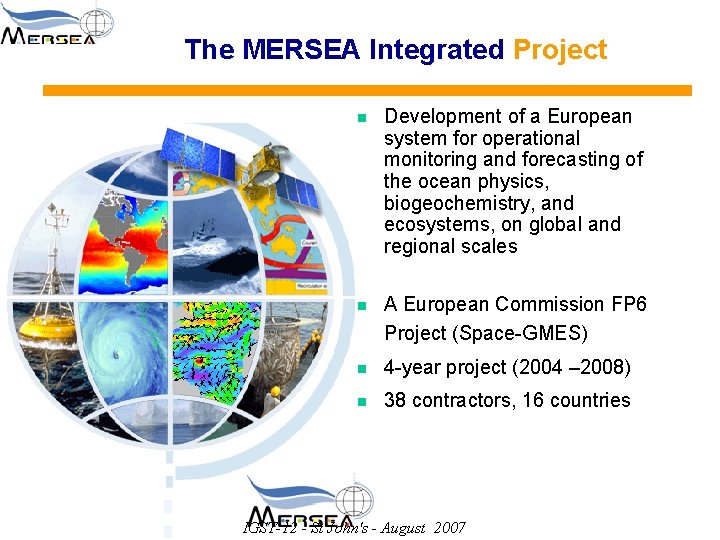
The MERSEA Integrated Project n Development of a European system for operational monitoring and forecasting of the ocean physics, biogeochemistry, and ecosystems, on global and regional scales n A European Commission FP 6 Project (Space-GMES) n 4 -year project (2004 – 2008) n 38 contractors, 16 countries IGST-12 - St John's - August 2007
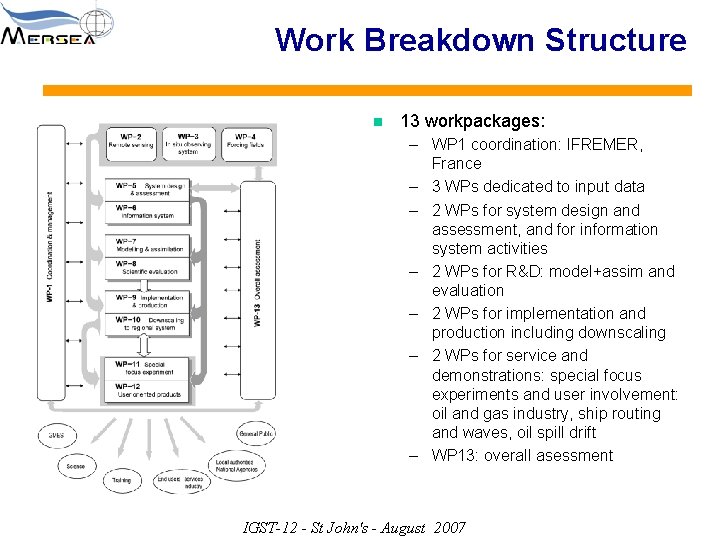
Work Breakdown Structure n 13 workpackages: – WP 1 coordination: IFREMER, France – 3 WPs dedicated to input data – 2 WPs for system design and assessment, and for information system activities – 2 WPs for R&D: model+assim and evaluation – 2 WPs for implementation and production including downscaling – 2 WPs for service and demonstrations: special focus experiments and user involvement: oil and gas industry, ship routing and waves, oil spill drift – WP 13: overall asessment IGST-12 - St John's - August 2007
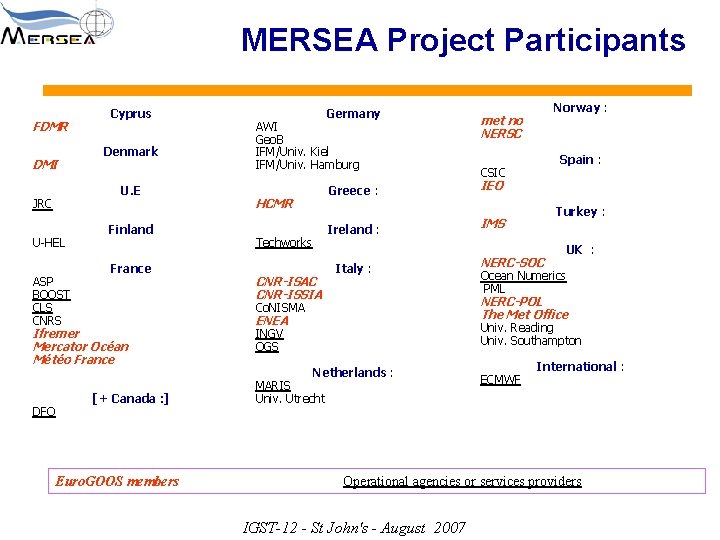
MERSEA Project Participants FDMR DMI Cyprus Denmark U. E JRC U-HEL ASP BOOST CLS CNRS Finland France AWI Geo. B IFM/Univ. Kiel IFM/Univ. Hamburg Greece : HCMR Ireland : Techworks CNR-ISAC CNR-ISSIA Italy : [+ Canada : ] Euro. GOOS members Norway : met no NERSC Spain : CSIC IEO Turkey : IMS NERC-SOC UK : Ocean Numerics PML NERC-POL The Met Office Co. NISMA Ifremer Mercator Océan Météo France DFO Germany ENEA Univ. Reading Univ. Southampton INGV OGS Netherlands : MARIS Univ. Utrecht ECMWF International : Operational agencies or services providers IGST-12 - St John's - August 2007
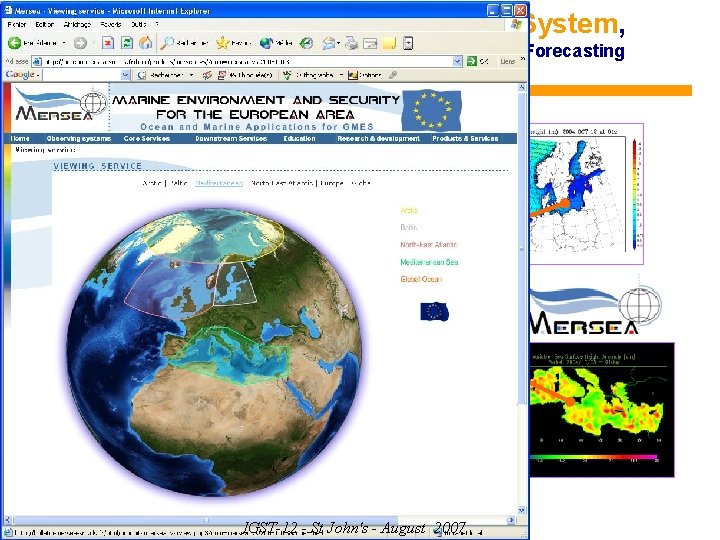
The MERSEA Integrated System, a European capacity for Ocean Monitoring and Forecasting Bologna Emilia Romagna Copenhagen Oresund Bergen Hordaland Exeter Devon Toulouse Midi-Pyrénées ARCTIC NEA -North NW Shelves BALTIC SEA GLOBAL NEA - South MED SEA IGST-12 - St John's - August 2007
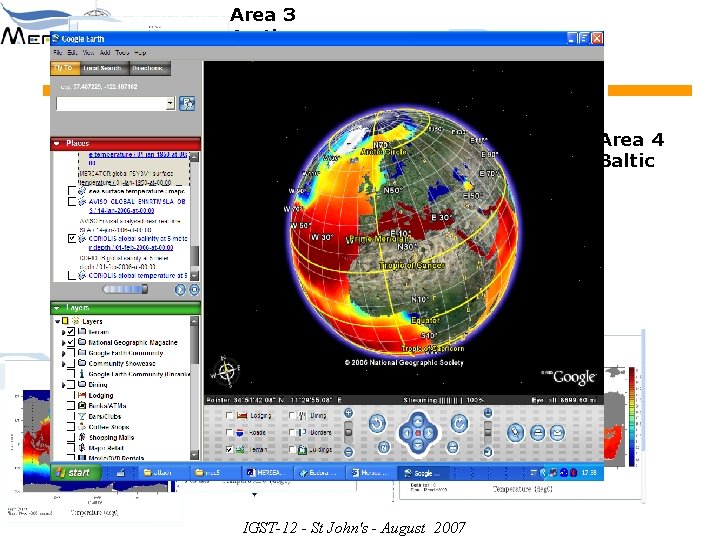
Area 3 Arctic Area 4 Baltic Area 2: North East Atlantic Area 1 Global Area 5 Med Sea IGST-12 - St John's - August 2007
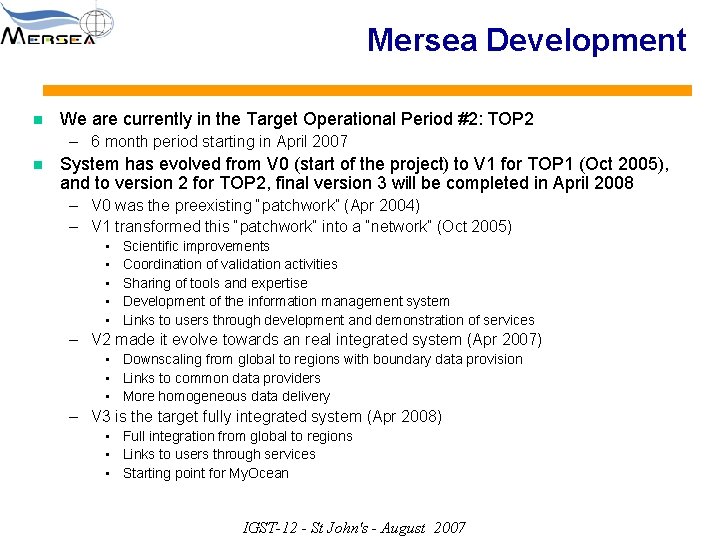
Mersea Development n We are currently in the Target Operational Period #2: TOP 2 – 6 month period starting in April 2007 n System has evolved from V 0 (start of the project) to V 1 for TOP 1 (Oct 2005), and to version 2 for TOP 2, final version 3 will be completed in April 2008 – V 0 was the preexisting “patchwork” (Apr 2004) – V 1 transformed this “patchwork” into a “network” (Oct 2005) • • • Scientific improvements Coordination of validation activities Sharing of tools and expertise Development of the information management system Links to users through development and demonstration of services – V 2 made it evolve towards an real integrated system (Apr 2007) • Downscaling from global to regions with boundary data provision • Links to common data providers • More homogeneous data delivery – V 3 is the target fully integrated system (Apr 2008) • Full integration from global to regions • Links to users through services • Starting point for My. Ocean IGST-12 - St John's - August 2007
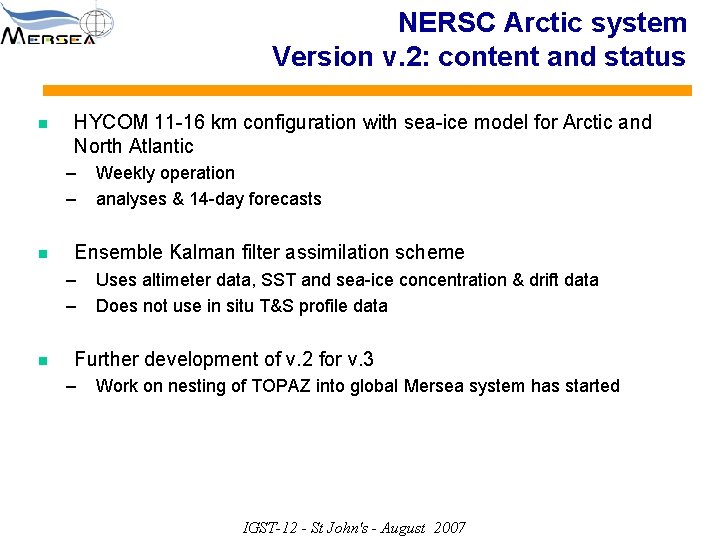
NERSC Arctic system Version v. 2: content and status n HYCOM 11 -16 km configuration with sea-ice model for Arctic and North Atlantic – – n Ensemble Kalman filter assimilation scheme – – n Weekly operation analyses & 14 -day forecasts Uses altimeter data, SST and sea-ice concentration & drift data Does not use in situ T&S profile data Further development of v. 2 for v. 3 – Work on nesting of TOPAZ into global Mersea system has started IGST-12 - St John's - August 2007
NERSC Arctic system Developments for version v. 2 n Agreement between NERSC and National Meteorological Institute: Terms and conditions of operations of TOPAZ at Met. No. Concluded 30 March 2007 n Ice drift velocity data assimilation implemented n Higher horizontal resolution: 11 -16 km replacing 18 -36 km n Ecosystem simulation shown to be relatively insensitive to assimilation of altimeter data n Port of system to new super-computer IGST-12 - St John's - August 2007
DMI Baltic system Version v. 2: content and status n 3 NM North Sea & 0. 5 NM Danish Strait configurations – – n DMI version of BSH c-mod ocean & sea-ice model Three configurations coupled by two-way nesting Twice daily operation – forecasts to 60 hours ahead n SST assimilation scheme n Lateral boundary data in North Sea from climatology IGST-12 - St John's - August 2007
DMI Baltic system Developments for version v. 2 n Increased resolution – – – n Mixing parameterizations – – – n Problems because of differences in bathymetry in Norwegian Trench (recall that models use s-coords and hence are smoothed) SST data assimilation implemented – n Horizontal dissipation revised to avoid current divergence K-W vertical mixing scheme represents breaking surface & internal waves Much sharper pycnocline obtained at some stations Attempted to use lateral boundary data from north-east Atlantic – n Doubled horizontal resolution and improved vertical resolution North Sea grid spacing: 3 NM (5 km) in horizontal; 2 m in vertical Danish Straits grid spacing: 0. 5 NM (900 m); 1 m uses simplified Kalman filter (Larsson et al 2007) System optimized for AMD Opteron computer IGST-12 - St John's - August 2007
INGV Mediterranean system Version v. 2: content and status n 1/16 o, 72 level configuration (with revised Atlantic domain) – n Daily forecasts and weekly analysis updates – n 10 -day forecasts Multi-variate 3 D variational assimilation scheme – – n NEMO ocean models with 72 layers Uses in situ T&S profile data & SST analysis Uses SSH data with revised Rio MDT Nesting into to global system – – Mechanics for nesting in global model have been set up A parallel version is run nested in v. 2 global IGST-12 - St John's - August 2007
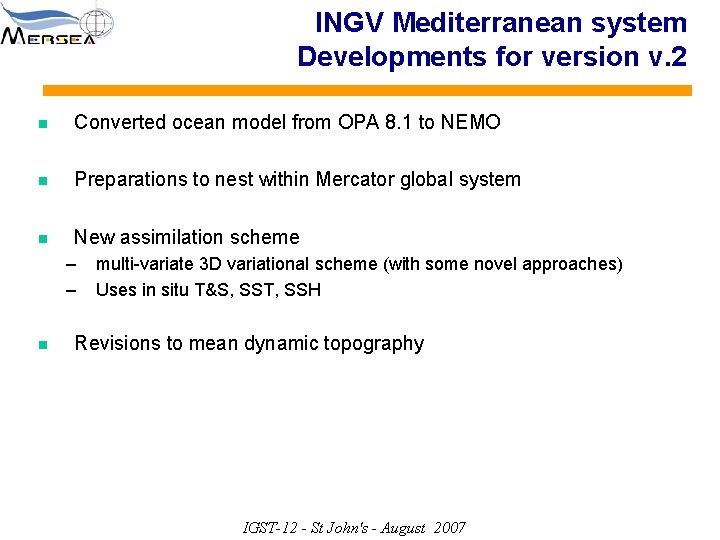
INGV Mediterranean system Developments for version v. 2 n Converted ocean model from OPA 8. 1 to NEMO n Preparations to nest within Mercator global system n New assimilation scheme – – n multi-variate 3 D variational scheme (with some novel approaches) Uses in situ T&S, SST, SSH Revisions to mean dynamic topography IGST-12 - St John's - August 2007