
Overture The Marriage of Figaro Composed by Wolfgang
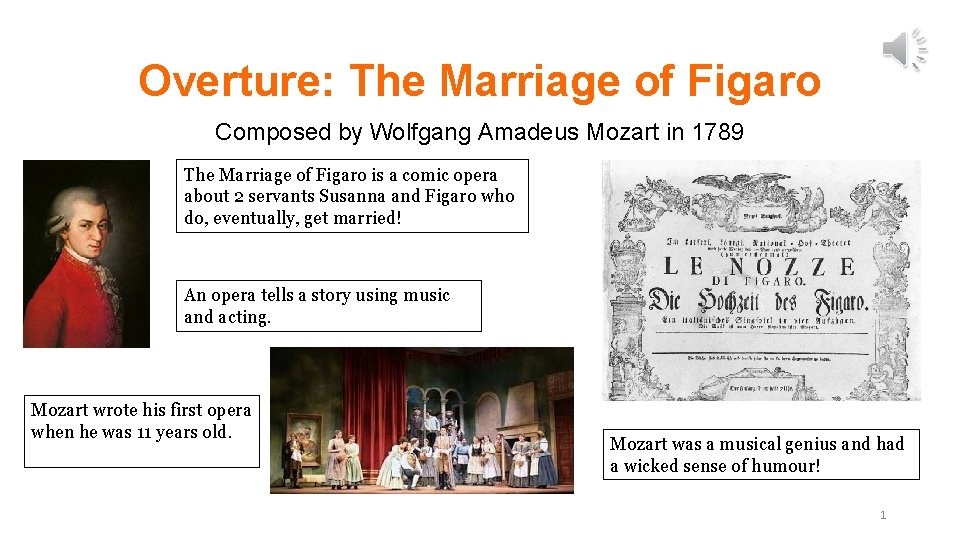
Overture: The Marriage of Figaro Composed by Wolfgang Amadeus Mozart in 1789 The Marriage of Figaro is a comic opera about 2 servants Susanna and Figaro who do, eventually, get married! An opera tells a story using music and acting. Mozart wrote his first opera when he was 11 years old. Mozart was a musical genius and had a wicked sense of humour! 1
Listening and Responding Setting the Scene Think about all the preparations needed for a wedding or big celebration. Who might be involved in the preparations? What are they doing? Chefs, waiters, florists, musicians, the bride and groom, various members of the family. How might everyone be feeling? Happy, sad, excited, cross, irritated? Imagine the different conversations! People chatting, shouting orders and instructions, whispering in the corner, on the telephone. What might they be saying? You could add speech bubbles to your picture for some of your characters. Let the music inspire you and create a picture of the preparations. 2
Musical Conversations Task 1: Imagine the conversation (Work with a partner) Look at the pictures you created in the listening activity. Gather ideas for ‘snippets’ of conversation that might be heard during the celebration preparation. Write your ‘snippets’ of conversation on the speech bubbles. For example: o o o Hurry up| I’m coming! What’s the time? | It’s nearly 8 O’clock We don’t have much time | Can you help me set the table? Mind where you’re going | I’m sorry, I’m sorry Don’t forget the cake| I’ll get it 3
Task 2: Create Rhythmic Conversations Choose one of your ‘conversations’ • Clap and say the words rhythmically • Is the rhythm pattern interesting? • Are the patterns the same or different? • Is the rhythm accurate? • Can you repeat it exactly? • Select 2 different untuned instruments and have a musical conversation using your rhythms. Can you: • Repeat the rhythms accurately? • Vary the dynamic e. g. play quieter? Louder • Vary the speed e. g. play slower faster? • Can you show emotion in the way you play your conversation? Can you communicate just in music if one person is feeling: Cross? Nervous? Worried, Excited? 4
Task 3 & 4: Perform your musical conversations • Perform your conversations to the class • Can the class guess what each pair is ‘saying’? • Now join with another pair and put your conversations together. • • • Explore different sequences (orders) and the number of times you could repeat each conversation. Try faster/slower/ louder quieter. Try layering them! Can you hear all the different ‘voices’? Try using different instruments. 5
- Slides: 5