
Overlapping Communities in Dynamic Networks Their Detection and







![Experiment set up �Dataset: Facebook network [] �New Orleans region � 63. 7 K](https://slidetodoc.com/presentation_image_h/fda49e56573a7cba55f18896d6b02bb8/image-22.jpg "Experiment set up �Dataset: Facebook network [] �New Orleans region � 63. 7 K")



- Slides: 31
Overlapping Communities in Dynamic Networks: Their Detection and Mobile Applications Nam P. Nguyen, Thang N. Dinh, Sindhura Tokala and My T. Thai {nanguyen, tdinh, sindhura, mythai}@cise. ufl. edu MOBICOM 2011
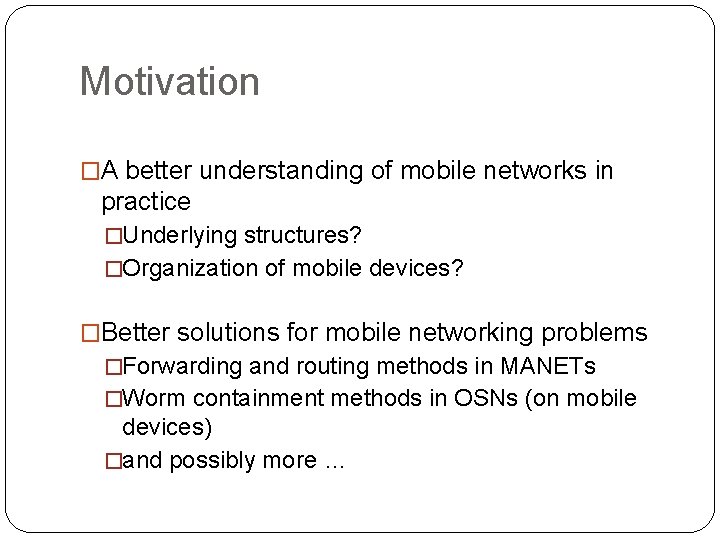
Motivation �A better understanding of mobile networks in practice �Underlying structures? �Organization of mobile devices? �Better solutions for mobile networking problems �Forwarding and routing methods in MANETs �Worm containment methods in OSNs (on mobile devices) �and possibly more …
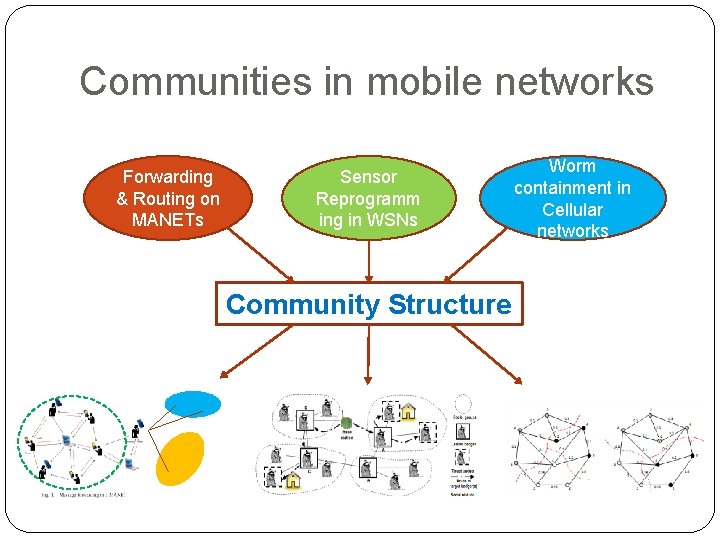
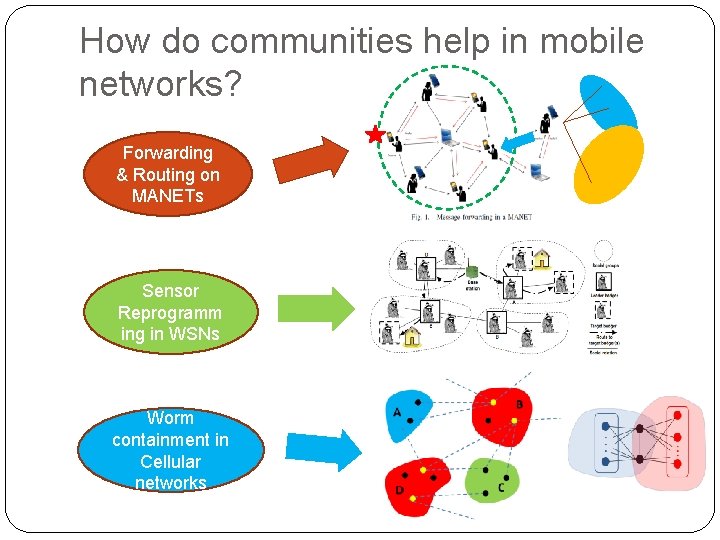
Communities in mobile networks Forwarding & Routing on MANETs Sensor Reprogramm ing in WSNs Community Structure Worm containment in Cellular networks
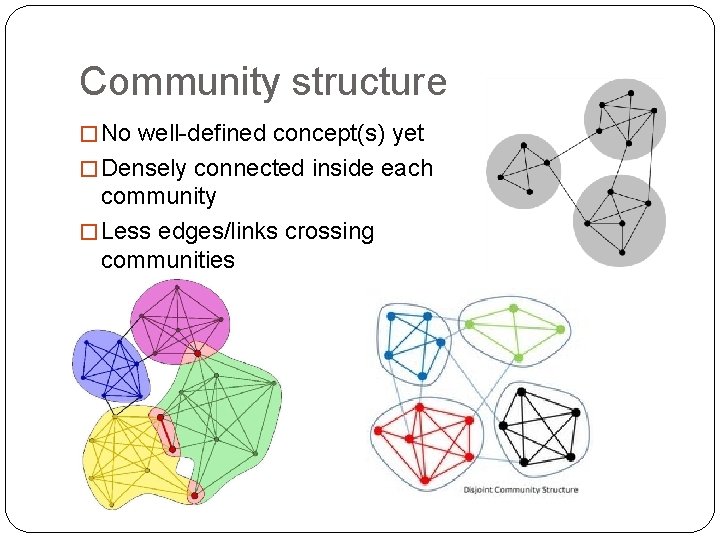
Community structure � No well-defined concept(s) yet � Densely connected inside each community � Less edges/links crossing communities
How do communities help in mobile networks? Forwarding & Routing on MANETs Sensor Reprogramm ing in WSNs Worm containment in Cellular networks
Community detection �The detection of network communities is �important However, … �Large and dynamic Mobile networks �Overlapping communities Q: A quick and efficient CS detection algorithm? A: An Adaptive CS detection algorithm
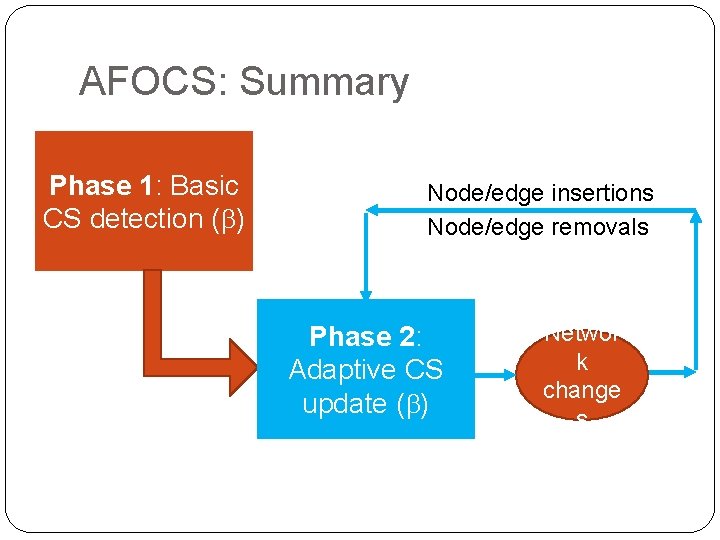
An adaptive algorithm Input network Phase 1: Basic CS detection ( ) Basic communities Our solution: AFOCS: A 2 -phase and limited input dependent framework Phase 2: Adaptive CS update ( ) Network changes : : Updated
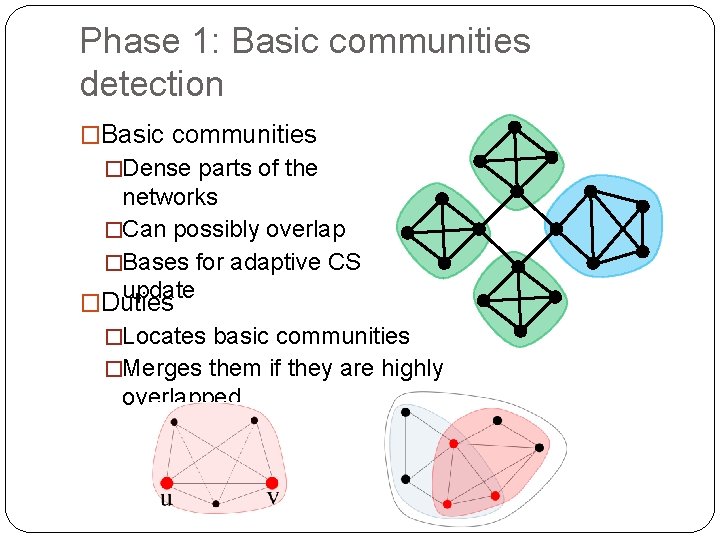
Phase 1: Basic communities detection �Basic communities �Dense parts of the networks �Can possibly overlap �Bases for adaptive CS update �Duties �Locates basic communities �Merges them if they are highly overlapped
Phase 1: Basic communities detection �Locating basic communities: when (C) = 0. 9 (C) =0. 725 �Merging: when OS(Ci, Cj) = 1. 027 = 0. 75
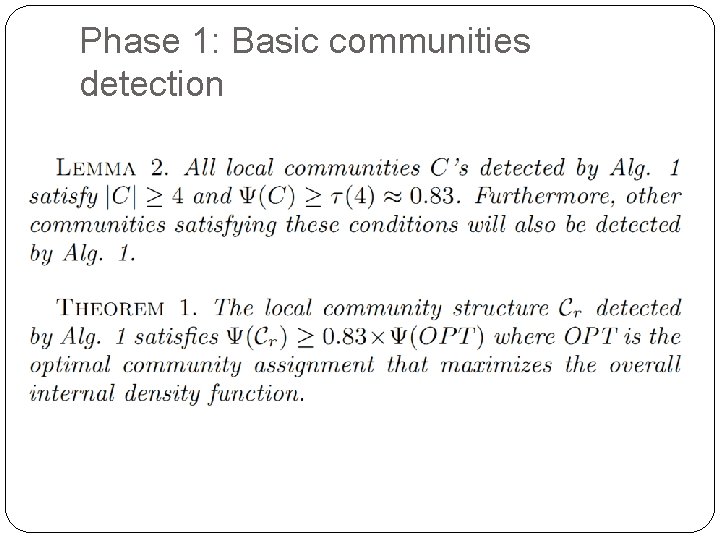
Phase 1: Basic communities detection
Phase 2: Adaptive CS update �Update network communities when changes are introduced Need to handle Basic communities Network changes – Adding a node/edge – Removing a node/edge Updated communities + Locally locate new local communities + Merge them if they highly overlap with current ones
Phase 2: Adding a new node u u u Y(Ct) ≥ t(4) × Y(OPT(u)t)
Phase 2: Adding a new edge
Phase 2: Removing a node �Identify the left-over structure(s) on C{u} �Merge overlapping substructure(s)
Phase 2: Removing an edge �Identify the left-over structure(s) on C{u, v} �Merge overlapping substructure(s)
AFOCS: Summary Phase 1: Basic CS detection ( ) Node/edge insertions Node/edge removals Phase 2: Adaptive CS update ( ) Networ k change s
A community-based forwarding & routing strategy in MANETs �Challenges �Fast and effective forwarding �Not introducing too much overhead info �Available (non-overlapping) community-based routings �Forward messages to the people/devices in the same community as the destination. �Our method: �Takes into account overlapping CS �Forwards messages to people/devices sharing more community labels with the destination
Experiment set up �Data: Reality Mining (MIT lab) �Contains communication, proximity, location, and activity information (via Bluetooth) from 100 students at MIT in the 2004 -2005 academic year � 500 random message sending requests are generated and distributed in different time points �Control parameters �hop-limit �time-to-live �max-copies
Results Avg. Delivery Ratio Avg. Delivery Time Avg. Duplicate Message + Competitive Avg. Delivery Ratio and Delivery Time + Significant improvement on the number of Avg. Duplicate Messages
A community-based worm containment method on OSNs �Online social networks have become more and more popular �Worm spreading on OSNs �From computers (traditional method) �From mobile devices (Smart phones, PDAs, etc)
Worm containment methods �Available methods (cellular networks) �Choosing people/devices from different disjoint communities and send patches to them �Our method: �Choosing the people/devices in the boundary of the overlap to send patches & have them redistribute the patches
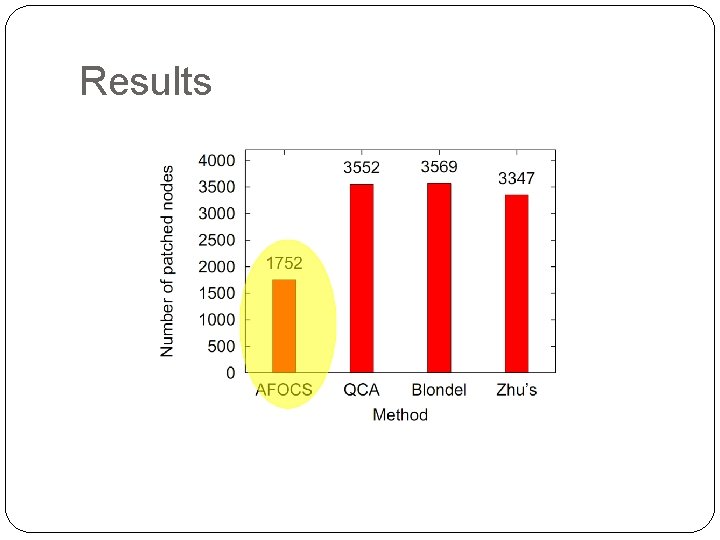
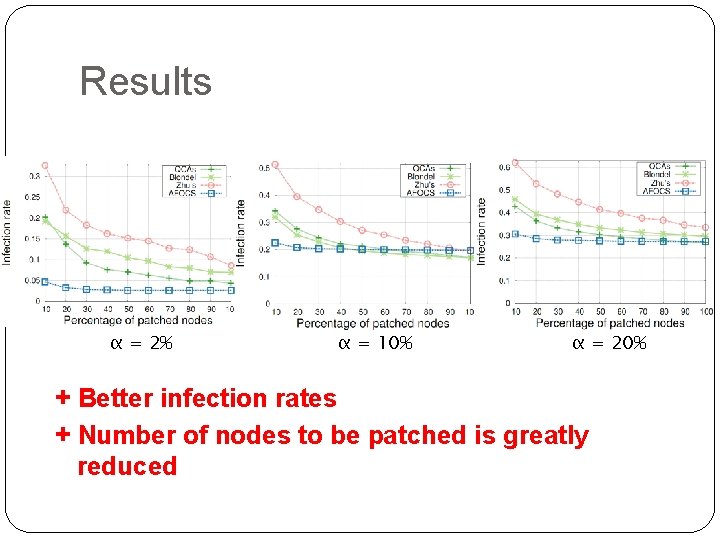
Experiment set up �Dataset: Facebook network [] �New Orleans region � 63. 7 K nodes + 1. 5 M edges (Avg. degree = 23/5) �Friendship and wall-posts �Worm propagation �Follows “Koobface” spreading model �Alarm threshold �α = 2%, 10% & 20%
Results
Results α = 2% α = 10% α = 20% + Better infection rates + Number of nodes to be patched is greatly reduced
Summary �AFOCS �A 2 -phase adaptive framework to identify and update CS in dynamic networks �Fast and efficient �Forwarding & Routing strategy on MANETs �Competitive Avg. Time and Delivery Ratio �Significant improvement of number of Avg. Duplicate Messages �Worm containment on OSNs �A tighter set of influential people/devices �Better performance in comparison with other methods.
Acknowledgement �Funding �NSF CAREER Award grant 0953284 �DTRA YIP grant HDTRA 1 -09 -1 -0061 �DTRA grant HDTRA 1 -08 -10. �Shepherd �Dr. Cecilia Mascolo, University of Cambrigde, UK
Q&A Thank you for your attention
Back-up slides �Additional slides for questions that may arise in the presentation
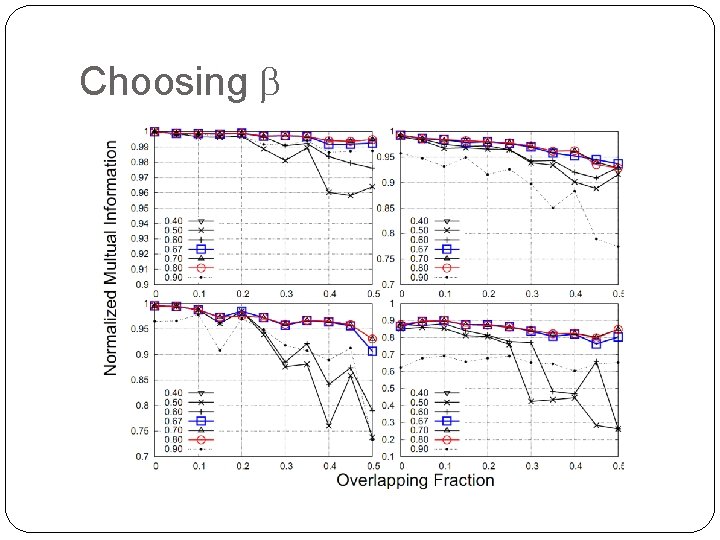
Choosing
AFOCS performance
AFOCS performance