
Overfishing overfished status and stock assessment FAOs perspective
- Slides: 16
Overfishing, overfished status, and stock assessment: FAO’s perspective Dr. Nicolas L Gutierrez Marine and Inland Fisheries Branch, FAO Workshop on Stock Assessment WTO – Negotiating Group on Rules 11 th June 2018 WWW. FAO. ORG 1
Outline • • What’s a stock assessment? Overfishing vs. overfished Regional coverage of stock assessments A way forward? WWW. FAO. ORG 2
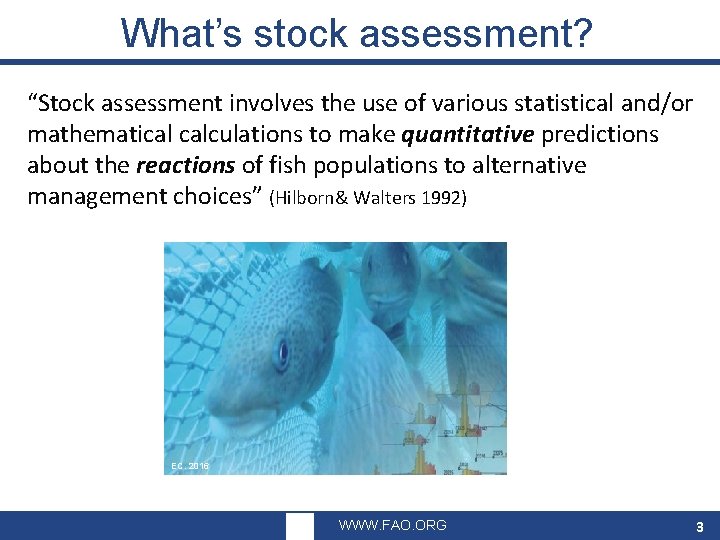
What’s stock assessment? “Stock assessment involves the use of various statistical and/or mathematical calculations to make quantitative predictions about the reactions of fish populations to alternative management choices” (Hilborn& Walters 1992) EC. 2016 WWW. FAO. ORG 3
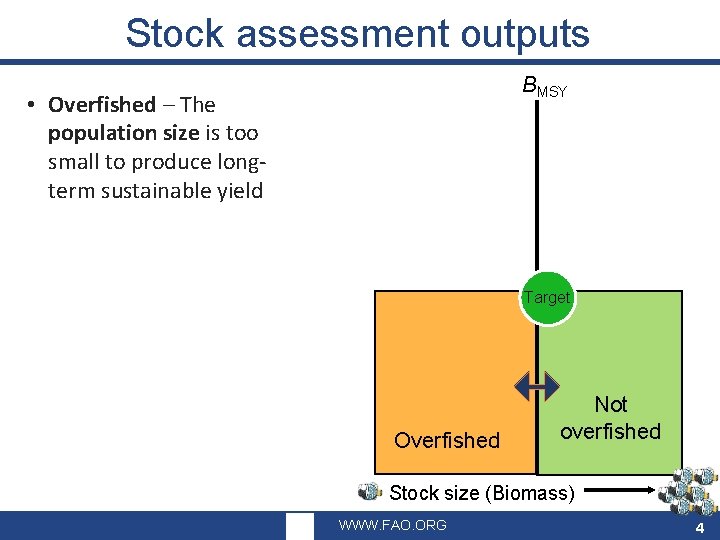
Stock assessment outputs • Overfished – The population size is too small to produce longterm sustainable yield BMSY Target Overfished Not overfished Stock size (Biomass) WWW. FAO. ORG 4
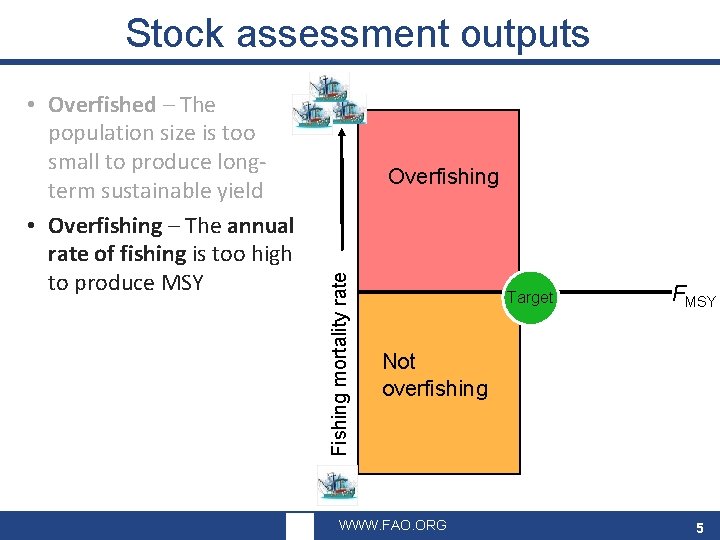
Stock assessment outputs Overfishing Fishing mortality rate • Overfished – The population size is too small to produce longterm sustainable yield • Overfishing – The annual rate of fishing is too high to produce MSY Target FMSY Not overfishing WWW. FAO. ORG 5
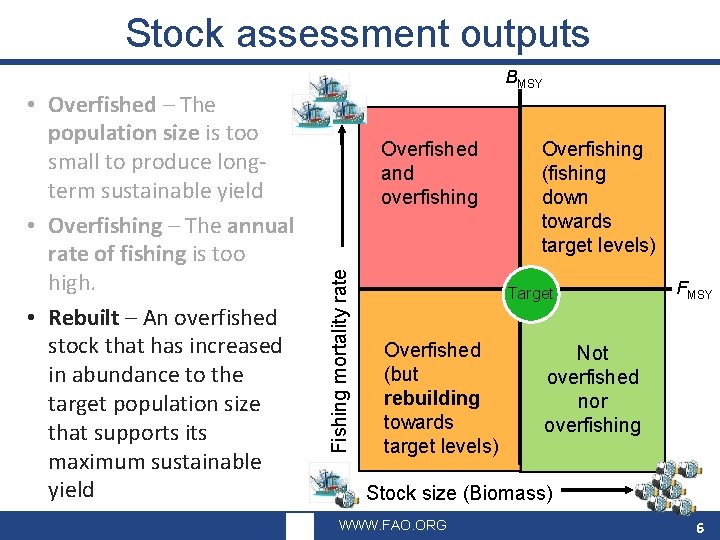
Stock assessment outputs BMSY Overfished and overfishing Fishing mortality rate • Overfished – The population size is too small to produce longterm sustainable yield • Overfishing – The annual rate of fishing is too high. • Rebuilt – An overfished stock that has increased in abundance to the target population size that supports its maximum sustainable yield Overfishing (fishing down towards target levels) Target Overfished (but rebuilding towards target levels) FMSY Not overfished nor overfishing Stock size (Biomass) WWW. FAO. ORG 6
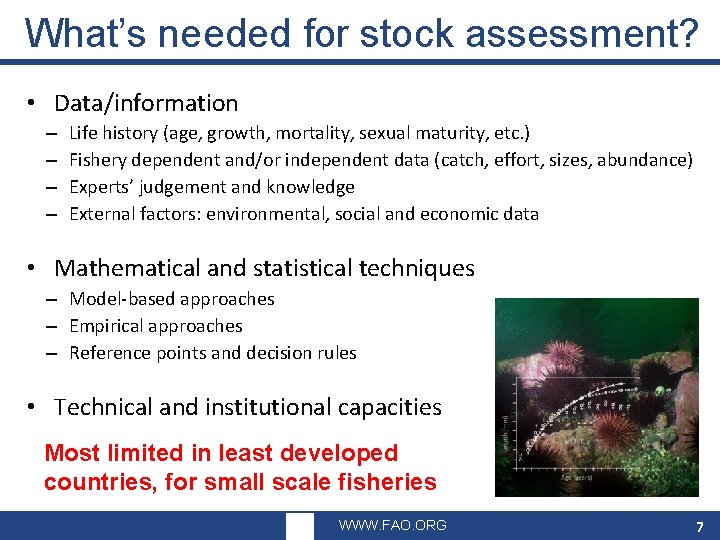
What’s needed for stock assessment? • Data/information – – Life history (age, growth, mortality, sexual maturity, etc. ) Fishery dependent and/or independent data (catch, effort, sizes, abundance) Experts’ judgement and knowledge External factors: environmental, social and economic data • Mathematical and statistical techniques – Model-based approaches – Empirical approaches – Reference points and decision rules • Technical and institutional capacities Most limited in least developed countries, for small scale fisheries WWW. FAO. ORG 7
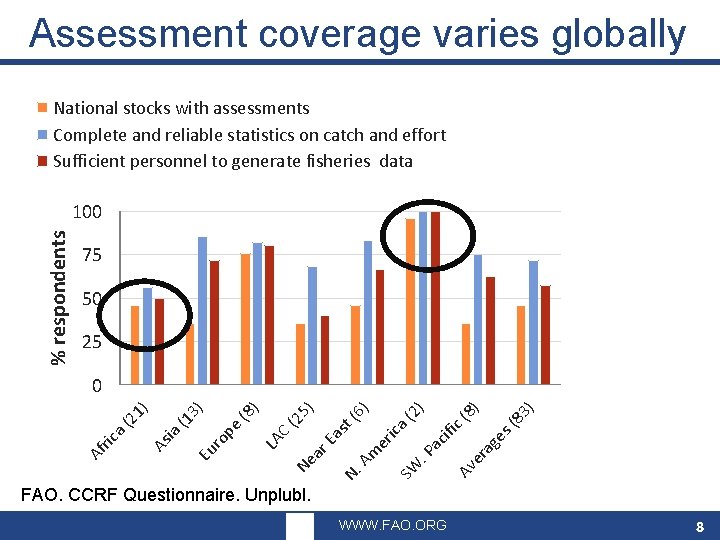
Assessment coverage varies globally National stocks with assessments Complete and reliable statistics on catch and effort Sufficient personnel to generate fisheries data % respondents 100 75 50 25 ) (8 3 8) er ag es c ( Av SW . P er ac ifi ica (2 ) ) t ( 6 N. A m r E as 5) Ne a LA C (2 ) e (8 op 3) Eu r (1 As ia Af ric a ( 2 1) 0 FAO. CCRF Questionnaire. Unplubl. WWW. FAO. ORG 8
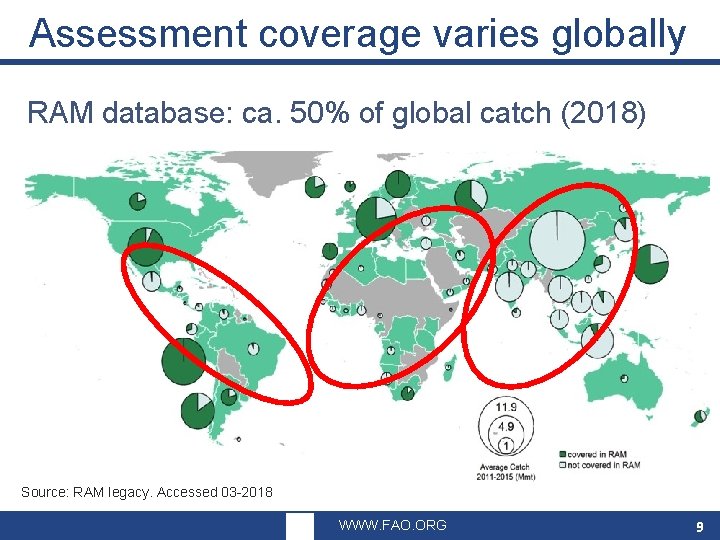
Assessment coverage varies globally RAM database: ca. 50% of global catch (2018) Source: RAM legacy. Accessed 03 -2018 WWW. FAO. ORG 9
A way forward? 1. Improve data and information availability 2. Apply data-limited assessments methods 3. Use empirical indicators and trends to inform management 4. Design, implement and enforce an effective management system WWW. FAO. ORG 9
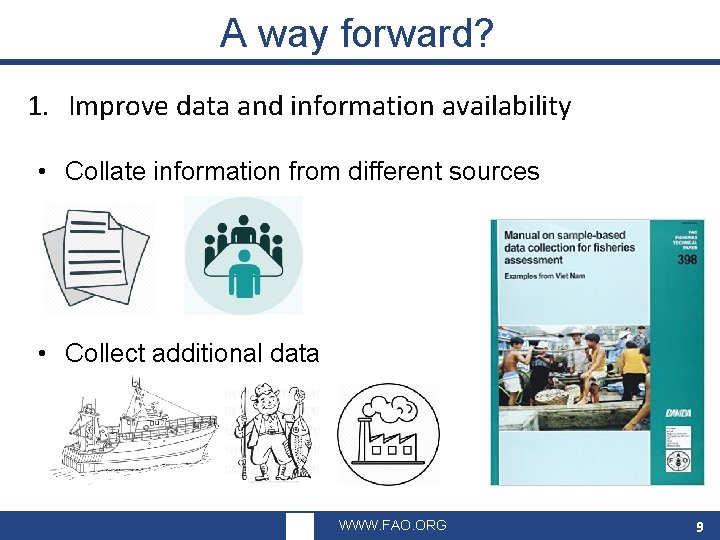
A way forward? 1. Improve data and information availability • Collate information from different sources • Collect additional data WWW. FAO. ORG 9
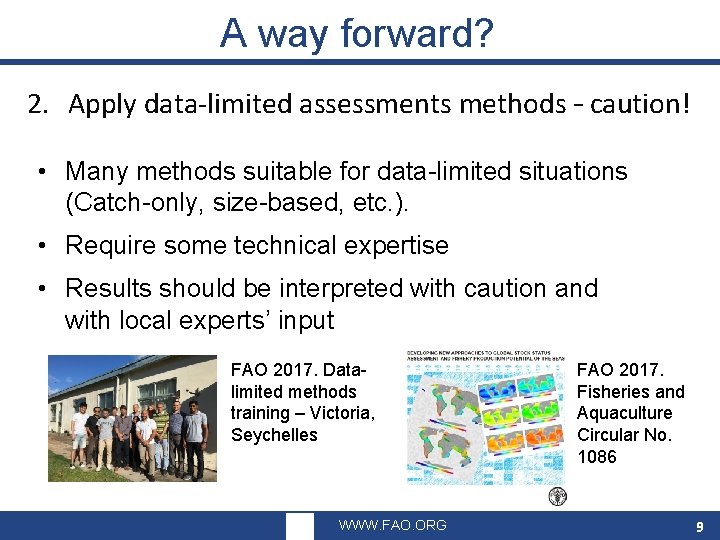
A way forward? 2. Apply data-limited assessments methods – caution! • Many methods suitable for data-limited situations (Catch-only, size-based, etc. ). • Require some technical expertise • Results should be interpreted with caution and with local experts’ input FAO 2017. Datalimited methods training – Victoria, Seychelles WWW. FAO. ORG FAO 2017. Fisheries and Aquaculture Circular No. 1086 9
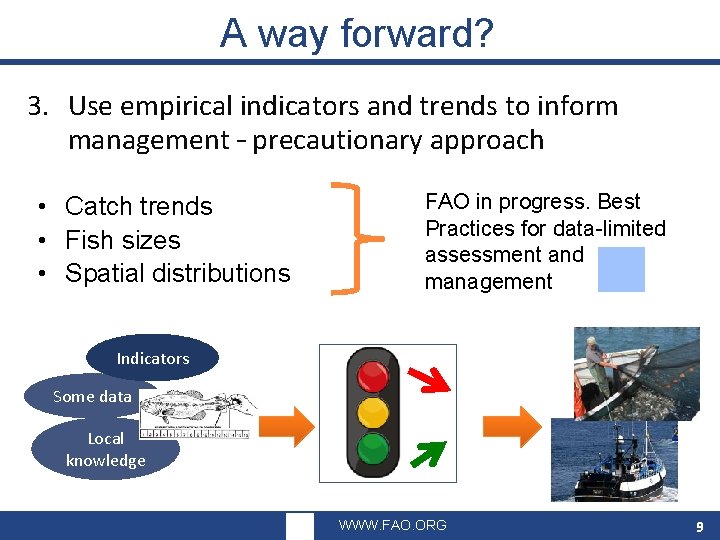
A way forward? 3. Use empirical indicators and trends to inform management – precautionary approach • Catch trends • Fish sizes • Spatial distributions FAO in progress. Best Practices for data-limited assessment and management Indicators Some data Local knowledge WWW. FAO. ORG 9
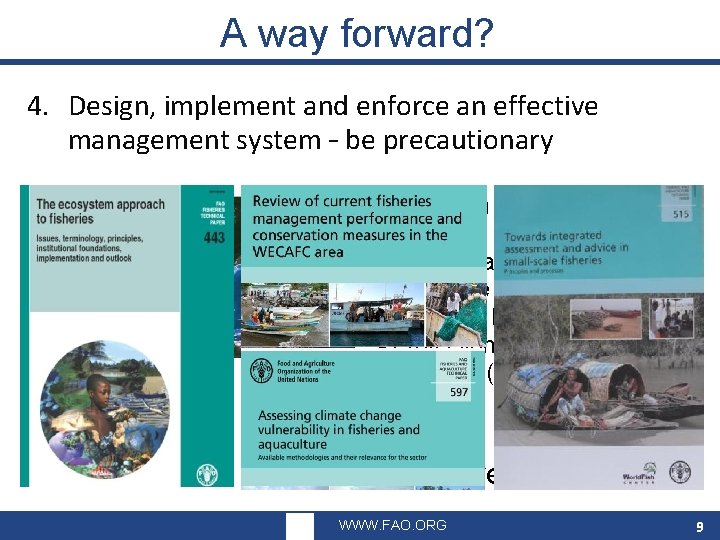
A way forward? 4. Design, implement and enforce an effective management system – be precautionary Sian’Kan Mexican lobster - Traditional management - Exclusive access rights - Minimum legal sizes - Protection of gravid females - Effective (self) enforcement Effective management! WWW. FAO. ORG 9
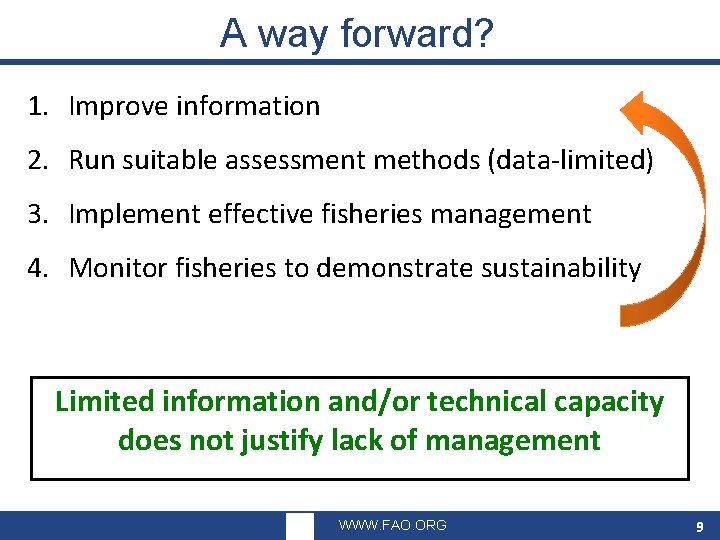
A way forward? 1. Improve information 2. Run suitable assessment methods (data-limited) 3. Implement effective fisheries management 4. Monitor fisheries to demonstrate sustainability Limited information and/or technical capacity does not justify lack of management WWW. FAO. ORG 9
Thank you Nicolas L Gutierrez, Ph. D Fishery Resources Officer Fisheries and Aquaculture Department Food and Agricultural Organization of the United Nations nicolas. gutierrez@fao. org WWW. FAO. ORG