
Overcoming Barriers Fire Life Safety for the Deaf
Overcoming Barriers: Fire & Life Safety for the Deaf & Hard of Hearing Population 2014 Fire Prevention Institute October 22, 2014
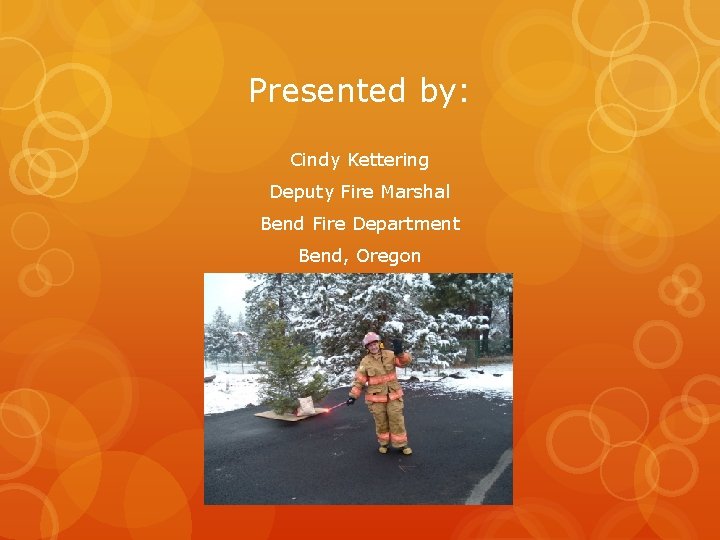
Presented by: Cindy Kettering Deputy Fire Marshal Bend Fire Department Bend, Oregon
Learning Objectives Participants will be able to: Understand the history of technology and research as it pertains to the deaf and hard of hearing population. Understand codes and laws pertaining to visual, tactile, and auditory notification appliances. Understand the educational and fire safety needs of persons who are deaf or hard of hearing. Identify target populations in their own community. Identify community partners who may be able to provide assistance. Take steps to create a specialized campaign in their own community. Raise fire and life safety awareness in the local population as a whole.
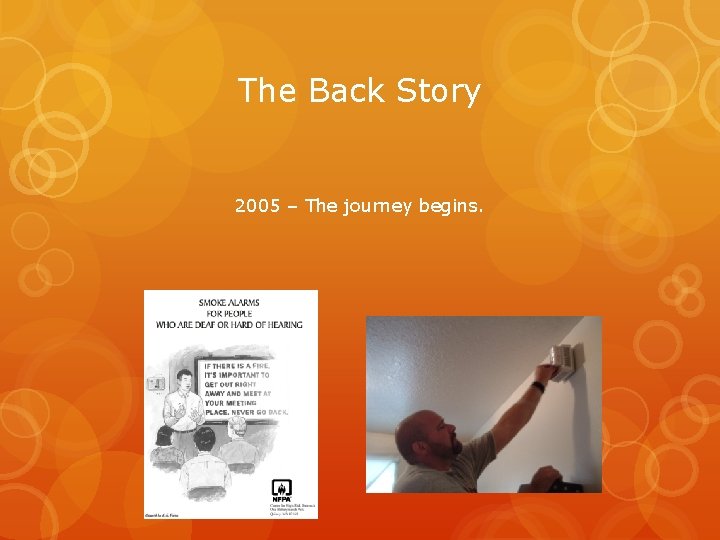
The Back Story 2005 – The journey begins.

History of Important Moments in Hearing Loss 1500’s – Italy - Geronimo Cardano Communication through pictures & symbols 1620 – Juan Pablo de Bonet publishes first book on sign language. 1755 – France – first sign language school created Fingerspelling Gestures representing words, phrases, and ideas
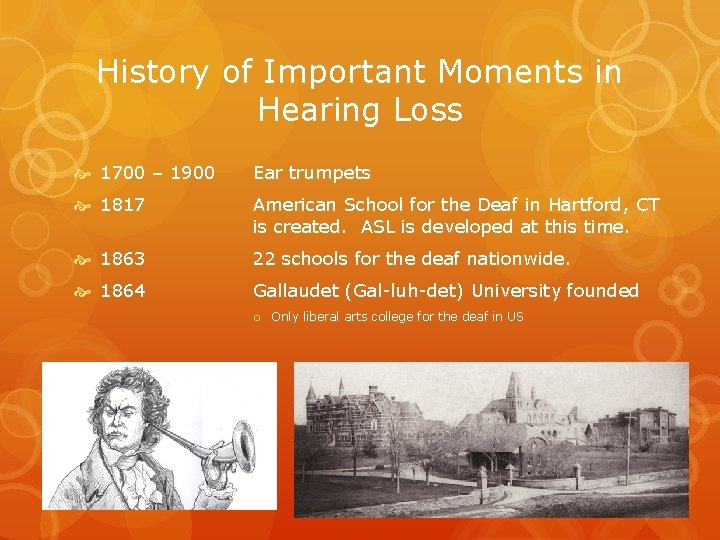
History of Important Moments in Hearing Loss 1700 – 1900 Ear trumpets 1817 American School for the Deaf in Hartford, CT is created. ASL is developed at this time. 1863 22 schools for the deaf nationwide. 1864 Gallaudet (Gal-luh-det) University founded o Only liberal arts college for the deaf in US
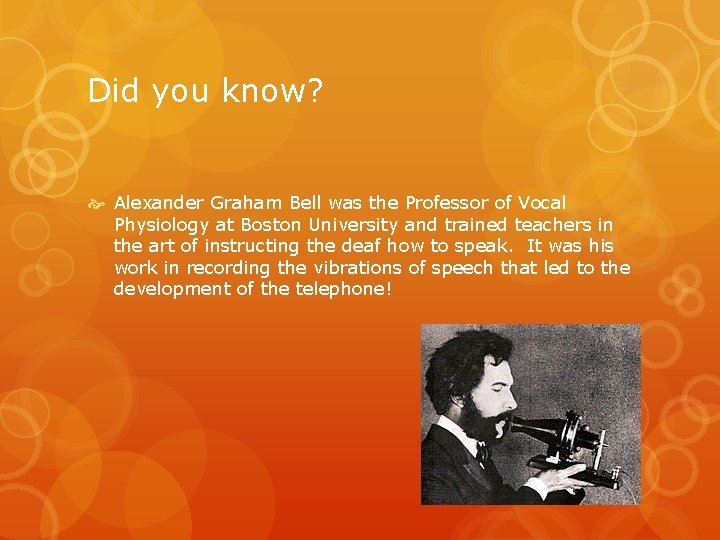
Did you know? Alexander Graham Bell was the Professor of Vocal Physiology at Boston University and trained teachers in the art of instructing the deaf how to speak. It was his work in recording the vibrations of speech that led to the development of the telephone!
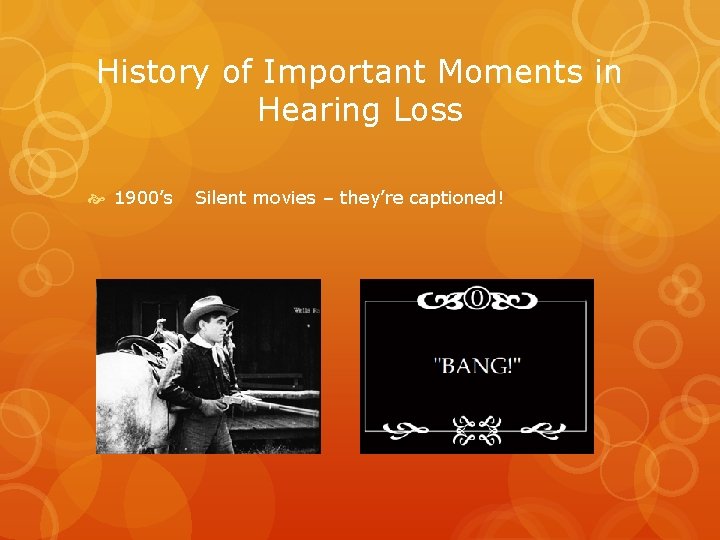
History of Important Moments in Hearing Loss 1900’s Silent movies – they’re captioned!
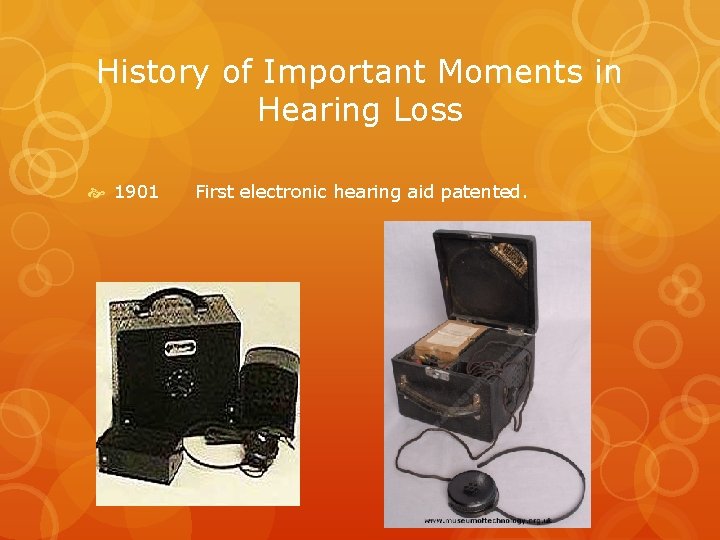
History of Important Moments in Hearing Loss 1901 First electronic hearing aid patented.
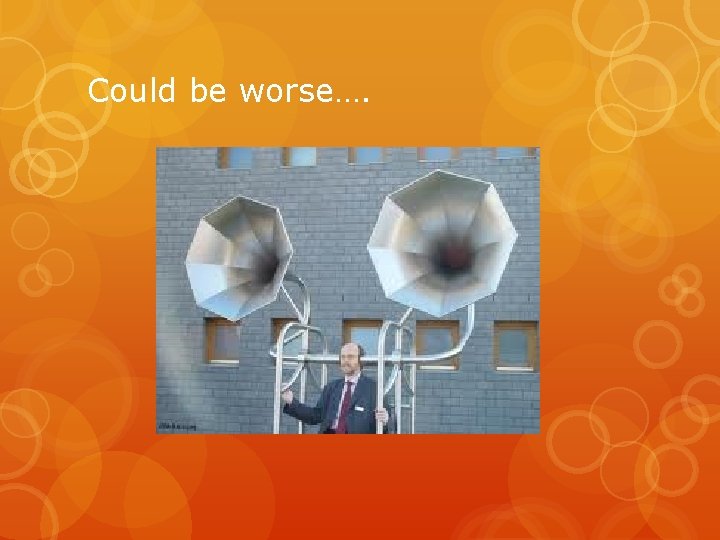
Could be worse….
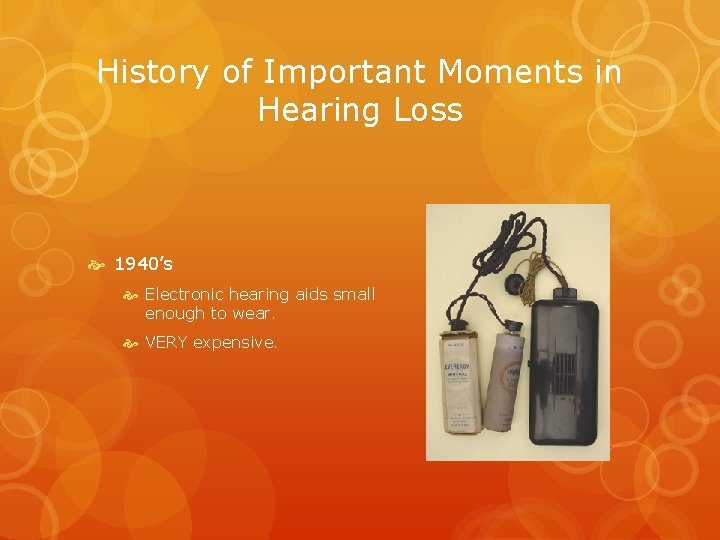
History of Important Moments in Hearing Loss 1940’s Electronic hearing aids small enough to wear. VERY expensive.
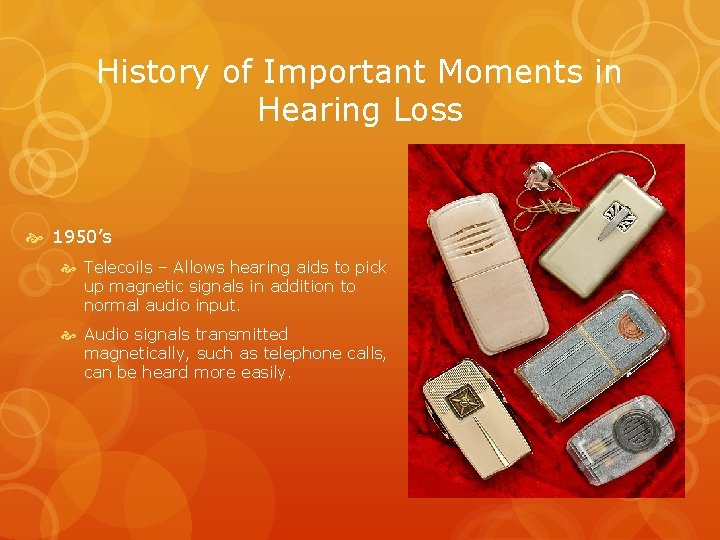
History of Important Moments in Hearing Loss 1950’s Telecoils – Allows hearing aids to pick up magnetic signals in addition to normal audio input. Audio signals transmitted magnetically, such as telephone calls, can be heard more easily.
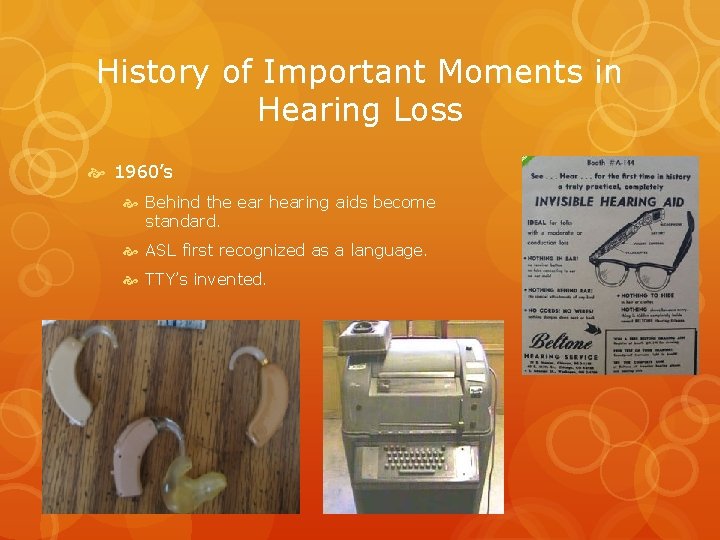
History of Important Moments in Hearing Loss 1960’s Behind the ear hearing aids become standard. ASL first recognized as a language. TTY’s invented.
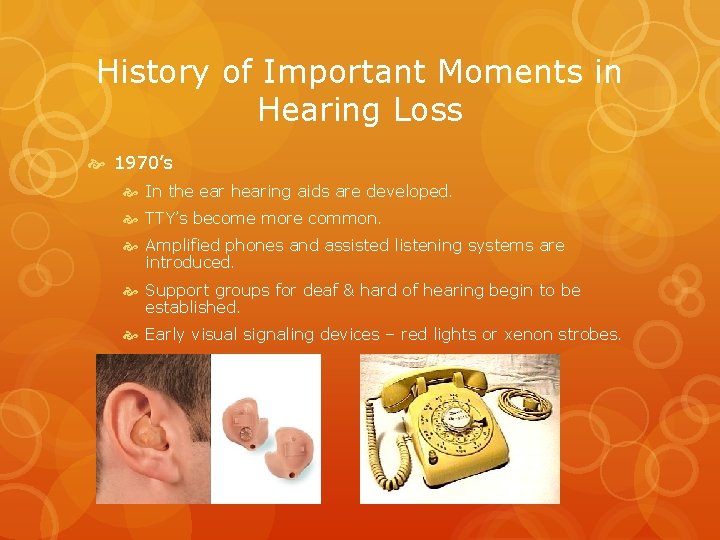
History of Important Moments in Hearing Loss 1970’s In the ear hearing aids are developed. TTY’s become more common. Amplified phones and assisted listening systems are introduced. Support groups for deaf & hard of hearing begin to be established. Early visual signaling devices – red lights or xenon strobes.
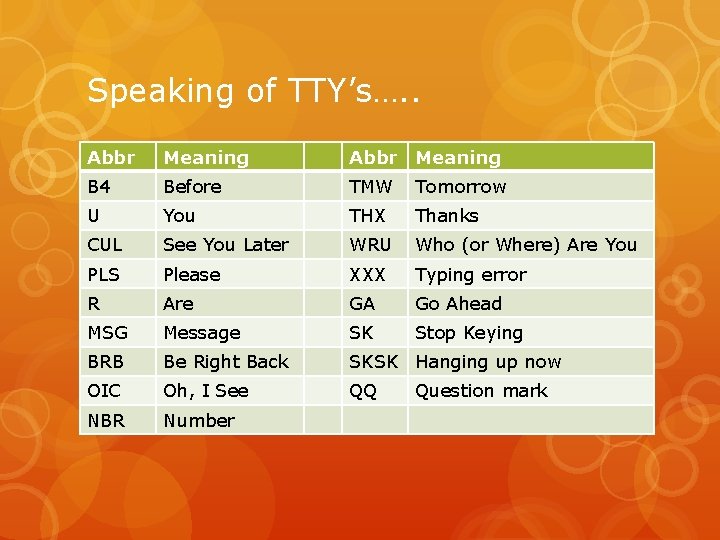
Speaking of TTY’s…. . Abbr Meaning B 4 Before TMW Tomorrow U You THX Thanks CUL See You Later WRU Who (or Where) Are You PLS Please XXX Typing error R Are GA Go Ahead MSG Message SK Stop Keying BRB Be Right Back SKSK Hanging up now OIC Oh, I See QQ NBR Number Question mark
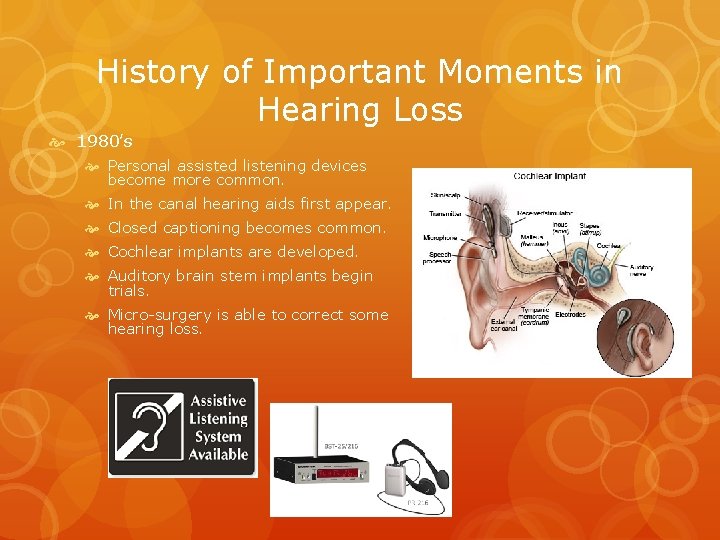
History of Important Moments in Hearing Loss 1980’s Personal assisted listening devices become more common. In the canal hearing aids first appear. Closed captioning becomes common. Cochlear implants are developed. Auditory brain stem implants begin trials. Micro-surgery is able to correct some hearing loss.
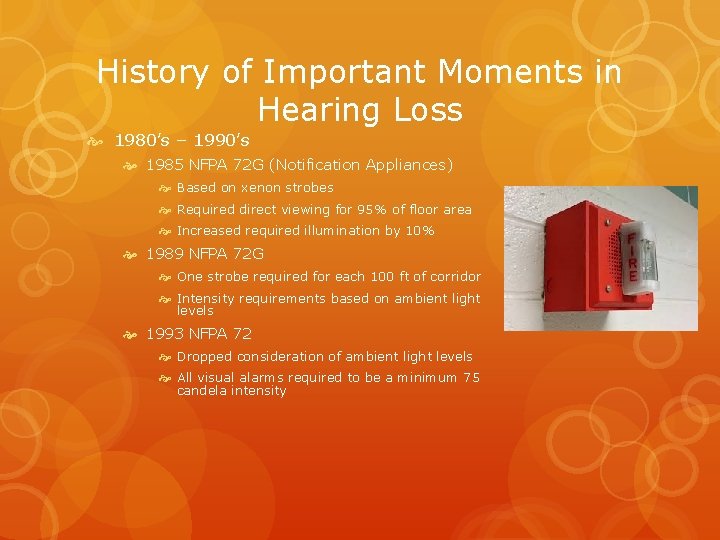
History of Important Moments in Hearing Loss 1980’s – 1990’s 1985 NFPA 72 G (Notification Appliances) Based on xenon strobes Required direct viewing for 95% of floor area Increased required illumination by 10% 1989 NFPA 72 G One strobe required for each 100 ft of corridor Intensity requirements based on ambient light levels 1993 NFPA 72 Dropped consideration of ambient light levels All visual alarms required to be a minimum 75 candela intensity
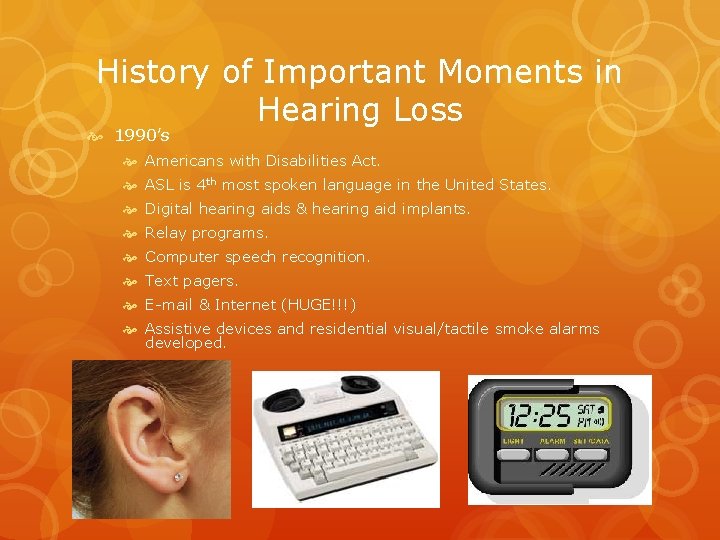
History of Important Moments in Hearing Loss 1990’s Americans with Disabilities Act. ASL is 4 th most spoken language in the United States. Digital hearing aids & hearing aid implants. Relay programs. Computer speech recognition. Text pagers. E-mail & Internet (HUGE!!!) Assistive devices and residential visual/tactile smoke alarms developed.
Whoa, wait!! Residential smoke alarms for the deaf and hard of hearing were developed in the 1990’s! Residential smoke alarms for the hearing population were developed in the 1970’s! Yes, technology for the deaf and hard of hearing is running about 20 YEARS behind the mainstream!
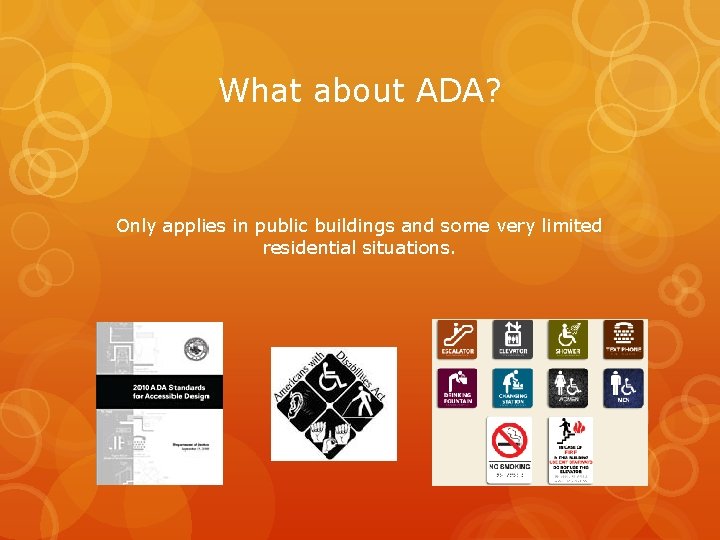
What about ADA? Only applies in public buildings and some very limited residential situations.
Fair Housing Act It shall be unlawful for any person to refuse to permit, at the expense of a handicapped person, reasonable modifications of existing premises, occupied or to be occupied by a handicapped person, if the proposed modifications may be necessary to afford the handicapped person full enjoyment of the premises of a dwelling. In the case of a rental, the landlord may, where it is reasonable to do so, condition permission for a modification on the renter agreeing to restore the interior of the premises to the condition that existed before the modification, reasonable wear and tear excepted. 24 C. F. R. § 100. 203
Public Housing Public housing projects have even greater obligations to tenants with disabilities. Landlords in housing projects that receive any funding from the Section 8 housing program or other programs of the U. S. Department of Housing and Urban Development (HUD) must pay for the installation of flashing doorbells and visual notification systems and other modifications. Qualified interpreters must be provided when necessary for effective communication. 24 C. F. R. § 8. 6.
So what is the problem? Lack of statistics. The US Census has not tracked those who are deaf or hard of hearing since 1930. The last census of the U. S. deaf population was privately conducted in 1971 and was sponsored by the National Association of the Deaf. Current statistics are ESTIMATES from a variety of sources.
So what is the problem? Gallaudet Research Institute estimates 13% of the US population (over 38 million people) have some form of hearing loss. The Hearing Loss Association of America places their estimate at 20%, or 48 million Americans. The 2012 American Community Survey (part of the US Census Bureau) estimates 10. 5 million Americans have a “hearing difficulty”. Another 14 million are said to have a “cognitive difficulty”. The “Fire Safe & Sound” fact sheet from USFA listed 11 million Americans in 2006 – another edition listed 28 million.
So what is the problem? The fire service is not tracking statistics for incidents involving those who are deaf or hard of hearing. “Human Factors” – Physically disabled, doesn’t specify type. “Detector Type” – No option to enter visual, tactile, or low frequency alarms.
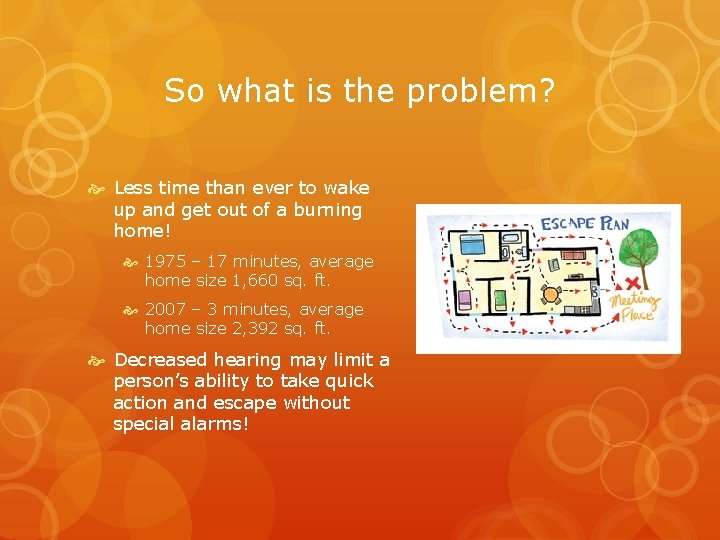
So what is the problem? Less time than ever to wake up and get out of a burning home! 1975 – 17 minutes, average home size 1, 660 sq. ft. 2007 – 3 minutes, average home size 2, 392 sq. ft. Decreased hearing may limit a person’s ability to take quick action and escape without special alarms!
So what is the problem? Research into fire risks and notification appliances for the deaf and hard of hearing has only been going on since the early 1990’s!
Research 1990 – Nober, Well, & Moss – Fire Journal – Smoke Alarms for the Hearing Impaired. 1991 – UL – Emergency Signaling Devices for Use by the Hearing Impaired 1998 – Fire Reform Center (AU) – Arousal From Sleep With A Smoke Detector in Children and Adults 1999 – USFA – Fire Risks for the Deaf or Hard of Hearing 2004 - CPSC – A Review of the Sound Effectiveness of Residential Smoke Alarms 2005 – Gallaudet University – Waking Effectiveness of Audible, Visual, and Vibratory Emergency Alarms on People of All Hearing Abilities 2005 – NIH – Smoke Detector Alert for the Deaf 2007 – NFPA/Victoria University (AU) – Optimizing Fire Alarm Notification for High Risk Groups
Summary of Research Results 1991 – The UL study first used 110 hearing able UL employees who were given headphones to simulate deafness. 92% could perceive the strobe light with their eyes closed. The next part of the study used 101 deaf persons between the ages of 10 and 65. A strobe was placed on a 7 ft tall pole at the end of the room opposite the foot of the bed. The subject was said to be successfully awakened if they perceived the alarm within 4 minutes of activation. According to the study, 88% of the subjects were able to perceive the 110 cd strobe.
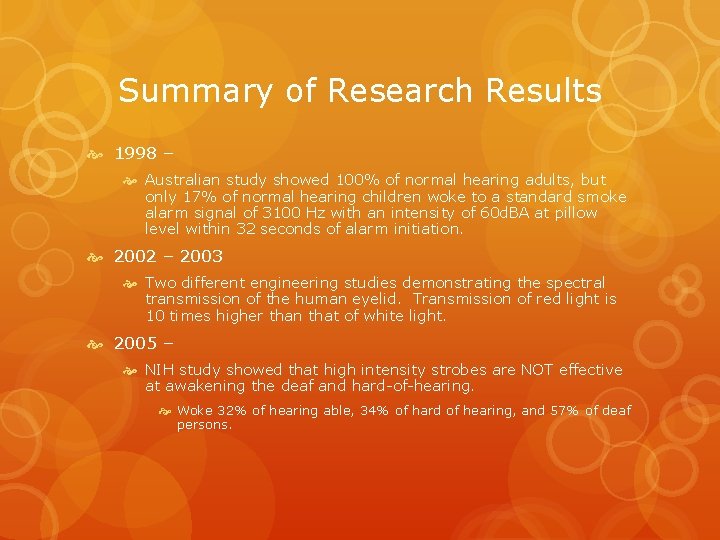
Summary of Research Results 1998 – Australian study showed 100% of normal hearing adults, but only 17% of normal hearing children woke to a standard smoke alarm signal of 3100 Hz with an intensity of 60 d. BA at pillow level within 32 seconds of alarm initiation. 2002 – 2003 Two different engineering studies demonstrating the spectral transmission of the human eyelid. Transmission of red light is 10 times higher than that of white light. 2005 – NIH study showed that high intensity strobes are NOT effective at awakening the deaf and hard-of-hearing. Woke 32% of hearing able, 34% of hard of hearing, and 57% of deaf persons.
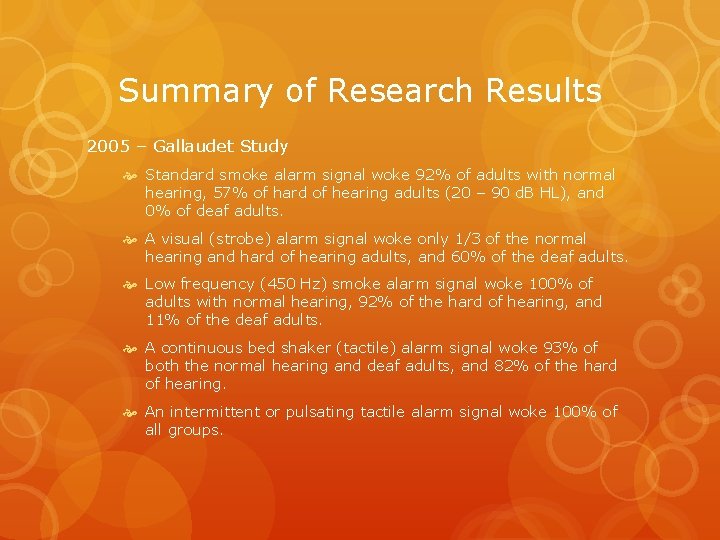
Summary of Research Results 2005 – Gallaudet Study Standard smoke alarm signal woke 92% of adults with normal hearing, 57% of hard of hearing adults (20 – 90 d. B HL), and 0% of deaf adults. A visual (strobe) alarm signal woke only 1/3 of the normal hearing and hard of hearing adults, and 60% of the deaf adults. Low frequency (450 Hz) smoke alarm signal woke 100% of adults with normal hearing, 92% of the hard of hearing, and 11% of the deaf adults. A continuous bed shaker (tactile) alarm signal woke 93% of both the normal hearing and deaf adults, and 82% of the hard of hearing. An intermittent or pulsating tactile alarm signal woke 100% of all groups.
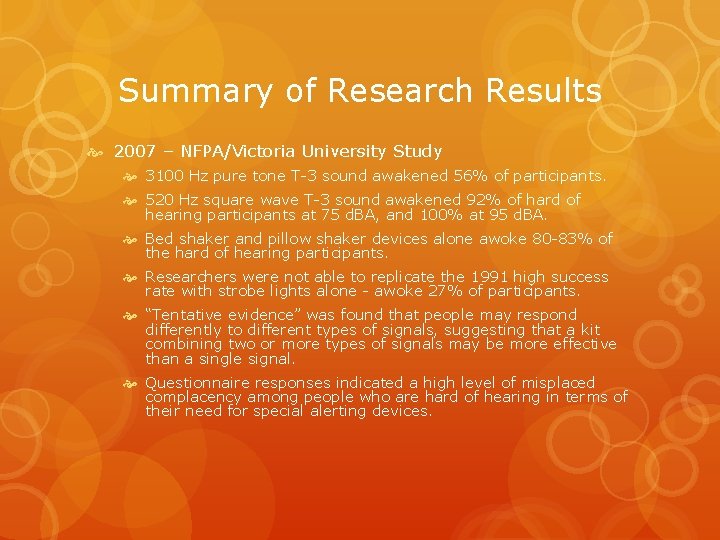
Summary of Research Results 2007 – NFPA/Victoria University Study 3100 Hz pure tone T-3 sound awakened 56% of participants. 520 Hz square wave T-3 sound awakened 92% of hard of hearing participants at 75 d. BA, and 100% at 95 d. BA. Bed shaker and pillow shaker devices alone awoke 80 -83% of the hard of hearing participants. Researchers were not able to replicate the 1991 high success rate with strobe lights alone - awoke 27% of participants. “Tentative evidence” was found that people may respond differently to different types of signals, suggesting that a kit combining two or more types of signals may be more effective than a single signal. Questionnaire responses indicated a high level of misplaced complacency among people who are hard of hearing in terms of their need for special alerting devices.
So, what happened? Education. USFA “Fire Safe and Sound” – A Fire Safety Factsheet for the Deaf and Hard of Hearing NFPA “Smoke Alarms for People who are Deaf or Hard of Hearing” 4 page guide and 1 page information sheet Oklahoma State University ABLE Tech DVD’s & Youtube videos Online & printed fire safety information ABLE Tech provides Assistive Technology (AT) through grants, loaning of devices, reuse and exchange programs, and assistance with purchase of AT.
So, what happened? Engineering & Enforcement 2009 International Fire Code Visual alarms are required in public and common areas of most buildings. Group I-1 (residential care over 16), R-1(hotel/motel), and R-4 (residential care 5 - 16) dwelling units or sleeping units shall be provided with a visible alarm notification appliance activated by both the in-room smoke alarm and the building fire alarm system. Group R-2 (apartments) that are required to have a fire alarm system must have visual alarms in common and public areas, but not required within individual dwelling units. 2010 OFC 907. 6. 2. 3. 4
Engineering & Enforcement 2013 NFPA 72 Section 18. 4. 5. 3 Effective Jan. 1, 2014, audible appliances provided for the sleeping areas to awaken occupants shall produce a low frequency alarm signal the complies with the following: 1) The alarm signal shall be a square wave or provide equivalent awakening ability. 2) The wave shall have a fundamental frequency of 520 Hz +/10 percent. This applies to new construction or substantial alteration, does not apply to existing construction or to single family dwellings. Visual appliances are still required to use a clear or white light. - spectral transmission of the human eyelid
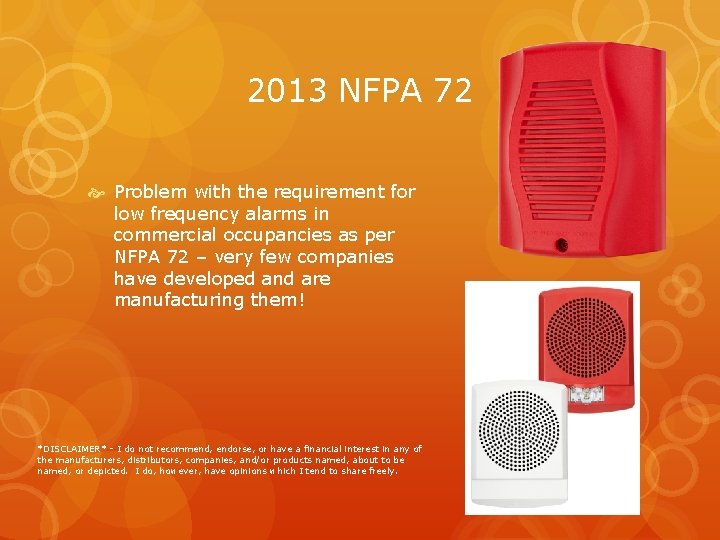
2013 NFPA 72 Problem with the requirement for low frequency alarms in commercial occupancies as per NFPA 72 – very few companies have developed and are manufacturing them! *DISCLAIMER* - I do not recommend, endorse, or have a financial interest in any of the manufacturers, distributors, companies, and/or products named, about to be named, or depicted. I do, however, have opinions which I tend to share freely.
2013 NFPA 72 Section 18. 5. 5. 7 Visible Notification Appliances in Sleeping Areas Greater than or equal to 24” from ceiling – 110 cd Less than 24” from ceiling – 177 cd If the linear dimension of the room exceeds 16 ft, a visible notification appliance must be within 16 ft of the pillow.
2013 NFPA 72 Section 18. 10 Tactile Notification Appliances Tactile appliances shall be permitted if used in addition to audible, or visible, or both notification appliances. Tactile appliances shall meet the performance requirements of ANSI/UL 1971, Standard for Signaling Devices for the Hearing Impaired, or equivalent.
Engineering & Enforcement Oregon Revised Statute 479. 255 Smoke alarm or smoke detector required in certain structures; alarms and devices for persons who are hard of hearing. (1) Every dwelling unit regulated under ORS chapter 90, every lodging house and every hotel guest room shall contain an approved and properly functioning smoke alarm or smoke detector, installed in accordance with the state building code and rules of the State Fire Marshal. (2) A hotel shall provide no fewer than one smoke alarm for persons who are hard of hearing and one door knock device for each 75, or fraction thereof, rooms of the hotel that are regularly used for sleeping. (3) If a person renting a room in a hotel requests a room with a smoke detector or a smoke alarm for persons who are hard of hearing and a door knock device, the landlord shall: (a) Install a portable smoke alarm for persons who are hard of hearing and a door knock device; or (b) Provide the person with a room in which a smoke detector or smoke alarm for persons who are hard of hearing and a door knock device have been permanently installed. (4) The landlord may require a guest to pay a refundable deposit if the landlord provides the smoke alarm for persons who are hard of hearing under subsection (3)(a) of this section. (5) A hotel shall provide a printed notice of the requirements of subsection (3) of this section, posted conspicuously at the place of registration or in each guest room.
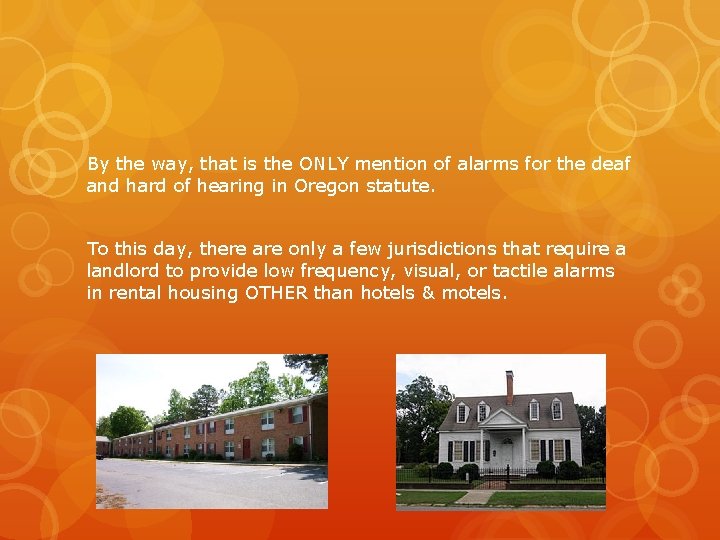
By the way, that is the ONLY mention of alarms for the deaf and hard of hearing in Oregon statute. To this day, there are only a few jurisdictions that require a landlord to provide low frequency, visual, or tactile alarms in rental housing OTHER than hotels & motels.
A few laws on the books…. Maryland - On written request of a tenant who is deaf or hearing impaired, the landlord must provide a smoke detector that, when activated, provides a signal that is sufficient to warn the deaf or hearing impaired tenant. A landlord may require reimbursement from a tenant for the cost of a smoke alarm required under this section. (2013) Virginia - Landlords shall notify deaf or hearing-impaired tenants of the availability of special smoke detectors. New tenants shall be asked, in writing, at the time of rental, whether visual smoke detectors will be needed. Upon request, the landlord or proprietor shall provide visual smoke detectors, which have an effective intensity of not less than 100 candela. (2007) Texas - Texas deaf or hard of hearing renters and/or occupants of a multi-family residence may request a visual smoke alarm. Landlords must purchase and install, within a reasonable amount of time and at no cost to the renters, visual smoke alarms in the bedrooms where a deaf or hard of hearing person will be sleeping. (2010)
Washington Law RC 43. 44. 110 – Smoke detection devices in dwelling units (1) Smoke detection devices shall be installed inside all dwelling units: (a) Occupied by persons other than the owner on and after December 31, 1981; or (b) Built or manufactured in this state after December 31, 1980. (2) The smoke detection devices shall be designed, manufactured, and installed inside dwelling units in conformance with: (a) Nationally accepted standards; and (b) As provided by the administrative procedure act, chapter 34. 05 RCW, rules and regulations promulgated by the chief of the Washington state patrol, through the director of fire protection. (3) Installation of smoke detection devices shall be the responsibility of the owner. Maintenance of smoke detection devices, including the replacement of batteries where required for the properation of the smoke detection device, shall be the responsibility of the tenant, who shall maintain the device as specified by the manufacturer. At the time of a vacancy, the owner shall insure that the smoke detection device is operational prior to the reoccupancy of the dwelling unit. (4) Any owner or tenant failing to comply with this section shall be punished by a fine of not more than two hundred dollars. (5) For the purposes of this section: (a) "Dwelling unit" means a single unit providing complete, independent living facilities for one or more persons including permanent provisions for living, sleeping, eating, cooking, and sanitation; and (b) "Smoke detection device" means an assembly incorporating in one unit a device which detects visible or invisible particles of combustion, the control equipment, and the alarm-sounding device, operated from a power supply either in the unit or obtained at the point of installation.
Washington Office of the Deaf and Hard of Hearing According to the 2012 -13 Washington State Directory of Services for People Who are Deaf, Hard of Hearing, and Deaf-Blind, “approximately 262, 481 individuals who are deaf and hard of hearing live in the state of Washington. ” The ODHH maintains a website with a comprehensive list of services available here: http: //www. dshs. wa. gov/odhh (to be perfectly honest, it’s WAY better than Oregon’s ODHHS website)
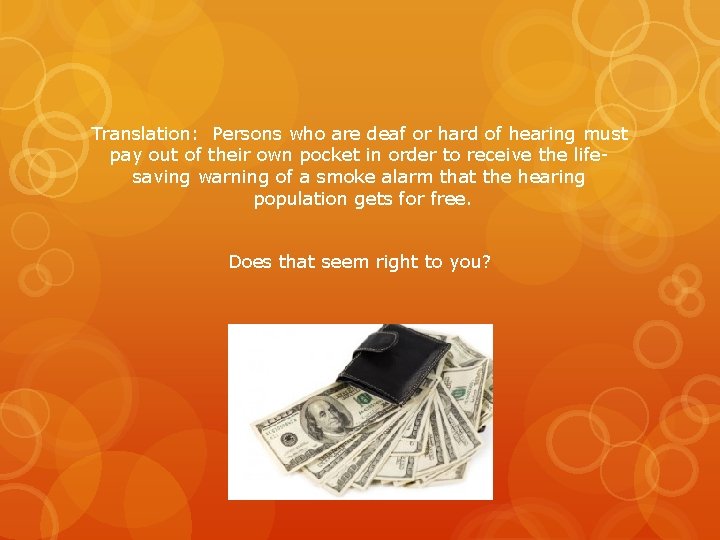
Translation: Persons who are deaf or hard of hearing must pay out of their own pocket in order to receive the lifesaving warning of a smoke alarm that the hearing population gets for free. Does that seem right to you?
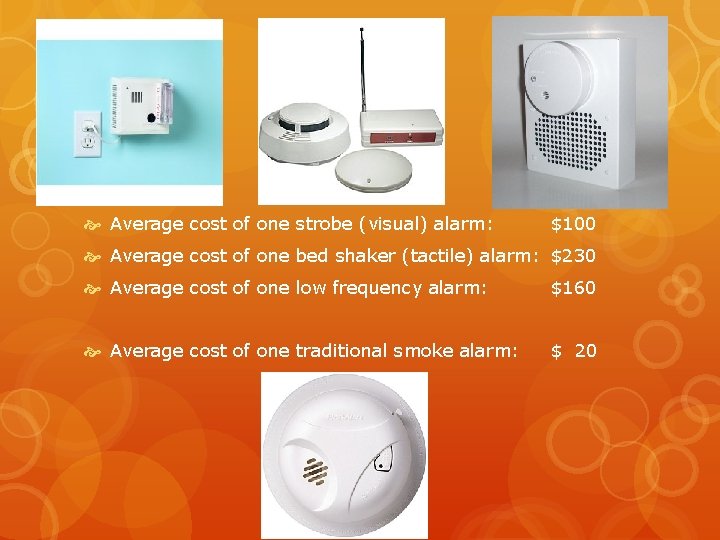
Average cost of one strobe (visual) alarm: $100 Average cost of one bed shaker (tactile) alarm: $230 Average cost of one low frequency alarm: $160 Average cost of one traditional smoke alarm: $ 20
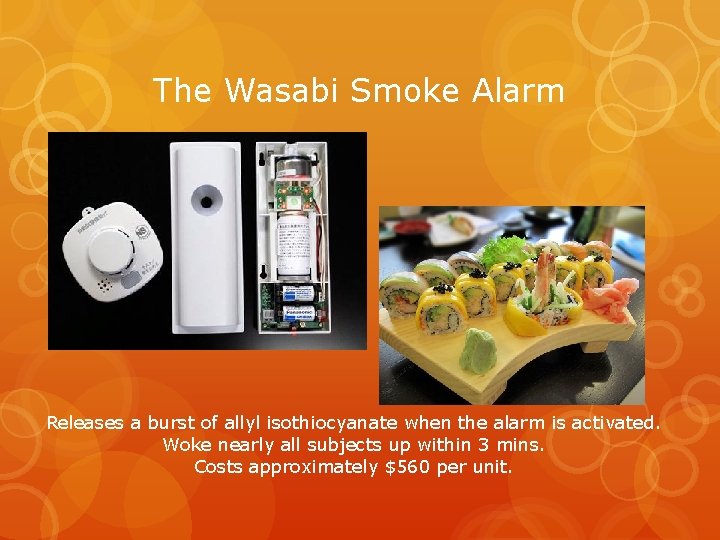
The Wasabi Smoke Alarm Releases a burst of allyl isothiocyanate when the alarm is activated. Woke nearly all subjects up within 3 mins. Costs approximately $560 per unit.
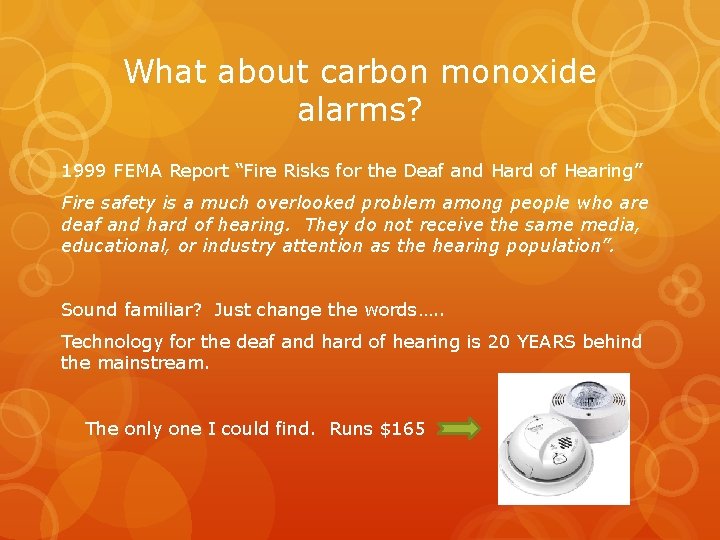
What about carbon monoxide alarms? 1999 FEMA Report “Fire Risks for the Deaf and Hard of Hearing” Fire safety is a much overlooked problem among people who are deaf and hard of hearing. They do not receive the same media, educational, or industry attention as the hearing population”. Sound familiar? Just change the words…. . Technology for the deaf and hard of hearing is 20 YEARS behind the mainstream. The only one I could find. Runs $165
So, what CAN we do right now?
The Oklahoma Model Pioneers in fire safety for those with disabilities. Oklahoma ABLE Tech is the statewide Assistive Technology Act Program located at Oklahoma State University. ABLE Tech's mission is to improve access to and acquisition of assistive technology (AT) for individuals with disabilities of all ages. A tremendous variety of AT and resources are available today. Fire safety videos and printed information for both children and adults are available at no charge. The videos, which are on You. Tube as well are closed captioned and in ASL. In 2013, they received a $205, 132 grant from FEMA to implement the Solutions 2013 Smoke Alarm Project. Persons residing within the 16 -county service area can receive visual, tactile, or low frequency alarms at no cost.
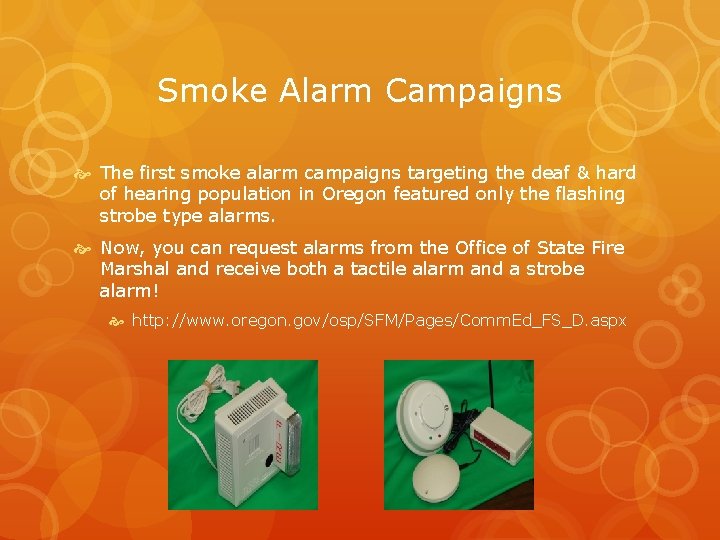
Smoke Alarm Campaigns The first smoke alarm campaigns targeting the deaf & hard of hearing population in Oregon featured only the flashing strobe type alarms. Now, you can request alarms from the Office of State Fire Marshal and receive both a tactile alarm and a strobe alarm! http: //www. oregon. gov/osp/SFM/Pages/Comm. Ed_FS_D. aspx
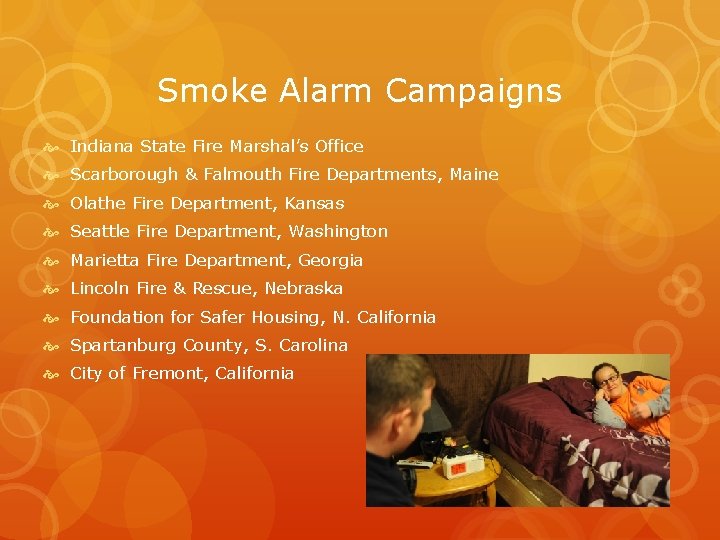
Smoke Alarm Campaigns Indiana State Fire Marshal’s Office Scarborough & Falmouth Fire Departments, Maine Olathe Fire Department, Kansas Seattle Fire Department, Washington Marietta Fire Department, Georgia Lincoln Fire & Rescue, Nebraska Foundation for Safer Housing, N. California Spartanburg County, S. Carolina City of Fremont, California
Palm Beach County Fire & Rescue July, 2011 through April 2012 Palm Beach County, FL 400, 000 seniors over the age of 60 Of that group, 155, 540 have some degree of hearing loss, and 16, 000 are “profoundly deaf”. PBCFR obtained a grant and installed 650 alarms/notification devices. Application process based on income, level of hearing loss, age of the dwelling, and number of people with disabilities in the home. Homes with children who had profound hearing loss were prioritized. Scripts for videos in ASL were written and filmed with the president of the Florida Association of the Deaf. Installation completed by teams using print forms as well as laptops/i. Pads with videos in ASL explaining the program.
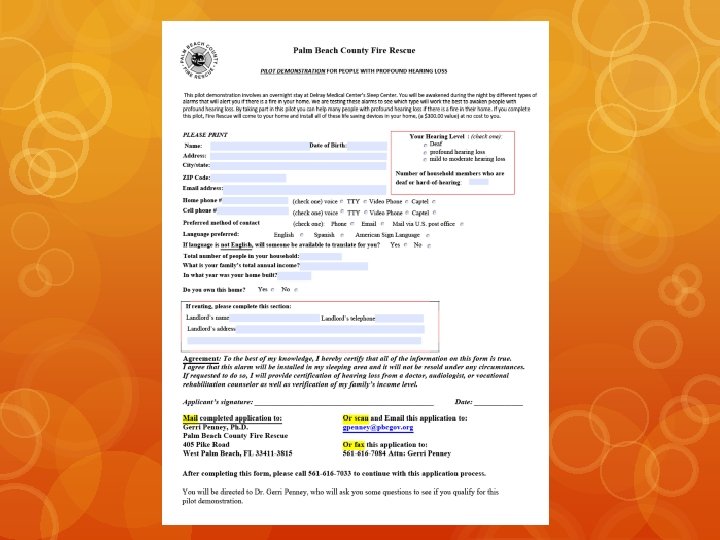
Palm Beach County Fire & Rescue Pilot Demonstration Project 50 people with profound hearing loss (averaging 90 d. B and above). Purpose is to see which type of alarm(s) would awaken them best in the event of a fire. Light (visual) Sound (low frequency) Movement (tactile) Participants were required to stay overnight in a sleep center, where they were awakened during the night by different types of alarms. All participants received alarms installed in their residence at no cost. Project results have not yet been published. No reply to e-mail request for information.
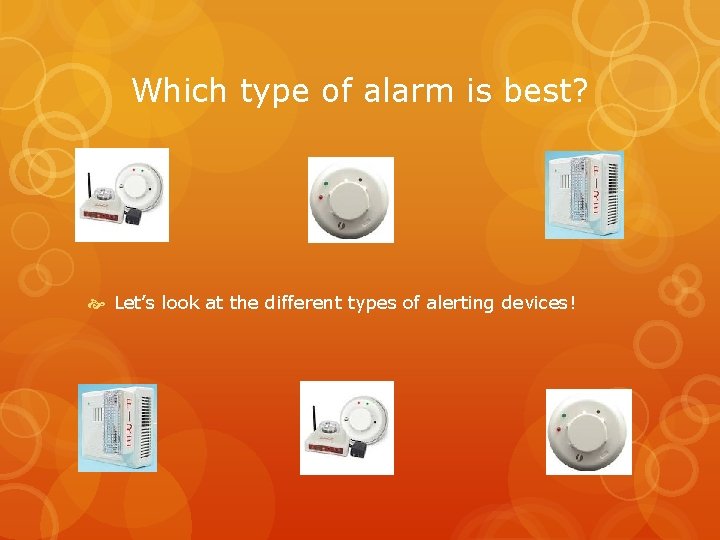
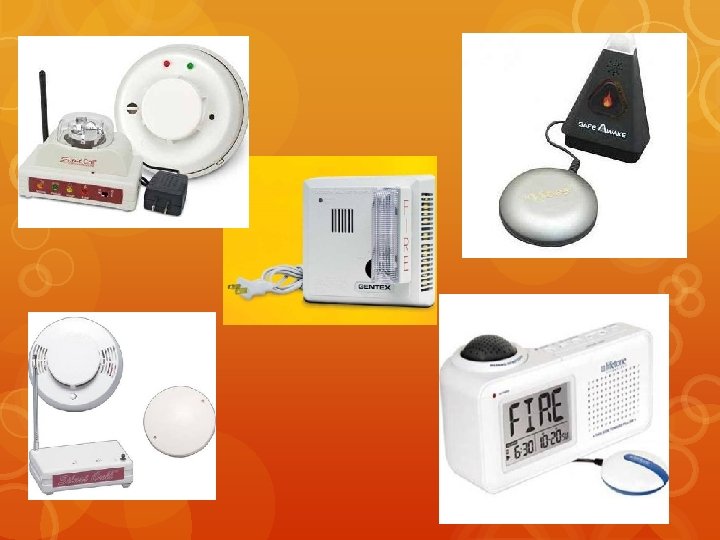
Which type of alarm is best? Let’s look at the different types of alerting devices!
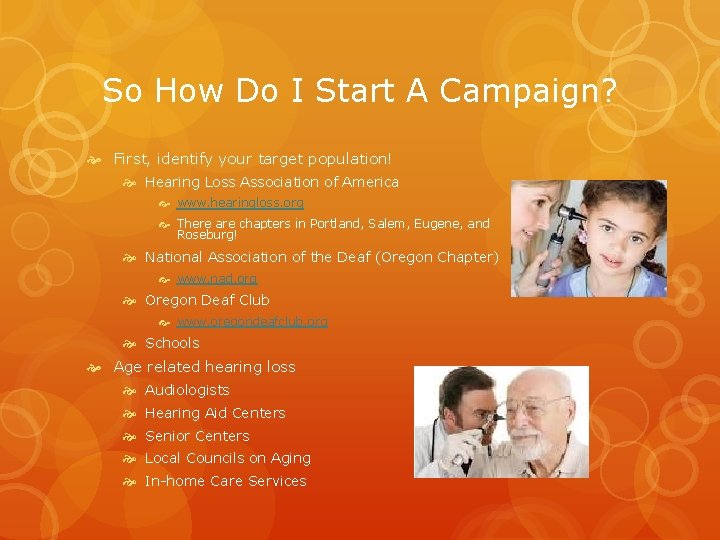
So How Do I Start A Campaign? First, identify your target population! Hearing Loss Association of America www. hearingloss. org There are chapters in Portland, Salem, Eugene, and Roseburg! National Association of the Deaf (Oregon Chapter) www. nad. org Oregon Deaf Club www. oregondeafclub. org Schools Age related hearing loss Audiologists Hearing Aid Centers Senior Centers Local Councils on Aging In-home Care Services
These same agencies also can make excellent community partners!!! Also local service and social clubs (the zoo groups). Other partners – Lowe’s, Home Depot, hardware stores, electrical contractors, even the alarm manufacturer’s themselves! To have a campaign, you really don’t have to reinvent the wheel. It can easily be incorporated into existing programs as a simply a new facet.
Starting Your Campaign Once you have identified your target population and have an idea of need, decide on the type and quantity of alarms you will need. Low frequency for hard of hearing. Combination of visual and tactile for either deaf or hard of hearing.
Starting Your Campaign The hard part – money. Donations from groups and community partners. Local service clubs are a great resource for this! Talk to the manufacturers of the alarms – you might be surprised! Grants Insurance companies FEMA Fire Prevention & Safety Grants
Starting Your Campaign Easiest – Add it on to an existing smoke alarm campaign. Target neighborhoods with large senior populations. Get the word out! Media releases Posters & flyers Social media
International Week of the Deaf is the last full week of September each year (Sept. 21 – 27) this year. Conveniently close to National Fire Prevention Week……
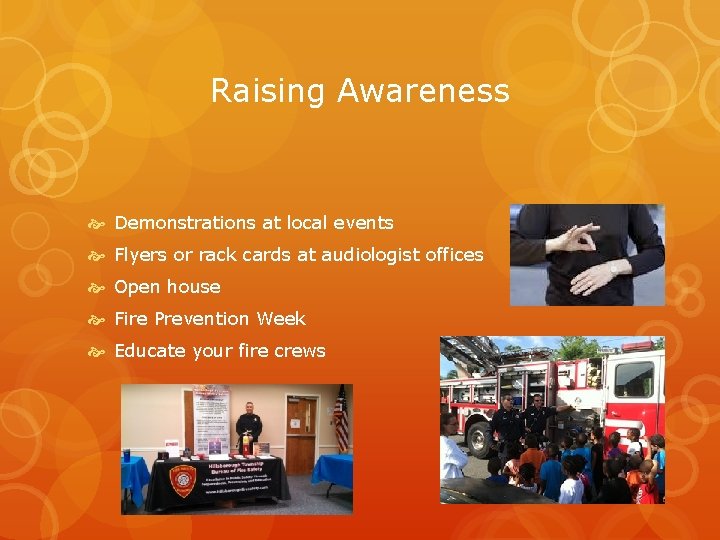
Raising Awareness Demonstrations at local events Flyers or rack cards at audiologist offices Open house Fire Prevention Week Educate your fire crews
Raising Awareness Very Important – Get the message out to the community! Public Service Announcements/Media Releases Consider use of social media – very heavily used by the deaf community. Almost everyone knows at least one person with hearing loss. It’s one of those things people “just don’t think of” – until we get them to think about it.
Did you know? A deaf or hard of hearing person can only read about 30% of the English language on lips. Most children who do not sign do well in English, but don’t really understand the meaning of words. Asking “do you read lips? ” to a deaf or hard of hearing person is very insulting. Instead, ask “how can we communicate? ” Deaf and hard of hearing people keenly watch people’s behaviors to learn about them and what’s happening in a situation. American Sign Language (ASL) is the primary language for the deaf and hard of hearing population, but it is only a recognized language in 20 of the 50 states.
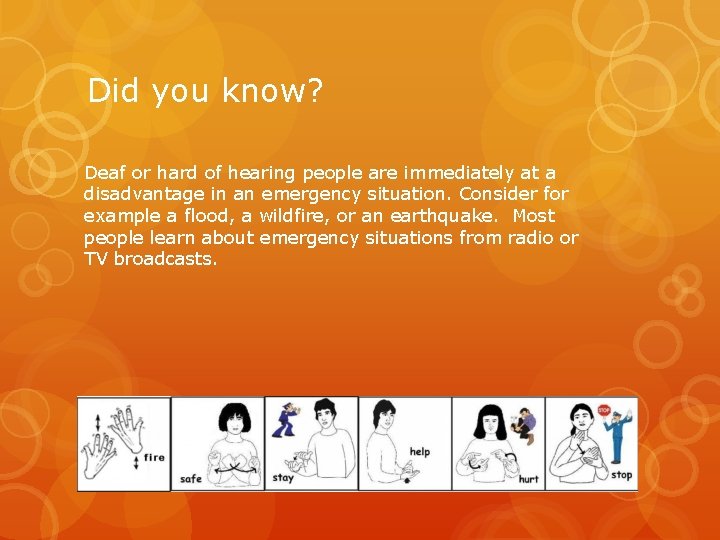
Did you know? Deaf or hard of hearing people are immediately at a disadvantage in an emergency situation. Consider for example a flood, a wildfire, or an earthquake. Most people learn about emergency situations from radio or TV broadcasts.
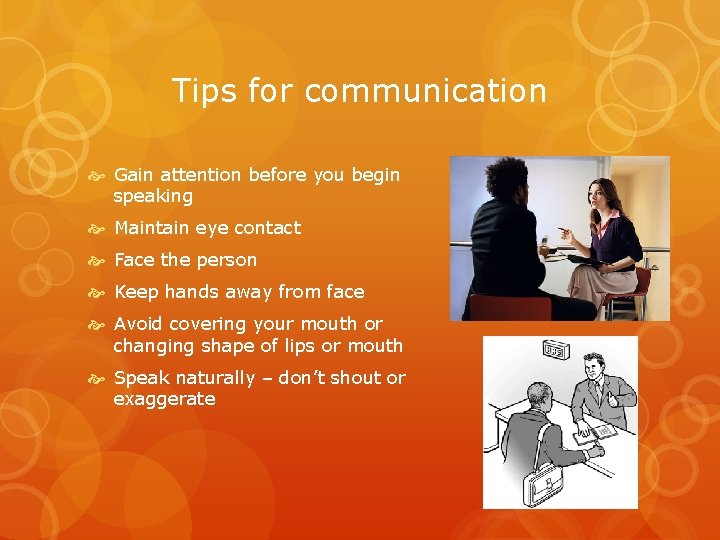
Tips for communication Gain attention before you begin speaking Maintain eye contact Face the person Keep hands away from face Avoid covering your mouth or changing shape of lips or mouth Speak naturally – don’t shout or exaggerate
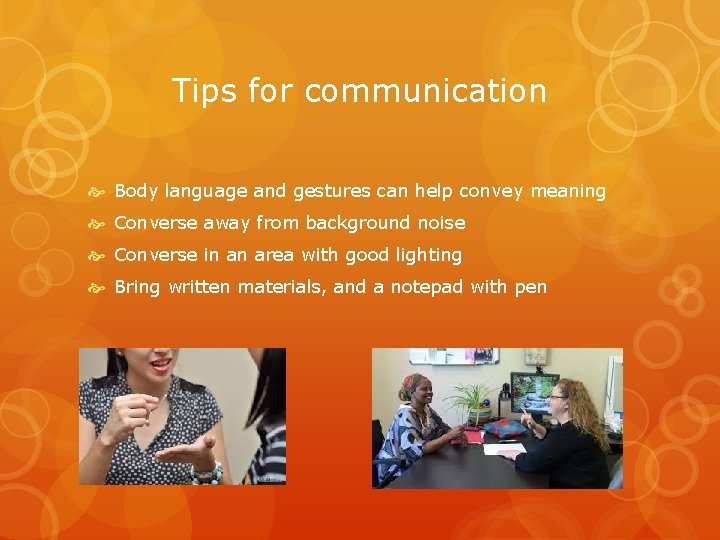
Tips for communication Body language and gestures can help convey meaning Converse away from background noise Converse in an area with good lighting Bring written materials, and a notepad with pen
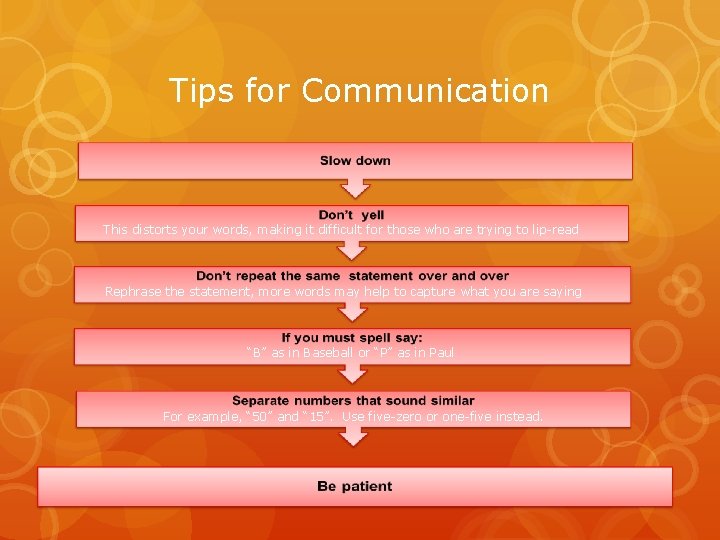
Tips for Communication This distorts your words, making it difficult for those who are trying to lip-read Rephrase the statement, more words may help to capture what you are saying “B” as in Baseball or “P” as in Paul For example, “ 50” and “ 15”. Use five-zero or one-five instead.
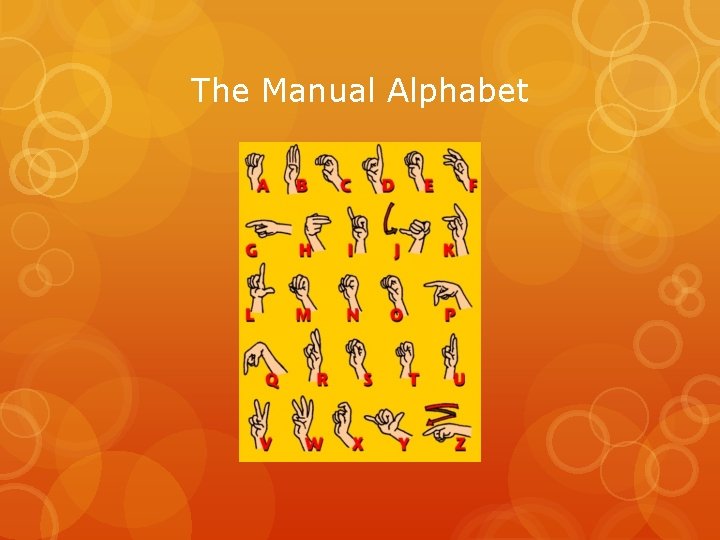
The Manual Alphabet

QUESTIONS? ?
THE END
- Slides: 73