
Over Lesson 12 2 Evaluate A B C

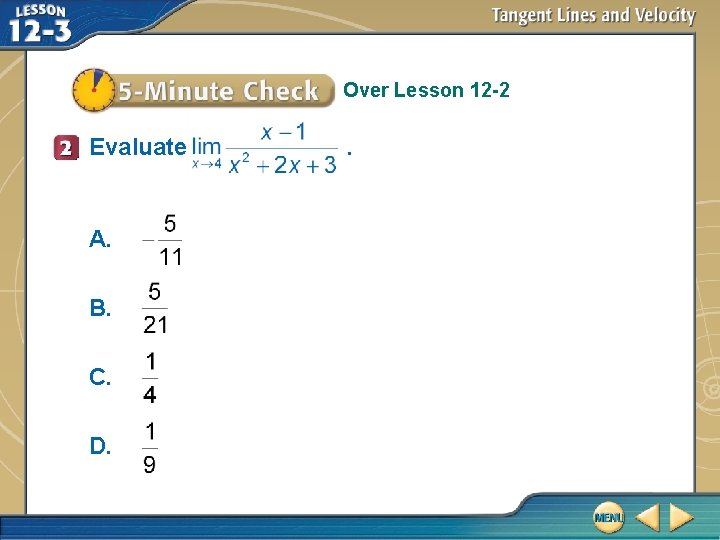
Over Lesson 12 -2 Evaluate A. B. C. D. .
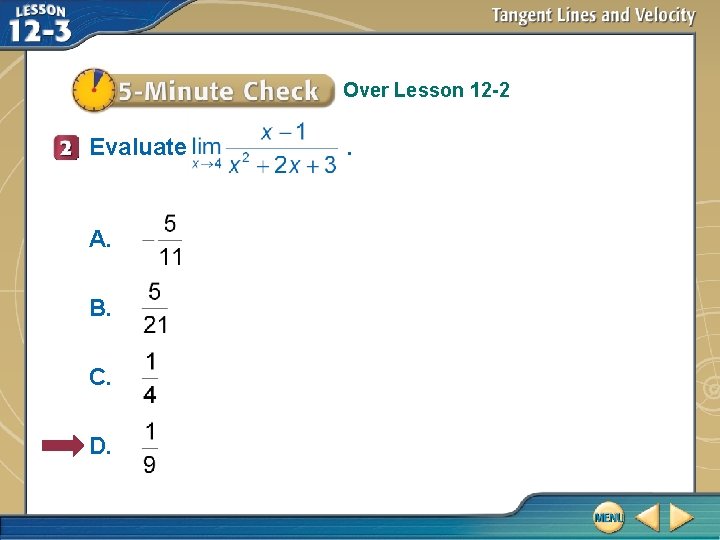
Over Lesson 12 -2 Evaluate A. B. C. D. .
You found average rates of change using secant lines. (Lesson 1 -4) • Find instantaneous rates of change by calculating slopes of tangent lines. • Find average and instantaneous velocity.
• tangent line • instantaneous rate of change • difference quotient • instantaneous velocity
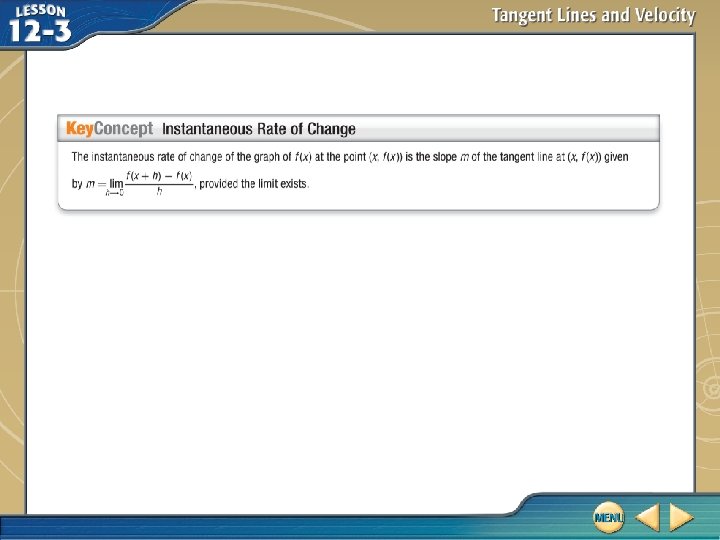
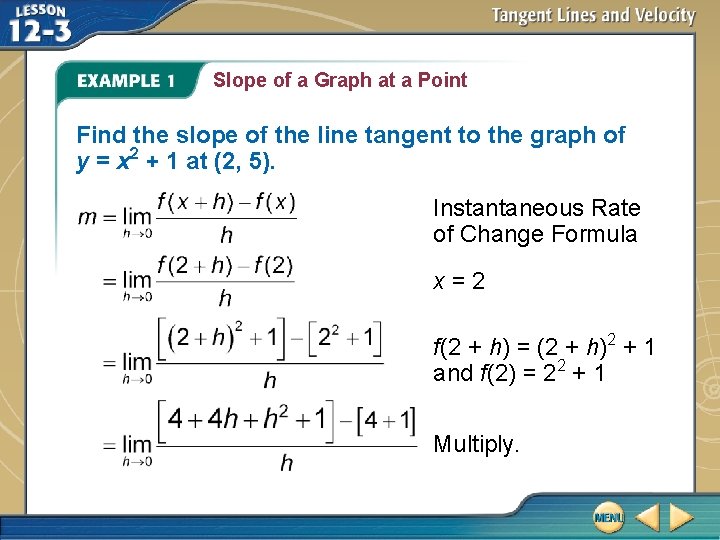
Slope of a Graph at a Point Find the slope of the line tangent to the graph of y = x 2 + 1 at (2, 5). Instantaneous Rate of Change Formula x=2 f(2 + h) = (2 + h)2 + 1 and f(2) = 22 + 1 Multiply.
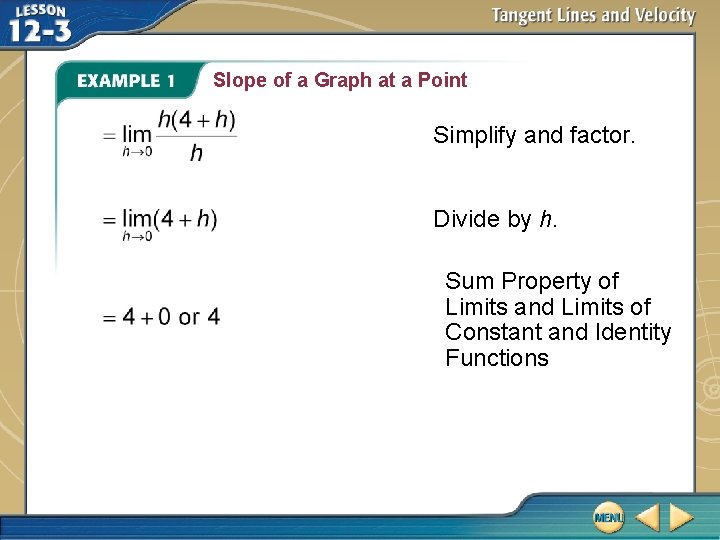
Slope of a Graph at a Point Simplify and factor. Divide by h. Sum Property of Limits and Limits of Constant and Identity Functions
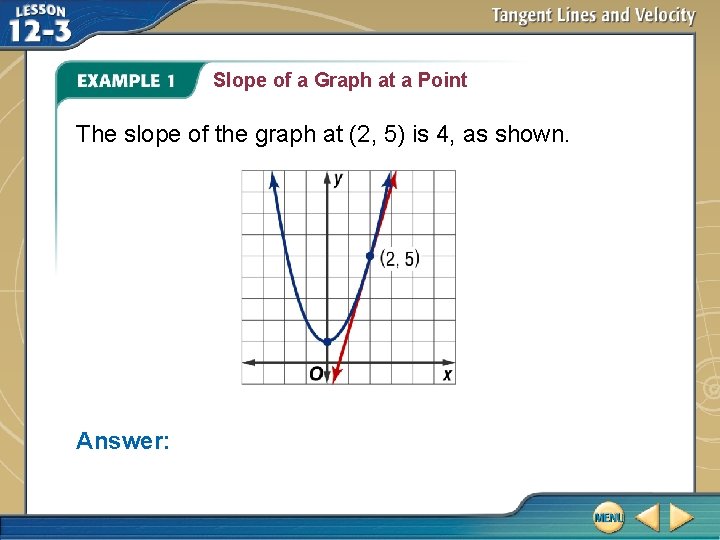
Slope of a Graph at a Point The slope of the graph at (2, 5) is 4, as shown. Answer:
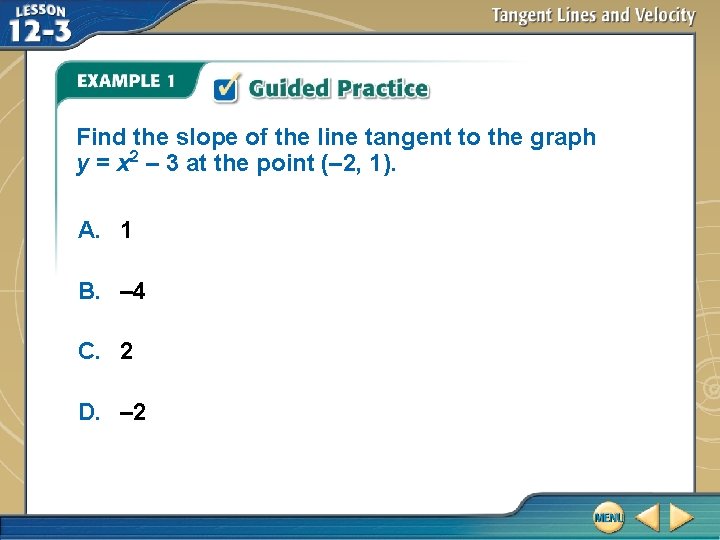
Find the slope of the line tangent to the graph y = x 2 – 3 at the point (– 2, 1). A. 1 B. – 4 C. 2 D. – 2
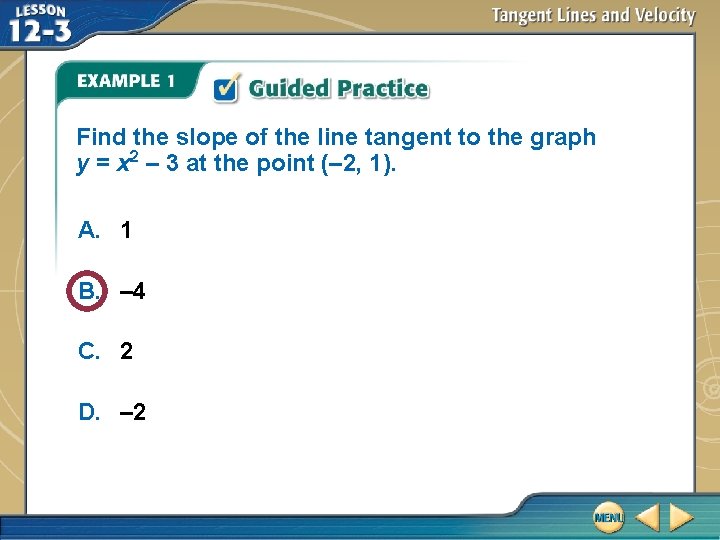
Find the slope of the line tangent to the graph y = x 2 – 3 at the point (– 2, 1). A. 1 B. – 4 C. 2 D. – 2
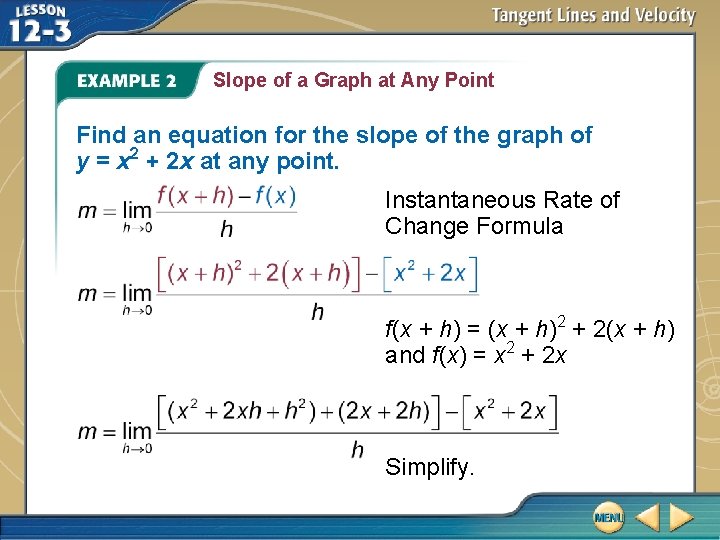
Slope of a Graph at Any Point Find an equation for the slope of the graph of y = x 2 + 2 x at any point. Instantaneous Rate of Change Formula f(x + h) = (x + h)2 + 2(x + h) and f(x) = x 2 + 2 x Simplify.
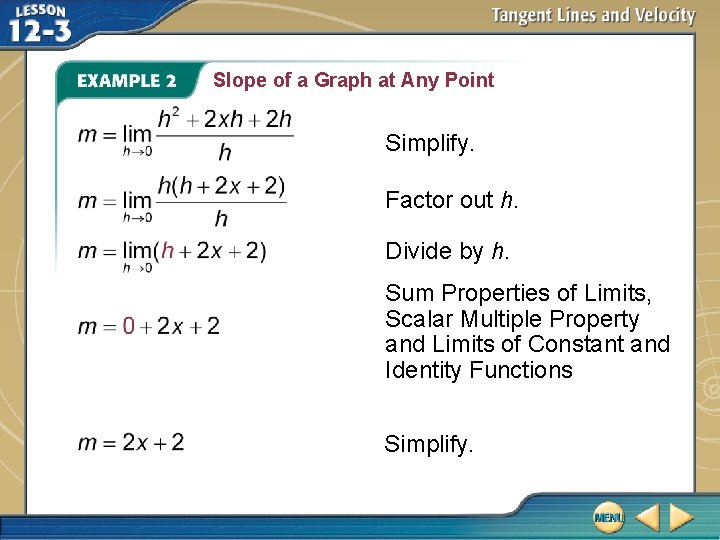
Slope of a Graph at Any Point Simplify. Factor out h. Divide by h. Sum Properties of Limits, Scalar Multiple Property and Limits of Constant and Identity Functions Simplify.
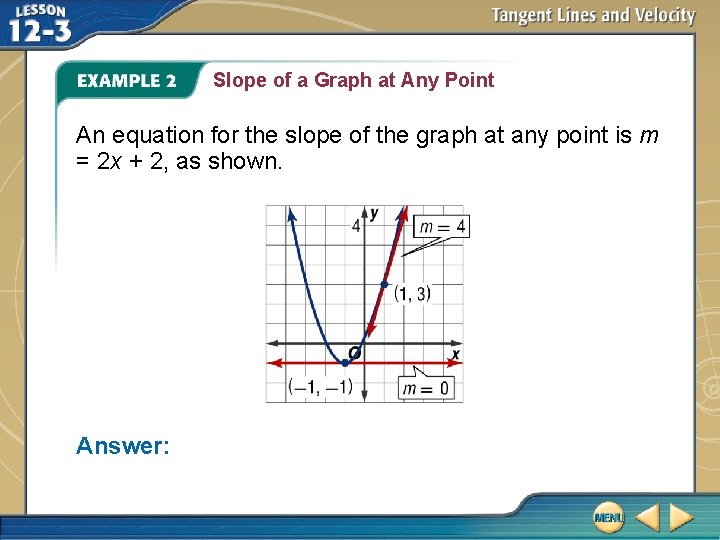
Slope of a Graph at Any Point An equation for the slope of the graph at any point is m = 2 x + 2, as shown. Answer:
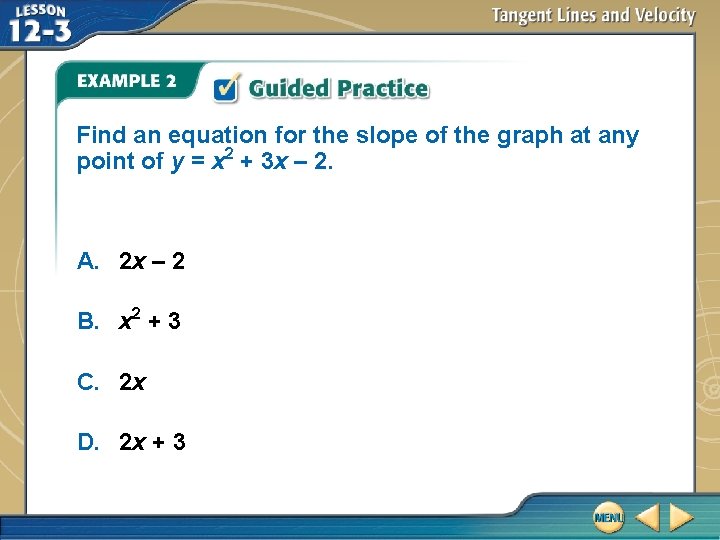
Find an equation for the slope of the graph at any point of y = x 2 + 3 x – 2. A. 2 x – 2 B. x 2 + 3 C. 2 x D. 2 x + 3
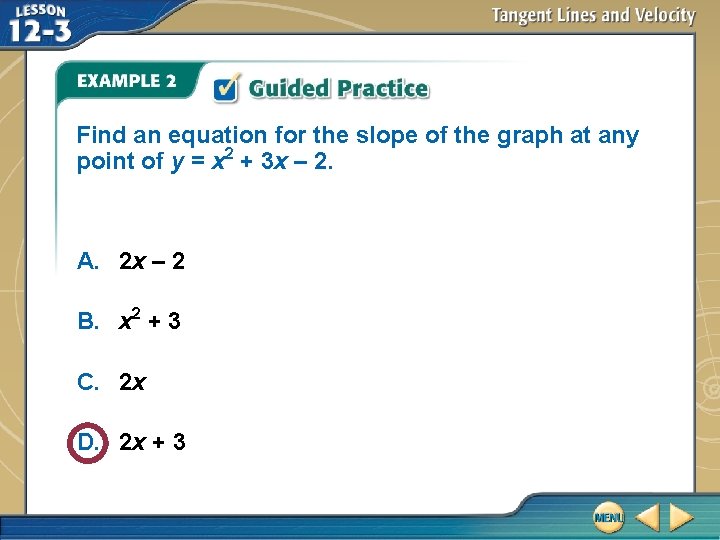
Find an equation for the slope of the graph at any point of y = x 2 + 3 x – 2. A. 2 x – 2 B. x 2 + 3 C. 2 x D. 2 x + 3
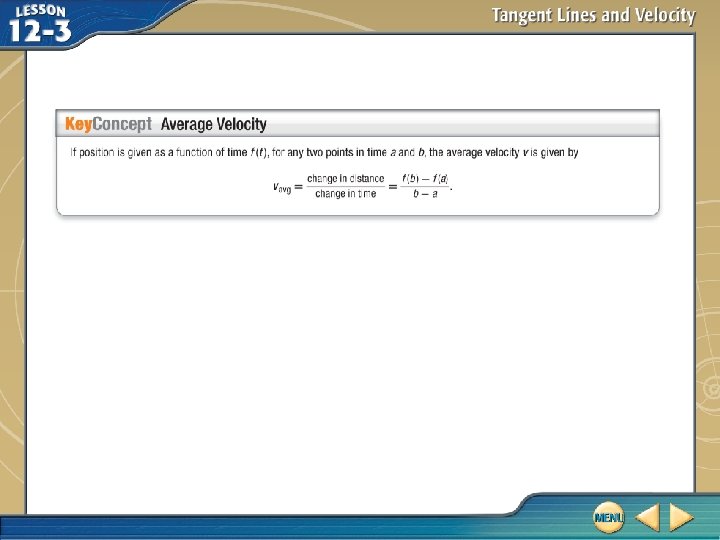
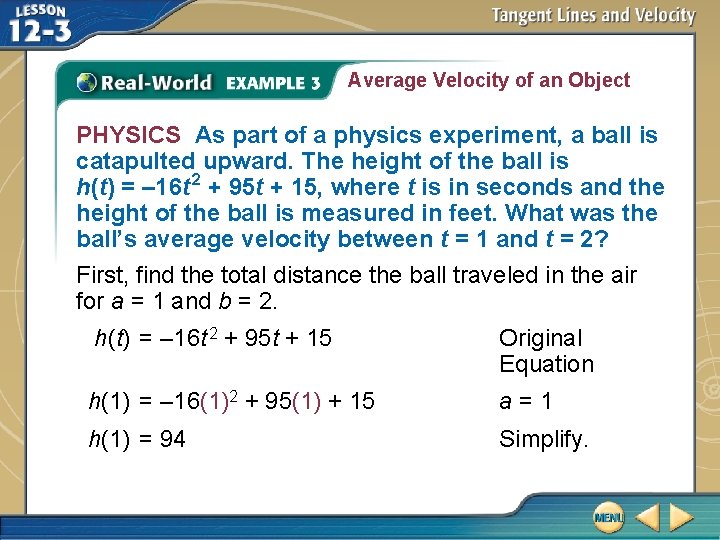
Average Velocity of an Object PHYSICS As part of a physics experiment, a ball is catapulted upward. The height of the ball is h(t) = – 16 t 2 + 95 t + 15, where t is in seconds and the height of the ball is measured in feet. What was the ball’s average velocity between t = 1 and t = 2? First, find the total distance the ball traveled in the air for a = 1 and b = 2. h(t) = – 16 t 2 + 95 t + 15 Original Equation h(1) = – 16(1)2 + 95(1) + 15 a=1 h(1) = 94 Simplify.
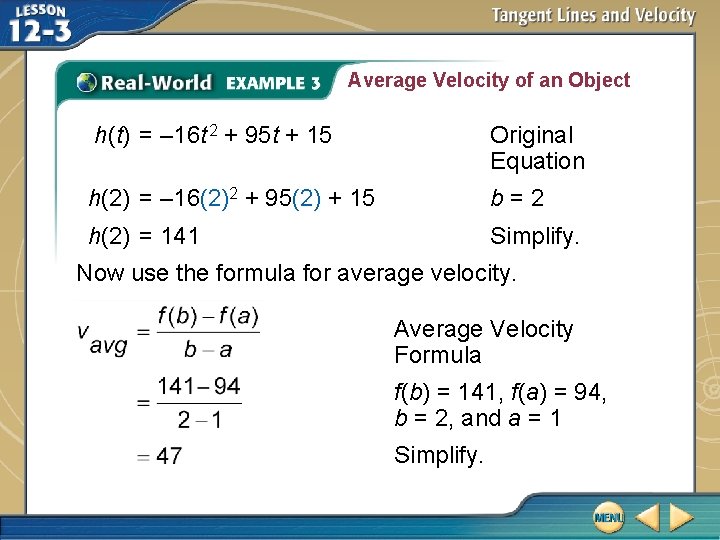
Average Velocity of an Object h(t) = – 16 t 2 + 95 t + 15 Original Equation h(2) = – 16(2)2 + 95(2) + 15 b=2 h(2) = 141 Simplify. Now use the formula for average velocity. Average Velocity Formula f(b) = 141, f(a) = 94, b = 2, and a = 1 Simplify.
BASEBALL A baseball is thrown upward into the air. The height of the baseball is h(t) = – 16 t 2 + 85 t + 6, where t is in seconds and the height of the baseball is measured in feet. What was the baseball’s average velocity between t = 1 and t = 3? A. 21 ft/sec B. 42 ft/sec C. 14 ft/sec D. 7 ft/sec
BASEBALL A baseball is thrown upward into the air. The height of the baseball is h(t) = – 16 t 2 + 85 t + 6, where t is in seconds and the height of the baseball is measured in feet. What was the baseball’s average velocity between t = 1 and t = 3? A. 21 ft/sec B. 42 ft/sec C. 14 ft/sec D. 7 ft/sec
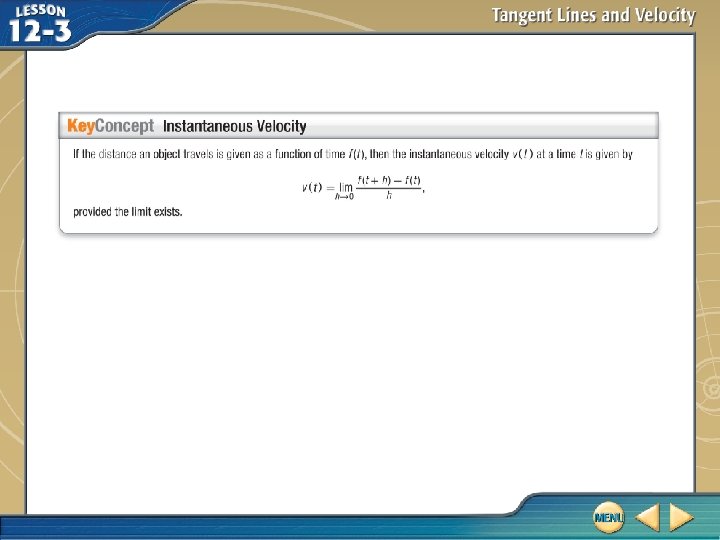
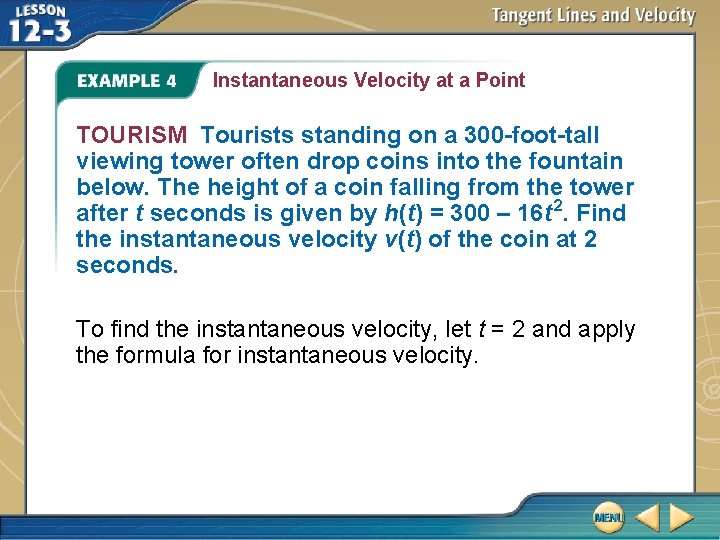
Instantaneous Velocity at a Point TOURISM Tourists standing on a 300 -foot-tall viewing tower often drop coins into the fountain below. The height of a coin falling from the tower after t seconds is given by h(t) = 300 – 16 t 2. Find the instantaneous velocity v(t) of the coin at 2 seconds. To find the instantaneous velocity, let t = 2 and apply the formula for instantaneous velocity.
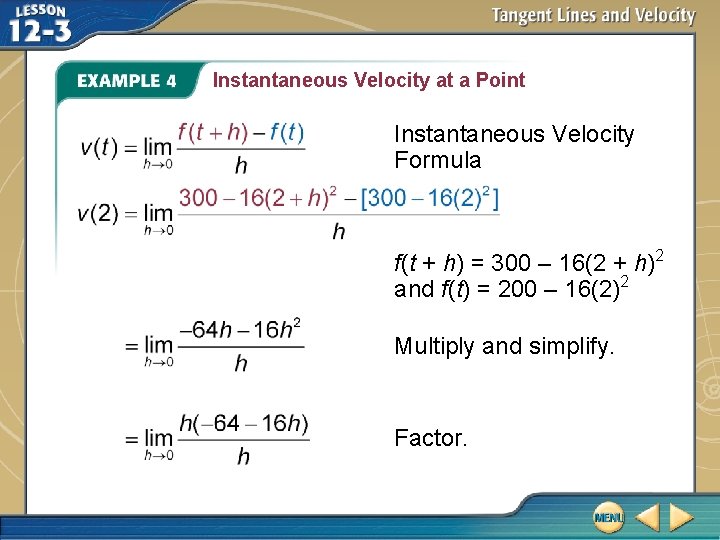
Instantaneous Velocity at a Point Instantaneous Velocity Formula f(t + h) = 300 – 16(2 + h)2 and f(t) = 200 – 16(2)2 Multiply and simplify. Factor.
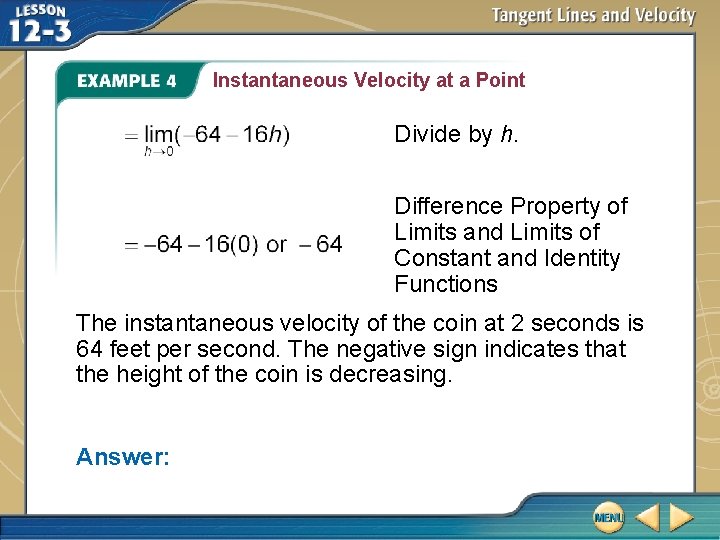
Instantaneous Velocity at a Point Divide by h. Difference Property of Limits and Limits of Constant and Identity Functions The instantaneous velocity of the coin at 2 seconds is 64 feet per second. The negative sign indicates that the height of the coin is decreasing. Answer:
CONSTRUCTION Molly’s father is building her a tree house. He accidentally drops his hammer out one of the windows in the house. The height of the hammer falling from the tree house is given by h(t) = 90 – 16 t 2. Find the instantaneous velocity v(t) of the hammer at 1 second. A. – 16 ft/sec B. 90 ft/sec C. – 32 ft/sec D. – 64 ft/sec
CONSTRUCTION Molly’s father is building her a tree house. He accidentally drops his hammer out one of the windows in the house. The height of the hammer falling from the tree house is given by h(t) = 90 – 16 t 2. Find the instantaneous velocity v(t) of the hammer at 1 second. A. – 16 ft/sec B. 90 ft/sec C. – 32 ft/sec D. – 64 ft/sec
Instantaneous Velocity at Any Point BEES The distance a bumblebee flies along a path is given by p(t) = 12 t – 6 t 3 + 1, where t is given in seconds and the distance of the bumblebee from its starting point is given in inches. Find the equation for the instantaneous velocity v(t) of the bumblebee at any point in time. Apply the formula for instantaneous velocity.
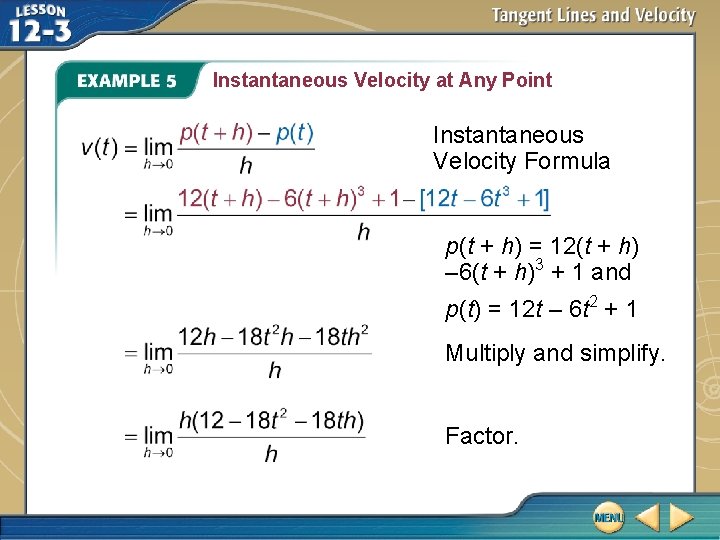
Instantaneous Velocity at Any Point Instantaneous Velocity Formula p(t + h) = 12(t + h) – 6(t + h)3 + 1 and p(t) = 12 t – 6 t 2 + 1 Multiply and simplify. Factor.
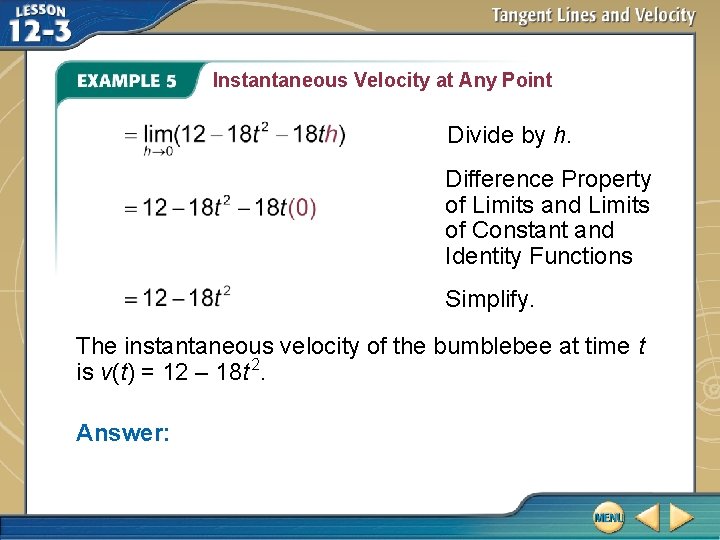
Instantaneous Velocity at Any Point Divide by h. Difference Property of Limits and Limits of Constant and Identity Functions Simplify. The instantaneous velocity of the bumblebee at time t is v(t) = 12 – 18 t 2. Answer:
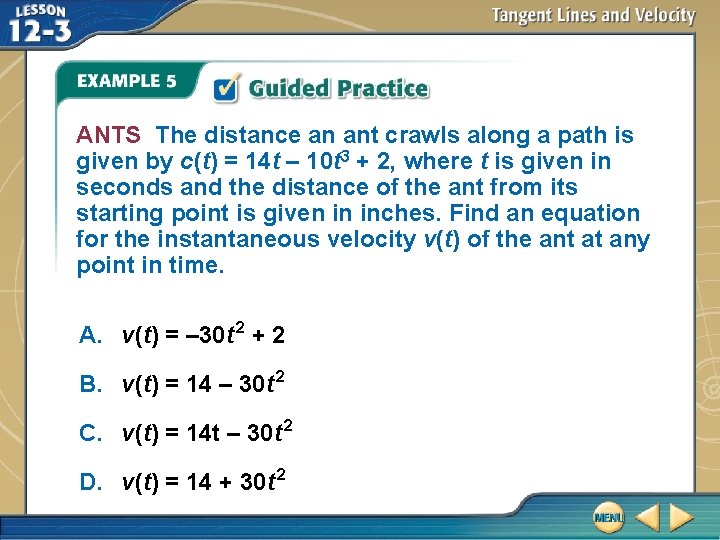
ANTS The distance an ant crawls along a path is given by c(t) = 14 t – 10 t 3 + 2, where t is given in seconds and the distance of the ant from its starting point is given in inches. Find an equation for the instantaneous velocity v(t) of the ant at any point in time. A. v(t) = – 30 t 2 + 2 B. v(t) = 14 – 30 t 2 C. v(t) = 14 t – 30 t 2 D. v(t) = 14 + 30 t 2
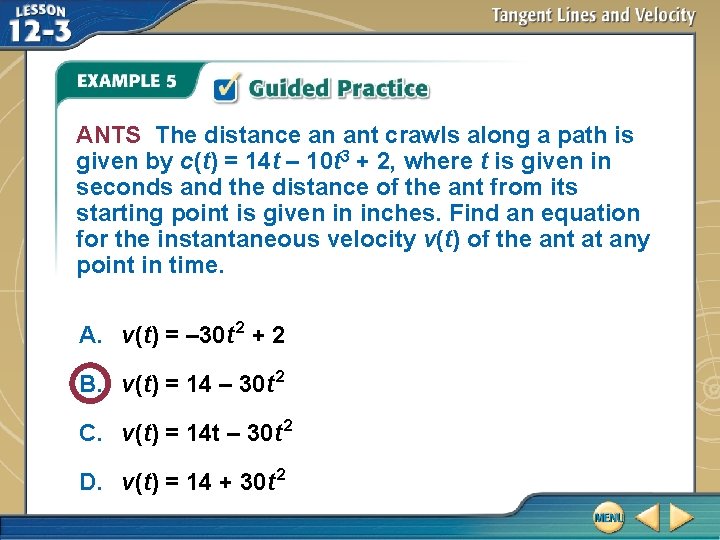
ANTS The distance an ant crawls along a path is given by c(t) = 14 t – 10 t 3 + 2, where t is given in seconds and the distance of the ant from its starting point is given in inches. Find an equation for the instantaneous velocity v(t) of the ant at any point in time. A. v(t) = – 30 t 2 + 2 B. v(t) = 14 – 30 t 2 C. v(t) = 14 t – 30 t 2 D. v(t) = 14 + 30 t 2
• tangent line • instantaneous rate of change • difference quotient • instantaneous velocity
- Slides: 33