
Outsourcing An easy way to increase profits Nike

- Slides: 42
Outsourcing • An “easy way” to increase profits • Nike, Cisco, Apple outsource most of their manufacturing – Each could focus on research, marketing – Each has gotten into trouble • 2001 – Nike reported unexpected profit shortfalls due to inventory problems • 2000 – Cisco had to write down billions in obsolete inventory • 1999 – Apple was unable to meet customer demand for new products
Outsourcing Benefits and Risks • Benefits – Economies of scale reduce manufacturing costs – Risk pooling – demand uncertainties are transferred – Reduced capital investment – Focus on core competencies – Increased flexibility • Risks – Loss of competitive knowledge – Conflicting objectives • Flexibility vs. long-term, stable commitments, etc. • Consider the IBM PC example.
A Framework for Outsourcing • Reasons for outsourcing – Dependency on capacity – Dependency on knowledge • Product architecture – Integral products – components are tightly related • Designed as a system • Not off-the-shelf components • Evaluated based on system performance – Modular products –independent components
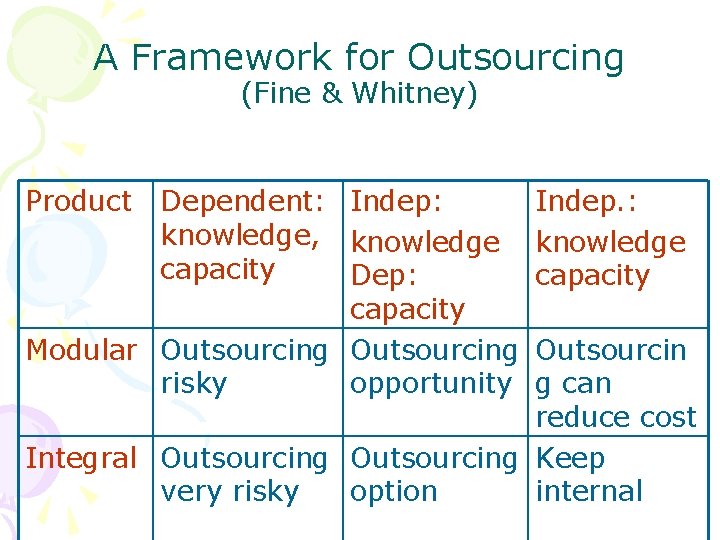
A Framework for Outsourcing (Fine & Whitney) Product Dependent: Indep: knowledge, knowledge capacity Dep: capacity Modular Outsourcing risky opportunity Indep. : knowledge capacity Outsourcin g can reduce cost Integral Outsourcing Keep very risky option internal
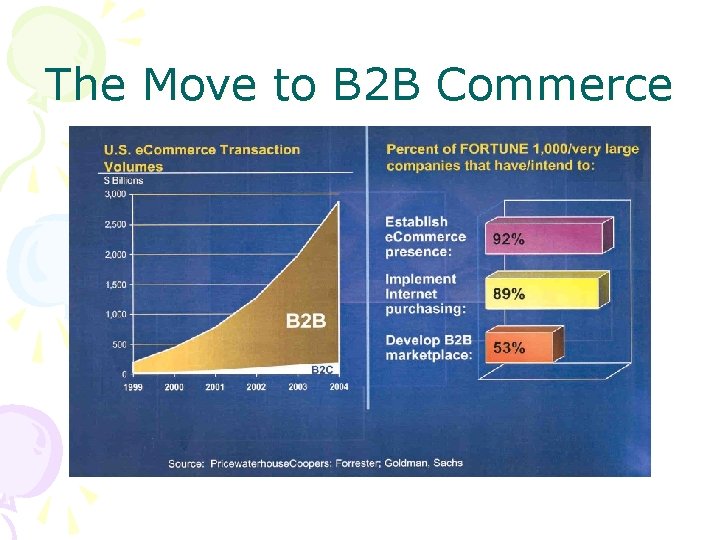
The Move to B 2 B Commerce
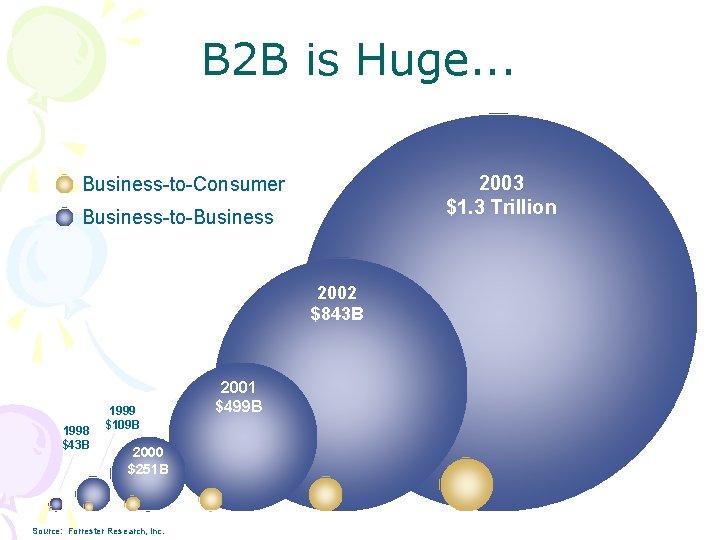
B 2 B is Huge. . . 2003 $1. 3 Trillion Business-to-Consumer Business-to-Business 2002 $843 B 1998 $43 B 1999 $109 B 2000 $251 B Source: Forrester Research, Inc. 2001 $499 B
Free. Markets Online • Free. Markets is an online market making firm that enabled industrial buyers to link up with their potential suppliers in a live electronic bidding • The end result of such interaction among a network of suppliers was procurement cost savings of about 15% for the buyers • The company was founded in 1995 and was on the verge of breaking even in 1998 – It was expecting to receive commissions and fees of nearly $6 million for arranging procurement of ~$200 million worth of industrial components and parts
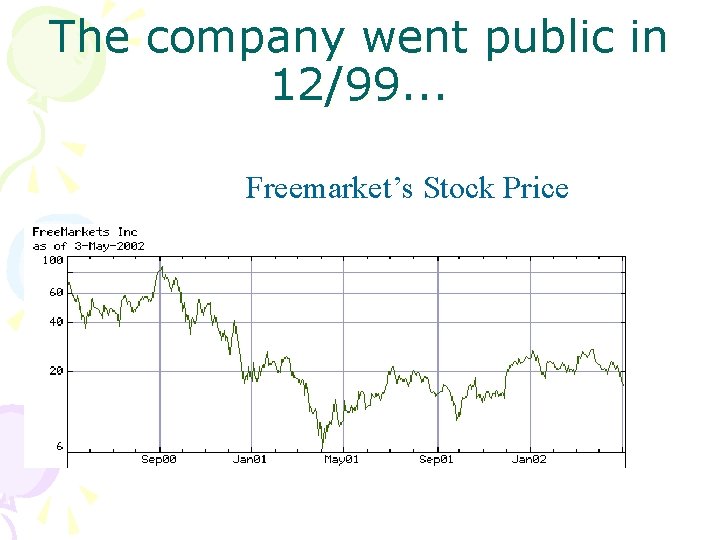
The company went public in 12/99. . . Freemarket’s Stock Price
Where is Free. Markets today? • For the three months ended in 3/31/01 – Revenue totaled $33 M – Net loss totaled $43. 7 M • For the three months ended in 12/31/01 – Revenue totaled $44. 8 M – Net loss totaled $2. 8 M
Highly Fragmented • Most product categories are highly fragmented, with numerous suppliers each offering different level of quality, service and pricing options • Buyers incur significant cost in the actual purchase process – A buyer must invest internal resources to manage the process of collecting, analyzing and acting upon all the information in the market – In addition to purchase price companies spend over 10% in additional procurement costs • On the suppliers side, there are significant costs in using the manufacturing reps – These commissions range from 4% to 7% of purchase price
How Does Free. Markets Online Create Value for its Customers? • Consulting/Purchase outsourcing – Putting together specs, drawings, lot sizes, documentation and RFQs – Identifying potential savings opportunities – Identifying and qualifying suppliers – Educating and training buyers – Conducting the Competitive Bidding Event (CBE) – Providing post bid analysis and support
How Does Free. Markets Online Create Value for its Customers? • Consulting/Purchase outsourcing • Distribution Intermediary
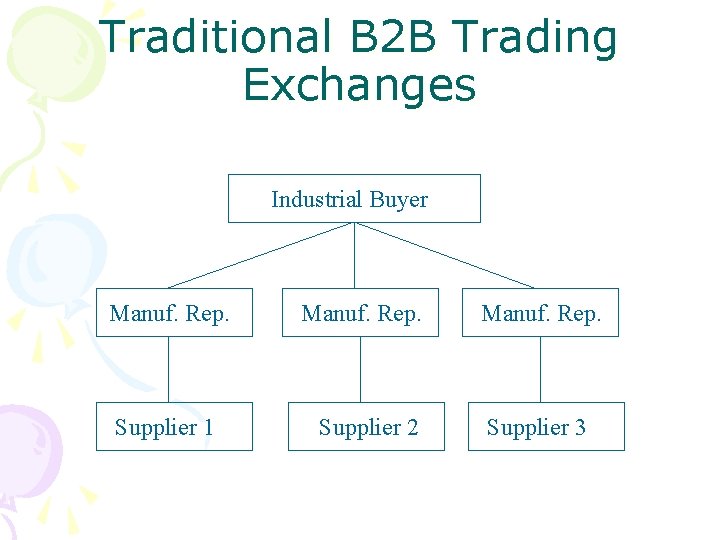
Traditional B 2 B Trading Exchanges Industrial Buyer Manuf. Rep. Supplier 1 Manuf. Rep. Supplier 2 Manuf. Rep. Supplier 3
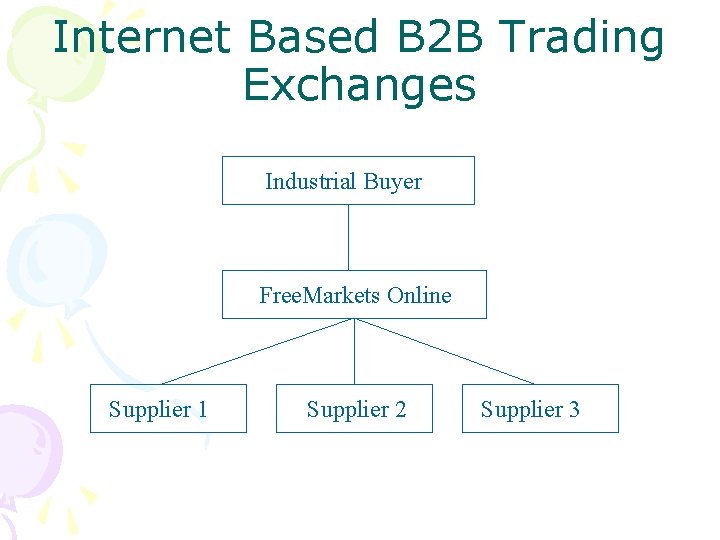
Internet Based B 2 B Trading Exchanges Industrial Buyer Free. Markets Online Supplier 1 Supplier 2 Supplier 3
How Does Free. Markets Online Create Value for its Customers? • Consulting/Purchase outsourcing • Distribution Intermediary • Network Enabler/Software Provider
What are the Barriers for the buyers? • Elimination of established relationships with the suppliers and their representatives • Elimination of manufacturing reps could result in loss of convenience
What is the value to the suppliers? • Less value for the suppliers – Commission costs fell from 7% to 2. 5% – Table 7. 5 implies reduction in commission by $174 M(4. 5%)=$8 M – Table 7. 5 also shows $35 M drop in revenue for the suppliers • Suppliers could benefit from lower sales, marketing and distribution costs and better utilization of capacity
The Revenue Model • A hybrid of service fees and sales commissions – Free. Markets charged monthly fee from the buyer based on the size of the market making team dedicated to the event – Winning supplier paid sales commissions; this was paid in installments as suppliers shipped products
Problems with the revenue model • Buyer side: – Free. Markets invests substantially in a project – Consulting revenue is independent of the value created – Does not lead to another intensive purchasing study for the customer – Gross margin on consulting is about 22% – Doesn’t scale well • Supplier side: – Free. Markets does not represent the supplier – Free. Markets success depends on their ability to identify many potential suppliers – Suppliers pay commissions to the company that reduced their margins
Vertical vs Horizontal Focus? • Vertical: – Advantage: Free. Markets can capitalize on its deep knowledge of supplier industries – Disadvantage: Hard to scale-up • Horizontal: – Advantage: Ability to generate multiple contracts from one buyers – Disadvantage: Free. Markets does not bring much expertise to the transaction
How about licensing the technology? • Are buyers capable of using the technology by themselves? • If not, how will this hurt? • If they are, where is revenue going to come from? • How can these problems be addressed?
By the end of 1998… • Free. Markets was pursuing the horizontal market expansion • In 2000, the company started licensing its software
E-Marketplaces: The Initial (95 -99) business model • The e-marketplace concept started as a new way to procure products, particularly non-production items. E-marketplaces – Expand everyone’s market reach – Generate lower price for the buyers – Cut operational costs for buyers and suppliers • Automating the procurement process will reduce processing cost per order from as high as $150 to as low as $5 per order – Focus on liquidity – Transaction fee paid by the suppliers – Serve as a virtual distributor
Problems with this Business Model • Sellers resist paying a fee to the company whose main objective is to reduce the purchase price • Buyers resist paying a fee • The revenue model needs to be flexible – Sometimes the wrong party is charged • Low barriers to entry created a fragmented industry flooded with participants – Just in the chemical industry there were about 30 e-markets
Continuous evolution of the business model • Transaction fees (typically paid by the sellers) – Sometimes the wrong party is charged – Buyers and suppliers resist paying • Subscription fees (typically paid by the buyer) – Depends on a number of dimensions • Licensing the software
Evolving Market Types • Value-added independent e-markets – They are expanding their offering to include inventory management and financial services (Zoho); supply chain planning (Covisint, e 2 open, Converge, The. Supply)
A Framework for e. Procurement • Type of Component – Strategic Components • Part of the finished product • Not industry specific; company specific • Examples: PC motherboard and chassis – Commodity Products • Can be purchased from a large number of suppliers • Price is determined by market forces • Examples: Memory unit in a PC – Indirect Material • MRO
A Framework for e. Procurement • Level of Risk – Uncertain Demand (Inventory risk) – Volatile market price (Price Risk) – Component availability (Shortage Risk)
Risk: Commodity Products • Can be purchased either – in the open market through on-line auction, or – through the use of long term contracts • Long term contracts guarantee certain level of supply but may be risky for the buyer – Inventory risk, shortage risk or price risk
A Framework for e. Procurement • Indirect Material – Typically low risk and hence the focus is on content based hubs. – The objective is to use an MRO-hub that specializes in unifying catalogs from many suppliers – Examples: MRO. com, Grainger on-line catalogs
Grainger • W. W. Grainger has been selling industrial supplies for 72 years • In 1995 Grainger established Grainger. com, an on-line catalogue for more than 220, 000 products from 12, 000 suppliers • In 1999, Grainger experienced revenue growth of $102 M through its internet channel • The MRO supply industry is growing at a rate of 3 -4% a year. From 1996 to 1999 Grainger internet sales grew 32% a year and 20% in offline due to customers that were lured to Grainger from the web site
A Framework for e. Procurement • Strategic Components – Typically high risk components that can be purchased from a small number of suppliers – The objective is to use private or consortia-based e-marketplace. – The focus is on an e-marketplace that allow collaboration with the suppliers
Consortia or Private? • Transaction volume • Number of suppliers • Cost of building and maintaining the site • The importance of protecting proprietary business practices • Technology and product life cycles
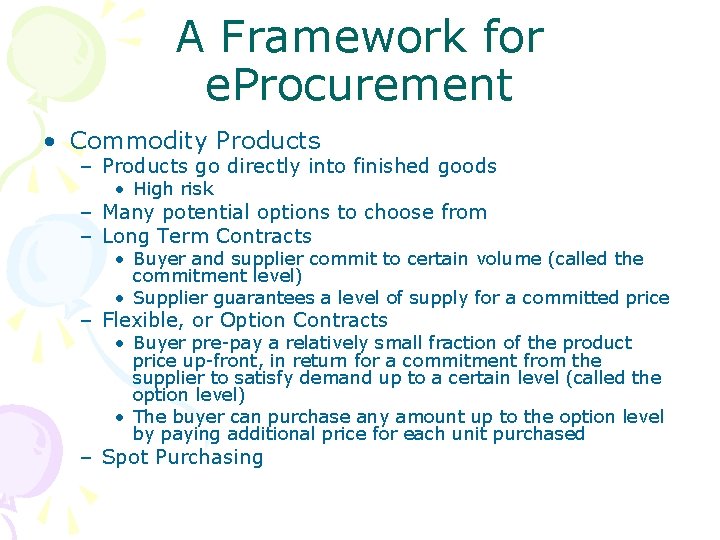
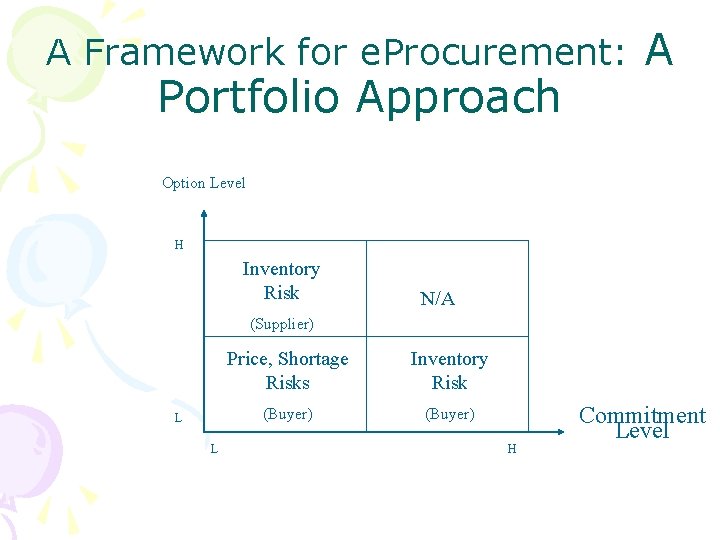
A Framework for e. Procurement • Commodity Products – Products go directly into finished goods • High risk – Many potential options to choose from – Long Term Contracts • Buyer and supplier commit to certain volume (called the commitment level) • Supplier guarantees a level of supply for a committed price – Flexible, or Option Contracts • Buyer pre-pay a relatively small fraction of the product price up-front, in return for a commitment from the supplier to satisfy demand up to a certain level (called the option level) • The buyer can purchase any amount up to the option level by paying additional price for each unit purchased – Spot Purchasing
A Framework for e. Procurement: Portfolio Approach A Option Level H Inventory Risk N/A (Supplier) L L Price, Shortage Risks Inventory Risk (Buyer) H Commitment Level
B 2 B Software Vendors • Oracle (Indirect and Direct) • i 2 Technologies and Manugistics (Direct) • Ariba (Indirect and Direct) • Commerce One (Indirect and Direct) • Agile (Direct) • Vertical. Net (Indirect)
E-Procurement: The reality • Companies conducting greater than 20% of procurement transactions online have reduced their transaction processing cost by nearly a third (Hackett Benchmarking) • Product savings and process cost improvements effect operating cost by 10% (Credit Suisse First Boston Technology Group)
E-Procurement: The reality • To capture this benefits purchasing organization needs to invest heavily in: – Changing internal procurement processes – Integrating e-marketplaces in internal systems – Purchasing B 2 B applications, and – Paying e-marketplace transaction Source: Forrester Research fee/subscription fee
Positive Aspects of Trading Exchanges (Companies who use exchanges): • Reduce costs or labor (31%) • Better access to products/vendors (24%) • Increase speed or efficiency (29%) • Access to more customers (21%) Source: AMR Research
Positive Aspects of Trading Exchanges (Companies who plan to use exchanges): • Reduce costs or labor (43%) • Better access to products/vendors (26%) • Increase speed or efficiency (23%) • Access to more customers (10%) • Source: AMR Research
Negative Aspects of Trading Exchanges (Companies use exchanges): • Security trust (17%) • Start Up cost (5%) • Loss of face-to-face relationships (12%) • Lack of standards (5%) • Immature technology (5%) • Integration issues (7%) • Source: AMR Research
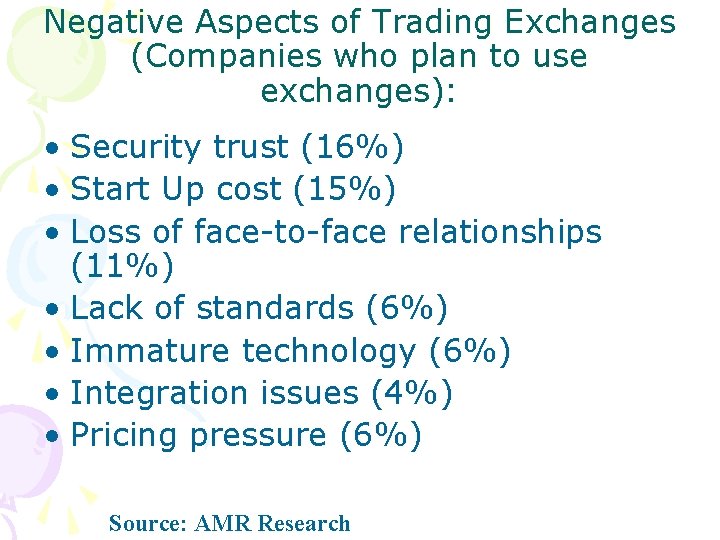
Negative Aspects of Trading Exchanges (Companies who plan to use exchanges): • Security trust (16%) • Start Up cost (15%) • Loss of face-to-face relationships (11%) • Lack of standards (6%) • Immature technology (6%) • Integration issues (4%) • Pricing pressure (6%) Source: AMR Research