
Output List Depth First Search 1 2 4



- Slides: 14
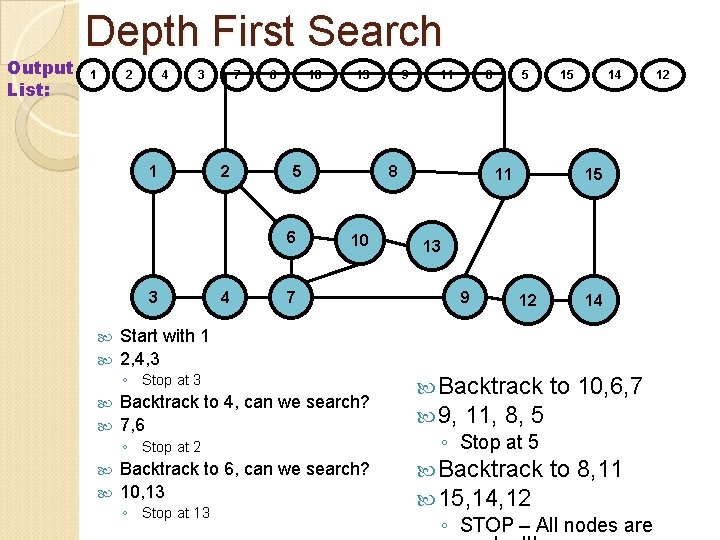
Output List: Depth First Search 1 2 4 3 1 7 2 6 10 5 6 3 4 13 9 11 8 8 10 7 5 11 15 14 15 13 9 12 14 Start with 1 2, 4, 3 ◦ Stop at 3 Backtrack to 4, can we search? 7, 6 ◦ Stop at 2 Backtrack to 6, can we search? 10, 13 ◦ Stop at 13 Backtrack to 10, 6, 7 9, 11, 8, 5 ◦ Stop at 5 Backtrack to 8, 11 15, 14, 12 ◦ STOP – All nodes are 12
Depth First Search – Real Life Application From xkcd. com
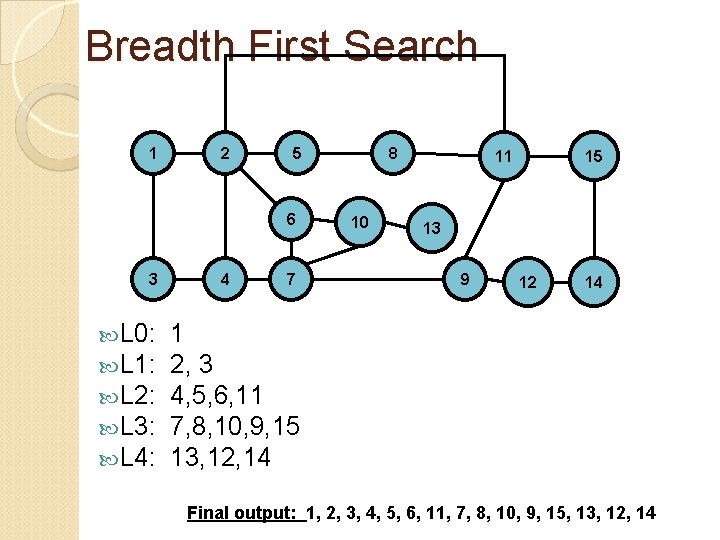
Breadth First Search 1 2 5 6 3 L 0: L 1: L 2: L 3: L 4: 4 7 8 10 11 15 13 9 12 14 1 2, 3 4, 5, 6, 11 7, 8, 10, 9, 15 13, 12, 14 Final output: 1, 2, 3, 4, 5, 6, 11, 7, 8, 10, 9, 15, 13, 12, 14
Topological Sort
Topological Sort The goal of a Topological Sort: ◦ When given a list of items with dependencies (i. e. item 5 must be completed before item 3, etc. ) ◦ Produce an ordering of the items that satisfies the given constraints. In order for the problem to be solvable, there can’t be a cyclic set of constraints. ◦ We can’t have item 5 must be completed before item 3, item 3 must be completed before item 7, and item 7 must be completed before item 5. Since that would be IMPOSSIBLE!!
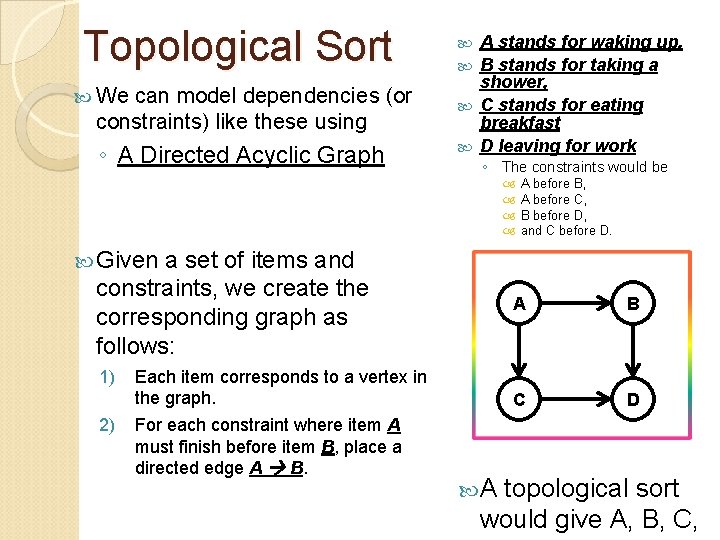
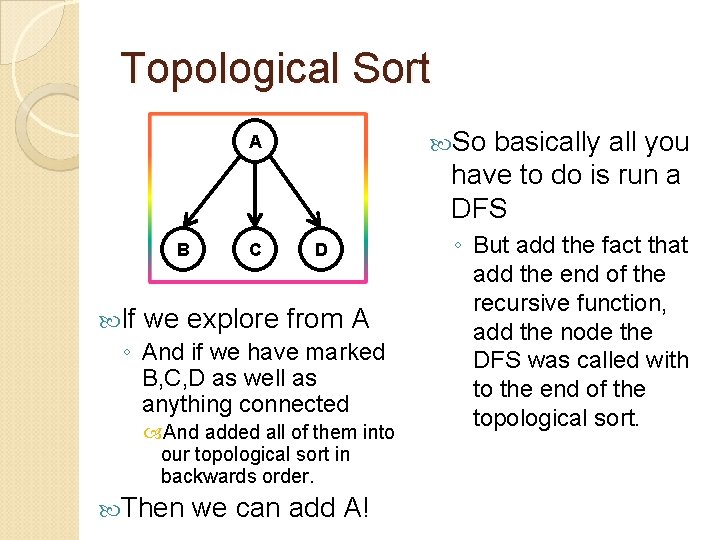
Topological Sort We can model dependencies (or constraints) like these using ◦ A Directed Acyclic Graph A stands for waking up, B stands for taking a shower, C stands for eating breakfast D leaving for work ◦ The constraints would be a set of items and constraints, we create the corresponding graph as follows: A before B, A before C, B before D, and C before D. Given 1) 2) Each item corresponds to a vertex in the graph. For each constraint where item A must finish before item B, place a directed edge A B. A A B C D topological sort would give A, B, C,
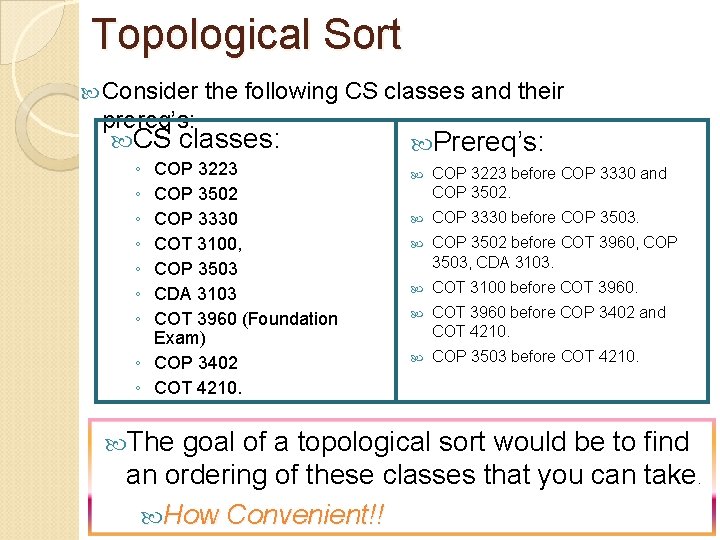
Topological Sort Consider the following CS classes and their prereq’s: CS classes: ◦ ◦ ◦ ◦ COP 3223 COP 3502 COP 3330 COT 3100, COP 3503 CDA 3103 COT 3960 (Foundation Exam) ◦ COP 3402 ◦ COT 4210. The Prereq’s: COP 3223 before COP 3330 and COP 3502. COP 3330 before COP 3503. COP 3502 before COT 3960, COP 3503, CDA 3103. COT 3100 before COT 3960 before COP 3402 and COT 4210. COP 3503 before COT 4210. goal of a topological sort would be to find an ordering of these classes that you can take. How Convenient!!
Topological Sort Algorithm We can use a DFS in our algorithm to determine a topological sort! ◦ The idea is: When you do a DFS on a directed acyclic graph, eventually you will reach a node with no outgoing edges. Why? Because if this never happened, you hit a cycle, because the number of nodes if finite. This node that you reach in a DFS is “safe” to place at the end of the topological sort. Think of leaving for work! ◦ Now what we find is If we have added each of the vertices “below” a vertex into our topological sort, it is safe then to add this one in. If we added in Leaving for work at the end, then we can surely add taking a shower.
Topological Sort So basically all you have to do is run a DFS A B If C D we explore from A ◦ And if we have marked B, C, D as well as anything connected And added all of them into our topological sort in backwards order. Then we can add A! ◦ But add the fact that add the end of the recursive function, add the node the DFS was called with to the end of the topological sort.
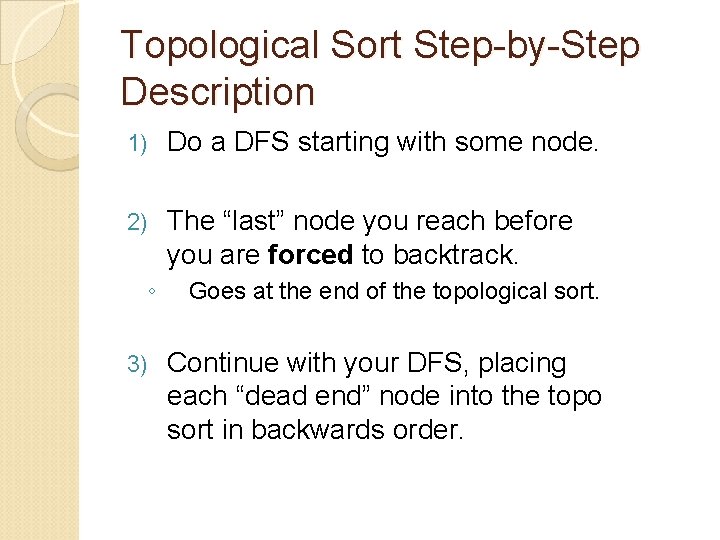
Topological Sort Step-by-Step Description 1) Do a DFS starting with some node. 2) The “last” node you reach before you are forced to backtrack. ◦ 3) Goes at the end of the topological sort. Continue with your DFS, placing each “dead end” node into the topo sort in backwards order.
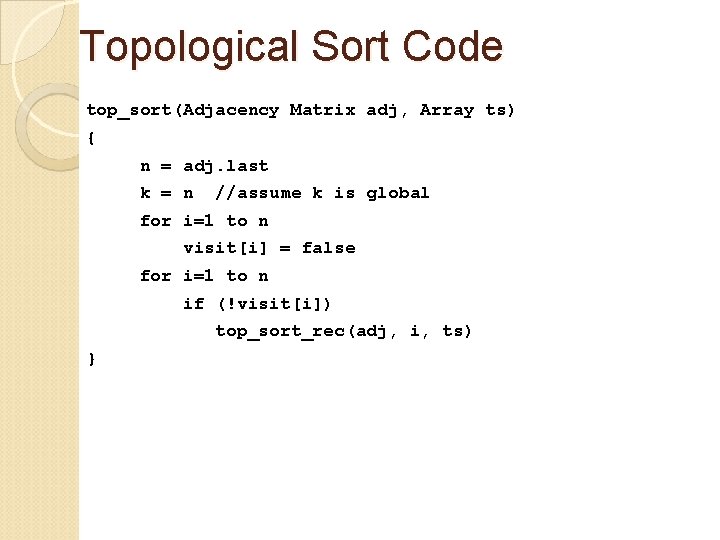
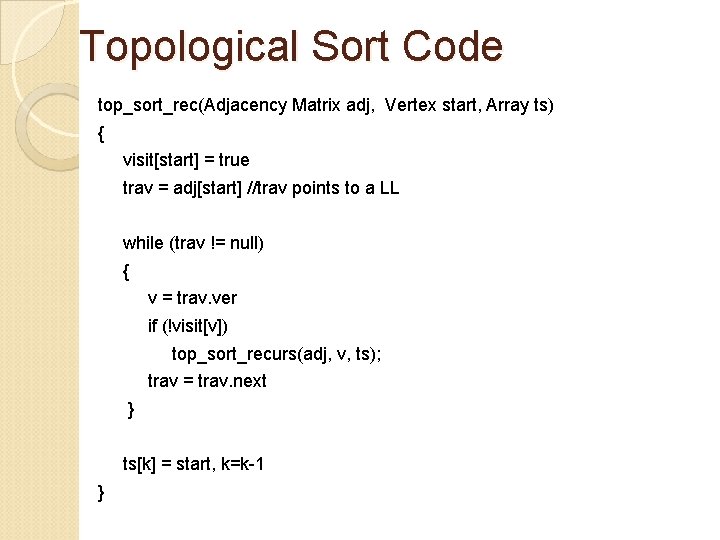
Topological Sort Code top_sort(Adjacency Matrix adj, Array ts) { n = adj. last k = n //assume k is global for i=1 to n visit[i] = false for i=1 to n if (!visit[i]) top_sort_rec(adj, i, ts) }
Topological Sort Code top_sort_rec(Adjacency Matrix adj, Vertex start, Array ts) { visit[start] = true trav = adj[start] //trav points to a LL while (trav != null) { v = trav. ver if (!visit[v]) top_sort_recurs(adj, v, ts); trav = trav. next } ts[k] = start, k=k-1 }
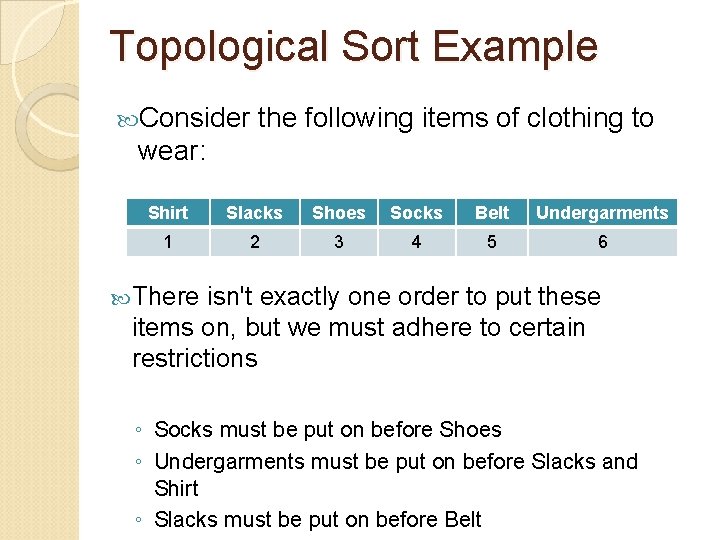
Topological Sort Example Consider the following items of clothing to wear: Shirt Slacks Shoes Socks Belt Undergarments 1 2 3 4 5 6 There isn't exactly one order to put these items on, but we must adhere to certain restrictions ◦ Socks must be put on before Shoes ◦ Undergarments must be put on before Slacks and Shirt ◦ Slacks must be put on before Belt
References Slides adapted from Arup Guha’s Computer Science II Lecture notes: http: //www. cs. ucf. edu/~dmarino/ucf/cop 350 3/lectures/ Additional material from the textbook: Data Structures and Algorithm Analysis in Java (Second Edition) by Mark Allen Weiss Additional images: www. wikipedia. com xkcd. com