
OutofthisWorld Physics Probing Quantum Gravity in the Lab
Out-of-this-World Physics: Probing Quantum Gravity in the Lab Greg Landsberg CERN Experimental Seminar March 26, 2001 Spring 2001 Greg Landsberg, Probing Quantum Gravity in the Lab
Outline Theory and Phenomenology of Large Extra Dimensions Current Limits on Large Extra Dimensions Cosmological Constraints Gravity at Short Distances LEP 2 Searches for Large Extra Dimensions Direct Graviton Emission Virtual Graviton Effects HERA Searches for Large Extra Dimensions Tevatron Searches for Large Extra Dimensions DØ Search for virtual graviton effects Looking for direct graviton emission Sensitivity of Future Collider Experiments New Ripples in Extra Dimensions Conclusions Spring 2001 Greg Landsberg, Probing Quantum Gravity in the Lab
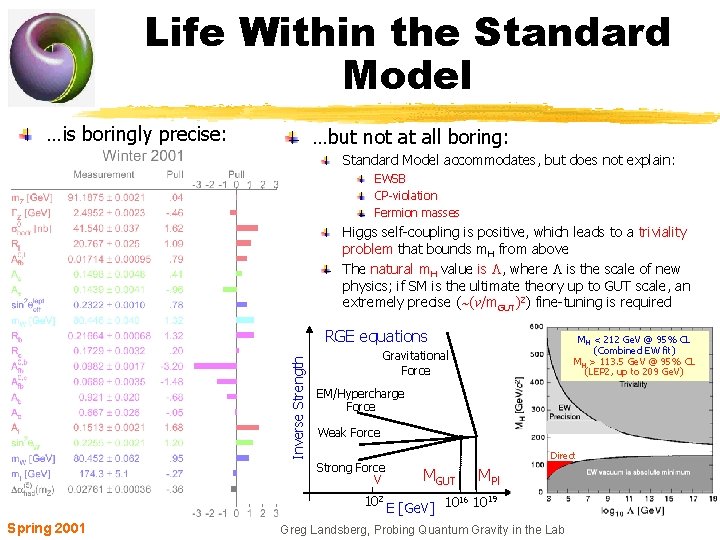
Life Within the Standard Model …is boringly precise: …but not at all boring: Standard Model accommodates, but does not explain: EWSB CP-violation Fermion masses Higgs self-coupling is positive, which leads to a triviality problem that bounds m. H from above The natural m. H value is L, where L is the scale of new physics; if SM is the ultimate theory up to GUT scale, an extremely precise ( (v/m. GUT)2) fine-tuning is required Inverse Strength RGE equations Gravitational Force EM/Hypercharge Force Weak Force Strong Force v 102 Spring 2001 MH < 212 Ge. V @ 95% CL (Combined EW fit) MH > 113. 5 Ge. V @ 95% CL (LEP 2, up to 209 Ge. V) Direct MGUT MPl 19 16 E [Ge. V] 10 10 Greg Landsberg, Probing Quantum Gravity in the Lab
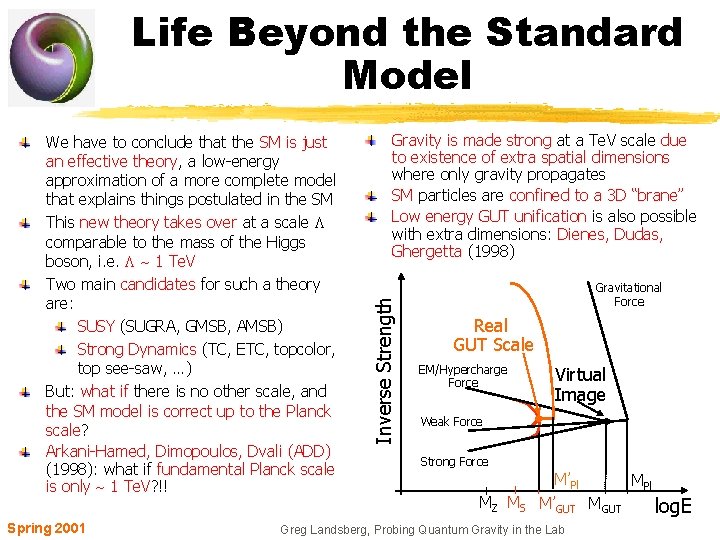
Life Beyond the Standard Model Spring 2001 Gravity is made strong at a Te. V scale due to existence of extra spatial dimensions where only gravity propagates SM particles are confined to a 3 D “brane” Low energy GUT unification is also possible with extra dimensions: Dienes, Dudas, Ghergetta (1998) Inverse Strength We have to conclude that the SM is just an effective theory, a low-energy approximation of a more complete model that explains things postulated in the SM This new theory takes over at a scale L comparable to the mass of the Higgs boson, i. e. L 1 Te. V Two main candidates for such a theory are: SUSY (SUGRA, GMSB, AMSB) Strong Dynamics (TC, ETC, topcolor, top see-saw, …) But: what if there is no other scale, and the SM model is correct up to the Planck scale? Arkani-Hamed, Dimopoulos, Dvali (ADD) (1998): what if fundamental Planck scale is only 1 Te. V? !! Gravitational Force Real GUT Scale EM/Hypercharge Force Virtual Image Weak Force Strong Force MZ MS M’Pl M’GUT MGUT log. E Greg Landsberg, Probing Quantum Gravity in the Lab

A Crazy Idea? – But it Could Work! But: how to make gravity strong? G’N = 1/MS 2 GF MS 1 Te. V Ruled out for flat extra dimensions, but has not been ruled out for sufficiently small compactified extra dimensions: More precisely, from Gauss’s law: Compact Dimension What about Newton’s law? Flat Dimension MS – effective Planck Scale Spring 2001 Amazing as it is, but no one has tested Newton’s law to distances less than 1 mm (as of 1998) Therefore, large spatial extra dimensions compactified at a submillimeter scale are, in principle, allowed! Greg Landsberg, Probing Quantum Gravity in the Lab
Shakespeare on Compact Dimensions “…Why bastard? wherefore base? When my dimensions are as well compact, My mind as generous, and my shape as true, As honest madam's issue? ” (Edmund, bastard son to Gloucester) Shakespeare, King Lear, Act 1, Scene 2 Spring 2001 Greg Landsberg, Probing Quantum Gravity in the Lab

Examples of Compactified Spatial Dimensions M. C. Escher, Mobius Strip II (1963) M. C. Escher, Relativity (1953) [All M. C. Escher works and texts copyright © Cordon Art B. V. , P. O. Box 101, 3740 AC The Netherlands. Used by permission. ] Spring 2001 Greg Landsberg, Probing Quantum Gravity in the Lab
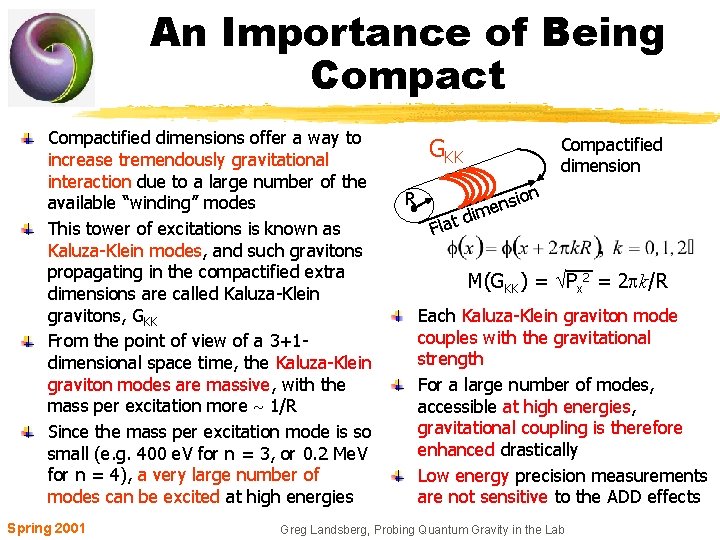
An Importance of Being Compactified dimensions offer a way to increase tremendously gravitational interaction due to a large number of the available “winding” modes This tower of excitations is known as Kaluza-Klein modes, and such gravitons propagating in the compactified extra dimensions are called Kaluza-Klein gravitons, GKK From the point of view of a 3+1 dimensional space time, the Kaluza-Klein graviton modes are massive, with the mass per excitation more 1/R Since the mass per excitation mode is so small (e. g. 400 e. V for n = 3, or 0. 2 Me. V for n = 4), a very large number of modes can be excited at high energies Spring 2001 Compactified dimension GKK R Flat d ion ns e m i M(GKK) = Px 2 = 2 pk/R Each Kaluza-Klein graviton mode couples with the gravitational strength For a large number of modes, accessible at high energies, gravitational coupling is therefore enhanced drastically Low energy precision measurements are not sensitive to the ADD effects Greg Landsberg, Probing Quantum Gravity in the Lab
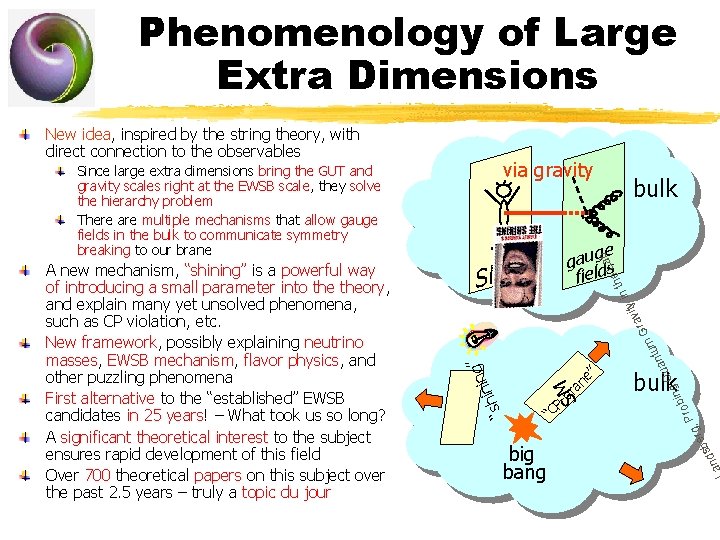
Phenomenology of Large Extra Dimensions New idea, inspired by the string theory, with direct connection to the observables via gravity e gaugds fiel ing bulk , erg b s nd b Pro SM “s big bang P “C ” e an r -b tu an u Q g” m G ity rav in L the SM in hin A new mechanism, “shining” is a powerful way of introducing a small parameter into theory, and explain many yet unsolved phenomena, such as CP violation, etc. New framework, possibly explaining neutrino masses, EWSB mechanism, flavor physics, and other puzzling phenomena First alternative to the “established” EWSB candidates in 25 years! – What took us so long? A significant theoretical interest to the subject ensures rapid development of this field Over 700 theoretical papers on this subject over the past 2. 5 years – truly a topic du jour bulk ab Since large extra dimensions bring the GUT and gravity scales right at the EWSB scale, they solve the hierarchy problem There are multiple mechanisms that allow gauge fields in the bulk to communicate symmetry breaking to our brane
Using the Extra Dimension Paradigm EWSB from extra dimensions: Hall, Kolda, PL B 459, 213 (1999) (lifted Higgs mass constraints) Antoniadis, Benakli, Quiros, NP B 583, 35 (2000) (EWSB from strings in ED) Cheng, Dobrescu, Hill, NP B 589, 249 (2000) (strong dynamics from ED) Mirabelli, Schmaltz, PR D 61, 113011 (2000) (Yukawa couplings from split left- and right-handed fermions in ED) Barbieri, Hall, Namura, hep-ph/0011311 (radiative EWSB via t-quark in the bulk) Flavor/CP physics from ED: Arkani-Hamed, Hall, Smith, Weiner, PR D 61, 116003 (2000) (flavor/CP breaking fields on distant branes in ED) Huang, Li, Wei, Yan, hep-ph/0101002 (CP-violating phases from moduli fields in ED) Spring 2001 Neutrino masses and oscillations from ED: Arkani-Hamed, Dimopoulos, Dvali, March-Russell, hep-ph/9811448 (light Dirac neutrinos from right-handed neutrinos in the bulk or light Majorana neutrinos from lepton number breaking on distant branes) Dienes, Dudas, Gherghetta, NP B 557, 25 (1999) (light neutrinos from right-handed neutrinos in ED or ED see-saw mechanism) Lukas, Ramon, Romanino, Ross, PL B 495, 136 (2000); hep-ph/0011295 (sterile neutrinos from bulk; oscillations into bulk KK states) Many other topics from Higgs to dark matter Greg Landsberg, Probing Quantum Gravity in the Lab
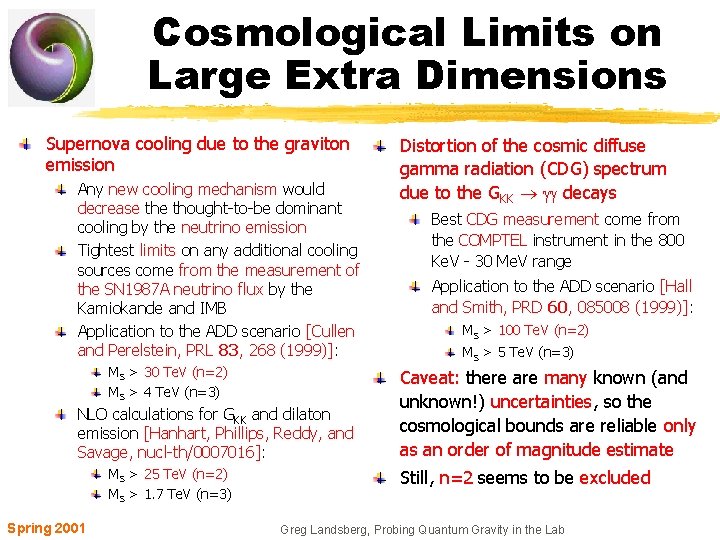
Cosmological Limits on Large Extra Dimensions Supernova cooling due to the graviton emission Any new cooling mechanism would decrease thought-to-be dominant cooling by the neutrino emission Tightest limits on any additional cooling sources come from the measurement of the SN 1987 A neutrino flux by the Kamiokande and IMB Application to the ADD scenario [Cullen and Perelstein, PRL 83, 268 (1999)]: MS > 30 Te. V (n=2) MS > 4 Te. V (n=3) NLO calculations for GKK and dilaton emission [Hanhart, Phillips, Reddy, and Savage, nucl-th/0007016]: MS > 25 Te. V (n=2) MS > 1. 7 Te. V (n=3) Spring 2001 Distortion of the cosmic diffuse gamma radiation (CDG) spectrum due to the GKK gg decays Best CDG measurement come from the COMPTEL instrument in the 800 Ke. V - 30 Me. V range Application to the ADD scenario [Hall and Smith, PRD 60, 085008 (1999)]: MS > 100 Te. V (n=2) MS > 5 Te. V (n=3) Caveat: there are many known (and unknown!) uncertainties, so the cosmological bounds are reliable only as an order of magnitude estimate Still, n=2 seems to be excluded Greg Landsberg, Probing Quantum Gravity in the Lab
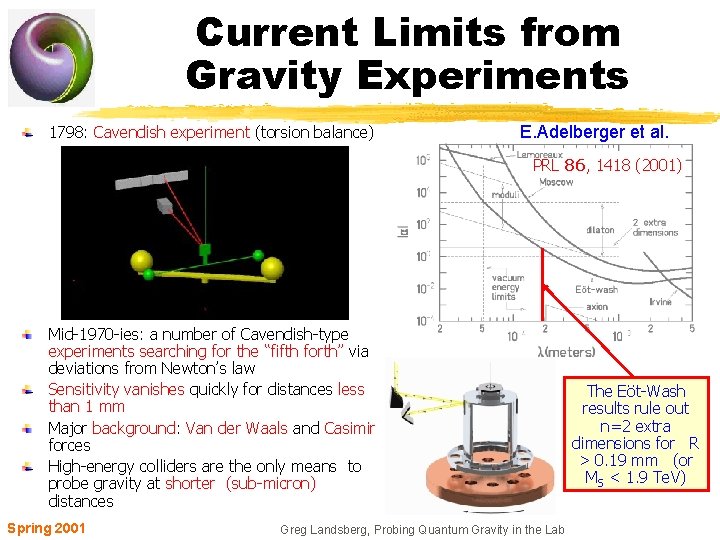
Current Limits from Gravity Experiments 1798: Cavendish experiment (torsion balance) E. Adelberger et al. PRL 86, 1418 (2001) Mid-1970 -ies: a number of Cavendish-type experiments searching for the “fifth forth” via deviations from Newton’s law Sensitivity vanishes quickly for distances less than 1 mm Major background: Van der Waals and Casimir forces High-energy colliders are the only means to probe gravity at shorter (sub-micron) distances Spring 2001 Greg Landsberg, Probing Quantum Gravity in the Lab The Eöt-Wash results rule out n=2 extra dimensions for R > 0. 19 mm (or MS < 1. 9 Te. V)
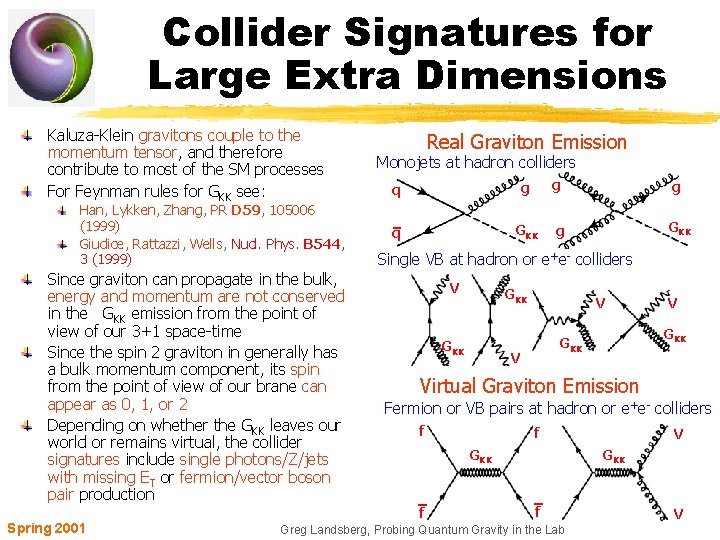
Collider Signatures for Large Extra Dimensions Kaluza-Klein gravitons couple to the momentum tensor, and therefore contribute to most of the SM processes For Feynman rules for GKK see: Han, Lykken, Zhang, PR D 59, 105006 (1999) Giudice, Rattazzi, Wells, Nucl. Phys. B 544, 3 (1999) Since graviton can propagate in the bulk, energy and momentum are not conserved in the GKK emission from the point of view of our 3+1 space-time Since the spin 2 graviton in generally has a bulk momentum component, its spin from the point of view of our brane can appear as 0, 1, or 2 Depending on whether the GKK leaves our world or remains virtual, the collider signatures include single photons/Z/jets with missing ET or fermion/vector boson pair production Spring 2001 Real Graviton Emission Monojets at hadron colliders q g g g q GKK g GKK Single VB at hadron or e+e- colliders V GKK GKK V V Virtual Graviton Emission Fermion or VB pairs at hadron or e+e- colliders f f GKK f V GKK f Greg Landsberg, Probing Quantum Gravity in the Lab V
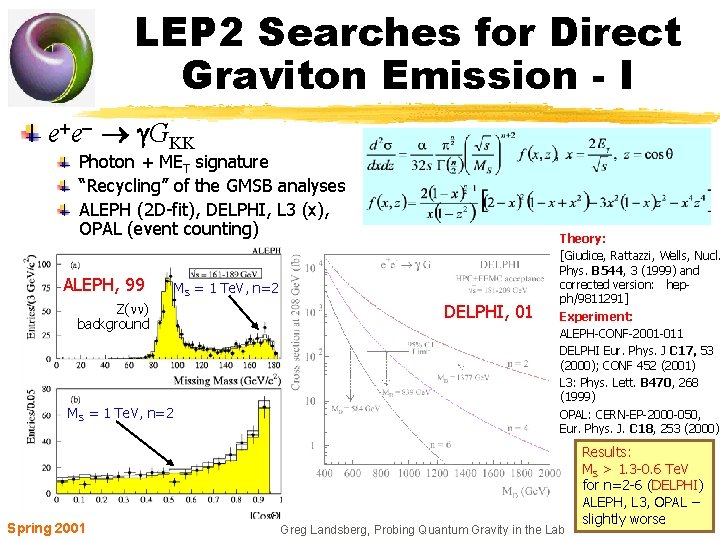
LEP 2 Searches for Direct Graviton Emission - I e+e- g. GKK Photon + MET signature “Recycling” of the GMSB analyses ALEPH (2 D-fit), DELPHI, L 3 (x), OPAL (event counting) ALEPH, 99 Z(nn) background MS = 1 Te. V, n=2 Spring 2001 MS = 1 Te. V, n=2 DELPHI, 01 Theory: [Giudice, Rattazzi, Wells, Nucl. Phys. B 544, 3 (1999) and corrected version: hepph/9811291] Experiment: ALEPH-CONF-2001 -011 DELPHI Eur. Phys. J C 17, 53 (2000); CONF 452 (2001) L 3: Phys. Lett. B 470, 268 (1999) OPAL: CERN-EP-2000 -050, Eur. Phys. J. C 18, 253 (2000) Greg Landsberg, Probing Quantum Gravity in the Lab Results: MS > 1. 3 -0. 6 Te. V for n=2 -6 (DELPHI) ALEPH, L 3, OPAL – slightly worse
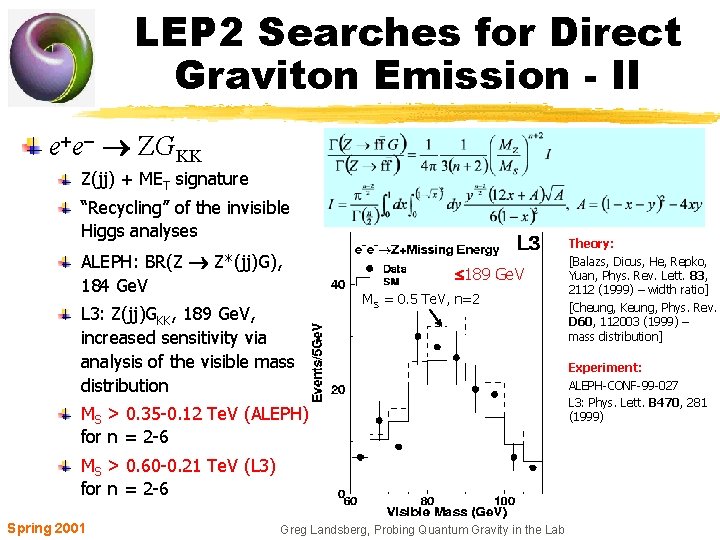
LEP 2 Searches for Direct Graviton Emission - II e+e- ZGKK Z(jj) + MET signature “Recycling” of the invisible Higgs analyses ALEPH: BR(Z Z*(jj)G), 184 Ge. V L 3: Z(jj)GKK, 189 Ge. V, increased sensitivity via analysis of the visible mass distribution 189 Ge. V MS = 0. 5 Te. V, n=2 MS > 0. 35 -0. 12 Te. V (ALEPH) for n = 2 -6 MS > 0. 60 -0. 21 Te. V (L 3) for n = 2 -6 Spring 2001 Greg Landsberg, Probing Quantum Gravity in the Lab Theory: [Balazs, Dicus, He, Repko, Yuan, Phys. Rev. Lett. 83, 2112 (1999) – width ratio] [Cheung, Keung, Phys. Rev. D 60, 112003 (1999) – mass distribution] Experiment: ALEPH-CONF-99 -027 L 3: Phys. Lett. B 470, 281 (1999)
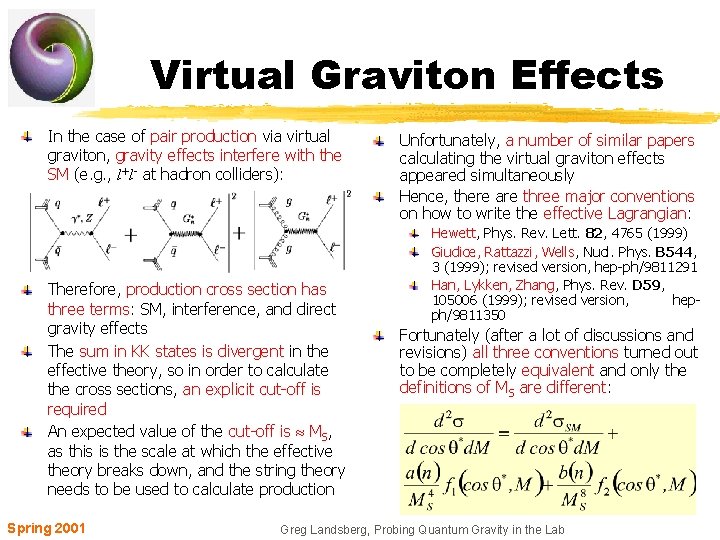
Virtual Graviton Effects In the case of pair production via virtual graviton, gravity effects interfere with the SM (e. g. , l+l- at hadron colliders): Therefore, production cross section has three terms: SM, interference, and direct gravity effects The sum in KK states is divergent in the effective theory, so in order to calculate the cross sections, an explicit cut-off is required An expected value of the cut-off is MS, as this is the scale at which the effective theory breaks down, and the string theory needs to be used to calculate production Spring 2001 Unfortunately, a number of similar papers calculating the virtual graviton effects appeared simultaneously Hence, there are three major conventions on how to write the effective Lagrangian: Hewett, Phys. Rev. Lett. 82, 4765 (1999) Giudice, Rattazzi, Wells, Nucl. Phys. B 544, 3 (1999); revised version, hep-ph/9811291 Han, Lykken, Zhang, Phys. Rev. D 59, 105006 (1999); revised version, hepph/9811350 Fortunately (after a lot of discussions and revisions) all three conventions turned out to be completely equivalent and only the definitions of MS are different: Greg Landsberg, Probing Quantum Gravity in the Lab
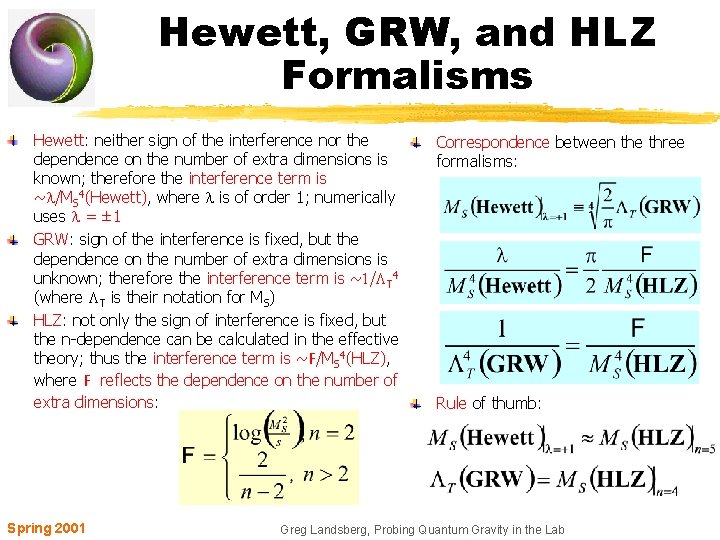
Hewett, GRW, and HLZ Formalisms Hewett: neither sign of the interference nor the dependence on the number of extra dimensions is known; therefore the interference term is ~l/MS 4(Hewett), where l is of order 1; numerically uses l = ± 1 GRW: sign of the interference is fixed, but the dependence on the number of extra dimensions is unknown; therefore the interference term is ~1/LT 4 (where LT is their notation for MS) HLZ: not only the sign of interference is fixed, but the n-dependence can be calculated in the effective theory; thus the interference term is ~F/MS 4(HLZ), where F reflects the dependence on the number of extra dimensions: Spring 2001 Correspondence between the three formalisms: Rule of thumb: Greg Landsberg, Probing Quantum Gravity in the Lab
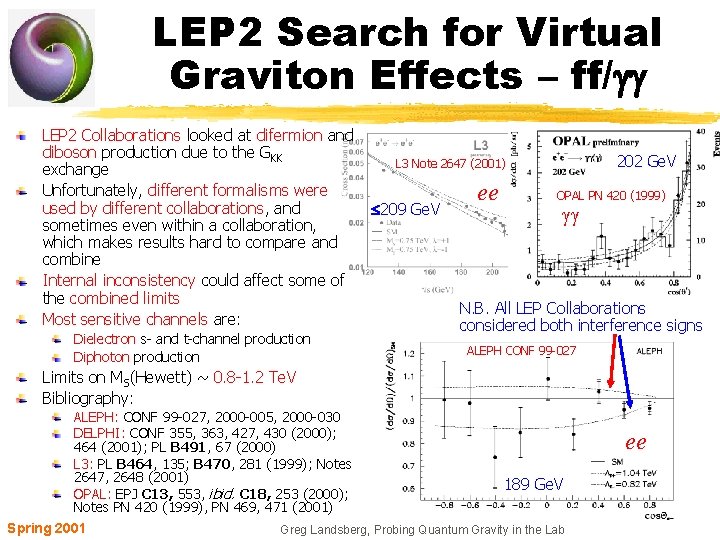
LEP 2 Search for Virtual Graviton Effects – ff/gg LEP 2 Collaborations looked at difermion and diboson production due to the GKK exchange Unfortunately, different formalisms were used by different collaborations, and sometimes even within a collaboration, which makes results hard to compare and combine Internal inconsistency could affect some of the combined limits Most sensitive channels are: Dielectron s- and t-channel production Diphoton production 202 Ge. V L 3 Note 2647 (2001) 209 Ge. V ee OPAL PN 420 (1999) gg N. B. All LEP Collaborations considered both interference signs ALEPH CONF 99 -027 Limits on MS(Hewett) ~ 0. 8 -1. 2 Te. V Bibliography: ALEPH: CONF 99 -027, 2000 -005, 2000 -030 DELPHI: CONF 355, 363, 427, 430 (2000); 464 (2001); PL B 491, 67 (2000) L 3: PL B 464, 135; B 470, 281 (1999); Notes 2647, 2648 (2001) 189 Ge. V OPAL: EPJ C 13, 553, ibid. C 18, 253 (2000); Notes PN 420 (1999), PN 469, 471 (2001) Spring 2001 Greg Landsberg, Probing Quantum Gravity in the Lab ee
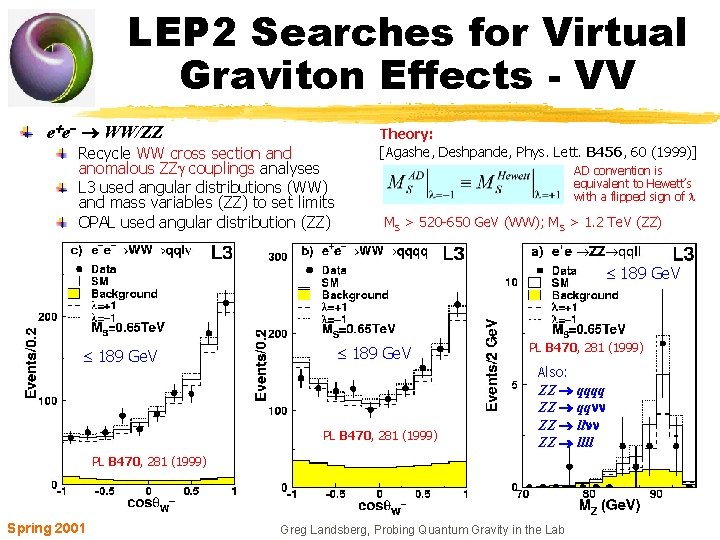
LEP 2 Searches for Virtual Graviton Effects - VV e+e- WW/ZZ Recycle WW cross section and anomalous ZZg couplings analyses L 3 used angular distributions (WW) and mass variables (ZZ) to set limits OPAL used angular distribution (ZZ) Theory: [Agashe, Deshpande, Phys. Lett. B 456, 60 (1999)] AD convention is equivalent to Hewett’s with a flipped sign of l MS > 520 -650 Ge. V (WW); MS > 1. 2 Te. V (ZZ) 189 Ge. V PL B 470, 281 (1999) Also: ZZ qqqq ZZ qqnn ZZ llll PL B 470, 281 (1999) Spring 2001 Greg Landsberg, Probing Quantum Gravity in the Lab
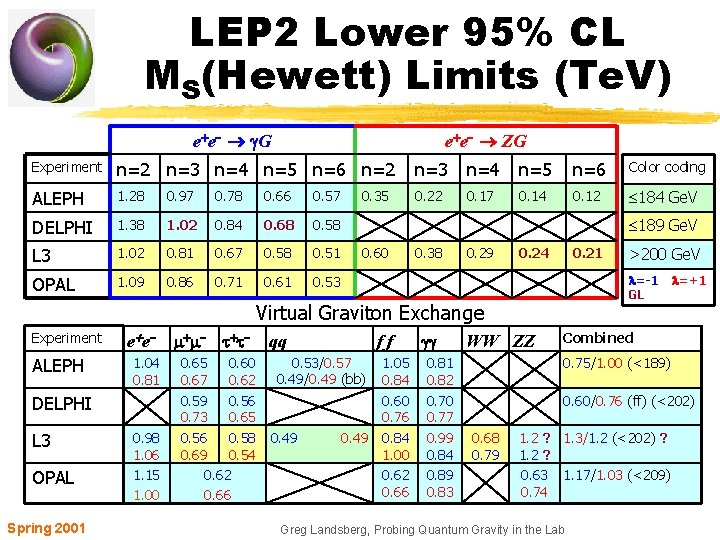
LEP 2 Lower 95% CL MS(Hewett) Limits (Te. V) e+e- g. G e+e- ZG Experiment n=2 n=3 n=4 n=5 n=6 Color coding ALEPH 1. 28 0. 97 0. 78 0. 66 0. 57 0. 22 0. 17 0. 14 0. 12 184 Ge. V DELPHI 1. 38 1. 02 0. 84 0. 68 0. 58 L 3 1. 02 0. 81 0. 67 0. 58 0. 51 OPAL 1. 09 0. 86 0. 71 0. 61 0. 53 0. 35 189 Ge. V 0. 60 0. 38 0. 29 0. 24 0. 21 l=-1 GL Virtual Graviton Exchange Experiment ALEPH e+e- m+m- t+t 1. 04 0. 81 DELPHI L 3 OPAL Spring 2001 0. 98 1. 06 1. 15 1. 00 0. 65 0. 60 0. 67 0. 62 0. 59 0. 56 0. 73 0. 65 0. 56 0. 58 0. 69 0. 54 0. 62 0. 66 qq ff 0. 53/0. 57 0. 49/0. 49 (bb) 0. 49 1. 05 0. 84 0. 60 0. 76 0. 49 0. 84 1. 00 0. 62 0. 66 gg 0. 81 0. 82 0. 70 0. 77 0. 99 0. 84 0. 89 0. 83 >200 Ge. V WW ZZ l=+1 Combined 0. 75/1. 00 (<189) 0. 60/0. 76 (ff) (<202) 0. 68 0. 79 1. 2 ? 1. 3/1. 2 (<202) ? 1. 2 ? 0. 63 1. 17/1. 03 (<209) 0. 74 Greg Landsberg, Probing Quantum Gravity in the Lab
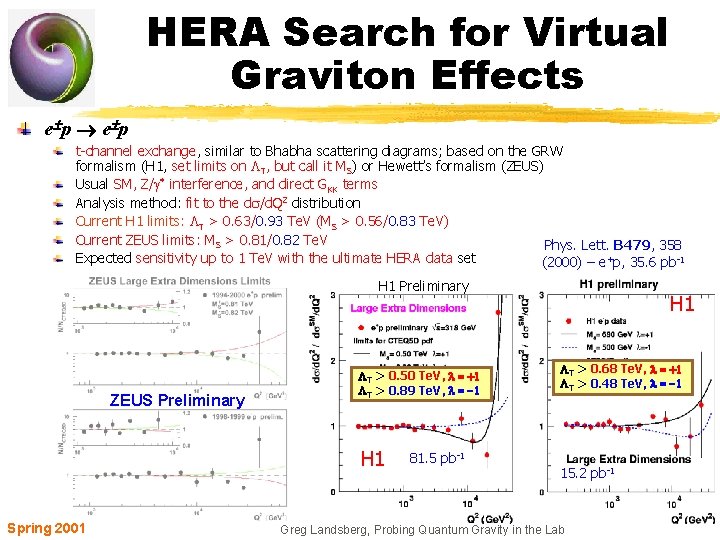
HERA Search for Virtual Graviton Effects e p t-channel exchange, similar to Bhabha scattering diagrams; based on the GRW formalism (H 1, set limits on LT, but call it MS) or Hewett’s formalism (ZEUS) Usual SM, Z/g* interference, and direct GKK terms Analysis method: fit to the ds/d. Q 2 distribution Current H 1 limits: LT > 0. 63/0. 93 Te. V (MS > 0. 56/0. 83 Te. V) Current ZEUS limits: MS > 0. 81/0. 82 Te. V Phys. Lett. B 479, 358 Expected sensitivity up to 1 Te. V with the ultimate HERA data set (2000) – e+p, 35. 6 pb-1 H 1 Preliminary ZEUS Preliminary LT > 0. 50 Te. V, l = +1 LT > 0. 89 Te. V, l = -1 H 1 Spring 2001 81. 5 pb-1 H 1 LT > 0. 68 Te. V, l = +1 LT > 0. 48 Te. V, l = -1 15. 2 pb-1 Greg Landsberg, Probing Quantum Gravity in the Lab
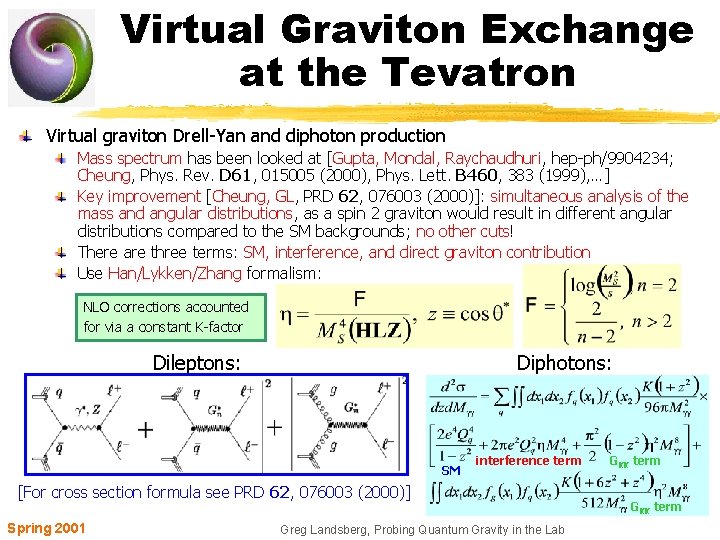
Virtual Graviton Exchange at the Tevatron Virtual graviton Drell-Yan and diphoton production Mass spectrum has been looked at [Gupta, Mondal, Raychaudhuri, hep-ph/9904234; Cheung, Phys. Rev. D 61, 015005 (2000), Phys. Lett. B 460, 383 (1999), …] Key improvement [Cheung, GL, PRD 62, 076003 (2000)]: simultaneous analysis of the mass and angular distributions, as a spin 2 graviton would result in different angular distributions compared to the SM backgrounds; no other cuts! There are three terms: SM, interference, and direct graviton contribution Use Han/Lykken/Zhang formalism: NLO corrections accounted for via a constant K-factor Dileptons: Diphotons: SM interference term [For cross section formula see PRD 62, 076003 (2000)] Spring 2001 Greg Landsberg, Probing Quantum Gravity in the Lab GKK term
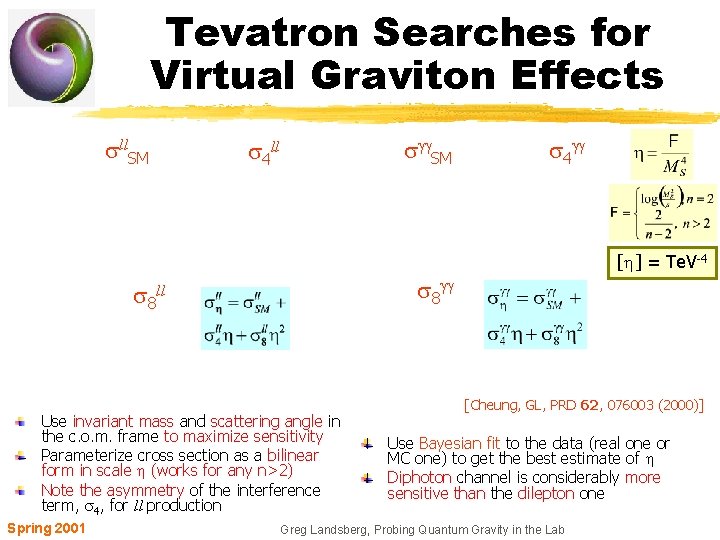
Tevatron Searches for Virtual Graviton Effects sll. SM sgg. SM s 4 ll s 4 gg [h] = Te. V-4 s 8 gg s 8 ll Use invariant mass and scattering angle in the c. o. m. frame to maximize sensitivity Parameterize cross section as a bilinear form in scale h (works for any n>2) Note the asymmetry of the interference term, s 4, for ll production Spring 2001 [Cheung, GL, PRD 62, 076003 (2000)] Use Bayesian fit to the data (real one or MC one) to get the best estimate of h Diphoton channel is considerably more sensitive than the dilepton one Greg Landsberg, Probing Quantum Gravity in the Lab
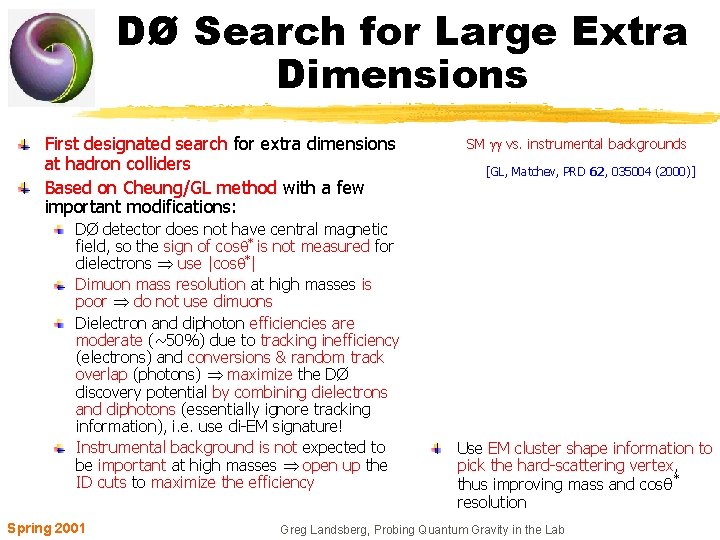
DØ Search for Large Extra Dimensions First designated search for extra dimensions at hadron colliders Based on Cheung/GL method with a few important modifications: DØ detector does not have central magnetic field, so the sign of cos * is not measured for dielectrons use |cos *| Dimuon mass resolution at high masses is poor do not use dimuons Dielectron and diphoton efficiencies are moderate (~50%) due to tracking inefficiency (electrons) and conversions & random track overlap (photons) maximize the DØ discovery potential by combining dielectrons and diphotons (essentially ignore tracking information), i. e. use di-EM signature! Instrumental background is not expected to be important at high masses open up the ID cuts to maximize the efficiency Spring 2001 SM gg vs. instrumental backgrounds [GL, Matchev, PRD 62, 035004 (2000)] Use EM cluster shape information to pick the hard-scattering vertex, thus improving mass and cos * resolution Greg Landsberg, Probing Quantum Gravity in the Lab
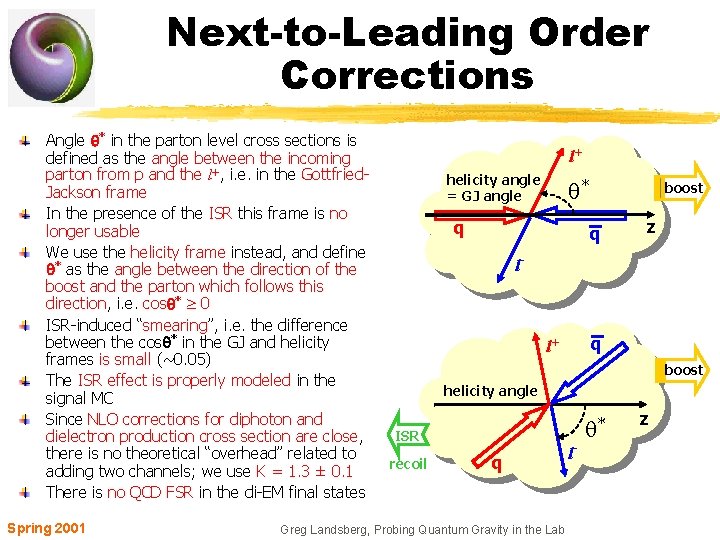
Next-to-Leading Order Corrections Angle q* in the parton level cross sections is defined as the angle between the incoming parton from p and the l+, i. e. in the Gottfried. Jackson frame In the presence of the ISR this frame is no longer usable We use the helicity frame instead, and define q* as the angle between the direction of the boost and the parton which follows this direction, i. e. cosq* 0 ISR-induced “smearing”, i. e. the difference between the cosq* in the GJ and helicity frames is small (~0. 05) The ISR effect is properly modeled in the signal MC Since NLO corrections for diphoton and dielectron production cross section are close, there is no theoretical “overhead” related to adding two channels; we use K = 1. 3 ± 0. 1 There is no QCD FSR in the di-EM final states Spring 2001 l+ helicity angle = GJ angle * q boost q z l- q l+ boost helicity angle ISR recoil q Greg Landsberg, Probing Quantum Gravity in the Lab l- * z
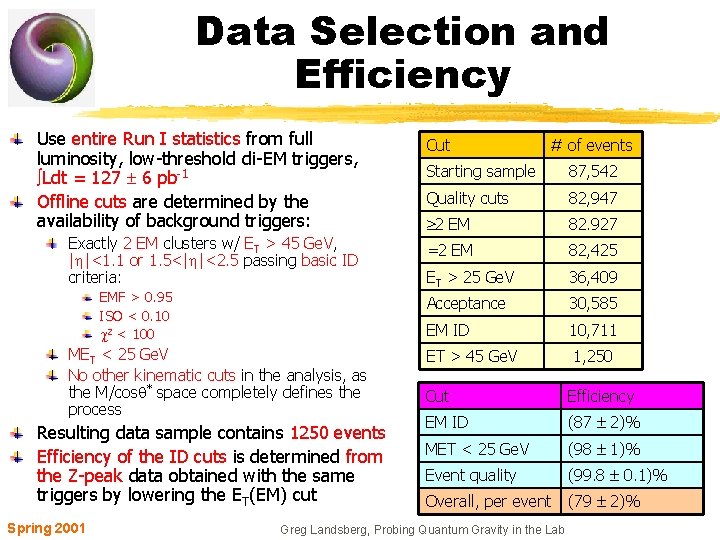
Data Selection and Efficiency Use entire Run I statistics from full luminosity, low-threshold di-EM triggers, Ldt = 127 6 pb-1 Offline cuts are determined by the availability of background triggers: Exactly 2 EM clusters w/ ET > 45 Ge. V, |h|<1. 1 or 1. 5<|h|<2. 5 passing basic ID criteria: EMF > 0. 95 ISO < 0. 10 c 2 < 100 MET < 25 Ge. V No other kinematic cuts in the analysis, as the M/cos * space completely defines the process Resulting data sample contains 1250 events Efficiency of the ID cuts is determined from the Z-peak data obtained with the same triggers by lowering the ET(EM) cut Spring 2001 Cut # of events Starting sample 87, 542 Quality cuts 82, 947 2 EM 82. 927 =2 EM 82, 425 ET > 25 Ge. V 36, 409 Acceptance 30, 585 EM ID 10, 711 ET > 45 Ge. V 1, 250 Cut Efficiency EM ID (87 2)% MET < 25 Ge. V (98 1)% Event quality (99. 8 0. 1)% Overall, per event (79 2)% Greg Landsberg, Probing Quantum Gravity in the Lab

Signal and SM Background Monte Carlo Based on Cheung/GL LO parton level generator [PRD 62, 076003 (2000)] that produces weighted events Augmented w/ fast parametric DØ detector simulation that properly models: DØ detector acceptance and resolutions Primary vertex smearing and resolution Effects of additional vertices from multiple interactions in the event Transverse kick of the di-EM system to account for ISR effects Integration over parton distribution functions (CTEQ 4 LO and other modern p. d. f. ) K-factor correction to the cross sections Both SM and gravity effects Spring 2001 SM s 8 Greg Landsberg, Probing Quantum Gravity in the Lab s 4 MS = 1 Te. V n=4
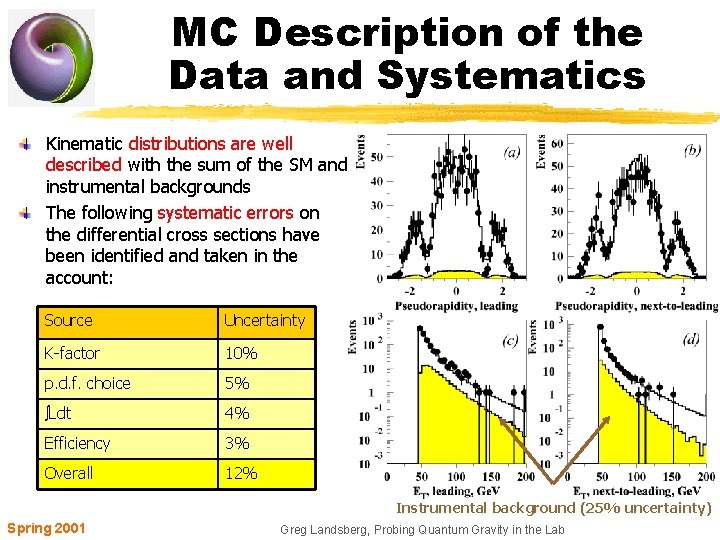
MC Description of the Data and Systematics Kinematic distributions are well described with the sum of the SM and instrumental backgrounds The following systematic errors on the differential cross sections have been identified and taken in the account: Source Uncertainty K-factor 10% p. d. f. choice 5% Ldt 4% Efficiency 3% Overall 12% Instrumental background (25% uncertainty) Spring 2001 Greg Landsberg, Probing Quantum Gravity in the Lab
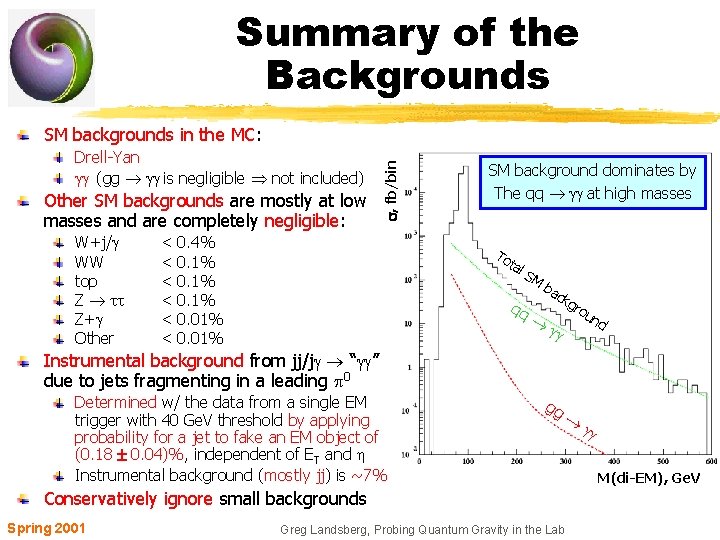
Summary of the Backgrounds Drell-Yan gg (gg gg is negligible not included) Other SM backgrounds are mostly at low masses and are completely negligible: W+j/g WW top Z tt Z+g Other < < < s, fb/bin SM backgrounds in the MC: 0. 4% 0. 1% 0. 01% SM background dominates by The qq gg at high masses To tal SM qq ba ck g ro un d gg Instrumental background from jj/jg “gg” due to jets fragmenting in a leading p 0 Determined w/ the data from a single EM trigger with 40 Ge. V threshold by applying probability for a jet to fake an EM object of (0. 18 0. 04)%, independent of ET and h Instrumental background (mostly jj) is ~7% gg Conservatively ignore small backgrounds Spring 2001 Greg Landsberg, Probing Quantum Gravity in the Lab gg M(di-EM), Ge. V
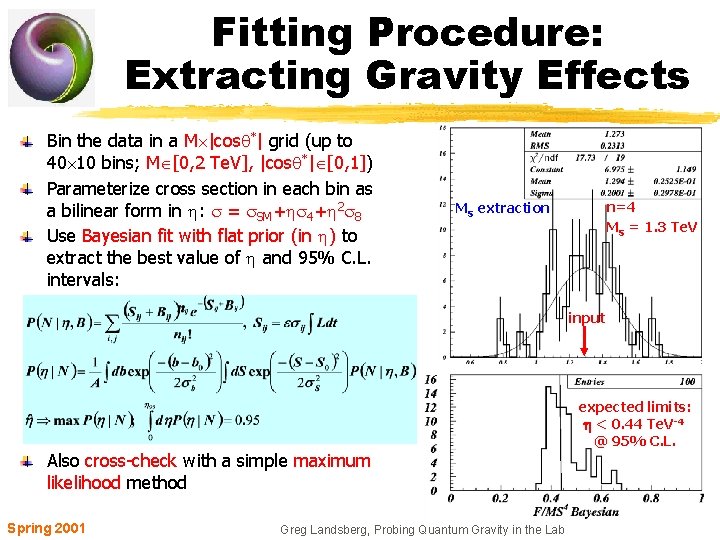
Fitting Procedure: Extracting Gravity Effects Bin the data in a M |cos *| grid (up to 40 10 bins; M [0, 2 Te. V], |cos *| [0, 1]) Parameterize cross section in each bin as a bilinear form in h: s = s. SM+hs 4+h 2 s 8 Use Bayesian fit with flat prior (in h) to extract the best value of h and 95% C. L. intervals: n=4 MS = 1. 3 Te. V MS extraction input expected limits: h < 0. 44 Te. V-4 @ 95% C. L. Also cross-check with a simple maximum likelihood method Spring 2001 Greg Landsberg, Probing Quantum Gravity in the Lab
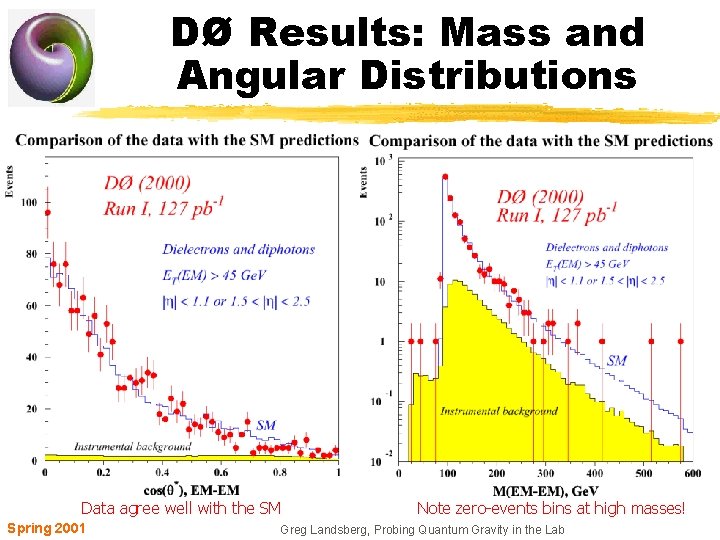
DØ Results: Mass and Angular Distributions Instrumental background Data agree well with the SM Spring 2001 Note zero-events bins at high masses! Greg Landsberg, Probing Quantum Gravity in the Lab
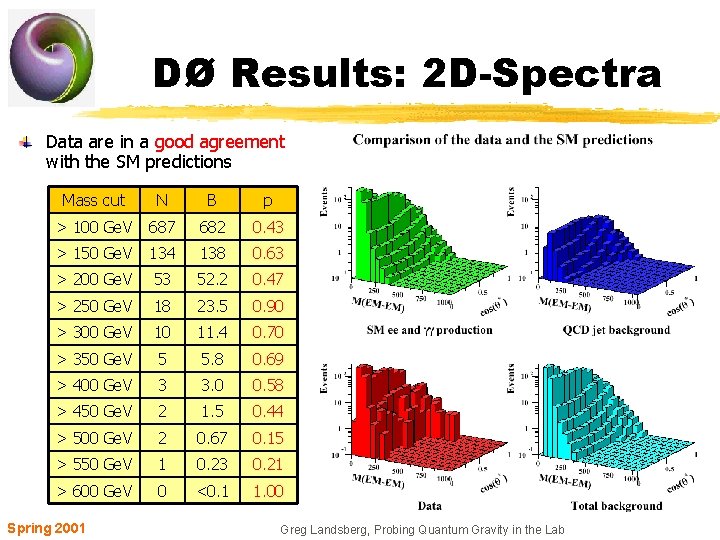
DØ Results: 2 D-Spectra Data are in a good agreement with the SM predictions Mass cut N B p > 100 Ge. V 687 682 0. 43 > 150 Ge. V 134 138 0. 63 > 200 Ge. V 53 52. 2 0. 47 > 250 Ge. V 18 23. 5 0. 90 > 300 Ge. V 10 11. 4 0. 70 > 350 Ge. V 5 5. 8 0. 69 > 400 Ge. V 3 3. 0 0. 58 > 450 Ge. V 2 1. 5 0. 44 > 500 Ge. V 2 0. 67 0. 15 > 550 Ge. V 1 0. 23 0. 21 > 600 Ge. V 0 <0. 1 1. 00 Spring 2001 Greg Landsberg, Probing Quantum Gravity in the Lab
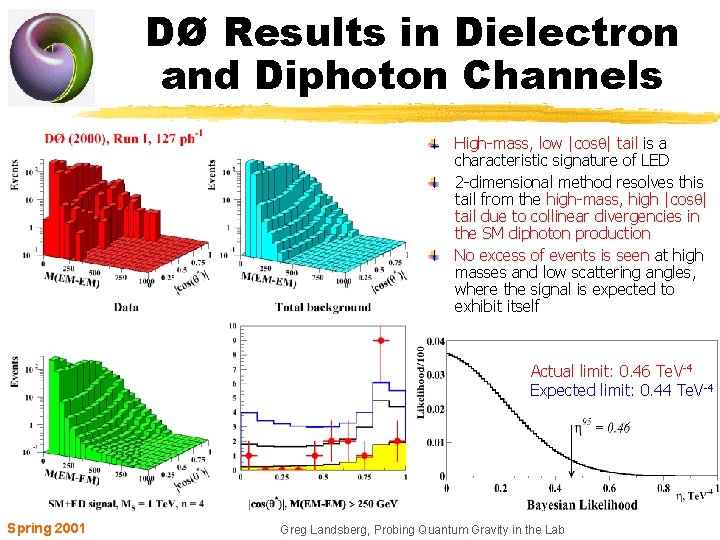
DØ Results in Dielectron and Diphoton Channels High-mass, low |cos | tail is a characteristic signature of LED 2 -dimensional method resolves this tail from the high-mass, high |cos | tail due to collinear divergencies in the SM diphoton production No excess of events is seen at high masses and low scattering angles, where the signal is expected to exhibit itself Actual limit: 0. 46 Te. V-4 Expected limit: 0. 44 Te. V-4 Spring 2001 Greg Landsberg, Probing Quantum Gravity in the Lab
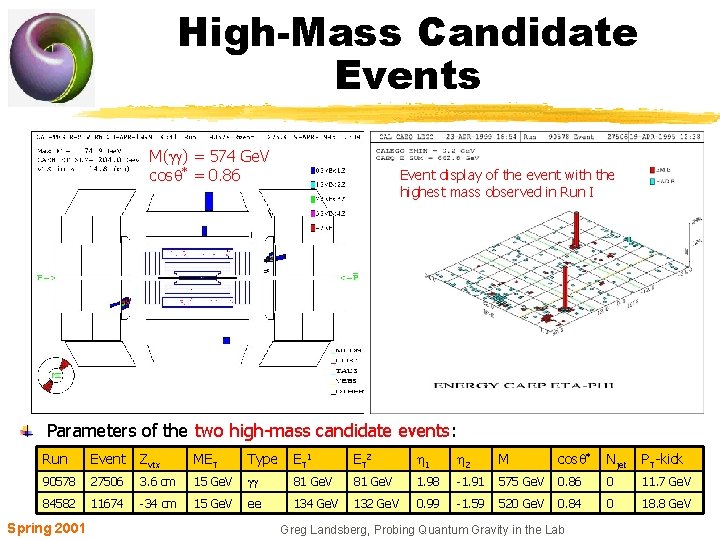
High-Mass Candidate Events M(gg) = 574 Ge. V cos * = 0. 86 Event display of the event with the highest mass observed in Run I Parameters of the two high-mass candidate events: Run Event Zvtx MET Type ET 1 ET 2 h 1 h 2 M cos * Njet PT-kick 90578 27506 3. 6 cm 15 Ge. V gg 81 Ge. V 1. 98 -1. 91 575 Ge. V 0. 86 0 11. 7 Ge. V 84582 11674 -34 cm 15 Ge. V ee 134 Ge. V 132 Ge. V 0. 99 -1. 59 520 Ge. V 0. 84 0 18. 8 Ge. V Spring 2001 Greg Landsberg, Probing Quantum Gravity in the Lab
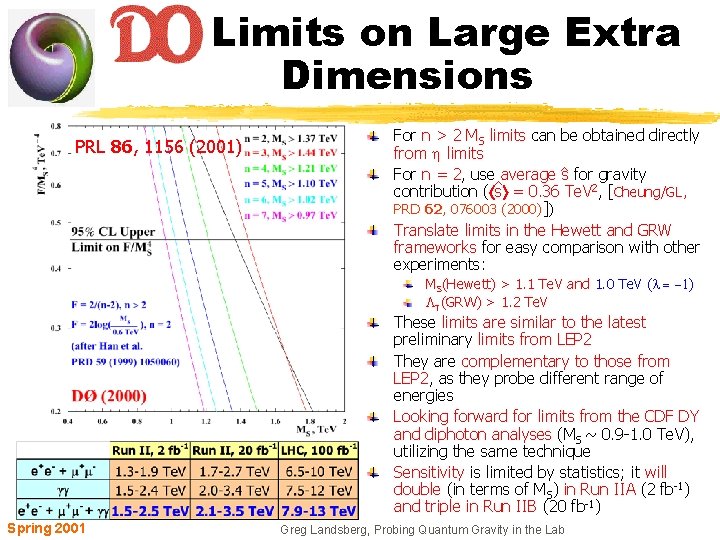
DØ Limits on Large Extra Dimensions PRL 86, 1156 (2001) For n > 2 MS limits can be obtained directly from h limits For n = 2, use average ^s for gravity ^ contribution ( s = 0. 36 Te. V 2, [Cheung/GL, PRD 62, 076003 (2000)]) Translate limits in the Hewett and GRW frameworks for easy comparison with other experiments: MS(Hewett) > 1. 1 Te. V and 1. 0 Te. V (l = -1) LT(GRW) > 1. 2 Te. V These limits are similar to the latest preliminary limits from LEP 2 They are complementary to those from LEP 2, as they probe different range of energies Looking forward for limits from the CDF DY and diphoton analyses (MS ~ 0. 9 -1. 0 Te. V), utilizing the same technique Sensitivity is limited by statistics; it will double (in terms of MS) in Run IIA (2 fb-1) and triple in Run IIB (20 fb-1) Spring 2001 Greg Landsberg, Probing Quantum Gravity in the Lab
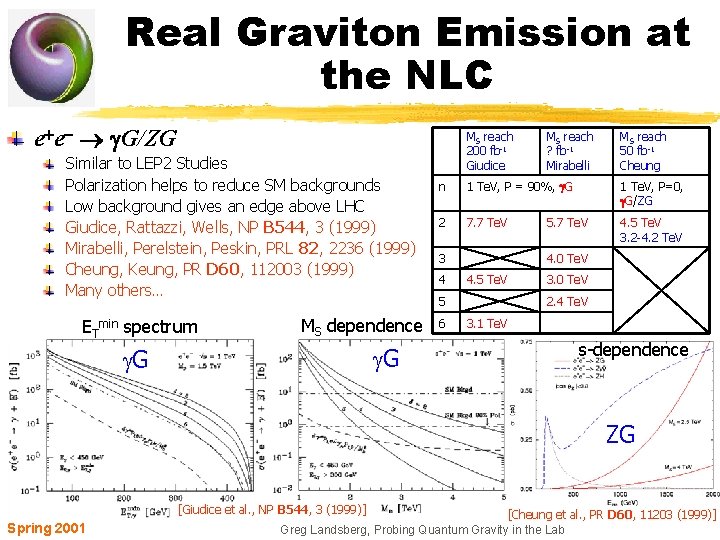
Real Graviton Emission at the NLC e+e- g. G/ZG Similar to LEP 2 Studies Polarization helps to reduce SM backgrounds Low background gives an edge above LHC Giudice, Rattazzi, Wells, NP B 544, 3 (1999) Mirabelli, Perelstein, Peskin, PRL 82, 2236 (1999) Cheung, Keung, PR D 60, 112003 (1999) Many others… ETmin spectrum MS dependence g. G MS reach 200 fb-1 Giudice MS reach ? fb-1 Mirabelli MS reach 50 fb-1 Cheung n 1 Te. V, P = 90%, g. G 1 Te. V, P=0, g. G/ZG 2 7. 7 Te. V 4. 5 Te. V 3. 2 -4. 2 Te. V 3 4 4. 0 Te. V 4. 5 Te. V 5 6 5. 7 Te. V 3. 0 Te. V 2. 4 Te. V 3. 1 Te. V s-dependence ZG [Giudice et al. , NP B 544, 3 (1999)] Spring 2001 [Cheung et al. , PR D 60, 11203 (1999)] Greg Landsberg, Probing Quantum Gravity in the Lab
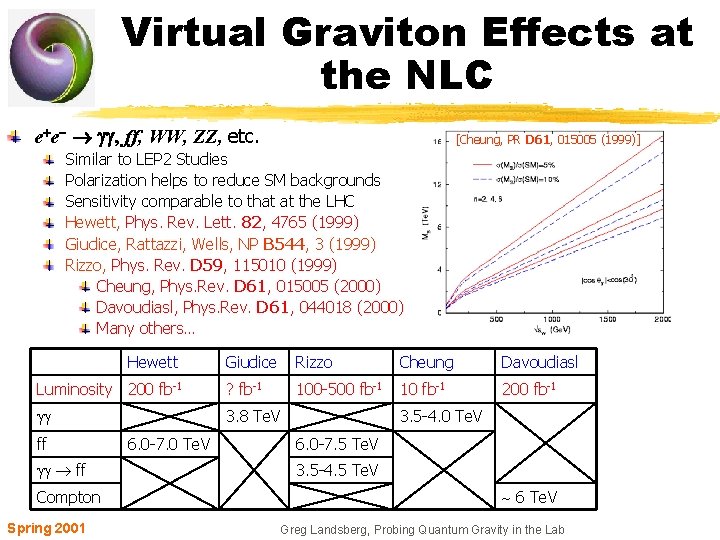
Virtual Graviton Effects at the NLC e+e- gg, ff, WW, ZZ, etc. [Cheung, PR D 61, 015005 (1999)] Similar to LEP 2 Studies Polarization helps to reduce SM backgrounds Sensitivity comparable to that at the LHC Hewett, Phys. Rev. Lett. 82, 4765 (1999) Giudice, Rattazzi, Wells, NP B 544, 3 (1999) Rizzo, Phys. Rev. D 59, 115010 (1999) Cheung, Phys. Rev. D 61, 015005 (2000) Davoudiasl, Phys. Rev. D 61, 044018 (2000) Many others… Hewett Giudice Rizzo Cheung Davoudiasl Luminosity 200 fb-1 ? fb-1 100 -500 fb-1 10 fb-1 200 fb-1 gg 3. 8 Te. V ff gg ff Compton Spring 2001 6. 0 -7. 0 Te. V 3. 5 -4. 0 Te. V 6. 0 -7. 5 Te. V 3. 5 -4. 5 Te. V 6 Te. V Greg Landsberg, Probing Quantum Gravity in the Lab
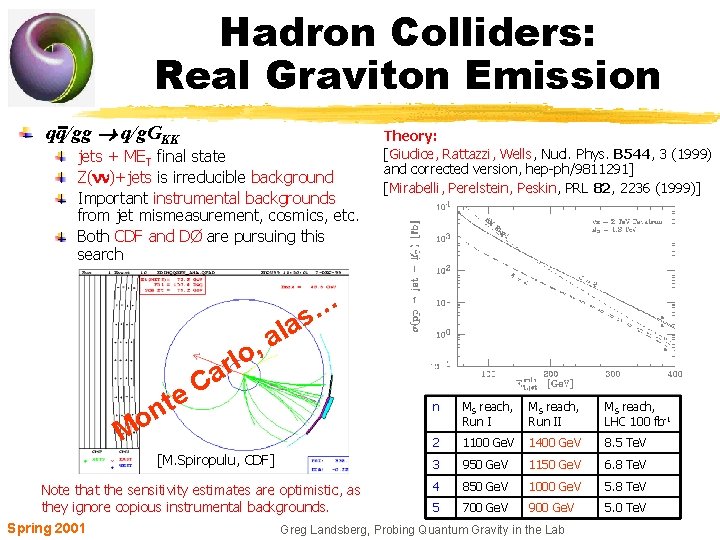
Hadron Colliders: Real Graviton Emission qq/gg q/g. GKK jets + MET final state Z(nn)+jets is irreducible background Important instrumental backgrounds from jet mismeasurement, cosmics, etc. Both CDF and DØ are pursuing this search Theory: [Giudice, Rattazzi, Wells, Nucl. Phys. B 544, 3 (1999) and corrected version, hep-ph/9811291] [Mirabelli, Perelstein, Peskin, PRL 82, 2236 (1999)] … s la a , lo r a C e t n Mo [M. Spiropulu, CDF] Note that the sensitivity estimates are optimistic, as they ignore copious instrumental backgrounds. Spring 2001 n MS reach, Run II MS reach, LHC 100 fb-1 2 1100 Ge. V 1400 Ge. V 8. 5 Te. V 3 950 Ge. V 1150 Ge. V 6. 8 Te. V 4 850 Ge. V 1000 Ge. V 5. 8 Te. V 5 700 Ge. V 900 Ge. V 5. 0 Te. V Greg Landsberg, Probing Quantum Gravity in the Lab
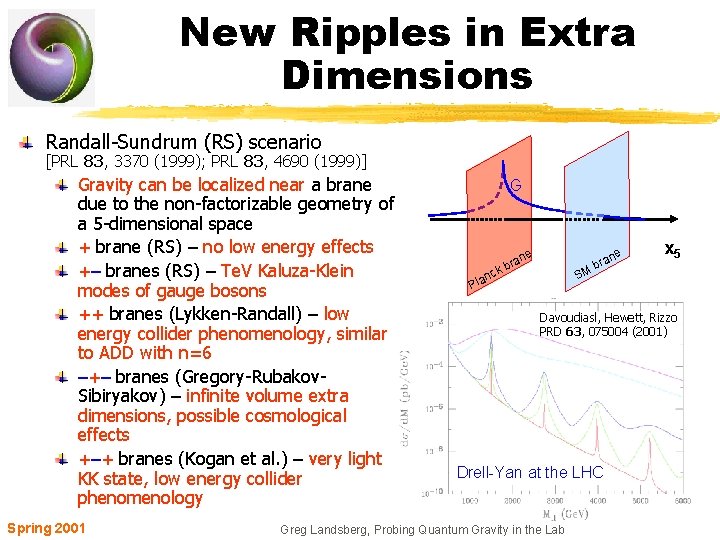
New Ripples in Extra Dimensions Randall-Sundrum (RS) scenario [PRL 83, 3370 (1999); PRL 83, 4690 (1999)] Gravity can be localized near a brane due to the non-factorizable geometry of a 5 -dimensional space + brane (RS) – no low energy effects +– branes (RS) – Te. V Kaluza-Klein modes of gauge bosons ++ branes (Lykken-Randall) – low energy collider phenomenology, similar to ADD with n=6 –+– branes (Gregory-Rubakov. Sibiryakov) – infinite volume extra dimensions, possible cosmological effects +–+ branes (Kogan et al. ) – very light KK state, low energy collider phenomenology Spring 2001 G ck n Pla n bra e e SM n bra x 5 Davoudiasl, Hewett, Rizzo PRD 63, 075004 (2001) Drell-Yan at the LHC Greg Landsberg, Probing Quantum Gravity in the Lab
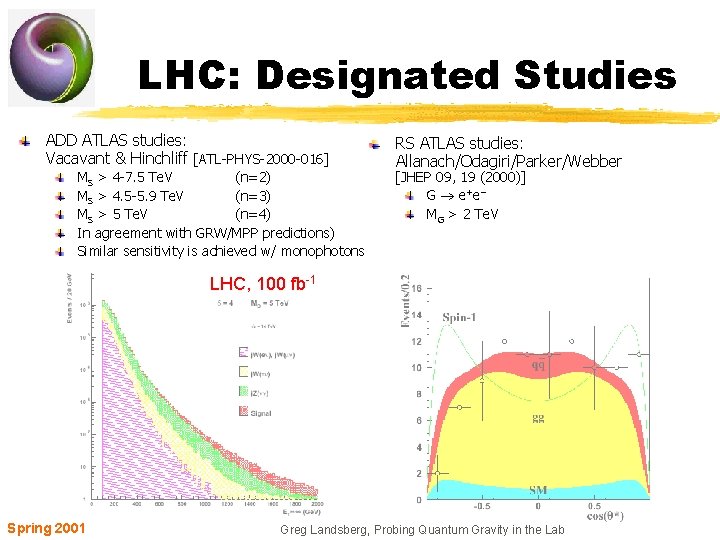
LHC: Designated Studies ADD ATLAS studies: Vacavant & Hinchliff [ATL-PHYS-2000 -016] MS > 4 -7. 5 Te. V (n=2) MS > 4. 5 -5. 9 Te. V (n=3) MS > 5 Te. V (n=4) In agreement with GRW/MPP predictions) Similar sensitivity is achieved w/ monophotons RS ATLAS studies: Allanach/Odagiri/Parker/Webber [JHEP 09, 19 (2000)] G e + e– MG > 2 Te. V LHC, 100 fb-1 Spring 2001 Greg Landsberg, Probing Quantum Gravity in the Lab
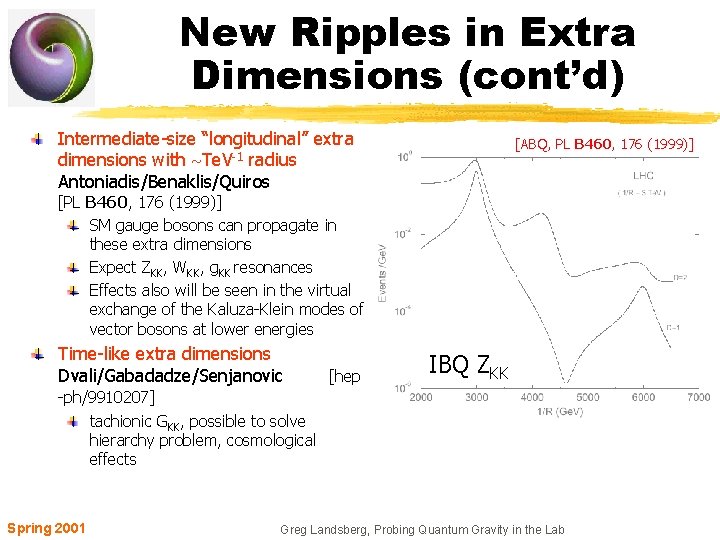
New Ripples in Extra Dimensions (cont’d) Intermediate-size “longitudinal” extra dimensions with Te. V-1 radius Antoniadis/Benaklis/Quiros [ABQ, PL B 460, 176 (1999)] [PL B 460, 176 (1999)] SM gauge bosons can propagate in these extra dimensions Expect ZKK, WKK, g. KK resonances Effects also will be seen in the virtual exchange of the Kaluza-Klein modes of vector bosons at lower energies Time-like extra dimensions Dvali/Gabadadze/Senjanovic [hep IBQ ZKK -ph/9910207] tachionic GKK, possible to solve hierarchy problem, cosmological effects Spring 2001 Greg Landsberg, Probing Quantum Gravity in the Lab
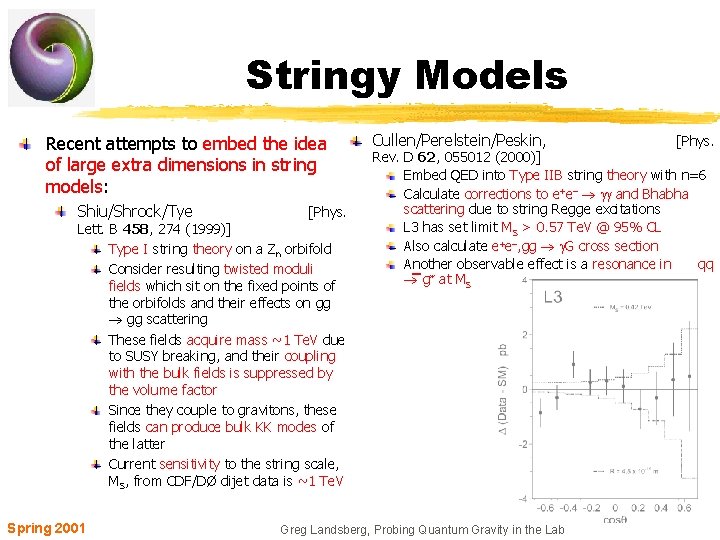
Stringy Models Recent attempts to embed the idea of large extra dimensions in string models: Shiu/Shrock/Tye [Phys. Lett. B 458, 274 (1999)] Type I string theory on a Zn orbifold Consider resulting twisted moduli fields which sit on the fixed points of the orbifolds and their effects on gg scattering These fields acquire mass ~1 Te. V due to SUSY breaking, and their coupling with the bulk fields is suppressed by the volume factor Since they couple to gravitons, these fields can produce bulk KK modes of the latter Current sensitivity to the string scale, MS, from CDF/DØ dijet data is ~1 Te. V Spring 2001 Cullen/Perelstein/Peskin, [Phys. Rev. D 62, 055012 (2000)] Embed QED into Type IIB string theory with n=6 Calculate corrections to e+e- gg and Bhabha scattering due to string Regge excitations L 3 has set limit MS > 0. 57 Te. V @ 95% CL Also calculate e+e-, gg g. G cross section Another observable effect is a resonance in qq * g at MS Greg Landsberg, Probing Quantum Gravity in the Lab
Black Hole Production Once the c. m. energy exceeds the compactification scale, MS, a critical energy density is achieved and the black hole is formed Not to worry about the Earth being sucked into such a black hole; they should be constantly formed by cosmic rays The temperature of such a black hole is: T= MPl 2/M MS 2/M O(M/MS) MS For MS T = 1 Te. V, the black body spectrum peaks at 250 Ge. V, and therefore the BH technically evaporates by emitting a single energetic photon – not quite a black body! Moreover, the lifetime of such a black hole is only 10 -29 s The Scwartzchild radius of such a black hole is 1/MS, i. e. it’s de Broglie wavelength; it’s not clear of one could even consider such an object as a bound state Spring 2001 Other possibility is evaporation in the bulk via GKK, in which case the signature is a deficit of high-s events At a hadron collider it’s easy to tweak p. d. f. to account for such a deficit At a lepton collider it’s hard to establish that the beams have not missed each other in one of the better established spatial dimensions Unlikely due to the s-wave dominance [Emparan, Horowitz, Mayer, PRL 85, 499 (2000)] Interesting possibility for a black hole is to have a color ‘hair’ that holds it to our brane; if the color quantum number is conserved, the black hole could be metastable and live seconds or even days before it decays in a large number of hadrons Look for events not in time with the accelerator clock with such a distinct signature (Dvali, GL, Matchev) Greg Landsberg, Probing Quantum Gravity in the Lab
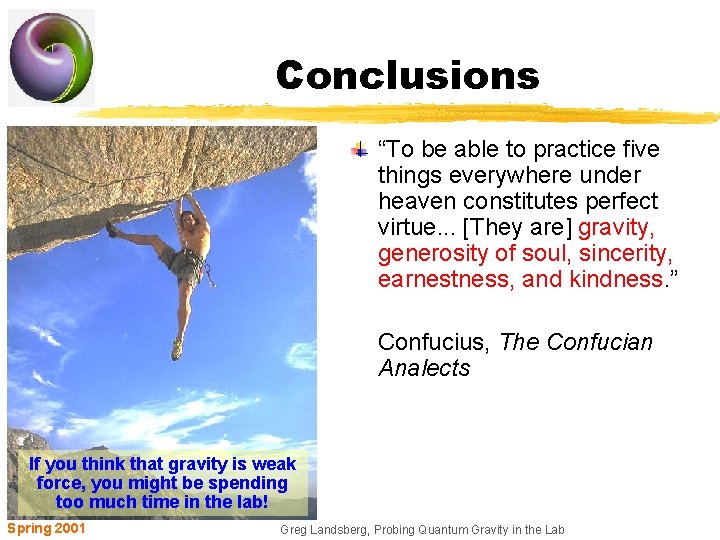
Conclusions “To be able to practice five things everywhere under heaven constitutes perfect virtue. . . [They are] gravity, generosity of soul, sincerity, earnestness, and kindness. ” Confucius, The Confucian Analects If you think that gravity is weak force, you might be spending too much time in the lab! Spring 2001 Greg Landsberg, Probing Quantum Gravity in the Lab
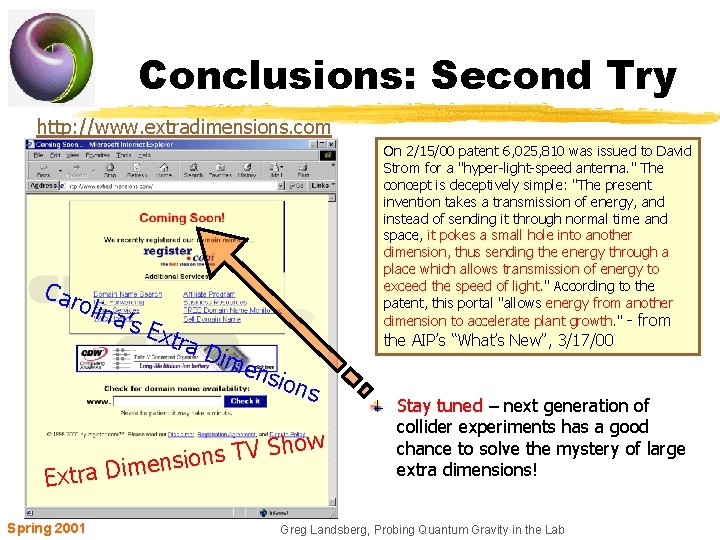
Conclusions: Second Try http: //www. extradimensions. com Car olin Extra Spring 2001 a’ s On 2/15/00 patent 6, 025, 810 was issued to David Strom for a "hyper-light-speed antenna. " The concept is deceptively simple: "The present invention takes a transmission of energy, and instead of sending it through normal time and space, it pokes a small hole into another dimension, thus sending the energy through a place which allows transmission of energy to exceed the speed of light. " According to the patent, this portal "allows energy from another dimension to accelerate plant growth. " - from Extr a. D ime the AIP’s “What’s New”, 3/17/00 nsio n s ow h S V T s n Dimensio Stay tuned – next generation of collider experiments has a good chance to solve the mystery of large extra dimensions! Greg Landsberg, Probing Quantum Gravity in the Lab
- Slides: 45