
Outlook for shale gas and tight oil development


- Slides: 23
Outlook for shale gas and tight oil development in the U. S. For Washington Association of Money Managers April 18, 2013 | Washington, DC By Adam Sieminski, Administrator U. S. Energy Information Administration Independent Statistics & Analysis www. eia. gov
U. S. Shale Gas Adam Sieminski , WAMM, April 18, 2013 2
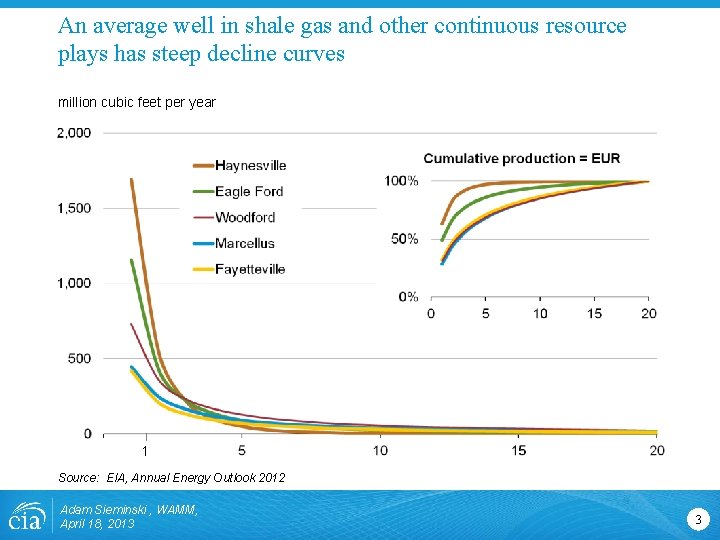
An average well in shale gas and other continuous resource plays has steep decline curves million cubic feet per year 1 Source: EIA, Annual Energy Outlook 2012 Adam Sieminski , WAMM, April 18, 2013 3
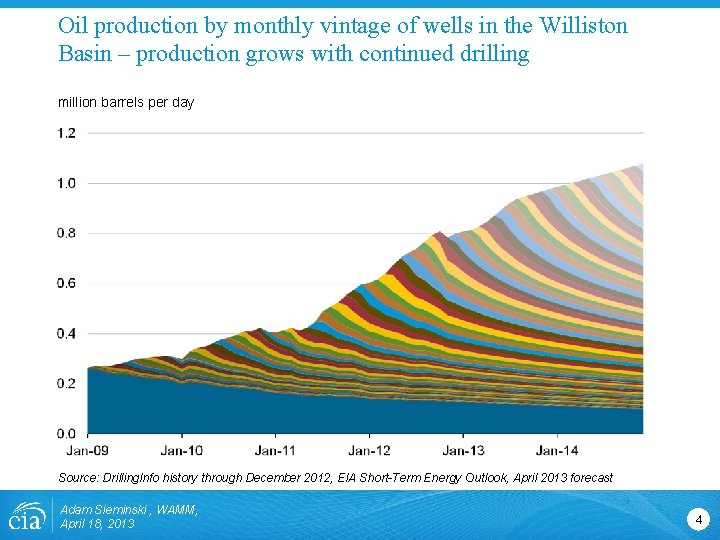
Oil production by monthly vintage of wells in the Williston Basin – production grows with continued drilling million barrels per day Source: Drilling. Info history through December 2012, EIA Short-Term Energy Outlook, April 2013 forecast Adam Sieminski , WAMM, April 18, 2013 4
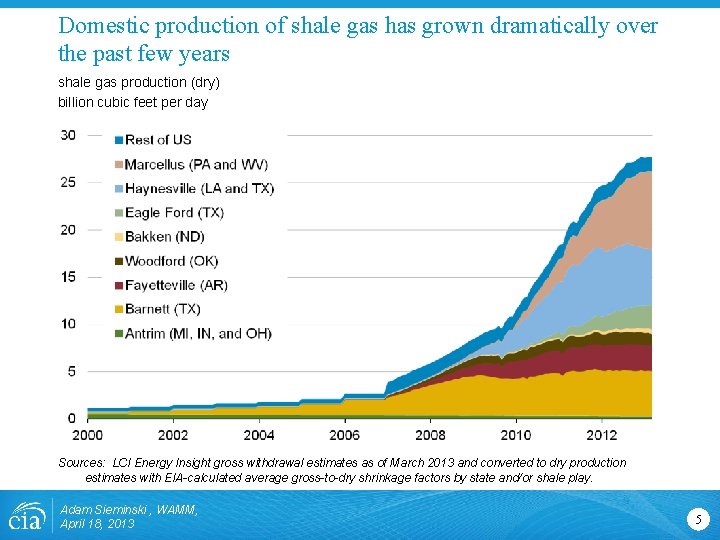
Domestic production of shale gas has grown dramatically over the past few years shale gas production (dry) billion cubic feet per day Sources: LCI Energy Insight gross withdrawal estimates as of March 2013 and converted to dry production estimates with EIA-calculated average gross-to-dry shrinkage factors by state and/or shale play. Adam Sieminski , WAMM, April 18, 2013 5
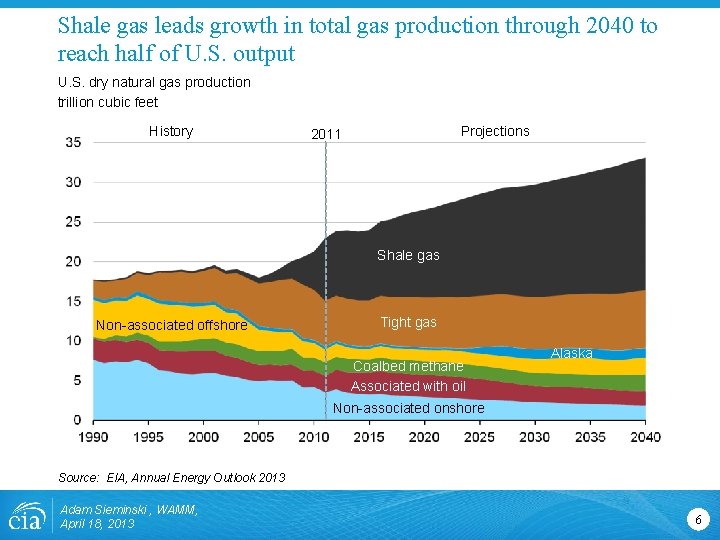
Shale gas leads growth in total gas production through 2040 to reach half of U. S. output U. S. dry natural gas production trillion cubic feet History Projections 2011 Shale gas Non-associated offshore Tight gas Coalbed methane Associated with oil Alaska Non-associated onshore Source: EIA, Annual Energy Outlook 2013 Adam Sieminski , WAMM, April 18, 2013 6
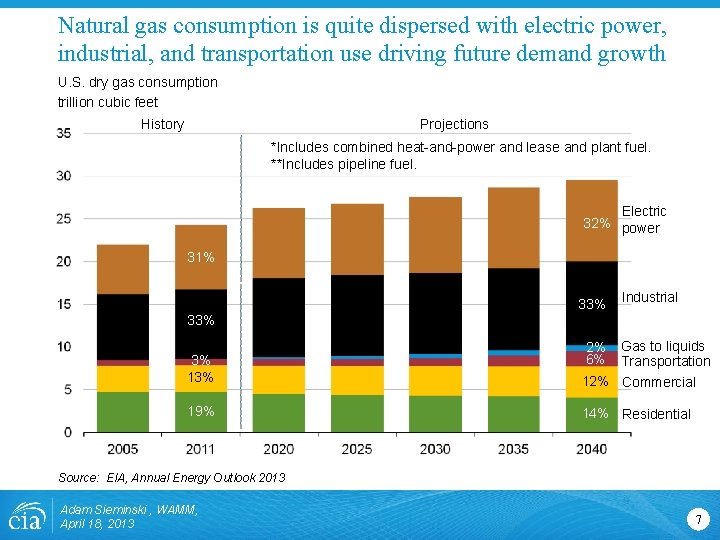
Natural gas consumption is quite dispersed with electric power, industrial, and transportation use driving future demand growth U. S. dry gas consumption trillion cubic feet History Projections *Includes combined heat-and-power and lease and plant fuel. **Includes pipeline fuel. Electric 32% power 31% 33% Industrial 33% 2% 6% Gas to liquids Transportation 3% 12% Commercial 19% 14% Residential Source: EIA, Annual Energy Outlook 2013 Adam Sieminski , WAMM, April 18, 2013 7
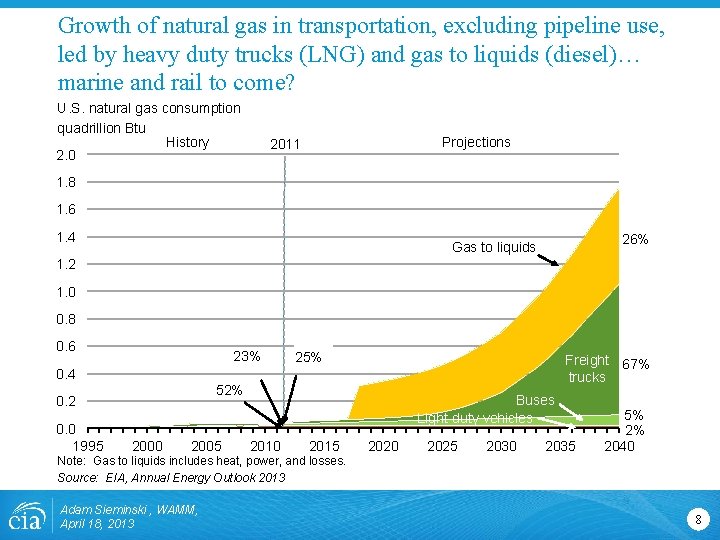
Growth of natural gas in transportation, excluding pipeline use, led by heavy duty trucks (LNG) and gas to liquids (diesel)… marine and rail to come? U. S. natural gas consumption quadrillion Btu History 2. 0 Projections 2011 1. 8 1. 6 1. 4 26% Gas to liquids 1. 2 1. 0 0. 8 0. 6 23% 25% Freight 67% trucks 0. 4 52% 0. 2 0. 0 1995 Buses Light-duty vehicles 95% 2000 2005 2010 2015 2020 2025 2030 2035 5% 2% 2040 Note: Gas to liquids includes heat, power, and losses. Source: EIA, Annual Energy Outlook 2013 Adam Sieminski , WAMM, April 18, 2013 8
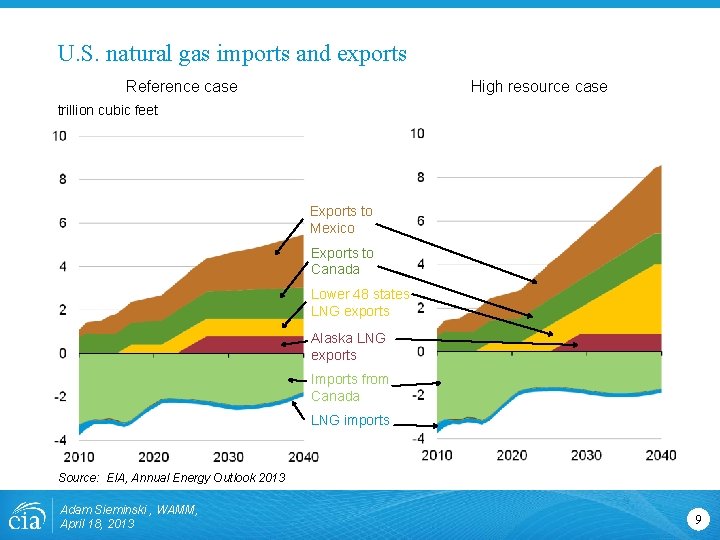
U. S. natural gas imports and exports High resource case Reference case trillion cubic feet Exports to Mexico Exports to Canada Lower 48 states LNG exports Alaska LNG exports Imports from Canada LNG imports Source: EIA, Annual Energy Outlook 2013 Adam Sieminski , WAMM, April 18, 2013 9
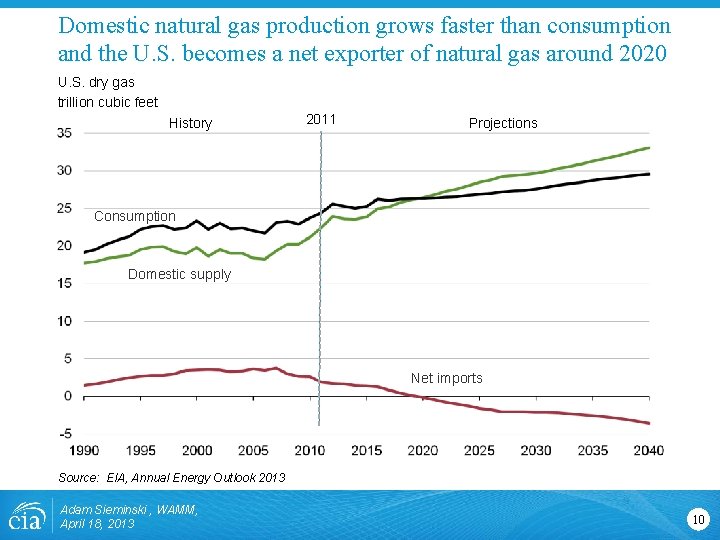
Domestic natural gas production grows faster than consumption and the U. S. becomes a net exporter of natural gas around 2020 U. S. dry gas trillion cubic feet History 2011 Projections Consumption Domestic supply Net imports Source: EIA, Annual Energy Outlook 2013 Adam Sieminski , WAMM, April 18, 2013 10
U. S. Tight Oil Adam Sieminski , WAMM, April 18, 2013 11
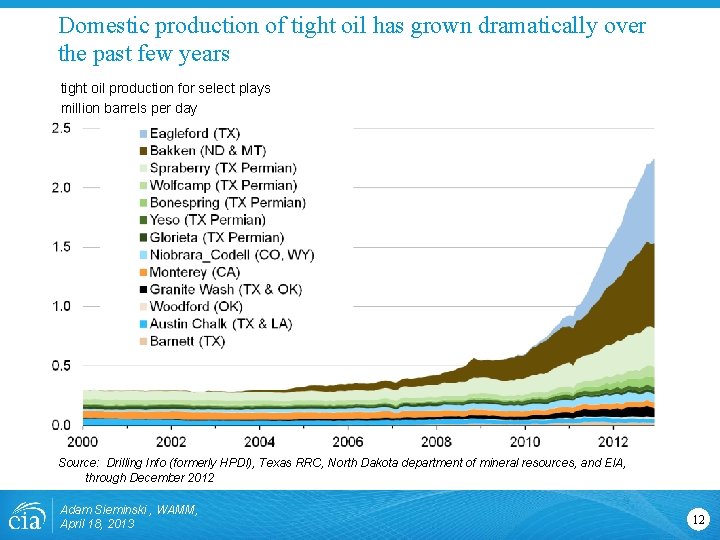
Domestic production of tight oil has grown dramatically over the past few years tight oil production for select plays million barrels per day Source: Drilling Info (formerly HPDI), Texas RRC, North Dakota department of mineral resources, and EIA, through December 2012 Adam Sieminski , WAMM, April 18, 2013 12
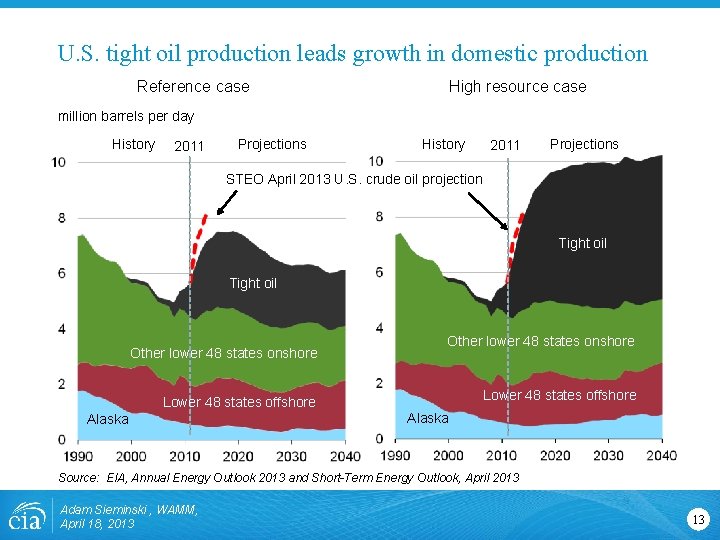
U. S. tight oil production leads growth in domestic production Reference case High resource case million barrels per day History 2011 Projections STEO April 2013 U. S. crude oil projection Tight oil Other lower 48 states onshore Lower 48 states offshore Alaska Source: EIA, Annual Energy Outlook 2013 and Short-Term Energy Outlook, April 2013 Adam Sieminski , WAMM, April 18, 2013 13
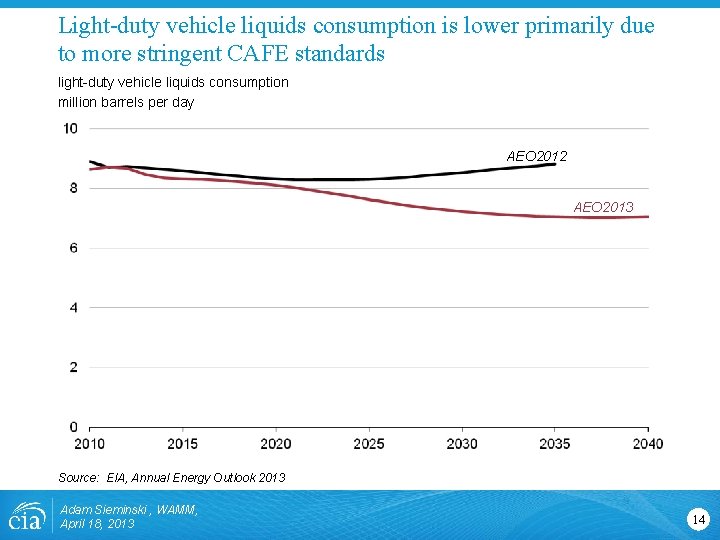
Light-duty vehicle liquids consumption is lower primarily due to more stringent CAFE standards light-duty vehicle liquids consumption million barrels per day AEO 2012 AEO 2013 Source: EIA, Annual Energy Outlook 2013 Adam Sieminski , WAMM, April 18, 2013 14
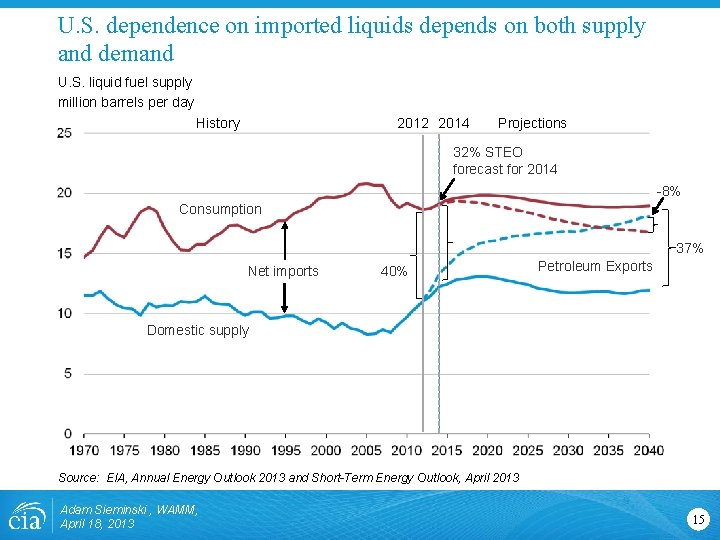
U. S. dependence on imported liquids depends on both supply and demand U. S. liquid fuel supply million barrels per day History 2012 2014 Projections 32% STEO forecast for 2014 -8% Consumption 37% Net imports 40% Petroleum Exports Domestic supply Source: EIA, Annual Energy Outlook 2013 and Short-Term Energy Outlook, April 2013 Adam Sieminski , WAMM, April 18, 2013 15
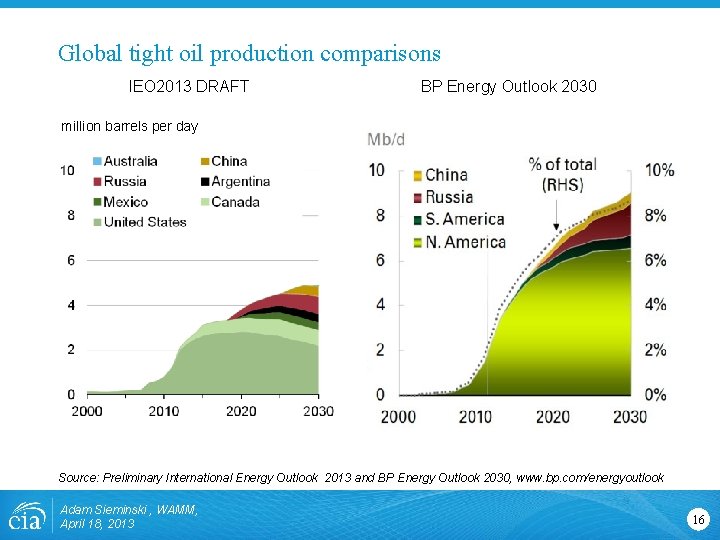
Global tight oil production comparisons IEO 2013 DRAFT BP Energy Outlook 2030 million barrels per day Source: Preliminary International Energy Outlook 2013 and BP Energy Outlook 2030, www. bp. com/energyoutlook Adam Sieminski , WAMM, April 18, 2013 16
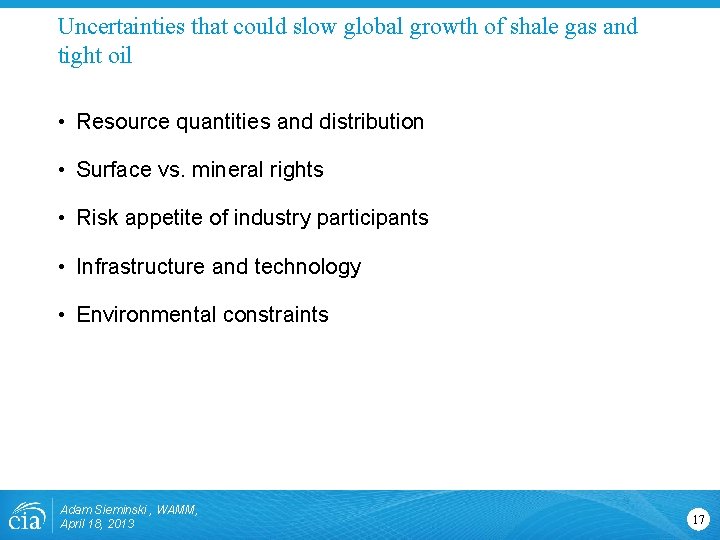
Uncertainties that could slow global growth of shale gas and tight oil • Resource quantities and distribution • Surface vs. mineral rights • Risk appetite of industry participants • Infrastructure and technology • Environmental constraints Adam Sieminski , WAMM, April 18, 2013 17
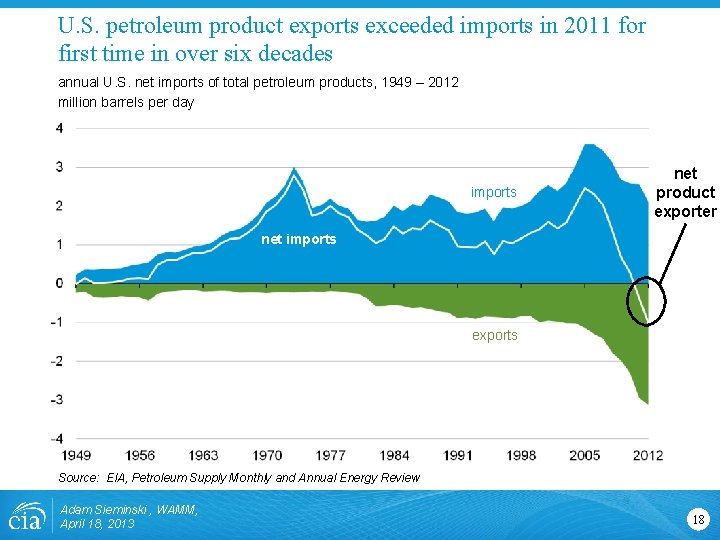
U. S. petroleum product exports exceeded imports in 2011 for first time in over six decades annual U. S. net imports of total petroleum products, 1949 – 2012 million barrels per day imports net product exporter net imports exports Source: EIA, Petroleum Supply Monthly and Annual Energy Review Adam Sieminski , WAMM, April 18, 2013 18
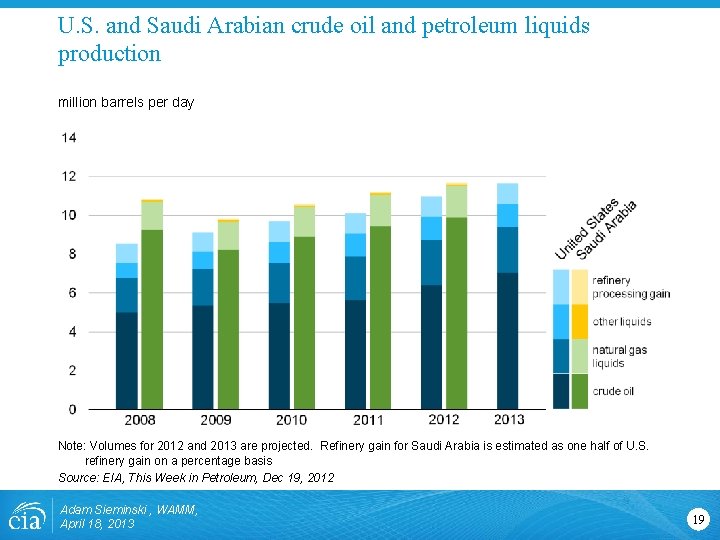
U. S. and Saudi Arabian crude oil and petroleum liquids production million barrels per day Note: Volumes for 2012 and 2013 are projected. Refinery gain for Saudi Arabia is estimated as one half of U. S. refinery gain on a percentage basis Source: EIA, This Week in Petroleum, Dec 19, 2012 Adam Sieminski , WAMM, April 18, 2013 19
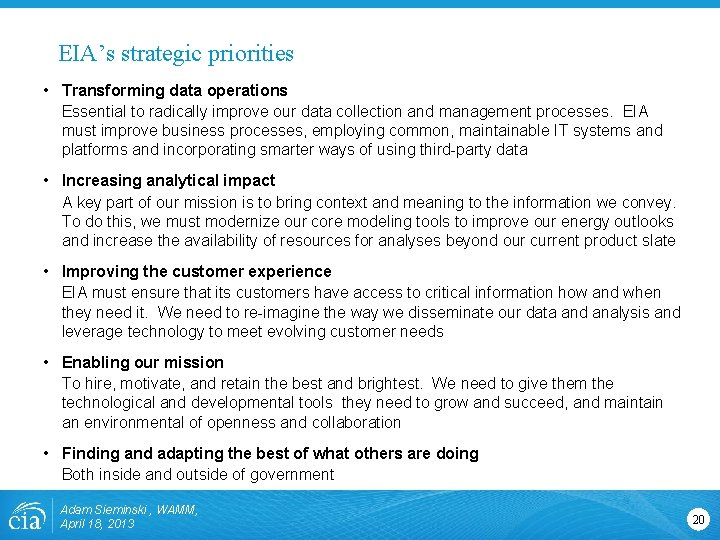
EIA’s strategic priorities • Transforming data operations Essential to radically improve our data collection and management processes. EIA must improve business processes, employing common, maintainable IT systems and platforms and incorporating smarter ways of using third-party data • Increasing analytical impact A key part of our mission is to bring context and meaning to the information we convey. To do this, we must modernize our core modeling tools to improve our energy outlooks and increase the availability of resources for analyses beyond our current product slate • Improving the customer experience EIA must ensure that its customers have access to critical information how and when they need it. We need to re-imagine the way we disseminate our data and analysis and leverage technology to meet evolving customer needs • Enabling our mission To hire, motivate, and retain the best and brightest. We need to give them the technological and developmental tools they need to grow and succeed, and maintain an environmental of openness and collaboration • Finding and adapting the best of what others are doing Both inside and outside of government Adam Sieminski , WAMM, April 18, 2013 20
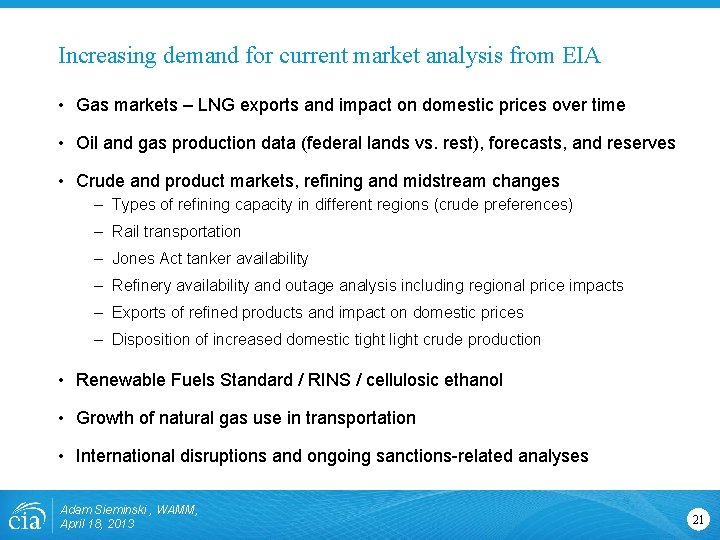
Increasing demand for current market analysis from EIA • Gas markets – LNG exports and impact on domestic prices over time • Oil and gas production data (federal lands vs. rest), forecasts, and reserves • Crude and product markets, refining and midstream changes – Types of refining capacity in different regions (crude preferences) – Rail transportation – Jones Act tanker availability – Refinery availability and outage analysis including regional price impacts – Exports of refined products and impact on domestic prices – Disposition of increased domestic tight light crude production • Renewable Fuels Standard / RINS / cellulosic ethanol • Growth of natural gas use in transportation • International disruptions and ongoing sanctions-related analyses Adam Sieminski , WAMM, April 18, 2013 21
Keynote Speakers Thomas Fanning Chairman, President and CEO Southern Company Aldo Flores-Quiroga Secretary General International Energy Forum Hans Rosling Chairman Gapminder
For more information U. S. Energy Information Administration home page | www. eia. gov Annual Energy Outlook | www. eia. gov/forecasts/aeo Short-Term Energy Outlook | www. eia. gov/forecasts/steo International Energy Outlook | www. eia. gov/forecasts/ieo Today In Energy | www. eia. gov/todayinenergy Monthly Energy Review | www. eia. gov/totalenergy/data/monthly Annual Energy Review | www. eia. gov/totalenergy/data/annual Adam Sieminski , WAMM, April 18, 2013 23