
Outlines r Mobile malcode Overview r Viruses r
Outlines r Mobile malcode Overview r Viruses r Worms
Mobile Malcode Overview r Malicious programs which spread from machine to machine without the consent of the owners/operators/users m Windows Automatic Update is (effectively) consensual r Many strains possible m Viruses m Worms m Compromised Auto-updates • No user action required, very dangerous
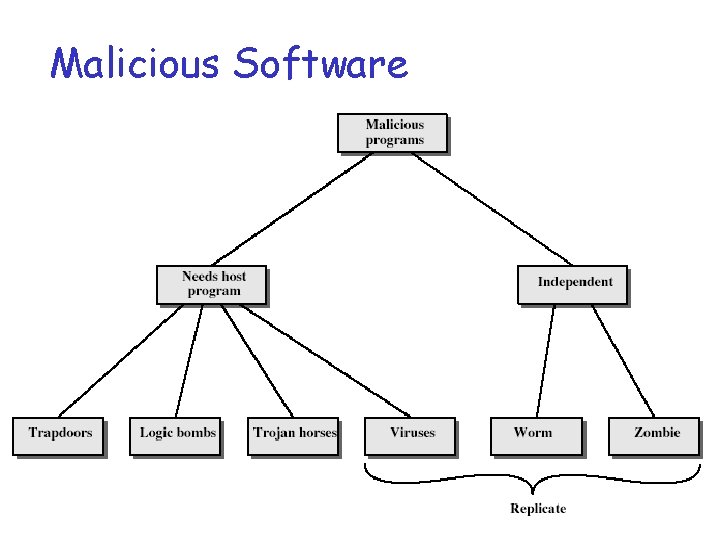
Malicious Software
Trapdoors (Back doors) r Secret entry point into a program r Allows those who know access bypassing usual security procedures, e. g. , authentications r Have been commonly used by developers r A threat when left in production programs allowing exploited by attackers r Very hard to block in O/S r Requires good s/w development & update
Logic Bomb r One of oldest types of malicious software r Code embedded in legitimate program r Activated when specified conditions met m E. g. , presence/absence of some file m Particular date/time m Particular user m Particular series of keystrokes r When triggered typically damage system m Modify/delete files/disks
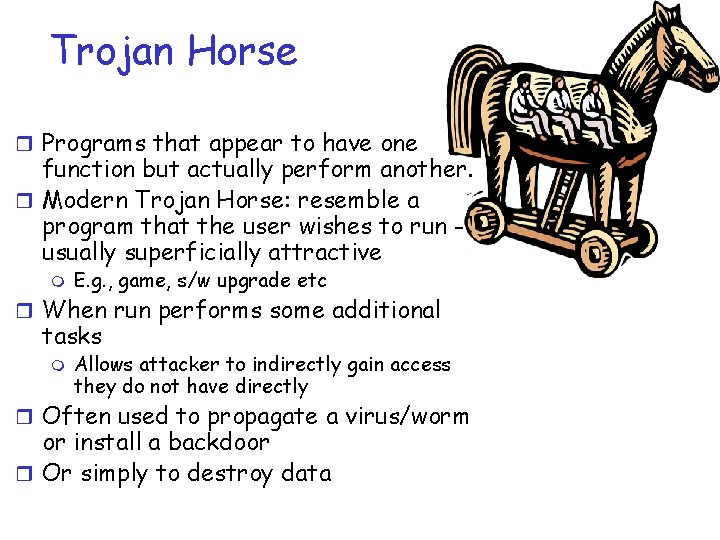
Trojan Horse r Programs that appear to have one function but actually perform another. r Modern Trojan Horse: resemble a program that the user wishes to run usually superficially attractive m E. g. , game, s/w upgrade etc r When run performs some additional tasks m Allows attacker to indirectly gain access they do not have directly r Often used to propagate a virus/worm or install a backdoor r Or simply to destroy data
Zombie r Program which secretly takes over another networked computer r Then uses it to indirectly launch attacks r Often used to launch distributed denial of service (DDo. S) attacks r Exploits known flaws in network systems
Outlines r Mobile malcode Overview r Viruses r Worms r Denial of Services Attacks
Viruses r Definition from RFC 1135: A virus is a piece of code that inserts itself into a host, including operating systems, to propagate. It cannot run independently. It requires that its host program be run to activate it. r On execution m Search for valid target files • Usually executable files • Often only infect uninfected files m Insert a copy into targeted files • When the target is executed, the virus starts running r Only spread when contaminated files are moved from machine to machine r Mature defenses available
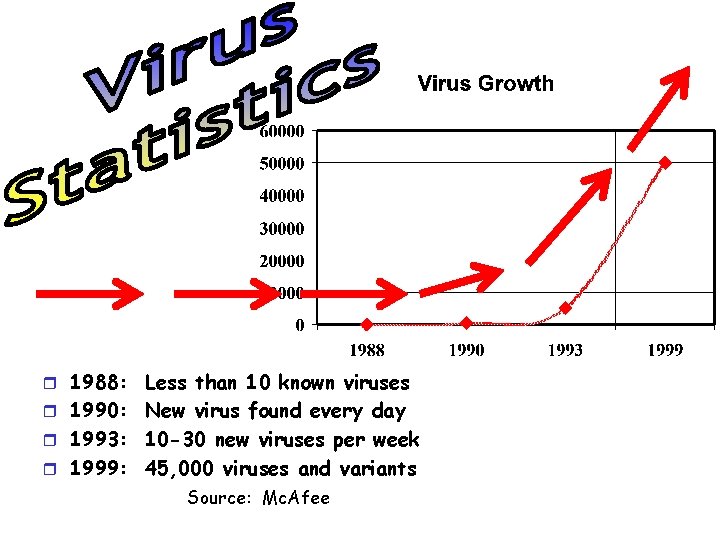
r 1988: Less than 10 known viruses r 1990: New virus found every day r 1993: 10 -30 new viruses per week r 1999: 45, 000 viruses and variants Source: Mc. Afee
Virus Operation r virus phases: m propagation – replicating to programs/disks m dormant – waiting on trigger event m triggering – by event to execute payload m execution – of payload r details usually machine/OS specific m exploiting features/weaknesses
Anatomy of a Virus r Two primary components m Propagation mechanism m Payload r Propagation m Method by which the virus spreads itself. m Old days: single PC, transferred to other hosts by ways of floppy diskettes. m Nowadays: Internet.
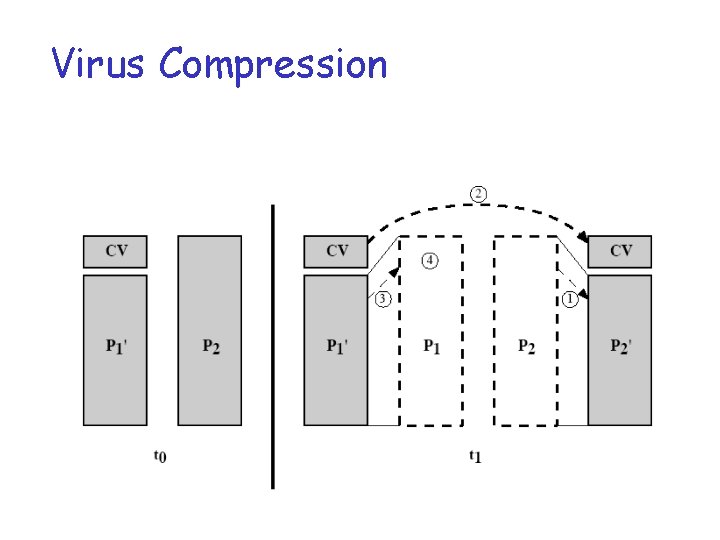
Virus Compression
Virus Infectables I -- Macros r Usually executable files: . com, . exe, . bat r Macro code attached to some data file r Interpreted by program using file m E. g. , Word/Excel macros m Especially using auto command & command macros r Code is now platform independent r Is a major source of new viral infections r Blur distinction between data and program files r Classic trade-off: "ease of use" vs "security” r Have improving security in Word etc r Are no longer dominant virus threat
Virus Infectables (cont’d) r System sector viruses m Infect control sectors on a disk • DOS boot sectors • Partition (MBR) sectors m System sector viruses spread easily via floppy disk infections r Companion viruses m Create a. com files for each. exe files m DOS runs COM files before EXE files m Relatively easy to find and eliminate r Cluster viruses m Change the DOS directory info so that directory entries point to the virus code instead of the real program m Even though every program on the disk may be "infected“, there is only one copy of the virus on the disk
Variable Viruses r Polymorphic viruses m Change with each infection • Executables virus code changing (macros: var name, line spacing, etc. ) • Control flow permutations (rearrange code with goto’s) m Attempt to defeat scanners r Virus writing tool kits have been created to "simplify" creation of new viruses m Current tool kits create viruses that can be detected easily with existing scanner technology m But just a matter of time …
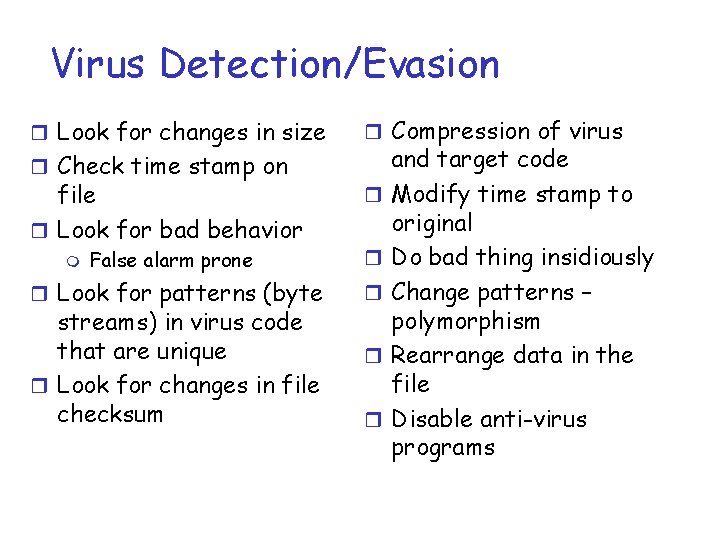
Virus Detection/Evasion r Look for changes in size r Compression of virus r Check time stamp on file r Look for bad behavior r False alarm prone r m r Look for patterns (byte streams) in virus code that are unique r Look for changes in file checksum r r r and target code Modify time stamp to original Do bad thing insidiously Change patterns – polymorphism Rearrange data in the file Disable anti-virus programs
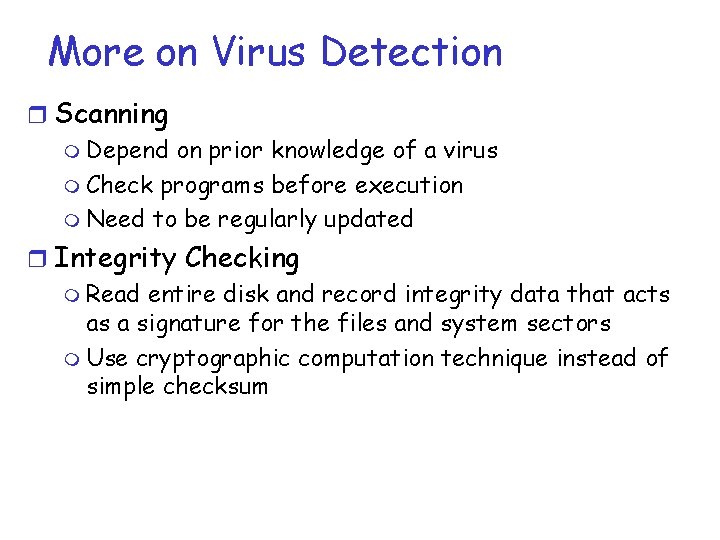
More on Virus Detection r Scanning m Depend on prior knowledge of a virus m Check programs before execution m Need to be regularly updated r Integrity Checking m Read entire disk and record integrity data that acts as a signature for the files and system sectors m Use cryptographic computation technique instead of simple checksum
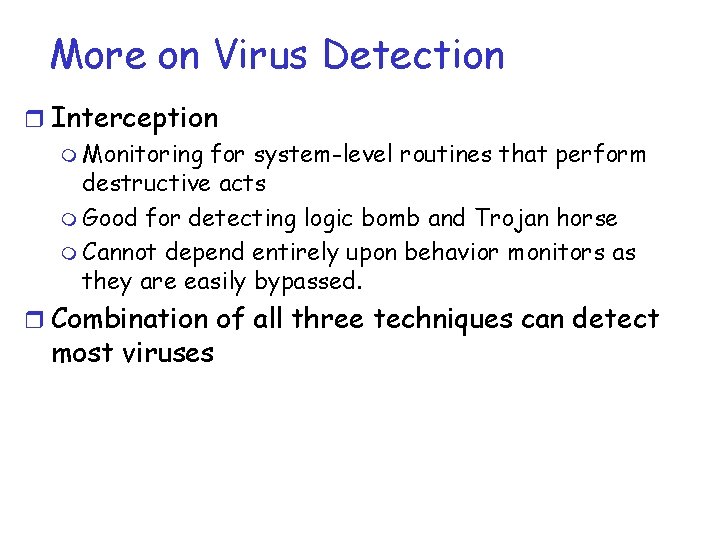
More on Virus Detection r Interception m Monitoring for system-level routines that perform destructive acts m Good for detecting logic bomb and Trojan horse m Cannot depend entirely upon behavior monitors as they are easily bypassed. r Combination of all three techniques can detect most viruses
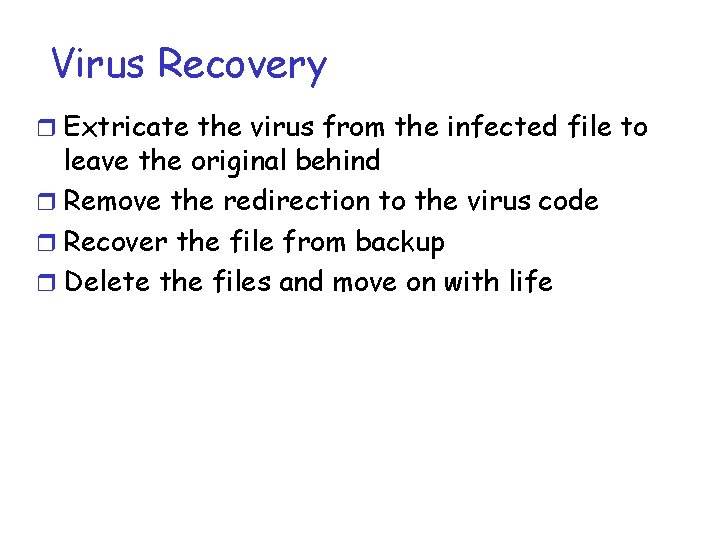
Virus Recovery r Extricate the virus from the infected file to leave the original behind r Remove the redirection to the virus code r Recover the file from backup r Delete the files and move on with life
History of Viruses
First Wild Viruses Apple I/II/III: 1981 r Three viruses for the Apple machines emerged in 1981 m Boot sector viruses r Floppies of that time had the disk operating system (DOS) on them by default m Wrote it without malice
First PC Virus: Pakistani Brain Virus (1986) r Written by Pakistani brothers to protect their copyright m Claim: infect only machines that had an unlicensed copy of their software m Boot sector, memory resident m Printed “Welcome to the Dungeon (c) 1986 Basit * Amjad (pvt) Ltd. BRAIN COMPUTER SERVICES 730 NIZAB BLOCK ALLAMA IQBAL TOWN LAHORE-PAKISTAN PHONE : 430791, 443248, 280530. Beware of this VIRUS. . Contact us for vaccination. . . !!"
Destructive Virus: Chernobyl (1998) r Designed to inflict harm m Flash BIOS: would cause permanent hardware damage to vulnerable motherboards m Also overwrote first 2 K sectors of each disk • Typically resulted in a loss of data and made it unbootable r Previously believed that being benign was necessary for virus longevity m Chernobyl provided evidence to the contrary
Early Macro Virus: Melissa (1999) r Microsoft Word 97 Macro virus r Target first 50 entries in Outlook’s address book r Adjusted subject “Important messages from ______” r Points to attachment as a document requested m Contains a list of porn sites r Macro security was greatly increased with Melissa
Outlines r Mobile malcode Overview r Viruses r Worms
Worms r Autonomous, active code that can replicate to remote hosts without any triggering m Replicating but not infecting program r Because they propagate autonomously, they can spread much more quickly than viruses! r Speed and general lack of user interaction make them the most significant threats
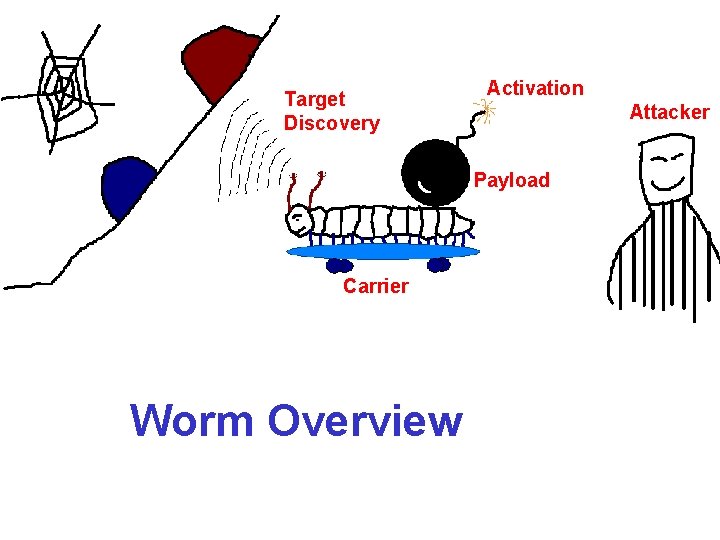
+ Target Discovery Activation Attacker Payload Carrier Worm Overview
Target Discovery • Port Scanning • Sequential: working through an address block • Random • Target Lists • Externally generated through Meta servers • Internal target list • Passive worms
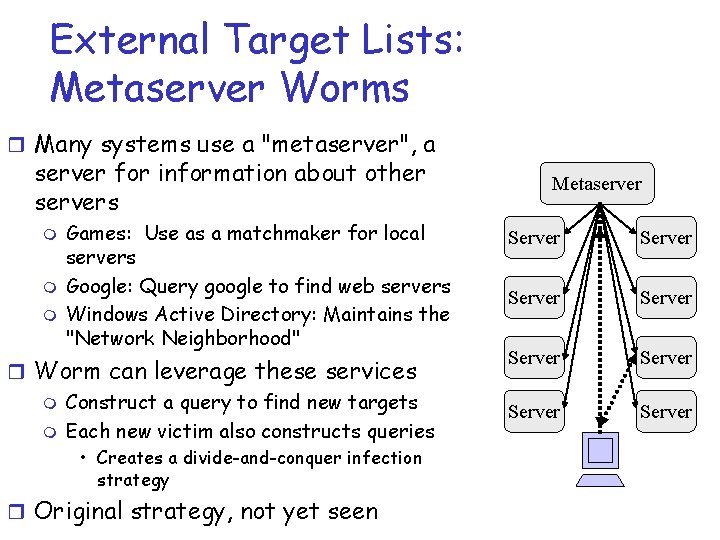
External Target Lists: Metaserver Worms r Many systems use a "metaserver", a server for information about other servers m m m Games: Use as a matchmaker for local servers Google: Query google to find web servers Windows Active Directory: Maintains the "Network Neighborhood" r Worm can leverage these services m Construct a query to find new targets m Each new victim also constructs queries • Creates a divide-and-conquer infection strategy r Original strategy, not yet seen Metaserver Server Server
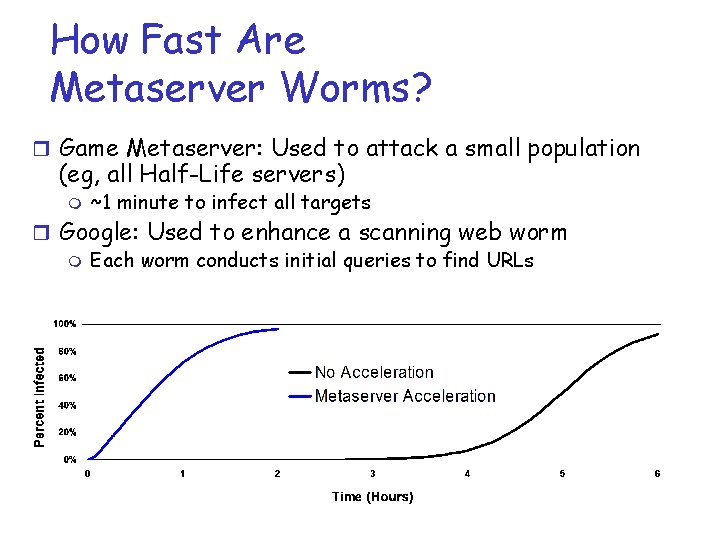
How Fast Are Metaserver Worms? r Game Metaserver: Used to attack a small population (eg, all Half-Life servers) m ~1 minute to infect all targets r Google: Used to enhance a scanning web worm m Each worm conducts initial queries to find URLs
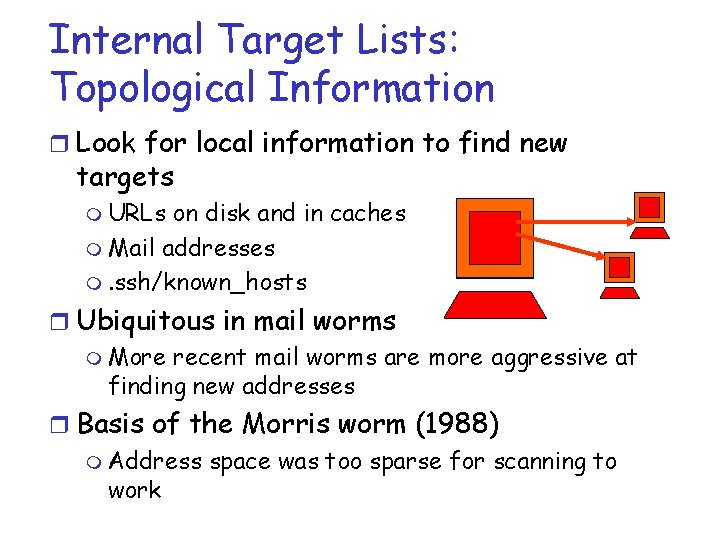
Internal Target Lists: Topological Information r Look for local information to find new targets m URLs on disk and in caches m Mail addresses m. ssh/known_hosts r Ubiquitous in mail worms m More recent mail worms are more aggressive at finding new addresses r Basis of the Morris worm (1988) m Address space was too sparse for scanning to work
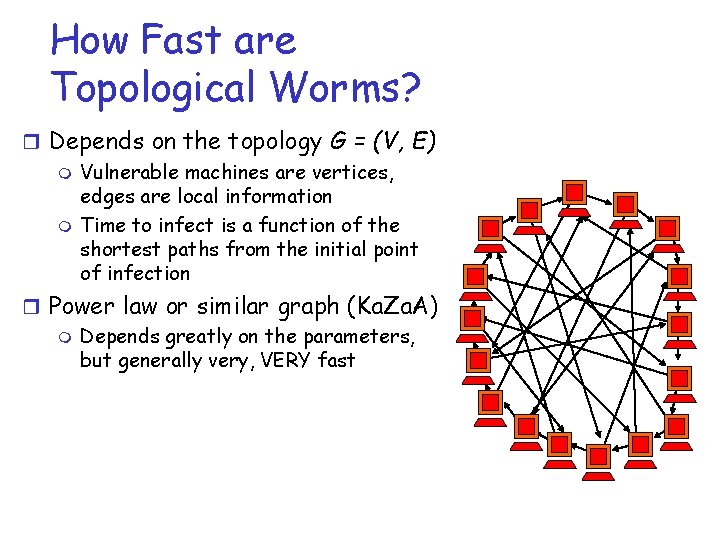
How Fast are Topological Worms? r Depends on the topology G = (V, E) m Vulnerable machines are vertices, edges are local information m Time to infect is a function of the shortest paths from the initial point of infection r Power law or similar graph (Ka. Za. A) m Depends greatly on the parameters, but generally very, VERY fast
Passive Worms r Wait for information about other targets E. g. , CRclean, an anti-Code. Red II worm m Wait for Code Red, respond with counterattack m Remove Code Red II and install itself on the machine r Speed is highly variable m Depends on normal communication traffic r Highly stealthy m Have to detect the act of infection, not target selection
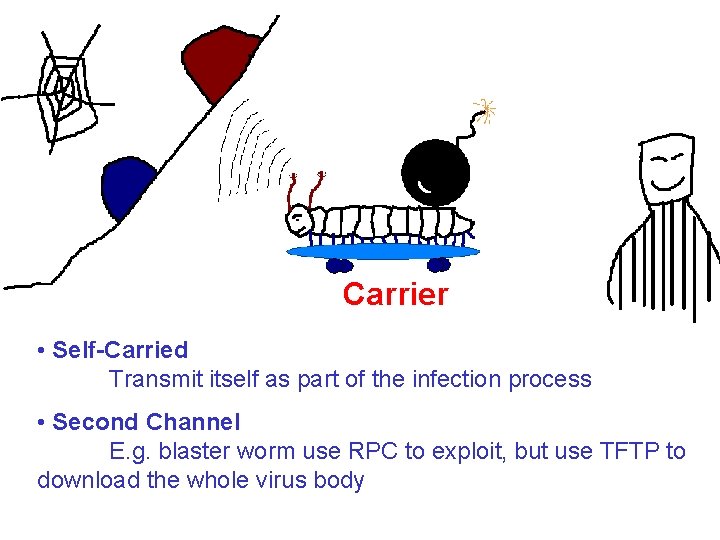
Carrier • Self-Carried Transmit itself as part of the infection process • Second Channel E. g. blaster worm use RPC to exploit, but use TFTP to download the whole virus body
Activation
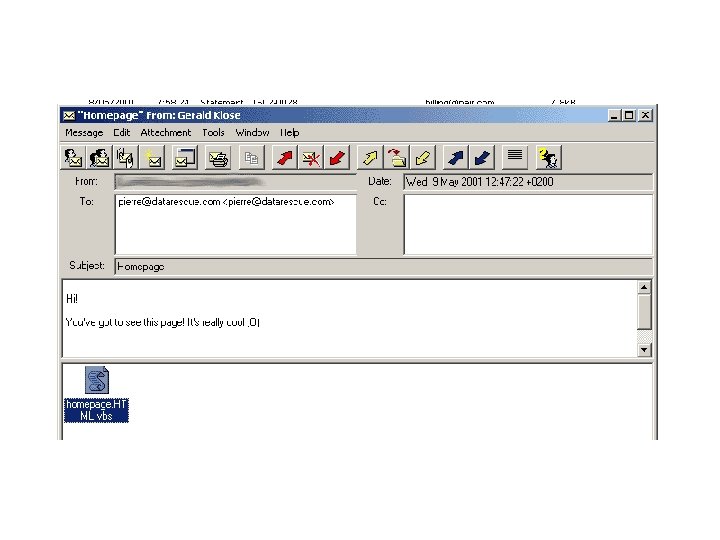
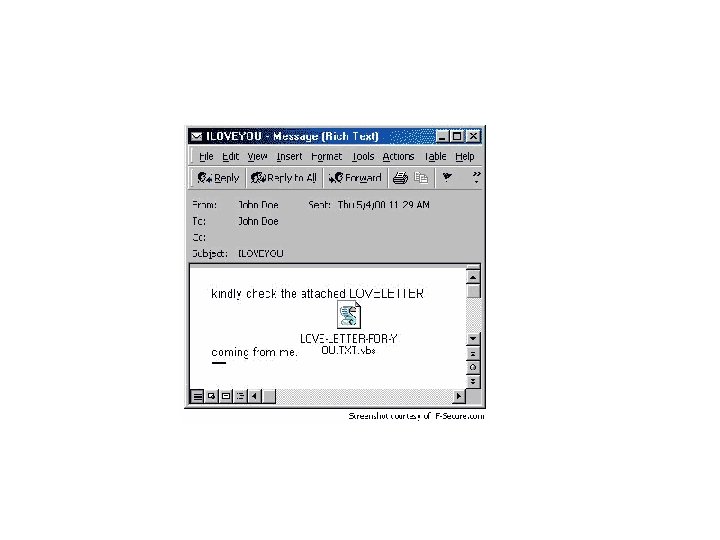
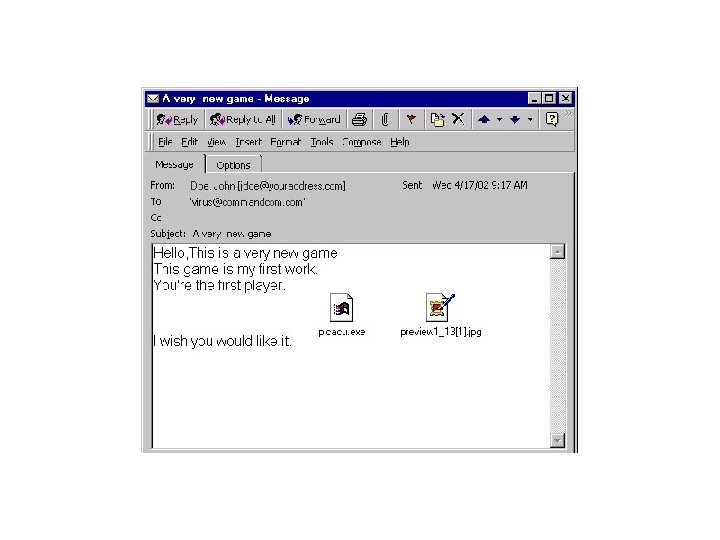
Activation r Human activation m Needs social engineering, especially for email worms • Melissa – “Attached is an important message for you!” • Iloveyou – “Open this message to see who loves you!” r Human activity-based activation m E. g. logging in, rebooting (Nimda’s secondary propagation) r Scheduled process activation m E. g. updates, backup etc. r Self activation, most common m E. g. Code Red exploit the IIS web servers
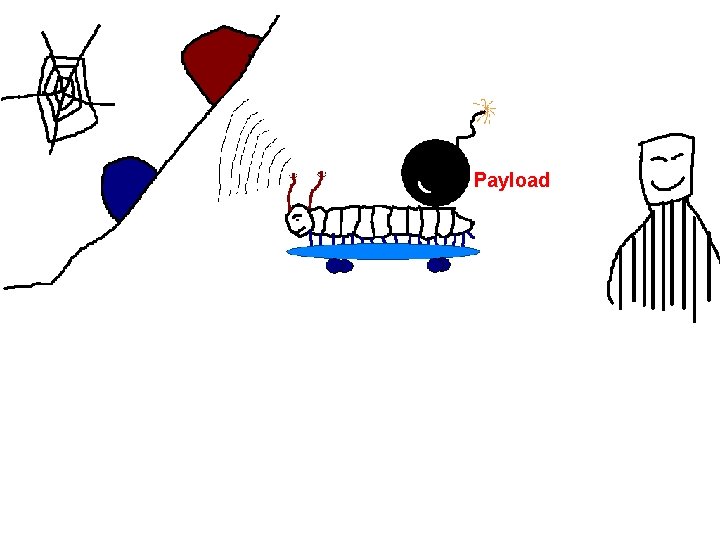
Payload
Payloads r None/nonfunctional m Most common m Still can have significant effects through traffic and machine load (e. g. , Morris worm) r Internet Remote Control m Code Red II open backdoor on victim machines: anyone with a web browser can execute arbitrary code r Internet Denial of Service (DOS) m E. g. , Code Red, Yaha r Data Collection r Data Damage: Klez r Worm maintenance
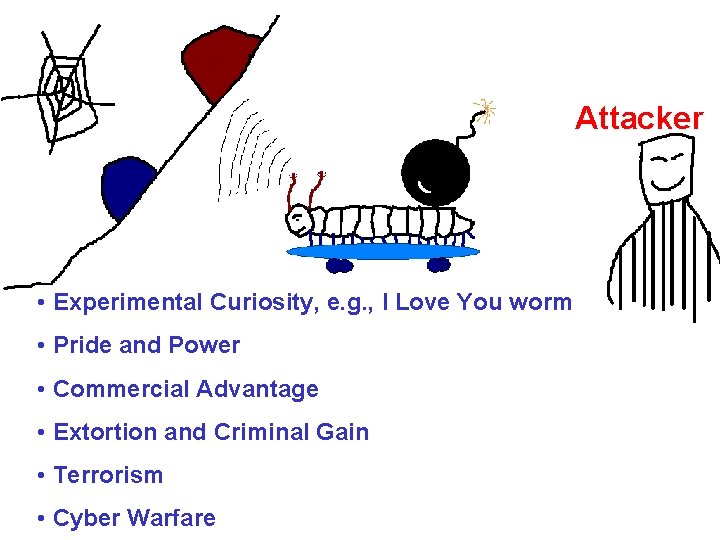
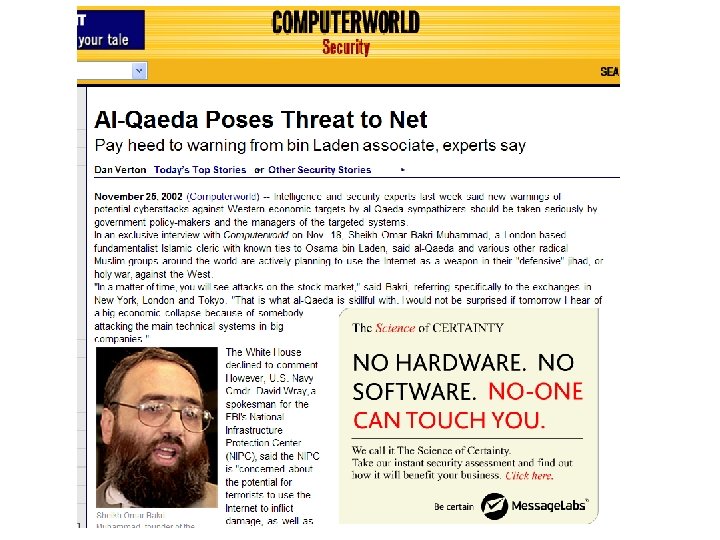
Attacker • Experimental Curiosity, e. g. , I Love You worm • Pride and Power • Commercial Advantage • Extortion and Criminal Gain • Terrorism • Cyber Warfare
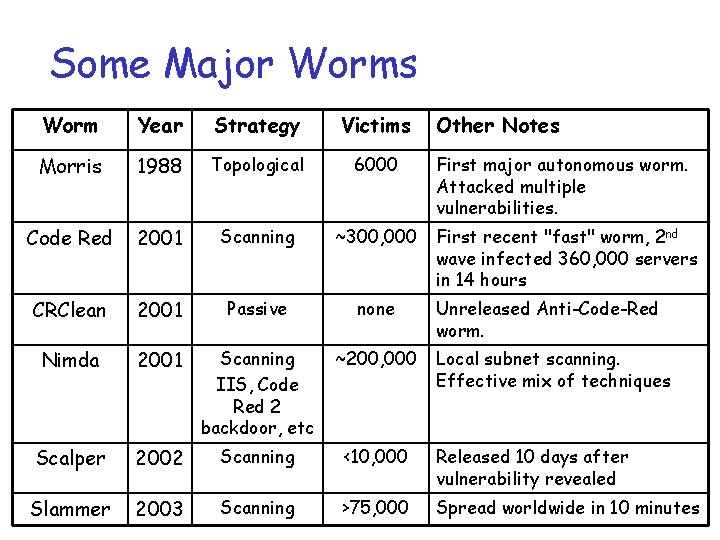
Some Major Worms Worm Year Strategy Victims Other Notes Morris 1988 Topological 6000 First major autonomous worm. Attacked multiple vulnerabilities. Code Red 2001 Scanning ~300, 000 First recent "fast" worm, 2 nd wave infected 360, 000 servers in 14 hours CRClean 2001 Passive none Nimda 2001 Scanning IIS, Code Red 2 backdoor, etc ~200, 000 Scalper 2002 Scanning <10, 000 Released 10 days after vulnerability revealed Slammer 2003 Scanning >75, 000 Spread worldwide in 10 minutes Unreleased Anti-Code-Red worm. Local subnet scanning. Effective mix of techniques
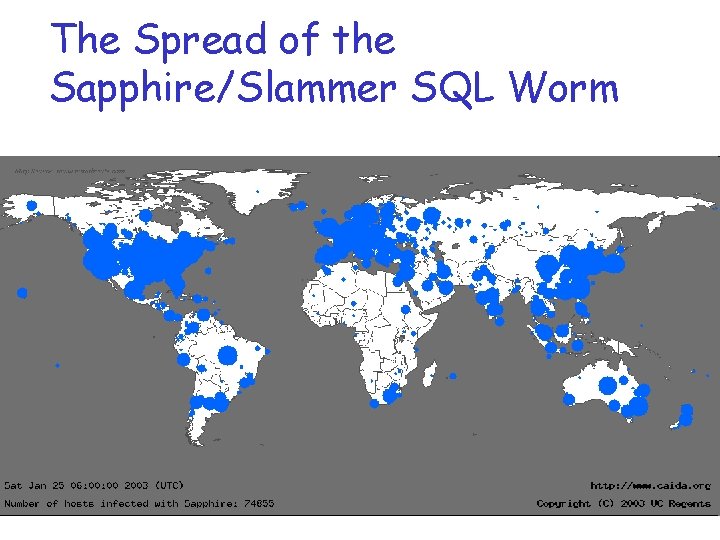
The Spread of the Sapphire/Slammer SQL Worm
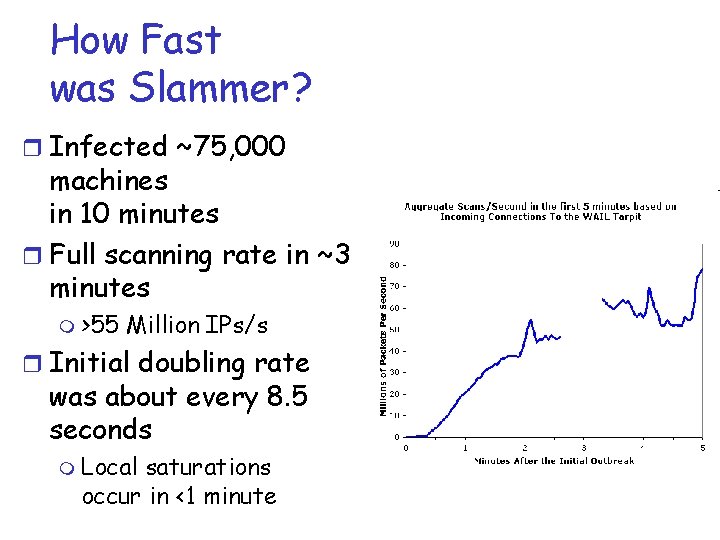
How Fast was Slammer? r Infected ~75, 000 machines in 10 minutes r Full scanning rate in ~3 minutes m >55 Million IPs/s r Initial doubling rate was about every 8. 5 seconds m Local saturations occur in <1 minute
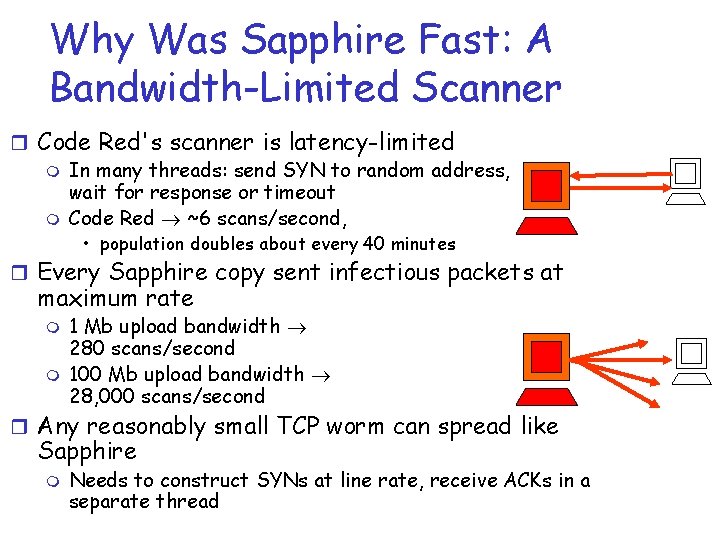
Why Was Sapphire Fast: A Bandwidth-Limited Scanner r Code Red's scanner is latency-limited m In many threads: send SYN to random address, wait for response or timeout m Code Red ~6 scans/second, • population doubles about every 40 minutes r Every Sapphire copy sent infectious packets at maximum rate m m 1 Mb upload bandwidth 280 scans/second 100 Mb upload bandwidth 28, 000 scans/second r Any reasonably small TCP worm can spread like Sapphire m Needs to construct SYNs at line rate, receive ACKs in a separate thread
Backup Slides
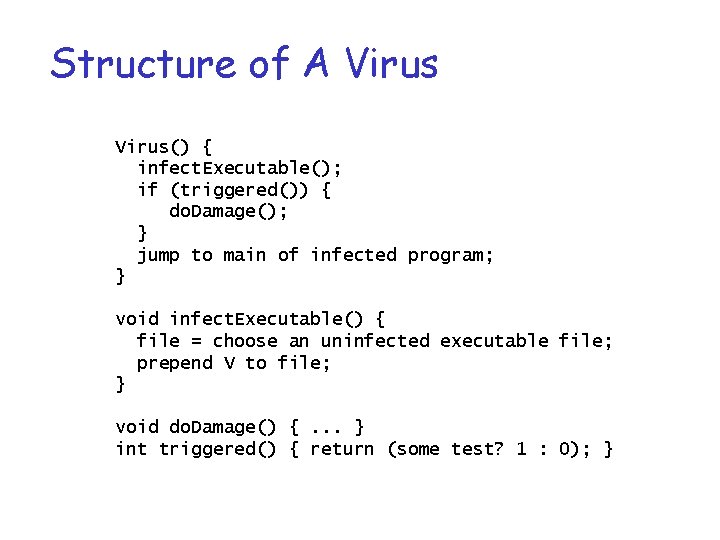
Structure of A Virus() { infect. Executable(); if (triggered()) { do. Damage(); } jump to main of infected program; } void infect. Executable() { file = choose an uninfected executable file; prepend V to file; } void do. Damage() {. . . } int triggered() { return (some test? 1 : 0); }
Fred Cohen’s Work: 1983 r First documented work with viruses m Cohen’s Ph. D advisor, Leo Adelman, coined the term “virus” m Virus: “a program that can infect other programs by modifying them to include a … version of itself” m Viruses can quickly (~30 min) spread through a networked file system r Dissertation (1986) conclusion: "universal" detection of a virus is undecidable m No 100% guaranteed detection for virus/worm
Early Mail Virus: Happy 99 (1999) r One of the earliest viruses that propagated automatically when an infected attachment is executed r Did not infect files, only email user accounts r Email sent from infected person to others in address book (novelty at the time)
Morris Worm r best known classic worm r released by Robert Morris in 1988 r targeted Unix systems r using several propagation techniques m simple password cracking of local pw file m exploit bug in finger daemon m exploit debug trapdoor in sendmail daemon r if any attack succeeds then replicated self
- Slides: 53