
Outline Why study tourism Scope of tourism History
- Slides: 19
Outline • • Why study tourism? Scope of tourism History of tourism Types of tourism – “fun in the sun” – Aboriginal tourism – Sex tourism
Outline: • Issues: – Health – Commodification – Authenticity – Nostalgia – Neo-Colonialism – Imperialist Nostalgia
Why study tourism? • Affects most countries and peoples of the world, either as hosts or as guests • Tourism advertising a major generator of Western ideas/images of the “Other” • Impact of tourism on receiving societies is a subject of debate • Questions of identity, racism in tourist/host encounters, new form of imperialism, etc.
History: • Hunter/gatherers travelled to meet seasonal sustenance needs and chose to travel for social gatherings • Agriculture moved to a more sedentary life style with centralised control, movement became a privilege of the elite classes • The Grand Tour of Continental Europe (late 15 th century)
History: • • • Secularisation of elite society Interest in scholarship, science, languages Political alliances between aristocrats Travel with a tutor-advisor Similar connection between travel and elite status in China and Japan
History • 1840 s a Methodist minister named Thomas Cook • day excursions to the countryside for labouring classes • democratisation of travel • moral and health reasons • overnight trips to Wales and Scotland
History • Using new steam technology for longer trips • 19 th century success of Thomas Cook and other travel companies • expansion of travel to all parts of the world, by middle class people of more and more nationalities
History • Democratisation of travel paralleled democratisation of education and politics in much of the world • Common theme of modern travel -“freedom” • 20 th century automobile, roads, motels • British Overseas Air Corporation 1950 s jet travel
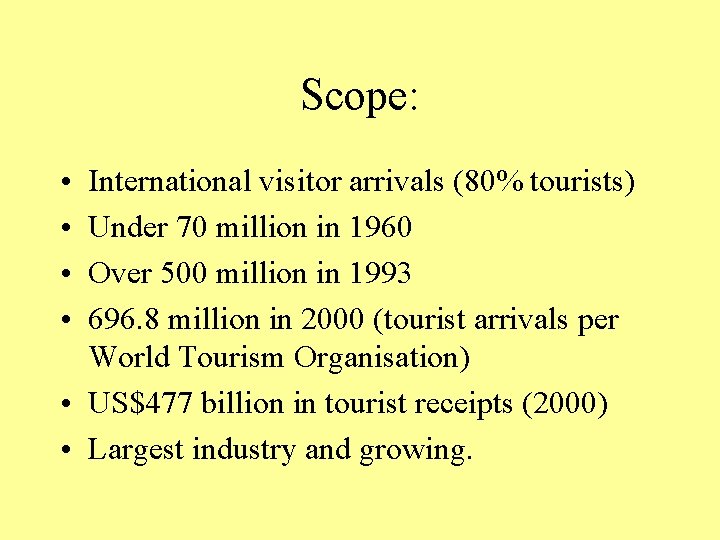
Scope: • • International visitor arrivals (80% tourists) Under 70 million in 1960 Over 500 million in 1993 696. 8 million in 2000 (tourist arrivals per World Tourism Organisation) • US$477 billion in tourist receipts (2000) • Largest industry and growing.
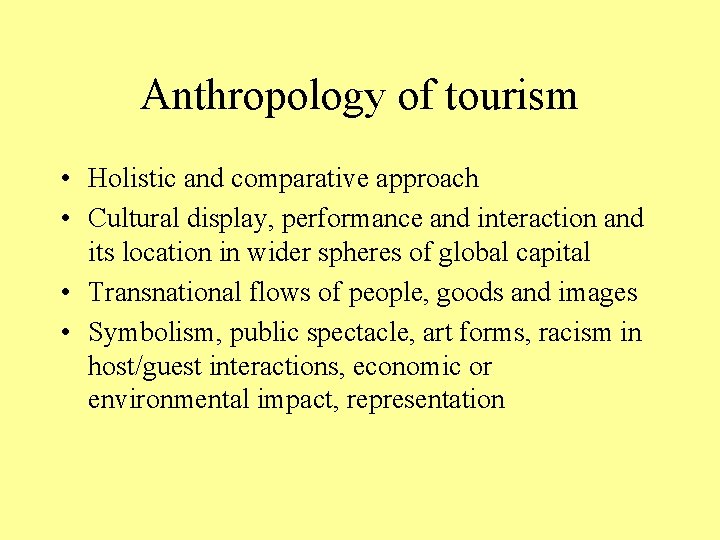
Anthropology of tourism • Holistic and comparative approach • Cultural display, performance and interaction and its location in wider spheres of global capital • Transnational flows of people, goods and images • Symbolism, public spectacle, art forms, racism in host/guest interactions, economic or environmental impact, representation
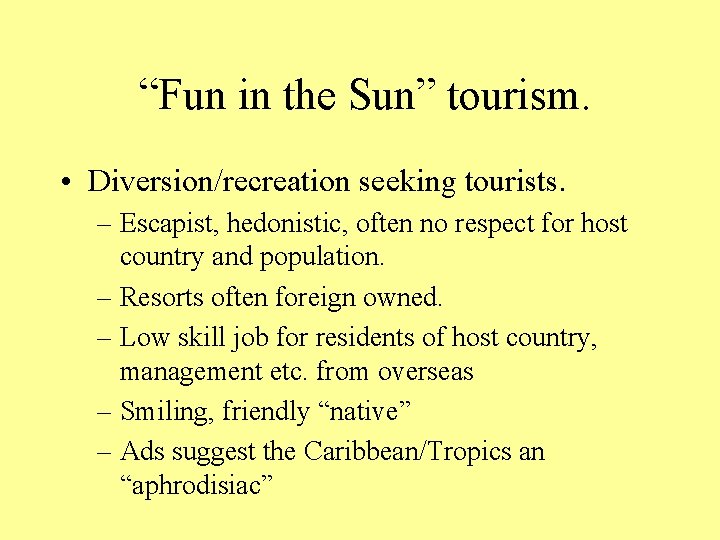
“Fun in the Sun” tourism. • Diversion/recreation seeking tourists. – Escapist, hedonistic, often no respect for host country and population. – Resorts often foreign owned. – Low skill job for residents of host country, management etc. from overseas – Smiling, friendly “native” – Ads suggest the Caribbean/Tropics an “aphrodisiac”
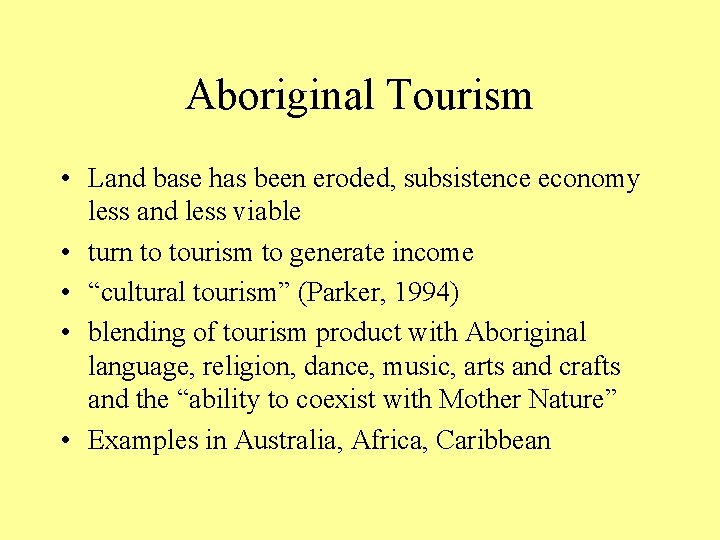
Aboriginal Tourism • Land base has been eroded, subsistence economy less and less viable • turn to tourism to generate income • “cultural tourism” (Parker, 1994) • blending of tourism product with Aboriginal language, religion, dance, music, arts and crafts and the “ability to coexist with Mother Nature” • Examples in Australia, Africa, Caribbean
Aboriginal Tourism • Income potential depends on relative degree of control over sites/industry • Demand for inexpensive souveniers restricts artistic innovation • Sacred sites trampled • Graffitti • Demand for “authenticity”
Sex tourism • Diversionary/recreational tourists • Thailand most well known example • Viet Nam war and military bases, soldiers on “R and R” • Poverty, particularly in rural areas • HIV/AIDS
Effects of Recreational/Diversion • Unskilled service employment • Infrastructure for tourists not locals (example, model Carib village in Dominica) • Waste, pollution • Symbolic -- world as “our” playground; “brown” people as servants; sex tourism; mystification of actual living conditions
Effects of experiential/existential • Potential for respected roles (translator, artist, guide) • Symbolic - required to enact “premodern selves” • Intrusion • Potential to drain local events of meaning • Commodification of culture
Nostalgia • lost youth (Japan’s “Silver. Moons, ” engage in youthful activities on vacation, return to place visited in youth) • life other than alienated life of developed world • Imperial nostalgia -- regret and desire for all that has been destroyed through colonialism or industrialisation (Renato Rosaldo)
Nostalgia • Eco-tourism • Creation of “heritage sites” • Creation of theme parks: Polynesian Cultural Center in Hawaii, Ancient City in Bangkok, Momoyama Castle near Kyoto • Model Carib village (Dominica)
Video: Cannibal Tours • What are the tourists hoping to find? • Identify some of the ethnocentric attitudes that the tourists. • What are the tourists hoping to find? • How do the people living along the Sepik River view the tourists?