
Outline What is the Every Newborn Action Plan
Outline

What is the Every Newborn Action Plan? A roadmap for change A platform for harmonized action by all partners • Setting out a clear vision with mortality target, strategic directions, and innovative actions within the continuum of care • Supported by evidence on epidemiology, effective interventions, delivery mechanisms and accelerators to progress to be published in The Lancet at the time of the launch in May 2014

‘Every Newborn’ key themes • Focus on care at time of birth • Prioritize high impact cost-effective interventions for mother and baby - together • Quality of care matters • Achieve universal coverage and equity • Count every newborn - measurement, oversight and accountability • Harness the power of parents, families and communities • Action by all – leadership, political will and financing
Every Newborn principles • Action plan will be linked to – or embedded in – other commitments and strategies in countries e. g. , • A Promise Renewed • National strategies and roadmaps for RMNCAH • Elimination of MTCT of HIV • Scaling up nutrition Etc ……… • And contribute to addressing social determinants of health that are a barrier to adequate maternal and newborn care including women’s empowerment, water and sanitation, education, connectivity
Tasks for group work • Review vision, goal and targets and make suggestions for preferred options • Review priority actions and recommend key actions to be addressed in the global action plan
Proposed vision – for discussion • Option 1: A world in which no pregnant woman or newborn baby dies, or suffers disability, due to a preventable cause. • Option 2: A world in which every pregnant woman and newborn baby survives and thrives, and childbirth is an event of celebration. • Option 3: A world in which preventable maternal and newborn deaths and stillbirths are being averted and babies thrive beyond survival.
Proposed goal – for discussion Achieve universal quality coverage of essential interventions for maternal and newborn health through strategic actions to strengthen the health system and community response for women’s and children’s health and address related social determinants of health.
Proposed targets Consensus so far on global targets, change for all of the next generation For discussion Absolute vs. relative target and level of target? • No consensus but tendency towards absolute (number) versus relative (%). • Possible option is absolute target of 7. 5/1000 - which is equivalent to highest current NMR in OECD countries
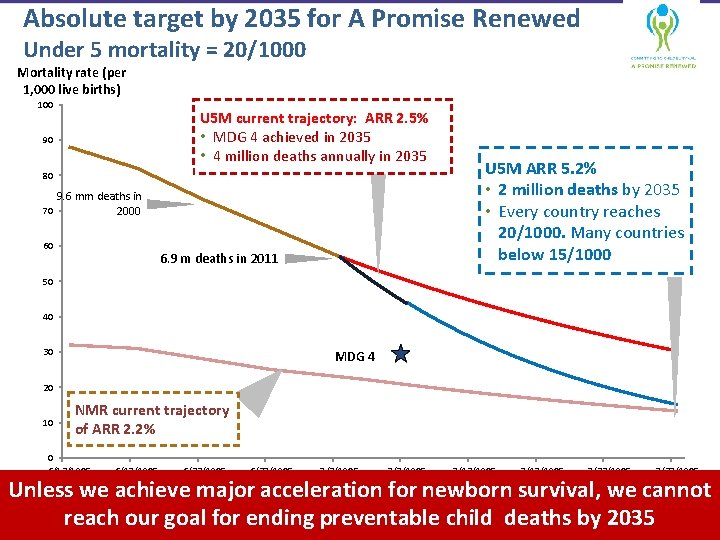
Absolute target by 2035 for A Promise Renewed Under 5 mortality = 20/1000 Mortality rate (per 1, 000 live births) 100 U 5 M current trajectory: ARR 2. 5% • MDG 4 achieved in 2035 • 4 million deaths annually in 2035 90 80 70 9. 6 mm deaths in 2000 60 6. 9 m deaths in 2011 U 5 M ARR 5. 2% • 2 million deaths by 2035 • Every country reaches 20/1000. Many countries below 15/1000 50 40 30 MDG 4 20 10 NMR current trajectory of ARR 2. 2% 0 6/12/1905 12: 00 AM 6/17/1905 12: 00 AM 6/22/1905 12: 00 AM 6/27/1905 12: 00 AM 7/2/1905 12: 00 AM 7/7/1905 12: 00 AM 7/12/1905 12: 00 AM 7/17/1905 12: 00 AM 7/22/1905 12: 00 AM 7/27/1905 12: 00 AM Unless we achieve major acceleration for newborn survival, we cannot 9 reach our goal for ending preventable child deaths by 2035 Source: UNICEF State of the World’s Children 2012; The UN Inter-agency Group for Child Mortality Estimation, Levels and Trends in Child Mortality: Report 2011, 2011; Team analysis from 2035 onward based on straight-line ARR reduction from UNICEF numbers 1990 -2035
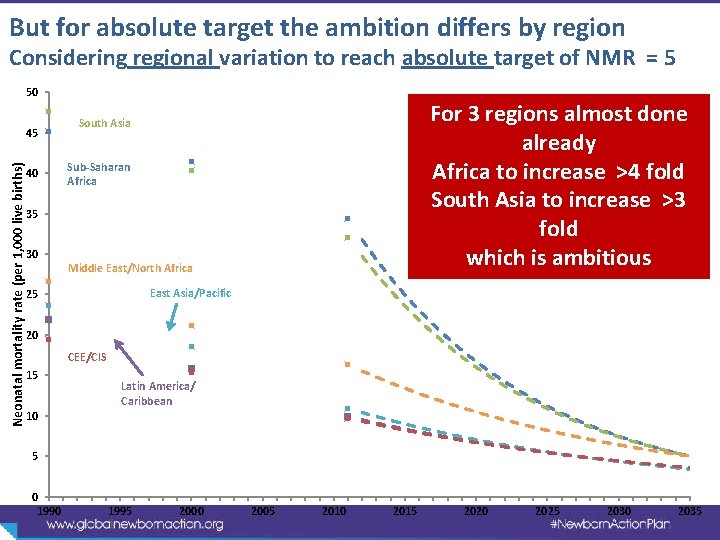
But for absolute target the ambition differs by region Considering regional variation to reach absolute target of NMR = 5 50 Neonatal mortality rate (per 1, 000 live births) 45 40 For 3 regions almost done already Africa to increase >4 fold South Asia to increase >3 fold which is ambitious South Asia Sub-Saharan Africa 35 30 Middle East/North Africa East Asia/Pacific 25 20 CEE/CIS 15 Latin America/ Caribbean 10 5 0 1995 2000 2005 2010 2015 2020 2025 2030 2035

Relative targets set the same pace for every country Considering a relative target of reducing NMR by 75% from 2011 50 All regions have to achieve the same ARR (5. 7% for all), but then still left with a gap in outcomes for the poorest South Asia Neonatal mortality rate (per 1, 000 live births) 45 40 Sub-Saharan Africa 35 30 Middle East/North Africa East Asia/Pacific 25 20 15 CEE/CIS Latin America/ Caribbean 10 5 0 1995 2000 2005 2010 2015 2020 2025 2030 2035

Proposed targets For discussion • Absolute versus relative target? • What additional targets? – Interim targets every five years – Equity target for sub-national level – Coverage targets for key interventions – Other
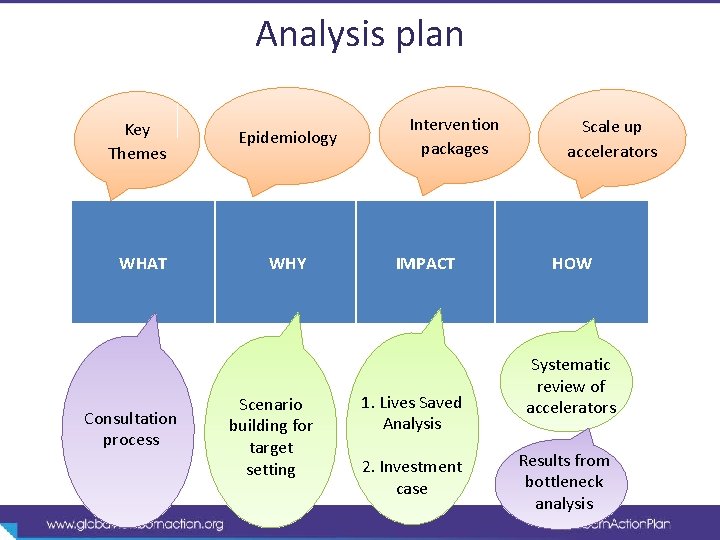
Analysis plan Key Themes WHAT Consultation process Epidemiology WHY Scenario building for target setting Intervention packages IMPACT 1. Lives Saved Analysis 2. Investment case Scale up accelerators HOW Systematic review of accelerators Results from bottleneck analysis
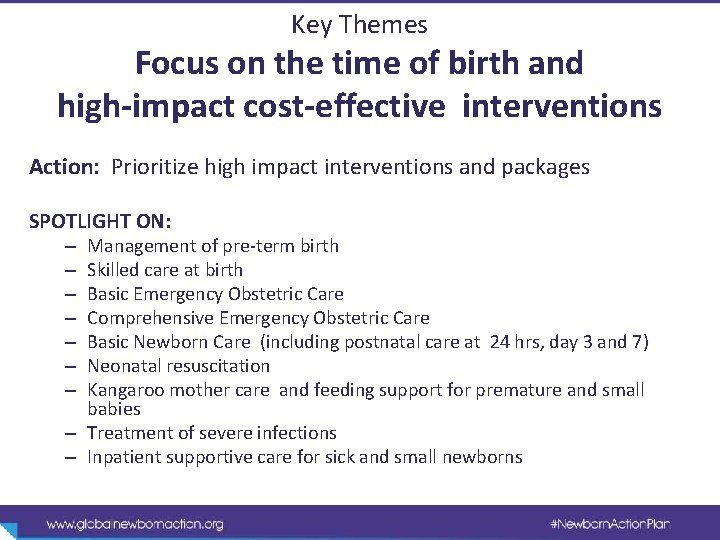
Key Themes Focus on the time of birth and high-impact cost-effective interventions Action: Prioritize high impact interventions and packages SPOTLIGHT ON: Management of pre-term birth Skilled care at birth Basic Emergency Obstetric Care Comprehensive Emergency Obstetric Care Basic Newborn Care (including postnatal care at 24 hrs, day 3 and 7) Neonatal resuscitation Kangaroo mother care and feeding support for premature and small babies – Treatment of severe infections – Inpatient supportive care for sick and small newborns – – – –
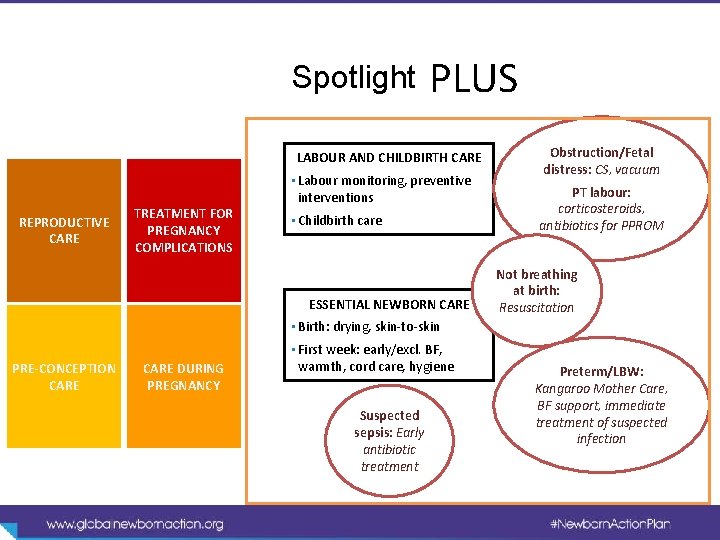
Spotlight PLUS LABOUR AND CHILDBIRTH CARE REPRODUCTIVE CARE TREATMENT FOR PREGNANCY COMPLICATIONS • Labour monitoring, preventive interventions • Childbirth care ESSENTIAL NEWBORN CARE Obstruction/Fetal distress: CS, vacuum PT labour: corticosteroids, antibiotics for PPROM Not breathing at birth: Resuscitation • Birth: drying, skin-to-skin PRE-CONCEPTION CARE DURING PREGNANCY • First week: early/excl. BF, warmth, cord care, hygiene Suspected sepsis: Early antibiotic treatment Preterm/LBW: Kangaroo Mother Care, BF support, immediate treatment of suspected infection
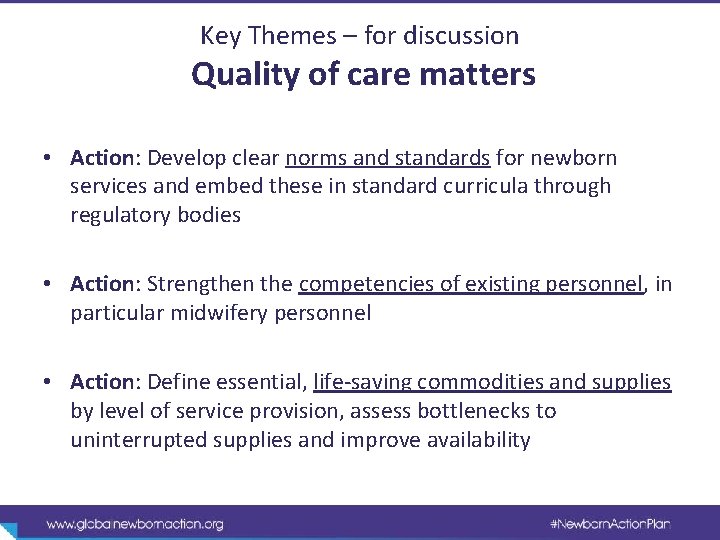
Key Themes – for discussion Quality of care matters • Action: Develop clear norms and standards for newborn services and embed these in standard curricula through regulatory bodies • Action: Strengthen the competencies of existing personnel, in particular midwifery personnel • Action: Define essential, life-saving commodities and supplies by level of service provision, assess bottlenecks to uninterrupted supplies and improve availability
Key Themes – for discussion Quality of care matters • Action: Monitor quality of care including through maternal and perinatal deaths reviews and respond • Action: Consider performance based incentives for quality of care by skilled personnel
Key Themes – for discussion Coverage and Equity • Action: Fill critical gaps in numbers of skilled personnel, in particular midwifery personnel, for maternal and newborn health through accelerated production, retention, and motivation approaches • Action: Define the delivery of the interventions packages by level of health service provision, at community, primary and referral levels - appropriate skills mix
Key Themes – for discussion Coverage and Equity • Action: Reduce out-of-pocket payments for maternal and newborn health services and institute financial protection mechanisms • Action: Give special attention to hard-to-reach and vulnerable populations and reduce inequities in coverage of effective interventions • Action: Give special attention to adolescent girls and implement approaches to help prevent early and unwanted pregnancies
Key Themes – for discussion Count every newborn • Action: Define newborn indicators and bench-marks of service delivery and strengthen the health information system, to track progress • Action: Institutionalize birth registration • Action: Implement maternal and perinatal death surveillance and response • Action: Conduct periodic household surveys in order to obtain objective and verifiable data on mortality and intervention coverage
Key Themes - for discussion Harness power of parents, families and communities • Action: Foster community leadership and develop local champions • Action: Consider incentives, such as conditional cash transfers, to increase demand for services • Action: Create awareness and increase optimal home care practices including care seeking • Action: Empower communities to solve practical problems such as transport
Roles – for discussion Governments: • Action: Address newborn health in the national health sector strategy, develop specific scale-up plans to meet the targets, and allocate resources based on impact and cost analysis • Action: Adopt policies to improve access, quality, demand coverage of newborn health services • Action: Strengthen capacity of district health managers to plan evidence-based newborn interventions and allocate adequate resources for service delivery at the district level
Roles – for discussion Governments (continued): • Action: Conduct annual reviews of progress involving all relevant stakeholders and take remedial actions • Action: Define implementation bottlenecks and foster research to find solutions • Action: Assign a responsible person or unit to coordinate implementation of newborn activities at national and/or district levels
Roles – other constituencies • • • UN and other multi-lateral organizations Donors, philanthropic institutions, bilateral agencies Business community Academic and research institutions Professional associations Civil society including NGOs and parents groups
- Slides: 25