
Outline What is blockchain Permissionless blockchain Bitcoin Formalizing


Outline • What is blockchain • Permissionless blockchain – Bitcoin • Formalizing blockchain
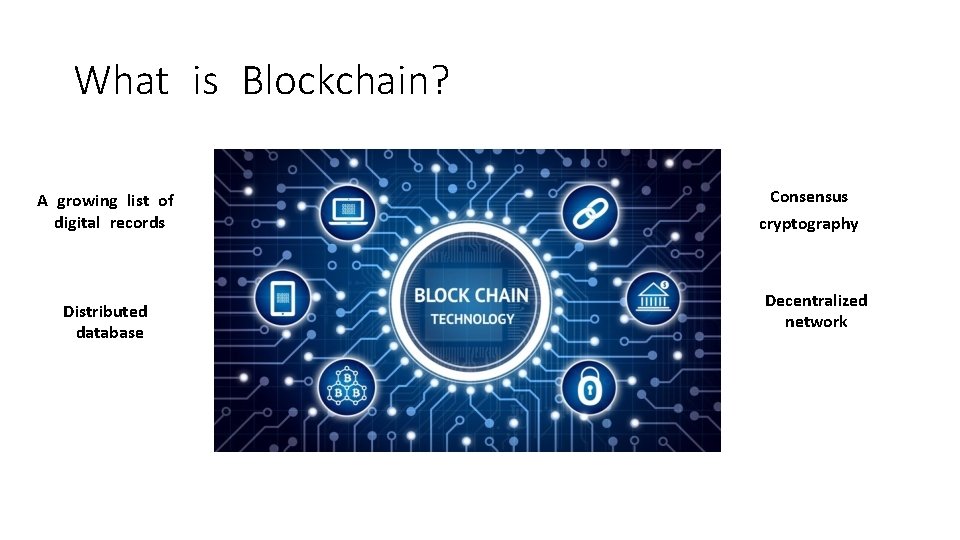
What is Blockchain? A growing list of digital records Distributed database Consensus cryptography Decentralized network
History of cryptocurrency • Hayek. Denationalization of money, free banking and inflation targeting. 1977. • Satoshi Nakamoto. Bitcoin: A Peer-to-Peer Electronic Cash System. 2008.
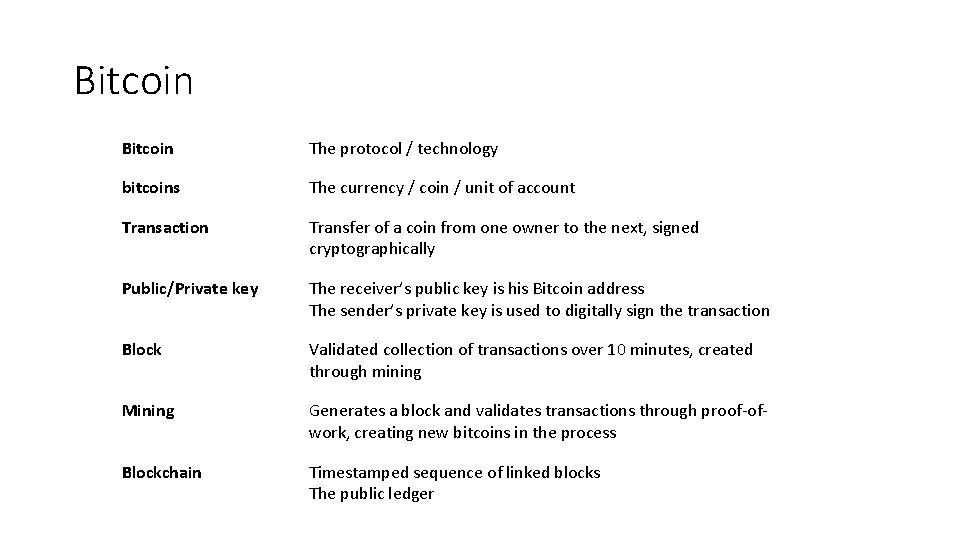
Bitcoin The protocol / technology bitcoins The currency / coin / unit of account Transaction Transfer of a coin from one owner to the next, signed cryptographically Public/Private key The receiver’s public key is his Bitcoin address The sender’s private key is used to digitally sign the transaction Block Validated collection of transactions over 10 minutes, created through mining Mining Generates a block and validates transactions through proof-ofwork, creating new bitcoins in the process Blockchain Timestamped sequence of linked blocks The public ledger
Bitcoin Overview • Every participant maintains a ledger of all the transactions • Work together to verify transactions • Key components: proof-of-work, blocks, hash chain
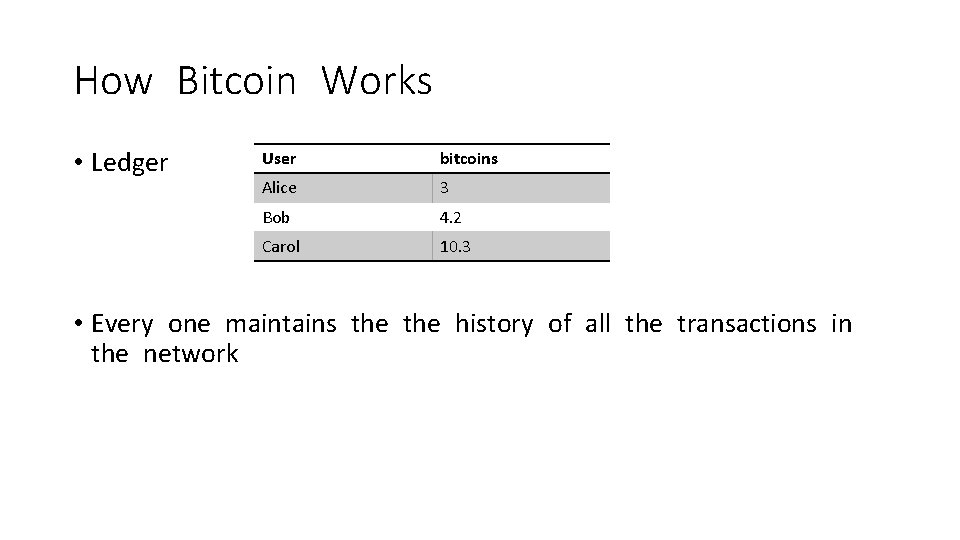
How Bitcoin Works • Ledger User bitcoins Alice 3 Bob 4. 2 Carol 10. 3 • Every one maintains the history of all the transactions in the network
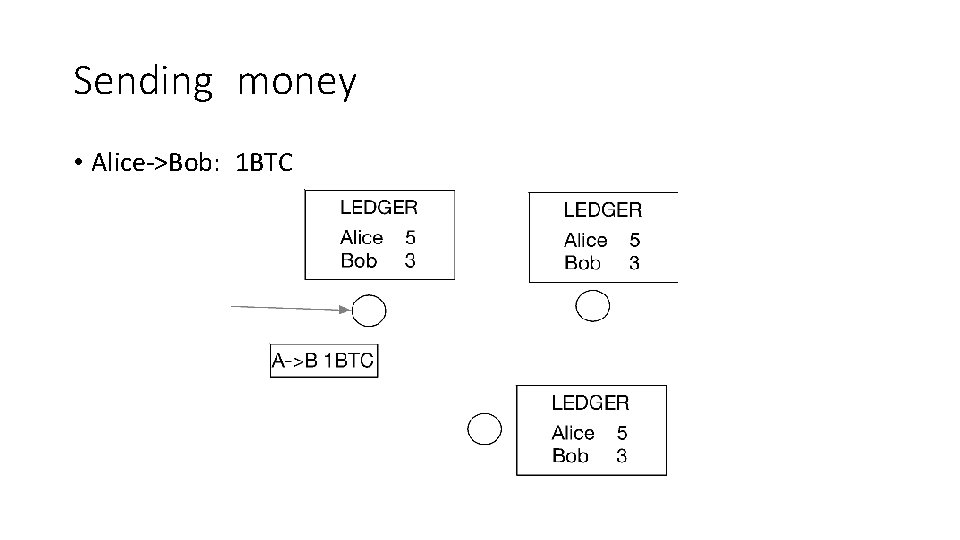
Sending money • Alice->Bob: 1 BTC
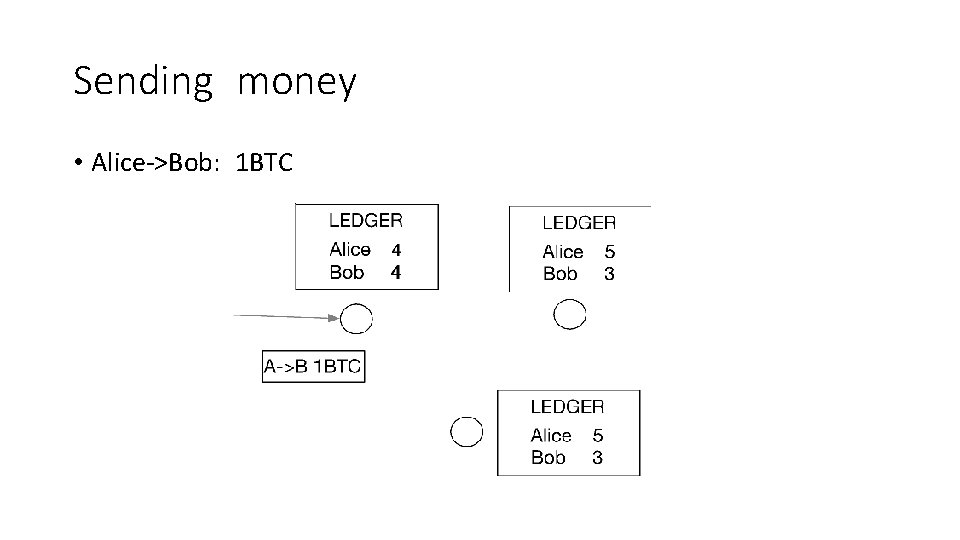
Sending money • Alice->Bob: 1 BTC
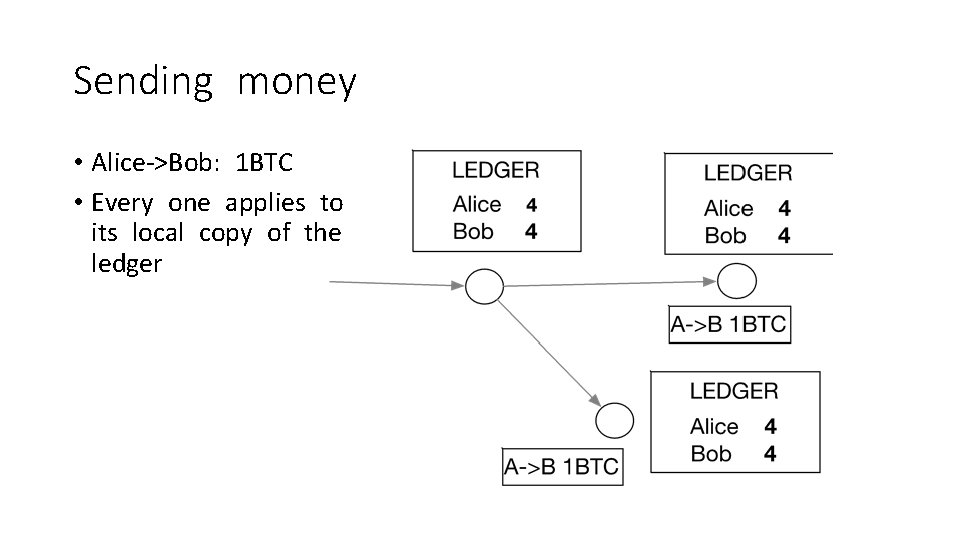
Sending money • Alice->Bob: 1 BTC • Every one applies to its local copy of the ledger
Questions • How to to make sure the sender actually sends the transaction? make sure the sender does have enough money? ensure the order of the transactions? ensure which transaction should be processed first?
Questions • How to make sure the sender actually sends the transaction? • Digital signatures • Two types: asymmetric key based (used in bitcoin) and symmetric key based • As long as the sender does not lose its private key, then the message with the digital signature is generated by the sender
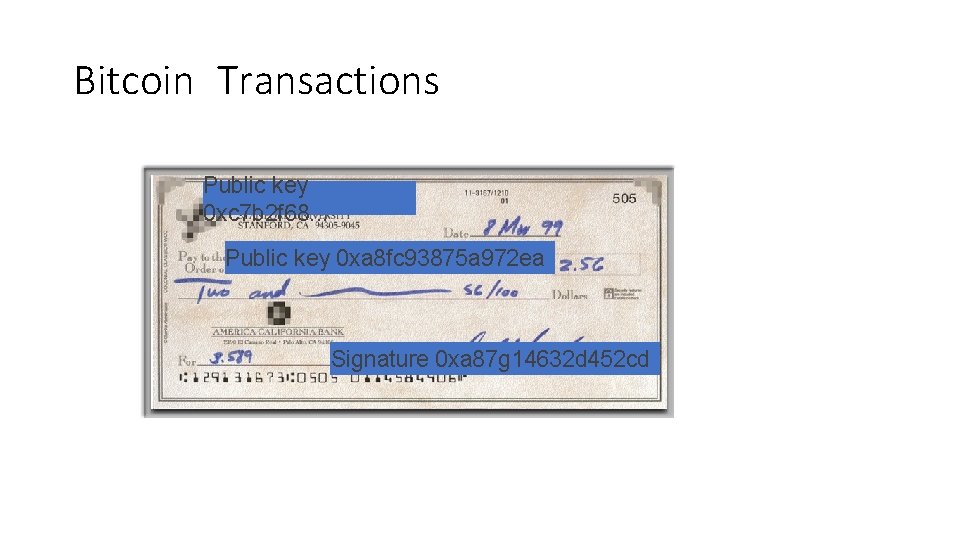
Bitcoin Transactions Public key 0 xc 7 b 2 f 68. . . Public key 0 xa 8 fc 93875 a 972 ea Signature 0 xa 87 g 14632 d 452 cd
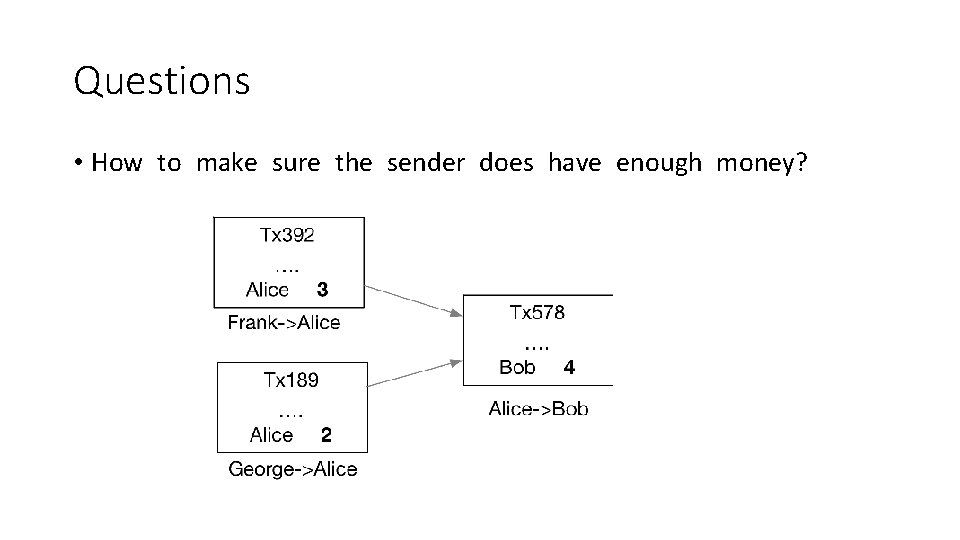
Questions • How to make sure the sender does have enough money?
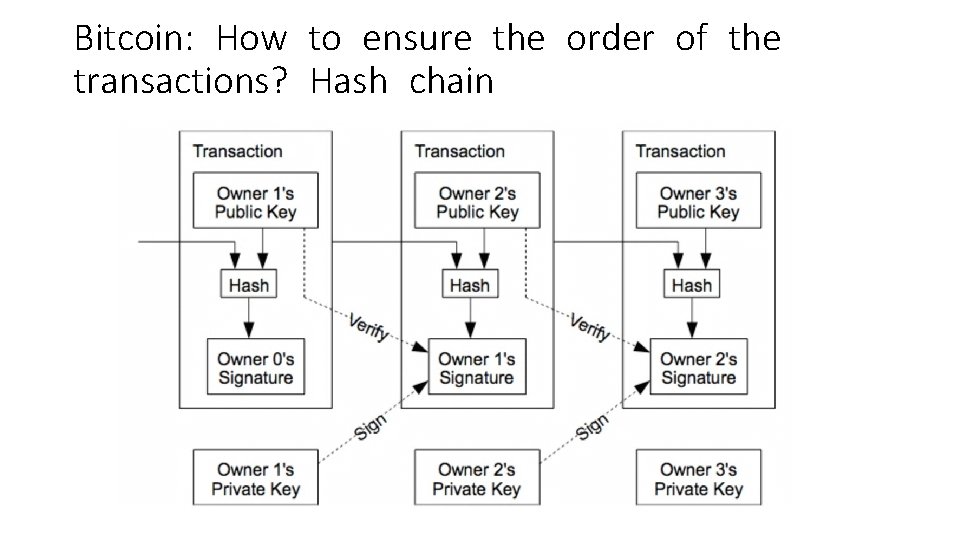
Bitcoin: How to ensure the order of the transactions? Hash chain
Questions • How to ensure the which transaction should be processed next? • Every time, one node (leader) proposes the next transaction (or a batch of transactions) • Proof of work • Current leader throws a puzzle and everyone tries to solve it • The one who solves it first will be the next leader
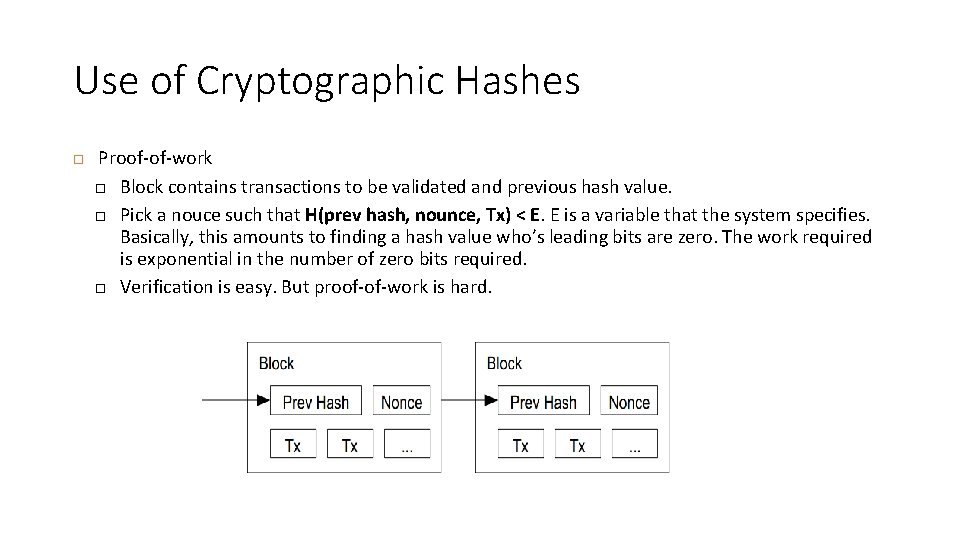
Use of Cryptographic Hashes Proof-of-work Block contains transactions to be validated and previous hash value. Pick a nouce such that H(prev hash, nounce, Tx) < E. E is a variable that the system specifies. Basically, this amounts to finding a hash value who’s leading bits are zero. The work required is exponential in the number of zero bits required. Verification is easy. But proof-of-work is hard.
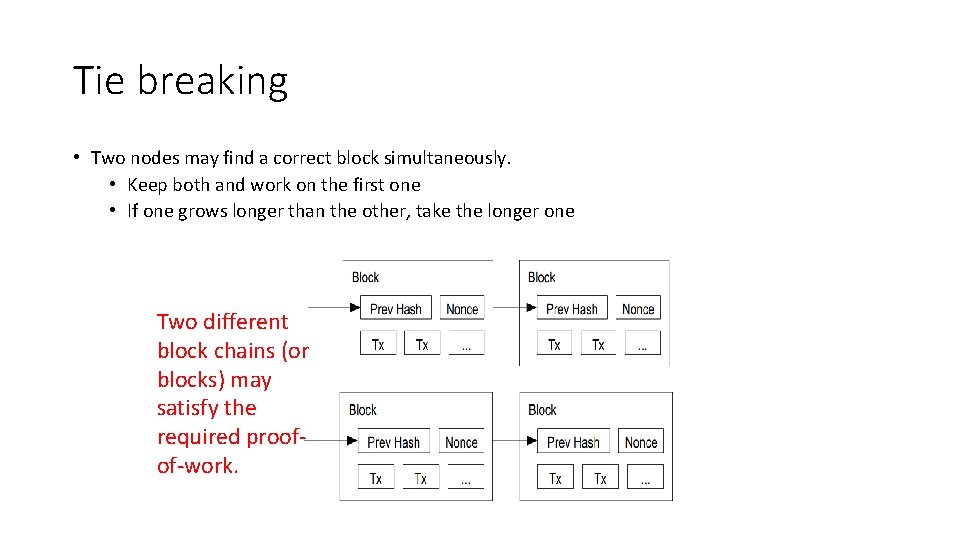
Tie breaking • Two nodes may find a correct block simultaneously. • Keep both and work on the first one • If one grows longer than the other, take the longer one Two different block chains (or blocks) may satisfy the required proofof-work.
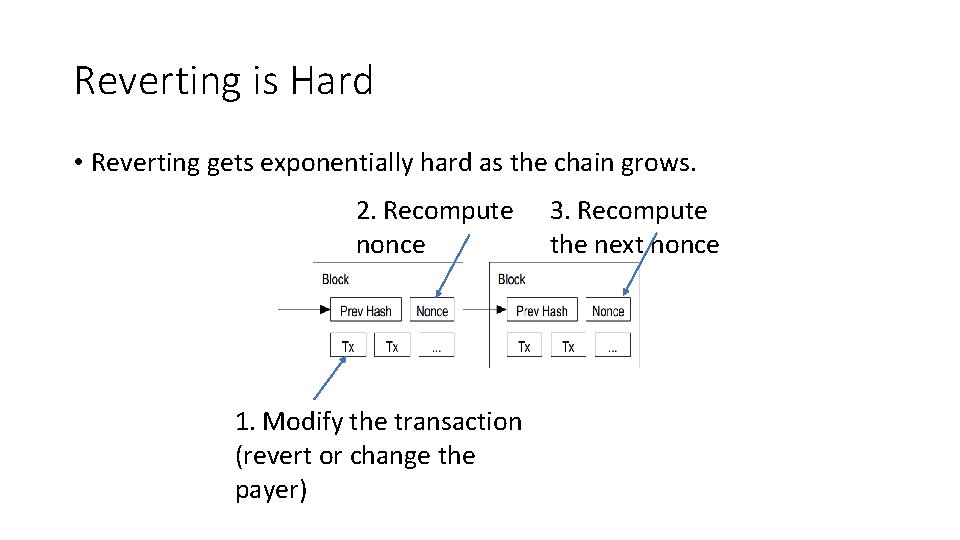
Reverting is Hard • Reverting gets exponentially hard as the chain grows. 2. Recompute nonce 1. Modify the transaction (revert or change the payer) 3. Recompute the next nonce
Practical Limitation • At least 10 mins to verify a transaction. • Agree to pay • Wait for one block (10 mins) for the transaction to go through. • But, for a large transaction ($$$) wait longer. Because if you wait longer it becomes more secure. For large $$$, you wait for six blocks (1 hour).
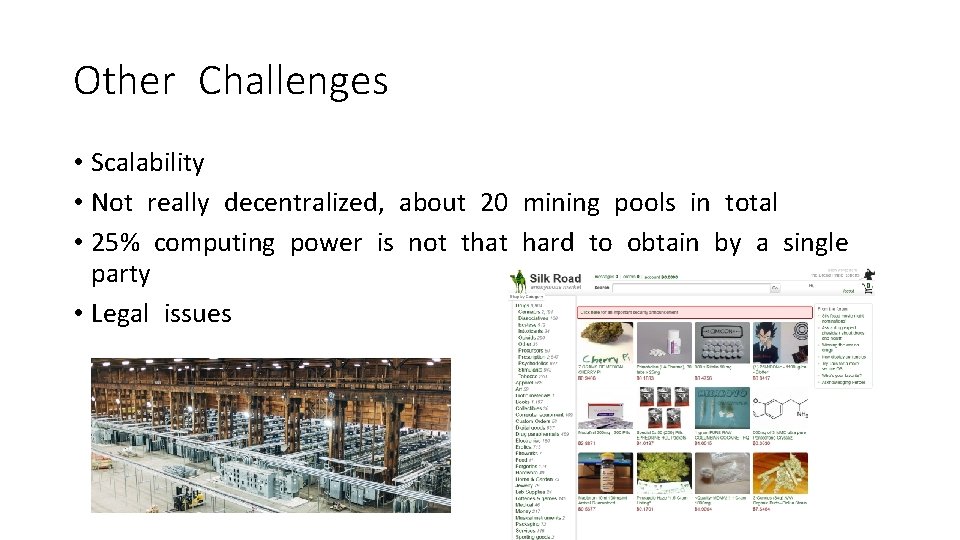
Other Challenges • Scalability • Not really decentralized, about 20 mining pools in total • 25% computing power is not that hard to obtain by a single party • Legal issues
Blockchains: Other topics • Cryptocurrencies • Permisisonless blockchains • Smart contract • Permissioned blockchains • Proof-of-stake
Smart Contract • A computer program executed in a secure environment that directly controls digital assets • EVM (Ethereum), Chaincode (Hyperledger Fabric) • Examples of secure environment • single trusted party (bank) • decentralized network(blockchain) • Trusted hardware (Intel SGX)
Ethereum Smart Contract • Two types of accounts • Normal account like Bitcoin • Smart contract account • 1)code, 2) private key-value storage • Code can • Send ETH to other accounts • Read/write storage • Call the contracts
Ethereum Transactions • Normal transactions • Transactions to contracts • Function calls • Specify which object you are talking to, which function, and what data • Transactions to create contracts
How to create a contract? • Send a transaction • • • To: empty Value: value sent to the new contract Data: code of the contract gasprice (ether per unit gas) Startgas (maximum gas consumable) Digital signature (ECDSA) • If tx is successful • Returns the address of the new contract

How to interact with a contract? • Send a transaction • • • To: contract address Value: value sent to the new contract Data: data supposed to be read by the contract gasprice (ether per unit gas) Startgas (maximum gas consumable) Digital signature (ECDSA) • If tx is successful • Returns the output from the contract
What’s the relationships between Po. W and BFT? • They solve the same problem, why? • Same • Linearizability • Different • Fixed leader vs different leaders
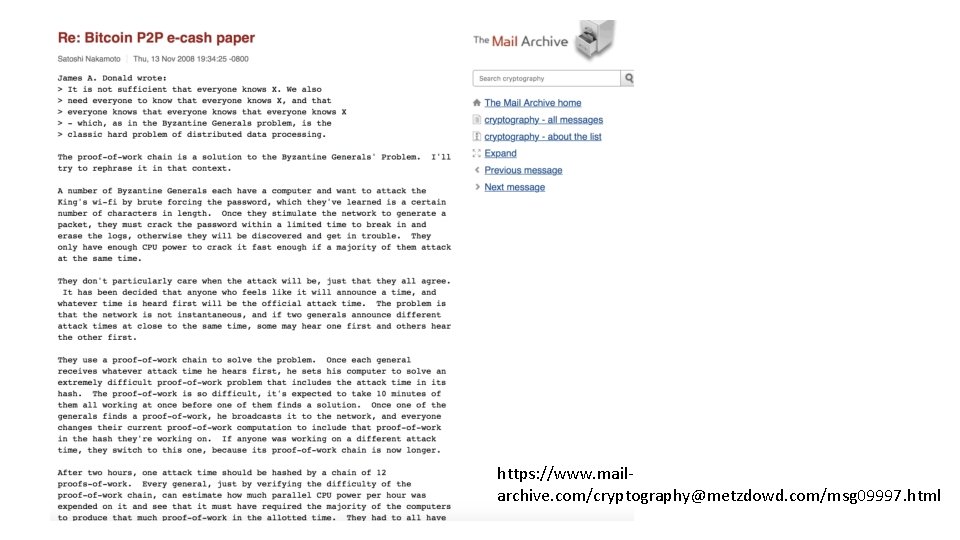
https: //www. mailarchive. com/cryptography@metzdowd. com/msg 09997. html

Permissioned Blockchains • Run BFT protocols to reach a consensus
Blockchain: A Layered View • Layer 1: State machine replication (SMR) • Layer 2: Smart contracts • Allow to programmatically facilitate, verify, or enforce the negotiation or performance of a business transactions • Layer 3: Services • Applications
The System Model • Timing assumption • Synchrony • Asynchrony • Partially synchrony • Adversary model • Correctness goals • Safety • Liveness
Adversary Model • Threshold Adversary Model • The total number of parties, n • The total number of parties that can fail, f • Typical threshold • N>2 f or n>3 f
Adversary Model • Computational Threshold Adversary (CTA) Model • The total amount of computational power, Nc • The total amount of computational power the adversary can control, Fc • Typically • Nc>2 Fc • In bitcoin, the computational power means the difficulty of inverting SHA 1/SHA 256
Adversary Model • Stake Threshold Adversary (STA) Model • Finite abstract resource R • The total amount of resources R, NR • The total amount of resource R that the adversary can control, FR • Example • Ethereum Proof-of-stake, NR > 3 FR • Combination of the previous two models
Nakamoto Consensus / Po. W Consensus • Timing assumption • Synchrony/asynchrony/partial synchrony? • Why? • If network delay can be unbounded then the adversary can boost its computational power just by making the no-faulty parties incur much higher delay…
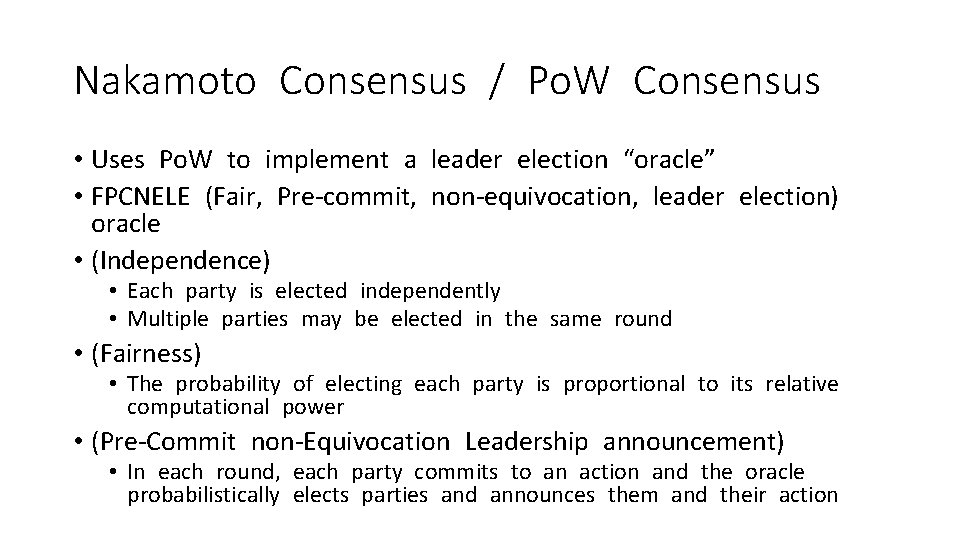
Nakamoto Consensus / Po. W Consensus • Uses Po. W to implement a leader election “oracle” • FPCNELE (Fair, Pre-commit, non-equivocation, leader election) oracle • (Independence) • Each party is elected independently • Multiple parties may be elected in the same round • (Fairness) • The probability of electing each party is proportional to its relative computational power • (Pre-Commit non-Equivocation Leadership announcement) • In each round, each party commits to an action and the oracle probabilistically elects parties and announces them and their action
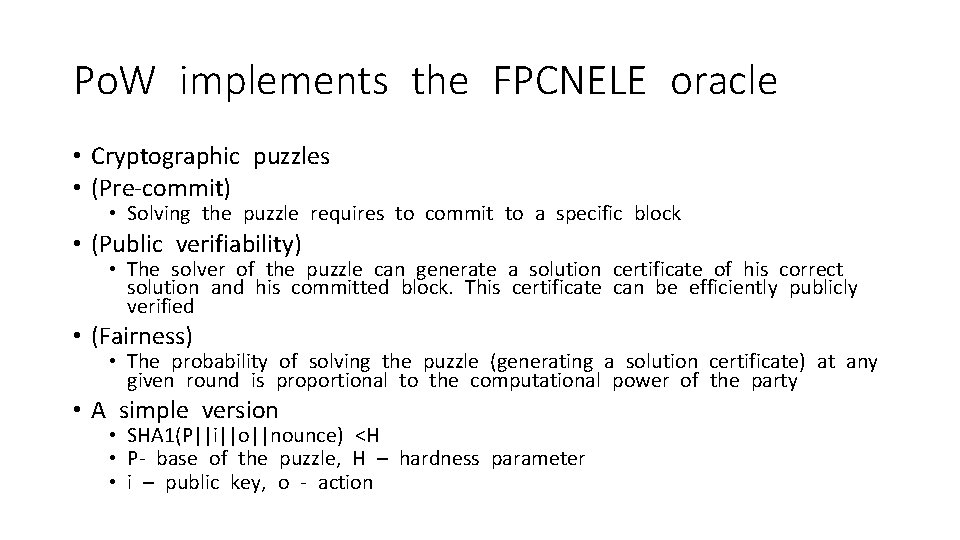
Po. W implements the FPCNELE oracle • Cryptographic puzzles • (Pre-commit) • Solving the puzzle requires to commit to a specific block • (Public verifiability) • The solver of the puzzle can generate a solution certificate of his correct solution and his committed block. This certificate can be efficiently publicly verified • (Fairness) • The probability of solving the puzzle (generating a solution certificate) at any given round is proportional to the computational power of the party • A simple version • SHA 1(P||i||o||nounce) <H • P- base of the puzzle, H – hardness parameter • i – public key, o - action
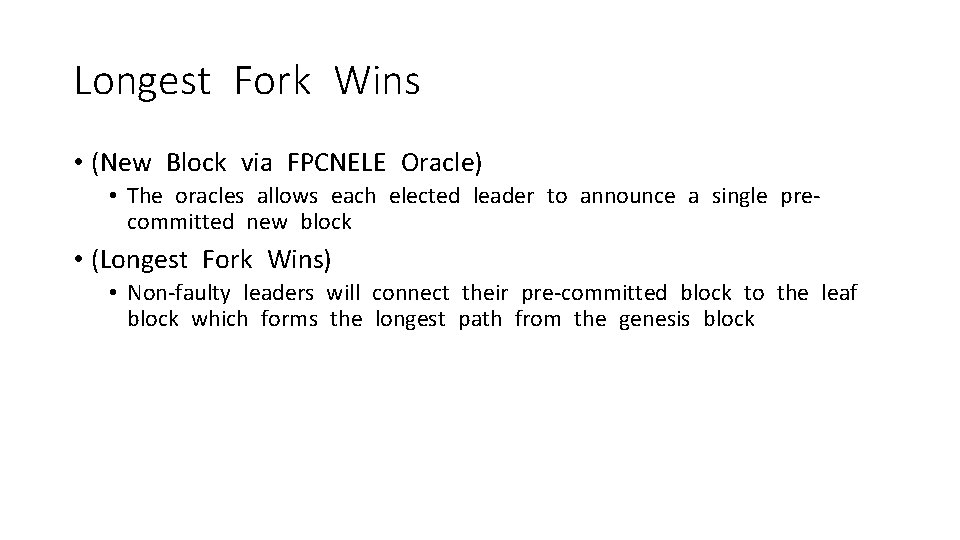
Longest Fork Wins • (New Block via FPCNELE Oracle) • The oracles allows each elected leader to announce a single precommitted new block • (Longest Fork Wins) • Non-faulty leaders will connect their pre-committed block to the leaf block which forms the longest path from the genesis block
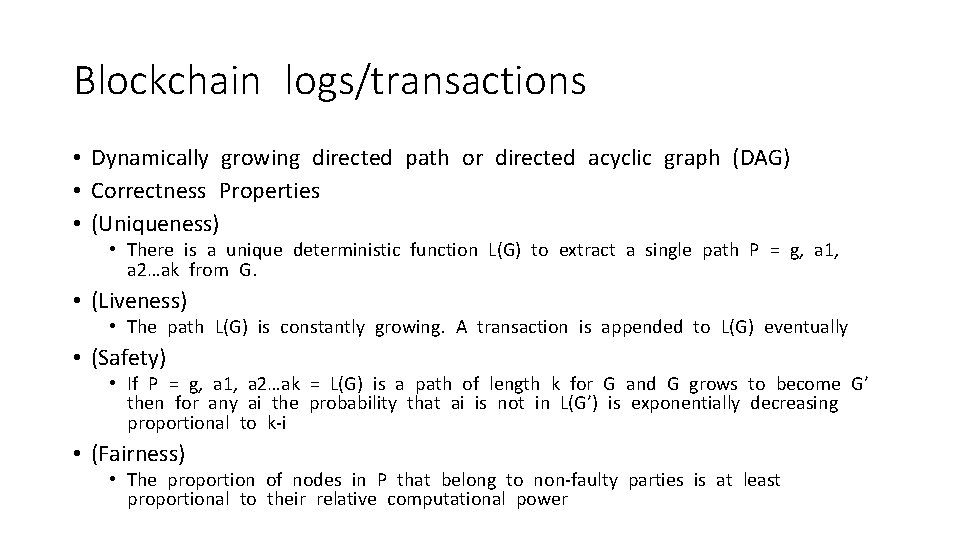
Blockchain logs/transactions • Dynamically growing directed path or directed acyclic graph (DAG) • Correctness Properties • (Uniqueness) • There is a unique deterministic function L(G) to extract a single path P = g, a 1, a 2…ak from G. • (Liveness) • The path L(G) is constantly growing. A transaction is appended to L(G) eventually • (Safety) • If P = g, a 1, a 2…ak = L(G) is a path of length k for G and G grows to become G’ then for any ai the probability that ai is not in L(G’) is exponentially decreasing proportional to k-i • (Fairness) • The proportion of nodes in P that belong to non-faulty parties is at least proportional to their relative computational power
Translation of NC notions in the BFT language • View • Length of the longest chain • Starting from 0 and grow upon every proposed transaction • A correct node rejects any other message from views lower than v • Propose • Successfully solving the puzzle at the end of L(G) implicitly and statistically represents acceptance of L(G) by a large fraction of parties • Commit • A node in view v decides on the block at a position v-e in L(G), the longest chain in G. With probability proportional to e, this block will not be overturned by any future insertions to G.
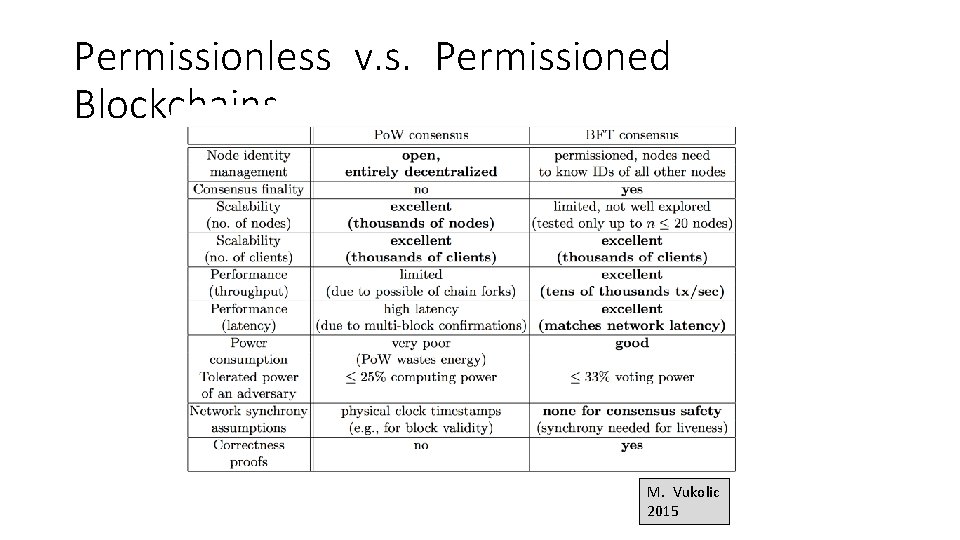
Permissionless v. s. Permissioned Blockchains M. Vukolic 2015
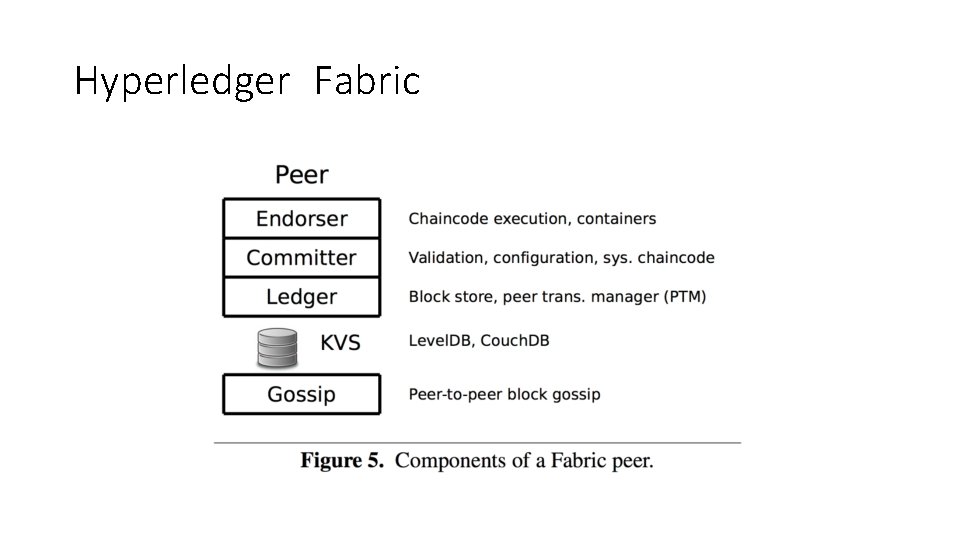
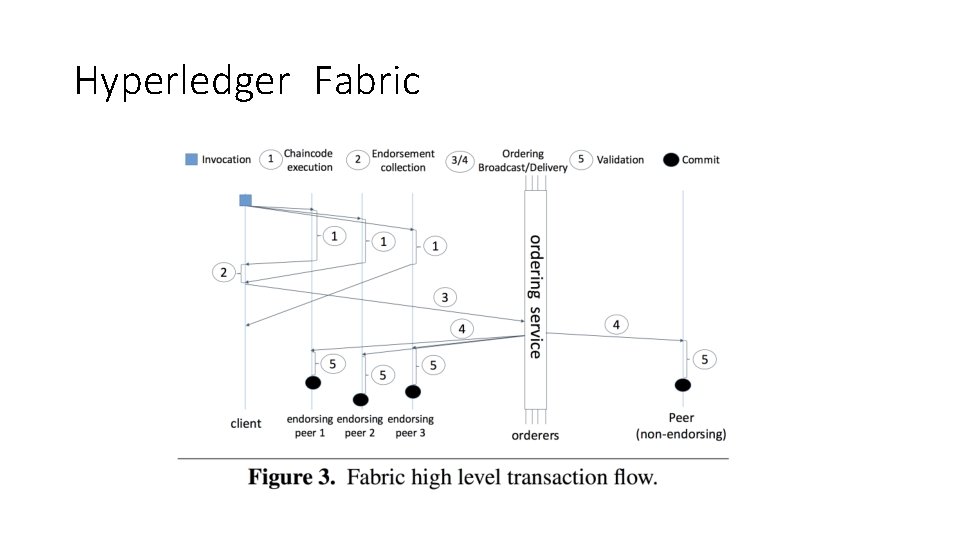
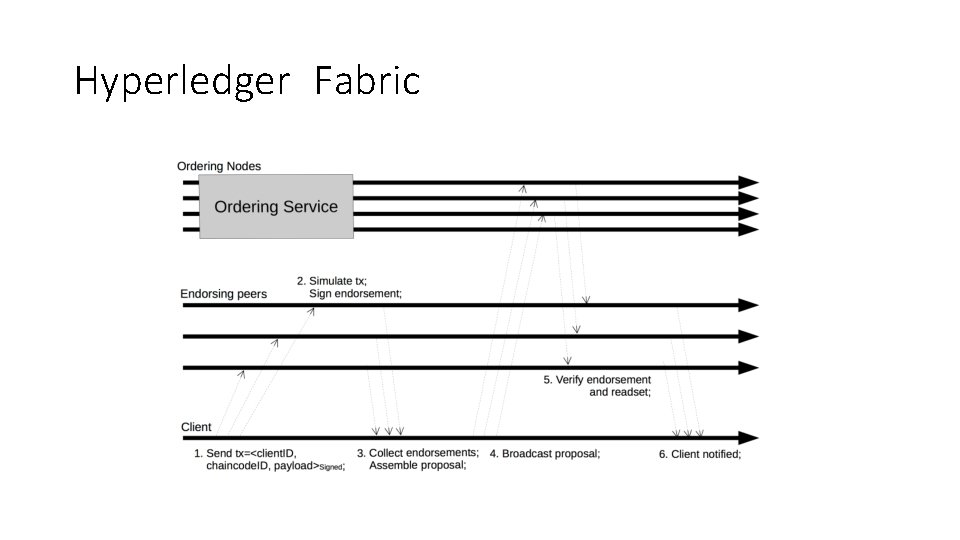
Hyperledger • Lead by IBM, supported by > 300 organizations • Five major projects • • • Fabric – PBFT Burrow Sawtooth Indy Iroha - BChain
Look into the consensus protocols • Hyperledger Fabric -- Zab/Paxos -> PBFT • Hyperledger Iroha – Sumeragi (BChain) • Tendermint – variant of PBFT • Symbiont -- BFT-SMa. Rt (implements variant of PBFT) • Corda – Raft and BFT-SMa. Rt • Quorum by JPMorgan Chase – Quorum. Chain and Raft-based Chain • Proprietary protocols - Kadena
Hyperledger Fabric
Hyperledger Fabric
Hyperledger Fabric
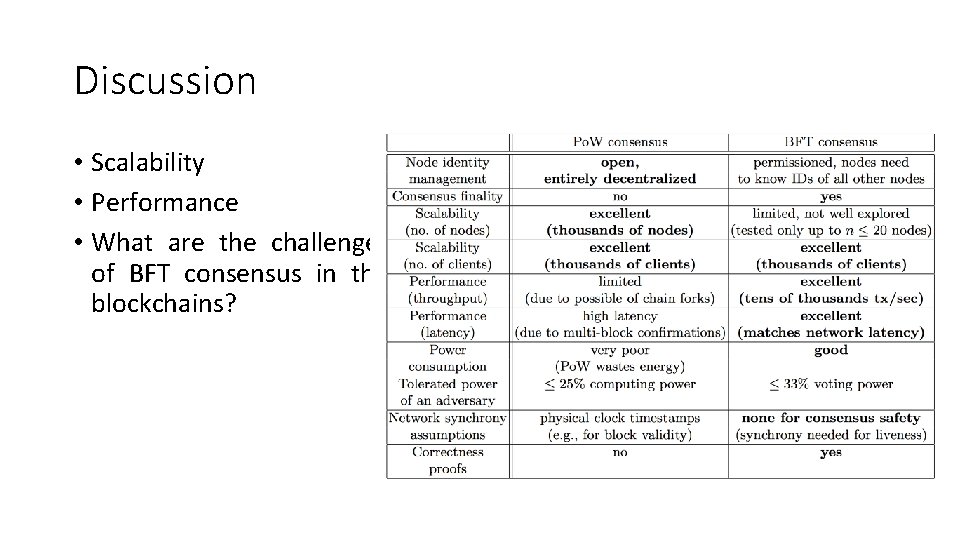
Discussion • Scalability • Performance • What are the challenges of BFT consensus in the blockchains?
Permissioned Blockchain – Open Problems • Engineering cryptographic systems … blockchain developers should look towards the established experience in cryptography, security, and theory of distributed systems for building trustworthy systems. Otherwise, it might be dangerous to entrust financial value to new protocols. Open discussion, expert reviews, broad validation, and standards recommendations should be employed. Christian Cachin and Marko Vukolic – IBM Research Zurich Blockchain consensus protocols in the wild. • Major components/problems • Formal protocol proof and reviews, technical comparisons, etc. • Application-driven implementation • Evaluation and Resilience under actual attacks and network incidents
Blockchain Challenges • Scalability • Cost • Killer app
- Slides: 50