
Outline Texture modeling continued Filteringbased approaches 1192022 Visual

Outline • Texture modeling - continued – Filtering-based approaches 1/19/2022 Visual Perception Modeling 1
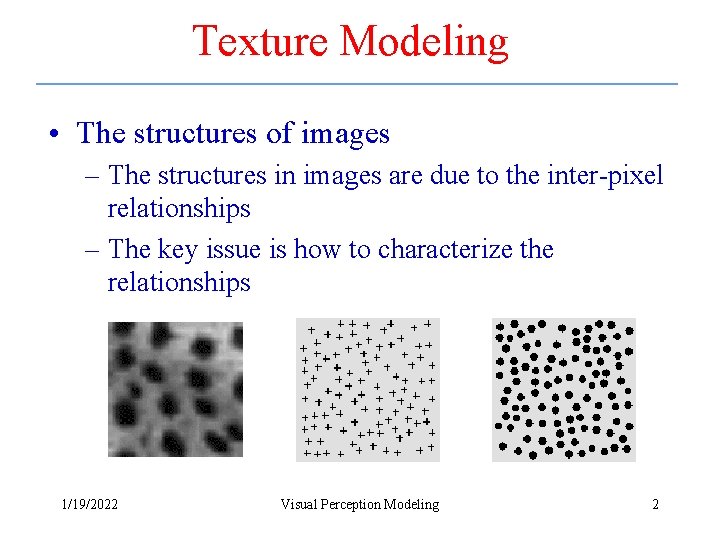
Texture Modeling • The structures of images – The structures in images are due to the inter-pixel relationships – The key issue is how to characterize the relationships 1/19/2022 Visual Perception Modeling 2

Representing Textures through Filtering • Filtering – Convolving an image with a linear filter yields a representation of the image on a different basis – The advantage of the transformation is that the process makes the local structure of the image “clear” • A filter can be viewed as a template • There is a strong response when the local image pattern looks similar to the filter kernel and a weak response when it does not 1/19/2022 Visual Perception Modeling 3
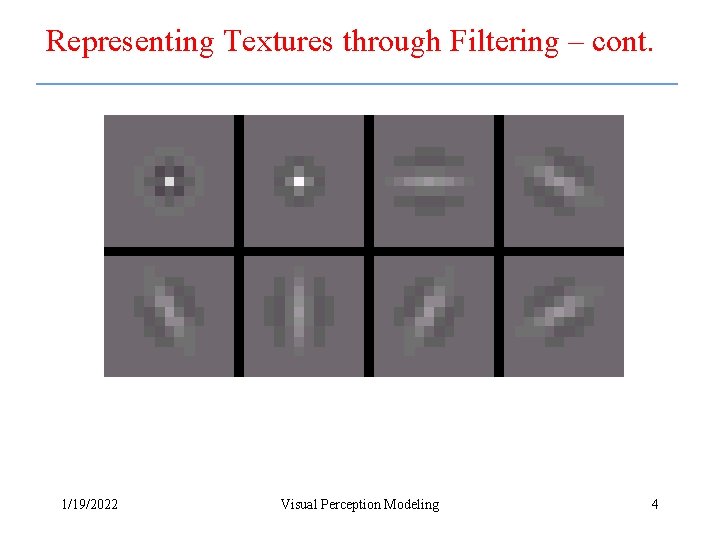
Representing Textures through Filtering – cont. 1/19/2022 Visual Perception Modeling 4
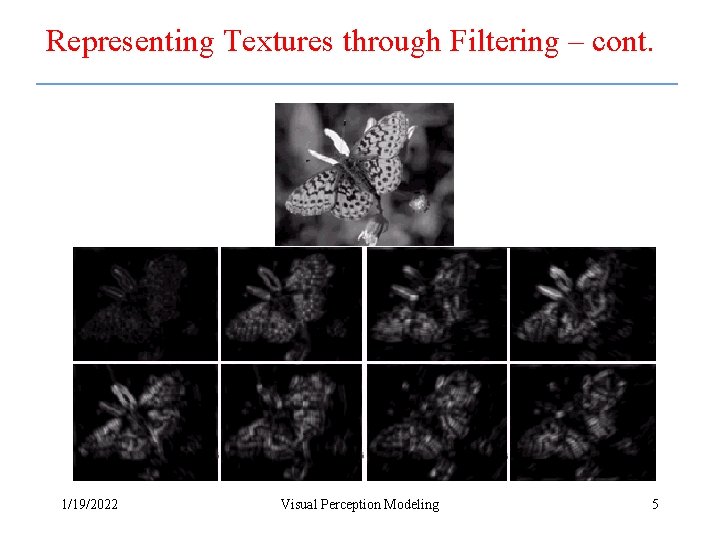
Representing Textures through Filtering – cont. 1/19/2022 Visual Perception Modeling 5
Representing Textures through Filtering – cont. • Gabor filters – Gabor filters have been widely in texture modeling – Mathematically, Gabor filters are optimal in the sense of local joint spatial/frequency representation 1/19/2022 Visual Perception Modeling 6
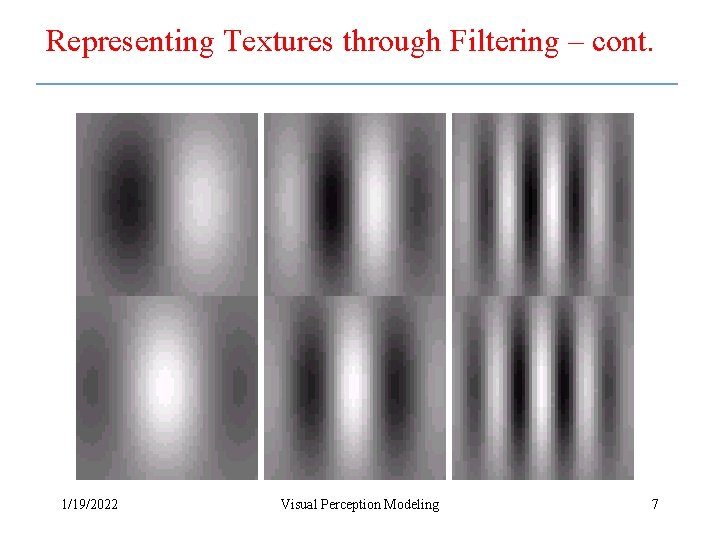
Representing Textures through Filtering – cont. 1/19/2022 Visual Perception Modeling 7
Representing Textures through Filtering – cont. • Problems with filtering-based approaches – The filter response itself does not give rise to a representation or a model for textures – Even for homogenous textures, the filter responses are not homogenous 1/19/2022 Visual Perception Modeling 8
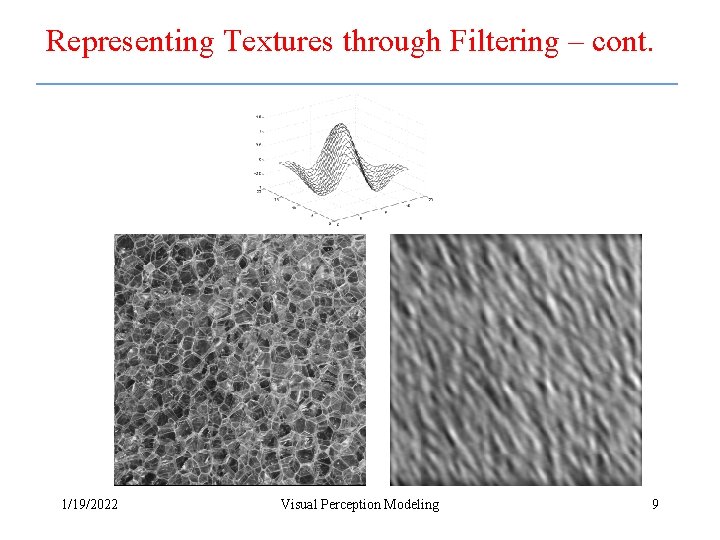
Representing Textures through Filtering – cont. 1/19/2022 Visual Perception Modeling 9
Representing Textures through Filtering – cont. • Non-linear smoothing – In order to derive a more homogenous and meaningful feature for textures, the filter responses are then passed through a non-linear stage • The hope is that smoothed filter response will be relative homogenous within a texture region • This can be used for texture classification, texture boundary detection, and texture discrimination 1/19/2022 Visual Perception Modeling 10
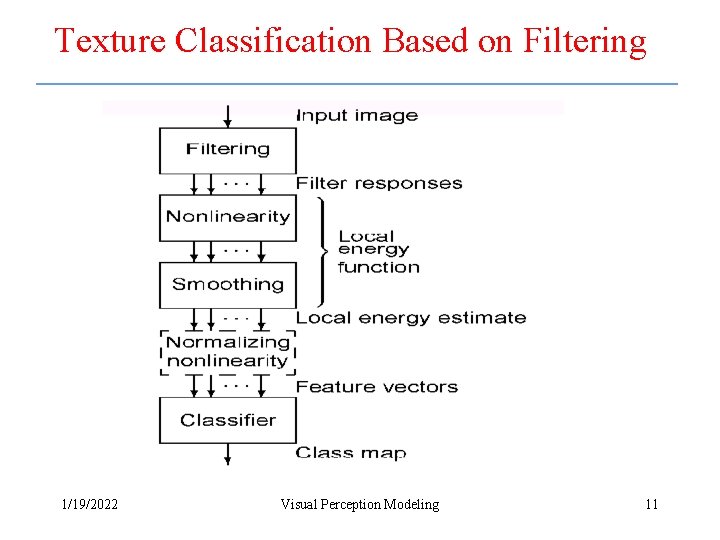
Texture Classification Based on Filtering 1/19/2022 Visual Perception Modeling 11
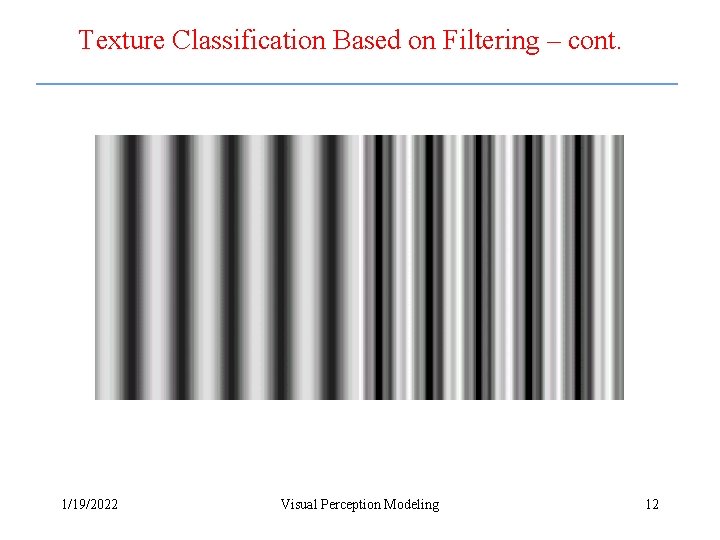
Texture Classification Based on Filtering – cont. 1/19/2022 Visual Perception Modeling 12
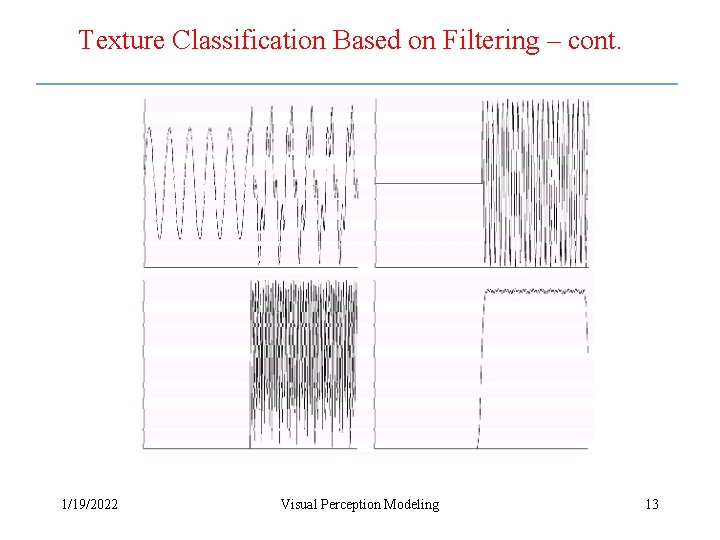
Texture Classification Based on Filtering – cont. 1/19/2022 Visual Perception Modeling 13
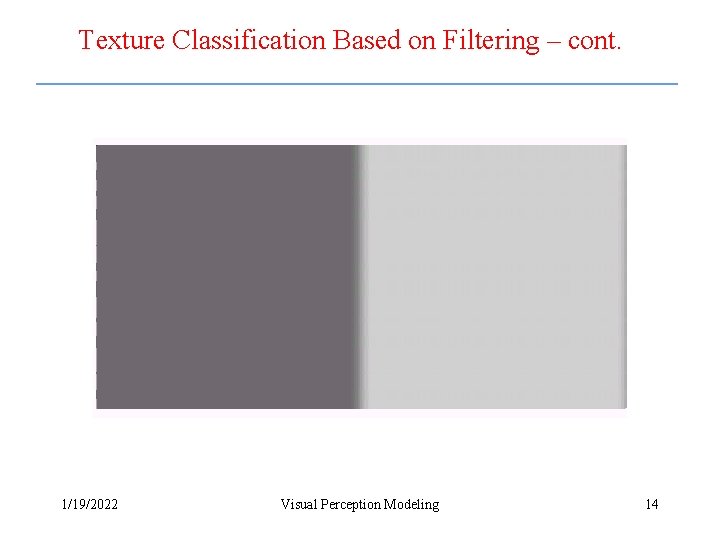
Texture Classification Based on Filtering – cont. 1/19/2022 Visual Perception Modeling 14
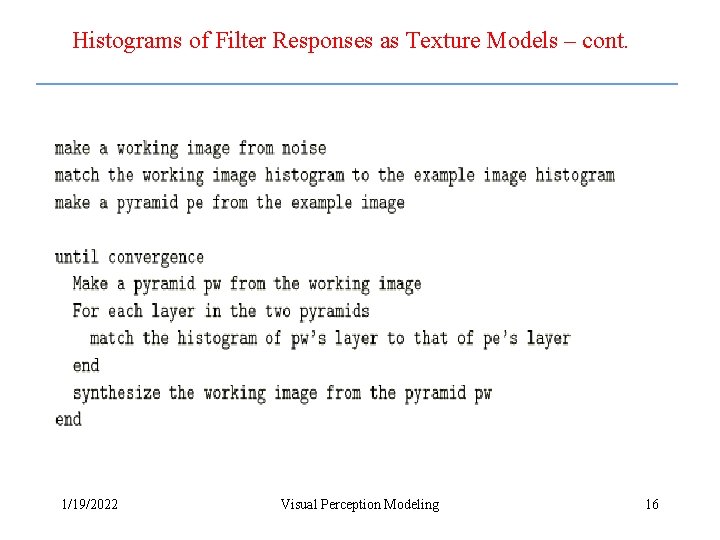
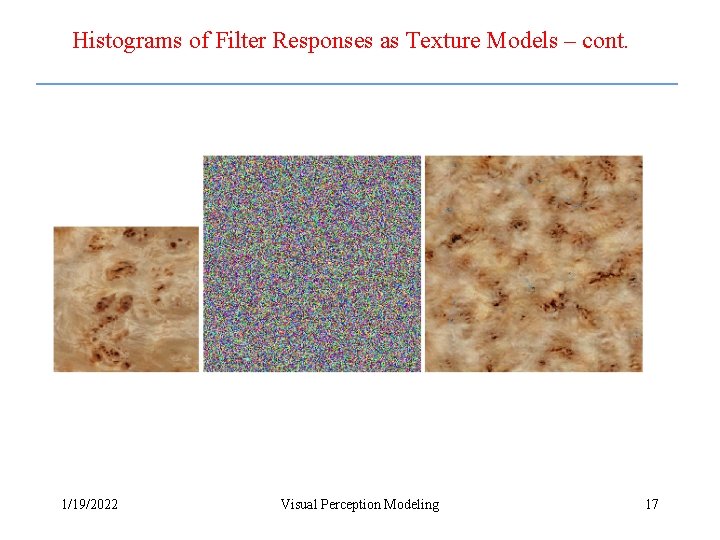
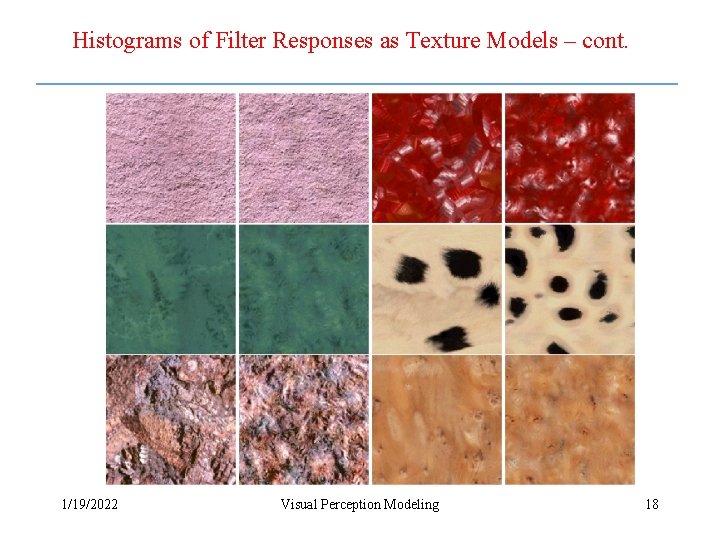
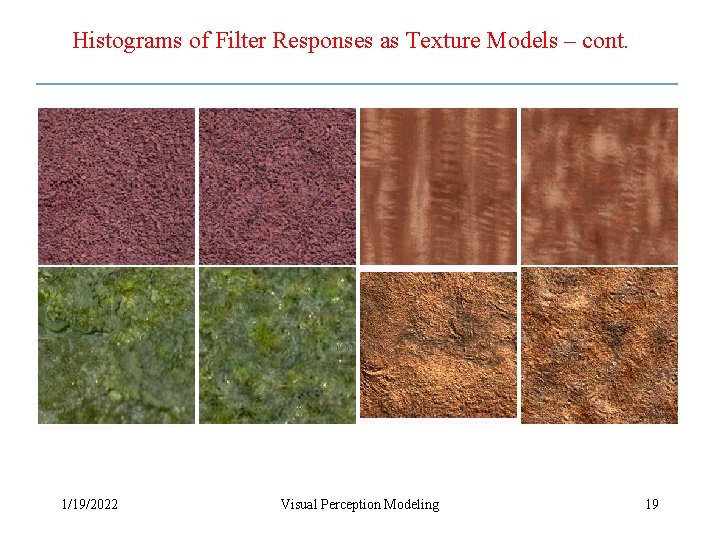
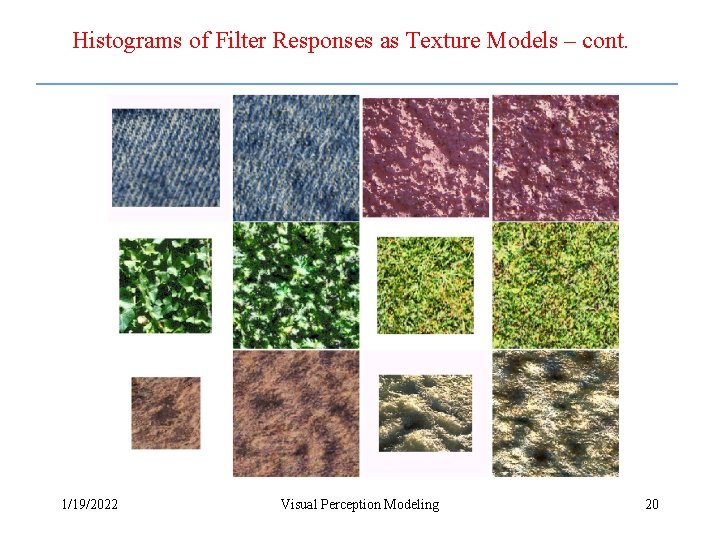
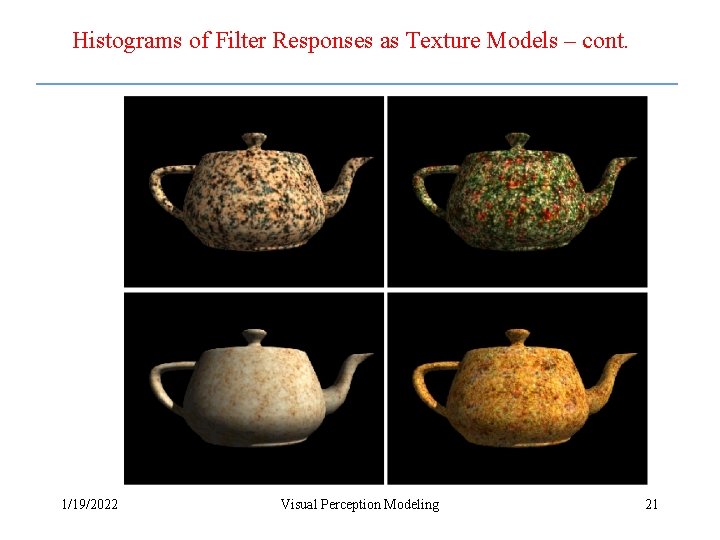
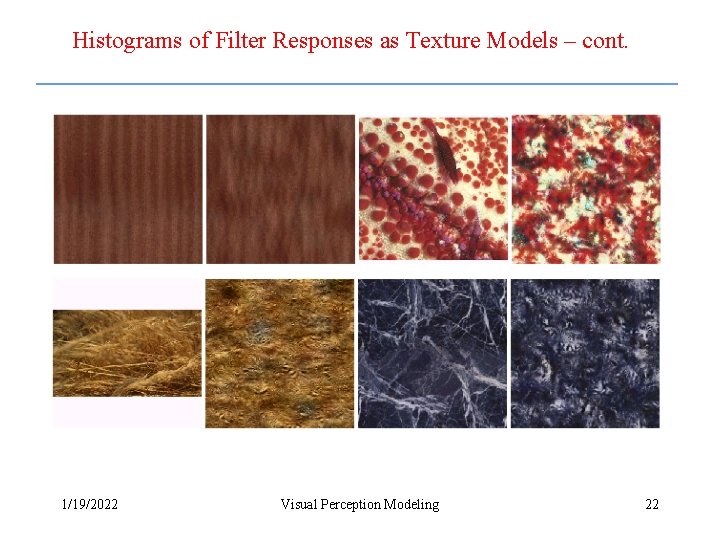
Histograms of Filter Responses as Texture Models • Histograms as texture features – For homogenous textures, histograms should not change very much • In other words, texture images with similar histograms of filter responses should look similar – Heeger and Bergen proposed a texture synthesis algorithm based on this observation 1/19/2022 Visual Perception Modeling 15
Histograms of Filter Responses as Texture Models – cont. 1/19/2022 Visual Perception Modeling 16
Histograms of Filter Responses as Texture Models – cont. 1/19/2022 Visual Perception Modeling 17
Histograms of Filter Responses as Texture Models – cont. 1/19/2022 Visual Perception Modeling 18
Histograms of Filter Responses as Texture Models – cont. 1/19/2022 Visual Perception Modeling 19
Histograms of Filter Responses as Texture Models – cont. 1/19/2022 Visual Perception Modeling 20
Histograms of Filter Responses as Texture Models – cont. 1/19/2022 Visual Perception Modeling 21
Histograms of Filter Responses as Texture Models – cont. 1/19/2022 Visual Perception Modeling 22
Non-Parametric Sampling • Non-parametric sampling – When we need to decide a pixel value, we calculate the conditional probability given the pixel values in the surrounding neighborhood • This is done by finding the similar surrounding neighborhood in the given texture 1/19/2022 Visual Perception Modeling 23
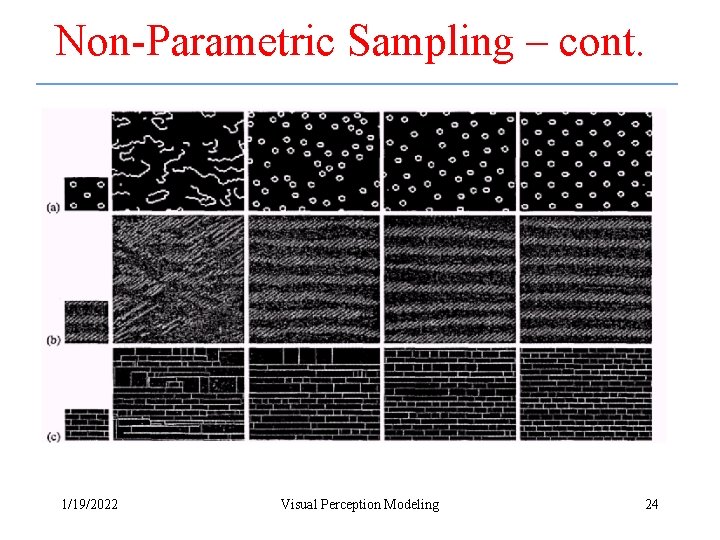
Non-Parametric Sampling – cont. 1/19/2022 Visual Perception Modeling 24
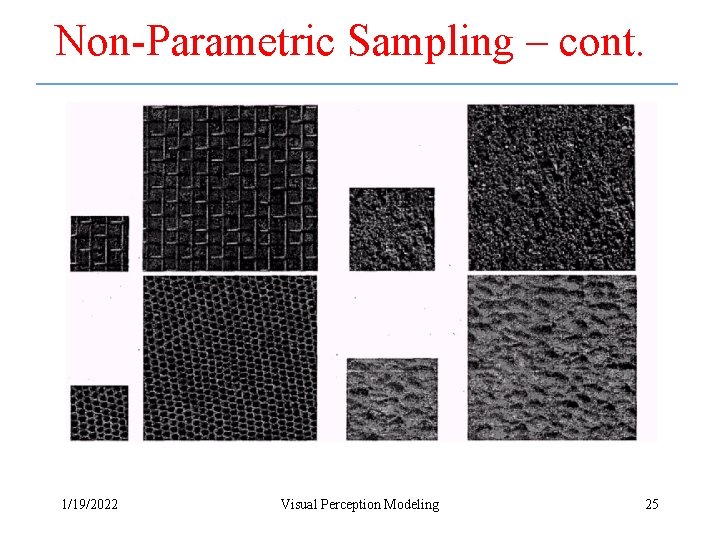
Non-Parametric Sampling – cont. 1/19/2022 Visual Perception Modeling 25
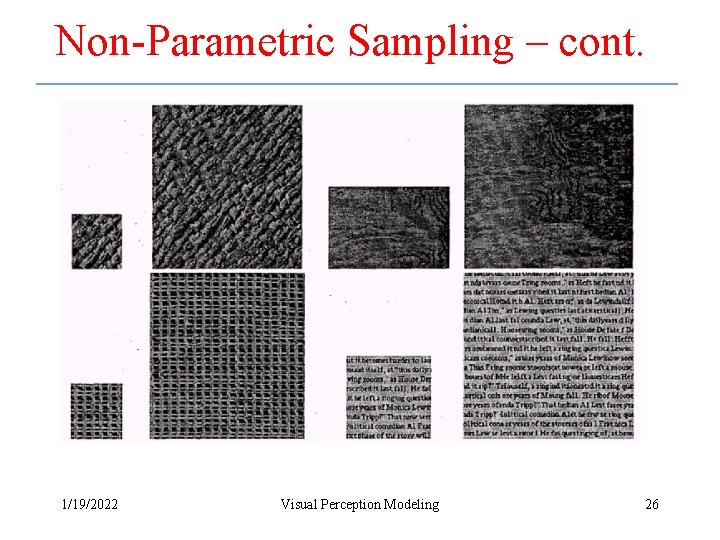
Non-Parametric Sampling – cont. 1/19/2022 Visual Perception Modeling 26
- Slides: 26