
Outline t t t Memory hierarchy The basics

Outline t t t Memory hierarchy The basics of caches l Direct-mapped cache l Address sub-division l Cache hit and miss l Memory support Measuring cache performance Improving cache performance l Set associative cache l Multiple level cache Virtual memory l Basics l Issues in virtual memory l Handling huge page table l TLB (Translation Lookaside Buffer) l TLB and cache A common framework for memory hierarchy 1
Memory Technology t Random access: l l Access time same for all locations SRAM: Static Random Access Memory n n l DRAM: Dynamic Random Access Memory n n t Low density, high power, expensive, fast Static: content will last (forever until lose power) Address not divided Use for caches High density, low power, cheap, slow Dynamic: need to be refreshed regularly Addresses in 2 halves (memory as a 2 D matrix): T RAS/CAS (Row/Column Access Strobe) Use for main memory Magnetic disk 2

Comparisons of Various Technologies Memory technology Typical access time SRAM 0. 5 – 2. 5 ns DRAM 50 – 70 ns 5, 000 – Magnetic 20, 000 ns disk Ideal memory t. Access time of SRAM t. Capacity and cost/GB of disk $ per GB in 2008 $2000 – $5, 000 $20 – $75 $0. 20 – $2 3
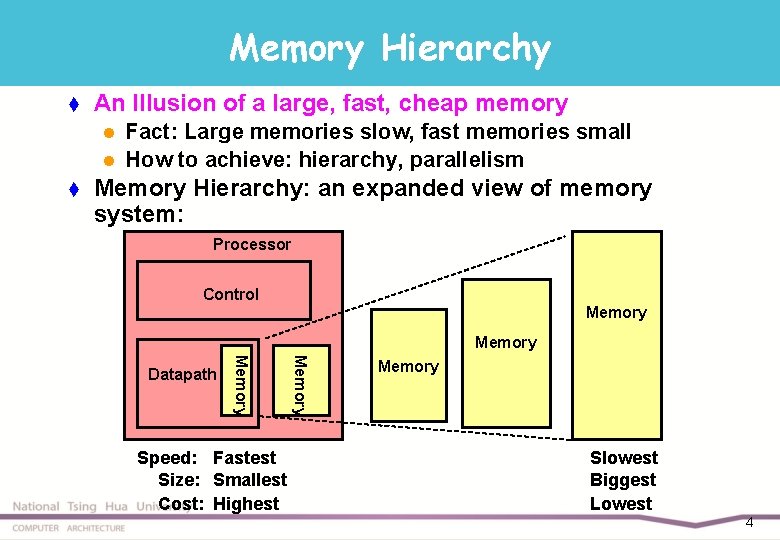
Memory Hierarchy t An Illusion of a large, fast, cheap memory l l t Fact: Large memories slow, fast memories small How to achieve: hierarchy, parallelism Memory Hierarchy: an expanded view of memory system: Processor Control Memory Speed: Fastest Size: Smallest Cost: Highest Memory Datapath Memory Slowest Biggest Lowest 4
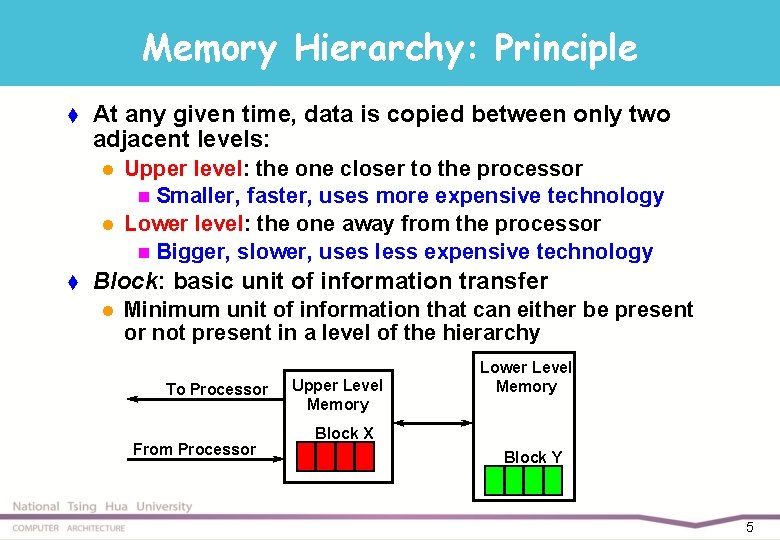
Memory Hierarchy: Principle t At any given time, data is copied between only two adjacent levels: l l t Upper level: the one closer to the processor n Smaller, faster, uses more expensive technology Lower level: the one away from the processor n Bigger, slower, uses less expensive technology Block: basic unit of information transfer l Minimum unit of information that can either be present or not present in a level of the hierarchy To Processor From Processor Upper Level Memory Lower Level Memory Block X Block Y 5
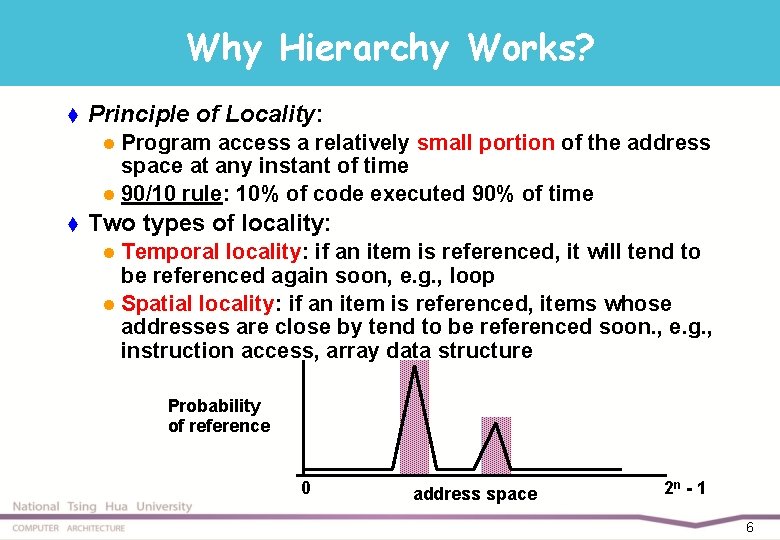
Why Hierarchy Works? t Principle of Locality: Program access a relatively small portion of the address space at any instant of time l 90/10 rule: 10% of code executed 90% of time l t Two types of locality: Temporal locality: if an item is referenced, it will tend to be referenced again soon, e. g. , loop l Spatial locality: if an item is referenced, items whose addresses are close by tend to be referenced soon. , e. g. , instruction access, array data structure l Probability of reference 0 address space 2 n - 1 6
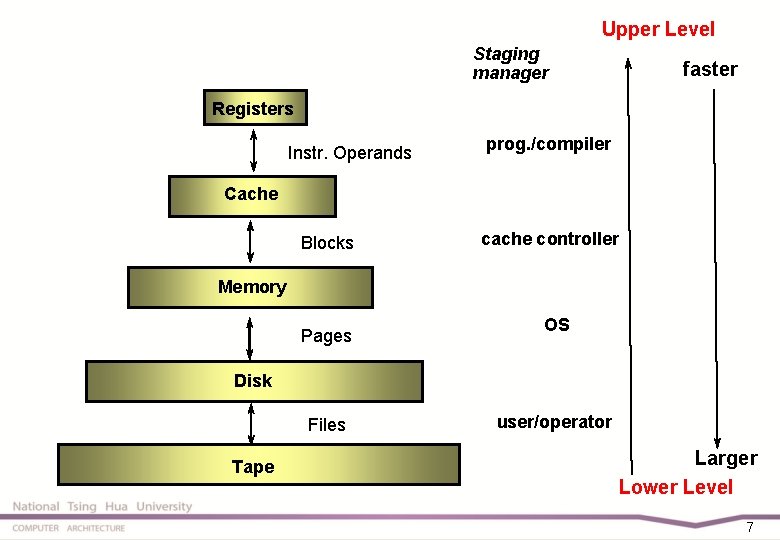
Upper Level Staging manager faster Registers Instr. Operands prog. /compiler Cache Blocks cache controller Memory Pages OS Disk Files Tape user/operator Larger Lower Level 7
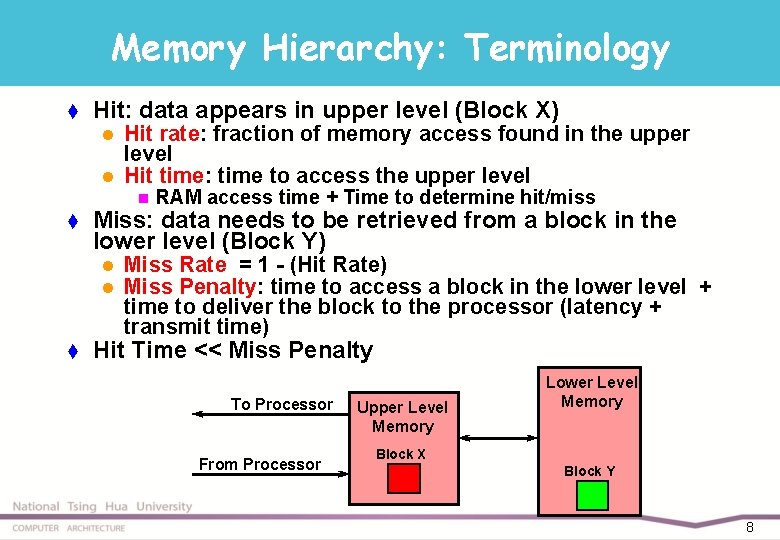
Memory Hierarchy: Terminology t Hit: data appears in upper level (Block X) l l Hit rate: fraction of memory access found in the upper level Hit time: time to access the upper level n t Miss: data needs to be retrieved from a block in the lower level (Block Y) l l t RAM access time + Time to determine hit/miss Miss Rate = 1 - (Hit Rate) Miss Penalty: time to access a block in the lower level + time to deliver the block to the processor (latency + transmit time) Hit Time << Miss Penalty To Processor From Processor Upper Level Memory Lower Level Memory Block X Block Y 8
4 Questions for Hierarchy Design Q 1: Where can a block be placed in the upper level? => block placement Q 2: How is a block found if it is in the upper level? => block finding Q 3: Which block should be replaced on a miss? => block replacement Q 4: What happens on a write? => write strategy 9
Summary of Memory Hierarchy t Two different types of locality: l l t Using the principle of locality: l l t Present the user with as much memory as is available in the cheapest technology. Provide access at the speed offered by the fastest technology. DRAM is slow but cheap and dense: l t Temporal Locality (Locality in Time) Spatial Locality (Locality in Space) Good for presenting users with a BIG memory system SRAM is fast but expensive, not very dense: l Good choice for providing users FAST accesses 10
Outline t t t Memory hierarchy The basics of caches l Direct-mapped cache l Address sub-division l Cache hit and miss l Memory support Measuring cache performance Improving cache performance l Set associative cache l Multiple level cache Virtual memory l Basics l Issues in virtual memory l Handling huge page table l TLB (Translation Lookaside Buffer) l TLB and cache A common framework for memory hierarchy 11
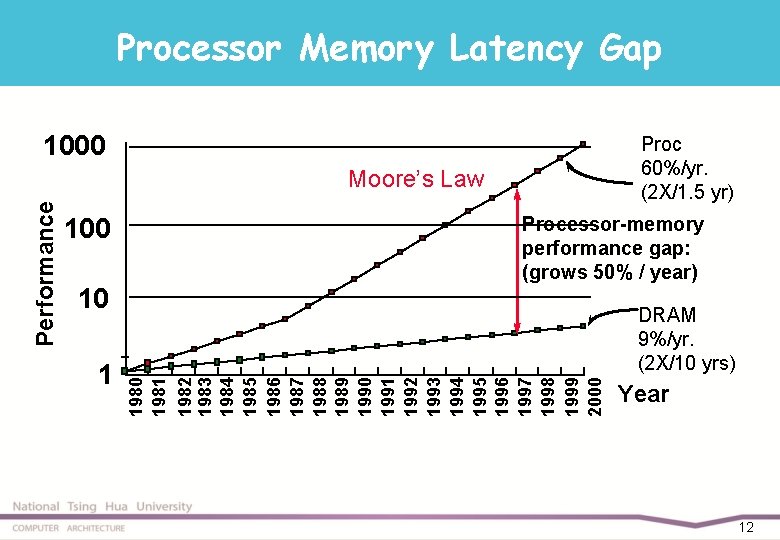
Processor Memory Latency Gap 1000 Proc 60%/yr. (2 X/1. 5 yr) 100 10 1 Processor-memory performance gap: (grows 50% / year) DRAM 9%/yr. (2 X/10 yrs) 1980 1981 1982 1983 1984 1985 1986 1987 1988 1989 1990 1991 1992 1993 1994 1995 1996 1997 1998 1999 2000 Performance Moore’s Law Year 12

Levels of Memory Hierarchy Upper Level Staging faster Transfer Unit Registers Instr. Operands prog. /compiler Cache Blocks cache controller Memory Pages OS Disk Files Tape user/operator Larger Lower Level 13
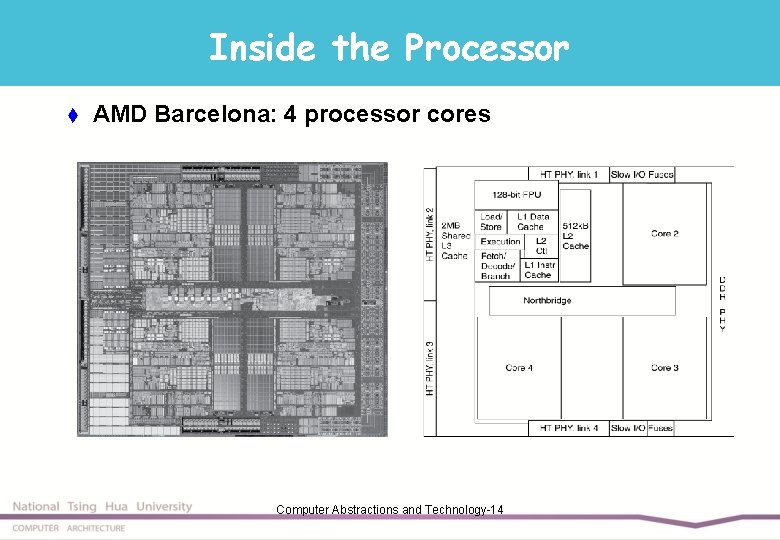
Inside the Processor t AMD Barcelona: 4 processor cores Computer Abstractions and Technology-14
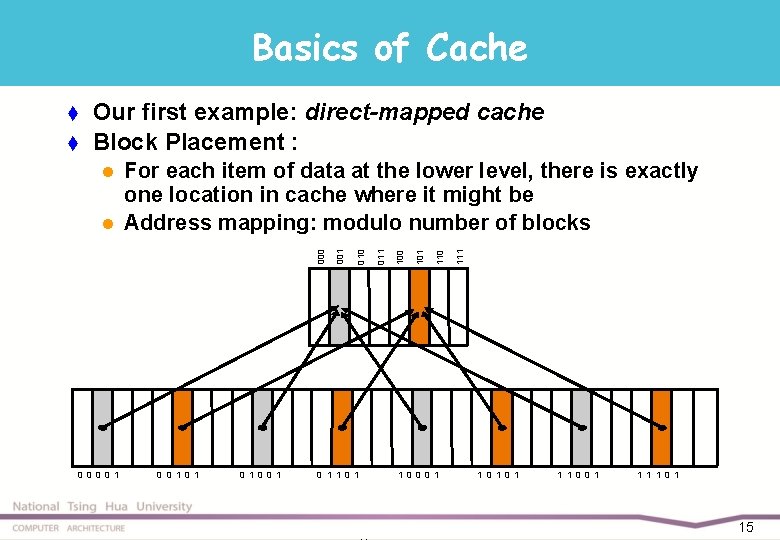
Basics of Cache 0 0 1 0 1 0 1 1 0 0 0 1 110 101 100 000 l For each item of data at the lower level, there is exactly one location in cache where it might be Address mapping: modulo number of blocks 011 l 010 t Our first example: direct-mapped cache Block Placement : 001 t 1 0 1 1 1 0 0 1 15
Tags and Valid Bits: Block Finding t How do we know which particular block is stored in a cache location? l l l t Store block address as well as the data Actually, only need the high-order bits Called the tag What if there is no data in a location? l l Valid bit: 1 = present, 0 = not present Initially 0 16
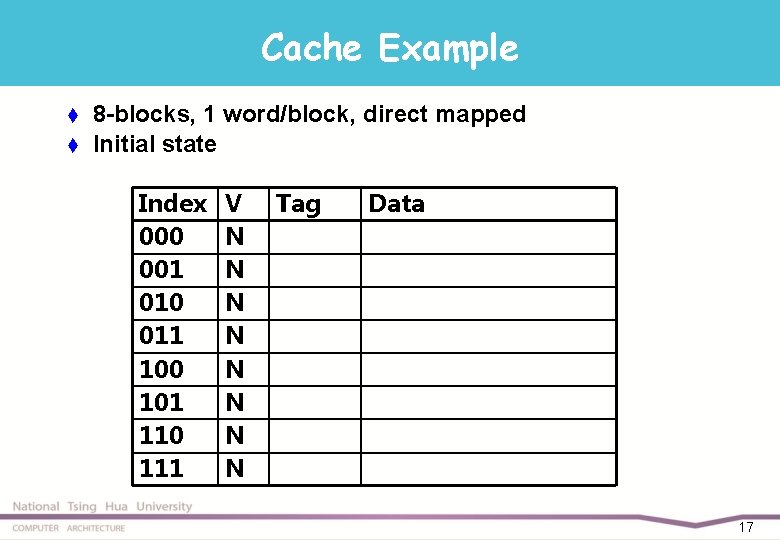
Cache Example t t 8 -blocks, 1 word/block, direct mapped Initial state Index 000 001 010 011 100 101 110 111 V N N N N Tag Data 17
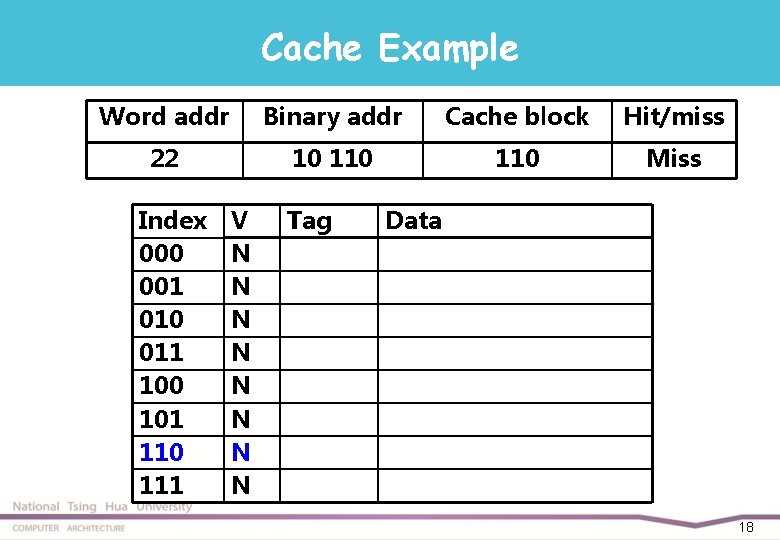
Cache Example Word addr Binary addr Cache block Hit/miss 22 10 110 Miss Index 000 001 010 011 100 101 110 111 V N N N N Tag Data 18
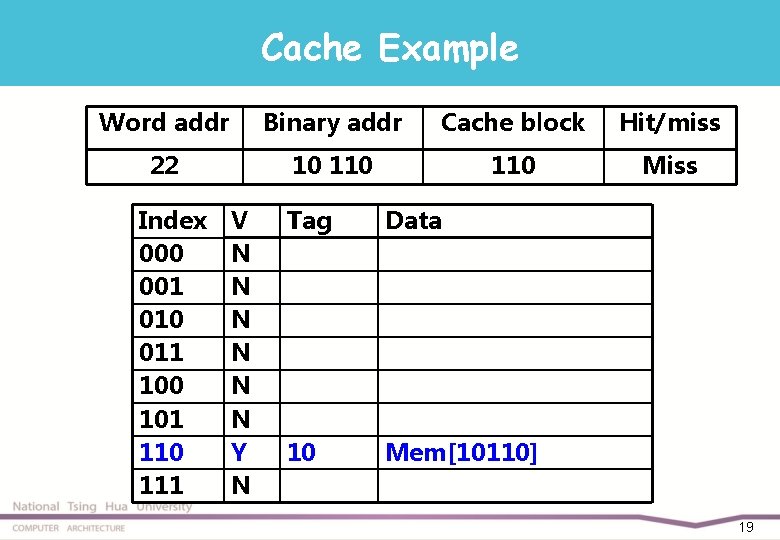
Cache Example Word addr Binary addr Cache block Hit/miss 22 10 110 Miss Index 000 001 010 011 100 101 110 111 V N N N Y N Tag Data 10 Mem[10110] 19
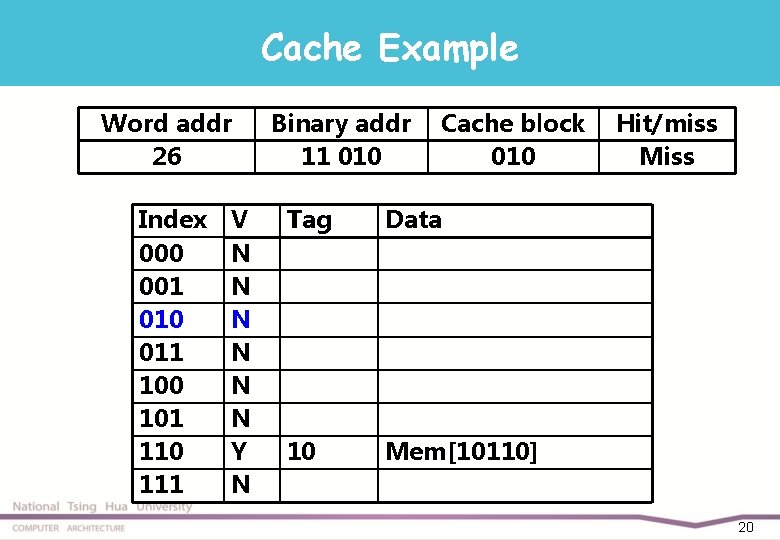
Cache Example Word addr 26 Index 000 001 010 011 100 101 110 111 V N N N Y N Binary addr 11 010 Cache block 010 Tag Data 10 Mem[10110] Hit/miss Miss 20
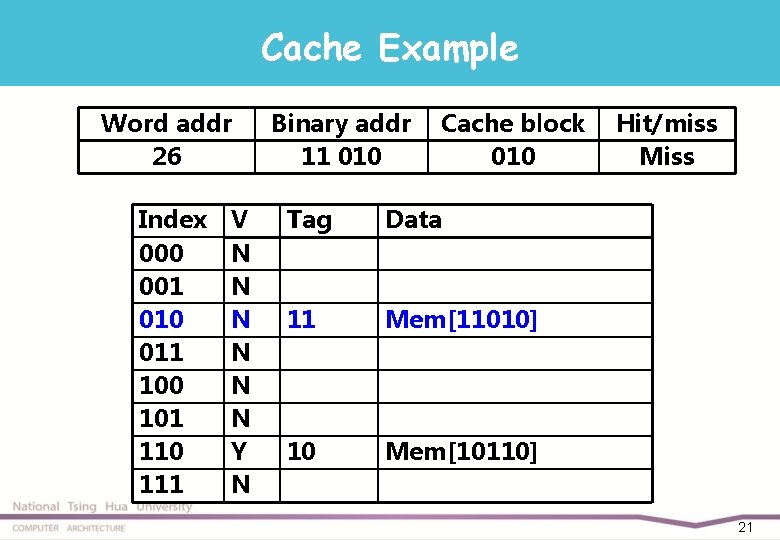
Cache Example Word addr 26 Index 000 001 010 011 100 101 110 111 V N N N Y N Binary addr 11 010 Cache block 010 Tag Data 11 Mem[11010] 10 Mem[10110] Hit/miss Miss 21
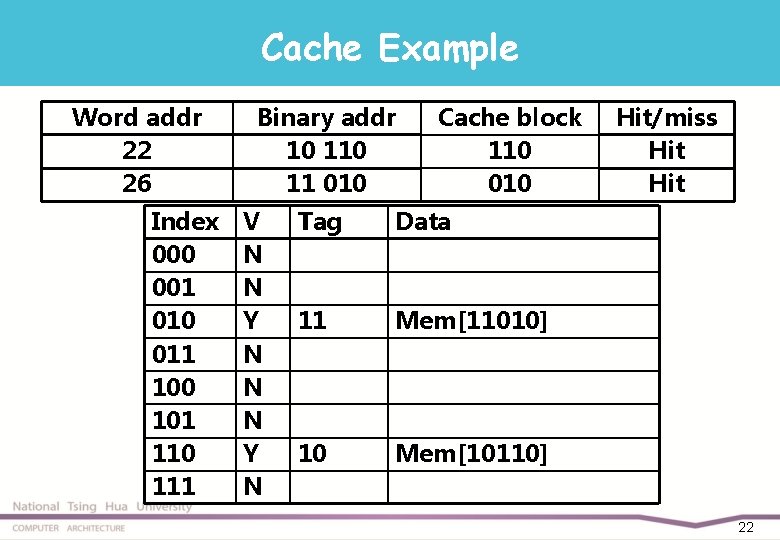
Cache Example Word addr 22 26 Index 000 001 010 011 100 101 110 111 Binary addr 10 11 010 V N N Y N Cache block 110 010 Tag Data 11 Mem[11010] 10 Mem[10110] Hit/miss Hit 22
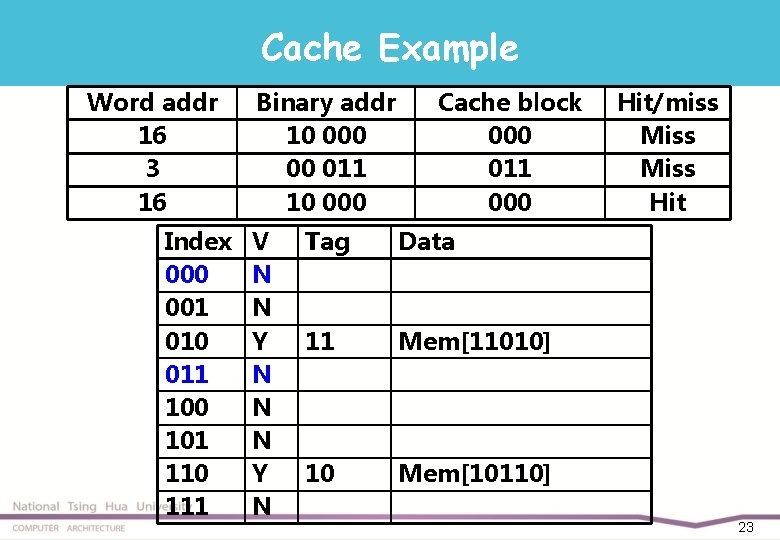
Cache Example Word addr 16 3 16 Index 000 001 010 011 100 101 110 111 Binary addr 10 00 011 10 000 V N N Y N Cache block 000 011 000 Tag Data 11 Mem[11010] 10 Mem[10110] Hit/miss Miss Hit 23
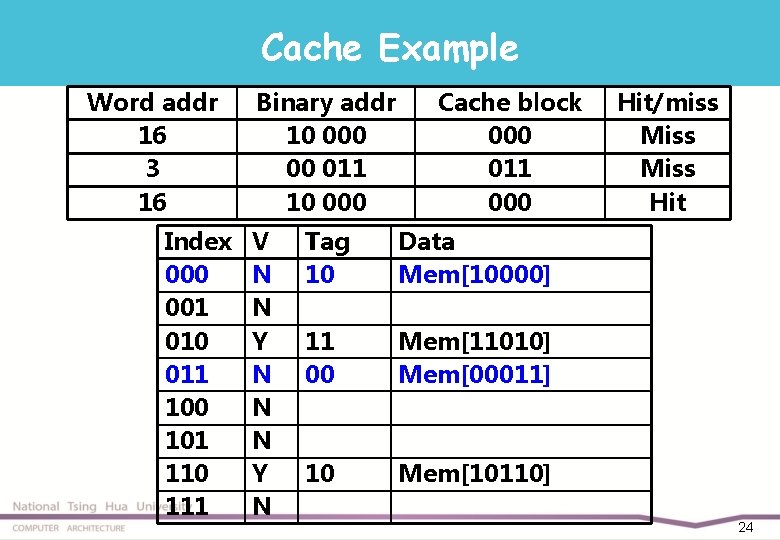
Cache Example Word addr 16 3 16 Index 000 001 010 011 100 101 110 111 Binary addr 10 00 011 10 000 V N N Y N Cache block 000 011 000 Tag 10 Data Mem[10000] 11 00 Mem[11010] Mem[00011] 10 Mem[10110] Hit/miss Miss Hit 24
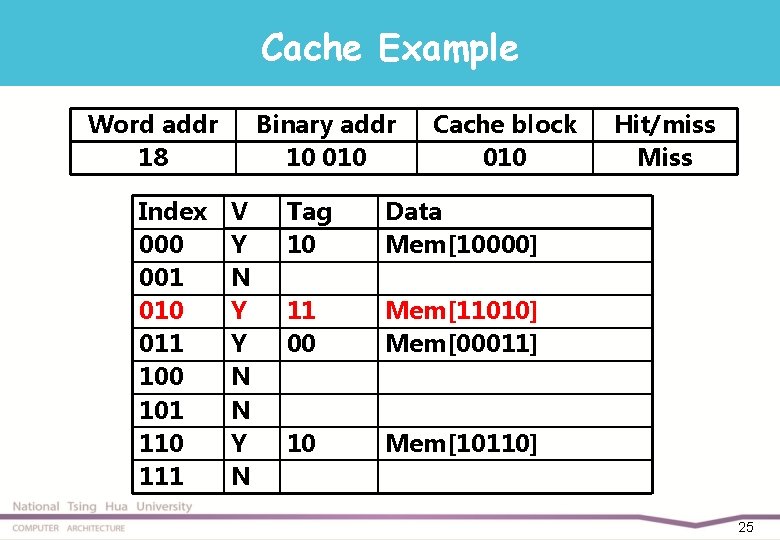
Cache Example Word addr 18 Index 000 001 010 011 100 101 110 111 Binary addr 10 010 V Y N Y Y N N Y N Cache block 010 Tag 10 Data Mem[10000] 11 00 Mem[11010] Mem[00011] 10 Mem[10110] Hit/miss Miss 25
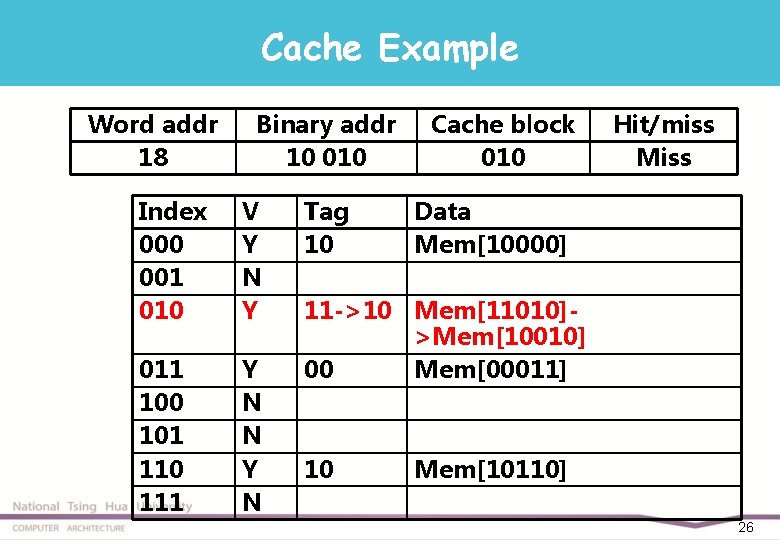
Cache Example Word addr 18 Binary addr 10 010 Index 000 001 010 V Y N Y 011 100 101 110 111 Y N N Y N Tag 10 Cache block 010 Hit/miss Miss Data Mem[10000] 11 ->10 Mem[11010]>Mem[10010] 00 Mem[00011] 10 Mem[10110] 26
Outline t t t Memory hierarchy The basics of caches l Direct-mapped cache l Address sub-division l Cache hit and miss l Memory support Measuring cache performance Improving cache performance l Set associative cache l Multiple level cache Virtual memory l Basics l Issues in virtual memory l Handling huge page table l TLB (Translation Lookaside Buffer) l TLB and cache A common framework for memory hierarchy 27
Memory Address 100000 100001 100010 100011 100100 100101 100110 100111 101000
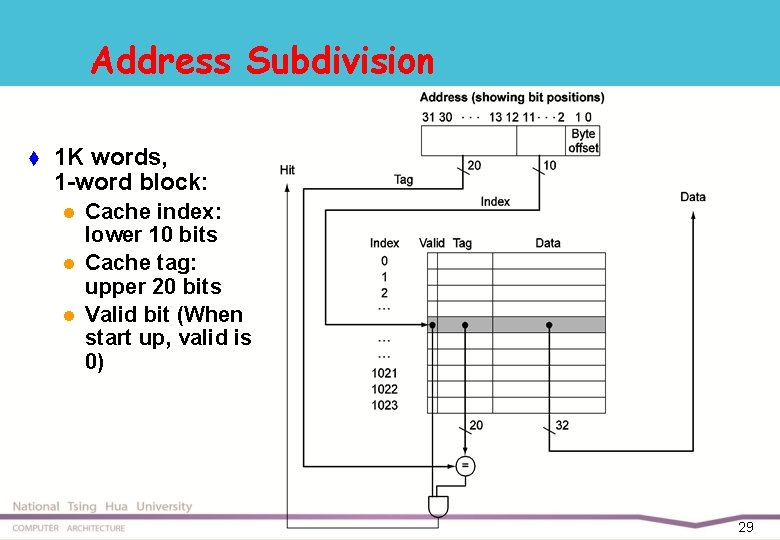
Address Subdivision t 1 K words, 1 -word block: l l l Cache index: lower 10 bits Cache tag: upper 20 bits Valid bit (When start up, valid is 0) 29
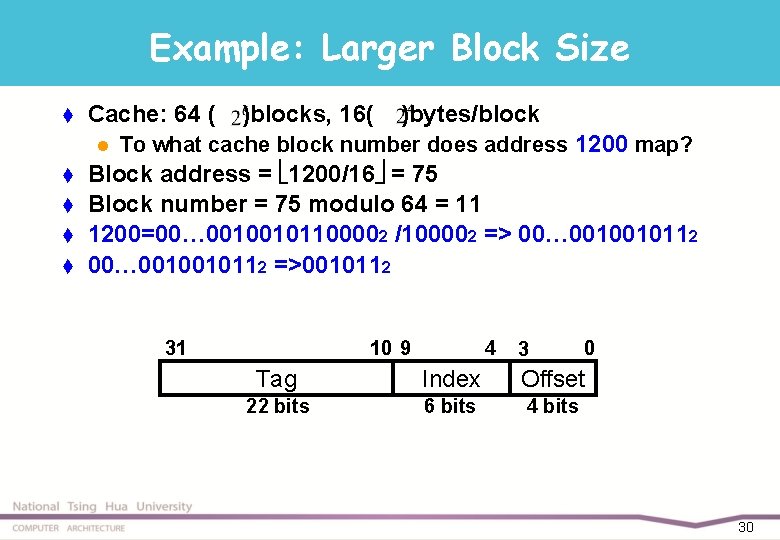
Example: Larger Block Size t Cache: 64 ( l t t )blocks, 16( )bytes/block To what cache block number does address 1200 map? Block address = 1200/16 = 75 Block number = 75 modulo 64 = 11 1200=00… 00100101100002 /100002 => 00… 0010010112 =>0010112 31 10 9 4 3 0 Tag Index Offset 22 bits 6 bits 4 bits 30
Example: Intrinsity Fast. MATH t Embedded MIPS processor l l t 12 -stage pipeline Instruction and data access on each cycle Split cache: separate I-cache and D-cache l Each 16 KB: 256 blocks × 16 words/block 31
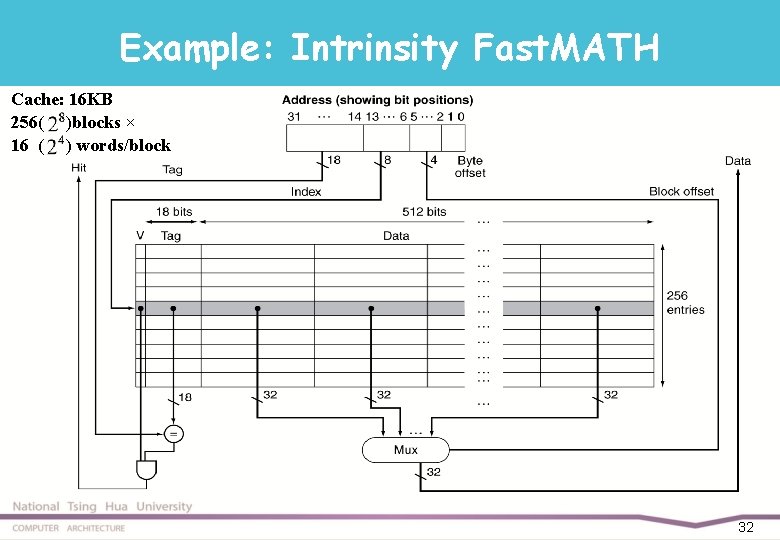
Example: Intrinsity Fast. MATH Cache: 16 KB 256( )blocks × 16 ( ) words/block 32
Block Size Considerations t Larger blocks should reduce miss rate l t Due to spatial locality But in a fixed-sized cache l Larger blocks fewer of them n t More competition increased miss rate Larger miss penalty l l l More access time and transmit time Larger blocks pollution Can override benefit of reduced miss rate 33
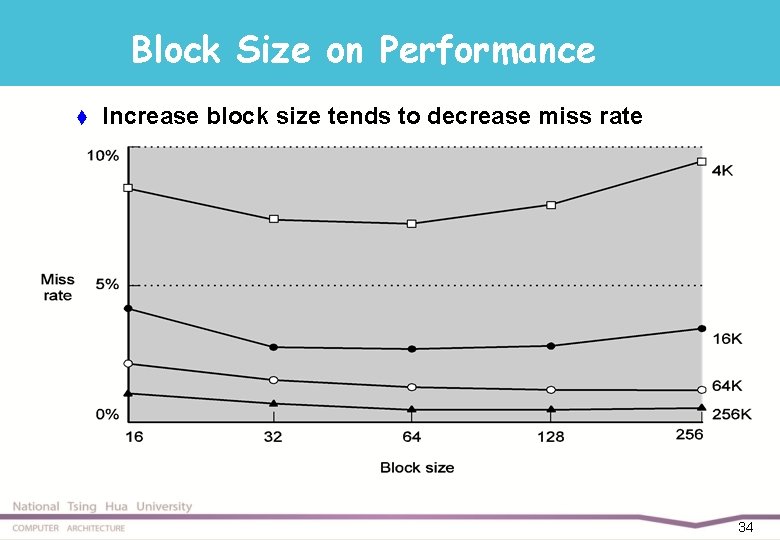
Block Size on Performance t Increase block size tends to decrease miss rate 34
Outline t t t Memory hierarchy The basics of caches l Direct-mapped cache l Address sub-division l Cache hit and miss l Memory support Measuring cache performance Improving cache performance l Set associative cache l Multiple level cache Virtual memory l Basics l Issues in virtual memory l Handling huge page table l TLB (Translation Lookaside Buffer) l TLB and cache A common framework for memory hierarchy 35
Cache Misses Read Hit: t On cache hit, CPU proceeds normally Read Miss: t On cache miss l l Stall the CPU pipeline Fetch block from next level of hierarchy Instruction cache miss n Restart instruction fetch Data cache miss n Complete data access 36
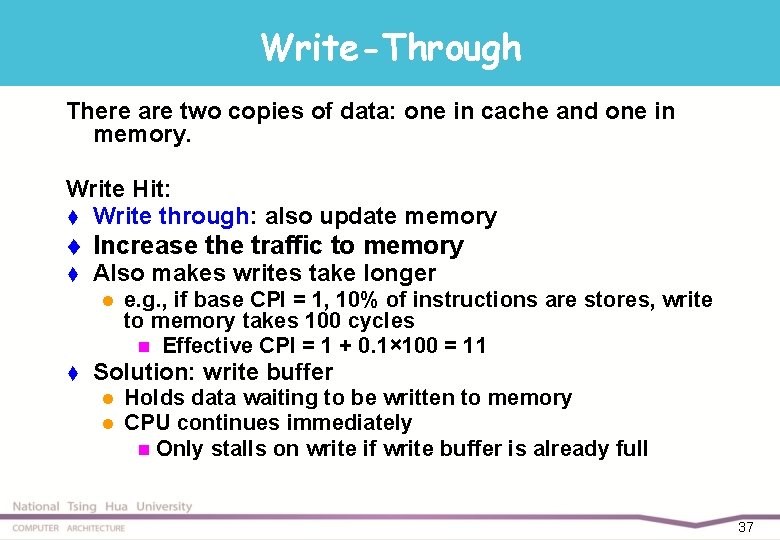
Write-Through There are two copies of data: one in cache and one in memory. Write Hit: t Write through: also update memory t Increase the traffic to memory t Also makes writes take longer l t e. g. , if base CPI = 1, 10% of instructions are stores, write to memory takes 100 cycles n Effective CPI = 1 + 0. 1× 100 = 11 Solution: write buffer l l Holds data waiting to be written to memory CPU continues immediately n Only stalls on write if write buffer is already full 37
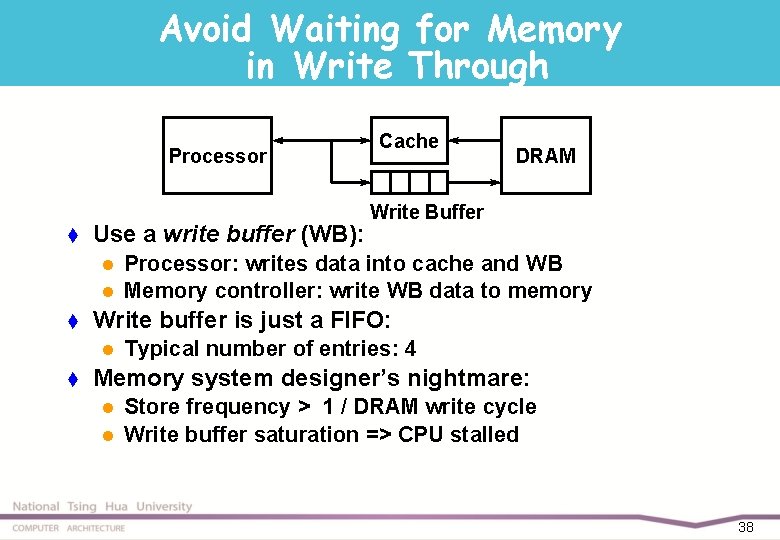
Avoid Waiting for Memory in Write Through Processor t Use a write buffer (WB): l l t DRAM Write Buffer Processor: writes data into cache and WB Memory controller: write WB data to memory Write buffer is just a FIFO: l t Cache Typical number of entries: 4 Memory system designer’s nightmare: l l Store frequency > 1 / DRAM write cycle Write buffer saturation => CPU stalled 38
Write-Back t Alternative, write-back: On data-write hit, just update the block in cache l t When a dirty block is replaced l l t Keep track of whether each block is dirty Write it back to memory Can use a write buffer to allow replacing block to be read first Data in cache and memory is inconsistent 39
Write Allocation Write Miss: t What should happen on a write miss? t Alternatives for write-through Allocate on miss: fetch the block l Write around: don’t fetch the block n Since programs often write a whole block before reading it (e. g. , initialization) For write-back l Usually fetch the block l t 40
Example: Intrinsity Fast. MATH t Embedded MIPS processor l l t Split cache: separate I-cache and D-cache l l t 12 -stage pipeline Instruction and data access on each cycle Each 16 KB: 256 blocks × 16 words/block D-cache: write-through or write-back SPEC 2000 miss rates l l l I-cache: 0. 4% D-cache: 11. 4% Weighted average: 3. 2% 41
Outline t t t Memory hierarchy The basics of caches l Direct-mapped cache l Address sub-division l Cache hit and miss l Memory support Measuring cache performance Improving cache performance l Set associative cache l Multiple level cache Virtual memory l Basics l Issues in virtual memory l Handling huge page table l TLB (Translation Lookaside Buffer) l TLB and cache A common framework for memory hierarchy 42
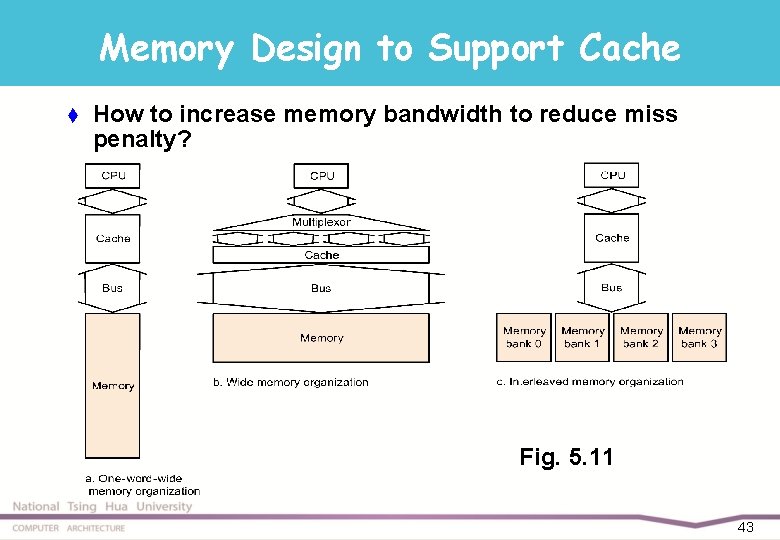
Memory Design to Support Cache t How to increase memory bandwidth to reduce miss penalty? Fig. 5. 11 43
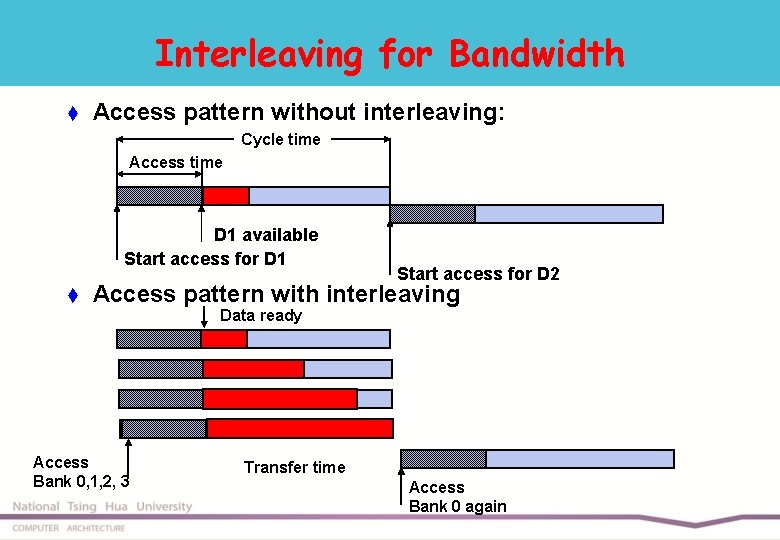
Interleaving for Bandwidth t Access pattern without interleaving: Cycle time Access time D 1 available Start access for D 1 t Start access for D 2 Access pattern with interleaving Data ready Access Bank 0, 1, 2, 3 Transfer time Access Bank 0 again
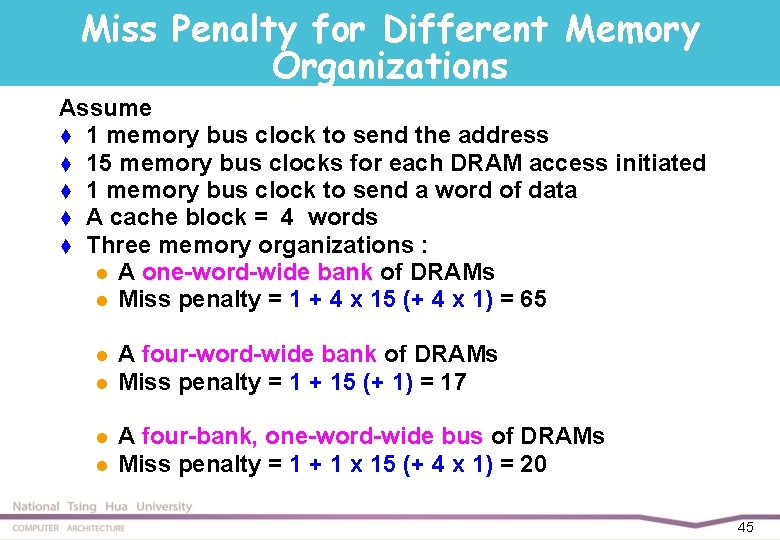
Miss Penalty for Different Memory Organizations Assume t 1 memory bus clock to send the address t 15 memory bus clocks for each DRAM access initiated t 1 memory bus clock to send a word of data t A cache block = 4 words t Three memory organizations : l A one-word-wide bank of DRAMs l Miss penalty = 1 + 4 x 15 (+ 4 x 1) = 65 l l A four-word-wide bank of DRAMs Miss penalty = 1 + 15 (+ 1) = 17 l l A four-bank, one-word-wide bus of DRAMs Miss penalty = 1 + 1 x 15 (+ 4 x 1) = 20 45
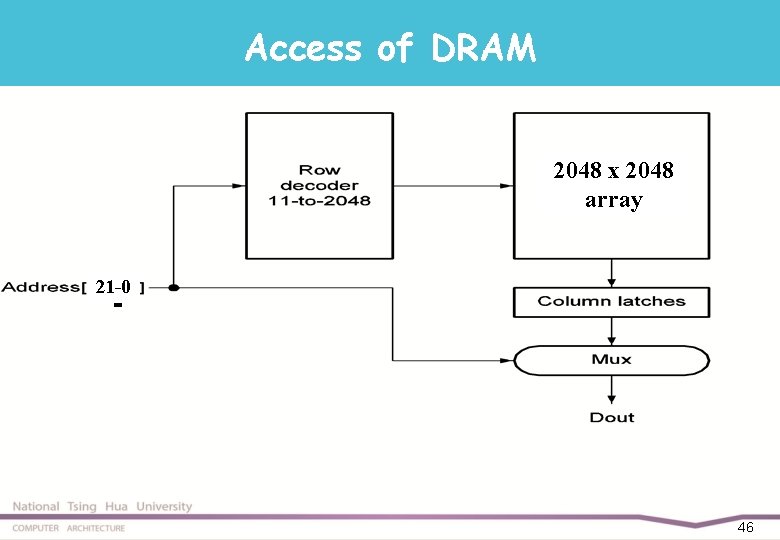
Access of DRAM 2048 x 2048 array 21 -0 46
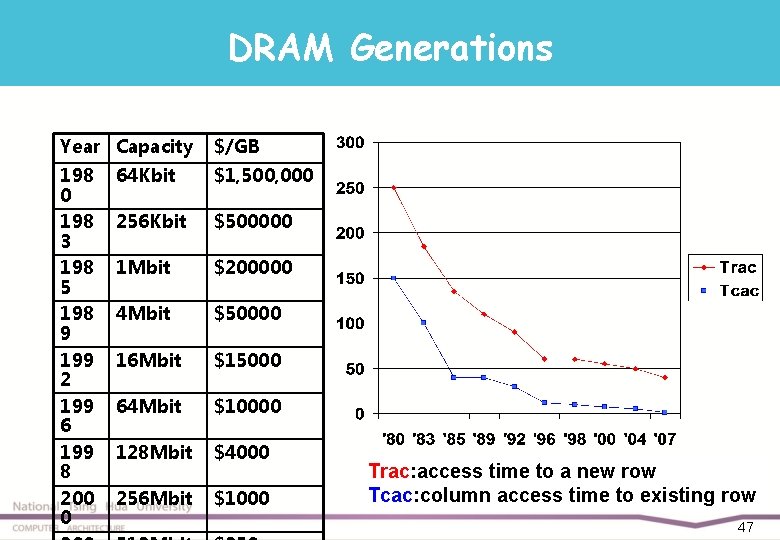
DRAM Generations Year Capacity $/GB 198 0 198 3 198 5 198 9 199 2 199 6 199 8 200 0 64 Kbit $1, 500, 000 256 Kbit $500000 1 Mbit $200000 4 Mbit $50000 16 Mbit $15000 64 Mbit $10000 128 Mbit $4000 256 Mbit $1000 Trac: access time to a new row Tcac: column access time to existing row 47
Outline t t t Memory hierarchy The basics of caches l Direct-mapped cache l Address sub-division l Cache hit and miss l Memory support Measuring cache performance Improving cache performance l Set associative cache l Multiple level cache Virtual memory l Basics l Issues in virtual memory l Handling huge page table l TLB (Translation Lookaside Buffer) l TLB and cache A common framework for memory hierarchy 48
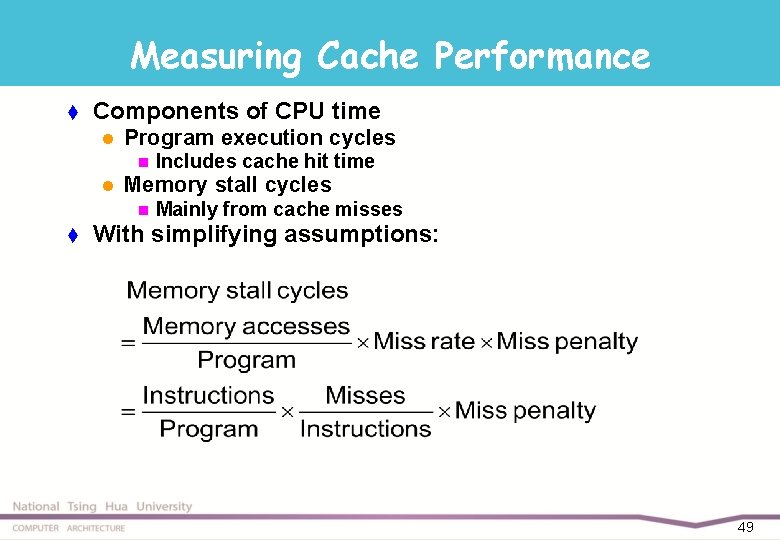
Measuring Cache Performance t Components of CPU time l Program execution cycles n l Memory stall cycles n t Includes cache hit time Mainly from cache misses With simplifying assumptions: 49
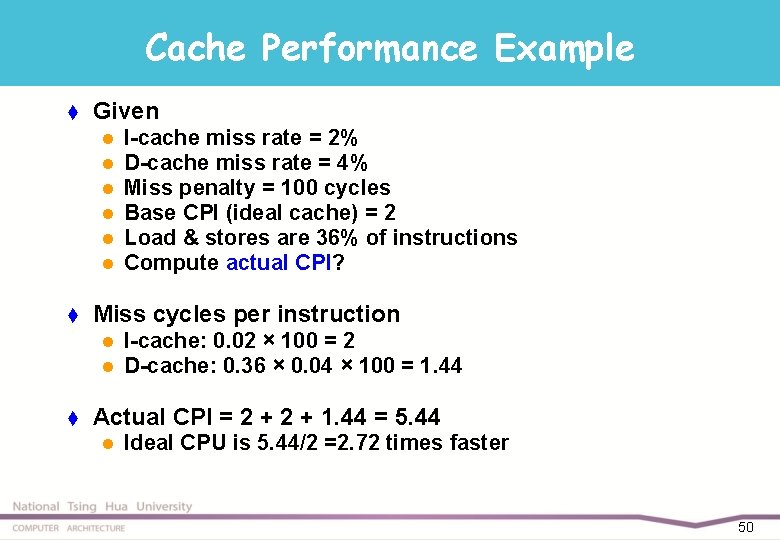
Cache Performance Example t Given l l l t Miss cycles per instruction l l t I-cache miss rate = 2% D-cache miss rate = 4% Miss penalty = 100 cycles Base CPI (ideal cache) = 2 Load & stores are 36% of instructions Compute actual CPI? I-cache: 0. 02 × 100 = 2 D-cache: 0. 36 × 0. 04 × 100 = 1. 44 Actual CPI = 2 + 1. 44 = 5. 44 l Ideal CPU is 5. 44/2 =2. 72 times faster 50
Average Memory Access Time t t Hit time is also important for performance Average memory access time (AMAT) l t AMAT = 1 × Hit time + Miss rate × Miss penalty Example l l CPU with 1 ns clock, hit time = 1 cycle, miss penalty = 20 cycles, I-cache miss rate = 5% AMAT = 1 + 0. 05 × 20 = 2 n 2 cycles per instruction 51
Performance Summary t When CPU performance increased l t Decreasing base CPI l t Greater proportion of time spent on memory stalls Increasing clock rate l t Miss penalty becomes more significant Memory stalls account for more CPU cycles Can’t neglect cache behavior when evaluating system performance 52
Improving Cache Performance t t t Reduce the time to hit in the cache Decreasing the miss ratio Decreasing the miss penalty 53
Outline t t t Memory hierarchy The basics of caches l Direct-mapped cache l Address sub-division l Cache hit and miss l Memory support Measuring cache performance Improving cache performance l Set associative cache l Multiple level cache Virtual memory l Basics l Issues in virtual memory l Handling huge page table l TLB (Translation Lookaside Buffer) l TLB and cache A common framework for memory hierarchy 54
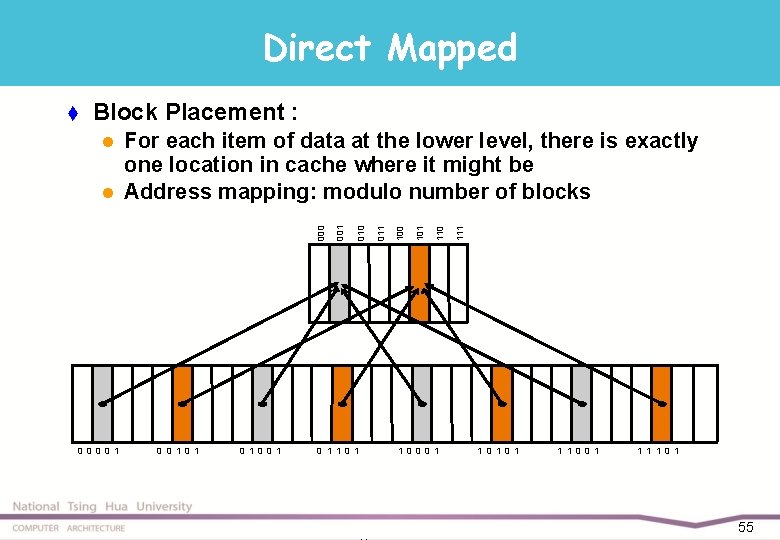
Direct Mapped Block Placement : 0 0 1 0 1 0 1 1 0 0 0 1 110 101 100 011 000 l For each item of data at the lower level, there is exactly one location in cache where it might be Address mapping: modulo number of blocks 010 l 001 t 1 0 1 1 1 0 0 1 1 0 1 55
Associative Caches t Fully associative l l l t Allow a given block to go in any cache entry Requires all entries to be searched at once Comparator per entry (expensive) n-way set associative l l Each set contains n entries Block number determines which set n l l (Block number) modulo (#Sets in cache) Search all entries in a given set at once n comparators (less expensive) 56
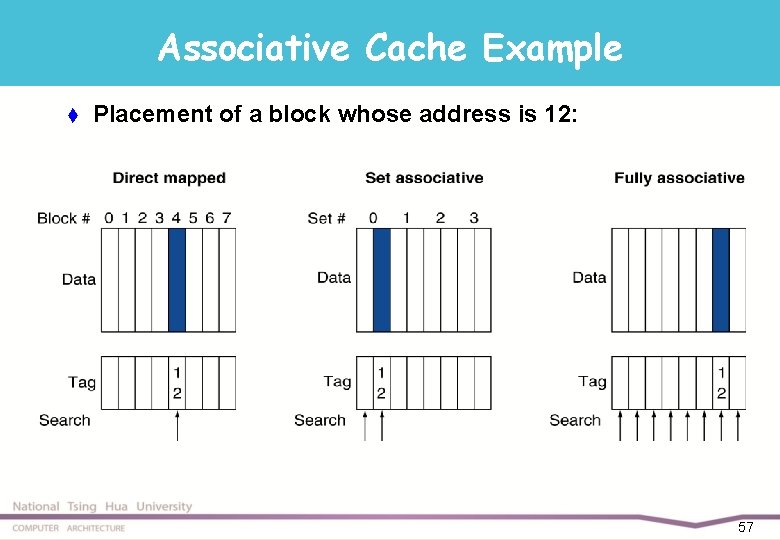
Associative Cache Example t Placement of a block whose address is 12: 57
Possible Associativity Structures An 8 -block cache 58
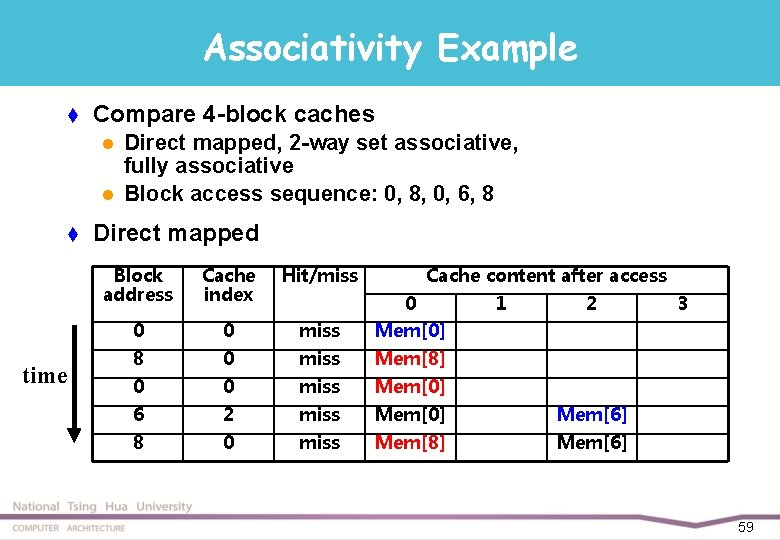
Associativity Example t Compare 4 -block caches l l t time Direct mapped, 2 -way set associative, fully associative Block access sequence: 0, 8, 0, 6, 8 Direct mapped Block address Cache index Hit/miss Cache content after access 0 0 miss Mem[0] 8 0 miss Mem[8] 0 0 miss Mem[0] 6 2 miss Mem[0] Mem[6] 8 0 miss Mem[8] Mem[6] 0 1 2 3 59
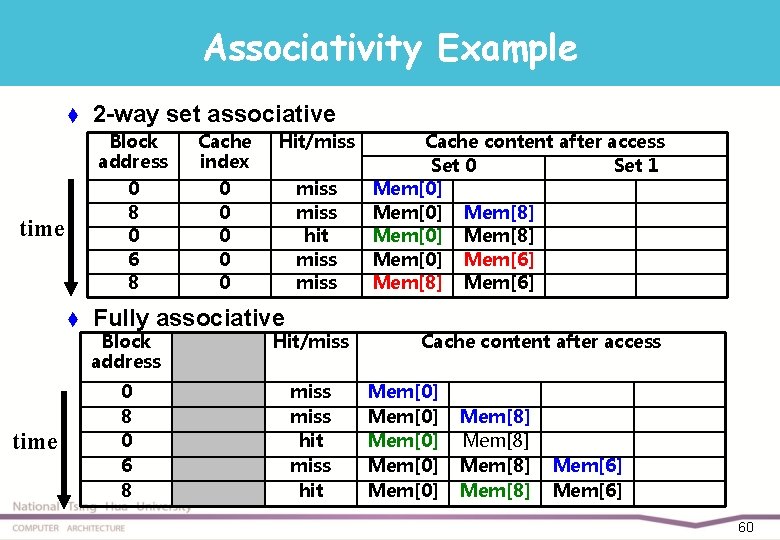
Associativity Example t time 2 -way set associative Block address Cache index Hit/miss 0 8 0 6 8 0 0 0 miss hit miss Fully associative Block address Hit/miss 0 8 0 6 8 miss hit Cache content after access Set 0 Set 1 Mem[0] Mem[8] Mem[0] Mem[6] Mem[8] Mem[6] Cache content after access Mem[0] Mem[0] Mem[8] Mem[6] 60
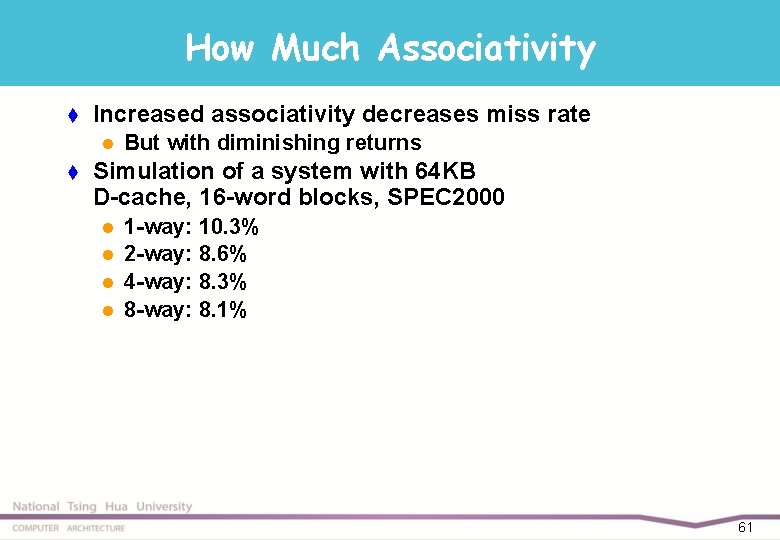
How Much Associativity t Increased associativity decreases miss rate l t But with diminishing returns Simulation of a system with 64 KB D-cache, 16 -word blocks, SPEC 2000 l l 1 -way: 10. 3% 2 -way: 8. 6% 4 -way: 8. 3% 8 -way: 8. 1% 61
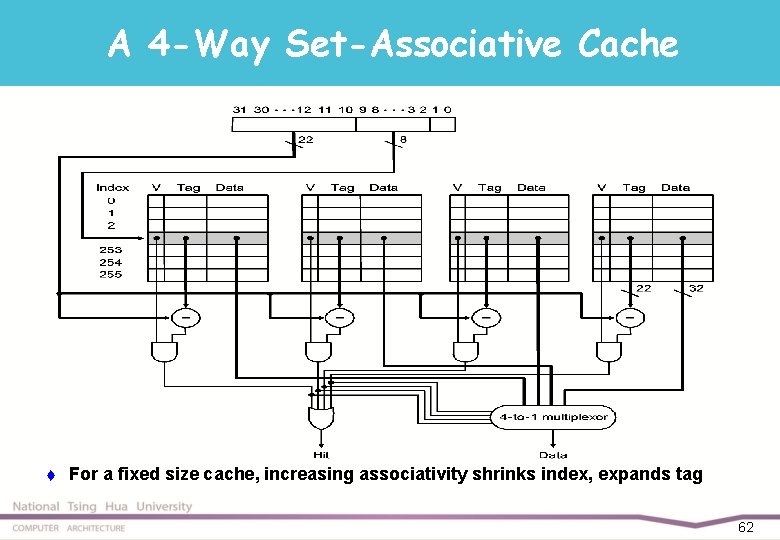
A 4 -Way Set-Associative Cache t For a fixed size cache, increasing associativity shrinks index, expands tag 62
Comparing Data Available Time t Direct mapped cache Cache block is available BEFORE Hit/Miss: l Possible to assume a hit and continue, recover later if miss l t N-way set-associative cache Data comes AFTER Hit/Miss decision l Extra MUX delay for the data l 63
Data Placement Policy t Direct mapped cache: l l l t N-way set associative cache: l t Each memory block has choice of N locations Fully associative cache: l t Each memory block mapped to one location No need to make any decision Current item replaces previous one in location Each memory block can be placed in ANY cache location Misses in N-way set-associative or fully associative cache: l l l Bring in new block from memory Throw out a block to make room for new block Need to decide on which block to throw out 64
Cache Block Replacement t t Direct mapped: no choice Set associative or fully associative: l l l Random LRU (Least Recently Used): n Hardware keeps track of the access history and replace the block that has not been used for the longest time An example of a pseudo LRU (for a two-way set associative) : n use a pointer pointing at each block in turn n whenever an access to the block the pointer is pointing at, move the pointer to the next block n when need to replace, replace the block currently pointed at 65
Outline t t t Memory hierarchy The basics of caches l Direct-mapped cache l Address sub-division l Cache hit and miss l Memory support Measuring cache performance Improving cache performance l Set associative cache l Multiple level cache Virtual memory l Basics l Issues in virtual memory l Handling huge page table l TLB (Translation Lookaside Buffer) l TLB and cache A common framework for memory hierarchy 66
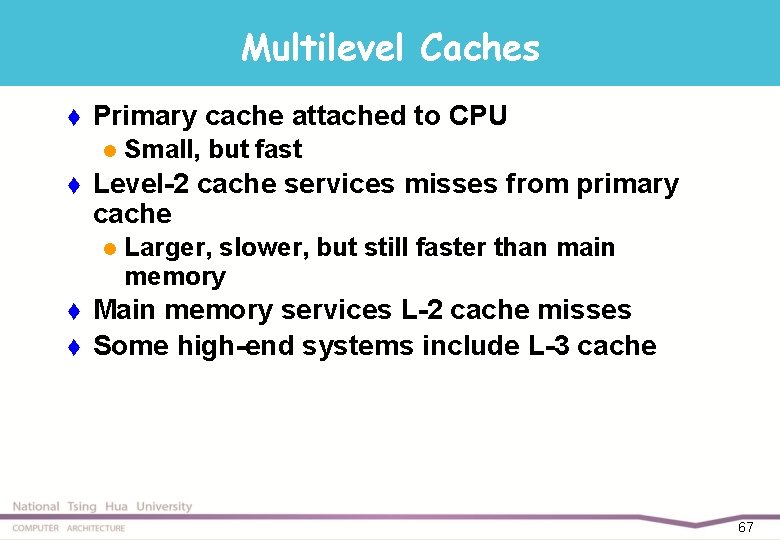
Multilevel Caches t Primary cache attached to CPU l t Level-2 cache services misses from primary cache l t t Small, but fast Larger, slower, but still faster than main memory Main memory services L-2 cache misses Some high-end systems include L-3 cache 67
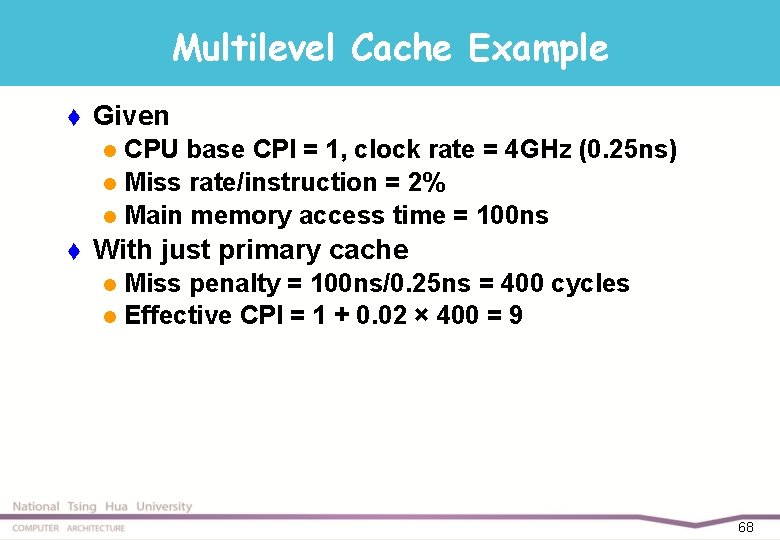
Multilevel Cache Example t Given CPU base CPI = 1, clock rate = 4 GHz (0. 25 ns) l Miss rate/instruction = 2% l Main memory access time = 100 ns l t With just primary cache Miss penalty = 100 ns/0. 25 ns = 400 cycles l Effective CPI = 1 + 0. 02 × 400 = 9 l 68
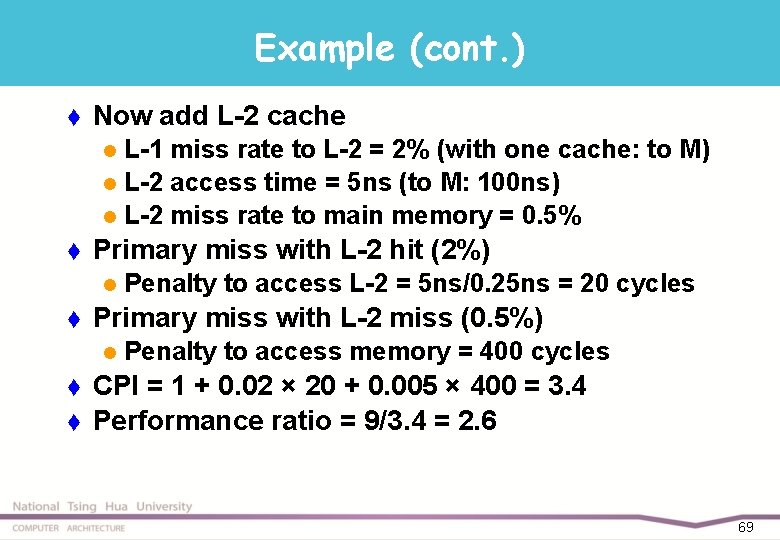
Example (cont. ) t Now add L-2 cache L-1 miss rate to L-2 = 2% (with one cache: to M) l L-2 access time = 5 ns (to M: 100 ns) l L-2 miss rate to main memory = 0. 5% l t Primary miss with L-2 hit (2%) l t Primary miss with L-2 miss (0. 5%) l t t Penalty to access L-2 = 5 ns/0. 25 ns = 20 cycles Penalty to access memory = 400 cycles CPI = 1 + 0. 02 × 20 + 0. 005 × 400 = 3. 4 Performance ratio = 9/3. 4 = 2. 6 69
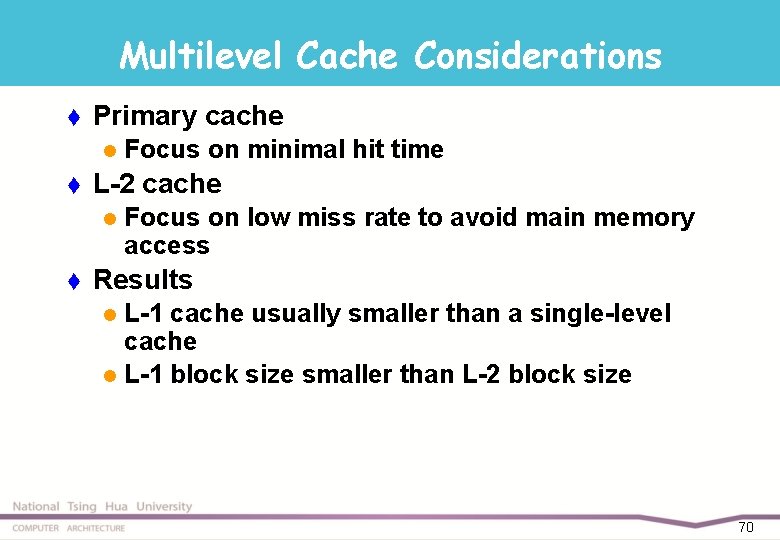
Multilevel Cache Considerations t Primary cache l t L-2 cache l t Focus on minimal hit time Focus on low miss rate to avoid main memory access Results L-1 cache usually smaller than a single-level cache l L-1 block size smaller than L-2 block size l 70
Interactions with Advanced CPUs t Out-of-order CPUs can execute instructions during cache miss Pending load stays in load/store unit l Dependent instructions wait in reservation stations l Independent instructions continue l t Effect of miss depends on program data flow Much harder to analyze l Use system simulation l 71
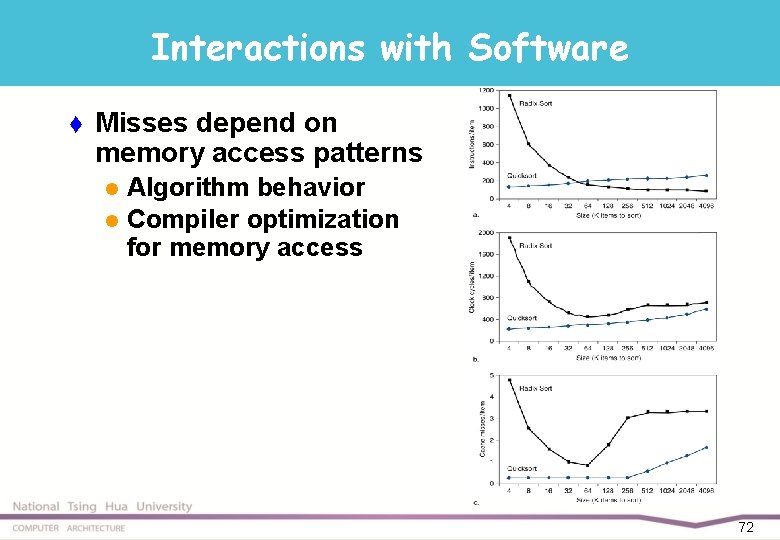
Interactions with Software t Misses depend on memory access patterns Algorithm behavior l Compiler optimization for memory access l 72
Outline t t t Memory hierarchy The basics of caches l Direct-mapped cache l Address sub-division l Cache hit and miss l Memory support Measuring cache performance Improving cache performance l Set associative cache l Multiple level cache Virtual memory l Basics l Issues in virtual memory l Handling huge page table l TLB (Translation Lookaside Buffer) l TLB and cache A common framework for memory hierarchy 73
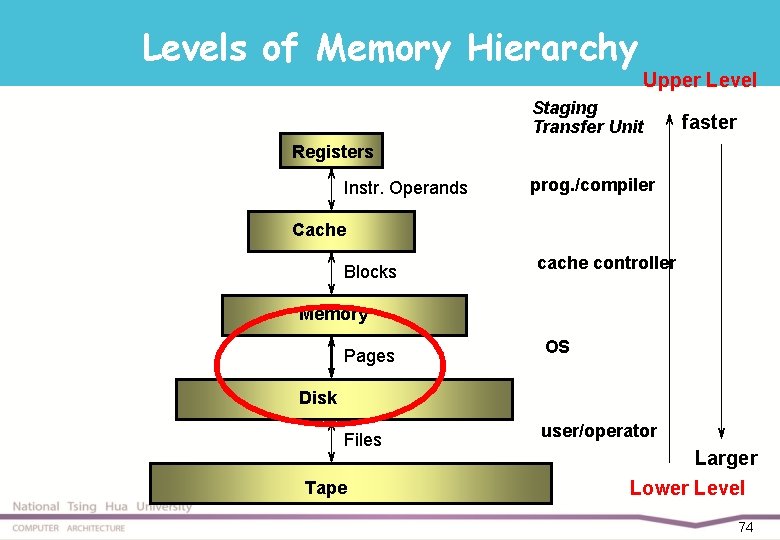
Levels of Memory Hierarchy Upper Level Staging Transfer Unit faster Registers Instr. Operands prog. /compiler Cache Blocks cache controller Memory Pages OS Disk Files Tape user/operator Larger Lower Level 74
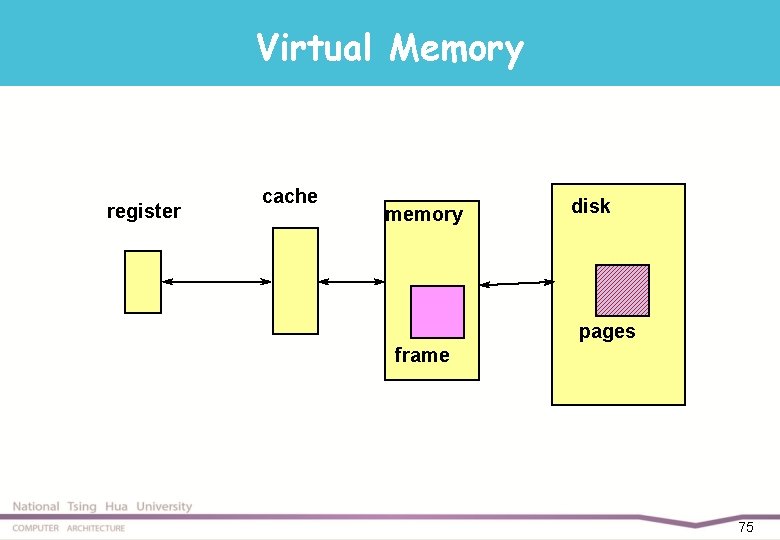
Virtual Memory register cache memory disk pages frame 75
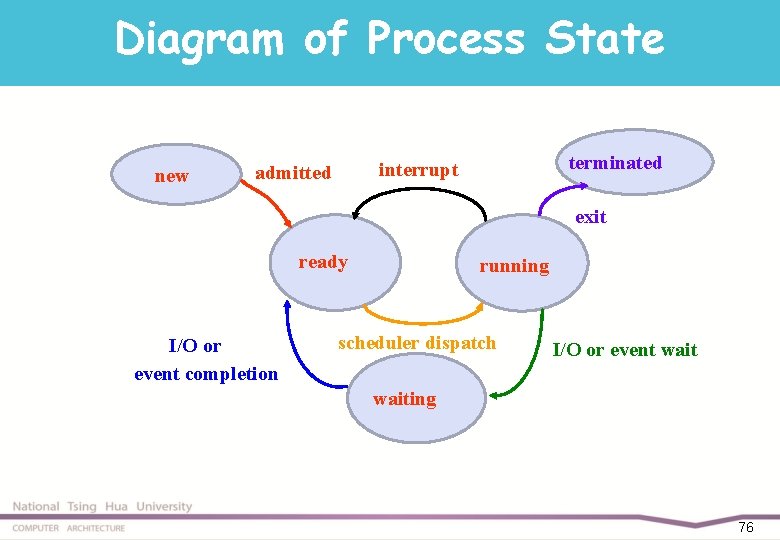
Diagram of Process State new terminated interrupt admitted exit ready I/O or event completion running scheduler dispatch I/O or event waiting 76
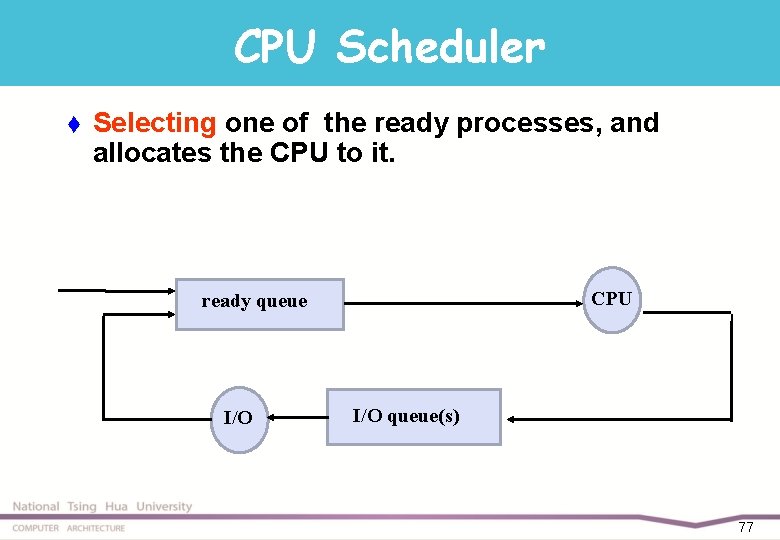
CPU Scheduler t Selecting one of the ready processes, and allocates the CPU to it. CPU ready queue I/O queue(s) 77
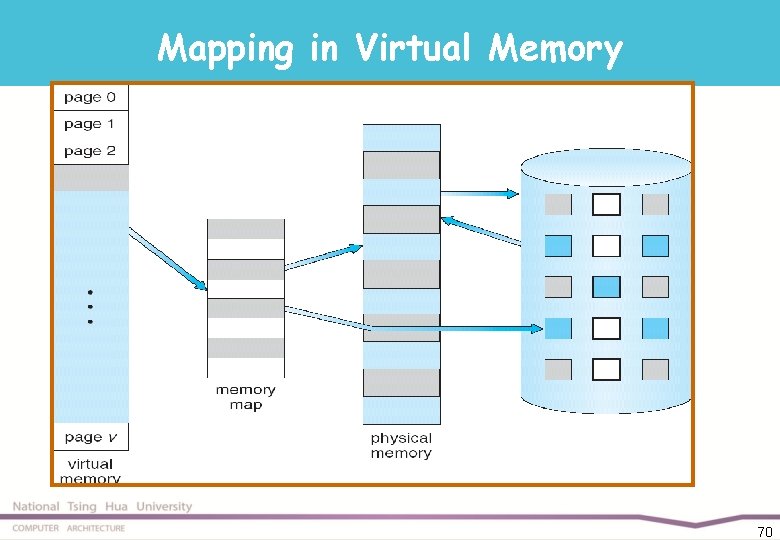
Virtual Memory t Programs share main memory (Multi-programming and I/O) l l Program executed in a name space (virtual address space) different from memory space (physical address space) Each gets a private virtual address space holding its frequently used code and data, starting at address 0, only accessible to itself n n l l t yet, any can run anywhere in physical memory virtual memory implements the translation from virtual space to physical space Every program has lots of memory (> physical memory) Protected from other programs Use main memory as a “cache” for secondary (disk) storage l Managed jointly by CPU hardware and the operating system (OS) 78
Virtual Memory - Continued t CPU and OS translate virtual addresses to physical addresses l l VM “block” is called a page VM translation “miss” is called a page fault 79
Mapping in Virtual Memory 70
Outline t t t Memory hierarchy The basics of caches l Direct-mapped cache l Address sub-division l Cache hit and miss l Memory support Measuring cache performance Improving cache performance l Set associative cache l Multiple level cache Virtual memory l Basics l Issues in virtual memory l Handling huge page table l TLB (Translation Lookaside Buffer) l TLB and cache A common framework for memory hierarchy 81
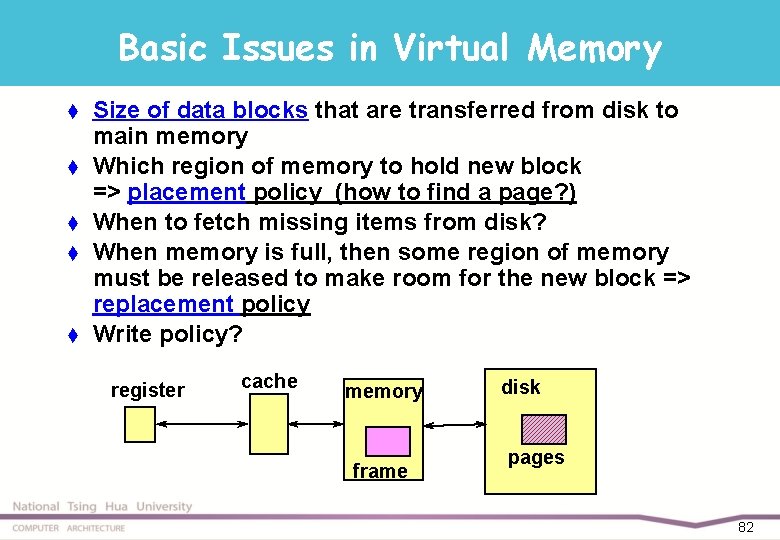
Basic Issues in Virtual Memory t t t Size of data blocks that are transferred from disk to main memory Which region of memory to hold new block => placement policy (how to find a page? ) When to fetch missing items from disk? When memory is full, then some region of memory must be released to make room for the new block => replacement policy Write policy? register cache memory frame disk pages 82
Block Size and Placement Policy t Huge miss penalty: a page fault may take millions of cycles to process l Pages should be fairly large (e. g. , 4 KB) to amortize the high access time l Reducing page faults is important n fully associative placement => use page table (in memory) to locate pages 83
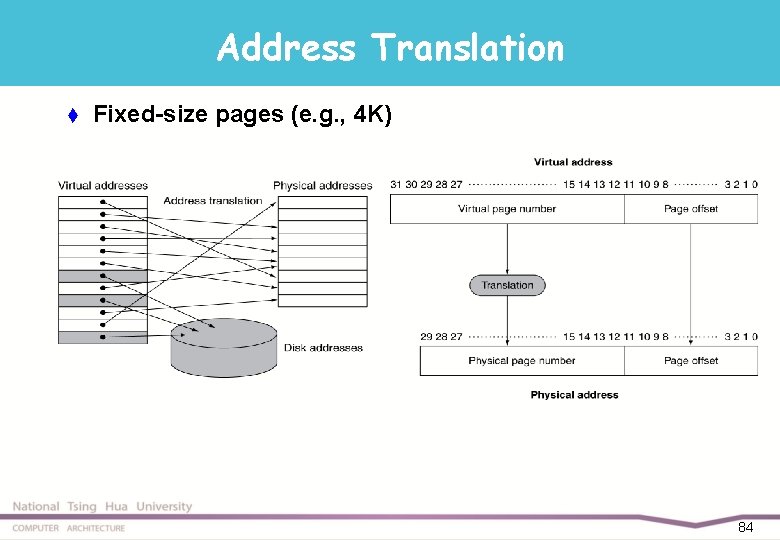
Address Translation t Fixed-size pages (e. g. , 4 K) 84
Page Tables t Stores placement information l l l t If page is present in memory l l t Page table stored in main memory Array of page table entries, indexed by virtual page number Page table register in CPU points to the starting entry of page table in physical memory PTE stores the physical page number Plus other status bits (referenced, dirty, …) If page is not present l PTE can refer to location in swap space on disk 85
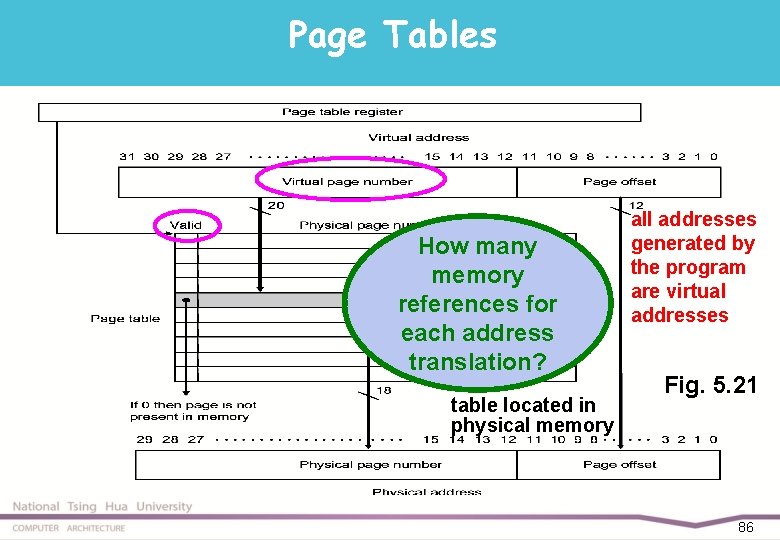
Page Tables How many memory references for each address translation? table located in physical memory all addresses generated by the program are virtual addresses Fig. 5. 21 86
Page Fault: What Happens When You Miss? t t t Page hit, proceed normally Page fault means that page is not resident in memory Huge miss penalty: a page fault may take millions of cycles to process Hardware must detect situation but it cannot remedy the situation Can handle the faults in software instead of hardware, because handling time is small compared to disk access l l the software can be very smart or complex the faulting process can be context-switched 87
OS Handling Page Faults t Hardware must trap to the operating system so that it can remedy the situation l l t If memory full, pick a page to discard (may write it to disk) Load the page in from disk Update the page table Resume to program so HW will retry and succeed! In addition, OS must know where to find the page l l Create space on disk for all pages of process (swap space) Use a data structure to record where each valid page is on disk (may be part of page table) 88
When to Fetch Missing Items From Disk? t Fetch only on a fault l => demand load policy
Page Replacement and Writes t To reduce page fault rate, prefer least-recently used (LRU) replacement l l l t Reference bit (aka use bit) in PTE set to 1 on access to page Periodically cleared to 0 by OS A page with reference bit = 0 has not been used recently Disk writes take millions of cycles l l l Write through is impractical Use write-back Dirty bit in PTE set when page is written 90
Problems of Page Table t t Page table is too big Access to page table is too slow (needs one memory read) 91
Outline t t t Memory hierarchy The basics of caches l Direct-mapped cache l Address sub-division l Cache hit and miss l Memory support Measuring cache performance Improving cache performance l Set associative cache l Multiple level cache Virtual memory l Basics l Issues in virtual memory l Handling huge page table l TLB (Translation Lookaside Buffer) l TLB and cache A common framework for memory hierarchy 92
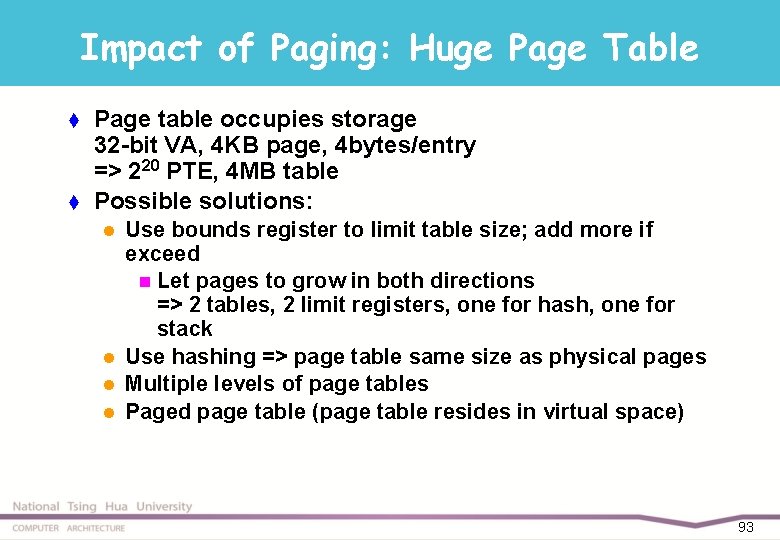
Impact of Paging: Huge Page Table t t Page table occupies storage 32 -bit VA, 4 KB page, 4 bytes/entry => 220 PTE, 4 MB table Possible solutions: l l Use bounds register to limit table size; add more if exceed n Let pages to grow in both directions => 2 tables, 2 limit registers, one for hash, one for stack Use hashing => page table same size as physical pages Multiple levels of page tables Paged page table (page table resides in virtual space) 93
Outline t t t Memory hierarchy The basics of caches l Direct-mapped cache l Address sub-division l Cache hit and miss l Memory support Measuring cache performance Improving cache performance l Set associative cache l Multiple level cache Virtual memory l Basics l Issues in virtual memory l Handling huge page table l TLB (Translation Look-aside Buffer): access to page table is too slow (needs one memory read) l TLB and cache A common framework for memory hierarchy 94
Impact of Paging: More Memory Access ! t Each memory operation (instruction fetch, load, store) requires a page-table access! l l l t Basically double number of memory operations One to access the PTE Then the actual memory access to page tables has good locality 95
Fast Translation Using a TLB t Access to page tables has good locality l Fast cache of PTEs within the CPU l Called a Translation Look-aside Buffer (TLB) 96
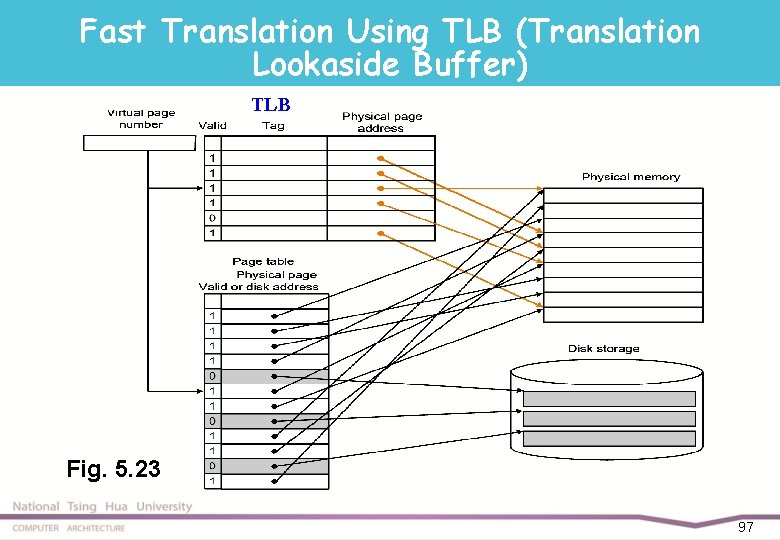
Fast Translation Using TLB (Translation Lookaside Buffer) TLB Fig. 5. 23 97
Translation Lookaside Buffer t Typical RISC processors have memory management unit (MMU) which includes TLB and does page table lookup l l l TLB can be organized as fully associative, set associative, or direct mapped TLBs are small, typical: 16– 512 PTEs, 0. 5– 1 cycle for hit, 10– 100 cycles for miss, 0. 01%– 1% miss rate Misses could be handled by hardware or software 98
TLB Hit t t TLB hit on read TLB hit on write: l Toggle dirty bit (write back to page table on replacement) 99
TLB Miss t If page is in memory l l Load the PTE of page table from memory and retry Could be handled in hardware n l Or in software n t Can get complex for more complicated page table structures Raise a special exception, with optimized handler If page is not in memory (page fault) l l OS handles fetching the page and updating the page table (software) Then restart the faulting instruction 100
Outline t t t Memory hierarchy The basics of caches l Direct-mapped cache l Address sub-division l Cache hit and miss l Memory support Measuring cache performance Improving cache performance l Set associative cache l Multiple level cache Virtual memory l Basics l Issues in virtual memory l Handling huge page table l TLB (Translation Lookaside Buffer) l TLB and cache A common framework for memory hierarchy 101
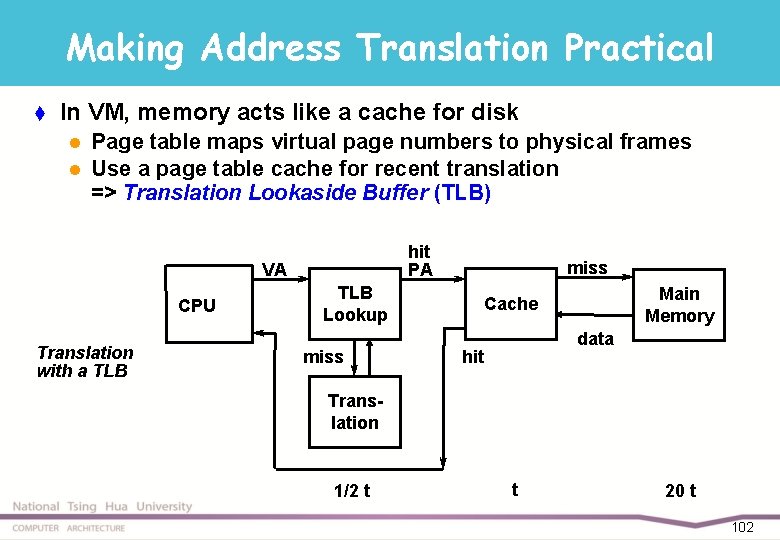
Making Address Translation Practical t In VM, memory acts like a cache for disk l l Page table maps virtual page numbers to physical frames Use a page table cache for recent translation => Translation Lookaside Buffer (TLB) hit PA VA CPU Translation with a TLB miss TLB Lookup miss Main Memory Cache data hit Translation 1/2 t t 20 t 102
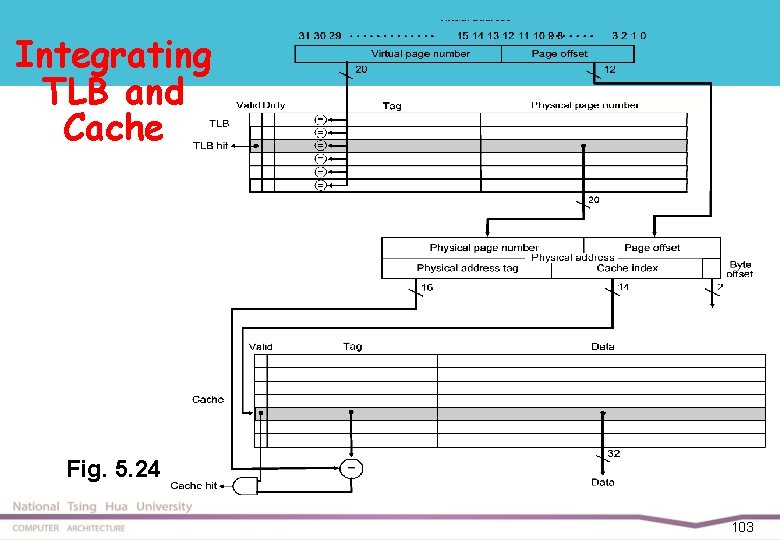
Integrating TLB and Cache Fig. 5. 24 103
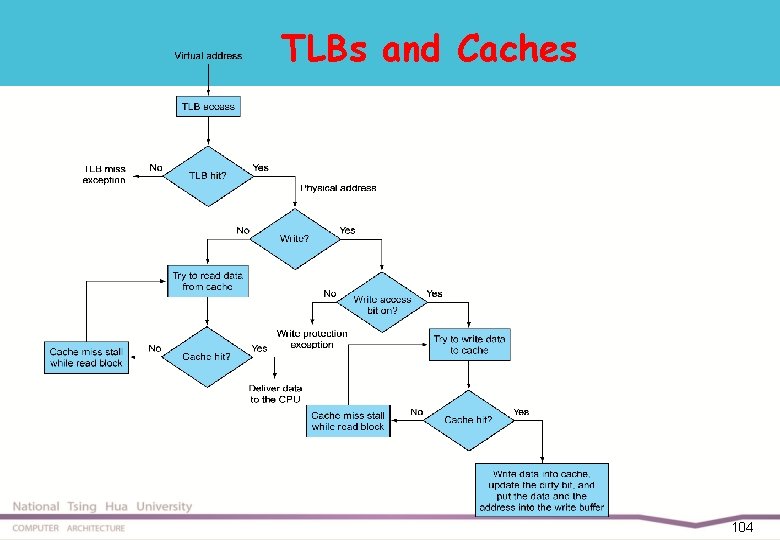
TLBs and Caches 104
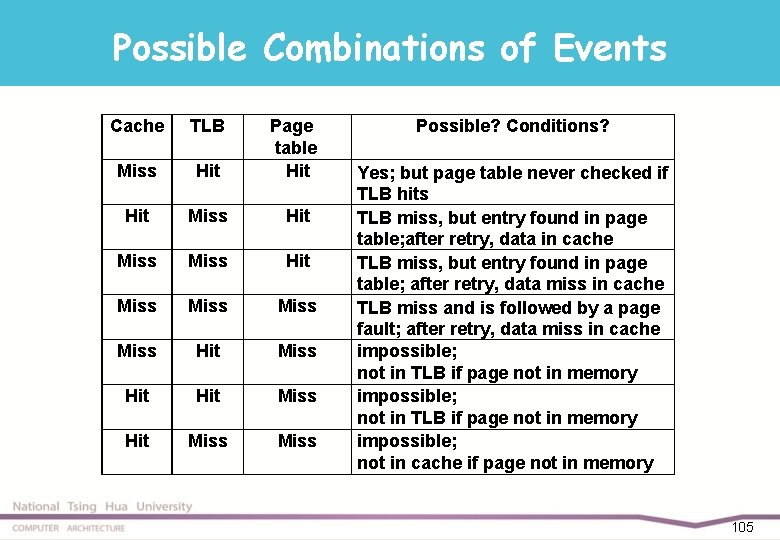
Possible Combinations of Events Cache TLB Miss Hit Page table Hit Miss Miss Hit Hit Miss Possible? Conditions? Yes; but page table never checked if TLB hits TLB miss, but entry found in page table; after retry, data in cache TLB miss, but entry found in page table; after retry, data miss in cache TLB miss and is followed by a page fault; after retry, data miss in cache impossible; not in TLB if page not in memory impossible; not in cache if page not in memory 105
Outline t t t Memory hierarchy The basics of caches l Direct-mapped cache l Address sub-division l Cache hit and miss l Memory support Measuring cache performance Improving cache performance l Set associative cache l Multiple level cache Virtual memory l Basics l Issues in virtual memory l Handling huge page table l TLB (Translation Lookaside Buffer) l TLB and cache A common framework for memory hierarchy 106
The Memory Hierarchy The BIG Picture t Common principles apply at all levels of the memory hierarchy l t Based on notions of caching At each level in the hierarchy l l Block placement Finding a block Replacement on a miss Write policy 107
Block Placement t Determined by associativity l Direct mapped (1 -way associative) n l n-way set associative n l n choices within a set Fully associative n t One choice for placement Any location Higher associativity reduces miss rate l Increases complexity, cost, and access time 108
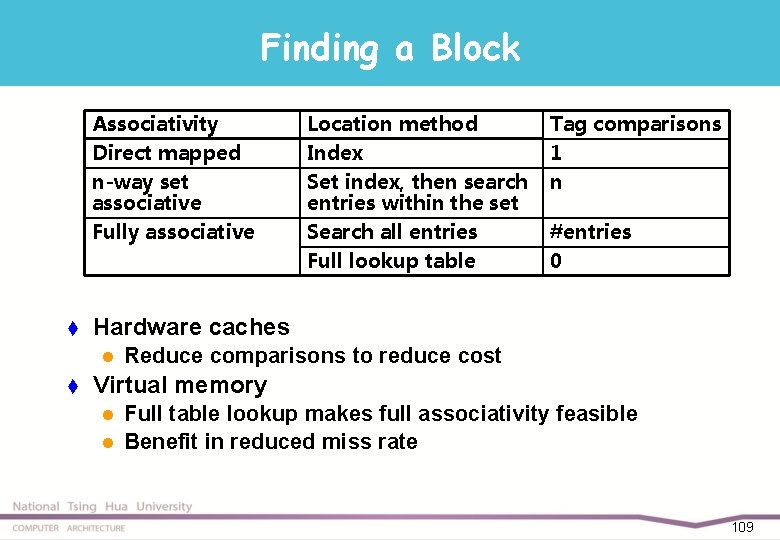
Finding a Block Associativity Direct mapped n-way set associative Fully associative t Tag comparisons 1 n #entries 0 Hardware caches l t Location method Index Set index, then search entries within the set Search all entries Full lookup table Reduce comparisons to reduce cost Virtual memory l l Full table lookup makes full associativity feasible Benefit in reduced miss rate 109
Replacement t Choice of entry to replace on a miss l Least recently used (LRU) n l Random n t Complex and costly hardware for high associativity Close to LRU, easier to implement Virtual memory l LRU approximation with hardware support 110
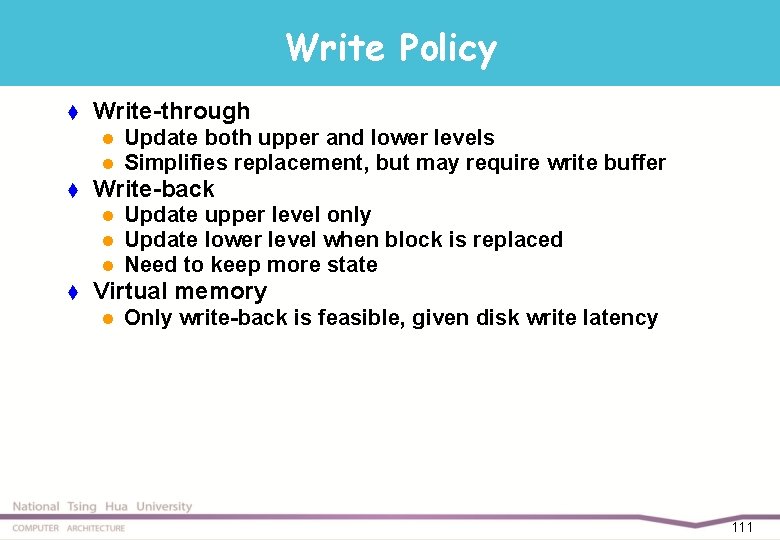
Write Policy t Write-through l l t Write-back l l l t Update both upper and lower levels Simplifies replacement, but may require write buffer Update upper level only Update lower level when block is replaced Need to keep more state Virtual memory l Only write-back is feasible, given disk write latency 111
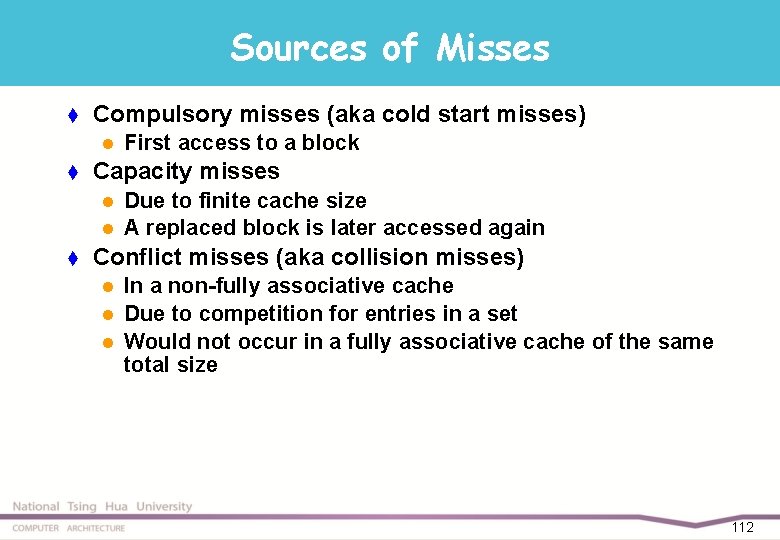
Sources of Misses t Compulsory misses (aka cold start misses) l t Capacity misses l l t First access to a block Due to finite cache size A replaced block is later accessed again Conflict misses (aka collision misses) l l l In a non-fully associative cache Due to competition for entries in a set Would not occur in a fully associative cache of the same total size 112
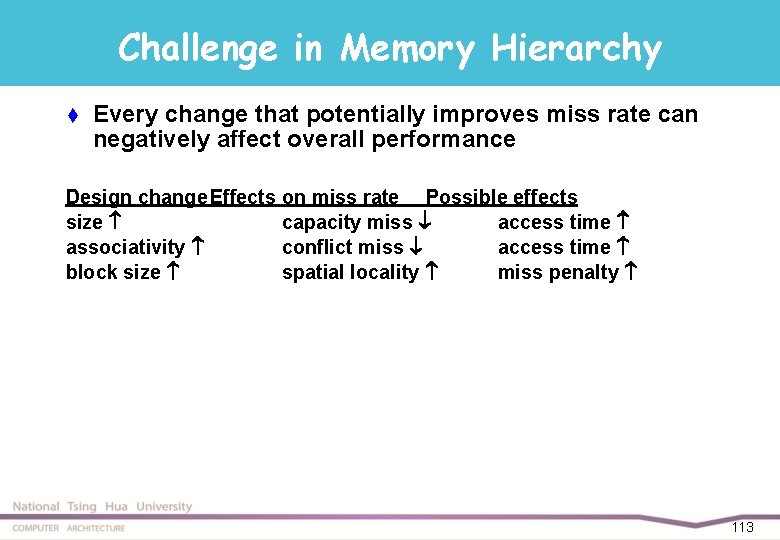
Challenge in Memory Hierarchy t Every change that potentially improves miss rate can negatively affect overall performance Design change. Effects on miss rate Possible effects size capacity miss access time associativity conflict miss access time block size spatial locality miss penalty 113
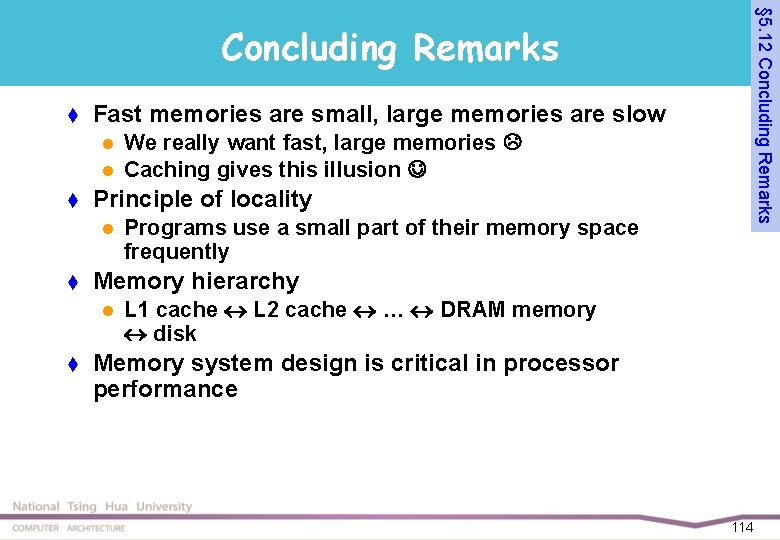
§ 5. 12 Concluding Remarks t Fast memories are small, large memories are slow l l t Principle of locality l t Programs use a small part of their memory space frequently Memory hierarchy l t We really want fast, large memories Caching gives this illusion L 1 cache L 2 cache … DRAM memory disk Memory system design is critical in processor performance 114
- Slides: 115