
Outline Review of Classical Operating Systems continued Distributed
Outline • Review of Classical Operating Systems - continued • Distributed Systems 1/16/2022 COP 5611 1
Announcement • The class email list – I created a class email list using ACNS’ service – If you do not receive an email from me this morning, you need to send me an email to add your email address to the list • Materials to make up – In general, the technical issues in distributed operating systems are different to the ones in classical operating systems – For this class, the following undergraduate topics may be helpful • • • 1/16/2022 Mutual exclusion (Process synchronization) Deadlock detection File systems Memory management Scheduling COP 5611 2
Operating System • An operating system is a layer of software on a bare machine that performs two basic functions – Resource management • To manage resources so that they are used in an efficient and fair manner – User friendliness 1/16/2022 COP 5611 3
Distributed Systems • A distributed system is a collection of independent computers that appears to its users as a single coherent system – Independent computers mean that they do not share memory or clock – The computers communicate with each other by exchanging messages over a communication network 1/16/2022 COP 5611 4
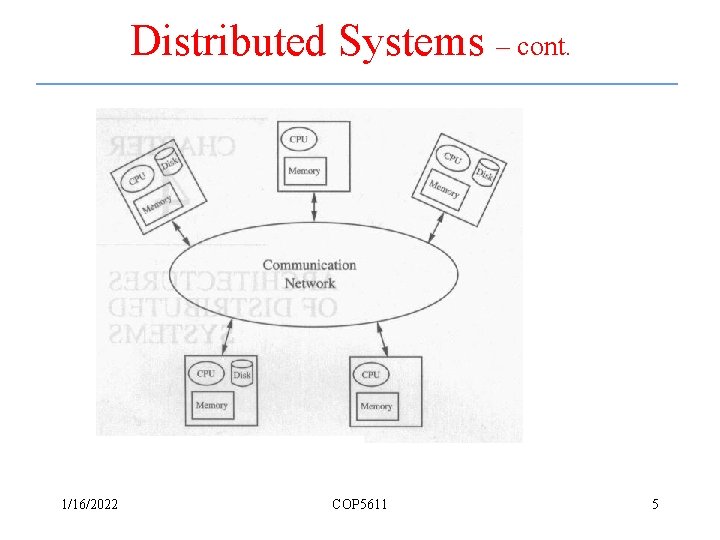
Distributed Systems – cont. 1/16/2022 COP 5611 5
Distributed Systems – cont. • Is each of the following systems a distributed system according to our definition? – Workstations at the Computer Science department – World wide web 1/16/2022 COP 5611 6
Distributed Systems – cont. • Motivations – The availability of powerful microprocessors – Significant advances in communication technology – A group of people working together need to share data and expensive resources 1/16/2022 COP 5611 7
Distributed Systems – cont. • Advantages – The computing power of a group of cheap workstations can be enormous • Decisive price/performance advantage over traditional time-sharing systems – Resource sharing – Enhanced performance – Improved reliability and availability – Modular expandability 1/16/2022 COP 5611 8
Distributed System Architecture • The minicomputer model – Consists of several minicomputers, each supports multiple users and provides access to remote resources • The workstation model – Consists of a number of workstations, each supports a single user in general • The processor model – The ratio of the number of processors to the number of users is greater than one 1/16/2022 COP 5611 9
Distributed System Architecture – cont. • The classification given above does not consider the underlying hardware – Distributed systems are often classified based on the hardware • Multiprocessor systems • Homogenous multi-computer systems • Heterogeneous multi-computer systems 1/16/2022 COP 5611 10
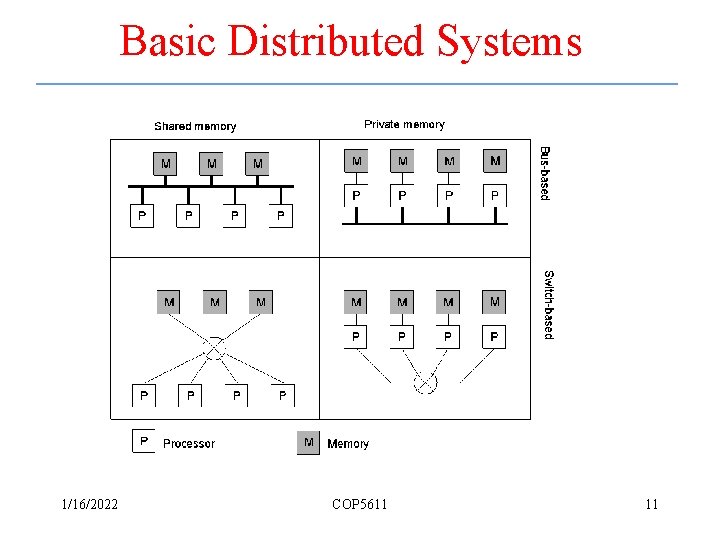
Basic Distributed Systems 1. 6 1/16/2022 COP 5611 11
Multiprocessor Systems – cont. • Multiprocessor systems are often divided into two categories – In tightly coupled systems, all processors share the same memory address space and all processors can directly access a global main memory – In loosely coupled systems, not only is the main memory partitioned and attached to processors, but each processor has its own address space • A processor cannot directly access memory attached to other processors 1/16/2022 COP 5611 12
Multiprocessor Systems – cont. • Based on the vicinity and accessibility of the main memory to the processors, there are three main types of multiprocessor system architectures – UMA – Uniform memory access – NUMA – Non-uniform memory access – NORMA – no remote memory access 1/16/2022 COP 5611 13
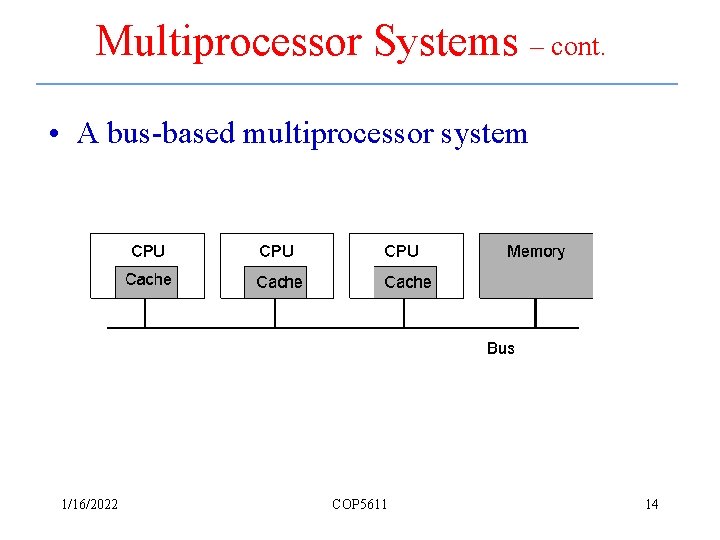
Multiprocessor Systems – cont. • A bus-based multiprocessor system 1/16/2022 COP 5611 14
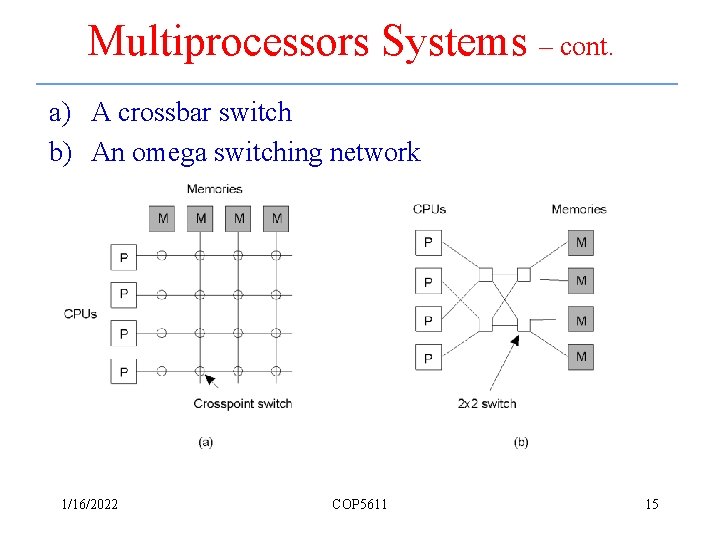
Multiprocessors Systems – cont. a) A crossbar switch b) An omega switching network 1/16/2022 COP 5611 15
Homogeneous Multicomputer Systems • Compared to multiprocessor systems, building multicomputer systems is relatively easy – Each CPU has a direct connection to its own local memory – The problem is how the CPUs communicate with each other • There are kinds of multi-computer systems – Bus-based / switch-based 1/16/2022 COP 5611 16
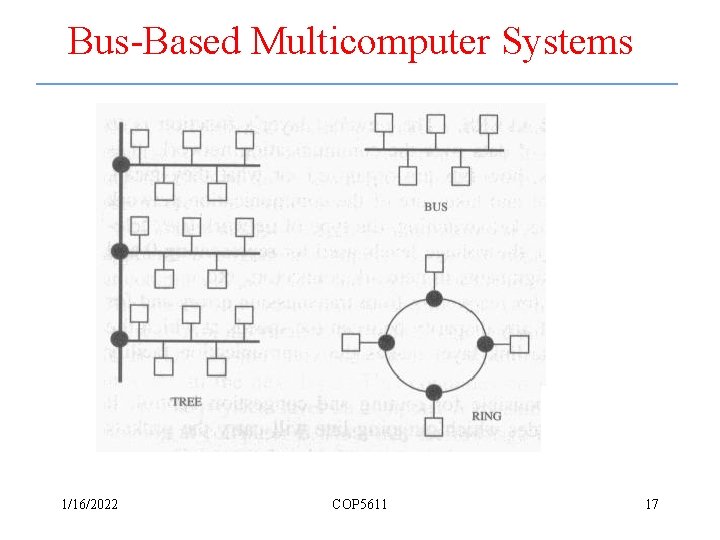
Bus-Based Multicomputer Systems 1/16/2022 COP 5611 17
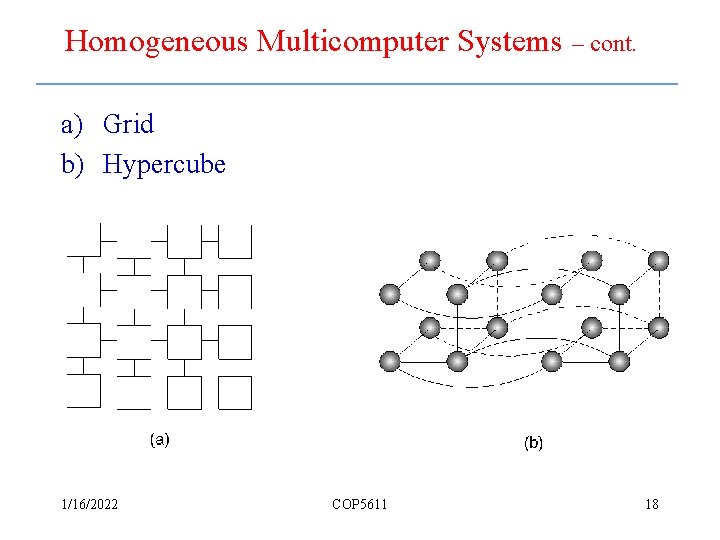
Homogeneous Multicomputer Systems – cont. a) Grid b) Hypercube 1 -9 1/16/2022 COP 5611 18
Heterogeneous Multicomputer Systems • Most of the distributed systems are built on top of a heterogeneous multicomputer systems – Computers can vary widely • Some of them can be even multiprocessor or homogeneous multicomputer systems – The interconnection network may be highly heterogeneous as well 1/16/2022 COP 5611 19
Distributed Operating Systems • Hardware for distributed systems is important, but the software largely determines what a distributed system looks like to a user • Distributed operating systems are much like the traditional operating systems – Resource management – User friendliness – The key concept is transparency 1/16/2022 COP 5611 20
Distributed Operating Systems – cont. • In a truly distributed operating system, the user views the system as a virtual uniprocessor system even though physically it consists of multiple computers – In other words, the use of multiple computers and accessing remote data and resources should be invisible to the user 1/16/2022 COP 5611 21
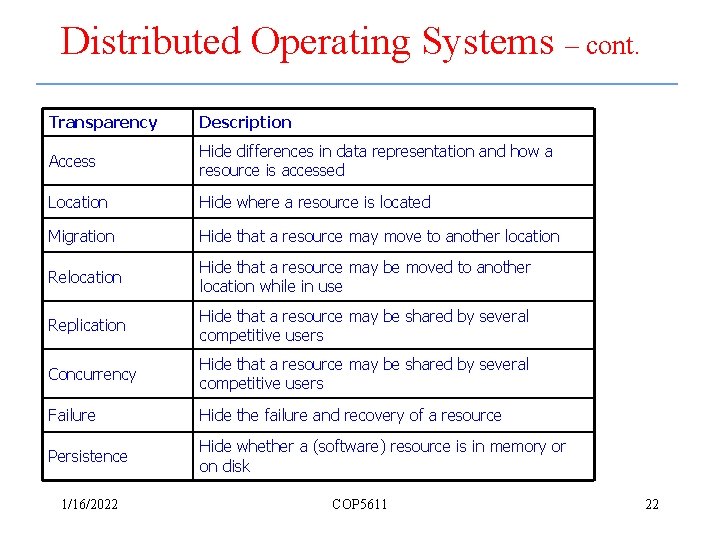
Distributed Operating Systems – cont. Transparency Description Access Hide differences in data representation and how a resource is accessed Location Hide where a resource is located Migration Hide that a resource may move to another location Relocation Hide that a resource may be moved to another location while in use Replication Hide that a resource may be shared by several competitive users Concurrency Hide that a resource may be shared by several competitive users Failure Hide the failure and recovery of a resource Persistence Hide whether a (software) resource is in memory or on disk 1/16/2022 COP 5611 22
Distributed Operating Systems – cont. • Degree of transparency and performance – There is a trade-off between a high degree of transparency and the performance of the system • Three categories – Distributed Operating System (DOS) – Network Operating System (NOS) – Middleware 1/16/2022 COP 5611 23
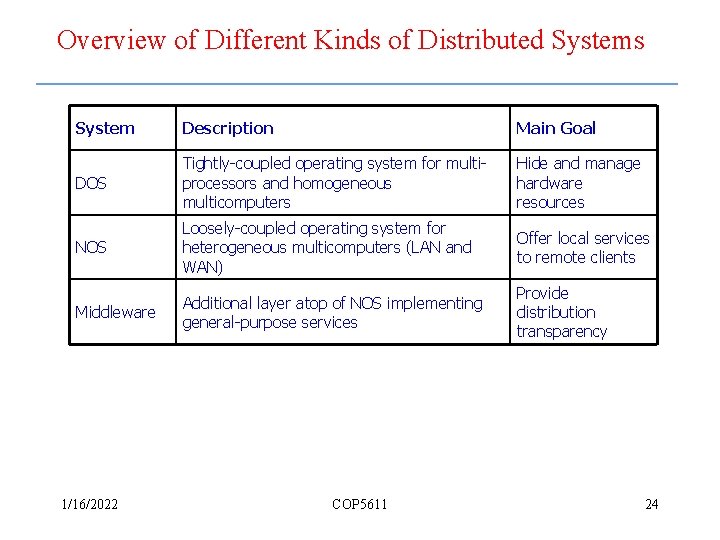
Overview of Different Kinds of Distributed Systems System Description Main Goal DOS Tightly-coupled operating system for multiprocessors and homogeneous multicomputers Hide and manage hardware resources NOS Loosely-coupled operating system for heterogeneous multicomputers (LAN and WAN) Offer local services to remote clients Middleware Additional layer atop of NOS implementing general-purpose services Provide distribution transparency 1/16/2022 COP 5611 24
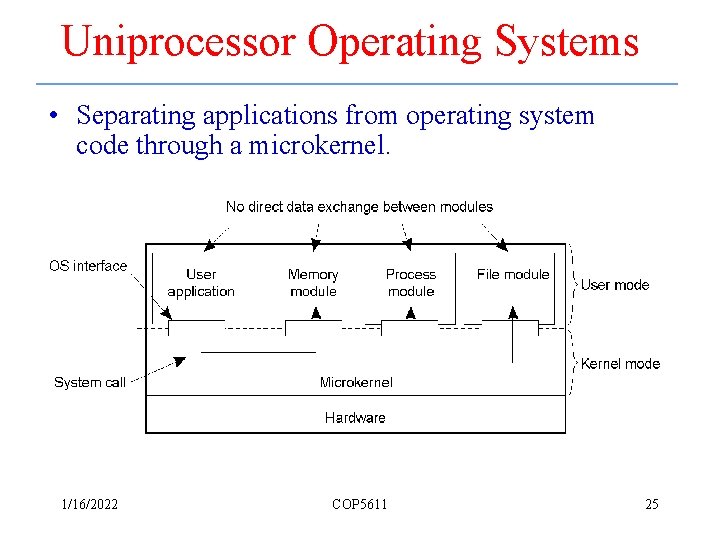
Uniprocessor Operating Systems • Separating applications from operating system code through a microkernel. 1. 11 1/16/2022 COP 5611 25
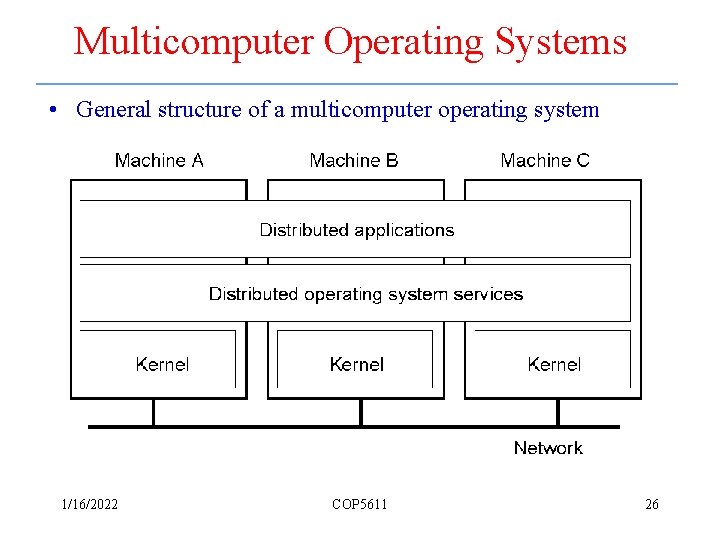
Multicomputer Operating Systems • General structure of a multicomputer operating system 1/16/2022 COP 5611 26
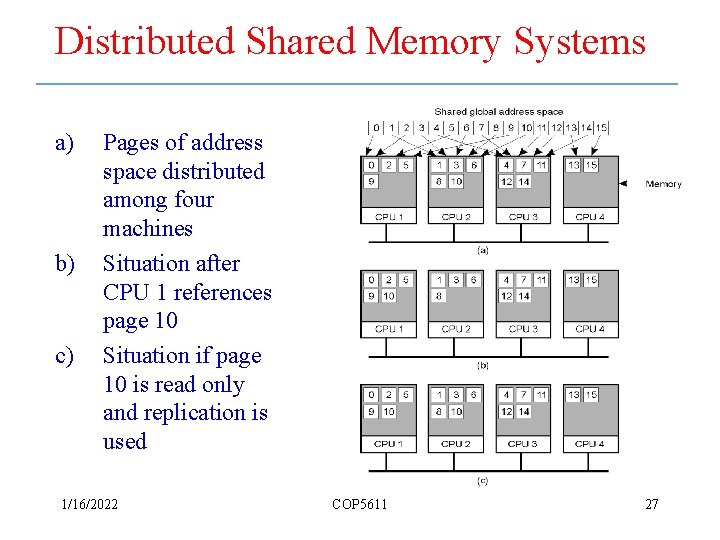
Distributed Shared Memory Systems a) b) c) Pages of address space distributed among four machines Situation after CPU 1 references page 10 Situation if page 10 is read only and replication is used 1/16/2022 COP 5611 27
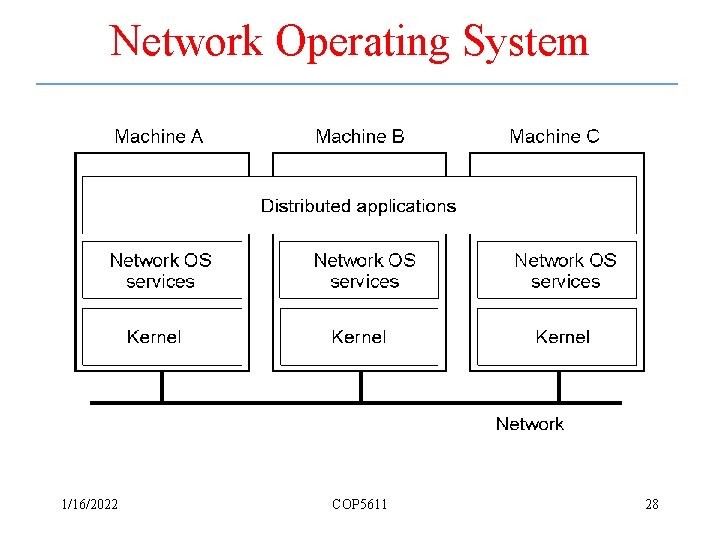
Network Operating System 1 -19 1/16/2022 COP 5611 28
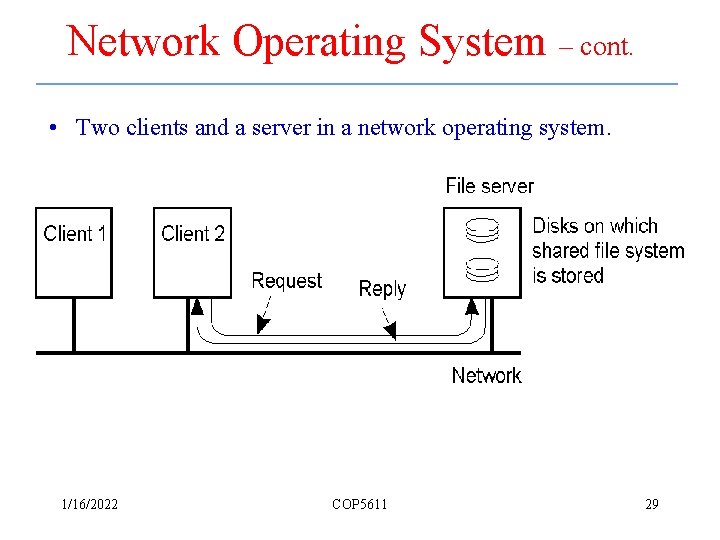
Network Operating System – cont. • Two clients and a server in a network operating system. 1/16/2022 COP 5611 29
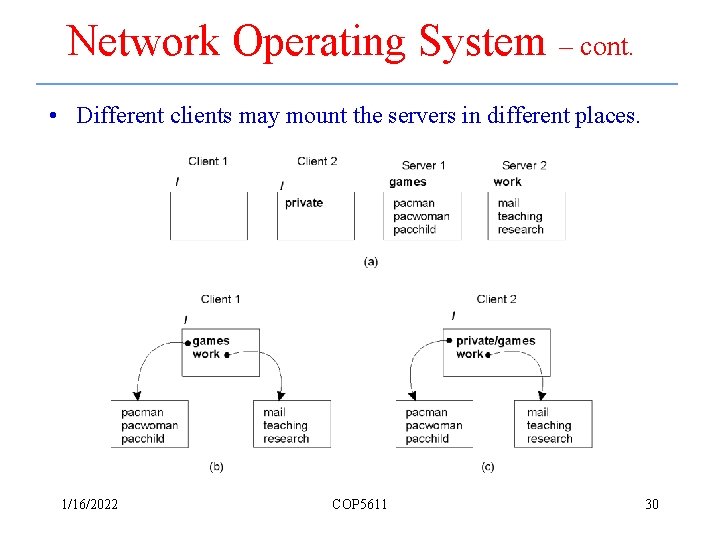
Network Operating System – cont. • Different clients may mount the servers in different places. 1/16/2022 COP 5611 30
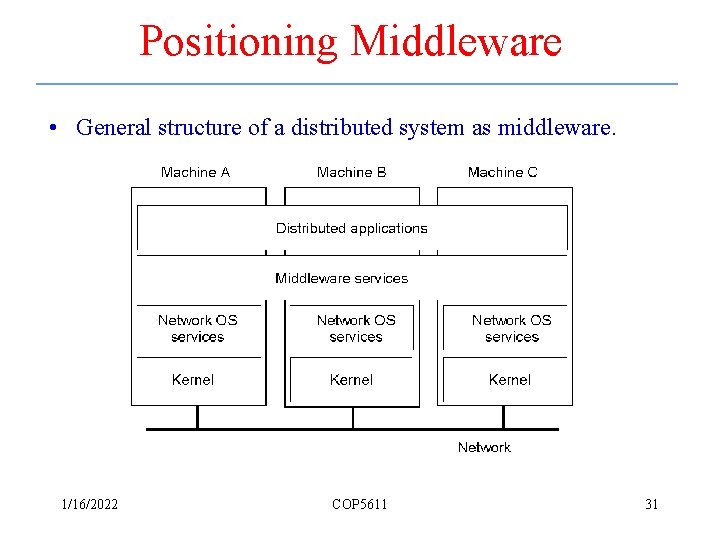
Positioning Middleware • General structure of a distributed system as middleware. 1/16/2022 COP 5611 31
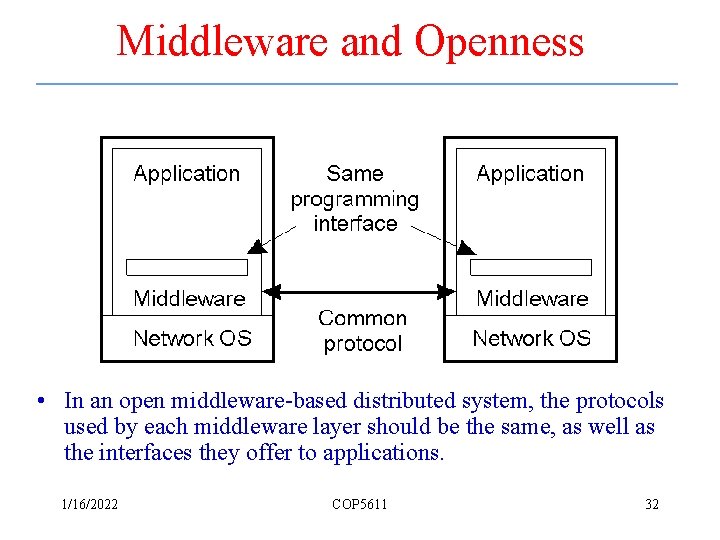
Middleware and Openness 1. 23 • In an open middleware-based distributed system, the protocols used by each middleware layer should be the same, as well as the interfaces they offer to applications. 1/16/2022 COP 5611 32
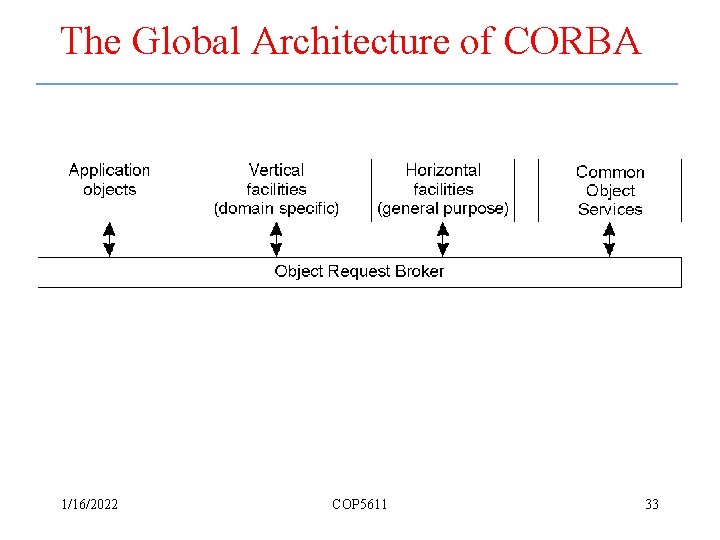
The Global Architecture of CORBA 1/16/2022 COP 5611 33
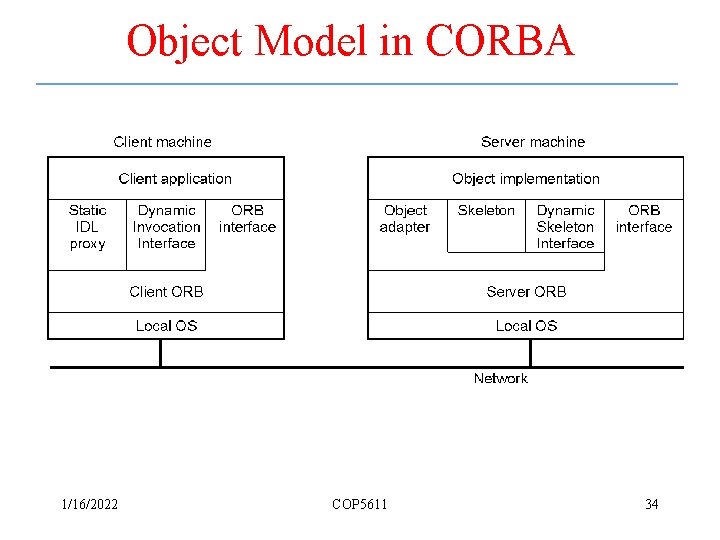
Object Model in CORBA • The general organization of a CORBA system. 1/16/2022 COP 5611 34
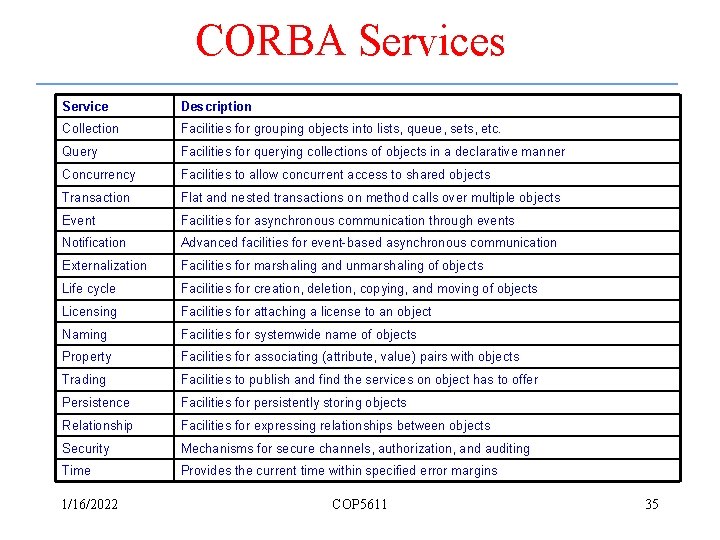
CORBA Services Service Description Collection Facilities for grouping objects into lists, queue, sets, etc. Query Facilities for querying collections of objects in a declarative manner Concurrency Facilities to allow concurrent access to shared objects Transaction Flat and nested transactions on method calls over multiple objects Event Facilities for asynchronous communication through events Notification Advanced facilities for event-based asynchronous communication Externalization Facilities for marshaling and unmarshaling of objects Life cycle Facilities for creation, deletion, copying, and moving of objects Licensing Facilities for attaching a license to an object Naming Facilities for systemwide name of objects Property Facilities for associating (attribute, value) pairs with objects Trading Facilities to publish and find the services on object has to offer Persistence Facilities for persistently storing objects Relationship Facilities for expressing relationships between objects Security Mechanisms for secure channels, authorization, and auditing Time Provides the current time within specified error margins 1/16/2022 COP 5611 35
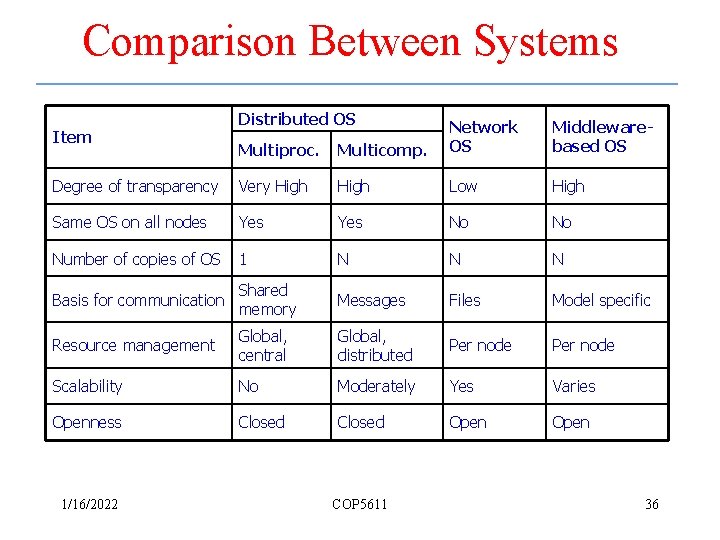
Comparison Between Systems Distributed OS Multiproc. Multicomp. Network OS Degree of transparency Very High Low High Same OS on all nodes Yes No No Number of copies of OS 1 N N N Basis for communication Shared memory Messages Files Model specific Resource management Global, central Global, distributed Per node Scalability No Moderately Yes Varies Openness Closed Open Item 1/16/2022 COP 5611 Middlewarebased OS 36
Issues in Distributed Operating Systems • Absence of global knowledge – In a distributed system, due to the unavailability of a global memory and a global clock and due to unpredictable message delays, it is practically impossible to for a computer to collect up-to-date information about the global state of the distributed system – Therefore a fundamental problem is to develop efficient techniques to implement a decentralized system wide control – Another problem is how to order all the events 1/16/2022 COP 5611 37
Issues in Distributed Operating Systems – cont. • Naming – Plays an important role in achieving location transparency – A name service maps a logical name into a physical address by making use of a table lookup, an algorithm, or a combination of both – In distributed systems, the tables may be replicated and stored at many places • Consider naming in a distributed file system 1/16/2022 COP 5611 38
Issues in Distributed Operating Systems – cont. • Scalability – Systems generally grow with time, especially distributed systems – Scalability requires that the growth should not result in system unavailability or degraded performance – This puts additional constraints on design approaches 1/16/2022 COP 5611 39
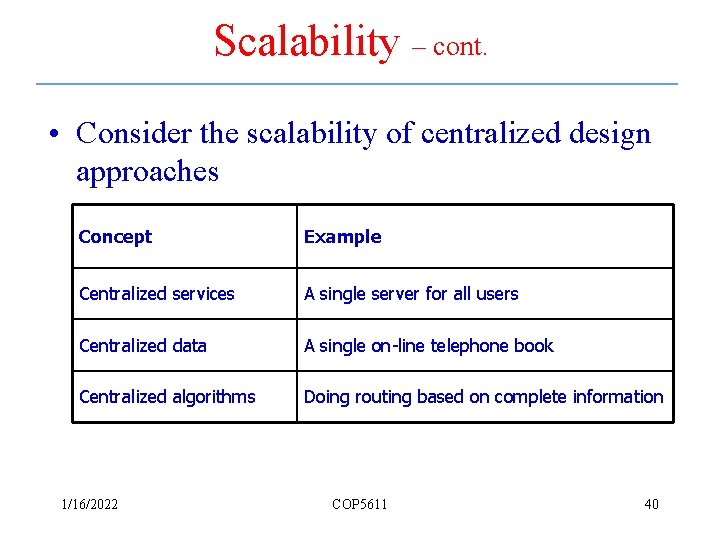
Scalability – cont. • Consider the scalability of centralized design approaches Concept Example Centralized services A single server for all users Centralized data A single on-line telephone book Centralized algorithms Doing routing based on complete information 1/16/2022 COP 5611 40
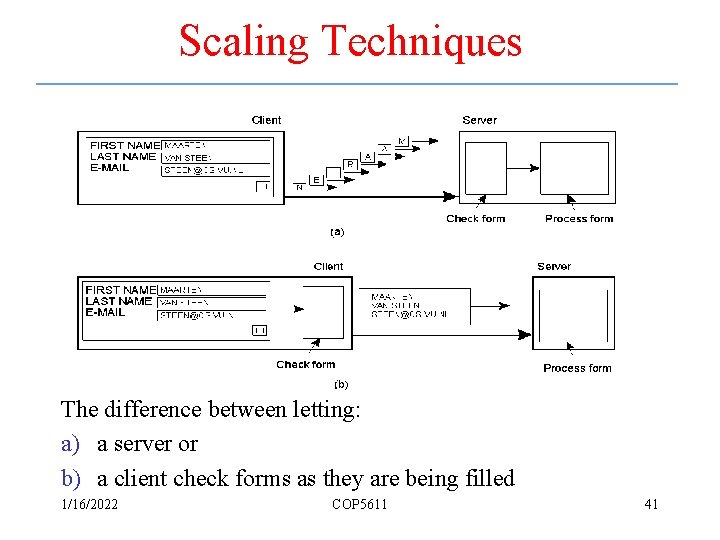
Scaling Techniques The difference between letting: a) a server or b) a client check forms as they are being filled 1/16/2022 COP 5611 41
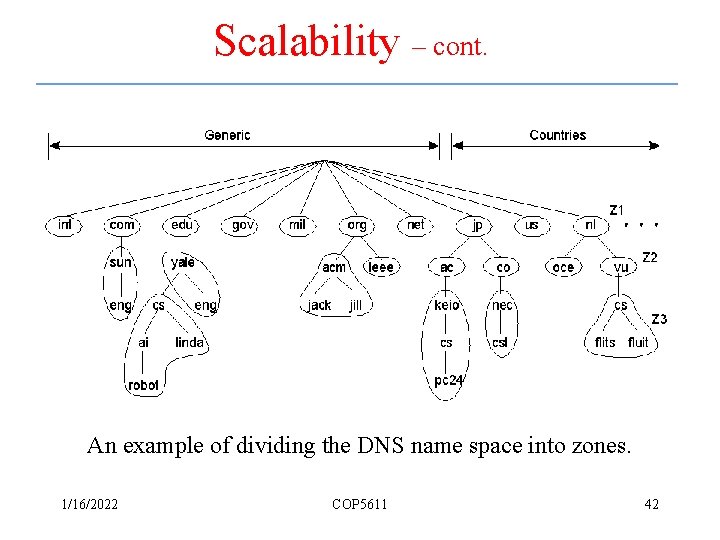
Scalability – cont. An example of dividing the DNS name space into zones. 1/16/2022 COP 5611 42
Issues in Distributed Operating Systems – cont. • Compatibility – Refers to the interoperability among the resources in a system – Three different levels • Binary level – All processors execute the same binary instruction repertoire – Virtual binary level • Execution level – Same source code can be compiled and executed properly • Protocol level 1/16/2022 COP 5611 43
Issues in Distributed Operating Systems – cont. • Process synchronization – The synchronization of processes in distributed systems is difficult because of the unavailability of shared memory • It needs to synchronize processes running on different computers when they try to concurrently access a shared resource • This is the mutual exclusion problem as in classical operating systems 1/16/2022 COP 5611 44
Issues in Distributed Operating Systems – cont. • Resource management – Resource management needs to make both local and remote resources available to uses in an effective manner – Data migration • Distributed file system • Distributed shared memory – Computation migration • Remote procedure call – Distributed scheduling 1/16/2022 COP 5611 45
Issues in Distributed Operating Systems – cont. • Security and protection – The same two issues as in classical operating systems need to be considered • Authentication • Authorization 1/16/2022 COP 5611 46
Issues in Distributed Operating Systems – cont. • Structuring – The distributed operating system requires some additional constraints on the structure of the underlying operating system – The collective kernel structure • An operating system is structured as a collection of processes that are largely independent of each other – Object-oriented operating system • The operating system’s services are implemented as objects 1/16/2022 COP 5611 47
The Client-Server Model • The client-server model provides one organization for a distributed system – The processes are organized into clients and servers – Clients request services from servers which provide services • A server is a process implementing a specific service • A client is a process that requests a service from a server by sending it a request and subsequently waiting for the server’s reply 1/16/2022 COP 5611 48
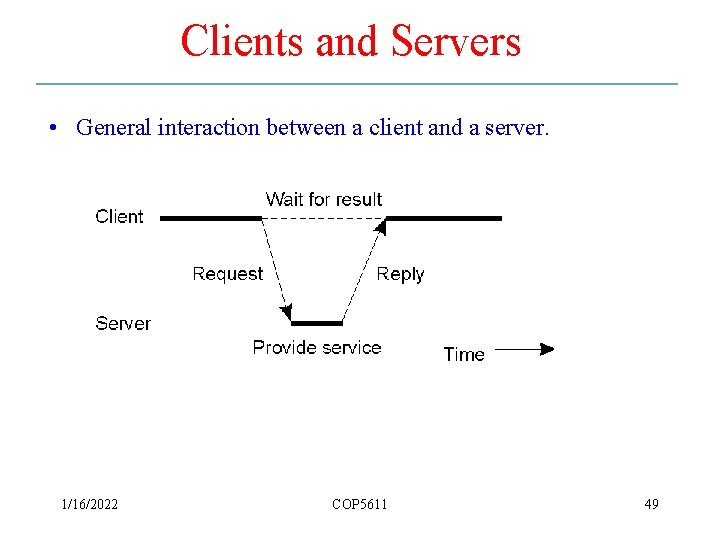
Clients and Servers • General interaction between a client and a server. 1/16/2022 COP 5611 49
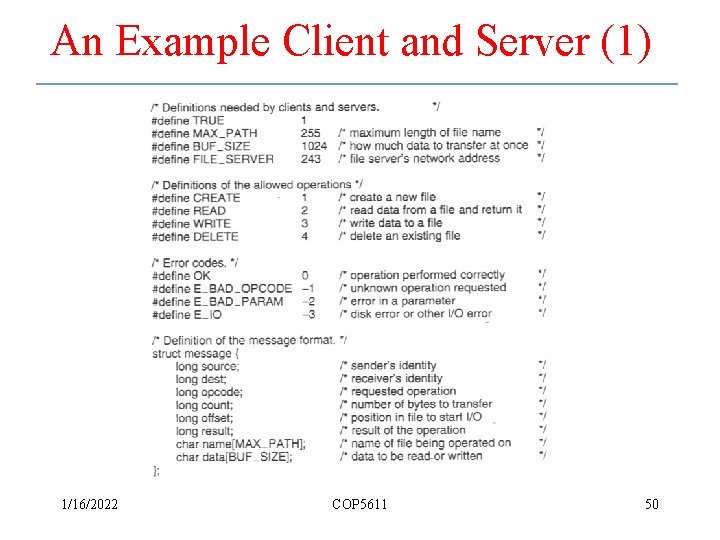
An Example Client and Server (1) 1/16/2022 COP 5611 50
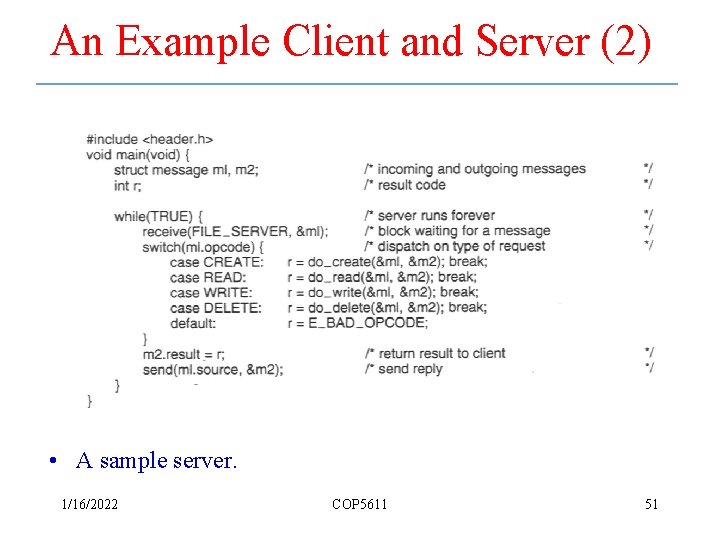
An Example Client and Server (2) • A sample server. 1/16/2022 COP 5611 51
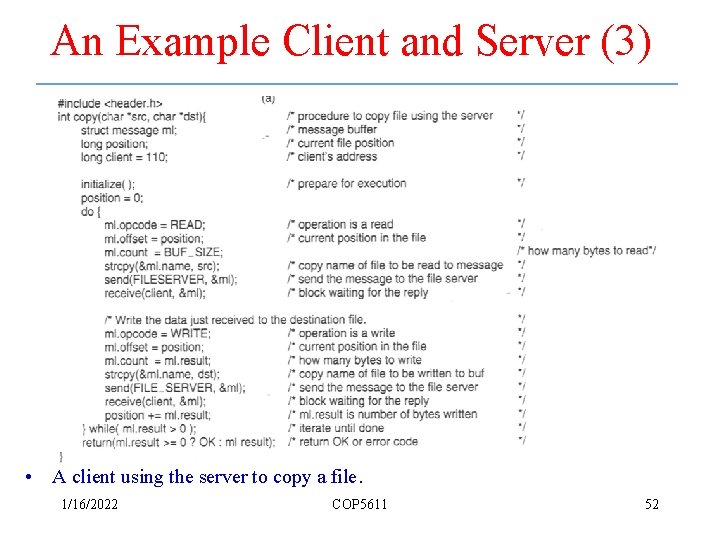
An Example Client and Server (3) • A client using the server to copy a file. 1/16/2022 COP 5611 52
Application Layering • A main issue in the client-server model is there is no clear distinction between a client and a server • Especially in the context of databases, the entire system is divided into three levels – The user-interface level – The processing level – The data level 1/16/2022 COP 5611 53
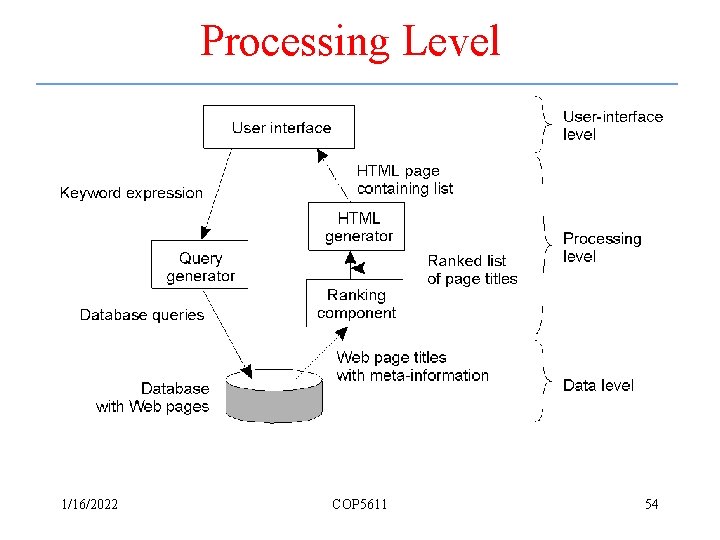
Processing Level • The general organization of an Internet search engine into three different layers 1 -28 1/16/2022 COP 5611 54
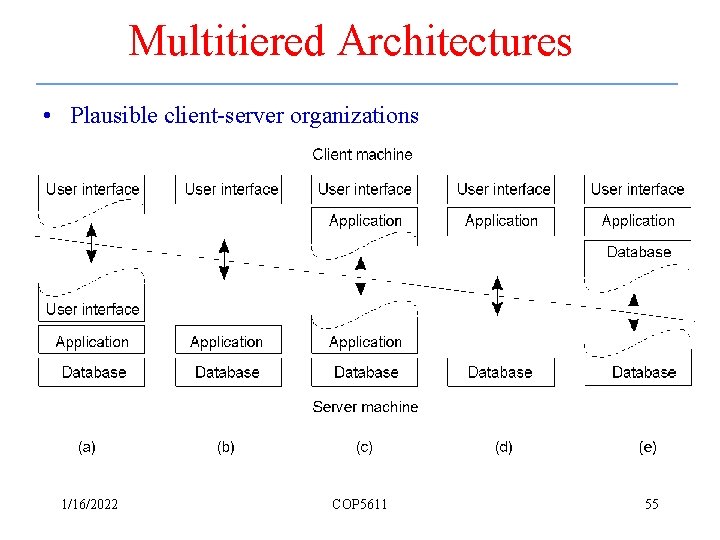
Multitiered Architectures • Plausible client-server organizations 1/16/2022 COP 5611 55
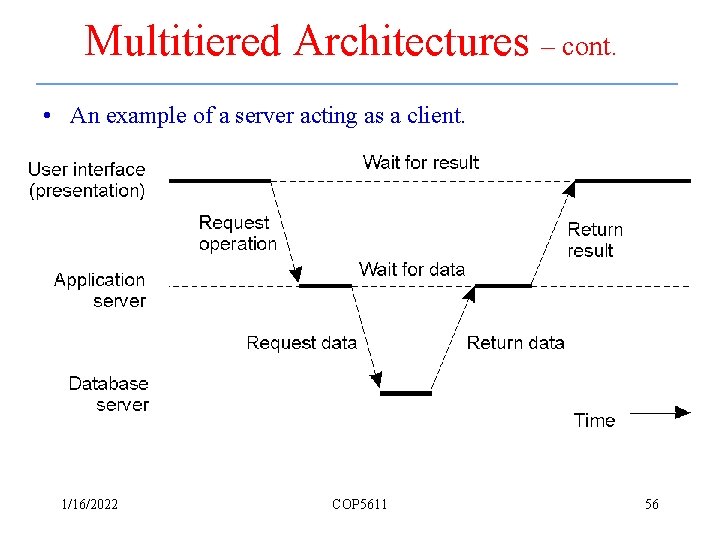
Multitiered Architectures – cont. • An example of a server acting as a client. 1/16/2022 COP 5611 56
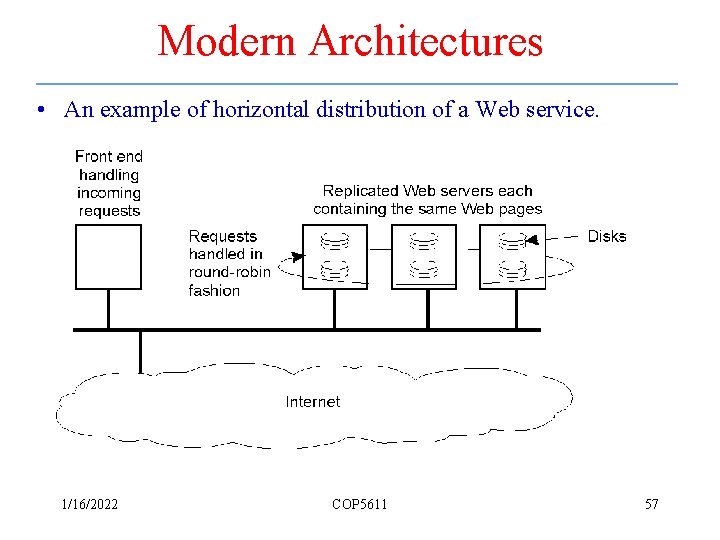
Modern Architectures • An example of horizontal distribution of a Web service. 1/16/2022 COP 5611 57
Summary – Definition of a distributed system – Motivations – Distributed system architectures – Distributed operating systems • DOS / NOS / Middleware – Technical issues in a distributed operating system – The client-server model • Next time – Communication in distributed systems 1/16/2022 COP 5611 58
- Slides: 58