
Outline Part II How do we measure attachment

- Slides: 25
Outline Part II �How do we measure attachment? ◦ Attachment Q-sort ◦ Adult Attachment Interview (AAI) �Why do early relationships matter? �Implications for Childhood and Adulthood �Interventions
Attachment Qsort � 90 Behaviors observed at home or other naturalistic settings �Forced cards. choice procedure – 9 piles of 10 ◦ Least like – to most like the child �Scoring: reflects how similar the child is to a hypothetical securely attached child
Attachment Qsort �AQS Security Score = correlation b/w participant’s sort of his/her child and expert sort of prototypical secure child
Attachment Qsort Advantages �Works for broader age range (12 -48 months) �Conducted in home = ecological validity �Does not induce stress on child �Applicable to cultures in which (1) parentinfant separation is uncommon and/or (2) prototypical secure child looks different
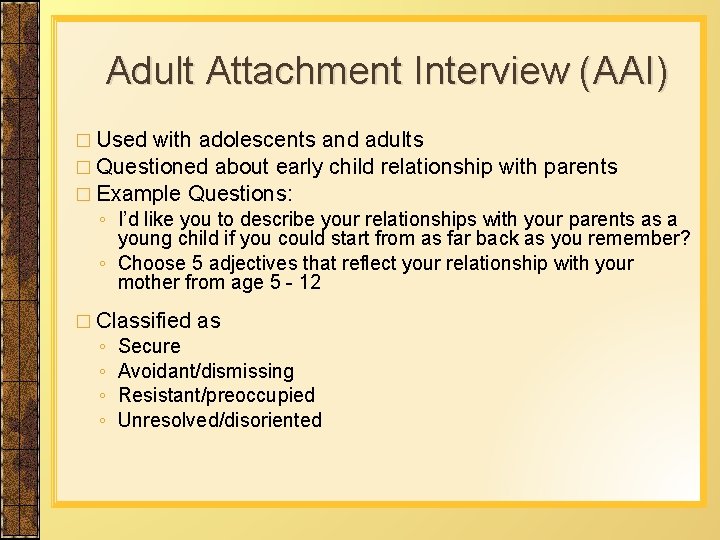
Adult Attachment Interview (AAI) � Used with adolescents and adults � Questioned about early child relationship � Example Questions: with parents ◦ I’d like you to describe your relationships with your parents as a young child if you could start from as far back as you remember? ◦ Choose 5 adjectives that reflect your relationship with your mother from age 5 - 12 � Classified ◦ ◦ as Secure Avoidant/dismissing Resistant/preoccupied Unresolved/disoriented
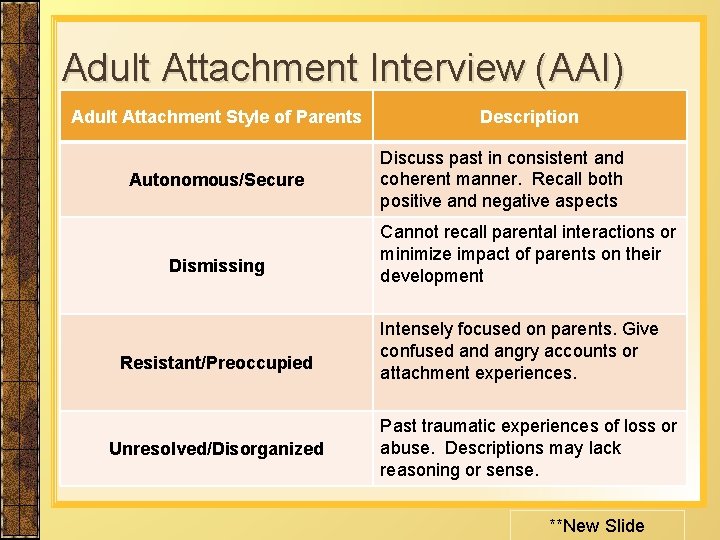
Adult Attachment Interview (AAI) Adult Attachment Style of Parents Autonomous/Secure Dismissing Resistant/Preoccupied Unresolved/Disorganized Description Discuss past in consistent and coherent manner. Recall both positive and negative aspects Cannot recall parental interactions or minimize impact of parents on their development Intensely focused on parents. Give confused angry accounts or attachment experiences. Past traumatic experiences of loss or abuse. Descriptions may lack reasoning or sense. **New Slide
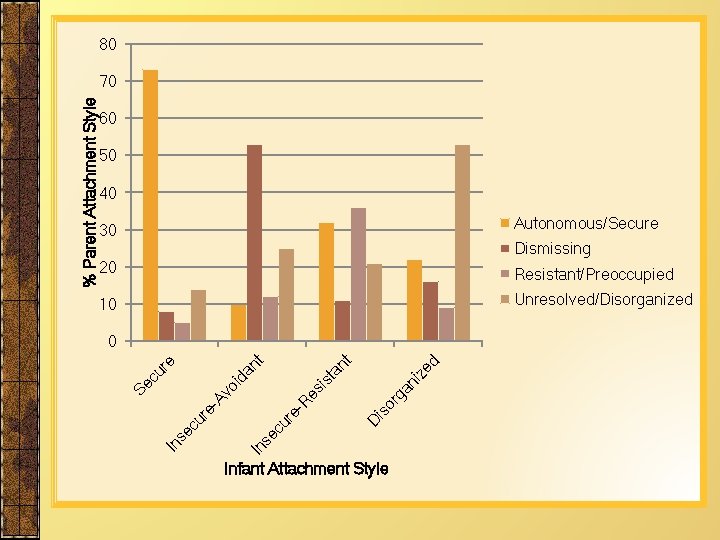
80 60 50 40 Autonomous/Secure 30 Dismissing 20 Resistant/Preoccupied 10 Unresolved/Disorganized iz ed an t is o D cu r e- R es rg an is t an t In se cu re -A vo id cu r e 0 Se % Parent Attachment Style 70 Infant Attachment Style
So Why do Early Attachment Relationships Matter?
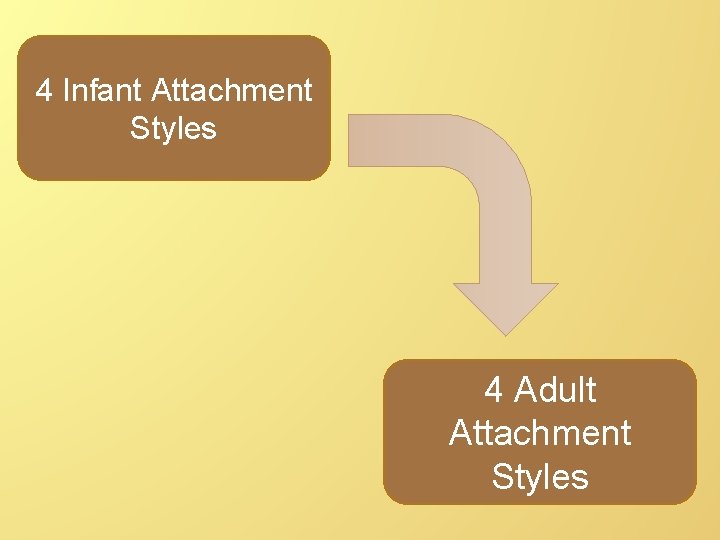
4 Infant Attachment Styles 4 Adult Attachment Styles
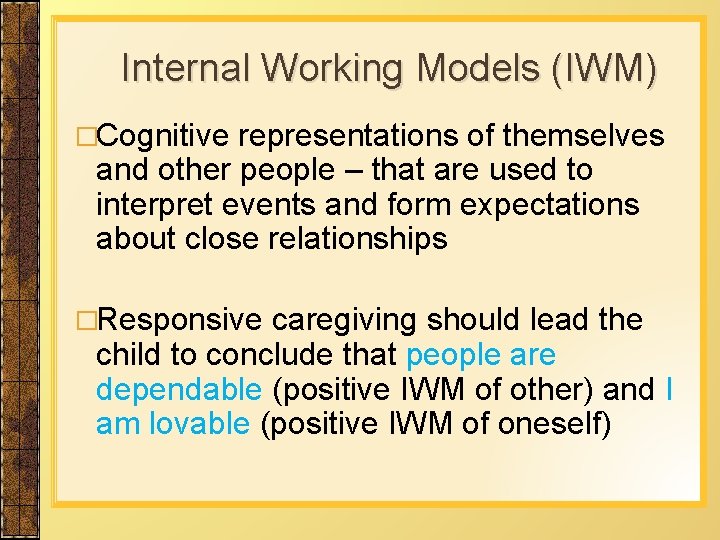
Internal Working Models (IWM) �Cognitive representations of themselves and other people – that are used to interpret events and form expectations about close relationships �Responsive caregiving should lead the child to conclude that people are dependable (positive IWM of other) and I am lovable (positive IWM of oneself)
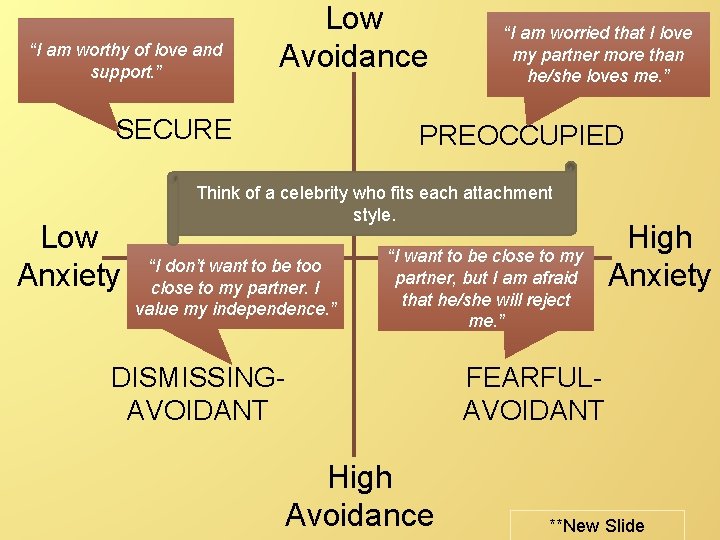
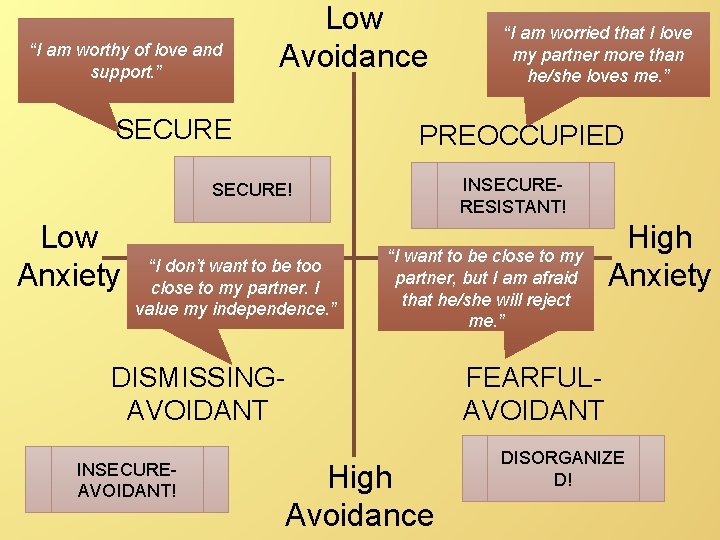
“I am worthy of love and support. ” Low Avoidance SECURE Low Anxiety “I am worried that I love my partner more than he/she loves me. ” PREOCCUPIED Think of a celebrity who fits each attachment style. “I don’t want to be too close to my partner. I value my independence. ” “I want to be close to my partner, but I am afraid that he/she will reject me. ” DISMISSINGAVOIDANT High Anxiety FEARFULAVOIDANT High Avoidance **New Slide
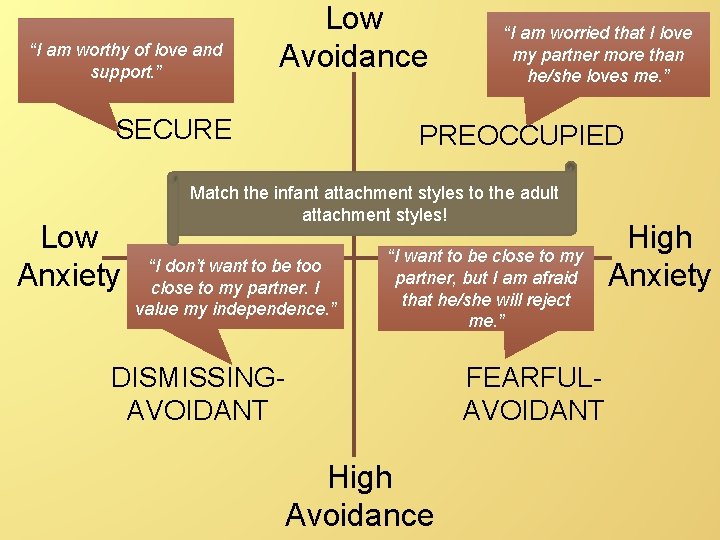
“I am worthy of love and support. ” Low Avoidance SECURE Low Anxiety “I am worried that I love my partner more than he/she loves me. ” PREOCCUPIED Match the infant attachment styles to the adult attachment styles! “I don’t want to be too close to my partner. I value my independence. ” “I want to be close to my partner, but I am afraid that he/she will reject me. ” DISMISSINGAVOIDANT FEARFULAVOIDANT High Avoidance High Anxiety
“I am worthy of love and support. ” Low Avoidance SECURE PREOCCUPIED INSECURERESISTANT! SECURE! Low Anxiety “I don’t want to be too close to my partner. I value my independence. ” “I want to be close to my partner, but I am afraid that he/she will reject me. ” DISMISSINGAVOIDANT INSECUREAVOIDANT! “I am worried that I love my partner more than he/she loves me. ” High Anxiety FEARFULAVOIDANT High Avoidance DISORGANIZE D!
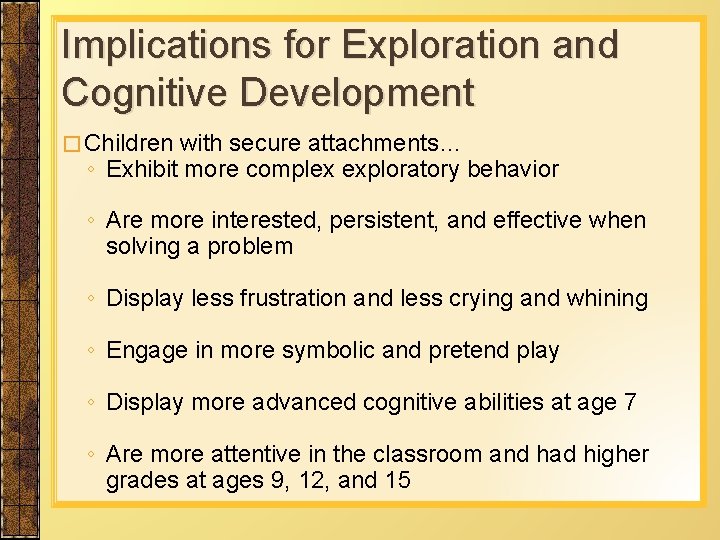
Implications for Exploration and Cognitive Development � Children with secure attachments… ◦ Exhibit more complex exploratory behavior ◦ Are more interested, persistent, and effective when solving a problem ◦ Display less frustration and less crying and whining ◦ Engage in more symbolic and pretend play ◦ Display more advanced cognitive abilities at age 7 ◦ Are more attentive in the classroom and had higher grades at ages 9, 12, and 15
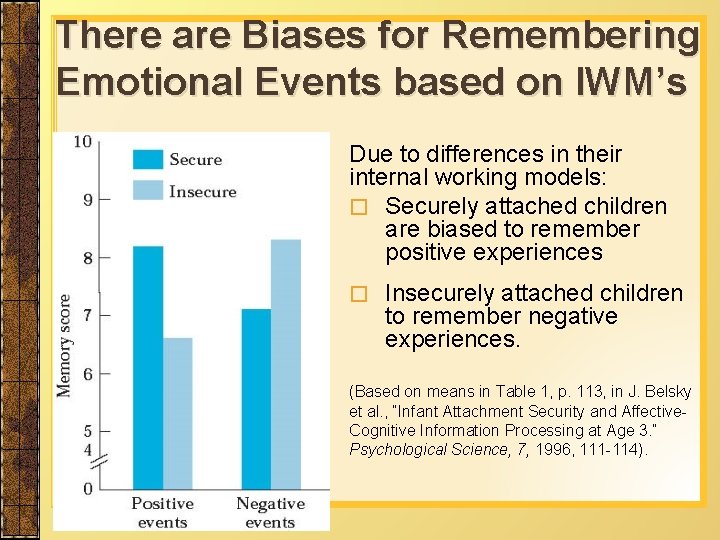
There are Biases for Remembering Emotional Events based on IWM’s Due to differences in their internal working models: � Securely attached children are biased to remember positive experiences � Insecurely attached children to remember negative experiences. (Based on means in Table 1, p. 113, in J. Belsky et al. , “Infant Attachment Security and Affective. Cognitive Information Processing at Age 3. ” Psychological Science, 7, 1996, 111 -114).
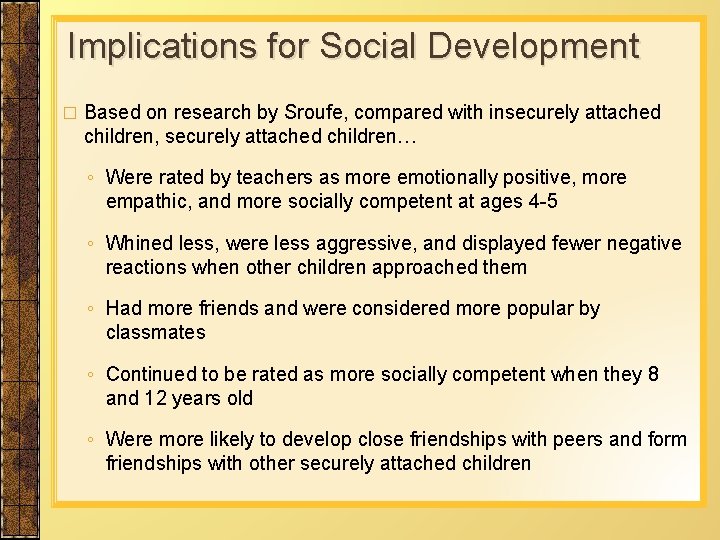
Implications for Social Development � Based on research by Sroufe, compared with insecurely attached children, securely attached children… ◦ Were rated by teachers as more emotionally positive, more empathic, and more socially competent at ages 4 -5 ◦ Whined less, were less aggressive, and displayed fewer negative reactions when other children approached them ◦ Had more friends and were considered more popular by classmates ◦ Continued to be rated as more socially competent when they 8 and 12 years old ◦ Were more likely to develop close friendships with peers and form friendships with other securely attached children
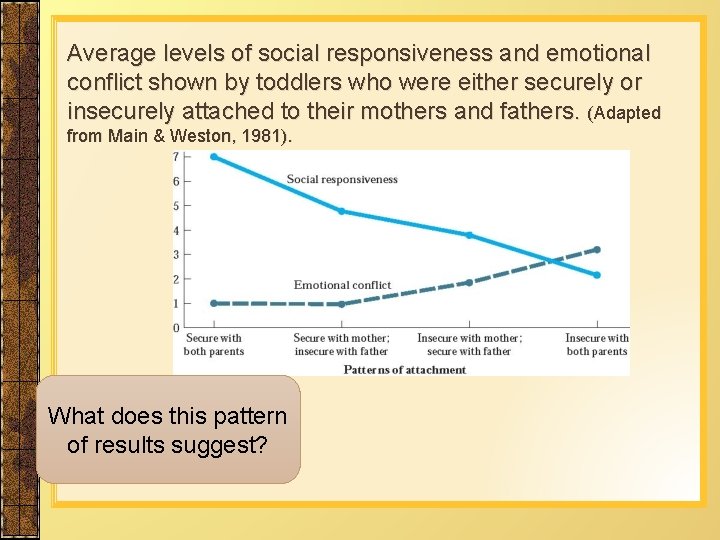
Average levels of social responsiveness and emotional conflict shown by toddlers who were either securely or insecurely attached to their mothers and fathers. (Adapted from Main & Weston, 1981). What does this pattern of results suggest?
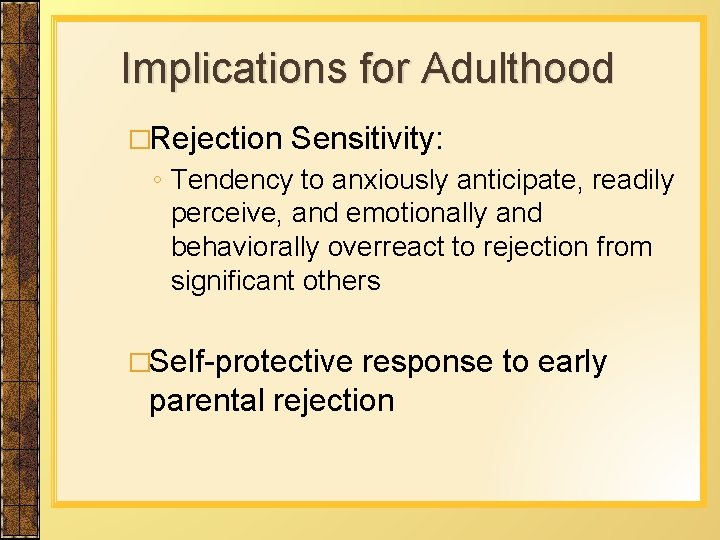
Implications for Adulthood �Rejection Sensitivity: ◦ Tendency to anxiously anticipate, readily perceive, and emotionally and behaviorally overreact to rejection from significant others �Self-protective response to early parental rejection
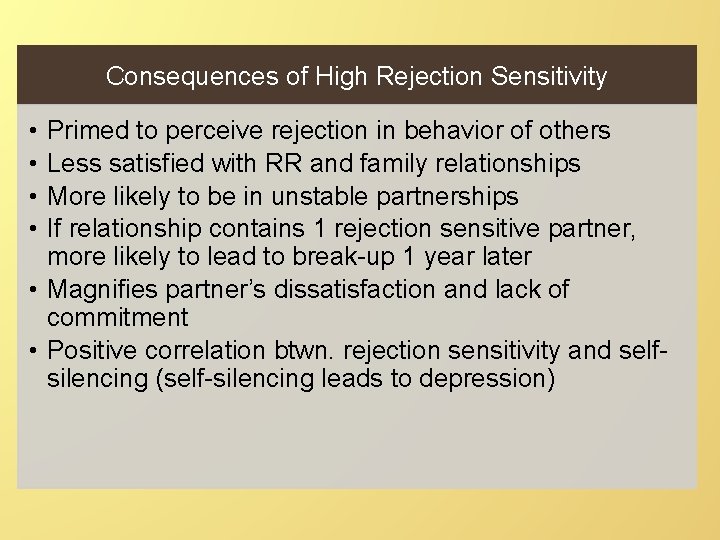
Consequences of High Rejection Sensitivity • • Primed to perceive rejection in behavior of others Less satisfied with RR and family relationships More likely to be in unstable partnerships If relationship contains 1 rejection sensitive partner, more likely to lead to break-up 1 year later • Magnifies partner’s dissatisfaction and lack of commitment • Positive correlation btwn. rejection sensitivity and selfsilencing (self-silencing leads to depression)
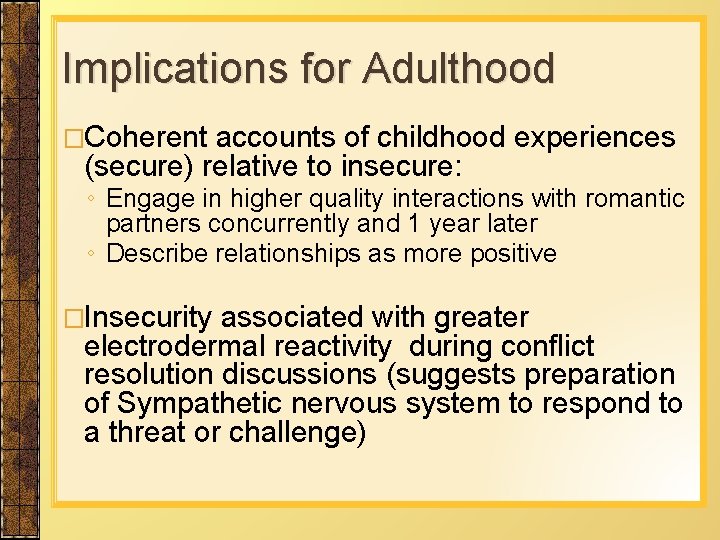
Implications for Adulthood �Coherent accounts of childhood experiences (secure) relative to insecure: ◦ Engage in higher quality interactions with romantic partners concurrently and 1 year later ◦ Describe relationships as more positive �Insecurity associated with greater electrodermal reactivity during conflict resolution discussions (suggests preparation of Sympathetic nervous system to respond to a threat or challenge)
Implications for Adulthood �In RR, Secure Adults show ◦ Higher satisfaction, trust, intimacy, love, and commitment with romantic partner ◦ Lower levels of conflict, interpersonal difficulty, negative affect ◦ More effective communication and problemsolving strategies
Stability of Attachment � 72% of children who were classified as secure in infancy were secure 20 years later �More likely to change from insecure to secure ◦ In one study, 42% of children who were insecure at 1 year were secure at 4 years. �Change/stability tends to depend on stability of parenting and environment �So, can we even change attachment style?
Attachment Style Interventions �Synchrony �Circle of Security �Steps Towards Effective Enjoyable Parenting™ (STEEP) and Seeing is Believing Training �Meta-analysis al. , 2003) on interventions (Bakermans-Kranenburg et ◦ 85 studies testing several types of interventions ◦ Increasing parental sensitivity changes infant attachment style
Summary �Infant attachment styles are ◦ Correlated with parent attachment styles ◦ Associated with developmental outcomes ◦ Stable into adulthood �Several measures and interventions exist �Parental sensitivity is currently the best intervention