
Outline of Slides 1 Introduction 2 Lessons from
- Slides: 12
Outline of Slides 1. Introduction 2. Lessons from Run 2 3. Calibration Strategy 4. Requirements for the ATLAS HL-LHC luminosity program 5. ATLAS planned detector upgrades 6. New proposals for detectors 7. Summary and Timeline ATLAS Phase-II Luminosity Upgrades 1 May 3, 2020.
Introduction • ATLAS formed a “Phase-II Luminosity Task Force” in June 2019 to ensure that the ambitious goal for the total luminosity uncertainty at the HL-LHC can be achieved. - Aim to optimize uncertainty on key precision measurements, including the Higgs boson coupling measurements, by reducing overall luminosity uncertainty to 1%, despite the much harsher experimental environment at HLLHC compared to Run 1 and Run 2. • The mandate stated that the task force should develop a strategy for precise ATLAS luminosity measurements during the HL-LHC: - - - Evaluate the conditions and detector requirements for a robust and precise luminosity measurement under HL-LHC conditions, including complementary measurements and necessary triggers for van der Meer (vd. M) calibration scans. Evaluate existing detector projects (including the timing detector, HGTD, and the new inner tracker, ITk), suitable for luminosity measurements during Phase-II. Investigate re-use of the present detector concepts and methods under Phase-II conditions. Evaluate the need for developing additional detector projects for luminosity measurements during Phase-II. ATLAS Phase-II Luminosity Upgrades 2 May 3, 2020.
Lessons from Run-2 • The precision in the luminosity program depends on having many complementary detectors and measurements. - In Run 2, the dedicated luminosity detector (LUCID) was the only detector calibrated during the vd. M scans (which happen at low luminosity). - Other measurements, such as Track Counting, were used to correct the known non-linearities of LUCID when going to physics running at high luminosity. - Several other measurements, such as Tile calorimeter PMT currents or LAr calorimeter gap currents in the endcap (EMEC) or forward (FCal) calorimeters, assist in validating the linearity and to constrain the uncertainties due to relative long-term drifts of the various detectors. - The main uncertainties are associated with (i) the absolute calibration in the vd. M scan, (ii) the calibration transfer to high luminosity (dominant source, and correlated from year-to-year), and (iii) from the imperfect long-term stability. In Run 2, they contributed (i) 0. 9% (ii) 1. 3% (iii) 0. 6% to the total uncertainty. • If the uncertainties are to be reduced significantly, the most important change needed is to have additional detectors that can be calibrated in the vd. M scans and with independent calibration transfers to high luminosity. ATLAS Phase-II Luminosity Upgrades 3 May 3, 2020.
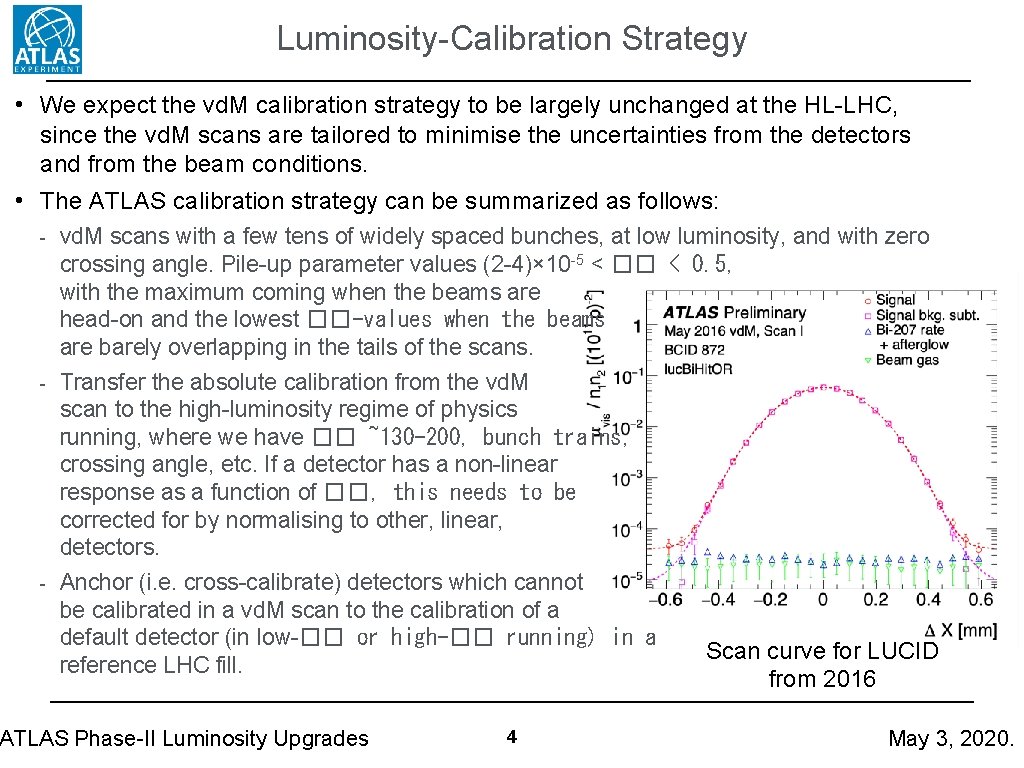
Luminosity-Calibration Strategy • We expect the vd. M calibration strategy to be largely unchanged at the HL-LHC, since the vd. M scans are tailored to minimise the uncertainties from the detectors and from the beam conditions. • The ATLAS calibration strategy can be summarized as follows: - vd. M scans with a few tens of widely spaced bunches, at low luminosity, and with zero crossing angle. Pile-up parameter values (2 -4)× 10 -5 < �� < 0. 5, with the maximum coming when the beams are head-on and the lowest ��-values when the beams are barely overlapping in the tails of the scans. - Transfer the absolute calibration from the vd. M scan to the high-luminosity regime of physics running, where we have �� ~130 -200, bunch trains, crossing angle, etc. If a detector has a non-linear response as a function of ��, this needs to be corrected for by normalising to other, linear, detectors. - Anchor (i. e. cross-calibrate) detectors which cannot be calibrated in a vd. M scan to the calibration of a default detector (in low-�� or high-�� running) in a reference LHC fill. ATLAS Phase-II Luminosity Upgrades 4 Scan curve for LUCID from 2016 May 3, 2020.
Summary of the Requirements • To reach the best possible accuracy the luminosity program should have: - At least three independent luminosity detectors with bunch-by-bunch capability, read out independently of the ATLAS DAQ and with enough statistical precision and dynamic range to be calibrated in vd. M scans and used at the highest foreseen physics luminosity. They should have small (sub-percent) intrinsic or correctable non-linearity over the full ��range, excellent long-term stability on a six- to nine-months time scale and be maintained/monitored with dedicated internal calibration systems if possible. - At least two of these measurements (with reduced calibration precision) should also be available online (increased importance due to luminosity-levelling as standard operation). - The three-fold offline redundancy is required to resolve the inconsistencies, and resulting systematic uncertainties, that would likely arise if only two independent bunchby-bunch luminometers were available; the two-fold online redundancy is needed to ensure the availability of an operational backup, as well as online-diagnostic capabilities to ensure efficient operation of both ATLAS and LHC as a whole. - Multiple auxiliary luminosity measurements (some possibly without bunch-by-bunch capability) with excellent linearity (well below 1%) between the vd. M and physics regimes, and corresponding short-term stability (over a few days) to link the vd. M and calibration transfer datasets. - Multiple auxiliary luminosity measurements usable in physics conditions, with excellent intrinsic long-term stability (well below 1%), or external calibration systems enabling this precision, but without the need for bunch-by-bunch capability. ATLAS Phase-II Luminosity Upgrades 5 May 3, 2020.
ATLAS Luminosity Detector Upgrades • Three planned projects with bunch-by-bunch capability, the capability to be calibrated in vd. M scans and being used over the full dynamic range in pile-up parameter �� and bunch integrated luminosity: - LUCID-3, a new and upgraded LUCID detector [dedicated slide later]. BCMʹ, a new and upgraded Beam Conditions Monitor (BCM) detector with diamond sensors, used for both beam protection for the inner tracker and luminosity measurement [dedicated slide later]. HGTD, the new timing detector constructed for HL-LHC [dedicated slide later]. • Additional planned detector upgrade projects used as auxiliary luminometers: - - The hadronic Tile Calorimeter, where PMT currents are proportional to the luminosity. Provides bunch-integrated relative luminosity measurements (no bunch-by-bunch capability); cannot be absolutely calibrated in vd. M scans; excellent linearity and long-term stability. The electromagnetic LAr Calorimeter, where gap currents are proportional to the luminosity. This measurement has the same limitations and advantages as the Tile calorimeter. For the upgraded electronics, there is also a possibility to implement new functionality to measure the luminosity from the dispersion of samples around the pedestal. The new inner tracker ITk will be used for offline Track Counting (TC) and Pixel Cluster Counting (PCC) luminosity measurements. Need a dedicated random-triggered event stream, similar to what exists in Run 1 and Run 2. Opportunities to use the Muon System and the Time. Pix detectors (TPX) will be investigated. • Proposed new detector ideas, to build some minimal redundancy into the program, since there are various uncertainties related to all the planned upgrade projects: - Dedicated PCC modules in the ITk, called Pixel Luminosity Rings (PLR) [dedicated slide later]. A BCM’ detector with silicon sensors, called Si-BCMʹ [dedicated slide later]. ATLAS Phase-II Luminosity Upgrades 6 May 3, 2020.
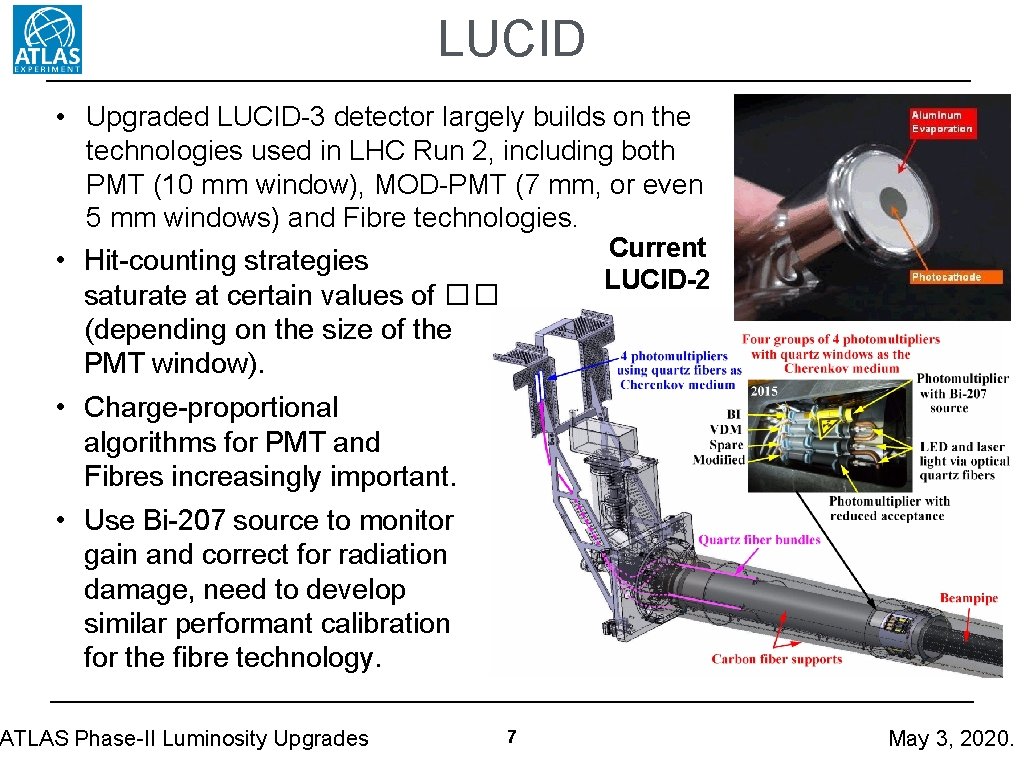
LUCID • Upgraded LUCID-3 detector largely builds on the technologies used in LHC Run 2, including both PMT (10 mm window), MOD-PMT (7 mm, or even 5 mm windows) and Fibre technologies. Current LUCID-2 • Hit-counting strategies saturate at certain values of �� (depending on the size of the PMT window). • Charge-proportional algorithms for PMT and Fibres increasingly important. • Use Bi-207 source to monitor gain and correct for radiation damage, need to develop similar performant calibration for the fibre technology. ATLAS Phase-II Luminosity Upgrades 7 May 3, 2020.
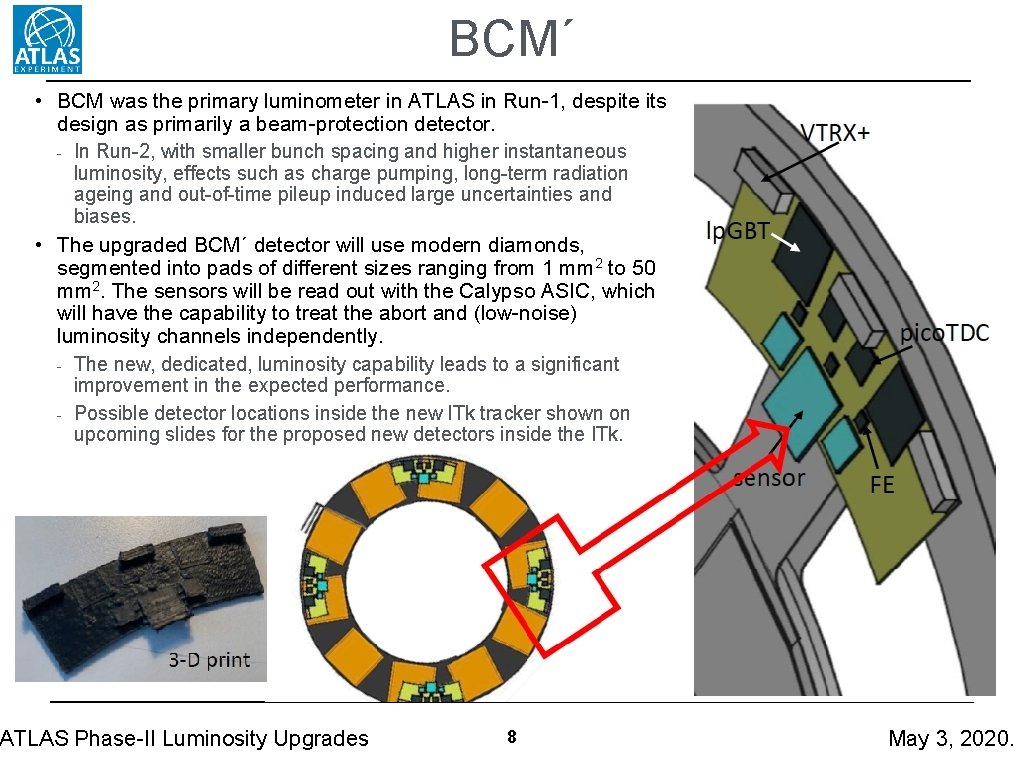
BCMʹ • BCM was the primary luminometer in ATLAS in Run-1, despite its design as primarily a beam-protection detector. - In Run-2, with smaller bunch spacing and higher instantaneous luminosity, effects such as charge pumping, long-term radiation ageing and out-of-time pileup induced large uncertainties and biases. • The upgraded BCMʹ detector will use modern diamonds, segmented into pads of different sizes ranging from 1 mm 2 to 50 mm 2. The sensors will be read out with the Calypso ASIC, which will have the capability to treat the abort and (low-noise) luminosity channels independently. - The new, dedicated, luminosity capability leads to a significant improvement in the expected performance. Possible detector locations inside the new ITk tracker shown on upcoming slides for the proposed new detectors inside the ITk. ATLAS Phase-II Luminosity Upgrades 8 May 3, 2020.
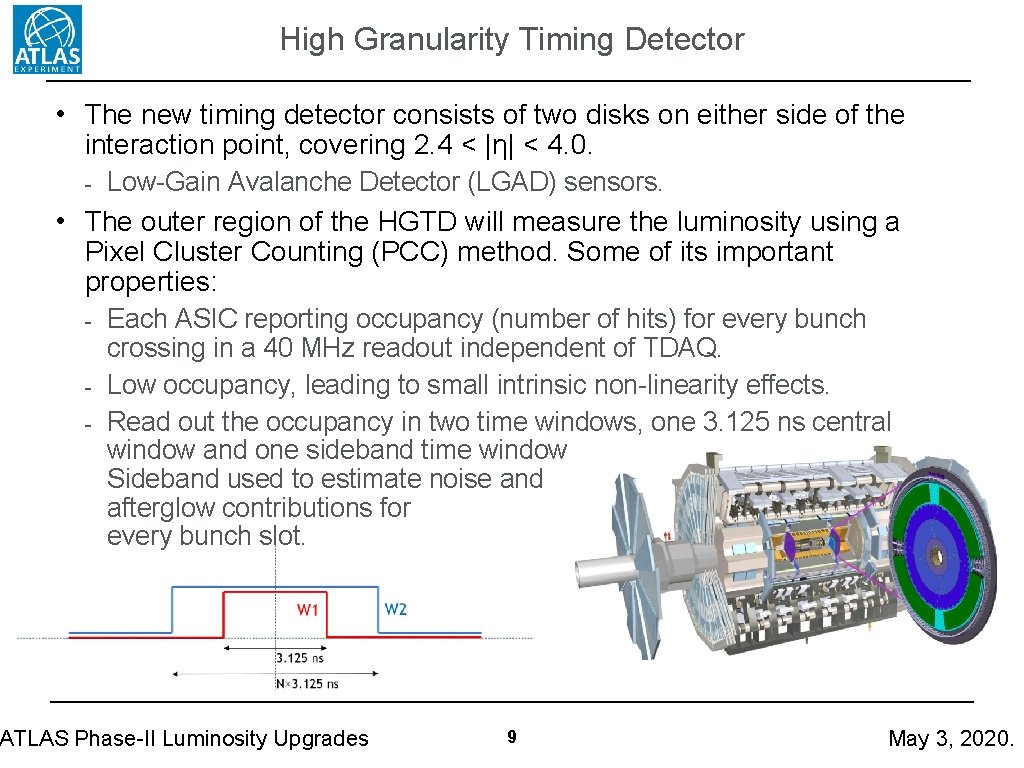
High Granularity Timing Detector • The new timing detector consists of two disks on either side of the interaction point, covering 2. 4 < |η| < 4. 0. - Low-Gain Avalanche Detector (LGAD) sensors. • The outer region of the HGTD will measure the luminosity using a Pixel Cluster Counting (PCC) method. Some of its important properties: - Each ASIC reporting occupancy (number of hits) for every bunch crossing in a 40 MHz readout independent of TDAQ. Low occupancy, leading to small intrinsic non-linearity effects. Read out the occupancy in two time windows, one 3. 125 ns central window and one sideband time window. Sideband used to estimate noise and afterglow contributions for every bunch slot. ATLAS Phase-II Luminosity Upgrades 9 May 3, 2020.
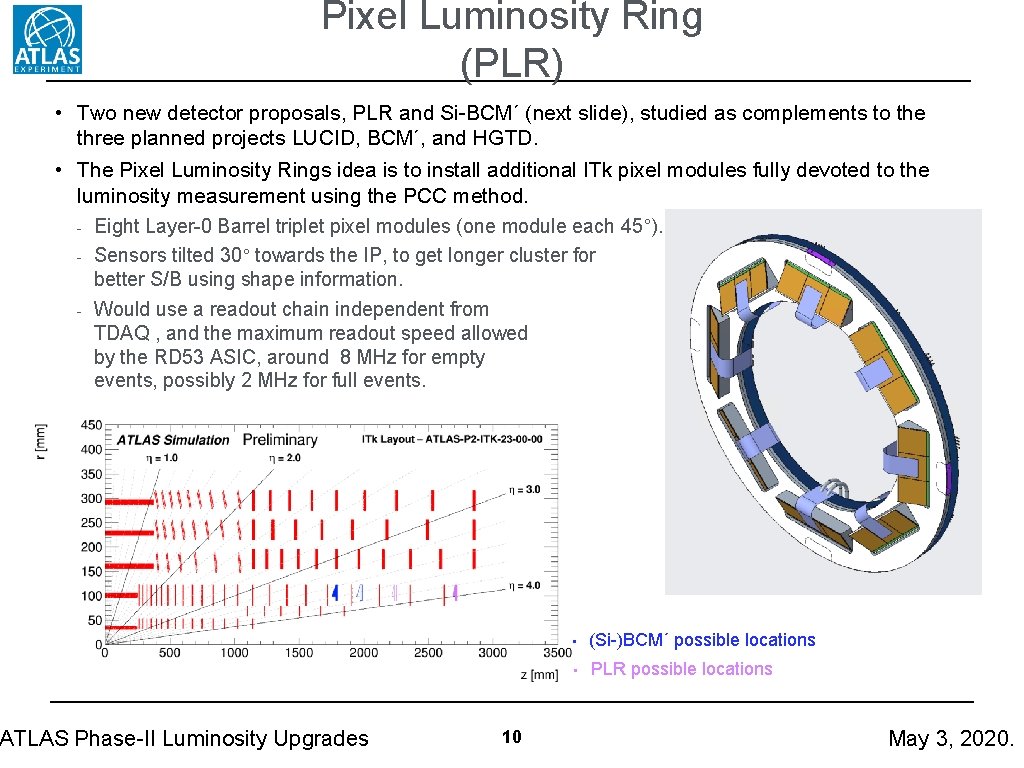
Pixel Luminosity Ring (PLR) • Two new detector proposals, PLR and Si-BCMʹ (next slide), studied as complements to the three planned projects LUCID, BCMʹ, and HGTD. • The Pixel Luminosity Rings idea is to install additional ITk pixel modules fully devoted to the luminosity measurement using the PCC method. - Eight Layer-0 Barrel triplet pixel modules (one module each 45∘). - Sensors tilted 30∘ towards the IP, to get longer cluster for better S/B using shape information. - Would use a readout chain independent from TDAQ , and the maximum readout speed allowed by the RD 53 ASIC, around 8 MHz for empty events, possibly 2 MHz for full events. ATLAS Phase-II Luminosity Upgrades 10 • (Si-)BCMʹ possible locations • PLR possible locations May 3, 2020.
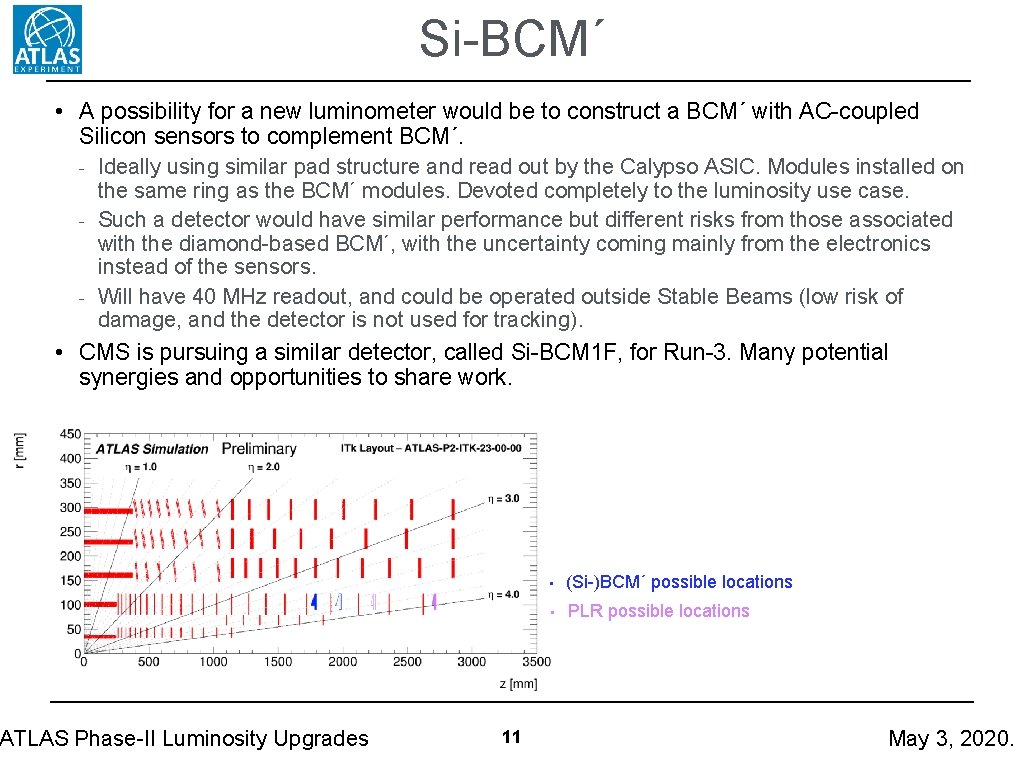
Si-BCMʹ • A possibility for a new luminometer would be to construct a BCMʹ with AC-coupled Silicon sensors to complement BCMʹ. - - Ideally using similar pad structure and read out by the Calypso ASIC. Modules installed on the same ring as the BCMʹ modules. Devoted completely to the luminosity use case. Such a detector would have similar performance but different risks from those associated with the diamond-based BCMʹ, with the uncertainty coming mainly from the electronics instead of the sensors. Will have 40 MHz readout, and could be operated outside Stable Beams (low risk of damage, and the detector is not used for tracking). • CMS is pursuing a similar detector, called Si-BCM 1 F, for Run-3. Many potential synergies and opportunities to share work. ATLAS Phase-II Luminosity Upgrades 11 • (Si-)BCMʹ possible locations • PLR possible locations May 3, 2020.
Outlook and Timeline • To conclude, the ATLAS strategy includes having at least three detectors that can be calibrated in the vd. M scans and operated at all �� values. - These are then complemented with auxiliary measurements from e. g. the inner tracker or the calorimeters. • The status of the already planned projects fulfilling these requirements are: - LUCID-3 is still in an R&D phase which is expected to last another couple of years. The detector can be constructed in about two years. - BCMʹ is progressing within the ITk project. Sensor and ASIC developments are ongoing. - HGTD is under TDR review by LHCC. Sensors and ASIC in R&D phase, expected to last another year or two. • The new detector proposals, PLR and Si-BCMʹ, will add some minimal redundancy in the program. They need to progress rapidly towards a realistic design with simulations and prototyping. ATLAS Phase-II Luminosity Upgrades 12 May 3, 2020.