
Outline of Presentation Country Profile II Overview of

- Slides: 24
Outline of Presentation Country Profile II. Overview of the Philippine Educational System III. Sector Performance IV. Current Initiatives V. Emerging Challenges and Future Prospects I.
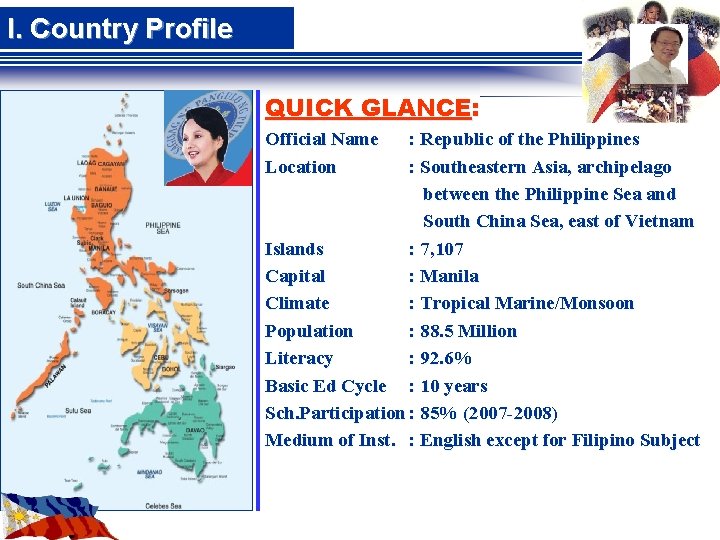
I. Country Profile QUICK GLANCE: Official Name Location : Republic of the Philippines : Southeastern Asia, archipelago between the Philippine Sea and South China Sea, east of Vietnam Islands : 7, 107 Capital : Manila Climate : Tropical Marine/Monsoon Population : 88. 5 Million Literacy : 92. 6% Basic Ed Cycle : 10 years Sch. Participation : 85% (2007 -2008) Medium of Inst. : English except for Filipino Subject
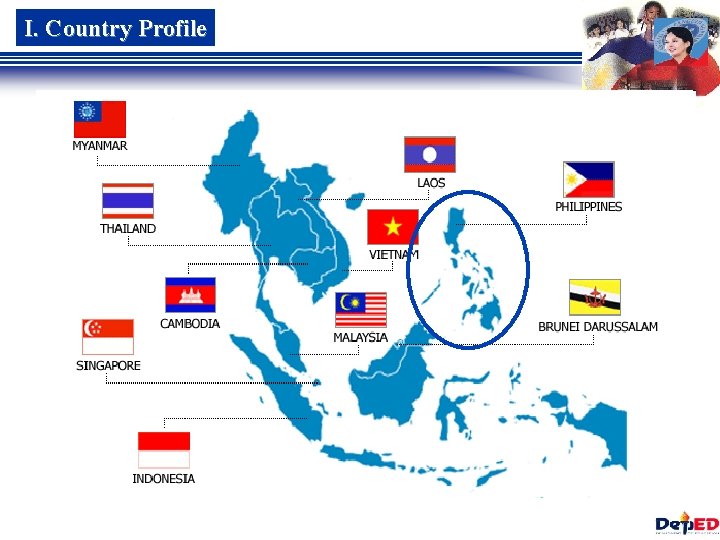
I. Country Profile
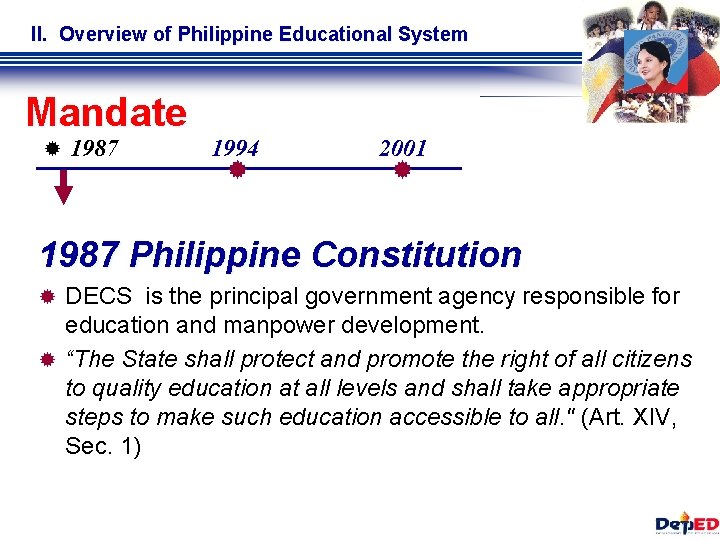
II. Overview of Philippine Educational System Mandate ® 1987 1994 ® ® 2001 ® 1987 Philippine Constitution DECS is the principal government agency responsible for education and manpower development. ® “The State shall protect and promote the right of all citizens to quality education at all levels and shall take appropriate steps to make such education accessible to all. " (Art. XIV, Sec. 1) ®
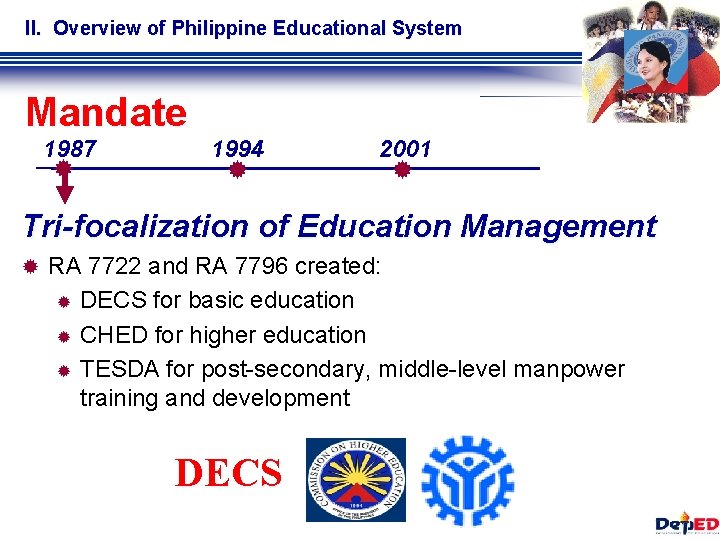
II. Overview of Philippine Educational System Mandate 1987 ® 1994 ® 2001 ® Tri-focalization of Education Management ® RA 7722 and RA 7796 created: ® DECS for basic education ® CHED for higher education ® TESDA for post-secondary, middle-level manpower training and development DECS
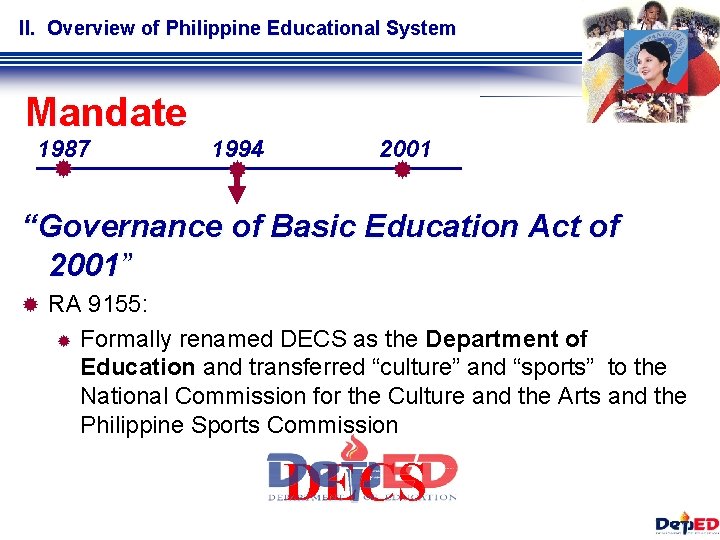
II. Overview of Philippine Educational System Mandate 1987 ® 1994 ® 2001 ® “Governance of Basic Education Act of 2001” ® RA 9155: ® Formally renamed DECS as the Department of Education and transferred “culture” and “sports” to the National Commission for the Culture and the Arts and the Philippine Sports Commission DECS
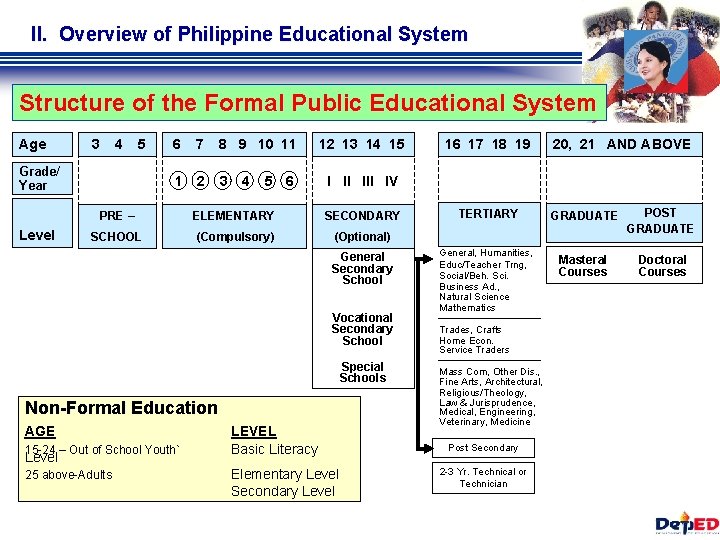
II. Overview of Philippine Educational System Structure of the Formal Public Educational System Age 3 4 5 Grade/ Year Level 6 7 8 9 10 11 1 2 3 4 5 6 12 13 14 15 ELEMENTARY SECONDARY SCHOOL (Compulsory) (Optional) General Secondary School Vocational Secondary School Special Schools Non-Formal Education 15 -24 – Out of School Youth` Level 25 above-Adults 20, 21 AND ABOVE I II IV PRE – AGE 16 17 18 19 LEVEL Basic Literacy Elementary Level Secondary Level TERTIARY General, Humanities, Educ/Teacher Trng, Social/Beh. Sci. Business Ad. , Natural Science Mathematics Trades, Crafts Home Econ. Service Traders Mass Com, Other Dis. , Fine Arts, Architectural, Religious/Theology, Law & Jurisprudence, Medical, Engineering, Veterinary, Medicine Post Secondary 2 -3 Yr. Technical or Technician GRADUATE POST GRADUATE Masteral Courses Doctoral Courses
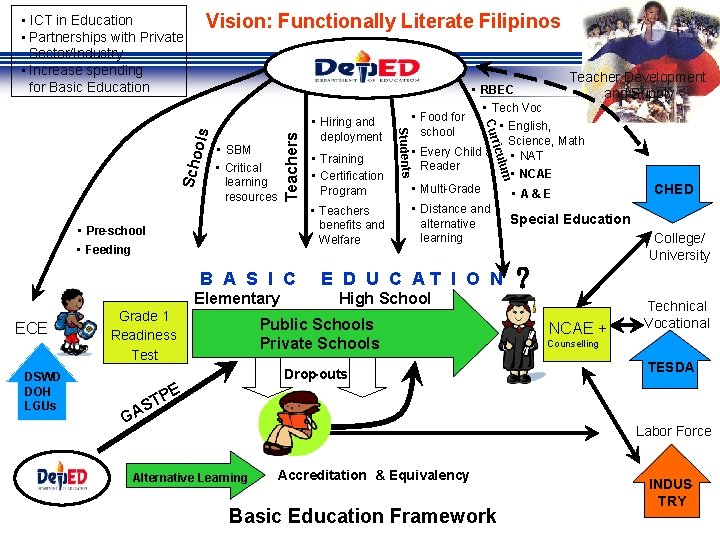
ols Scho B A S I C Elementary DSWD DOH LGUs Grade 1 Readiness Test • English, Science, Math • Every Child a • NAT Reader • NCAE • Multi-Grade • A&E lum • Feeding • Distance and alternative learning E D U C AT I O N High School Public Schools Private Schools Drop-outs ST A G Teacher Development and Supply ricu • Teachers benefits and Welfare • Pre-school ECE • Training • Certification Program • Food for school • RBEC • Tech Voc Cur • SBM • Critical learning resources • Hiring and deployment Students Teachers Vision: Functionally Literate Filipinos • ICT in Education • Partnerships with Private Sector/Industry • Increase spending for Basic Education CHED Special Education College/ University ? NCAE + Technical Vocational Counselling TESDA PE Labor Force Alternative Learning Accreditation & Equivalency Basic Education Framework INDUSTRY
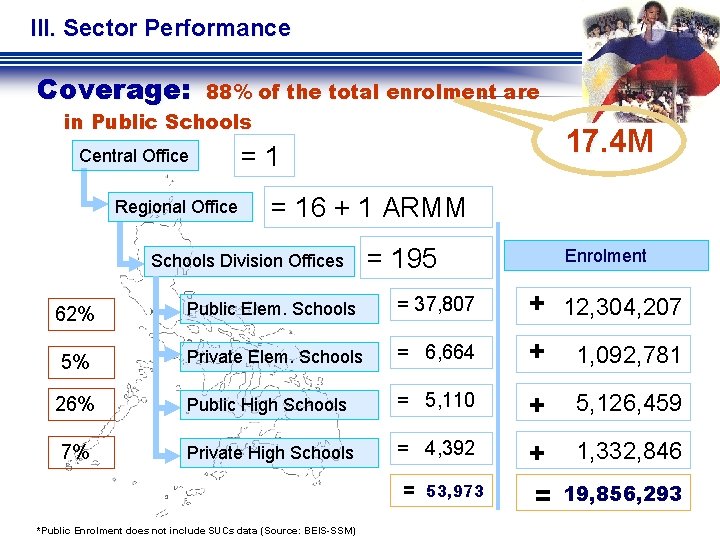
III. Sector Performance Coverage: 88% of the total enrolment are in Public Schools Central Office Regional Office =1 17. 4 M = 16 + 1 ARMM Schools Division Offices = 195 Enrolment 62% Public Elem. Schools = 37, 807 + 12, 304, 207 5% Private Elem. Schools = 6, 664 + 1, 092, 781 26% Public High Schools = 5, 110 + 5, 126, 459 7% Private High Schools = 4, 392 + 1, 332, 846 = 19, 856, 293 = *Public Enrolment does not include SUCs data (Source: BEIS-SSM) 53, 973
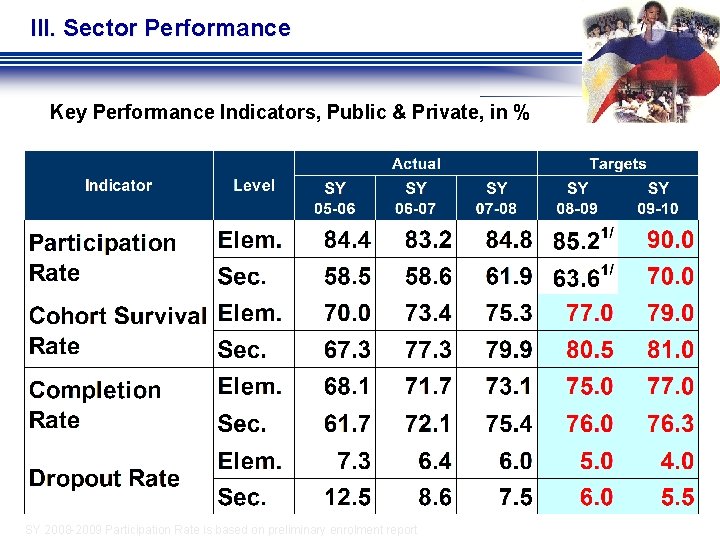
III. Sector Performance Key Performance Indicators, Public & Private, in % SY 2008 -2009 Participation Rate is based on preliminary enrolment report
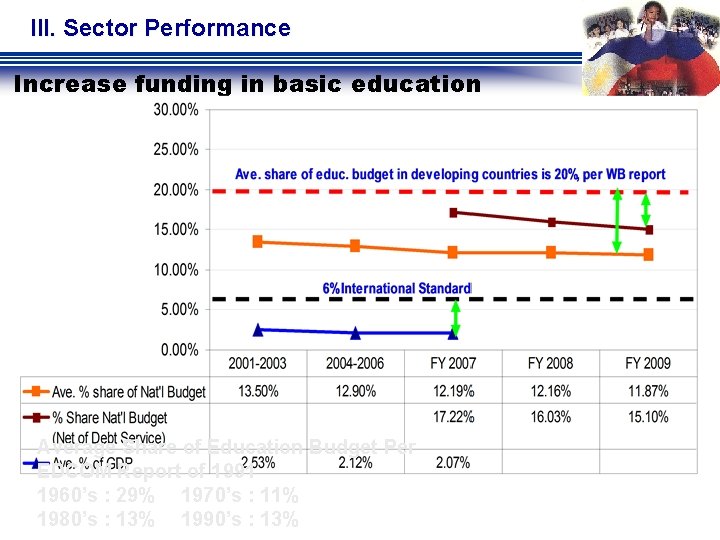
III. Sector Performance Increase funding in basic education N. B. The FY 2009 data refers to NEP level.
III. Sector Performance Increase funding in basic education Average Share of Education Budget Per EDCOM Report of 1991 1960’s : 29% 1970’s : 11% 1980’s : 13% 1990’s : 13%
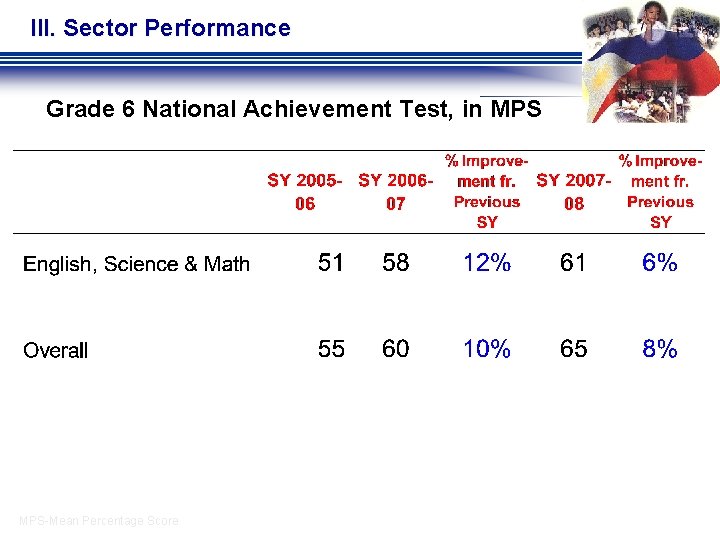
III. Sector Performance Grade 6 National Achievement Test, in MPS-Mean Percentage Score
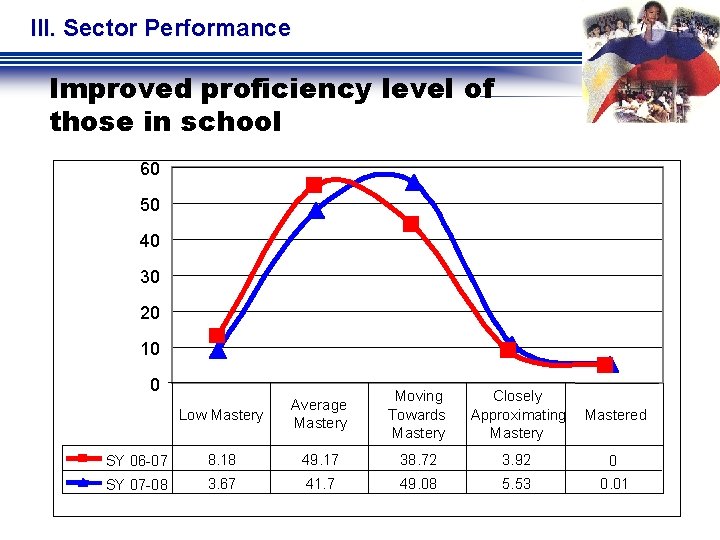
III. Sector Performance Improved proficiency level of those in school 60 50 40 30 20 10 0 Low Mastery Average Mastery Moving Towards Mastery Closely Approximating Mastery Mastered SY 06 -07 8. 18 49. 17 38. 72 3. 92 0 SY 07 -08 3. 67 41. 7 49. 08 5. 53 0. 01
IV. Current Initiatives Global Commitment 1. Philippines is committed to achieve the Millennium Development Goal 2 of achieving universal participation in primary level 2. Philippines is likewise committed to uphold Rights of Children based on the principles of the Convention on the Rights of the Child (CRC)
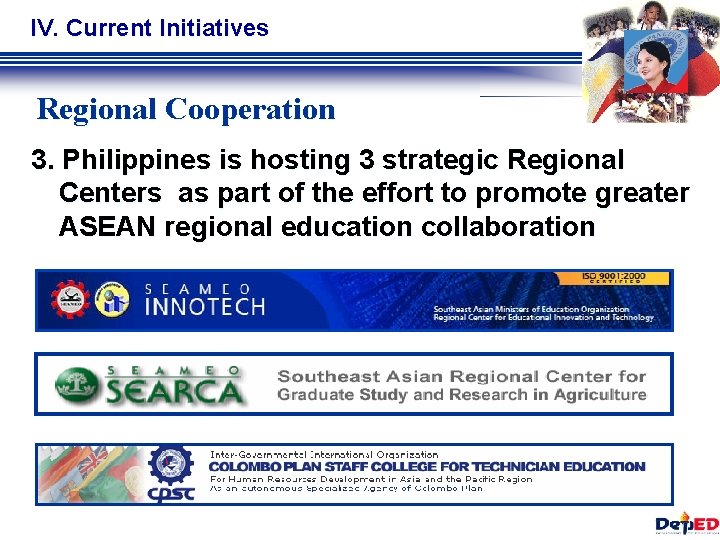
IV. Current Initiatives Regional Cooperation 3. Philippines is hosting 3 strategic Regional Centers as part of the effort to promote greater ASEAN regional education collaboration
IV. Current Initiatives 4. Philippines is supporting the proposed establishment of 3 new SEAMEO Regional Centers in Indonesia: a. SEAMEO Regional Center for Language (SEAMEO RECFOL) b. SEAMEO Regional Center for Mathematics (SEAMEO RECFOM) c. SEAMEO Regional Center for Science (SEAMEO RECFOS) 5. Philippines is actively participating in the Exchange Students Program being coordinated by various regional organization
IV. Current Initiatives Broadening Opportunities for Regional Cooperation 6. Philippines has been sending Filipino Teachers and Educators to participate in the various training programs being offered by other SEAMEO Regional Centers, ASEAN and APEC Ed. NET. 7. Top Filipino education professionals currently working with SEAMEO and other regional organizations particularly in crafting/designing regional programs and projects. 8. Filipino Teachers are being recruited to teach English language in several countries of Asia
IV. Current Initiatives Country Strategy 9. Dep. ED as the principal agency for basic education has instituted reforms under the Basic Education Sector Reform Agenda (BESRA) since the adoption of the Philippine Education for All 2015 (EFA 2015) Plan of Action. 10. The Philippines Basic Education Curriculum offers Asian Civilization, Culture and Tradition subject in Social Studies in both Elementary and Secondary.
IV. Current Initiatives Country Strategy 11. In 2004, Dep. ED started to offer Arabic Language and Islamic Values Education (ALIVE) subject for Muslim Students in the Public Schools 12. Under the Philippine Education For All 2015 Plan of Action, the country would soon adopt 12 years of basic education to make its educational system comparable with other ASEAN countries and to the rest of the world
V. Emerging Challenges and Future Prospects Emerging Challenges q Need to substantially increase participation of all school-aged children q Development of a common educational framework for ASEAN Region q Need to substantially address
V. Emerging Challenges and Future Prospects Emerging Challenges q Need to accelerate the effort of laying down the ground towards ASEAN Education Integration in terms of curriculum standards, quality assurance and assessment, monitoring and evaluation q Need to accelerate initiatives on the use of ICT in promoting Regional Education Cooperation