
Outline Neural networks reviewed Backpropagation program Texture modeling
Outline • Neural networks - reviewed – Back-propagation program • Texture modeling – Introduction 12/4/2020 Visual Perception Modeling 1
Back Propagation Program • Programs – Backprop. c – main program – Propagation. c – contains procedures for BP – Para-util. h and type-def. h – contain data structure definitions – Located at ~liux/public_html/courses/research/programs/neural-networks • Parameter files – Control parameter file – network-3 -3 -1. par – Training data file – network-3 -3 -1 -training. par 12/4/2020 Visual Perception Modeling 2
Back Propagation Program – cont. • Homework #5 – Gain some first-hand experience with neural networks – Study how the parameters affect the performance of neural networks 12/4/2020 Visual Perception Modeling 3
Texture Modeling • Texture is a phenomenon – Is widespread – Easy to recognize – Hard to define as many other perceptual phenomena • Texture arises from different resources – Views of large numbers of small objects • Grass, brush, pebbles, hair, . . . – Surfaces with orderly patterns • Cheetah skins, zebra stripes, . . . 12/4/2020 Visual Perception Modeling 4
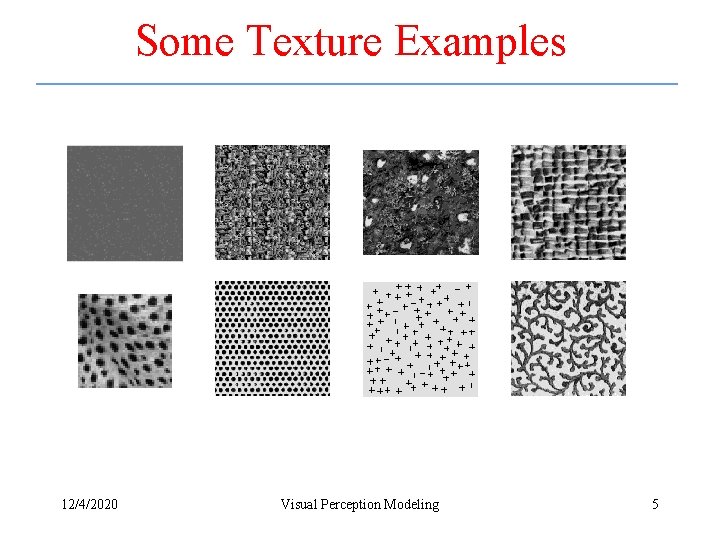
Some Texture Examples 12/4/2020 Visual Perception Modeling 5
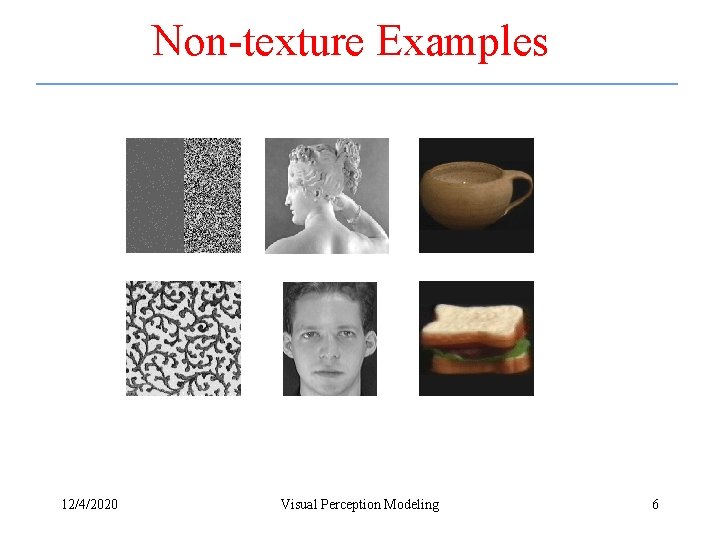
Non-texture Examples 12/4/2020 Visual Perception Modeling 6
Texture Definition • Image texture is defined as a function the spatial variation in pixel intensities – Local statistics or local properties are constant, slowly varying, or approximately periodic 12/4/2020 Visual Perception Modeling 7
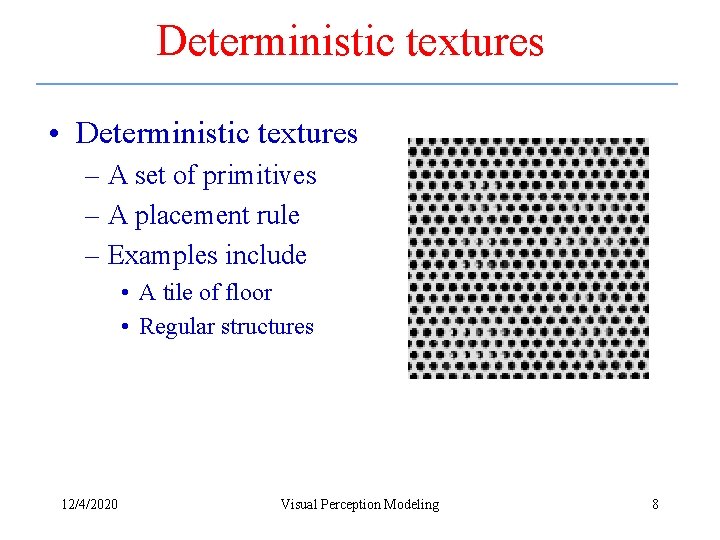
Deterministic textures • Deterministic textures – A set of primitives – A placement rule – Examples include • A tile of floor • Regular structures 12/4/2020 Visual Perception Modeling 8
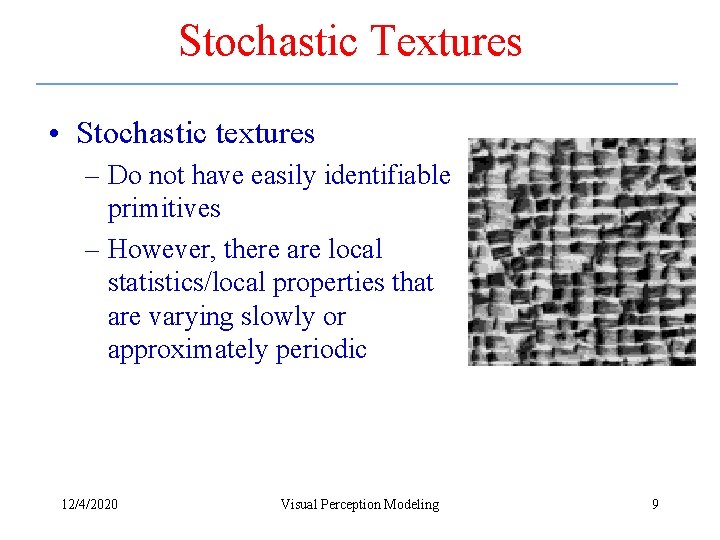
Stochastic Textures • Stochastic textures – Do not have easily identifiable primitives – However, there are local statistics/local properties that are varying slowly or approximately periodic 12/4/2020 Visual Perception Modeling 9
Texture Modeling • Texture modeling is to find feature statistics that characterize perceptual appearance of textures • There are two major computational issues – What kinds of feature statistics shall we use? – How to verify the sufficiency or goodness of chosen feature statistics? 12/4/2020 Visual Perception Modeling 10
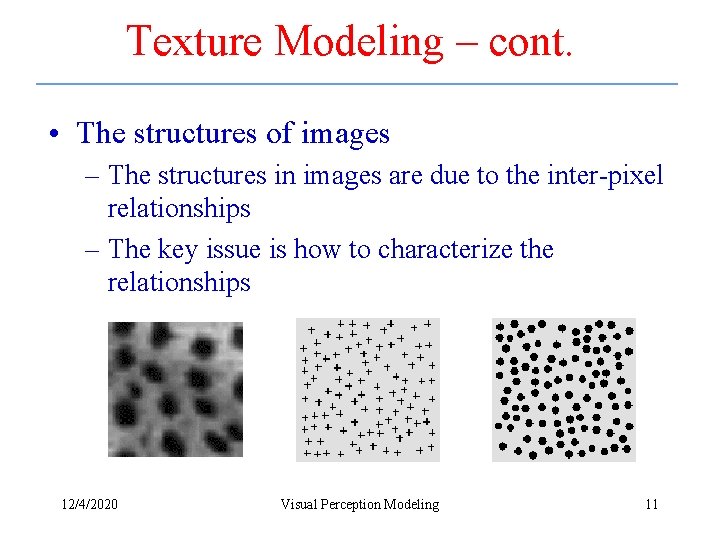
Texture Modeling – cont. • The structures of images – The structures in images are due to the inter-pixel relationships – The key issue is how to characterize the relationships 12/4/2020 Visual Perception Modeling 11
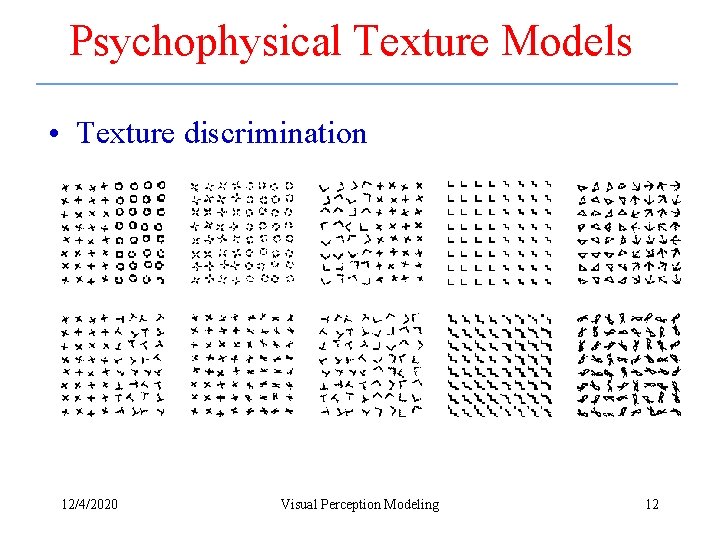
Psychophysical Texture Models • Texture discrimination 12/4/2020 Visual Perception Modeling 12
Psychophysical Texture Models – cont. • Julesz conjecture – Two textures that have identical second-order statistics are not pre-attentively discriminable • Second-order statistics – First-order statistics are the histogram of the texture images – Second-order statistics are defined as the likelihood of observing a pair of gray values occurring at the endpoints of a dipole 12/4/2020 Visual Perception Modeling 13
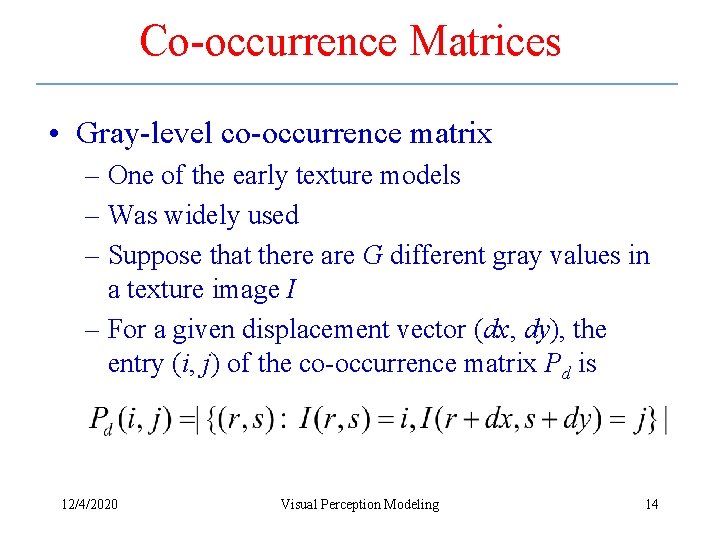
Co-occurrence Matrices • Gray-level co-occurrence matrix – One of the early texture models – Was widely used – Suppose that there are G different gray values in a texture image I – For a given displacement vector (dx, dy), the entry (i, j) of the co-occurrence matrix Pd is 12/4/2020 Visual Perception Modeling 14
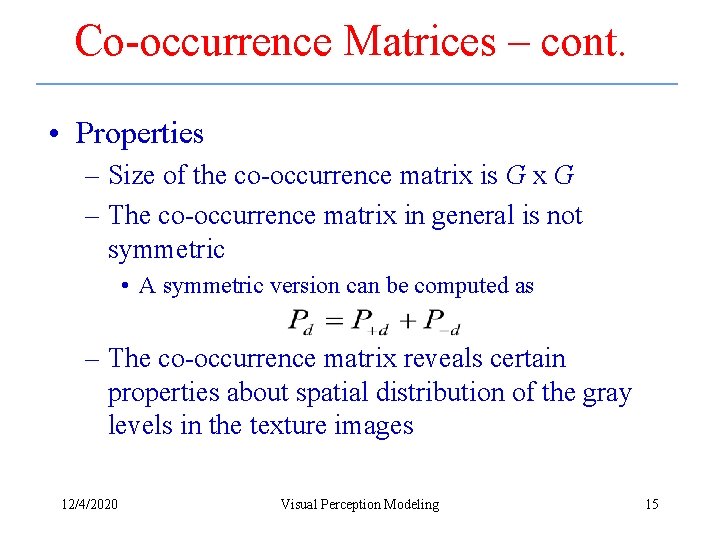
Co-occurrence Matrices – cont. • Properties – Size of the co-occurrence matrix is G x G – The co-occurrence matrix in general is not symmetric • A symmetric version can be computed as – The co-occurrence matrix reveals certain properties about spatial distribution of the gray levels in the texture images 12/4/2020 Visual Perception Modeling 15
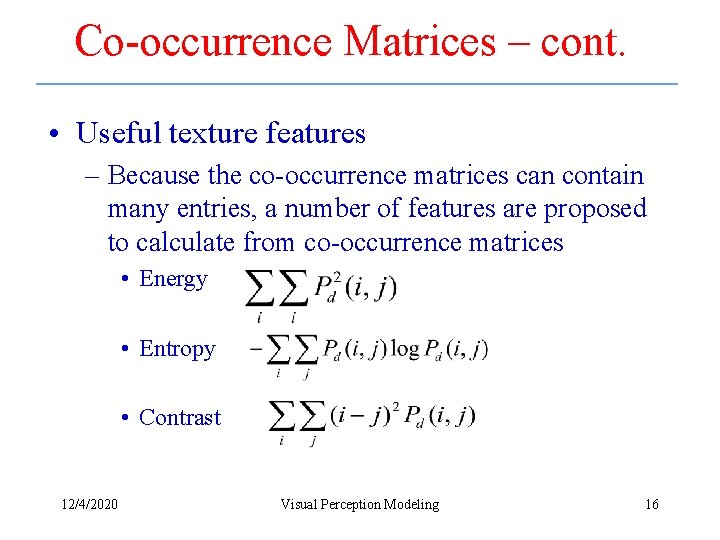
Co-occurrence Matrices – cont. • Useful texture features – Because the co-occurrence matrices can contain many entries, a number of features are proposed to calculate from co-occurrence matrices • Energy • Entropy • Contrast 12/4/2020 Visual Perception Modeling 16
Co-occurrence Matrices – cont. • Generalization of co-occurrence – k-gon statistics – In general, we can define an arbitrary polygon with k vertices and collect statistics on those vertices • A line segment defines the co-occurrence • A triangle defines 3 -gon statistics – It captures the dependence among pixels 12/4/2020 Visual Perception Modeling 17
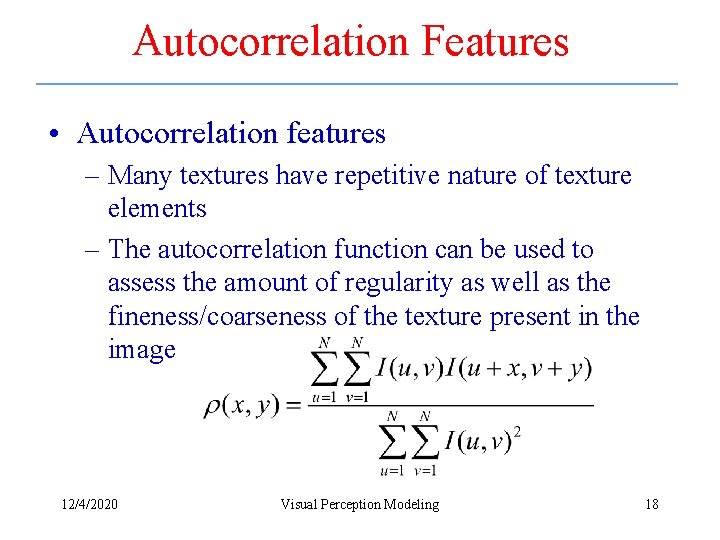
Autocorrelation Features • Autocorrelation features – Many textures have repetitive nature of texture elements – The autocorrelation function can be used to assess the amount of regularity as well as the fineness/coarseness of the texture present in the image 12/4/2020 Visual Perception Modeling 18
Geometrical Models • Geometrical models – Applies to textures with texture elements – Then one can compute the statistics of local elements or extract the placement rule that describes the texture – Voronoi tessellation features – Structural methods 12/4/2020 Visual Perception Modeling 19
- Slides: 19