
Outline Musculoskeletal injuries Risks Classification Treatment Heat Illnesses
- Slides: 43
Outline • Musculoskeletal injuries – Risks – Classification – Treatment • Heat Illnesses • Evaluation of test quality • Field tests – Anaerobic – Aerobic 1
Musculoskeletal Injuries • Risk increases for all levels of participation with increasing – Activity, intensity and duration • Incidence and severity can be reduced by understanding – Risks, preventative measures and care • Risks • 35 -60% of runners report injuries that reduce running or require medical attention – Patellar femoral articulation and foot • High impact aerobic dance 45 % of students 75% of instructors – Lower leg injuries with high frequency (> 3 times per 2
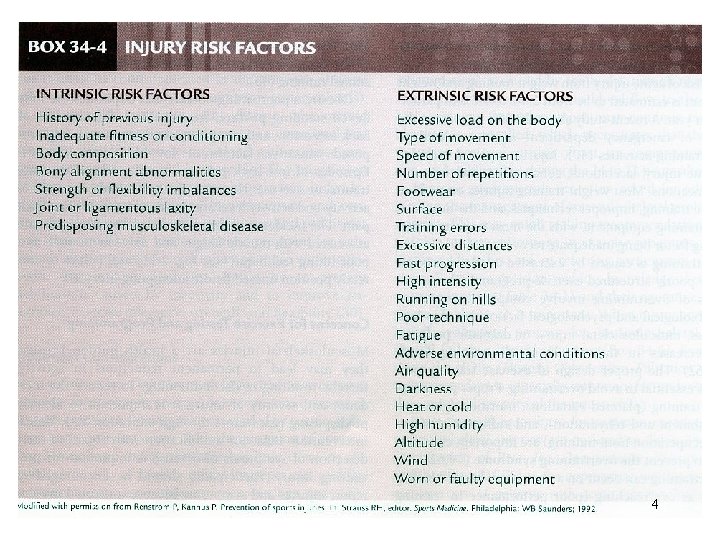
Injuries • intrinsic and extrinsic factors interact • Box 34. 4 ACSM – Poor biomechanics, past physical activity, poor baseline fitness, present level of training and weight load affect incidence of injury 3
4
Injuries • Repetitive bouts of micro trauma leading to overt tissue injury cause overuse injuries • Running – injury increases exponentially with frequency and total volume of training • Beginning jogger - one day rest – Progress to low impact activity on off days – Training errors are causal in 60 -80 % of running injuries • Eg. high progression rates and hill running 5
Warm up / Flexibility • Low flexibility is a risk factor – Muscle strain and musculoskeletal injury • Research study - most and least flexible had higher risk • Improper warm up - inc risk for injury – Warmth - inc elasticity of connective tissue, speeds metabolism, inc magnitude and speed of contraction • Muscle stretches more and can resist injury at greater force • Studies are inconclusive on warm up and injury may be more important for performance 6
Orthopedic Factors • Past injury and low physical activity are associated with risk • Excessive weight - acute and overuse injuries hip and knee – Vigorous activity may predispose to osteoarthritis due to mechanical trauma – Inc risk with competitive but not recreational running • Low back pain risk factors – Obesity, poor sitting posture, frequent flexion, loss of back extension and low activity – Poor lifting posture and fatigue – Usually related to acute trauma or overuse 7
Recommendations • Alter predisposing risk factors through education and clinical intervention • Early detection of symptoms and overuse - full rehabilitation • Do not recommend strenuous exercise for those with: – Acute joint injury – Chronic joint inflammation (osteoarthritis) – Uncontrolled systemic joint disease (rheumatoid arthritis) • For those with joint disease; – Progression needs to be individualized – Prevent debilitation due to inactivity – Improve endurance, strength and flexibility and exercise tolerance 8
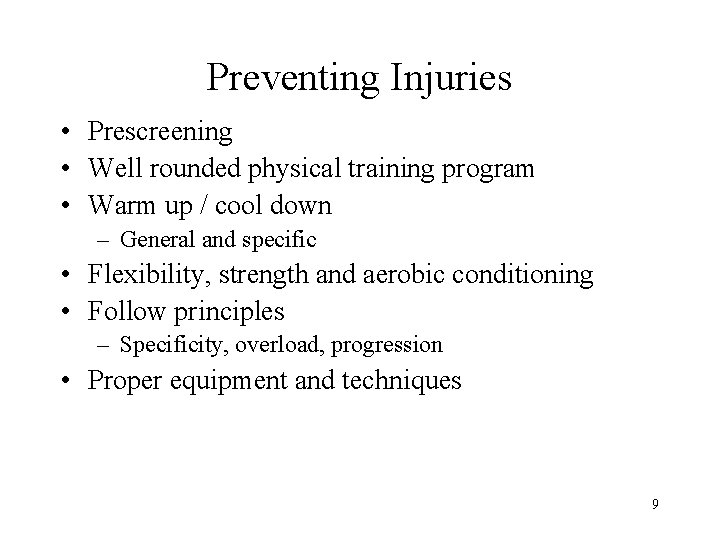
Preventing Injuries • Prescreening • Well rounded physical training program • Warm up / cool down – General and specific • Flexibility, strength and aerobic conditioning • Follow principles – Specificity, overload, progression • Proper equipment and techniques 9
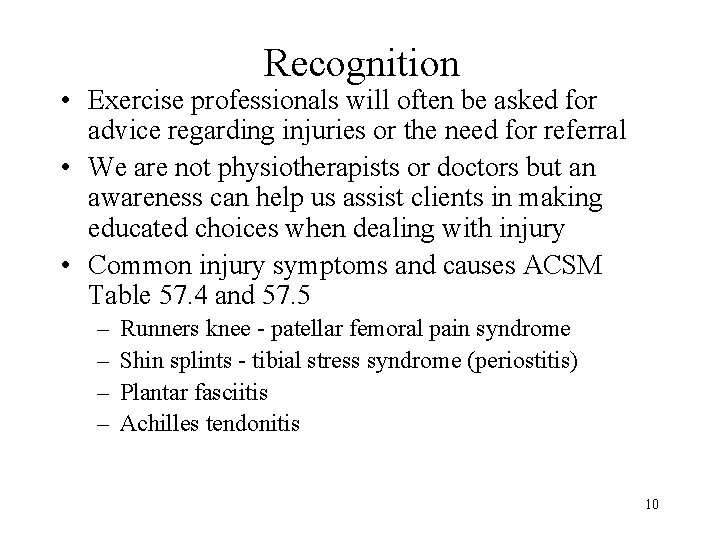
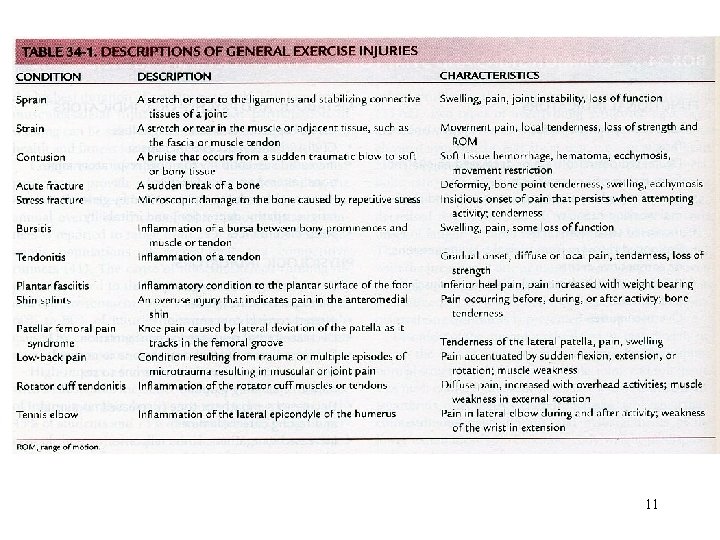
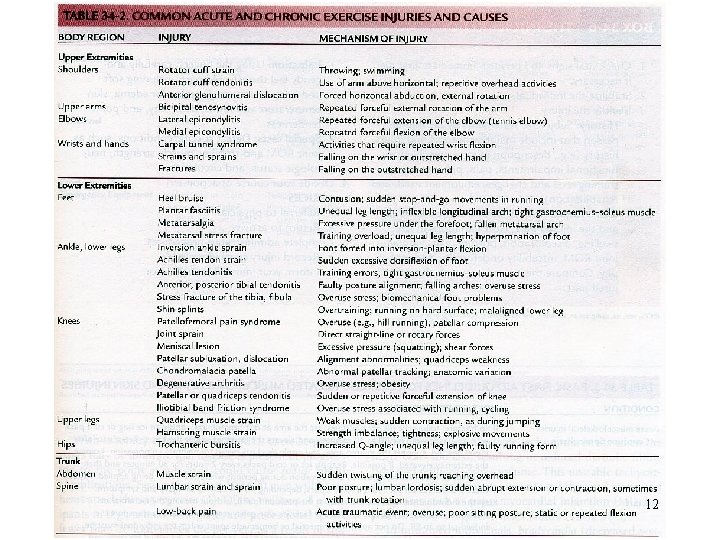
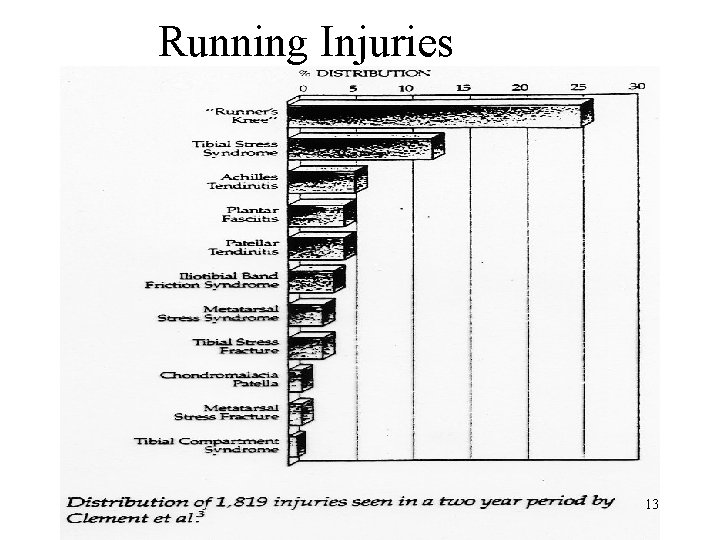
Recognition • Exercise professionals will often be asked for advice regarding injuries or the need for referral • We are not physiotherapists or doctors but an awareness can help us assist clients in making educated choices when dealing with injury • Common injury symptoms and causes ACSM Table 57. 4 and 57. 5 – – Runners knee - patellar femoral pain syndrome Shin splints - tibial stress syndrome (periostitis) Plantar fasciitis Achilles tendonitis 10
11
12
Running Injuries 13
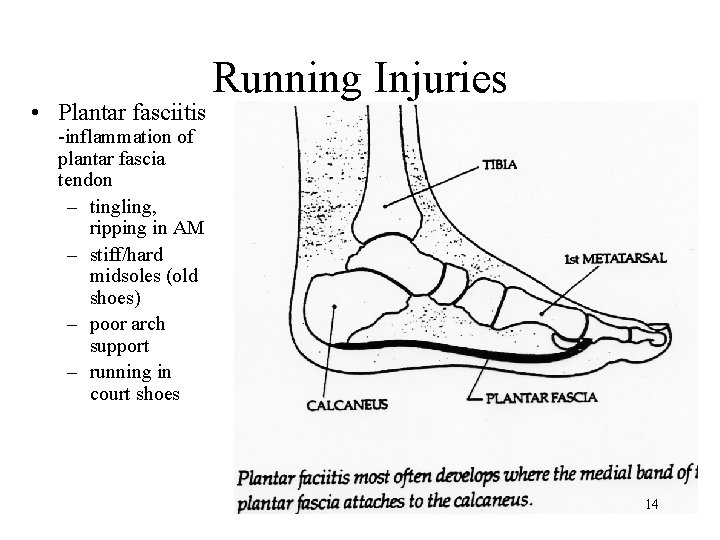
• Plantar fasciitis Running Injuries -inflammation of plantar fascia tendon – tingling, ripping in AM – stiff/hard midsoles (old shoes) – poor arch support – running in court shoes 14
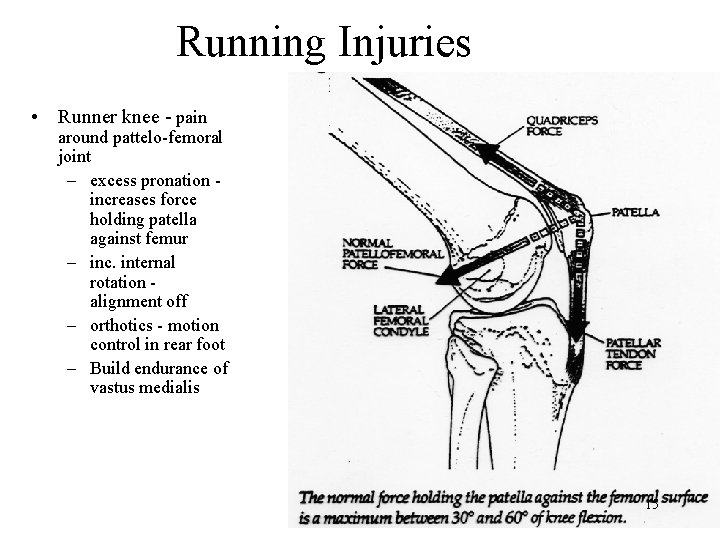
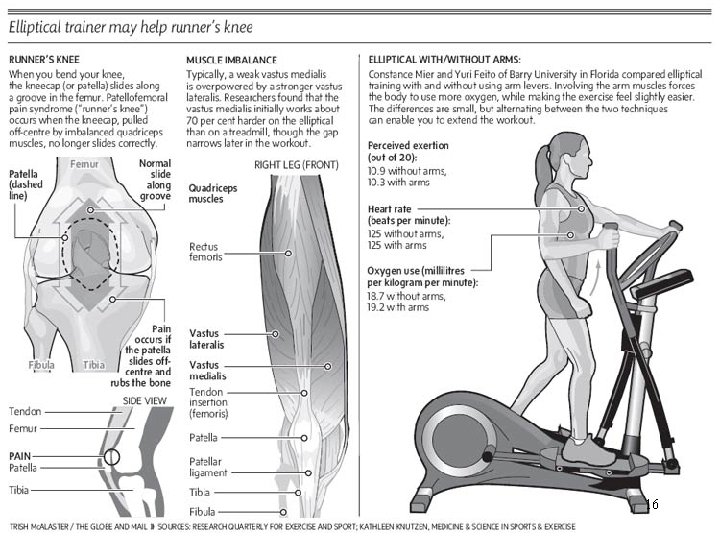
Running Injuries • Runner knee - pain around pattelo-femoral joint – excess pronation increases force holding patella against femur – inc. internal rotation alignment off – orthotics - motion control in rear foot – Build endurance of vastus medialis 15
16
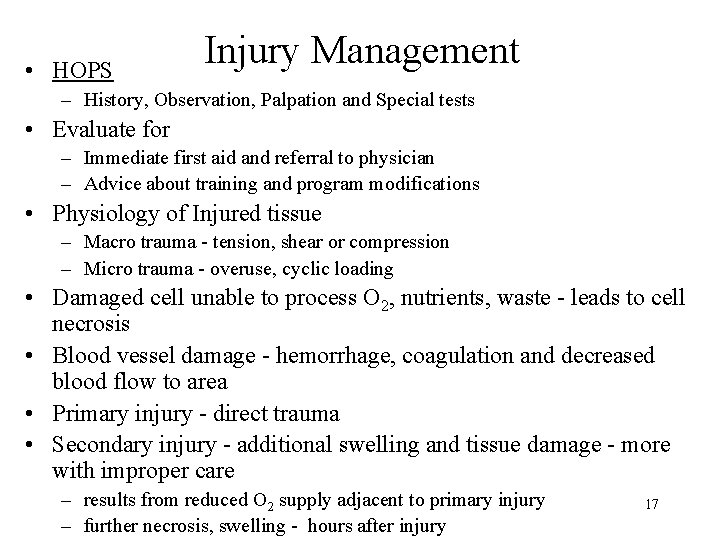
• HOPS Injury Management – History, Observation, Palpation and Special tests • Evaluate for – Immediate first aid and referral to physician – Advice about training and program modifications • Physiology of Injured tissue – Macro trauma - tension, shear or compression – Micro trauma - overuse, cyclic loading • Damaged cell unable to process O 2, nutrients, waste - leads to cell necrosis • Blood vessel damage - hemorrhage, coagulation and decreased blood flow to area • Primary injury - direct trauma • Secondary injury - additional swelling and tissue damage - more with improper care – results from reduced O 2 supply adjacent to primary injury – further necrosis, swelling - hours after injury 17
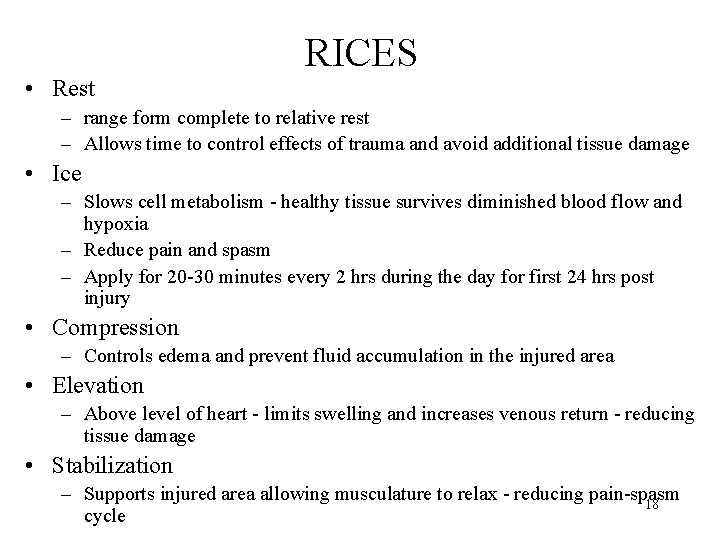
• Rest RICES – range form complete to relative rest – Allows time to control effects of trauma and avoid additional tissue damage • Ice – Slows cell metabolism - healthy tissue survives diminished blood flow and hypoxia – Reduce pain and spasm – Apply for 20 -30 minutes every 2 hrs during the day for first 24 hrs post injury • Compression – Controls edema and prevent fluid accumulation in the injured area • Elevation – Above level of heart - limits swelling and increases venous return - reducing tissue damage • Stabilization – Supports injured area allowing musculature to relax - reducing pain-spasm 18 cycle
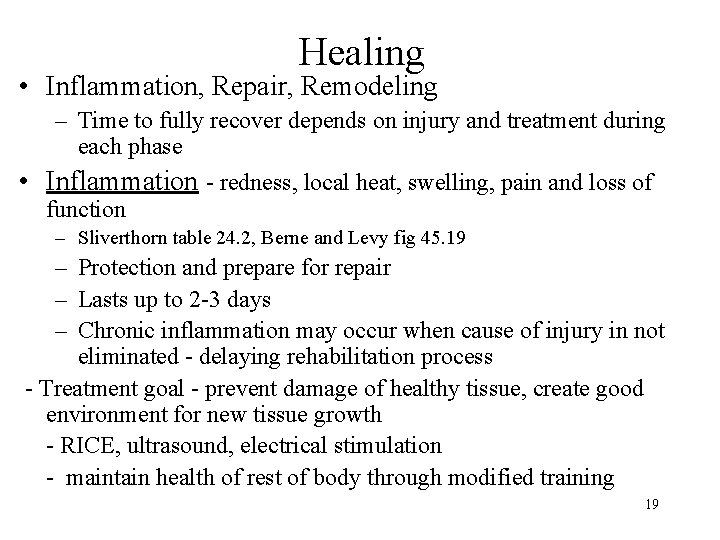
Healing • Inflammation, Repair, Remodeling – Time to fully recover depends on injury and treatment during each phase • Inflammation - redness, local heat, swelling, pain and loss of function – Sliverthorn table 24. 2, Berne and Levy fig 45. 19 – Protection and prepare for repair – Lasts up to 2 -3 days – Chronic inflammation may occur when cause of injury in not eliminated - delaying rehabilitation process - Treatment goal - prevent damage of healthy tissue, create good environment for new tissue growth - RICE, ultrasound, electrical stimulation - maintain health of rest of body through modified training 19
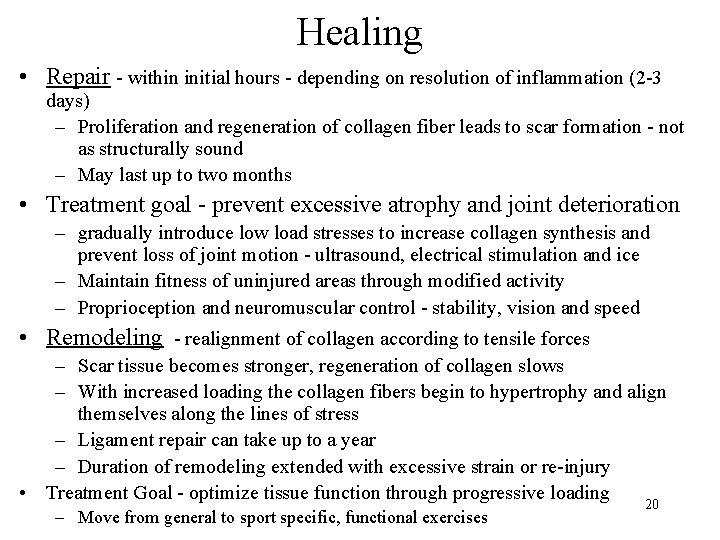
Healing • Repair - within initial hours - depending on resolution of inflammation (2 -3 days) – Proliferation and regeneration of collagen fiber leads to scar formation - not as structurally sound – May last up to two months • Treatment goal - prevent excessive atrophy and joint deterioration – gradually introduce low load stresses to increase collagen synthesis and prevent loss of joint motion - ultrasound, electrical stimulation and ice – Maintain fitness of uninjured areas through modified activity – Proprioception and neuromuscular control - stability, vision and speed • Remodeling - realignment of collagen according to tensile forces – Scar tissue becomes stronger, regeneration of collagen slows – With increased loading the collagen fibers begin to hypertrophy and align themselves along the lines of stress – Ligament repair can take up to a year – Duration of remodeling extended with excessive strain or re-injury • Treatment Goal - optimize tissue function through progressive loading 20 – Move from general to sport specific, functional exercises
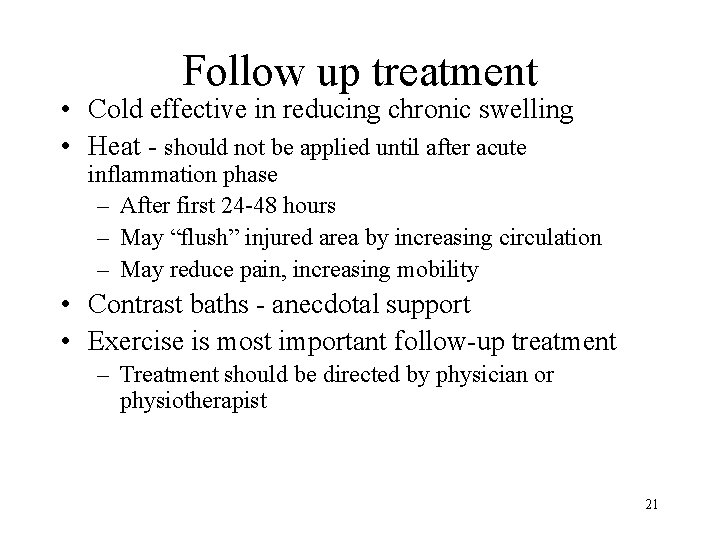
Follow up treatment • Cold effective in reducing chronic swelling • Heat - should not be applied until after acute inflammation phase – After first 24 -48 hours – May “flush” injured area by increasing circulation – May reduce pain, increasing mobility • Contrast baths - anecdotal support • Exercise is most important follow-up treatment – Treatment should be directed by physician or physiotherapist 21
22
23
24
Evaluation of Test Quality • A test should measure what it is supposed to measure (validity) • with consistency and repeatability (reliability) • Other criteria to consider – Objective (numerical measurement - time, distance, angle, force) – are norms available • Achievement level to which scores can be compared interpretation and evaluation – Economy - safety, practicality, time, cost, simplicity – Appropriateness - target group for norms and test design, relevance of outcome to goals 25
Referenced Tests • Norm-referenced test: – the test score is compared to a norm so the person can be compared against others in the same age and gender category • Criterion-referenced test: – the test score is compared to a standard. This target could be set appropriately for the age and gender • Eg police and fire fighter standard tests – validating a criterion (pass/fail) is a difficult task, while using a normative database and just reporting a percentile ranking is easier. – most criterions are based on normative data originally, could also be based on assessment of requirements for successful performance 26
Validity • How well does a test measure what it is intended to measure - most important aspect of test design • There are several types of validity • Construct Validity – degree to which a test measures an underlying attribute based on existing knowledge – Old CSTF sit-up test - legs held, hands behind neck, rate of 60 / min • Inappropriately tests stabilizer muscles at high contraction rate, allows contribution of psoas muscle group. • Content validity – Is the test battery measuring all the component abilities for performance – List ability components for sport, and ensure they are all represented • Eg soccer - speed, agility, coordination, kicking power… 27
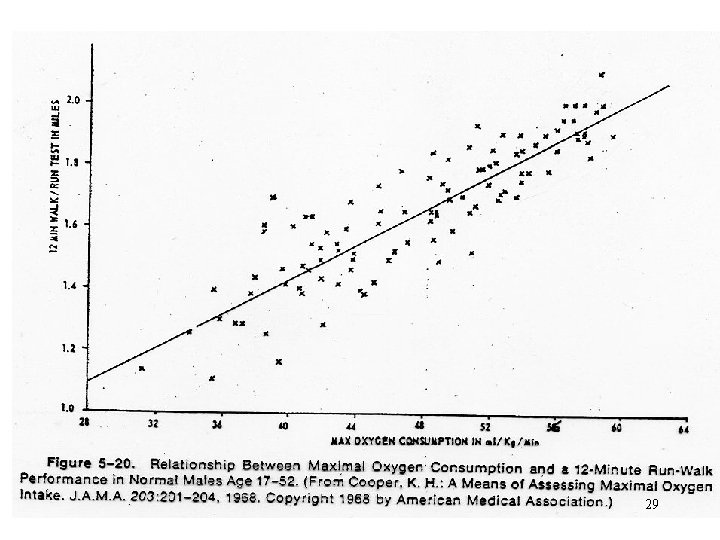
Validity (cont. ) • Criterion-Referenced Validity - includes concurrent and predictive – Concurrent Validity – Used when a test is proposed as a substitute for another test that is known to be valid – Degree of correlation with a criterion test should be reported • over. 8 validity coefficient is acceptable. • eg. Coopers and VO 2 Max (. 897) (see next slide) • SEE - standard error of estimation - should also be small – However, Cooper used adults who were well trained and motivated • ? Applicability to other groups ? – Predictive validity - amount by which test score corresponds to future behaviour or performance • Does prior fitness actually reduce injury in demanding jobs? • Do fitness scores relate to sport performance measures? (goals, rebounds, assists) 28
29
Reliability • Consistency or repeatability of a test - a test must be reliable to be valid – test can be reliable but invalid • Eg. 60 sec sit up test • Also defined as the ability of the test to detect reliable differences between subjects • Pass/Fail tells us very little if everyone gets the same result • Applicable when comparing to norms • Ensure test is being administered as it was designed – Single test, test retest, individual test score • Factors influencing reliability – Type of test, Ability, Length – Consistency of client preparation 30
Reliability (cont. ) • Inter-rater reliability - degree to which different testers agree – Standardization of training and certification important • Other sources of error – Calibration of equipment – Preparation of subjects – Personality of tester (motivation) 31
Field-Tests Laboratory Aerobic and Anaerobic Tests • Advantages and Disadvantages – allow examiners to test numerous participants at once without the need for sophisticated and expensive equipment. • Validity of Field-Tests – Field-tests are not as accurate as the criterion-test they are designed to emulate – Field-tests are usually used as motivational tools rather than in scientific studies, so the lower level of accuracy is often quite acceptable – Care must be taken however to use the field test on the population group it was designed for (may have concurrent validity for a certain age population but not for another) 32
• Reliability Field Test – If the field-test does not have a skill component they will usually be very reliable • e. g. Cooper test requires pacing skill – Simple tests of maximal strength, like the grip strength, have very high reliability • Objectivity – Field-tests usually have excellent objectivity (e. g. timed runs, laps completed in set amount of time) • Normative Databases – Field-tests often have large databases, in part because so many people can be tested easily – Care should be taken to use the appropriate database for the clients whom you have tested 33
Safety of Field Tests • Most aerobic tests are sub maximal and less likely to put excessive strain on subject • 20 m aerobic shuttle is maximal • Screening during test often difficult – ECG, BP • Rely on prescreening tests • Anaerobic tests require maximal effort - select clients carefully – High risk of muscle strain in sprint tests if not fully warmed-up or inexperienced with sprinting 34
Field Tests • Virtually all field-tests are very inexpensive to run – test numerous subjects at the same time, reducing personnel costs – minimal equipment is required • There are numerous field-tests available so finding an appropriate test for your client(s) should not be a problem. 35
Lab Organization • Warm Up (done in the 10 min prior to test participation) – 2 laps of 400 m track – stretching – 2 X 50 m sprints at 50 -75 % max • Purpose – to have you complete, administer and/or observe some common filed tests • Decide after outline – one aerobic – one anaerobic if you are used to sprinting 36
Anaerobic • Lactic acid and Alactic Systems – Usually reserved for specific sports groups – does not contribute to cardiovascular/respiratory fitness – can be associated with muscle strain • 600 m and 100 m shuttle tests – norms are for elite athletes – useful on test/retest basis only – require good warm up/stretching • T-Test – Test of agility (approximately 10 -15 seconds) – Two trials 37
• 600 m Run – – Anaerobic cont. Lactic acid System 2 trials (one in 343) 4 runners max. use inside lane warm up essential • 100 m shuttle – alactic/lactic acid systems – sprint 5 times between 20 m lines – practice trial at 75 % • 50 yard sprint – alactic system – practice trial at 75 % 38
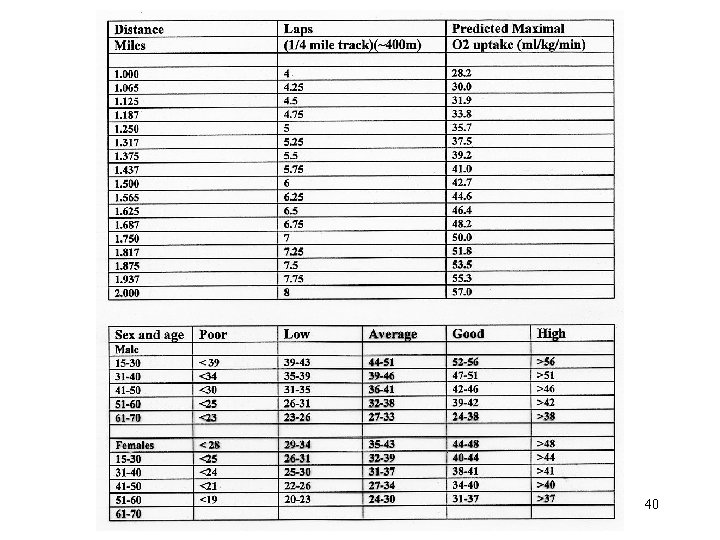
Aerobic System • Coopers Test – Target subjects - large groups, assumed to be healthy, experience running as pacing is important • Normative data for Swim and Bike Coopers tests are also available – – – warm up important 12 minutes around 400 m track pacing is important (experience) up to 30 runners, keep to inside lane use table p. 12 for miles and VO 2 max estimates administrator calls out times and records completed laps - to nearest quarter or tenth – good correlation to VO 2 max test results 39
40
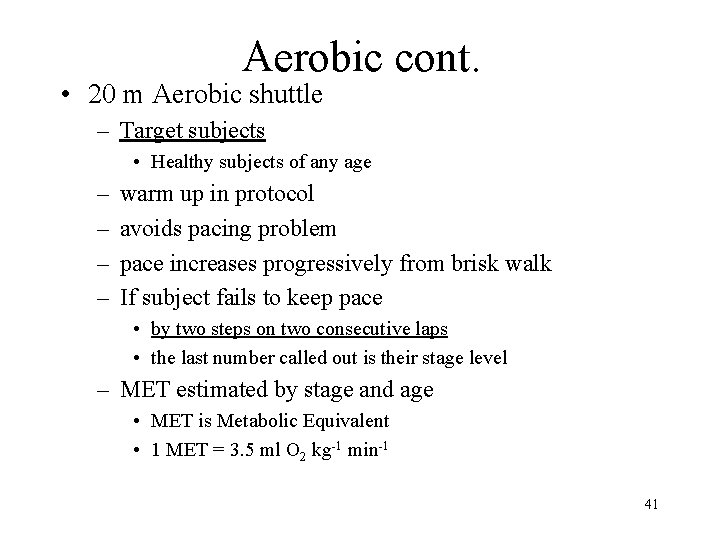
Aerobic cont. • 20 m Aerobic shuttle – Target subjects • Healthy subjects of any age – – warm up in protocol avoids pacing problem pace increases progressively from brisk walk If subject fails to keep pace • by two steps on two consecutive laps • the last number called out is their stage level – MET estimated by stage and age • MET is Metabolic Equivalent • 1 MET = 3. 5 ml O 2 kg-1 min-1 41
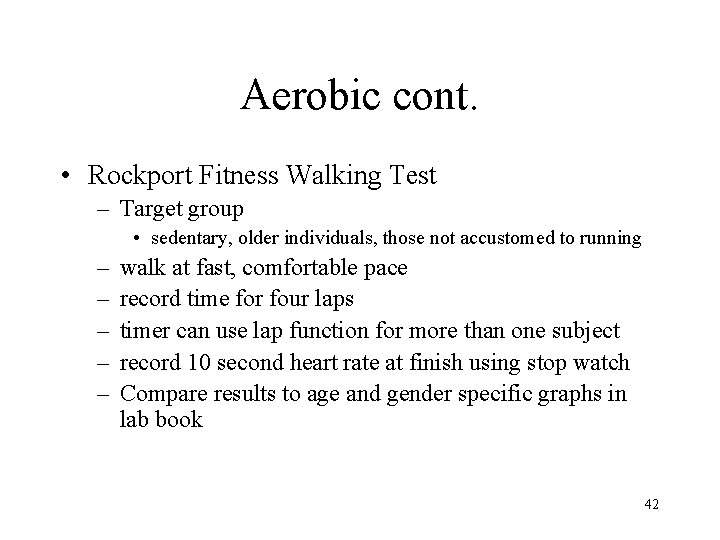
Aerobic cont. • Rockport Fitness Walking Test – Target group • sedentary, older individuals, those not accustomed to running – – – walk at fast, comfortable pace record time for four laps timer can use lap function for more than one subject record 10 second heart rate at finish using stop watch Compare results to age and gender specific graphs in lab book 42
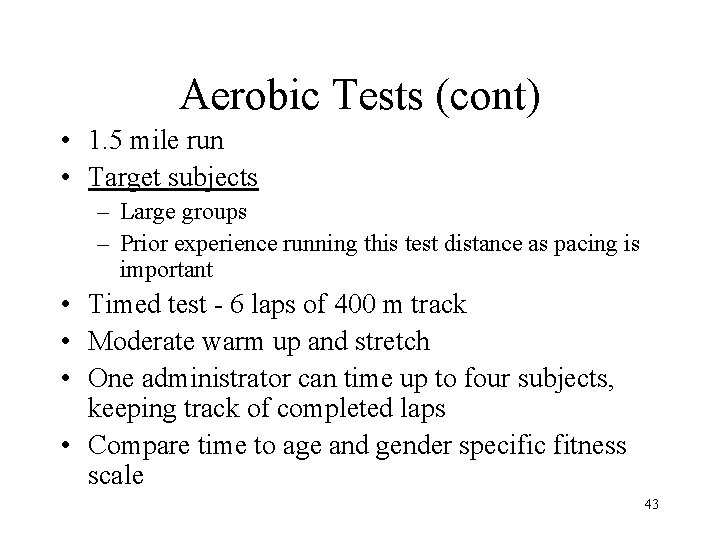
Aerobic Tests (cont) • 1. 5 mile run • Target subjects – Large groups – Prior experience running this test distance as pacing is important • Timed test - 6 laps of 400 m track • Moderate warm up and stretch • One administrator can time up to four subjects, keeping track of completed laps • Compare time to age and gender specific fitness scale 43