
outline Model equations and Integrals The Hill type

- Slides: 28
outline • • Model equations and Integrals The Hill type stability of two-planet systems The Hill type stability of many-planet systems Constructing systems of many and heavy planets collaborators : Tsiganis Kleomenis Antoniadou Kiki Mourtetzikoglou A. Skoulidou Despina
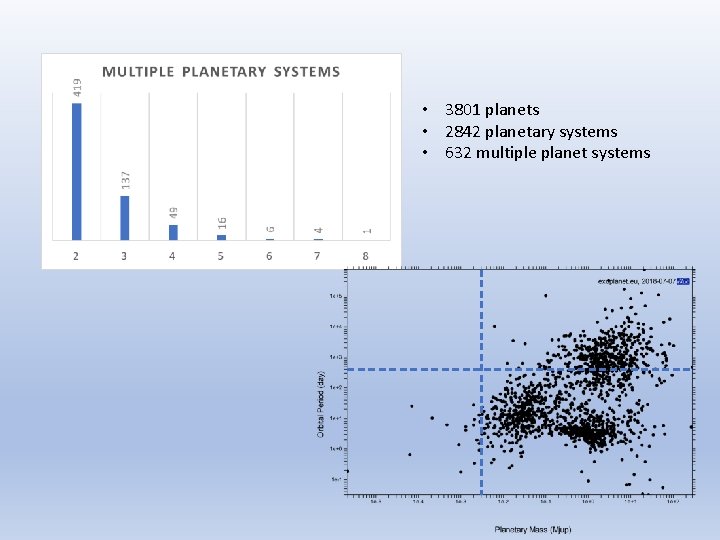
• 3801 planets • 2842 planetary systems • 632 multiple planet systems
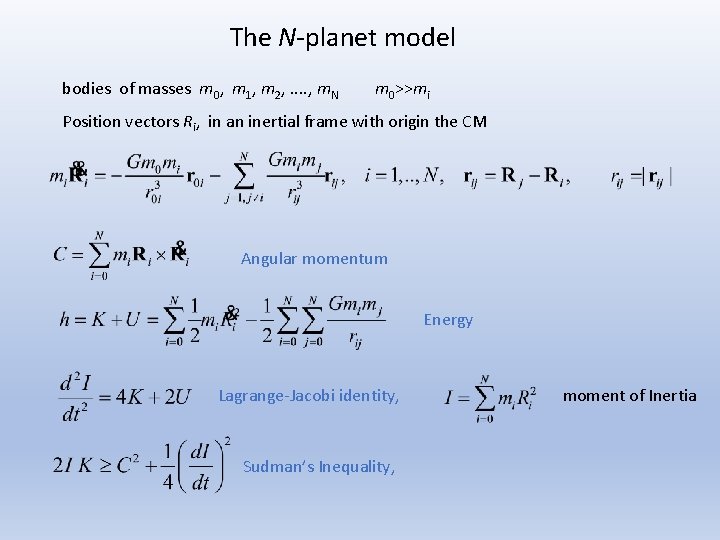
The N-planet model bodies of masses m 0, m 1, m 2, . . , m. N m 0>>mi Position vectors Ri, in an inertial frame with origin the CM Angular momentum Energy Lagrange-Jacobi identity, Sudman’s Inequality, moment of Inertia
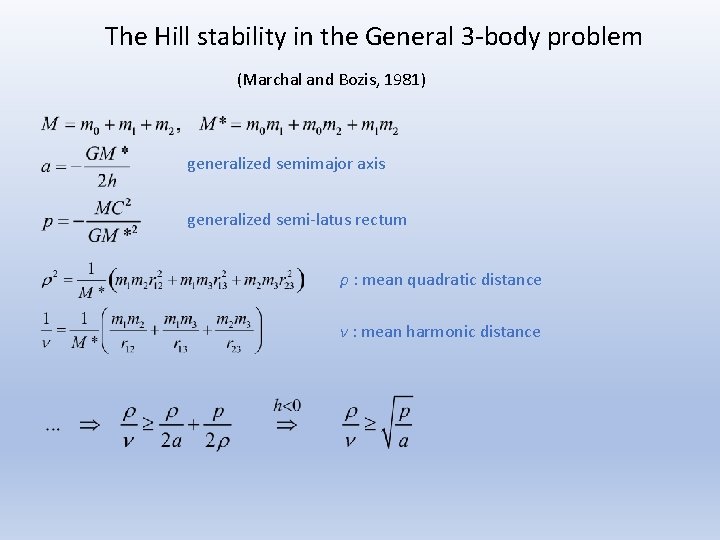
The Hill stability in the General 3 -body problem (Marchal and Bozis, 1981) generalized semimajor axis generalized semi-latus rectum ρ : mean quadratic distance ν : mean harmonic distance
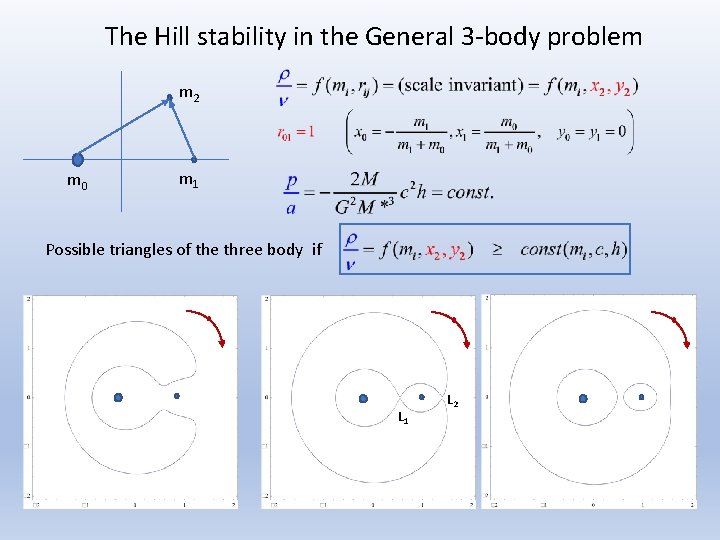
The Hill stability in the General 3 -body problem m 2 m 0 m 1 Possible triangles of the three body if L 1 L 2
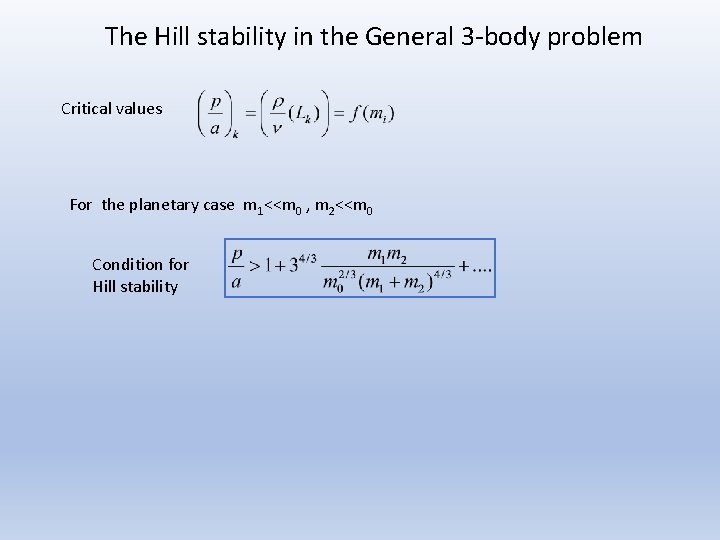
The Hill stability in the General 3 -body problem Critical values For the planetary case m 1<<m 0 , m 2<<m 0 Condition for Hill stability
Hill stability in 2 -planet systems Gladman’s reformulation (1993) Minimum separation of elliptic orbits : inner planet at apocenter (distance from m 0 is d=1) outer planet at pericenter) Condition for Hill stability
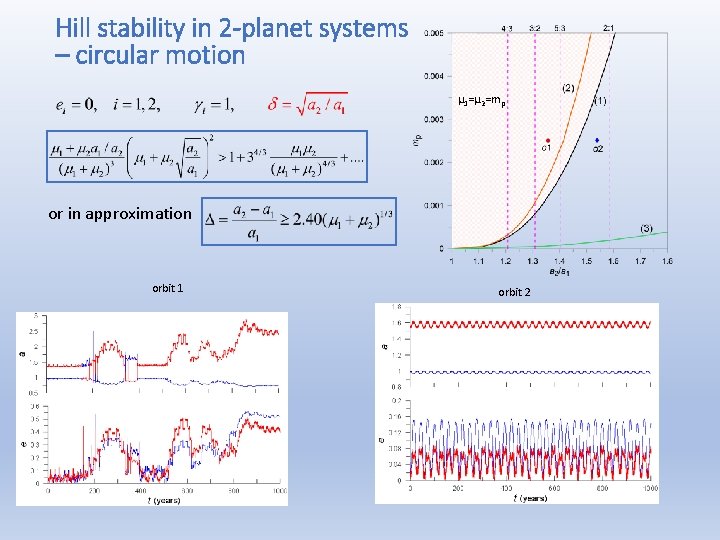
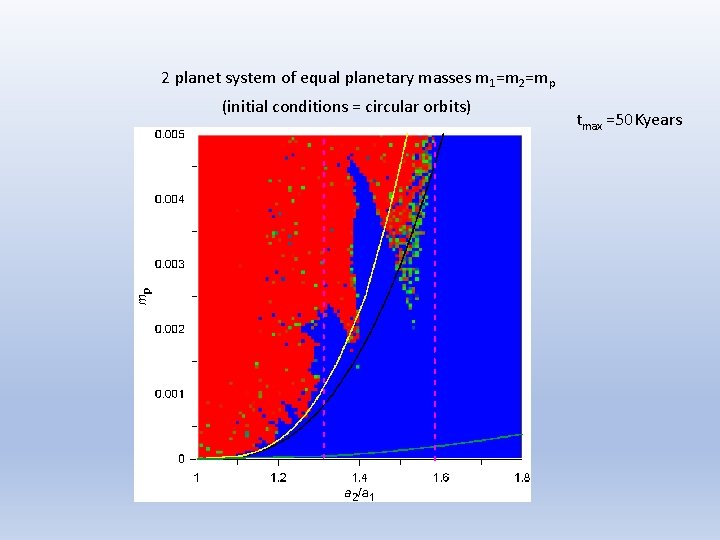
Hill stability in 2 -planet systems – circular motion μ 1=μ 2=mp or in approximation orbit 1 orbit 2
2 planet system of equal planetary masses m 1=m 2=mp (initial conditions = circular orbits) tmax =50 Kyears
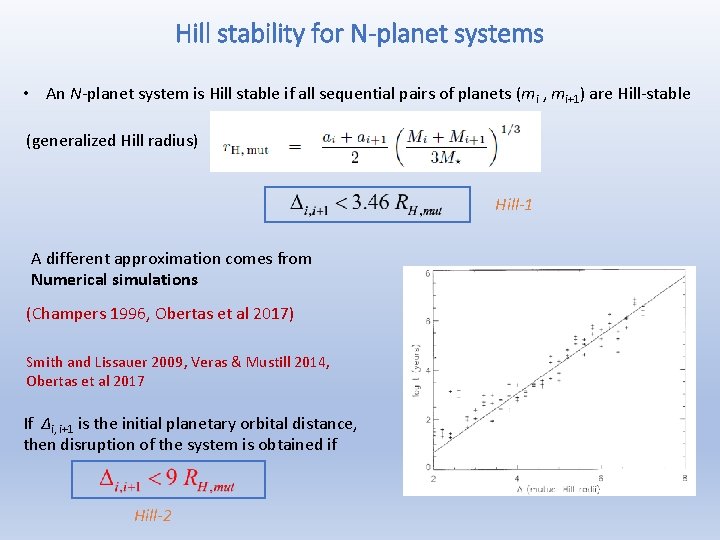
Hill stability for N-planet systems • An N-planet system is Hill stable if all sequential pairs of planets (mi , mi+1) are Hill-stable (generalized Hill radius) Hill-1 A different approximation comes from Numerical simulations (Champers 1996, Obertas et al 2017) Smith and Lissauer 2009, Veras & Mustill 2014, Obertas et al 2017 If Δi, i+1 is the initial planetary orbital distance, then disruption of the system is obtained if Hill-2
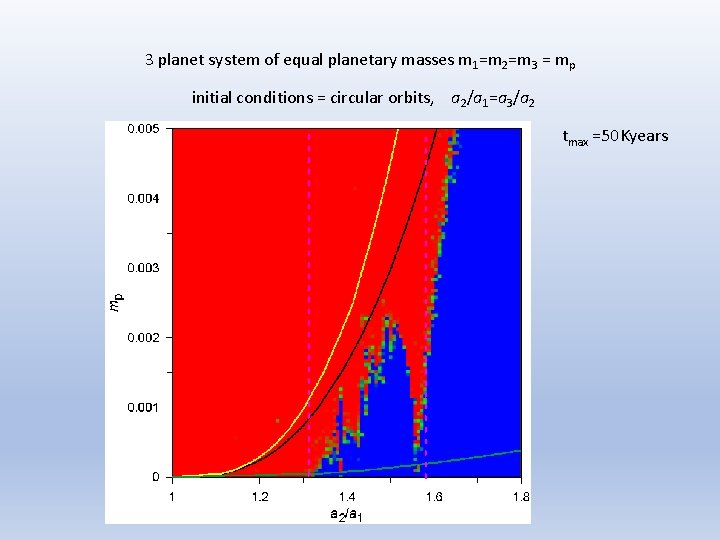
3 planet system of equal planetary masses m 1=m 2=m 3 = mp initial conditions = circular orbits, a 2/a 1=a 3/a 2 tmax =50 Kyears
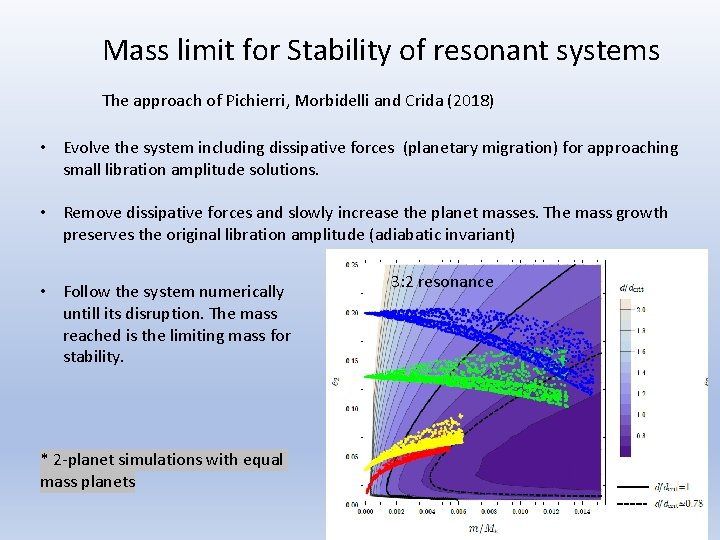
Mass limit for Stability of resonant systems The approach of Pichierri, Morbidelli and Crida (2018) • Evolve the system including dissipative forces (planetary migration) for approaching small libration amplitude solutions. • Remove dissipative forces and slowly increase the planet masses. The mass growth preserves the original libration amplitude (adiabatic invariant) • Follow the system numerically untill its disruption. The mass reached is the limiting mass for stability. * 2 -planet simulations with equal mass planets 3: 2 resonance
Mass limit for Stability of real systems with many planets Can there exist planetary systems with heavy planets at distances close to the critical Hill separation distance ?
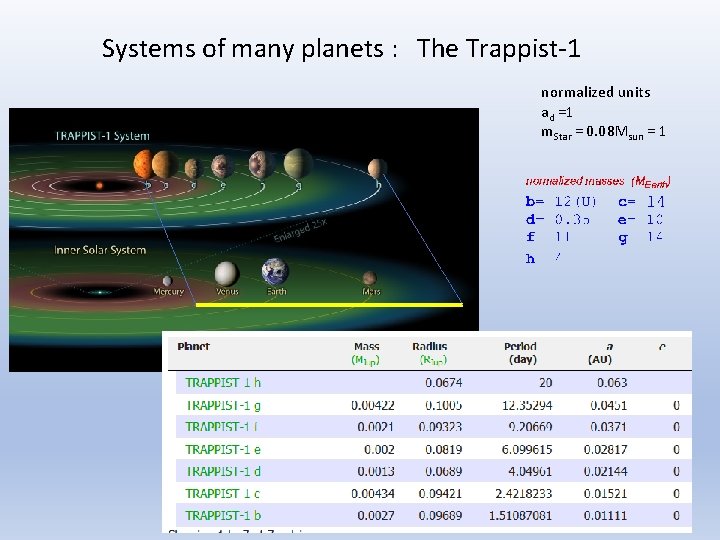
Systems of many planets : The Trappist-1 normalized units ad =1 m. Star = 0. 08 Msun = 1
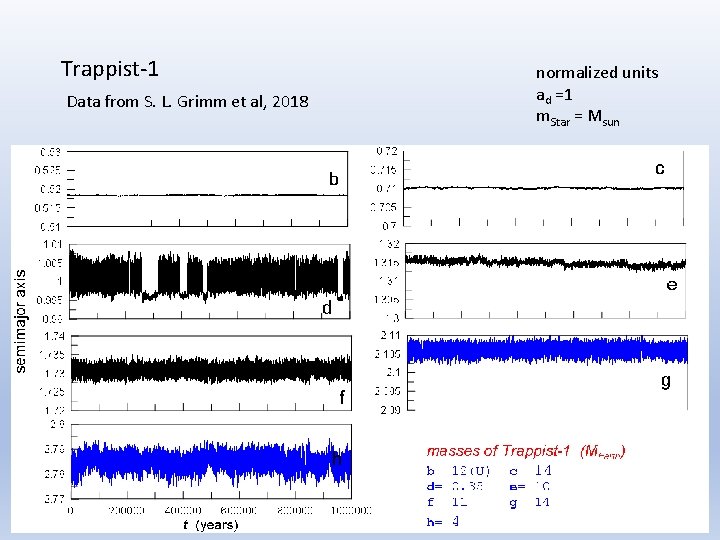
Trappist-1 Data from S. L. Grimm et al, 2018 normalized units ad =1 m. Star = Msun
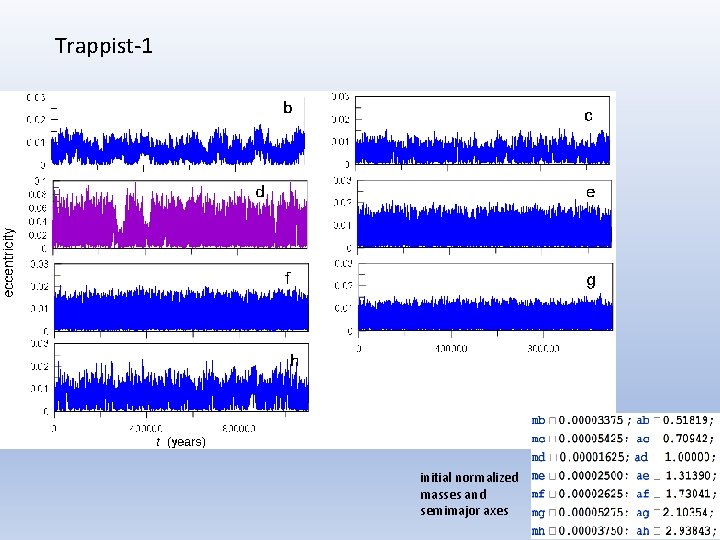
Trappist-1 initial normalized masses and semimajor axes
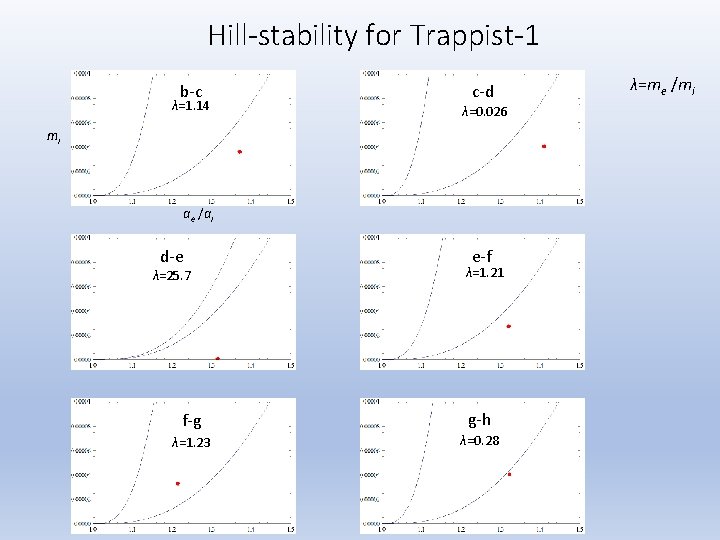
Hill-stability for Trappist-1 b-c λ=1. 14 c-d λ=0. 026 mi ae /ai d-e λ=25. 7 e-f λ=1. 21 f-g g-h λ=1. 23 λ=0. 28 λ=me /mi
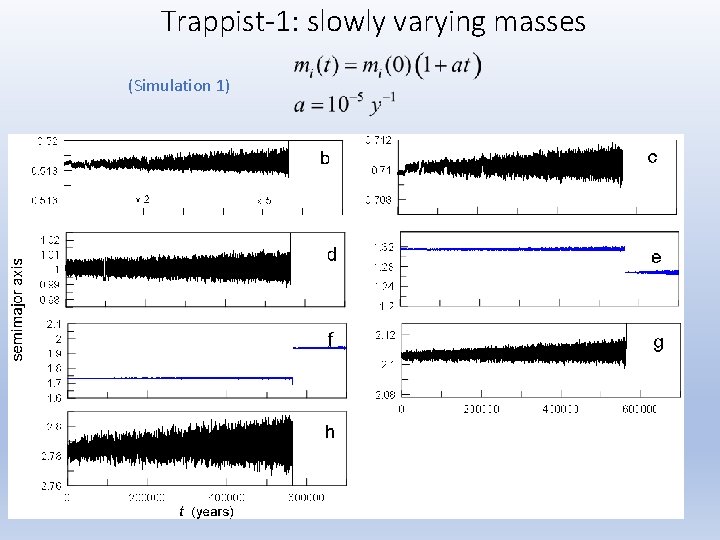
Trappist-1: slowly varying masses (Simulation 1)
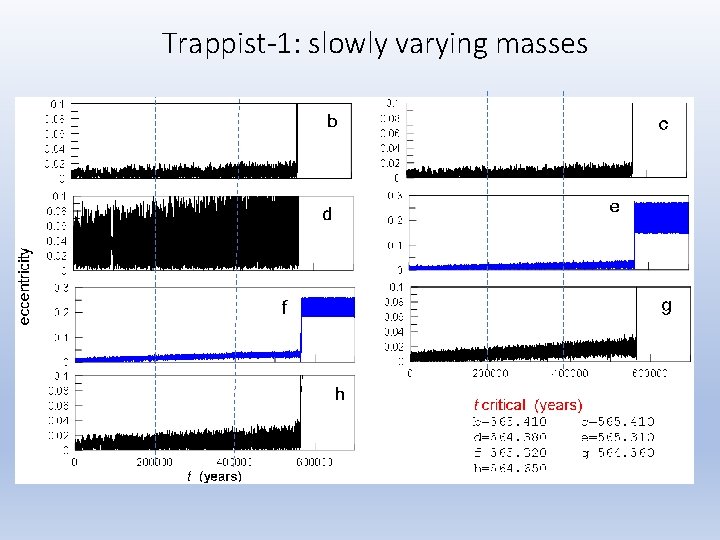
Trappist-1: slowly varying masses
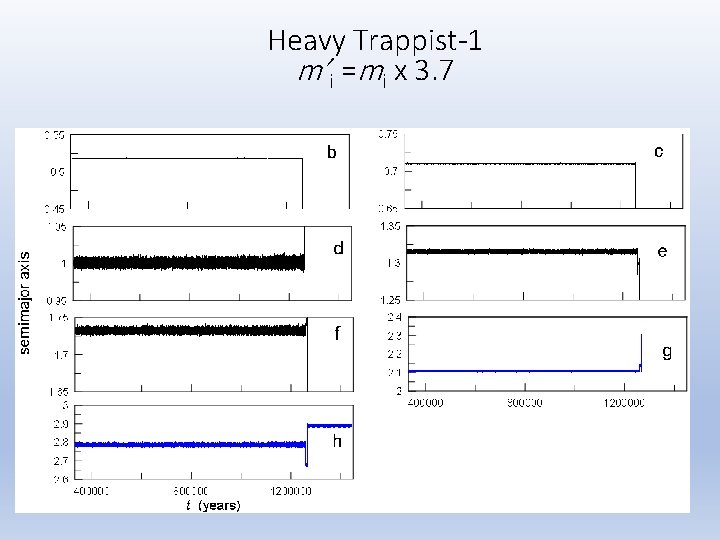
Heavy Trappist-1 m’i =mi x 3. 7
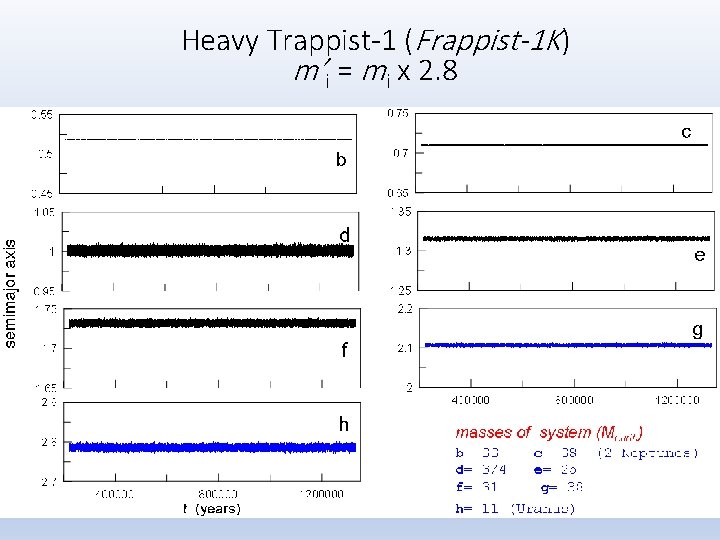
Heavy Trappist-1 (Frappist-1 K) m’i = mi x 2. 8
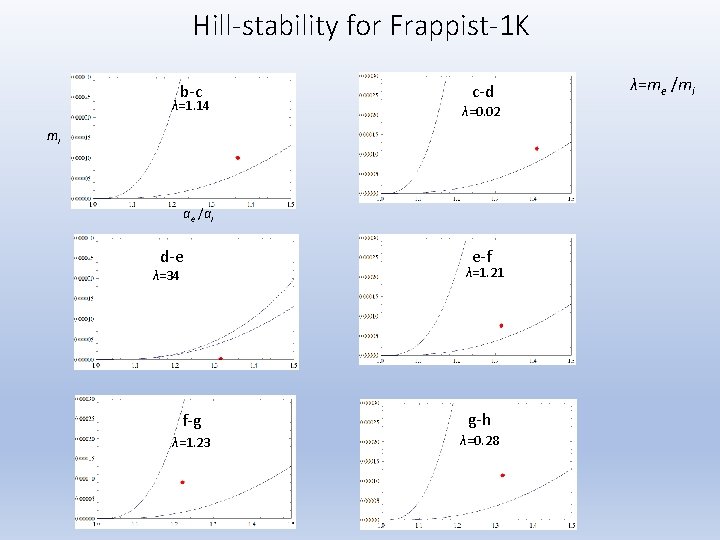
Hill-stability for Frappist-1 K b-c λ=1. 14 c-d λ=0. 02 mi ae /ai d-e λ=34 e-f λ=1. 21 f-g g-h λ=1. 23 λ=0. 28 λ=me /mi
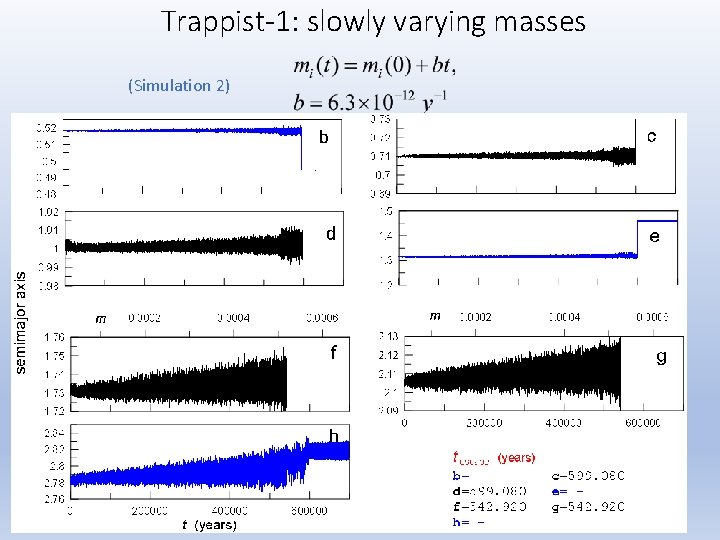
Trappist-1: slowly varying masses (Simulation 2)
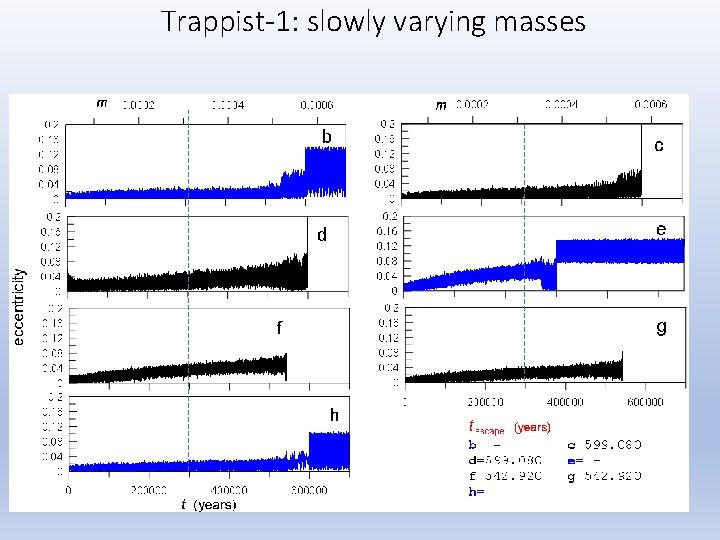
Trappist-1: slowly varying masses
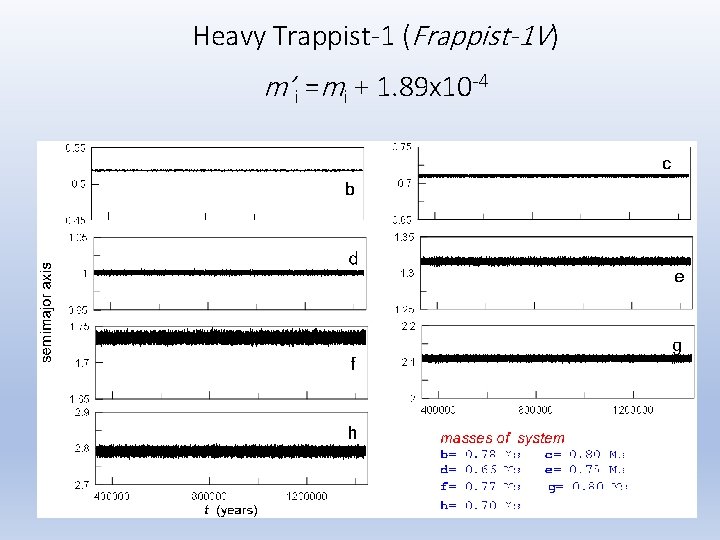
Heavy Trappist-1 (Frappist-1 V) m’i =mi + 1. 89 x 10 -4
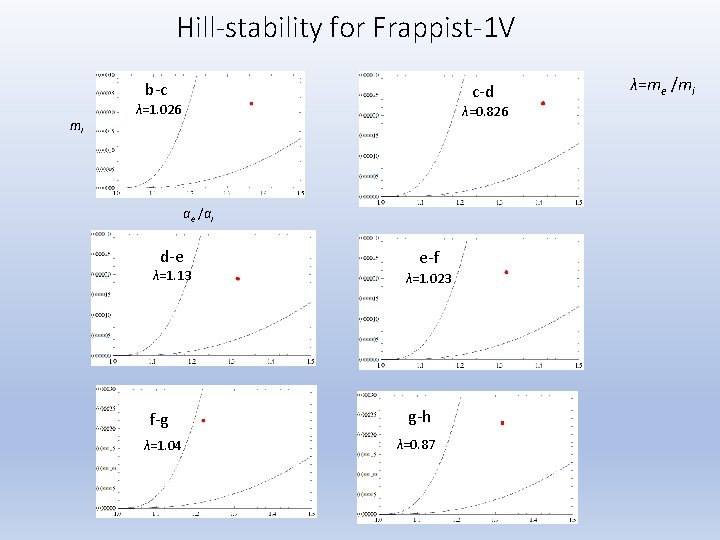
Hill-stability for Frappist-1 V b-c mi c-d λ=1. 026 λ=0. 826 ae /ai d-e e-f λ=1. 13 λ=1. 023 f-g g-h λ=1. 04 λ=0. 87 λ=me /mi
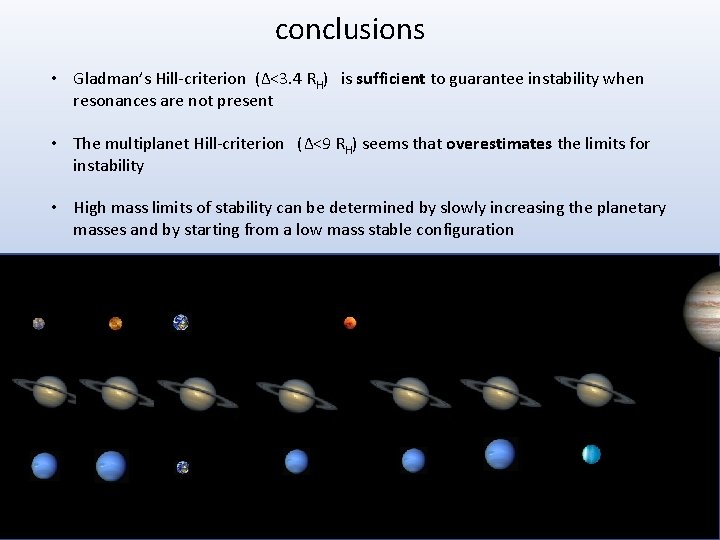
conclusions • Gladman’s Hill-criterion (Δ<3. 4 RΗ) is sufficient to guarantee instability when resonances are not present • The multiplanet Hill-criterion (Δ<9 RΗ) seems that overestimates the limits for instability • High mass limits of stability can be determined by slowly increasing the planetary masses and by starting from a low mass stable configuration