
Outline LTE radio access Basic transmission and multiple
Outline LTE radio access Basic transmission and multiple access schemes OFDM and OFDMA SC-FDMA (DFT-S-OFDM) Physical layer (PHY) Uplink physical resources Uplink reference signals Uplink L 1/L 2 control signaling Downlink physical resources Downlink reference signals Downlink L 1/L 2 control signaling Medium Access Control layer (MAC) Downlink scheduling Uplink scheduling -2 -
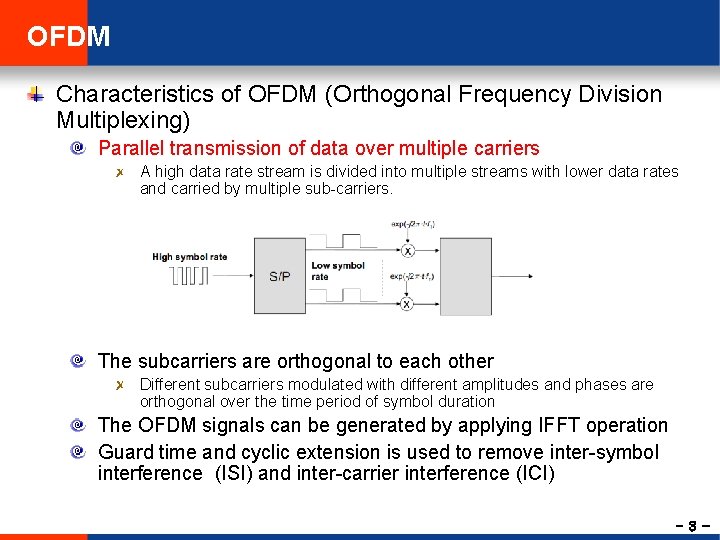
OFDM Characteristics of OFDM (Orthogonal Frequency Division Multiplexing) Parallel transmission of data over multiple carriers A high data rate stream is divided into multiple streams with lower data rates and carried by multiple sub-carriers. The subcarriers are orthogonal to each other Different subcarriers modulated with different amplitudes and phases are orthogonal over the time period of symbol duration The OFDM signals can be generated by applying IFFT operation Guard time and cyclic extension is used to remove inter-symbol interference (ISI) and inter-carrier interference (ICI) -3 -
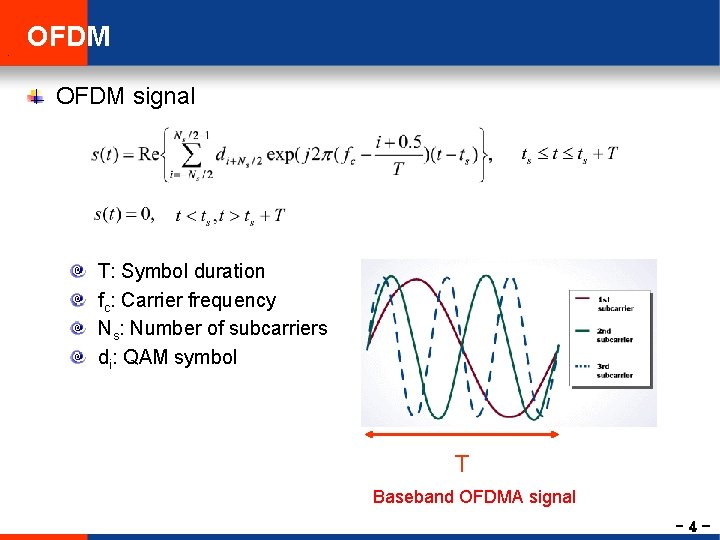
, OFDM signal T: Symbol duration fc: Carrier frequency Ns: Number of subcarriers di: QAM symbol T Baseband OFDMA signal -4 -
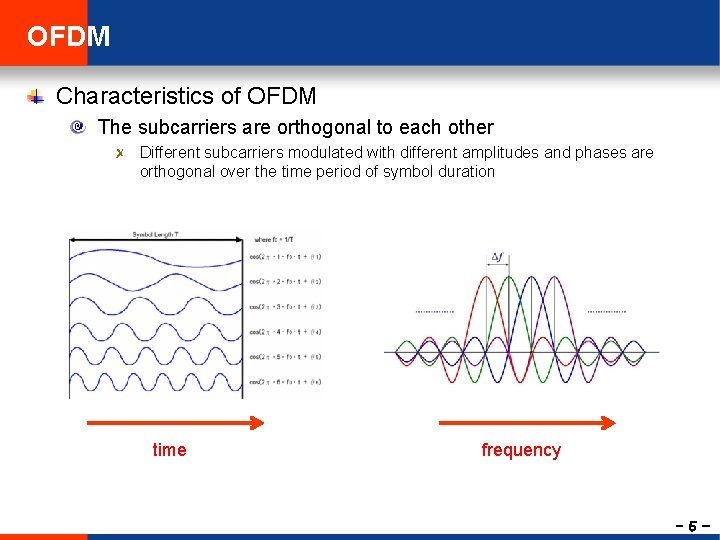
OFDM Characteristics of OFDM The subcarriers are orthogonal to each other Different subcarriers modulated with different amplitudes and phases are orthogonal over the time period of symbol duration time frequency -5 -

OFDM Characteristics of OFDM signals can be generated by applying IFFT operation Equivalent baseband signal In discrete time, OFDM transmitter OFDM receiver -6 -
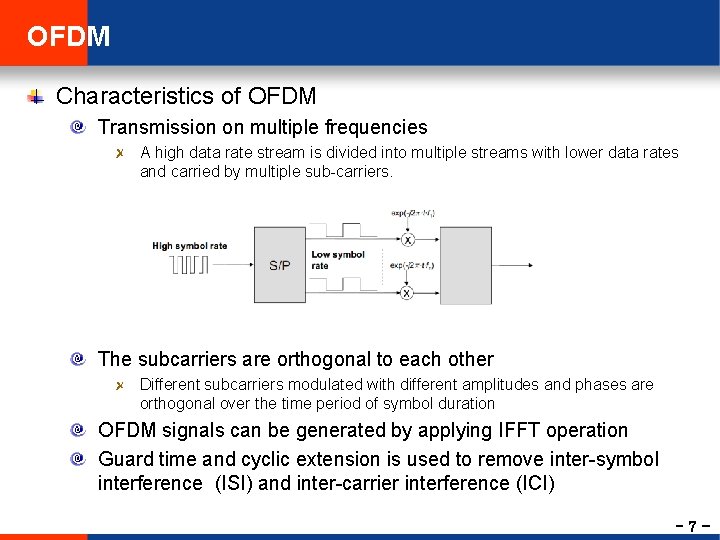
OFDM Characteristics of OFDM Transmission on multiple frequencies A high data rate stream is divided into multiple streams with lower data rates and carried by multiple sub-carriers. The subcarriers are orthogonal to each other Different subcarriers modulated with different amplitudes and phases are orthogonal over the time period of symbol duration OFDM signals can be generated by applying IFFT operation Guard time and cyclic extension is used to remove inter-symbol interference (ISI) and inter-carrier interference (ICI) -7 -
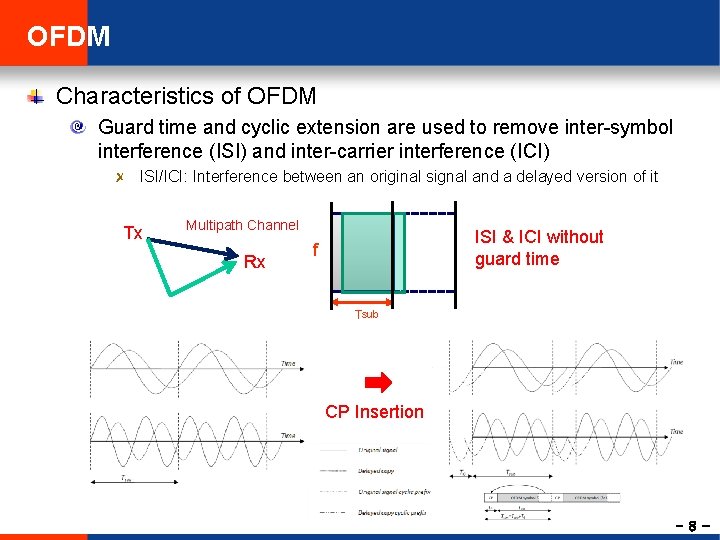
OFDM Characteristics of OFDM Guard time and cyclic extension are used to remove inter-symbol interference (ISI) and inter-carrier interference (ICI) ISI/ICI: Interference between an original signal and a delayed version of it Tx Multipath Channel Rx ISI & ICI without guard time f Tsub CP Insertion -8 -
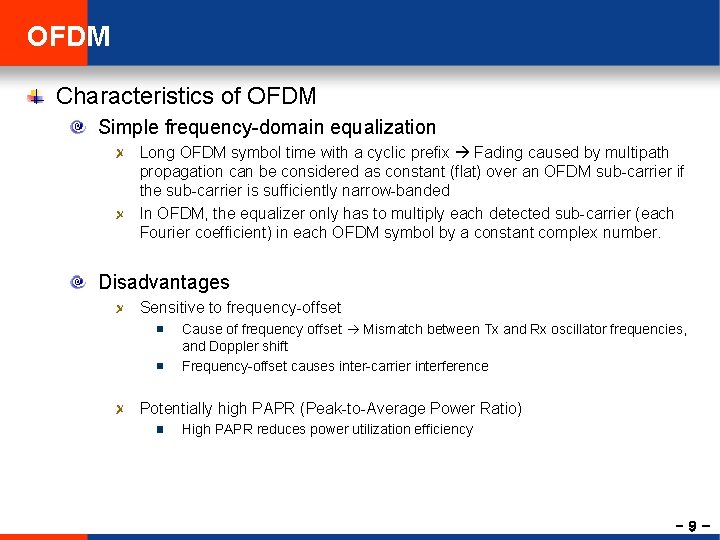
OFDM Characteristics of OFDM Simple frequency-domain equalization Long OFDM symbol time with a cyclic prefix Fading caused by multipath propagation can be considered as constant (flat) over an OFDM sub-carrier if the sub-carrier is sufficiently narrow-banded In OFDM, the equalizer only has to multiply each detected sub-carrier (each Fourier coefficient) in each OFDM symbol by a constant complex number. Disadvantages Sensitive to frequency-offset Cause of frequency offset Mismatch between Tx and Rx oscillator frequencies, and Doppler shift Frequency-offset causes inter-carrier interference Potentially high PAPR (Peak-to-Average Power Ratio) High PAPR reduces power utilization efficiency -9 -
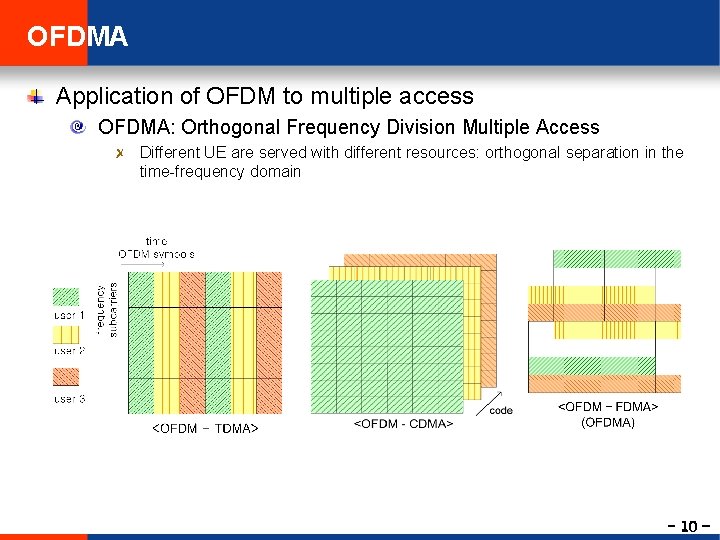
OFDMA Application of OFDM to multiple access OFDMA: Orthogonal Frequency Division Multiple Access Different UE are served with different resources: orthogonal separation in the time-frequency domain - 10 -
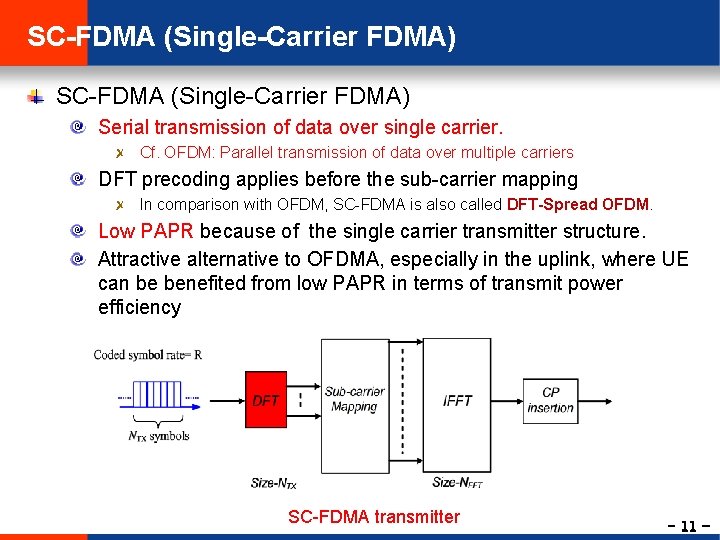
SC-FDMA (Single-Carrier FDMA) Serial transmission of data over single carrier. Cf. OFDM: Parallel transmission of data over multiple carriers DFT precoding applies before the sub-carrier mapping In comparison with OFDM, SC-FDMA is also called DFT-Spread OFDM. Low PAPR because of the single carrier transmitter structure. Attractive alternative to OFDMA, especially in the uplink, where UE can be benefited from low PAPR in terms of transmit power efficiency SC-FDMA transmitter - 11 -
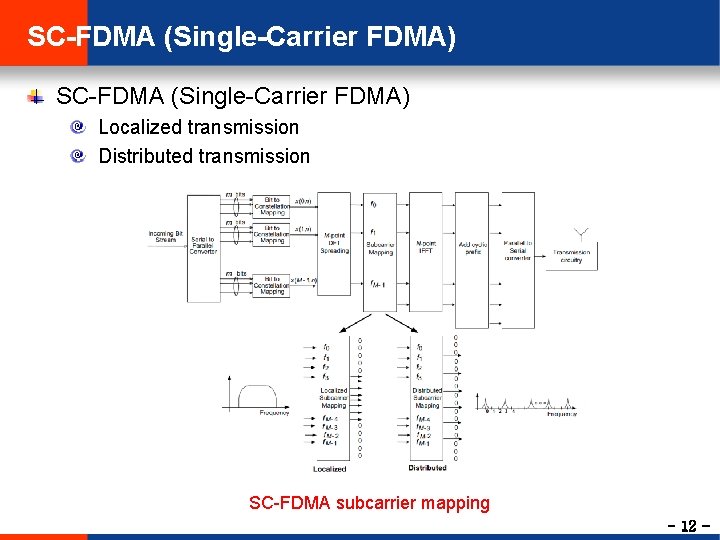
SC-FDMA (Single-Carrier FDMA) Localized transmission Distributed transmission SC-FDMA subcarrier mapping - 12 -
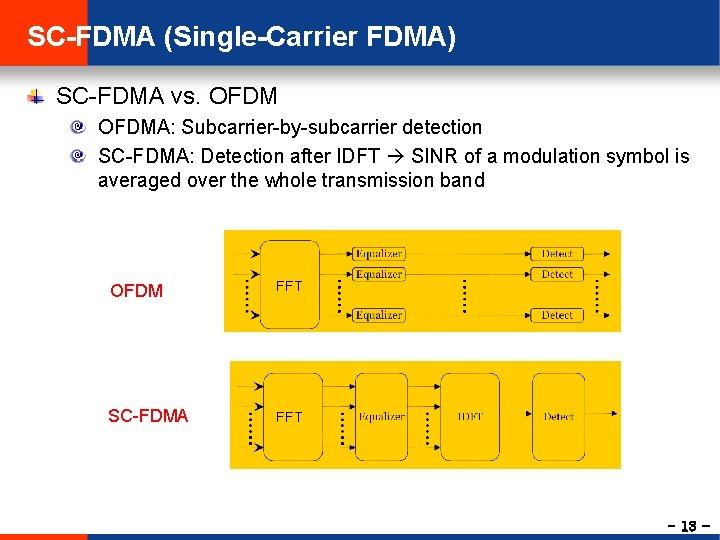
SC-FDMA (Single-Carrier FDMA) SC-FDMA vs. OFDMA: Subcarrier-by-subcarrier detection SC-FDMA: Detection after IDFT SINR of a modulation symbol is averaged over the whole transmission band OFDM FFT SC-FDMA FFT - 13 -
![SC-FDMA vs. OFDM PAPR/CM (Cubic Metric) x[n]: time domain signal after IFT SC-FDMA has](http://slidetodoc.com/presentation_image_h/19f7cc6e9cc8a56ccd14a79753cc573f/image-14.jpg "SC-FDMA vs. OFDM PAPR/CM (Cubic Metric) x[n]: time domain signal after IFT SC-FDMA has")
SC-FDMA vs. OFDM PAPR/CM (Cubic Metric) x[n]: time domain signal after IFT SC-FDMA has a lower PAPR than OFDM SC-FDMA vs. OFDM - 14 -
LTE radio access - 15 -
References “ 3 G Evolution: HSPA and LTE for Mobile Broadband”, E. Dahlman, S. Parkvall, J. Skold, and P. Beming, Academic Press (2 nd Ed, 2008). “LTE-The UMTS Long Term Evolution: from theory to practice”, S. Sesia, I. Toufik, and M. Baker, Jonh Wiley & Sons Ltd (2009) Physical layer specifications 3 GPP TS 36. 201: "Evolved Universal Terrestrial Radio Access (E-UTRA); Physical Layer – General Description". 3 GPP TS 36. 211: "Evolved Universal Terrestrial Radio Access (E-UTRA); Physical channels and modulation". 3 GPP TS 36. 212: "Evolved Universal Terrestrial Radio Access (E-UTRA); Multiplexing and channel coding". 3 GPP TS 36. 213: "Evolved Universal Terrestrial Radio Access (E-UTRA); Physical layer procedures". 3 GPP TS 36. 214: "Evolved Universal Terrestrial Radio Access (E-UTRA); Physical layer – Measurements“ 3 GPP TS 36. 300: “Evolved Universal Terrestrial Radio Access (E-UTRA) and Evolved Universal Terrestrial Radio Access Network (E-UTRAN); Overall description; Stage 2” MAC layer specification 3 GPP TR 36. 321, “Evolved Universal Terrestrial Radio Access (E-UTRA); Medium Access Control (MAC) protocol specification” - 16 -
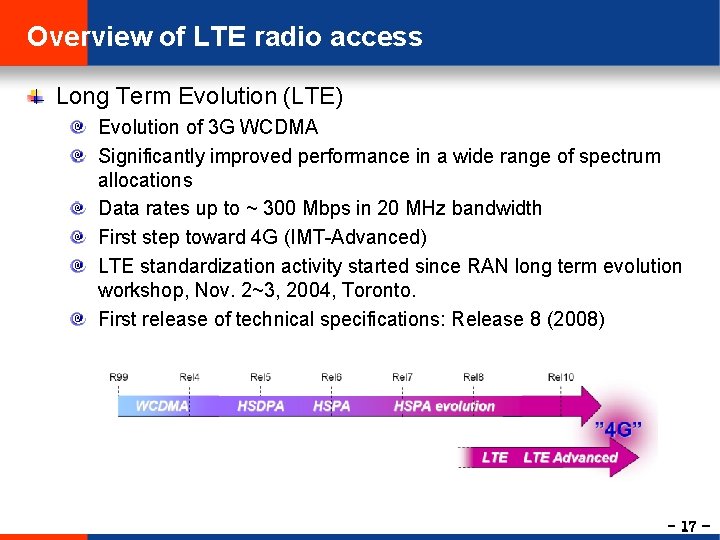
Overview of LTE radio access Long Term Evolution (LTE) Evolution of 3 G WCDMA Significantly improved performance in a wide range of spectrum allocations Data rates up to ~ 300 Mbps in 20 MHz bandwidth First step toward 4 G (IMT-Advanced) LTE standardization activity started since RAN long term evolution workshop, Nov. 2~3, 2004, Toronto. First release of technical specifications: Release 8 (2008) - 17 -
Basic transmission schemes Downlink OFDM Robust against multi-path channels Long OFDM symbol time with a cyclic prefix Simple frequency-domain equalization Frequency-domain scheduling: additional degree of freedom cf. HSPA: only time-domain scheduling Flexible transmission bandwidth Spectrum allocation with different sizes Broadcast/multicast transmission Uplink DFT-spread OFDM (DFT-S-OFDM, SC-FDMA) Single-carrier transmission Motivated by low PAPR (peak-to-average power ratio) Allows for higher average transmission power (Note) Obsession with the single-carrier property -> Leading to very complicated spec!! - 18 -
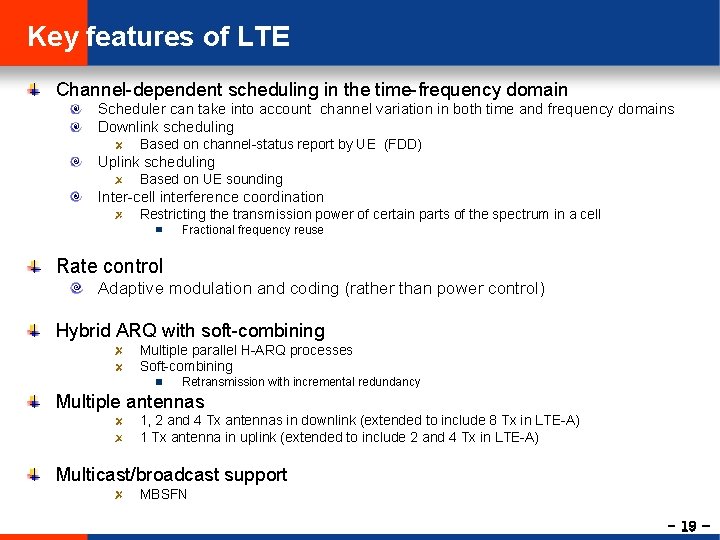
Key features of LTE Channel-dependent scheduling in the time-frequency domain Scheduler can take into account channel variation in both time and frequency domains Downlink scheduling Based on channel-status report by UE (FDD) Uplink scheduling Based on UE sounding Inter-cell interference coordination Restricting the transmission power of certain parts of the spectrum in a cell Fractional frequency reuse Rate control Adaptive modulation and coding (rather than power control) Hybrid ARQ with soft-combining Multiple parallel H-ARQ processes Soft-combining Retransmission with incremental redundancy Multiple antennas 1, 2 and 4 Tx antennas in downlink (extended to include 8 Tx in LTE-A) 1 Tx antenna in uplink (extended to include 2 and 4 Tx in LTE-A) Multicast/broadcast support MBSFN - 19 -
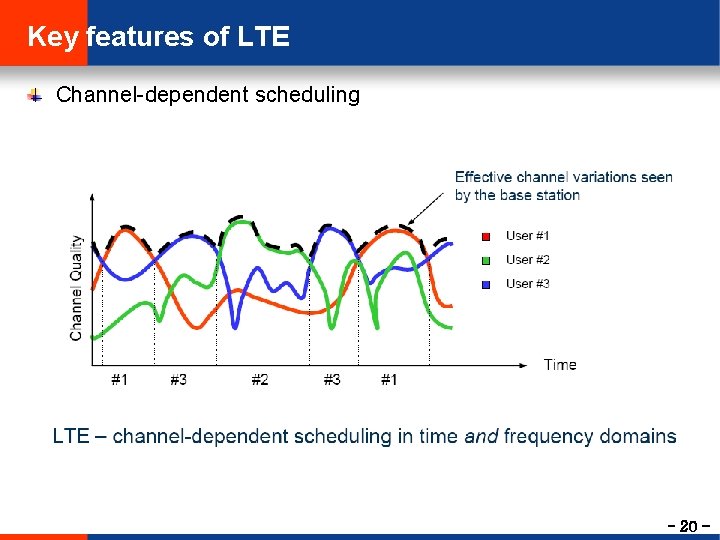
Key features of LTE Channel-dependent scheduling - 20 -
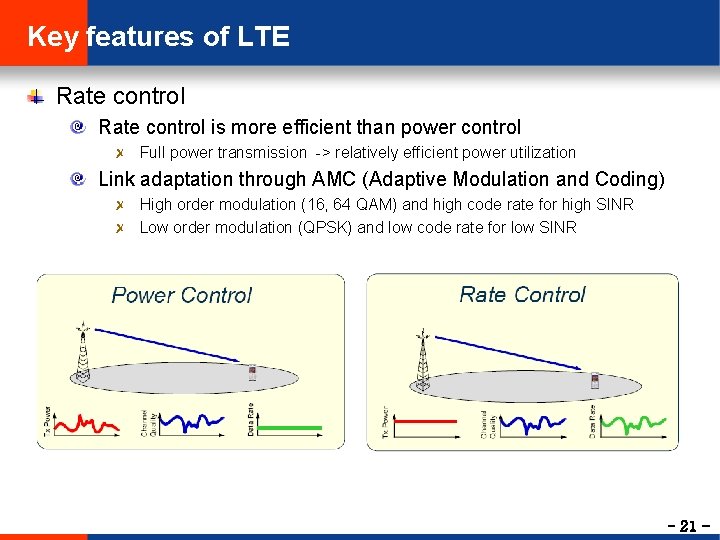
Key features of LTE Rate control is more efficient than power control Full power transmission -> relatively efficient power utilization Link adaptation through AMC (Adaptive Modulation and Coding) High order modulation (16, 64 QAM) and high code rate for high SINR Low order modulation (QPSK) and low code rate for low SINR - 21 -

Key features of LTE Hybrid ARQ with soft-combining - 22 -
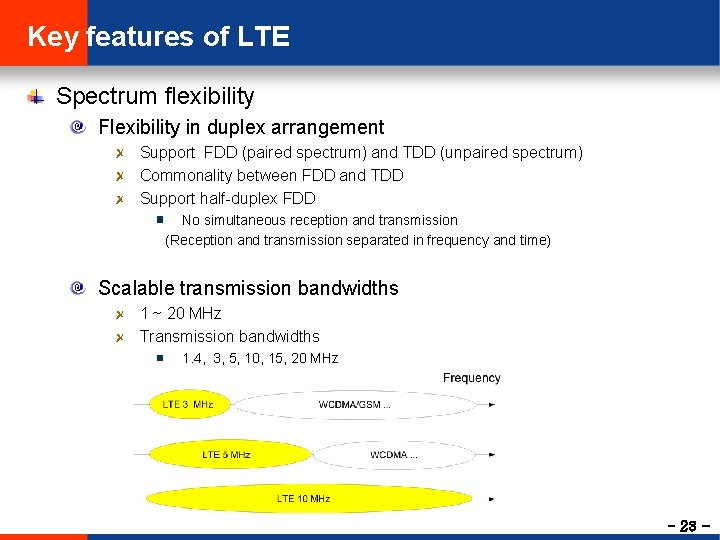
Key features of LTE Spectrum flexibility Flexibility in duplex arrangement Support FDD (paired spectrum) and TDD (unpaired spectrum) Commonality between FDD and TDD Support half-duplex FDD No simultaneous reception and transmission (Reception and transmission separated in frequency and time) Scalable transmission bandwidths 1 ~ 20 MHz Transmission bandwidths 1. 4, 3, 5, 10, 15, 20 MHz - 23 -

LTE-Advanced 3 GPP RAT for IMT-Advanced (4 G) LTE (3. 9 G) + alpha Including new features such as carrier aggregation, relaying, coordinated multipoint transmission, uplink MIMO etc. 3 GPP standardization schedule - 24 -
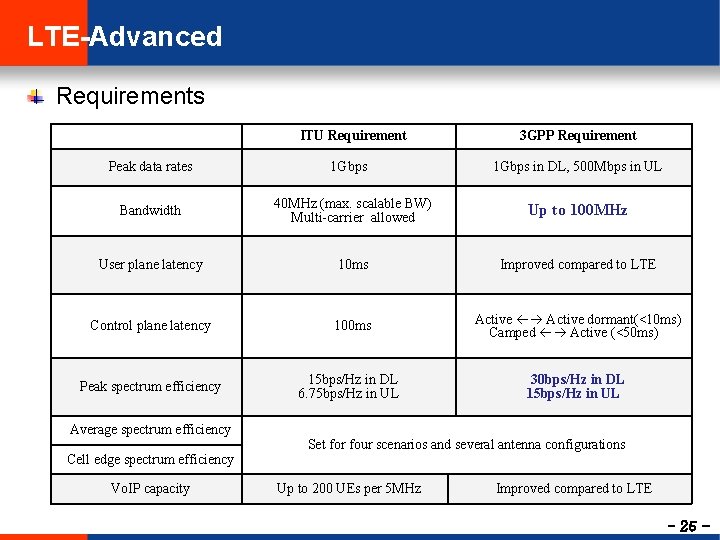
LTE-Advanced Requirements ITU Requirement Peak data rates 1 Gbps 3 GPP Requirement 1 Gbps in DL, 500 Mbps in UL Bandwidth 40 MHz (max. scalable BW) Multi-carrier allowed Up to 100 MHz User plane latency 10 ms Improved compared to LTE Control plane latency 100 ms Active dormant(<10 ms) Camped Active (<50 ms) Peak spectrum efficiency Average spectrum efficiency Cell edge spectrum efficiency Vo. IP capacity 15 bps/Hz in DL 6. 75 bps/Hz in UL 30 bps/Hz in DL 15 bps/Hz in UL Set for four scenarios and several antenna configurations Up to 200 UEs per 5 MHz Improved compared to LTE - 25 -
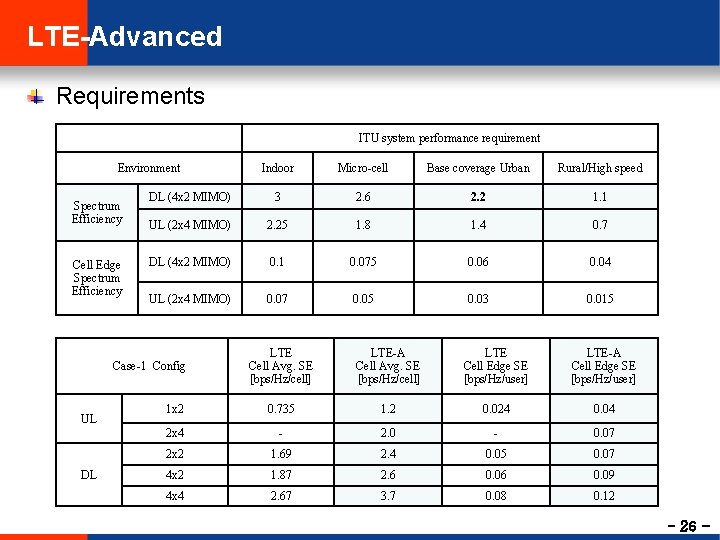
LTE-Advanced Requirements ITU system performance requirement Environment Spectrum Efficiency Cell Edge Spectrum Efficiency Indoor Micro-cell Base coverage Urban Rural/High speed DL (4 x 2 MIMO) 3 2. 6 2. 2 1. 1 UL (2 x 4 MIMO) 2. 25 1. 8 1. 4 0. 7 DL (4 x 2 MIMO) 0. 1 0. 075 0. 06 0. 04 UL (2 x 4 MIMO) 0. 07 0. 05 0. 03 0. 015 LTE Cell Avg. SE [bps/Hz/cell] LTE-A Cell Avg. SE [bps/Hz/cell] LTE Cell Edge SE [bps/Hz/user] LTE-A Cell Edge SE [bps/Hz/user] 1 x 2 0. 735 1. 2 0. 024 0. 04 2 x 4 - 2. 0 - 0. 07 2 x 2 1. 69 2. 4 0. 05 0. 07 4 x 2 1. 87 2. 6 0. 09 4 x 4 2. 67 3. 7 0. 08 0. 12 Case-1 Config UL DL - 26 -
![Frame structure [TS 36. 211 Sec 4] Basic time unit, Ts = 1/(15000 x](http://slidetodoc.com/presentation_image_h/19f7cc6e9cc8a56ccd14a79753cc573f/image-27.jpg "Frame structure [TS 36. 211 Sec 4] Basic time unit, Ts = 1/(15000 x")
Frame structure [TS 36. 211 Sec 4] Basic time unit, Ts = 1/(15000 x 2048) second Frame structure type 1 FDD Slot = 0. 5 ms, subframe = 1 ms (TTI) One radio frame consists of 10 subframes Supports full-and half-duplex operations at the terminal Full duplex: simultaneous transmission/reception Half duplex: only transmission or reception at a time - 27 -
![Frame structure [TS 36. 211 Sec 4] Frame structure type 2 TDD Special subframe](http://slidetodoc.com/presentation_image_h/19f7cc6e9cc8a56ccd14a79753cc573f/image-28.jpg "Frame structure [TS 36. 211 Sec 4] Frame structure type 2 TDD Special subframe")
Frame structure [TS 36. 211 Sec 4] Frame structure type 2 TDD Special subframe to provide guard time for downlink-to-uplink switching Dw. PTS: downlink part Up. PTS: uplink part GP: No transmissions to avoid interference between uplink and downlink transmissions - 28 -
![Frame structure [TS 36. 211 Sec 4] Frame structure type 2 (continued) Seven configurations](http://slidetodoc.com/presentation_image_h/19f7cc6e9cc8a56ccd14a79753cc573f/image-29.jpg "Frame structure [TS 36. 211 Sec 4] Frame structure type 2 (continued) Seven configurations")
Frame structure [TS 36. 211 Sec 4] Frame structure type 2 (continued) Seven configurations with different UL/DL ratios - 29 -
LTE - Uplink - 30 -
![Uplink transmission scheme [TS 36. 211 Sec 5. 3] Basic transmission scheme For both](http://slidetodoc.com/presentation_image_h/19f7cc6e9cc8a56ccd14a79753cc573f/image-31.jpg "Uplink transmission scheme [TS 36. 211 Sec 5. 3] Basic transmission scheme For both")
Uplink transmission scheme [TS 36. 211 Sec 5. 3] Basic transmission scheme For both FDD and TDD, the uplink transmission scheme is based on single-carrier FDMA, more specifically DFT S-OFDM Low PAPR (Peak-to-Average Power Ratio) Sub-carrier spacing f = 15 k. Hz. Two cyclic-prefix lengths Normal cyclic prefix and extended cyclic prefix corresponding to seven and six SC-FDMA symbol per slot, respectively. Normal cyclic prefix: TCP = 160 Ts (SC-FDMA symbol #0) , TCP = 144 Ts (SC -FDMA symbol #1 to #6) Extended cyclic prefix: TCP-e = 512 Ts (SC-FDMA symbol #0 to SC-FDMA symbol #5) - 31 -
![Uplink physical resources [TS 36. 211 Sec 5. 2] Uplink physical resources Resource element](http://slidetodoc.com/presentation_image_h/19f7cc6e9cc8a56ccd14a79753cc573f/image-32.jpg "Uplink physical resources [TS 36. 211 Sec 5. 2] Uplink physical resources Resource element")
Uplink physical resources [TS 36. 211 Sec 5. 2] Uplink physical resources Resource element (RE) Basic resource unit Resource block (RB) Basic allocation unit Normal CP: 12 subcarriers x 7 SC-FDMA symbols Extended CP: 12 subcarriers x 6 SC-FDMA symbols # of resource blocks can range from NRB-min = 6 to NRB-max = 110. (LTE) Always consecutive allocation A set of frequency consecutive RBs To maintain low PAPR - 32 -
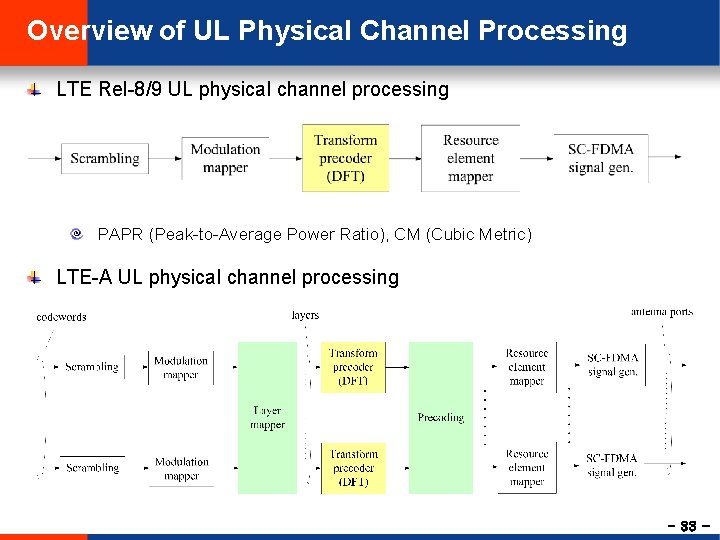
Overview of UL Physical Channel Processing LTE Rel-8/9 UL physical channel processing PAPR (Peak-to-Average Power Ratio), CM (Cubic Metric) LTE-A UL physical channel processing - 33 -
![Uplink reference signals [TS 36. 211 Sec 5. 5 ] Two types of reference](http://slidetodoc.com/presentation_image_h/19f7cc6e9cc8a56ccd14a79753cc573f/image-34.jpg "Uplink reference signals [TS 36. 211 Sec 5. 5 ] Two types of reference")
Uplink reference signals [TS 36. 211 Sec 5. 5 ] Two types of reference signals Demodulation reference signals (DMRS) Transmitted within data transmission RBs Used for channel estimation -> coherent demodulation of uplink transmissions Sounding reference signals (SRS) Transmitted over a range of frequency bands Used for estimation of uplink channel quality -> frequency-domain scheduling Structure of DMRS Time-division multiplexed with other uplink transmissions - 34 -
![Uplink reference signals SRS symbol structure [TS 36. 211 Sec 5. 5. 3] -](http://slidetodoc.com/presentation_image_h/19f7cc6e9cc8a56ccd14a79753cc573f/image-35.jpg "Uplink reference signals SRS symbol structure [TS 36. 211 Sec 5. 5. 3] -")
Uplink reference signals SRS symbol structure [TS 36. 211 Sec 5. 5. 3] - 35 -
![Uplink L 1/L 2 control signaling [TS 36. 211 Sec 5. 4] Signaling to](http://slidetodoc.com/presentation_image_h/19f7cc6e9cc8a56ccd14a79753cc573f/image-36.jpg "Uplink L 1/L 2 control signaling [TS 36. 211 Sec 5. 4] Signaling to")
Uplink L 1/L 2 control signaling [TS 36. 211 Sec 5. 4] Signaling to support downlink and uplink transport channels H-ARQ acknowledgement in response to downlink data Downlink channel quality feedback Scheduling request for uplink resource allocation Two different transmission methods If no simultaneous transmission of UL-SCH L 1/L 2 control signaling on PUCCH If simultaneous transmission of UL-SCH L 1/L 2 control signaling on PUSCH - 36 -
![Uplink L 1/L 2 control signaling on PUCCH [TS 36. 211 Sec 5. 4]](http://slidetodoc.com/presentation_image_h/19f7cc6e9cc8a56ccd14a79753cc573f/image-37.jpg "Uplink L 1/L 2 control signaling on PUCCH [TS 36. 211 Sec 5. 4]")
Uplink L 1/L 2 control signaling on PUCCH [TS 36. 211 Sec 5. 4] PUCCH structure Frequency hopping for frequency diversity Positioned at the edge of the band to avoid fragmentation of PDSCH transmission, making it possible to allocate a wide spectrum without breaking the single-carrier property FDM/CDM (Code Division Multiplexing) - 37 -
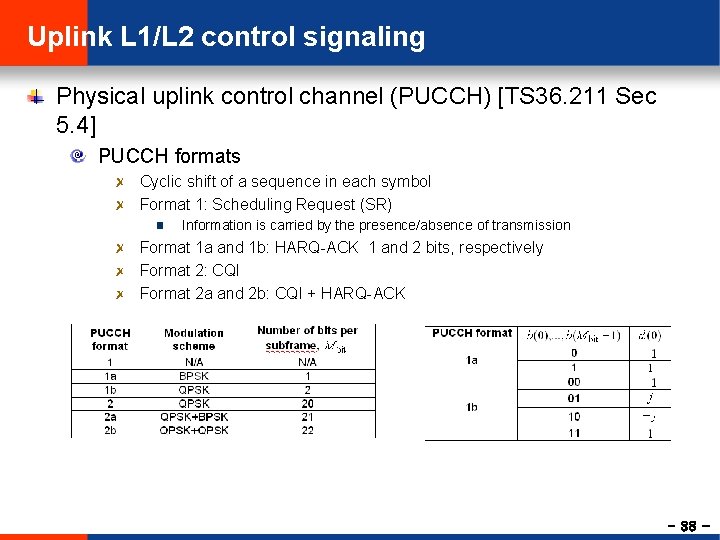
Uplink L 1/L 2 control signaling Physical uplink control channel (PUCCH) [TS 36. 211 Sec 5. 4] PUCCH formats Cyclic shift of a sequence in each symbol Format 1: Scheduling Request (SR) Information is carried by the presence/absence of transmission Format 1 a and 1 b: HARQ-ACK 1 and 2 bits, respectively Format 2: CQI Format 2 a and 2 b: CQI + HARQ-ACK - 38 -
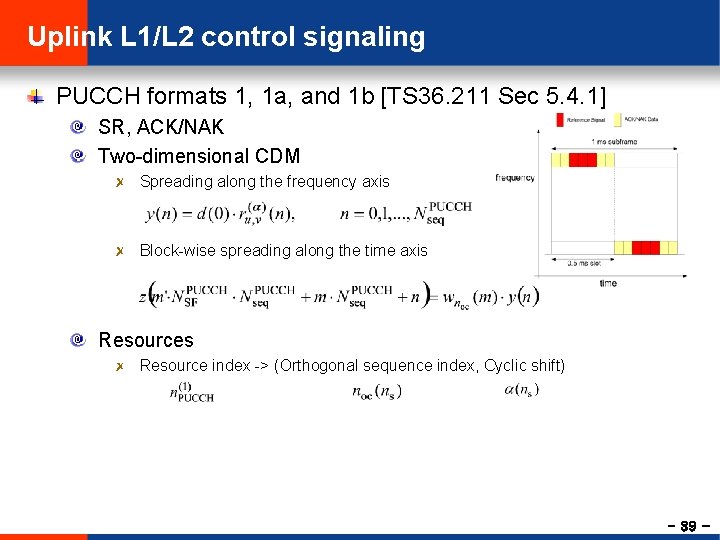
Uplink L 1/L 2 control signaling PUCCH formats 1, 1 a, and 1 b [TS 36. 211 Sec 5. 4. 1] SR, ACK/NAK Two-dimensional CDM Spreading along the frequency axis Block-wise spreading along the time axis Resource index -> (Orthogonal sequence index, Cyclic shift) - 39 -
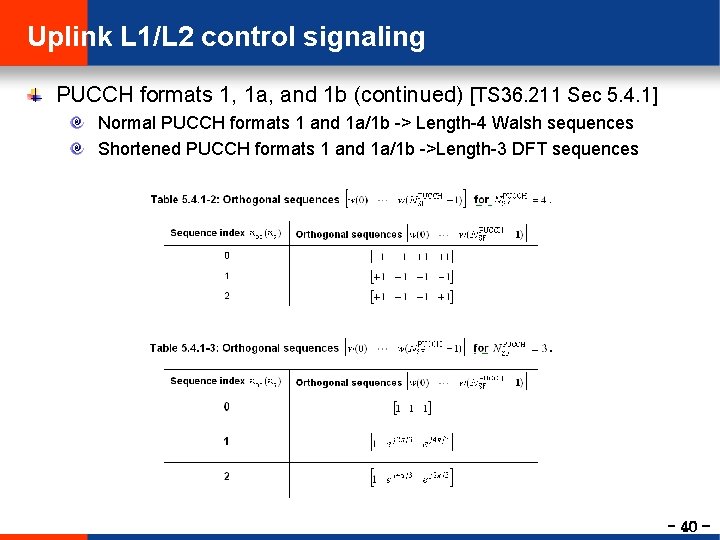
Uplink L 1/L 2 control signaling PUCCH formats 1, 1 a, and 1 b (continued) [TS 36. 211 Sec 5. 4. 1] Normal PUCCH formats 1 and 1 a/1 b -> Length-4 Walsh sequences Shortened PUCCH formats 1 and 1 a/1 b ->Length-3 DFT sequences - 40 -
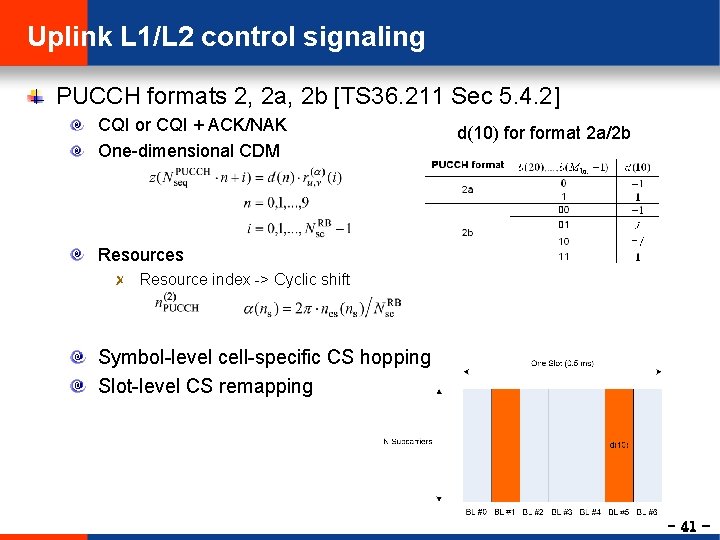
Uplink L 1/L 2 control signaling PUCCH formats 2, 2 a, 2 b [TS 36. 211 Sec 5. 4. 2] CQI or CQI + ACK/NAK One-dimensional CDM d(10) format 2 a/2 b Resources Resource index -> Cyclic shift Symbol-level cell-specific CS hopping Slot-level CS remapping - 41 -
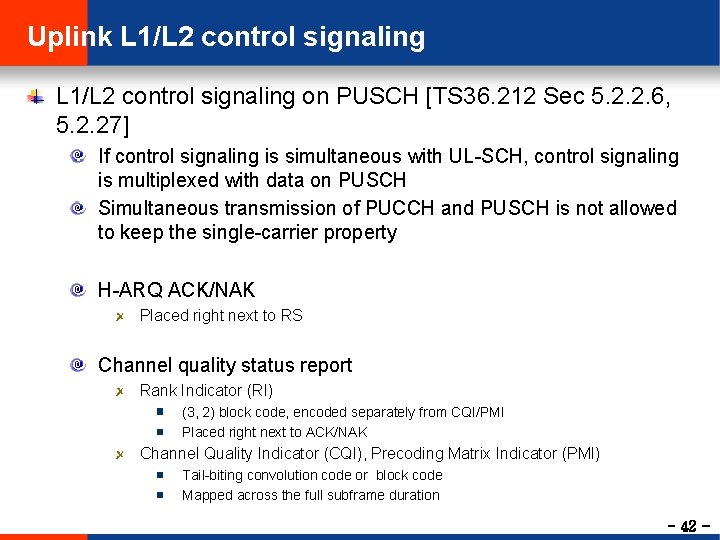
Uplink L 1/L 2 control signaling on PUSCH [TS 36. 212 Sec 5. 2. 2. 6, 5. 2. 27] If control signaling is simultaneous with UL-SCH, control signaling is multiplexed with data on PUSCH Simultaneous transmission of PUCCH and PUSCH is not allowed to keep the single-carrier property H-ARQ ACK/NAK Placed right next to RS Channel quality status report Rank Indicator (RI) (3, 2) block code, encoded separately from CQI/PMI Placed right next to ACK/NAK Channel Quality Indicator (CQI), Precoding Matrix Indicator (PMI) Tail-biting convolution code or block code Mapped across the full subframe duration - 42 -
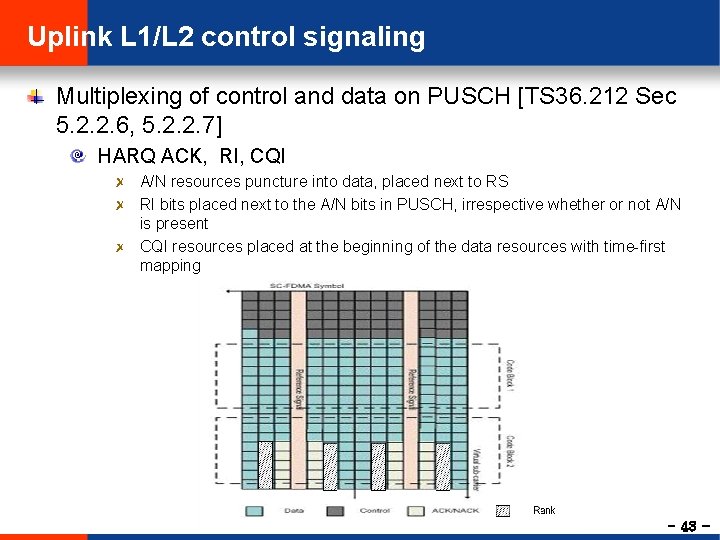
Uplink L 1/L 2 control signaling Multiplexing of control and data on PUSCH [TS 36. 212 Sec 5. 2. 2. 6, 5. 2. 2. 7] HARQ ACK, RI, CQI A/N resources puncture into data, placed next to RS RI bits placed next to the A/N bits in PUSCH, irrespective whether or not A/N is present CQI resources placed at the beginning of the data resources with time-first mapping - 43 -
![Uplink transmission PUSCH frequency hopping [TS 36. 211 Sec 5. 3. 7] [TS 36.](http://slidetodoc.com/presentation_image_h/19f7cc6e9cc8a56ccd14a79753cc573f/image-44.jpg "Uplink transmission PUSCH frequency hopping [TS 36. 211 Sec 5. 3. 7] [TS 36.")
Uplink transmission PUSCH frequency hopping [TS 36. 211 Sec 5. 3. 7] [TS 36. 213 Sec 8. 4. 1] Cell-specific hopping/mirroring Slot level hopping according to predefined hopping/mirroring patterns Different cells have different patterns Period is one frame Hopping according to explicit information The uplink scheduling grant indicates the offset of the resource to use for the second slot. Dynamic selection between the two modes Indication bits in the scheduling grant - 44 -
LTE - Downlink - 45 -
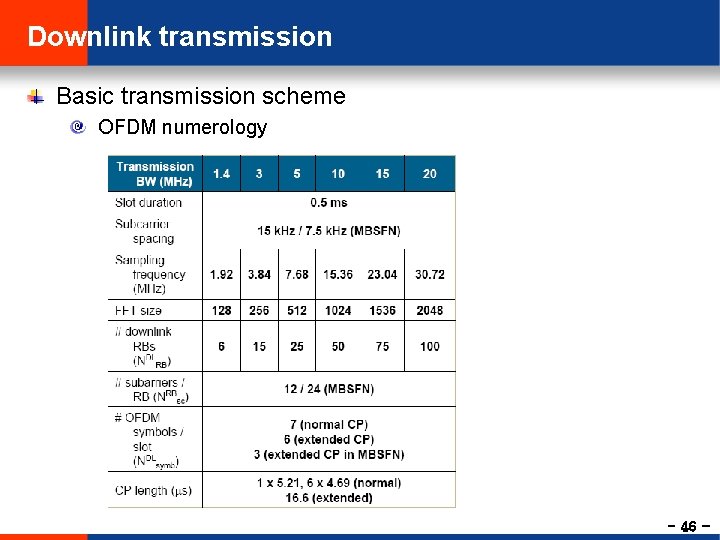
Downlink transmission Basic transmission scheme OFDM numerology - 46 -
![Downlink physical resources [TS 36. 211 Sec 6. 2] Downlink physical resources Resource element](http://slidetodoc.com/presentation_image_h/19f7cc6e9cc8a56ccd14a79753cc573f/image-47.jpg "Downlink physical resources [TS 36. 211 Sec 6. 2] Downlink physical resources Resource element")
Downlink physical resources [TS 36. 211 Sec 6. 2] Downlink physical resources Resource element Basic resource unit Resource block (RB) Basic allocation unit Normal CP: 12 subcarriers x 7 SC-FDMA symbols Extended CP: 12 subcarriers x 6 SC-FDMA symbols Non-consecutive allocation allowed - 47 -
![Downlink physical channels and signals [TS 36. 211 Sec 6. 2] Physical channels Physical](http://slidetodoc.com/presentation_image_h/19f7cc6e9cc8a56ccd14a79753cc573f/image-48.jpg "Downlink physical channels and signals [TS 36. 211 Sec 6. 2] Physical channels Physical")
Downlink physical channels and signals [TS 36. 211 Sec 6. 2] Physical channels Physical downlink shared channel (PDSCH) carries the downlink shared channel (DL-SCH) and paging channel (PCH) Physical downlink control channel (PDCCH) informs the UE about the resource allocation of PCH and DL-SCH, and Hybrid ARQ information related to DL-SCH carries the uplink scheduling grant Physical control format indicator channel (PCFICH) informs the UE about the number of OFDM symbols used for the PDCCHs; transmitted in every subframe. Physical broadcast channel (PBCH) The coded broadcast channel (BCH) transport block is mapped to four subframes within a 40 ms interval Each subframe is self-decodable Physical Hybrid ARQ Indicator Channel (PHICH) carries Hybrid ARQ ACK/NAKsin response to uplink transmissions. Physical multicast channel (PMCH) carries the multicast channel (MCH) transport channel Physical signals Reference signal Synchronization signal - 48 -
![Downlink physical resources Downlink frame structure [frame type 1 (FDD)] - 49 -](http://slidetodoc.com/presentation_image_h/19f7cc6e9cc8a56ccd14a79753cc573f/image-49.jpg "Downlink physical resources Downlink frame structure [frame type 1 (FDD)] - 49 -")
Downlink physical resources Downlink frame structure [frame type 1 (FDD)] - 49 -
![Synchronization and cell search Two cell search procedures [TS 36. 211 Sec 6. 11]](http://slidetodoc.com/presentation_image_h/19f7cc6e9cc8a56ccd14a79753cc573f/image-50.jpg "Synchronization and cell search Two cell search procedures [TS 36. 211 Sec 6. 11]")
Synchronization and cell search Two cell search procedures [TS 36. 211 Sec 6. 11] Initial synchronization Synchronization -> PBCH decoding -> SI acquisition New cell identification Synchronization -> RS detection -> RSRP/RSRQ measurement - 50 -
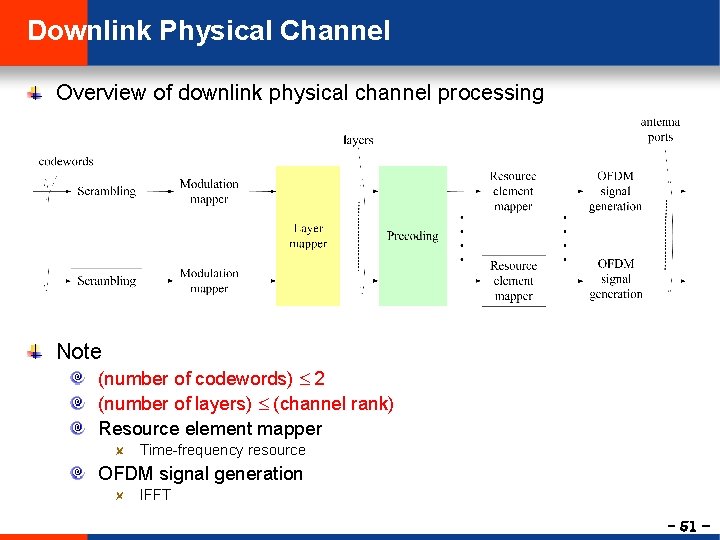
Downlink Physical Channel Overview of downlink physical channel processing Note (number of codewords) 2 (number of layers) (channel rank) Resource element mapper Time-frequency resource OFDM signal generation IFFT - 51 -
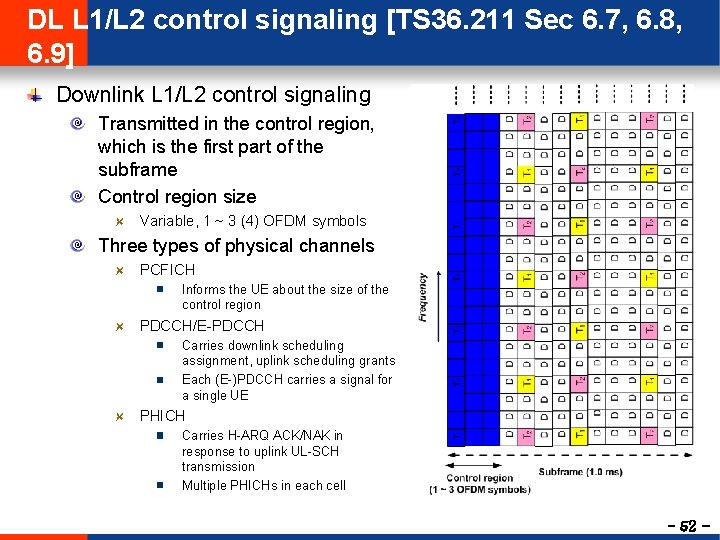
DL L 1/L 2 control signaling [TS 36. 211 Sec 6. 7, 6. 8, 6. 9] Downlink L 1/L 2 control signaling Transmitted in the control region, which is the first part of the subframe Control region size Variable, 1 ~ 3 (4) OFDM symbols Three types of physical channels PCFICH Informs the UE about the size of the control region PDCCH/E-PDCCH Carries downlink scheduling assignment, uplink scheduling grants Each (E-)PDCCH carries a signal for a single UE PHICH Carries H-ARQ ACK/NAK in response to uplink UL-SCH transmission Multiple PHICHs in each cell - 52 -
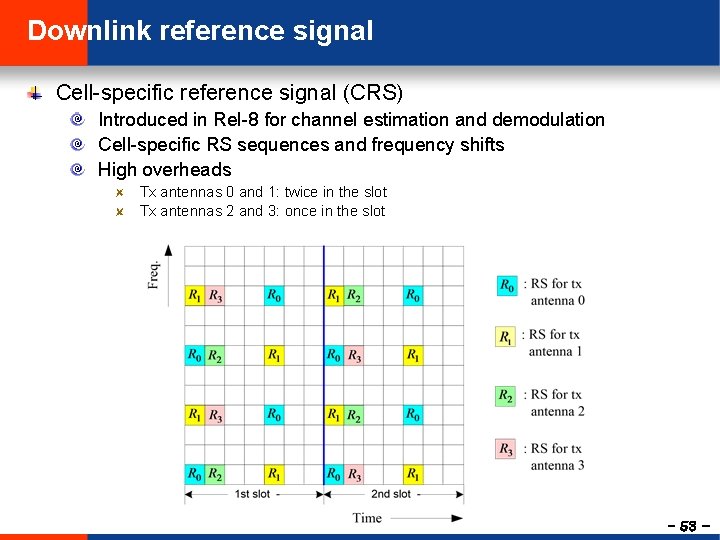
Downlink reference signal Cell-specific reference signal (CRS) Introduced in Rel-8 for channel estimation and demodulation Cell-specific RS sequences and frequency shifts High overheads Tx antennas 0 and 1: twice in the slot Tx antennas 2 and 3: once in the slot - 53 -
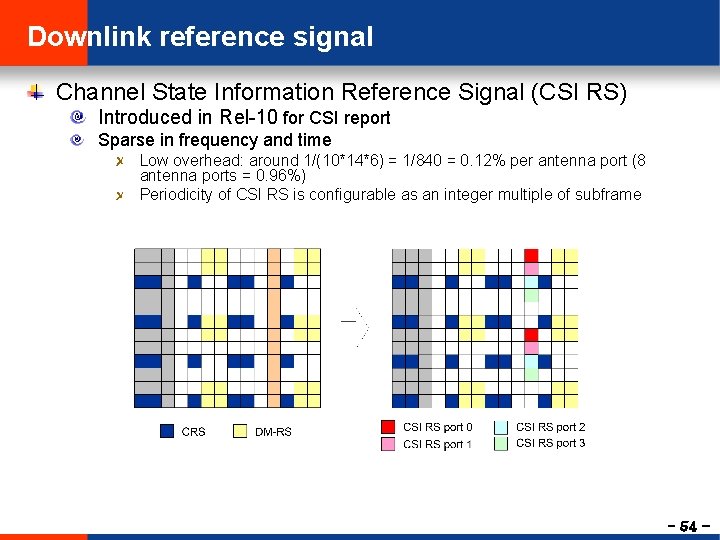
Downlink reference signal Channel State Information Reference Signal (CSI RS) Introduced in Rel-10 for CSI report Sparse in frequency and time Low overhead: around 1/(10*14*6) = 1/840 = 0. 12% per antenna port (8 antenna ports = 0. 96%) Periodicity of CSI RS is configurable as an integer multiple of subframe - 54 -
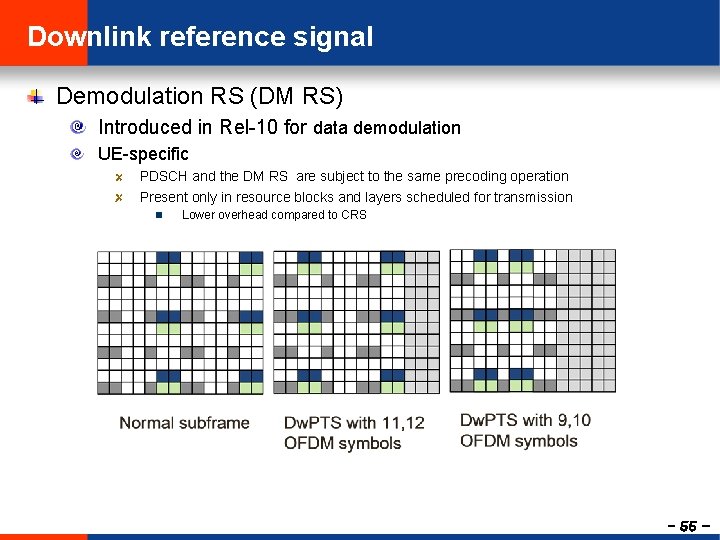
Downlink reference signal Demodulation RS (DM RS) Introduced in Rel-10 for data demodulation UE-specific PDSCH and the DM RS are subject to the same precoding operation Present only in resource blocks and layers scheduled for transmission Lower overhead compared to CRS - 55 -
Downlink MIMO LTE 1, 2, 4 Tx antennas Spatial multiplexing up to 4 layers Closed-loop codebook based precoding Open-loop Multi codewords Spectral efficiency up to 15 bps/Hz Tx diversity SFBC for 2 Tx antennas SFBC + FSTD for 4 Tx antennas Semi-static SU- and MU MIMO switching LTE-Advanced 1, 2, 4, 8 Tx antennas Spatial multiplexing up to 8 layers Closed-loop precoding Multi codewords Spectral efficienty up to 30 bps/Hz Dynamic SU- and MU-MIMO switching - 56 -
LTE – Scheduling - 57 -
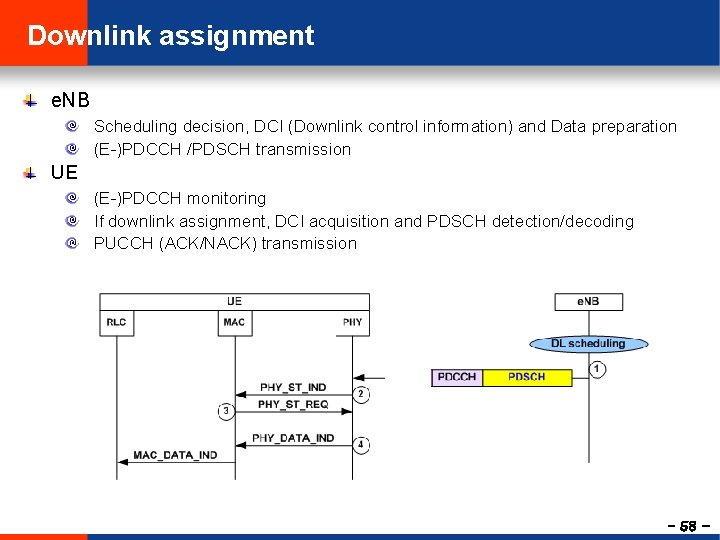
Downlink assignment e. NB Scheduling decision, DCI (Downlink control information) and Data preparation (E-)PDCCH /PDSCH transmission UE (E-)PDCCH monitoring If downlink assignment, DCI acquisition and PDSCH detection/decoding PUCCH (ACK/NACK) transmission - 58 -
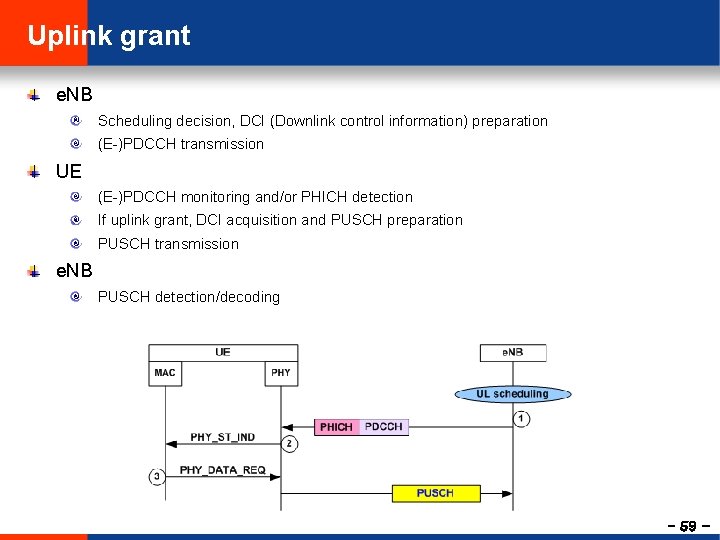
Uplink grant e. NB Scheduling decision, DCI (Downlink control information) preparation (E-)PDCCH transmission UE (E-)PDCCH monitoring and/or PHICH detection If uplink grant, DCI acquisition and PUSCH preparation PUSCH transmission e. NB PUSCH detection/decoding - 59 -
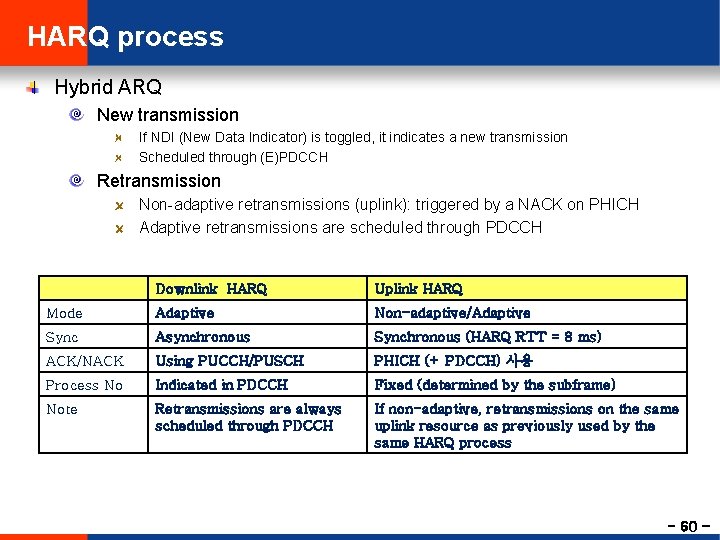
HARQ process Hybrid ARQ New transmission If NDI (New Data Indicator) is toggled, it indicates a new transmission Scheduled through (E)PDCCH Retransmission Non-adaptive retransmissions (uplink): triggered by a NACK on PHICH Adaptive retransmissions are scheduled through PDCCH Downlink HARQ Uplink HARQ Mode Adaptive Non-adaptive/Adaptive Sync Asynchronous Synchronous (HARQ RTT = 8 ms) ACK/NACK Using PUCCH/PUSCH PHICH (+ PDCCH) 사용 Process No Indicated in PDCCH Fixed (determined by the subframe) Note Retransmissions are always scheduled through PDCCH If non-adaptive, retransmissions on the same uplink resource as previously used by the same HARQ process - 60 -
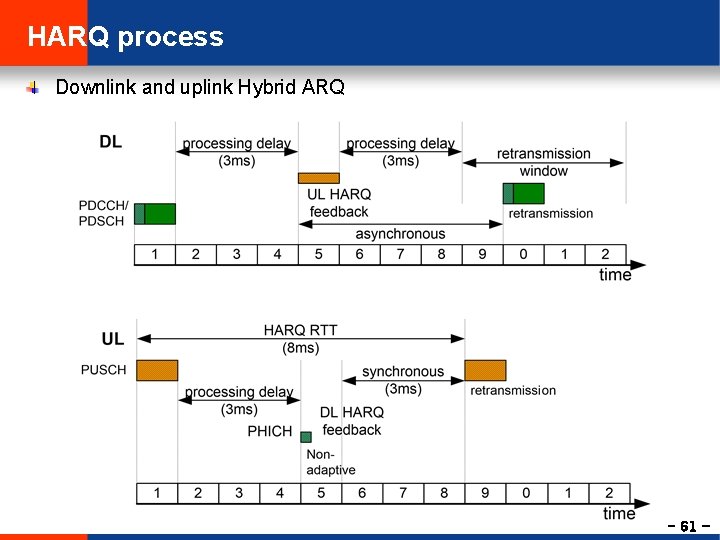
HARQ process Downlink and uplink Hybrid ARQ - 61 -
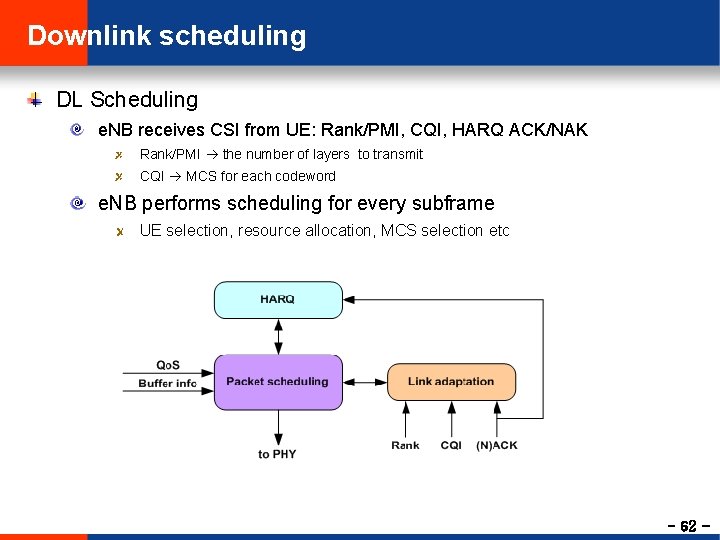
Downlink scheduling DL Scheduling e. NB receives CSI from UE: Rank/PMI, CQI, HARQ ACK/NAK Rank/PMI the number of layers to transmit CQI MCS for each codeword e. NB performs scheduling for every subframe UE selection, resource allocation, MCS selection etc - 62 -
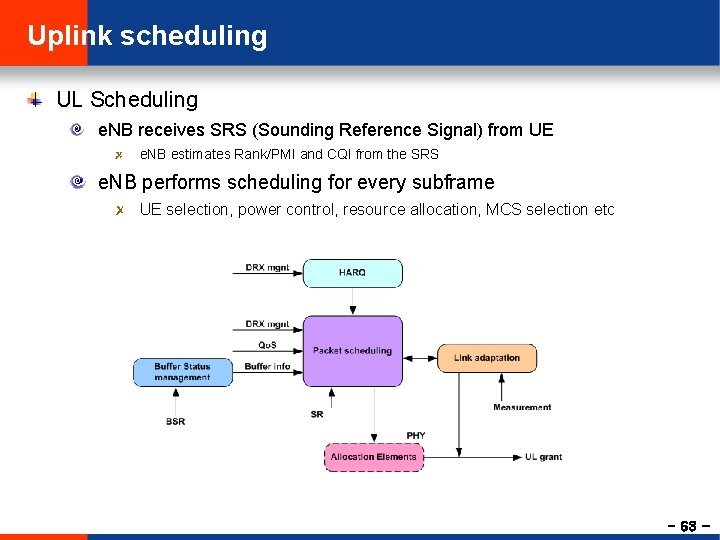
Uplink scheduling UL Scheduling e. NB receives SRS (Sounding Reference Signal) from UE e. NB estimates Rank/PMI and CQI from the SRS e. NB performs scheduling for every subframe UE selection, power control, resource allocation, MCS selection etc - 63 -
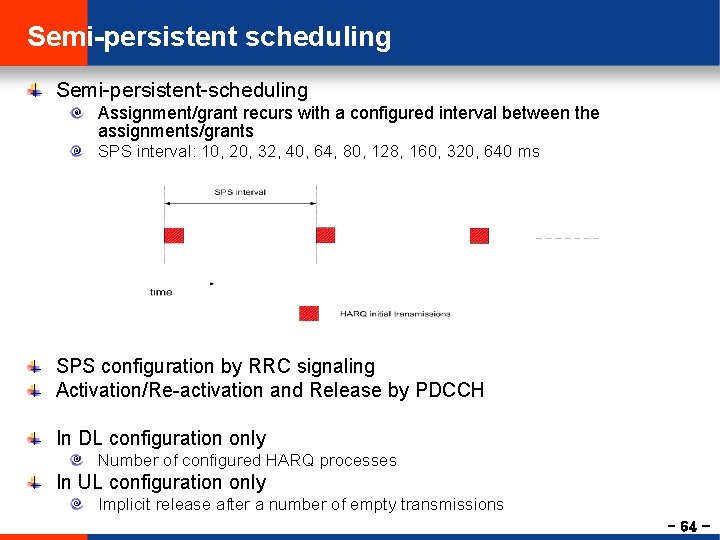
Semi-persistent scheduling Semi-persistent-scheduling Assignment/grant recurs with a configured interval between the assignments/grants SPS interval: 10, 20, 32, 40, 64, 80, 128, 160, 320, 640 ms SPS configuration by RRC signaling Activation/Re-activation and Release by PDCCH In DL configuration only Number of configured HARQ processes In UL configuration only Implicit release after a number of empty transmissions - 64 -
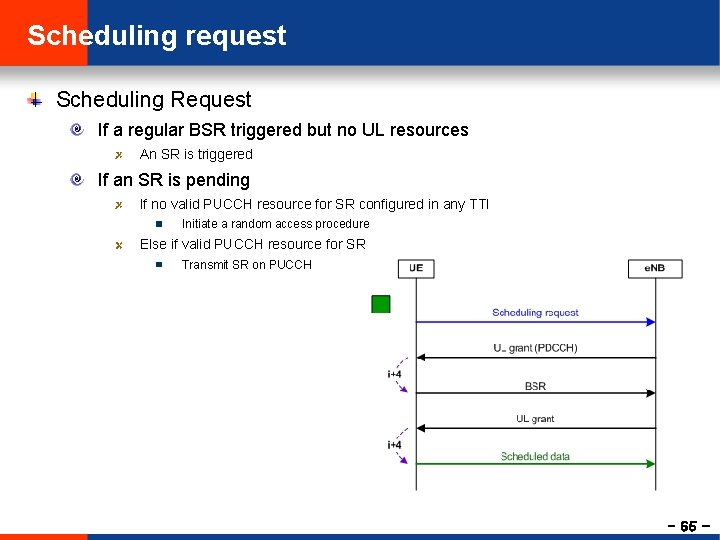
Scheduling request Scheduling Request If a regular BSR triggered but no UL resources An SR is triggered If an SR is pending If no valid PUCCH resource for SR configured in any TTI Initiate a random access procedure Else if valid PUCCH resource for SR Transmit SR on PUCCH - 65 -
Buffer status reporting BSR on a logical-channel group basis A BSR Indicates the amount of data across all logical channels in a logical channel group or all four logical channel groups Regular BSR Triggered if Arrival of UL data with higher priority than the one currently being transmitted Arrival of UL data with no already existing data retx. BSR-Timer expires and the UE has data available for transmission retx. BSR-Timer restarts upon the indication of an uplink grant for new transmission If there are UL resources for new transmission, transmitted on the allocated resources If no UL resources, triggers a Scheduling Request - 66 -
Buffer status reporting Periodic BSR Timer controlled periodic reporting Triggered if periodic. BSR-Timer expires (can be disabled) Transmitted on UL resources allocated for new transmission Padding BSR Transmitted, instead of padding, on UL resources allocated for new transmission if there are enough padding bits At most one Regular/Periodic BSR is reported in a TTI - 67 -
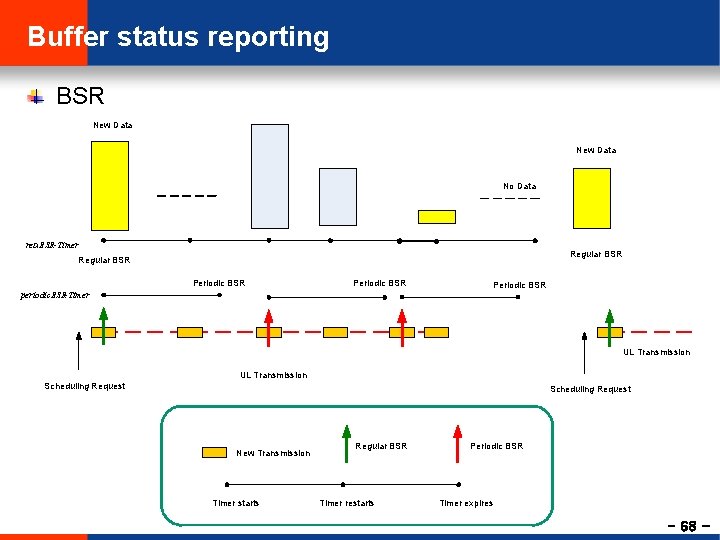
Buffer status reporting BSR New Data No Data retx. BSR-Timer Regular BSR Periodic BSR periodic. BSR-Timer UL Transmission Scheduling Request New Transmission Timer starts Regular BSR Timer restarts Periodic BSR Timer expires - 68 -
UL scheduling logical channel prioritization Logical channel prioritization Applies to a new transmission RRC controls scheduling by signaling for each logical channel Priority: 1, 2, . . 16 Prioritized Bit Rate (PBR): 0, 8, …, 2048 kbps Bucket Size Duration (BSD): 50, 100, …. , 1000 ms UE maintains Bj for each logical channel j Bj = 0 when the logical channel is established Incremented by PBR X TTI duration for each TTI Not exceeding the bucket size of the logical channel j Bj <= Bucket size = PBR x BSD Scheduling prioritization Step 1: All the logical channels with Bj > 0 are allocated resources in a decreasing priority order until meeting their Bj Step 2: Bj is decremented by the total size of MAC SDUs served to the logical channel j Step 3: if any resources remain, all the logical channels are served in a strict decreasing priority order - 69 -
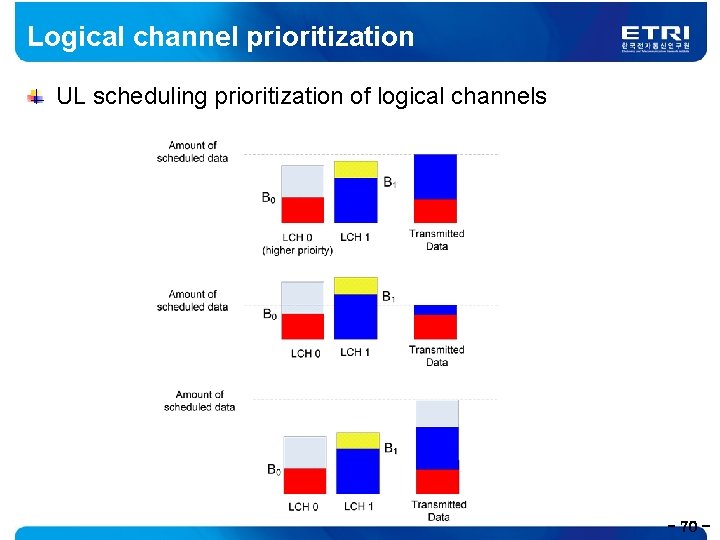
Logical channel prioritization UL scheduling prioritization of logical channels - 70 -

- Slides: 71