
Outline Lecture 1 part 1 Motivation Model Checking
- Slides: 17
Outline Lecture 1, part 1 • Motivation • Model Checking Lecture 1, part 2 • State/Event-based software model checking Lecture 2 • Component Substitutability
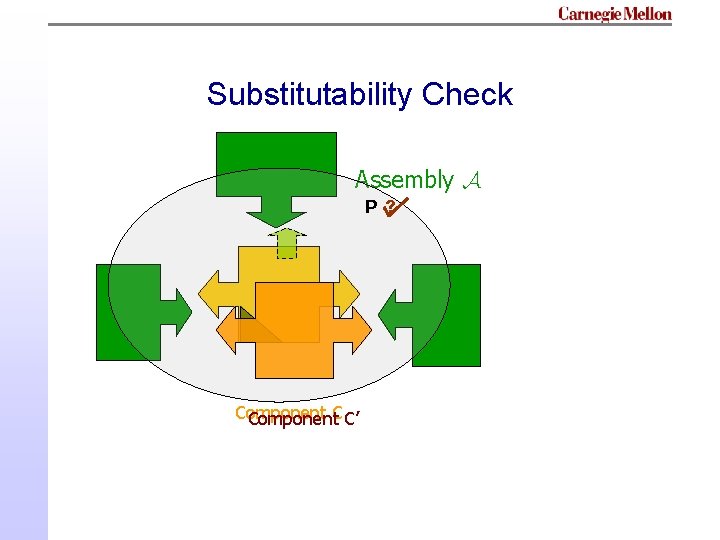
Substitutability Check Assembly A P ? Component. C C’
Motivation • Component-based Software – Software modules shipped by separate developers – An assembly consists of several components – Undergo several updates/bug-fixes during their lifecycle • Component assembly verification – Necessary on update of any component – High verification costs of global properties – Instead check for substitutability of new component
Substitutability Check • Given old and new components C, C’ and assembly A – Check if C’ is substitutable for C in A • Two phases: – Containment check • All behaviors of the previous component contained in new one – Compatibility check • Safety with respect to other components in assembly: all global specifications satisfied • Formulation – Obtain a finite behavioral model of all components by abstraction: labeled kripke structures – Use regular language inference in combination with a model checker
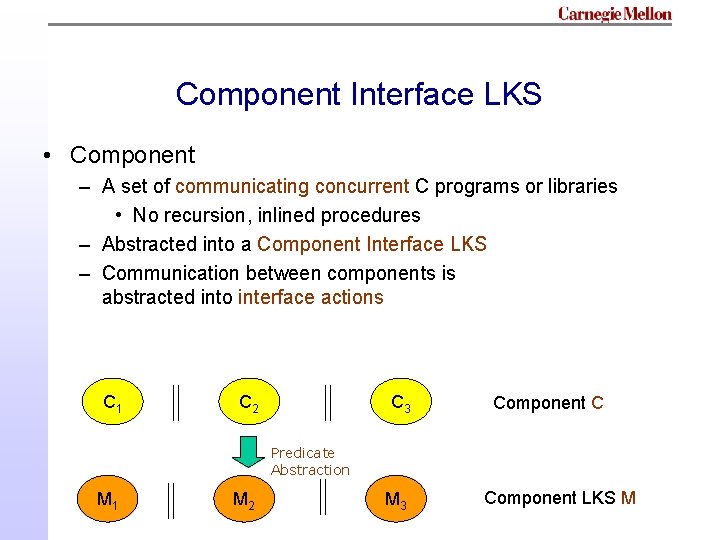
Component Interface LKS • Component – A set of communicating concurrent C programs or libraries • No recursion, inlined procedures – Abstracted into a Component Interface LKS – Communication between components is abstracted into interface actions C 1 C 2 C 3 Component C Predicate Abstraction M 1 M 2 M 3 Component LKS M
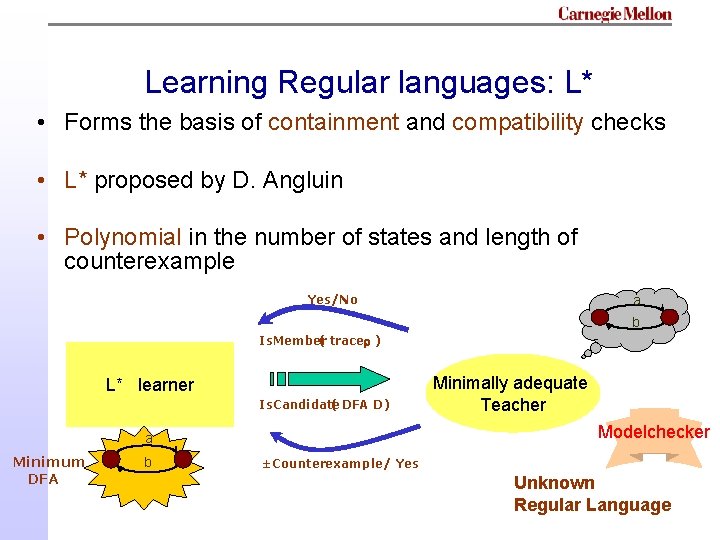
Learning Regular languages: L* • Forms the basis of containment and compatibility checks • L* proposed by D. Angluin • Polynomial in the number of states and length of counterexample Yes/No a b Is. Member ( trace ) L* learner Is. Candidate ( DFA D) Modelchecker a Minimum DFA b Minimally adequate Teacher ±Counterexample/ Yes Unknown Regular Language
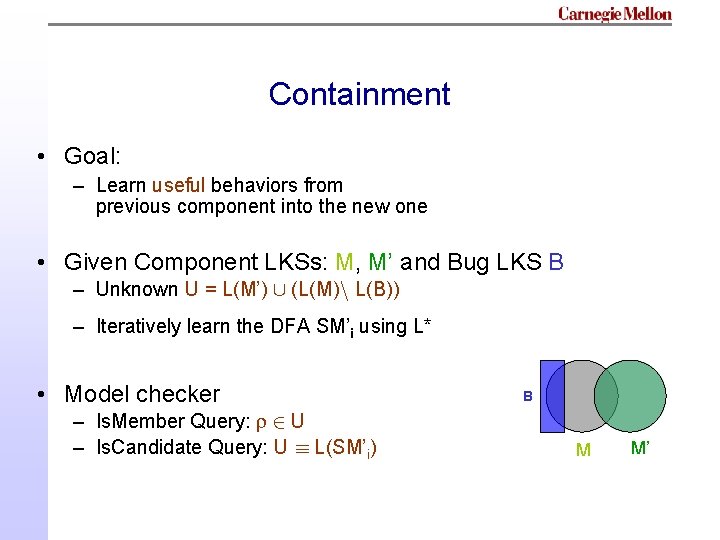
Containment • Goal: – Learn useful behaviors from previous component into the new one • Given Component LKSs: M, M’ and Bug LKS B – Unknown U = L(M’) [ (L(M)n L(B)) – Iteratively learn the DFA SM’i using L* • Model checker – Is. Member Query: 2 U – Is. Candidate Query: U ´ L(SM’i) B M M’
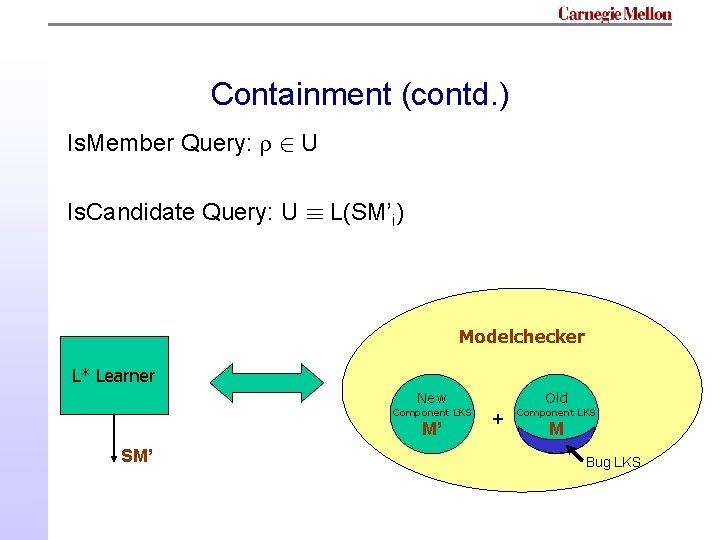
Containment (contd. ) Is. Member Query: 2 U Is. Candidate Query: U ´ L(SM’i) Modelchecker L* Learner New Component LKS M’ SM’ Old + Component LKS M Bug LKS
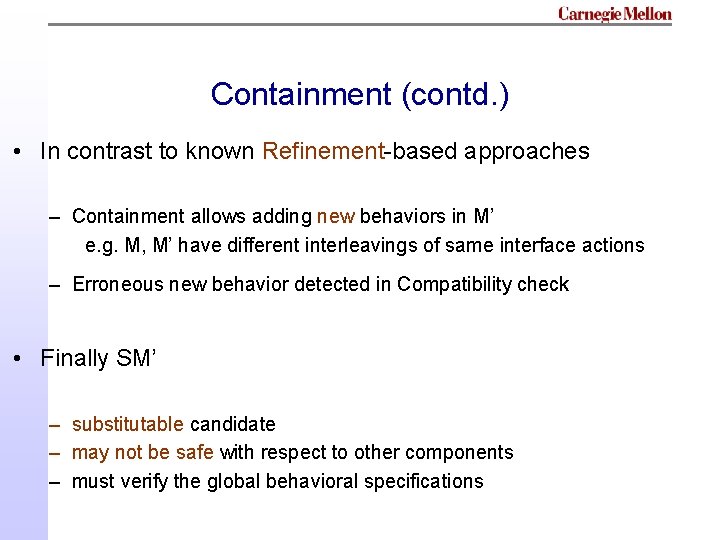
Containment (contd. ) • In contrast to known Refinement-based approaches – Containment allows adding new behaviors in M’ e. g. M, M’ have different interleavings of same interface actions – Erroneous new behavior detected in Compatibility check • Finally SM’ – substitutable candidate – may not be safe with respect to other components – must verify the global behavioral specifications
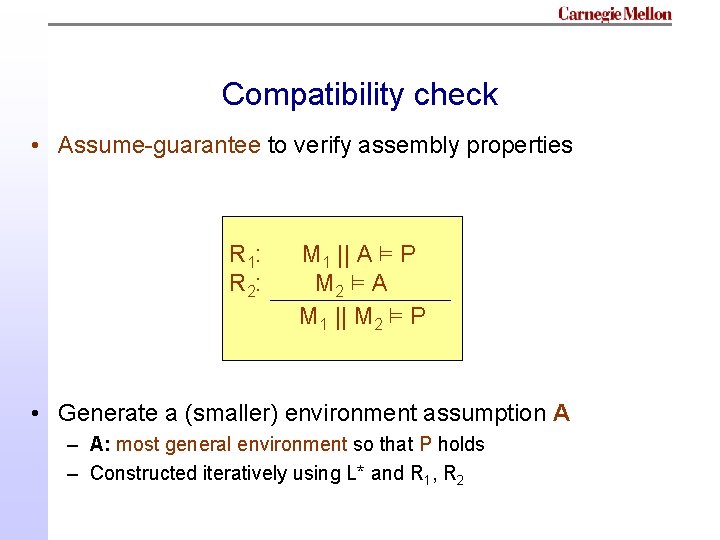
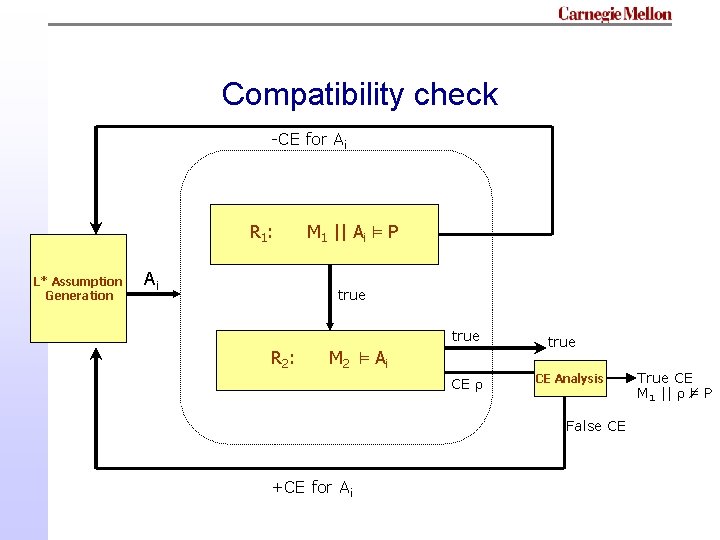
Compatibility check • Assume-guarantee to verify assembly properties R 1: R 2: M 1 || A ² P M 2 ² A M 1 || M 2 ² P • Generate a (smaller) environment assumption A – A: most general environment so that P holds – Constructed iteratively using L* and R 1, R 2
Compatibility check -CE for Ai R 1 : L* Assumption Generation Ai M 1 || Ai ² P true R 2 : M 2 ² Ai CE true CE Analysis False CE +CE for Ai True CE M 1 || 2 P
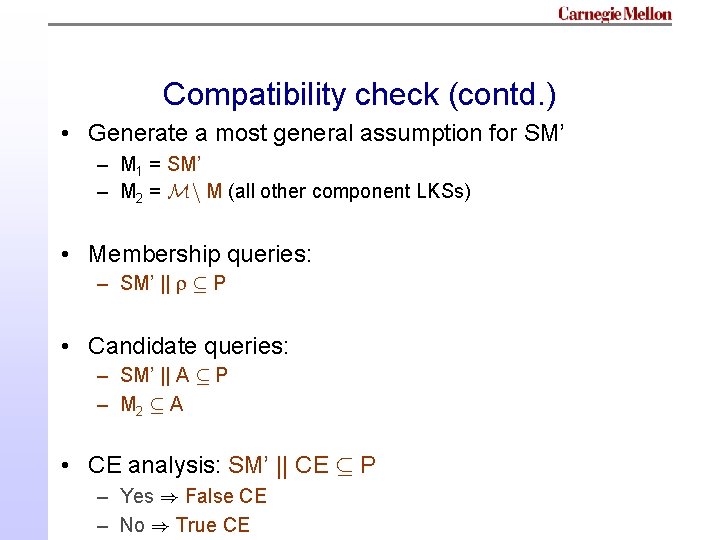
Compatibility check (contd. ) • Generate a most general assumption for SM’ – M 1 = SM’ – M 2 = Mn M (all other component LKSs) • Membership queries: – SM’ || µ P • Candidate queries: – SM’ || A µ P – M 2 µ A • CE analysis: SM’ || CE µ P – Yes ) False CE – No ) True CE
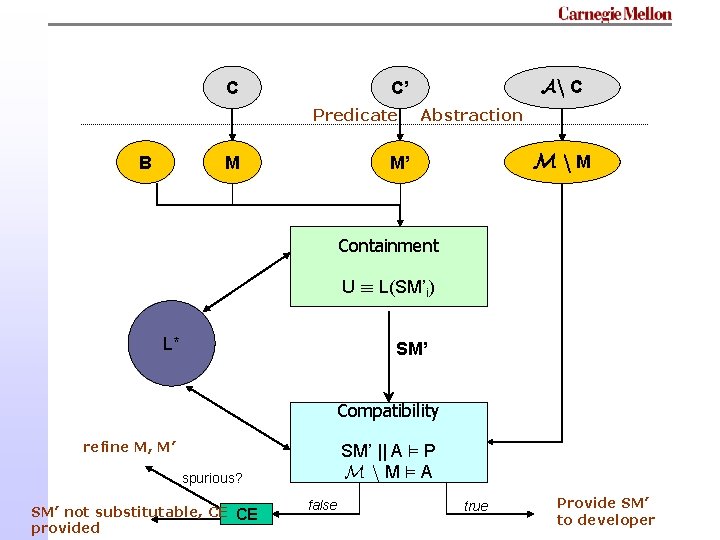
CEGAR • Compatibility check infers – Either SM’ is substitutable – Or counterexample CE • CE may be spurious wrt C, C’ – CE is present in component LKS M or M’ – Must refine M, M’ – Repeat substitutability check
C Predicate B An C C’ M Abstraction Mn. M M’ Containment U ´ L(SM’i) L* SM’ Compatibility refine M, M’ SM’ || A ² P Mn. M²A spurious? SM’ not substitutable, CE CE provided false true Provide SM’ to developer
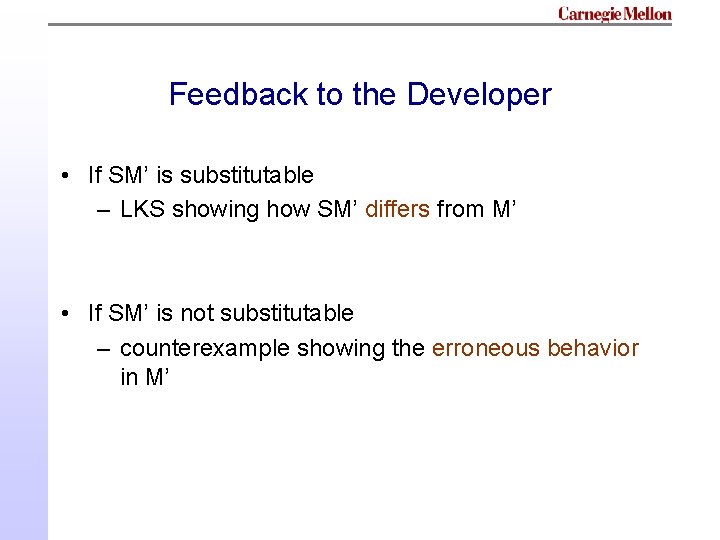
Feedback to the Developer • If SM’ is substitutable – LKS showing how SM’ differs from M’ • If SM’ is not substitutable – counterexample showing the erroneous behavior in M’
Experiments • Prototype implementation in Com. Fo. RT framework • ABB IPC component assembly – modified Write. Message. To. Queue component – checked for substitutability inside the assembly of four components (read, write, queue, critical section)
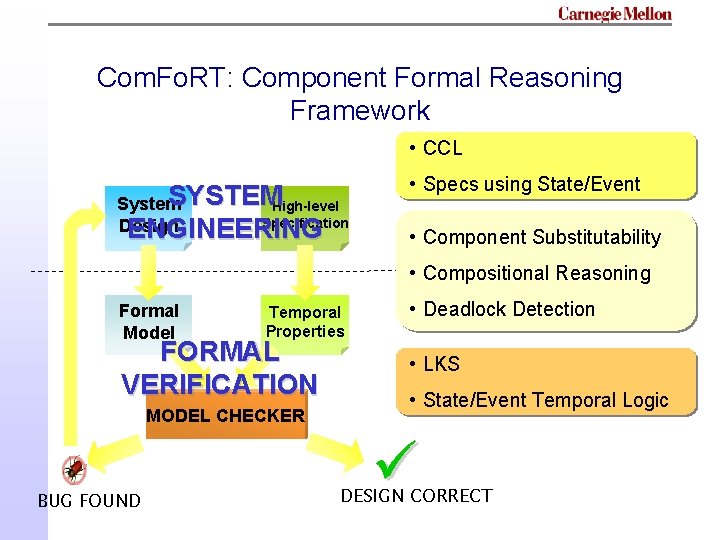
Com. Fo. RT: Component Formal Reasoning Framework • CCL SYSTEMHigh-level System Specification Design ENGINEERING • Specs using State/Event • Component Substitutability • Compositional Reasoning Formal Model Temporal Properties FORMAL VERIFICATION MODEL CHECKER BUG FOUND • Deadlock Detection • LKS • State/Event Temporal Logic DESIGN CORRECT