
OUTLINE Introduction Review of Berry phase and conception


OUTLINE + Introduction -Review of Berry phase and conception of monopole + Berry phase of atom-molecule conversion system -Berry phase under mean-field treatment -Fractional monopole -Many-body effect of Berry phase -Hannay angle + Summary and discussion
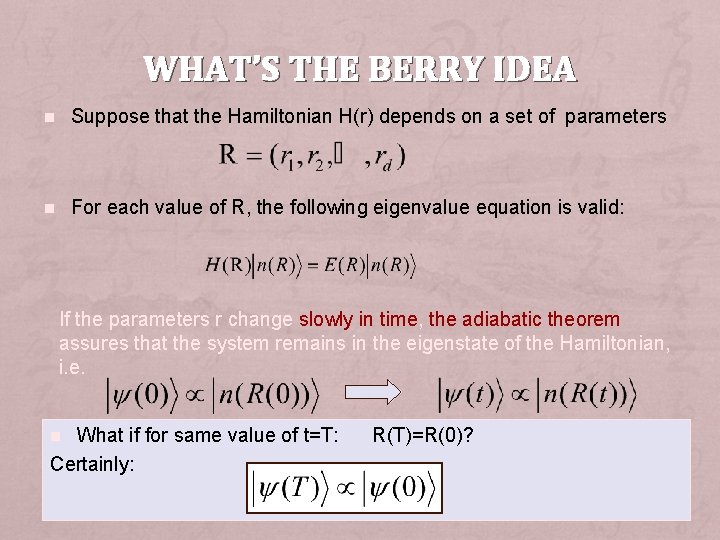
WHAT’S THE BERRY IDEA n Suppose that the Hamiltonian H(r) depends on a set of parameters n For each value of R, the following eigenvalue equation is valid: If the parameters r change slowly in time, the adiabatic theorem assures that the system remains in the eigenstate of the Hamiltonian, i. e. What if for same value of t=T: Certainly: n R(T)=R(0)? 3
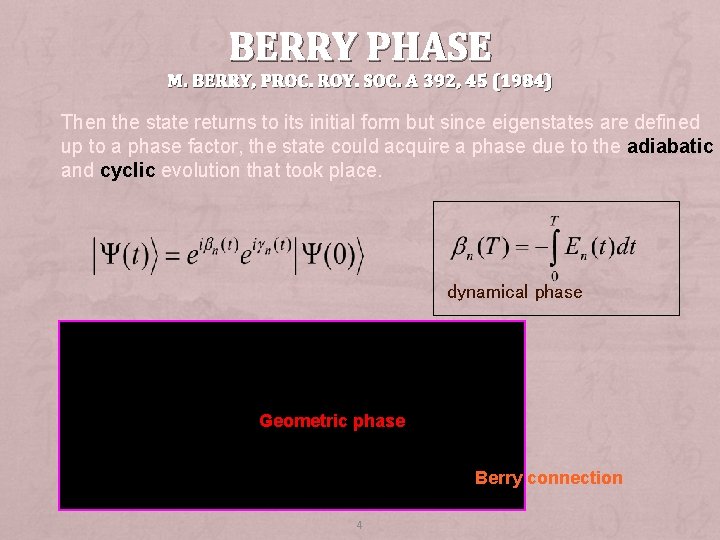
BERRY PHASE M. BERRY, PROC. ROY. SOC. A 392, 45 (1984) Then the state returns to its initial form but since eigenstates are defined up to a phase factor, the state could acquire a phase due to the adiabatic and cyclic evolution that took place. dynamical phase Geometric phase Berry connection 4
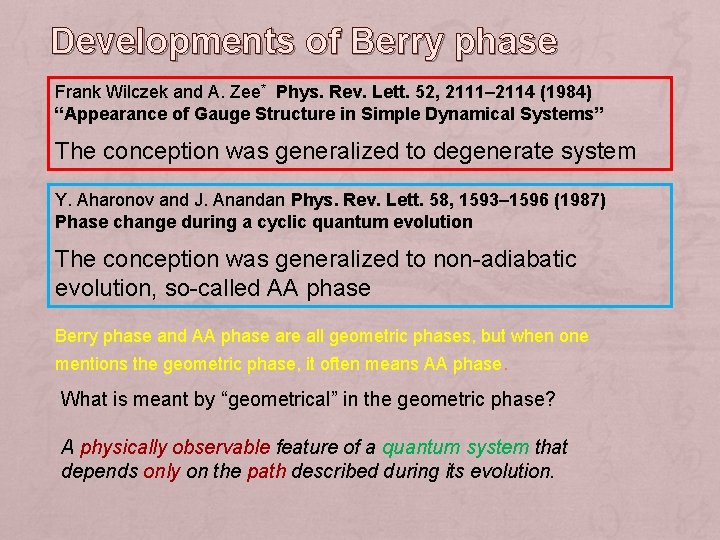
Developments of Berry phase Frank Wilczek and A. Zee* Phys. Rev. Lett. 52, 2111– 2114 (1984) “Appearance of Gauge Structure in Simple Dynamical Systems” The conception was generalized to degenerate system Y. Aharonov and J. Anandan Phys. Rev. Lett. 58, 1593– 1596 (1987) Phase change during a cyclic quantum evolution The conception was generalized to non-adiabatic evolution, so-called AA phase Berry phase and AA phase are all geometric phases, but when one mentions the geometric phase, it often means AA phase. What is meant by “geometrical” in the geometric phase? A physically observable feature of a quantum system that depends only on the path described during its evolution.
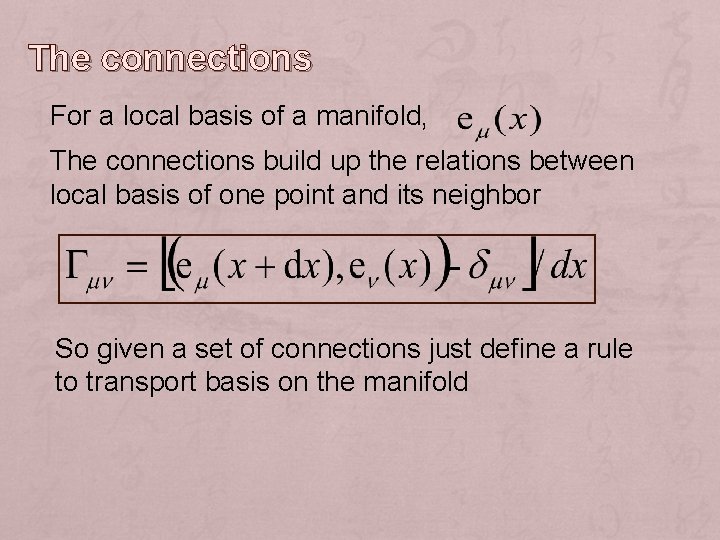
The connections For a local basis of a manifold, The connections build up the relations between local basis of one point and its neighbor So given a set of connections just define a rule to transport basis on the manifold
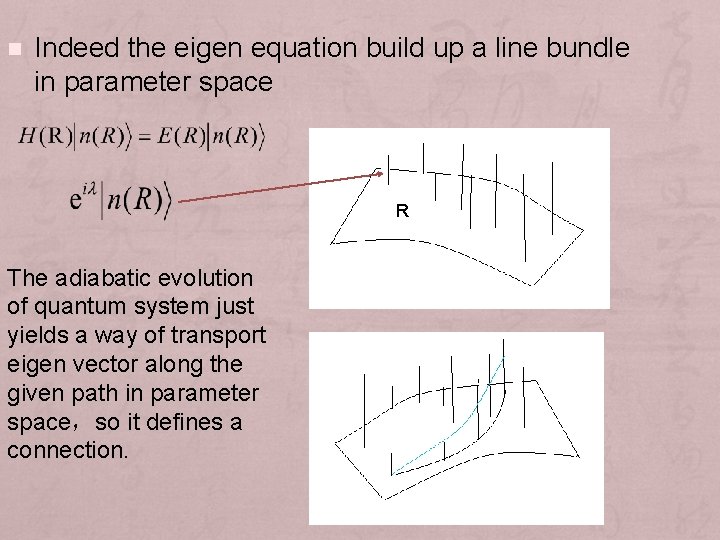
n Indeed the eigen equation build up a line bundle in parameter space R The adiabatic evolution of quantum system just yields a way of transport eigen vector along the given path in parameter space,so it defines a connection.
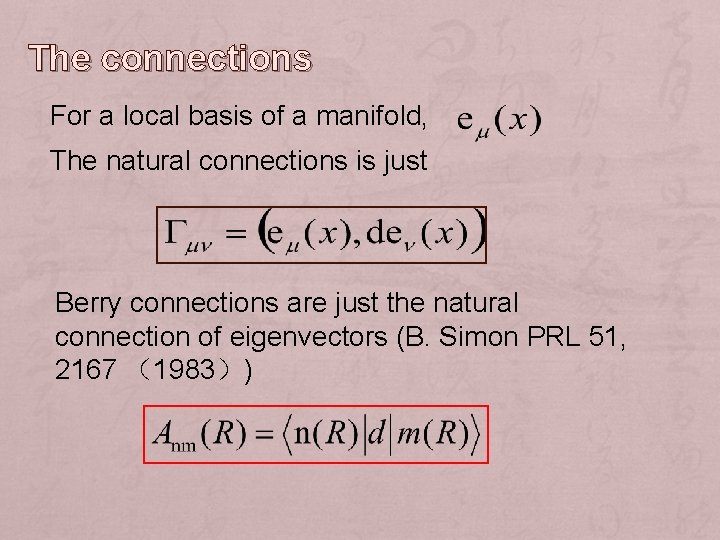
The connections For a local basis of a manifold, The natural connections is just Berry connections are just the natural connection of eigenvectors (B. Simon PRL 51, 2167 (1983))
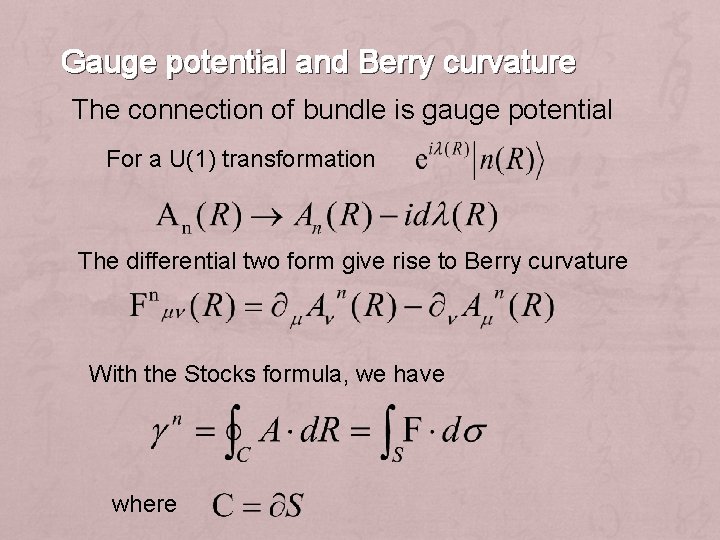
Gauge potential and Berry curvature The connection of bundle is gauge potential For a U(1) transformation The differential two form give rise to Berry curvature With the Stocks formula, we have where
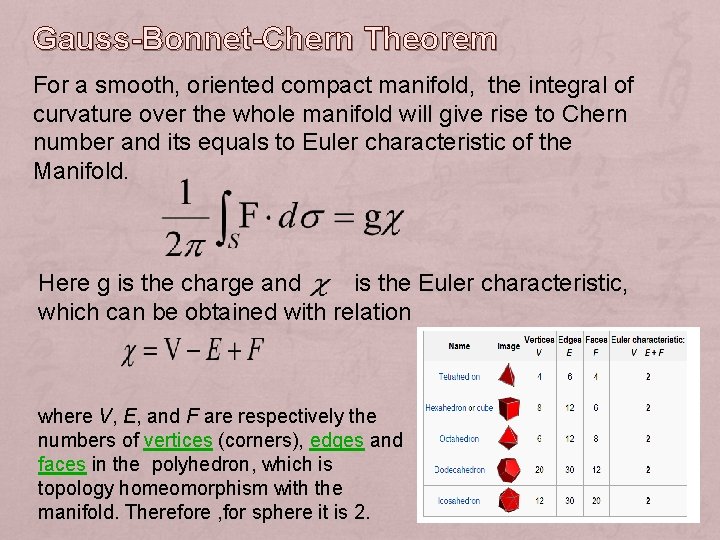
Gauss-Bonnet-Chern Theorem For a smooth, oriented compact manifold, the integral of curvature over the whole manifold will give rise to Chern number and its equals to Euler characteristic of the Manifold. Here g is the charge and is the Euler characteristic, which can be obtained with relation where V, E, and F are respectively the numbers of vertices (corners), edges and faces in the polyhedron, which is topology homeomorphism with the manifold. Therefore , for sphere it is 2.
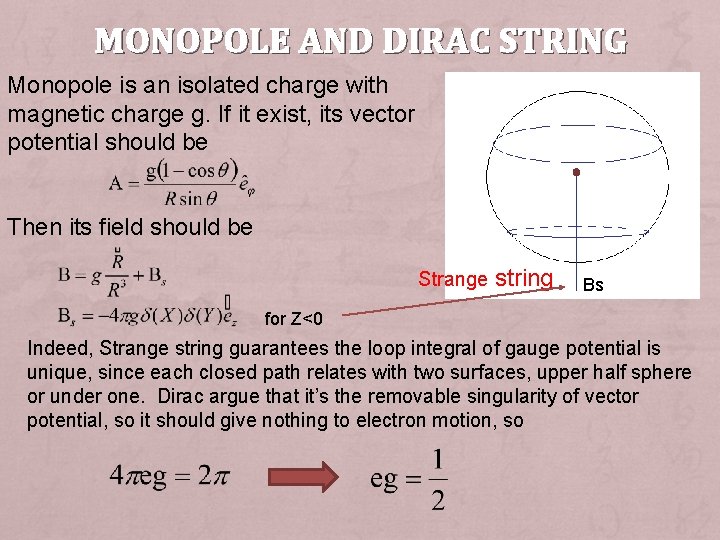
MONOPOLE AND DIRAC STRING Monopole is an isolated charge with magnetic charge g. If it exist, its vector potential should be Then its field should be Strange string Bs for Z<0 Indeed, Strange string guarantees the loop integral of gauge potential is unique, since each closed path relates with two surfaces, upper half sphere or under one. Dirac argue that it’s the removable singularity of vector potential, so it should give nothing to electron motion, so
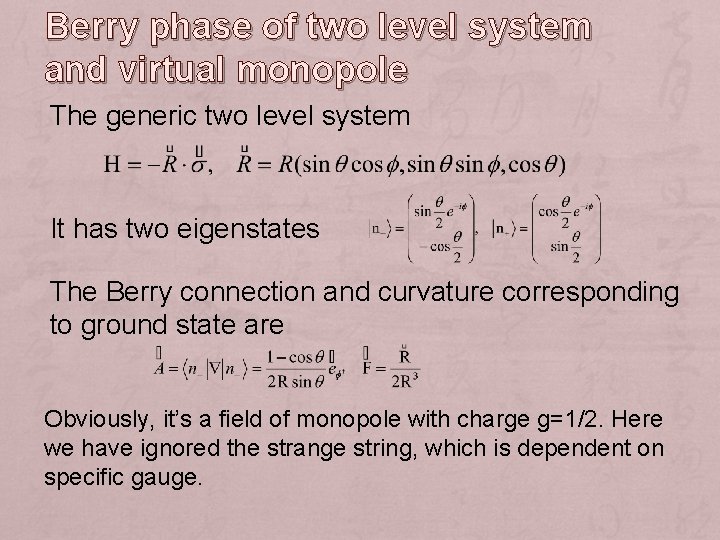
Berry phase of two level system and virtual monopole The generic two level system It has two eigenstates The Berry connection and curvature corresponding to ground state are Obviously, it’s a field of monopole with charge g=1/2. Here we have ignored the strange string, which is dependent on specific gauge.
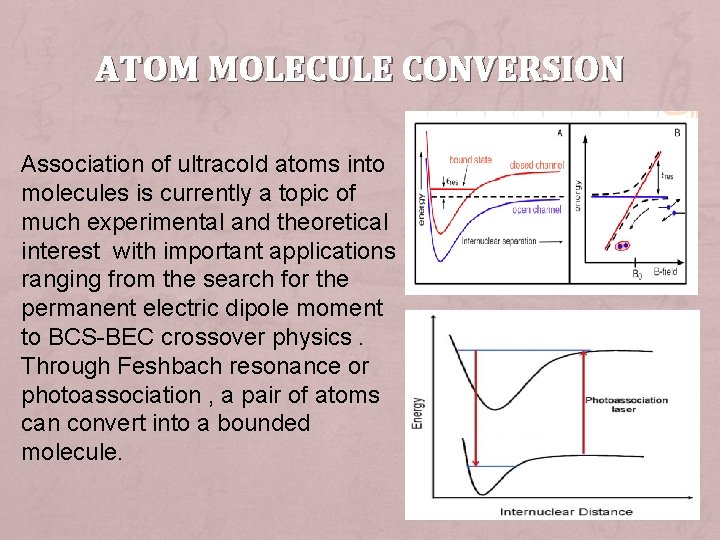
ATOM MOLECULE CONVERSION Association of ultracold atoms into molecules is currently a topic of much experimental and theoretical interest with important applications ranging from the search for the permanent electric dipole moment to BCS-BEC crossover physics. Through Feshbach resonance or photoassociation , a pair of atoms can convert into a bounded molecule.
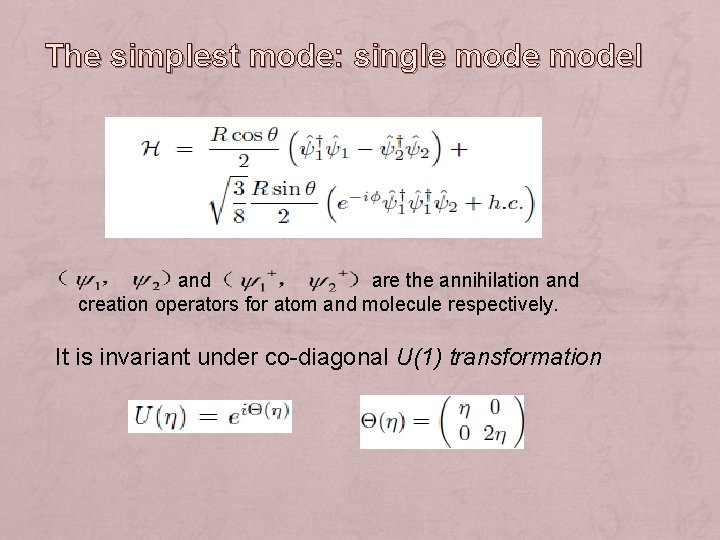
The simplest mode: single model and are the annihilation and creation operators for atom and molecule respectively. It is invariant under co-diagonal U(1) transformation
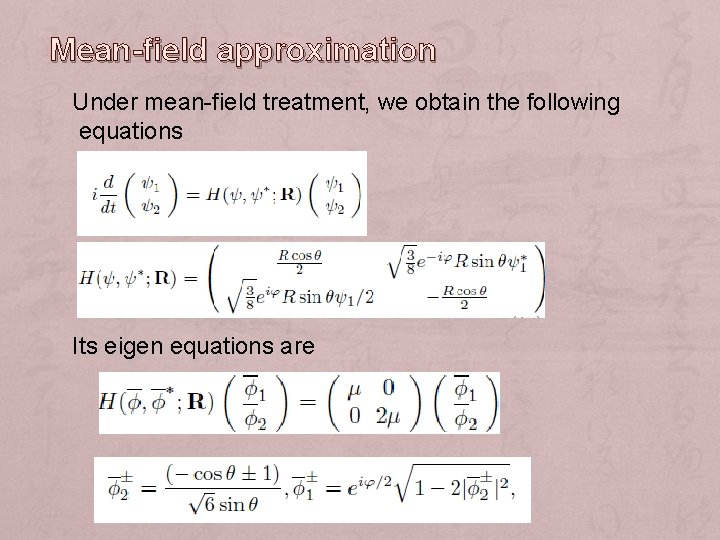
Mean-field approximation Under mean-field treatment, we obtain the following equations Its eigen equations are
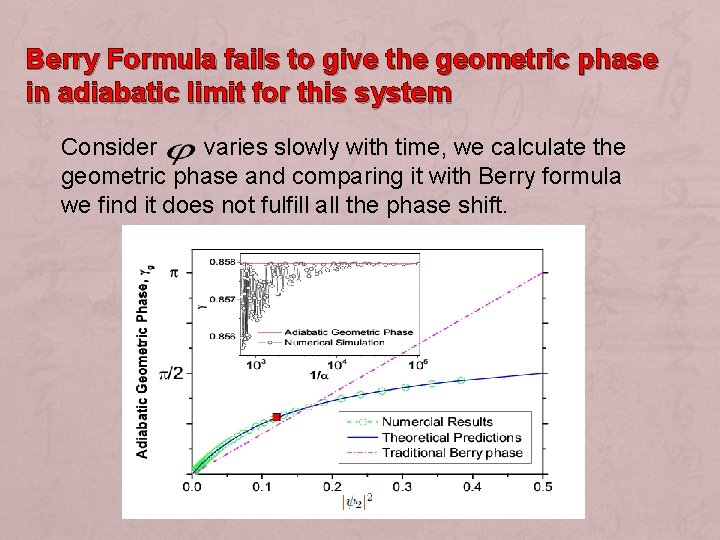
Berry Formula fails to give the geometric phase in adiabatic limit for this system Consider varies slowly with time, we calculate the geometric phase and comparing it with Berry formula we find it does not fulfill all the phase shift.
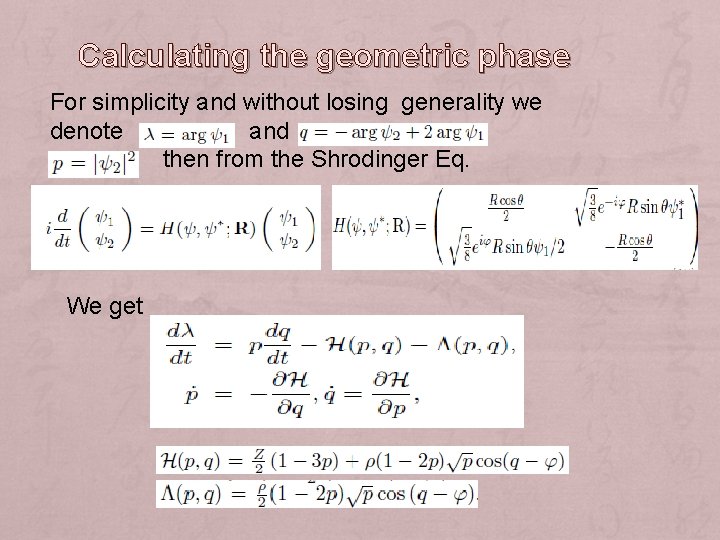
Calculating the geometric phase For simplicity and without losing generality we denote and then from the Shrodinger Eq. We get
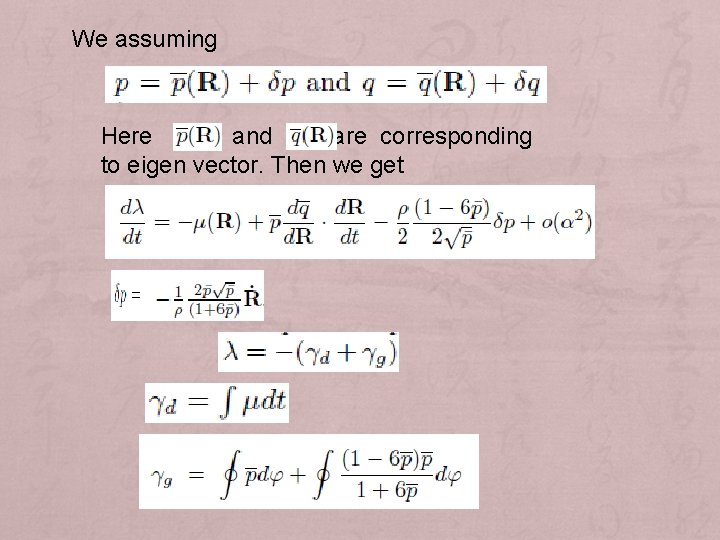
We assuming Here and are corresponding to eigen vector. Then we get
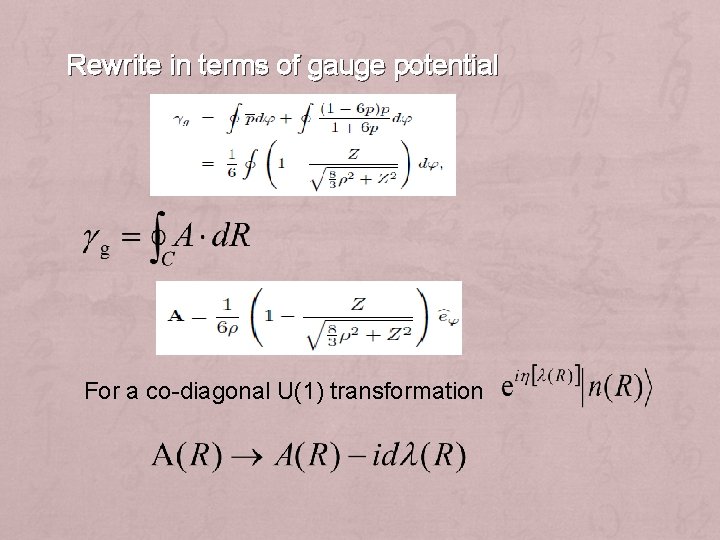
Rewrite in terms of gauge potential For a co-diagonal U(1) transformation
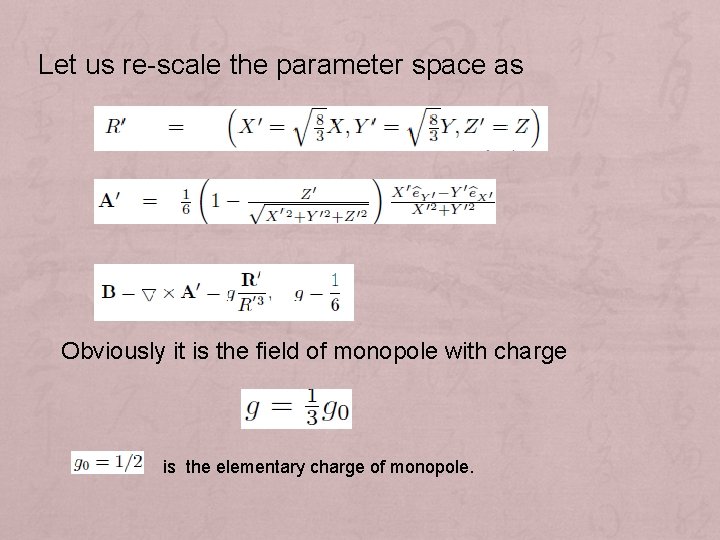
Let us re-scale the parameter space as Obviously it is the field of monopole with charge is the elementary charge of monopole.
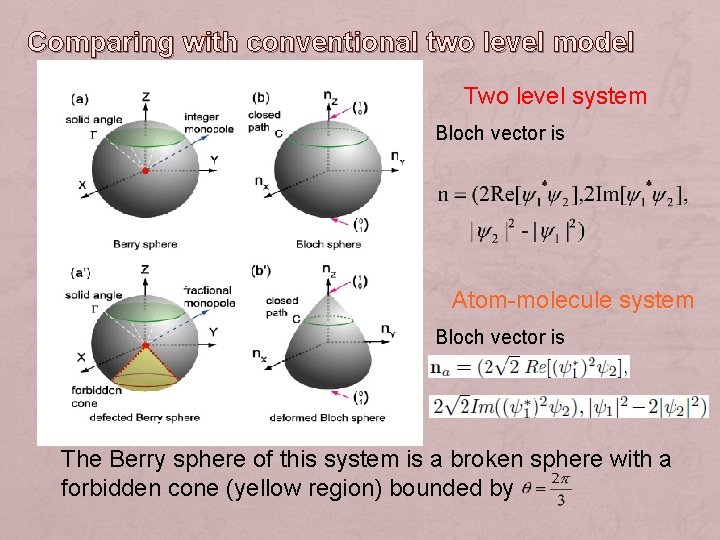
Comparing with conventional two level model Two level system Bloch vector is Atom-molecule system Bloch vector is The Berry sphere of this system is a broken sphere with a forbidden cone (yellow region) bounded by
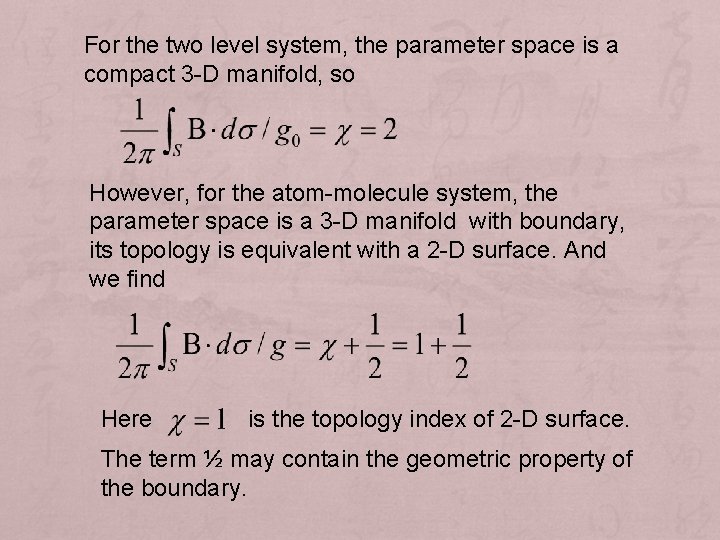
For the two level system, the parameter space is a compact 3 -D manifold, so However, for the atom-molecule system, the parameter space is a 3 -D manifold with boundary, its topology is equivalent with a 2 -D surface. And we find Here is the topology index of 2 -D surface. The term ½ may contain the geometric property of the boundary.
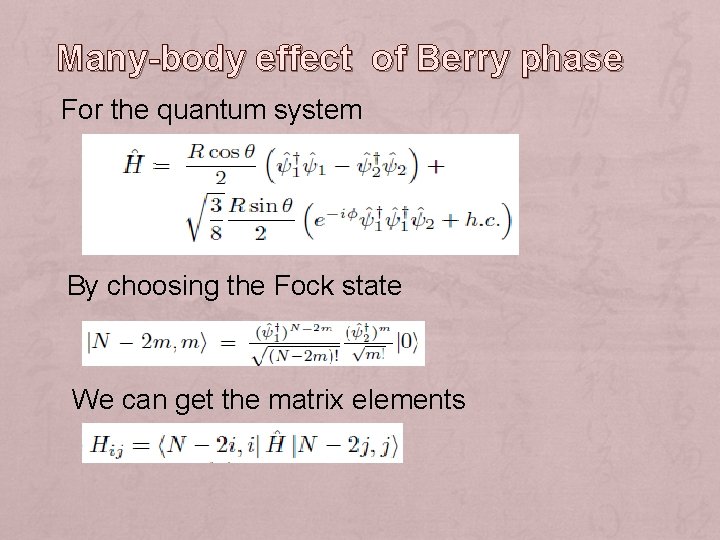
Many-body effect of Berry phase For the quantum system By choosing the Fock state We can get the matrix elements
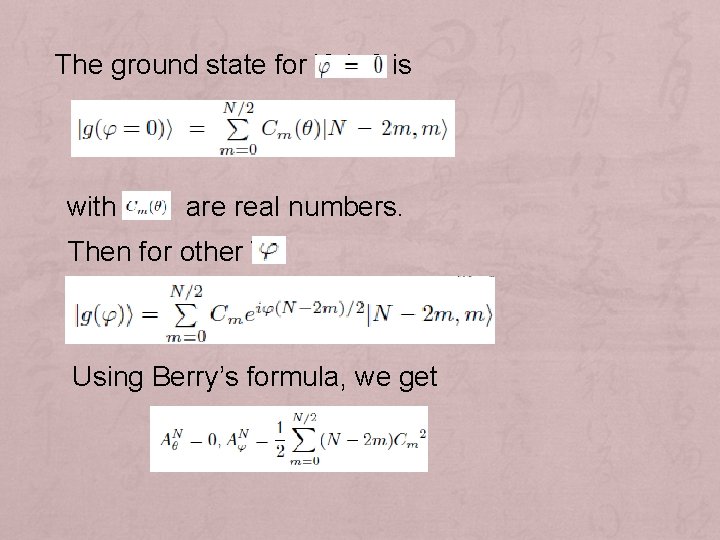
The ground state for fei=0 is with are real numbers. Then for other fei Using Berry’s formula, we get
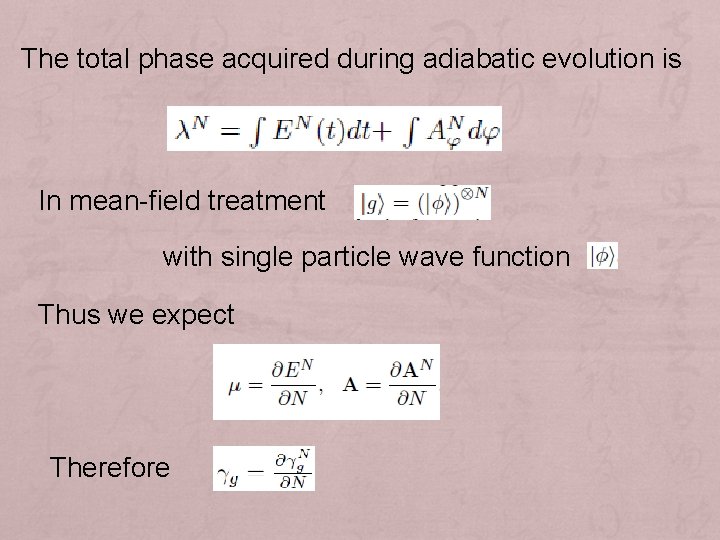
The total phase acquired during adiabatic evolution is In mean-field treatment with single particle wave function Thus we expect Therefore
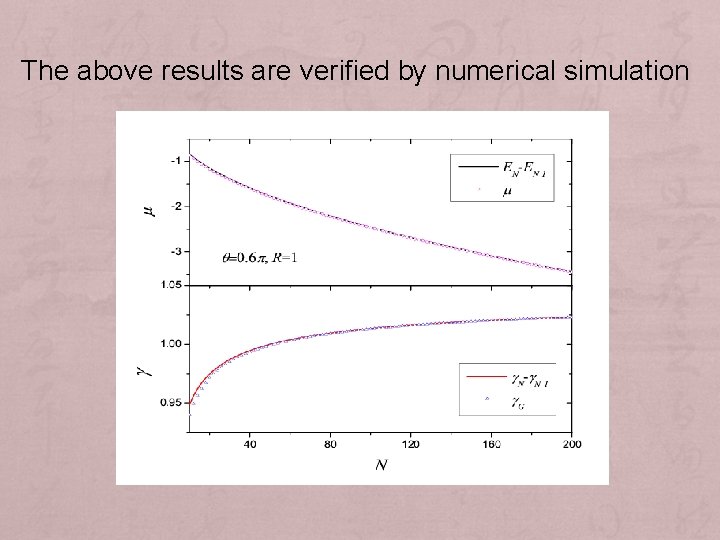
The above results are verified by numerical simulation
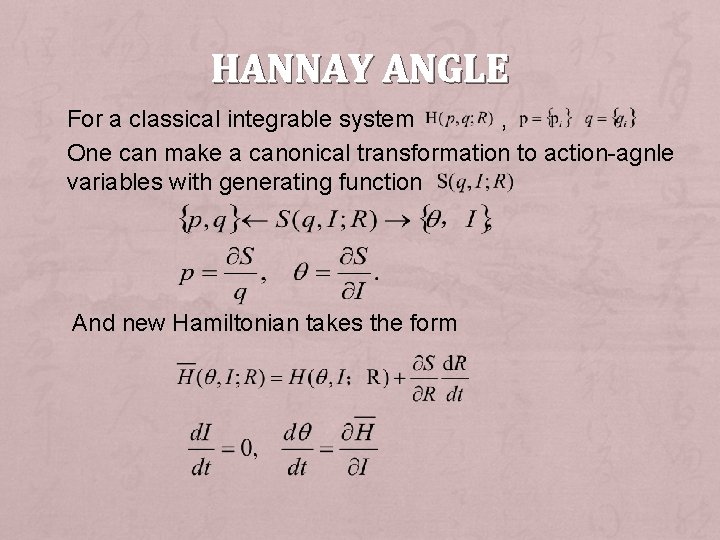
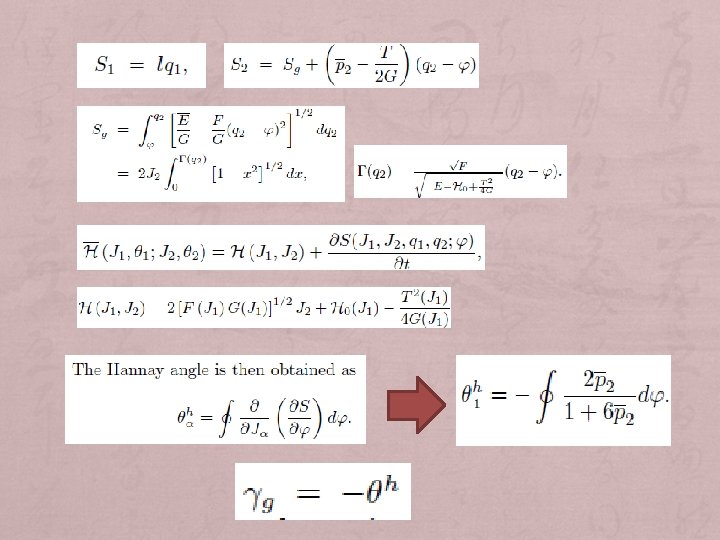
HANNAY ANGLE For a classical integrable system , One can make a canonical transformation to action-agnle variables with generating function And new Hamiltonian takes the form
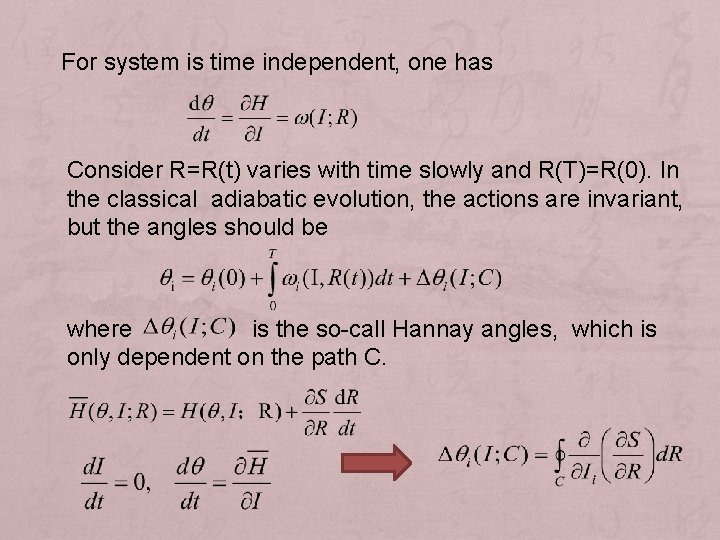
For system is time independent, one has Consider R=R(t) varies with time slowly and R(T)=R(0). In the classical adiabatic evolution, the actions are invariant, but the angles should be where is the so-call Hannay angles, which is only dependent on the path C.
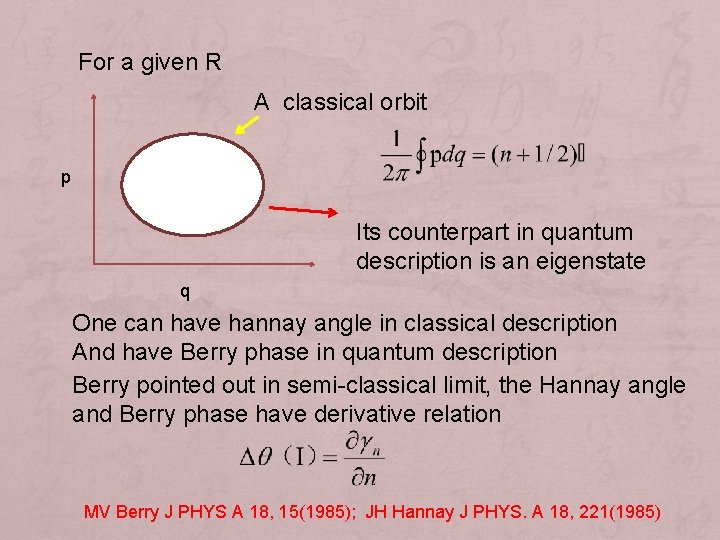
For a given R A classical orbit p Its counterpart in quantum description is an eigenstate q One can have hannay angle in classical description And have Berry phase in quantum description Berry pointed out in semi-classical limit, the Hannay angle and Berry phase have derivative relation MV Berry J PHYS A 18, 15(1985); JH Hannay J PHYS. A 18, 221(1985)
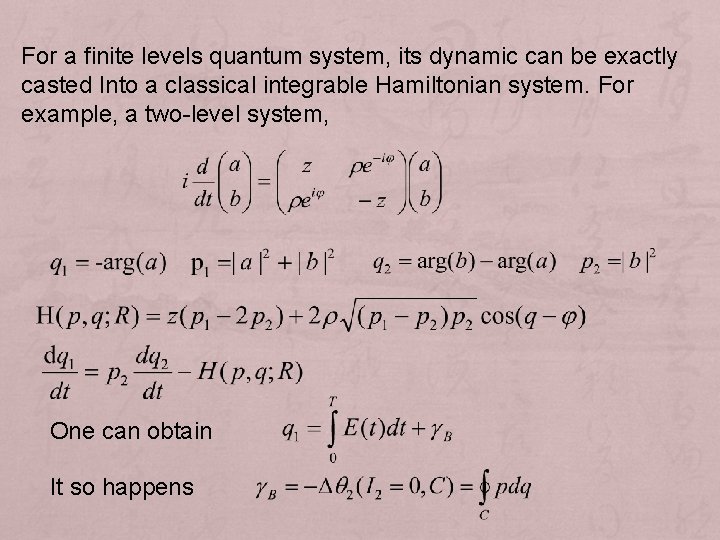
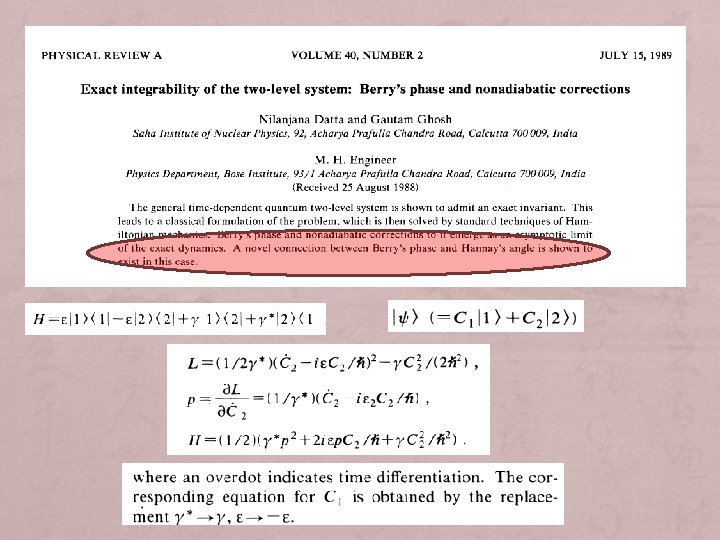
For a finite levels quantum system, its dynamic can be exactly casted Into a classical integrable Hamiltonian system. For example, a two-level system, One can obtain It so happens
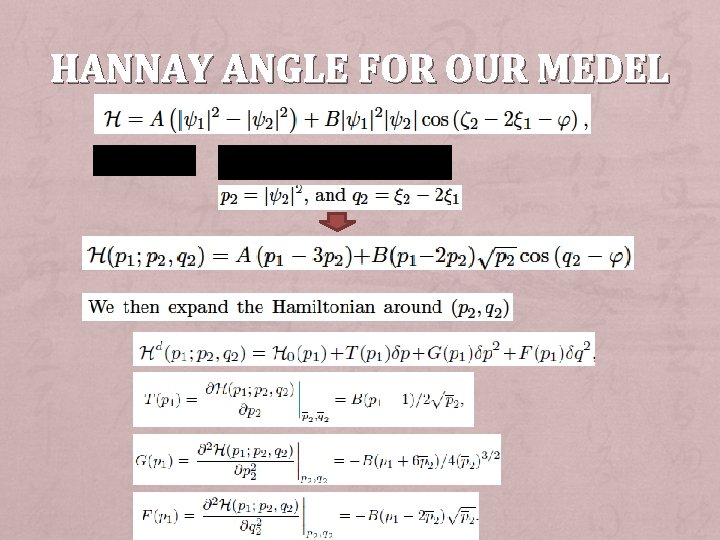
HANNAY ANGLE FOR OUR MEDEL
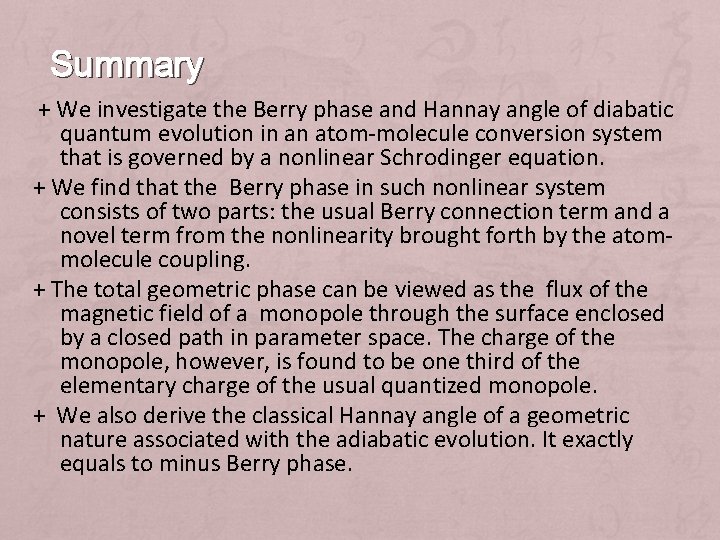
Summary + We investigate the Berry phase and Hannay angle of diabatic quantum evolution in an atom-molecule conversion system that is governed by a nonlinear Schrodinger equation. + We find that the Berry phase in such nonlinear system consists of two parts: the usual Berry connection term and a novel term from the nonlinearity brought forth by the atommolecule coupling. + The total geometric phase can be viewed as the flux of the magnetic field of a monopole through the surface enclosed by a closed path in parameter space. The charge of the monopole, however, is found to be one third of the elementary charge of the usual quantized monopole. + We also derive the classical Hannay angle of a geometric nature associated with the adiabatic evolution. It exactly equals to minus Berry phase.

Thanks!
- Slides: 35