
Outline Introduction Music Information Retrieval Classification Process Steps
- Slides: 28
Outline • • Introduction Music Information Retrieval Classification Process Steps Pitch Histograms Multiple Pitch Detection Algorithm Musical Genre Classification Implementation Future Work
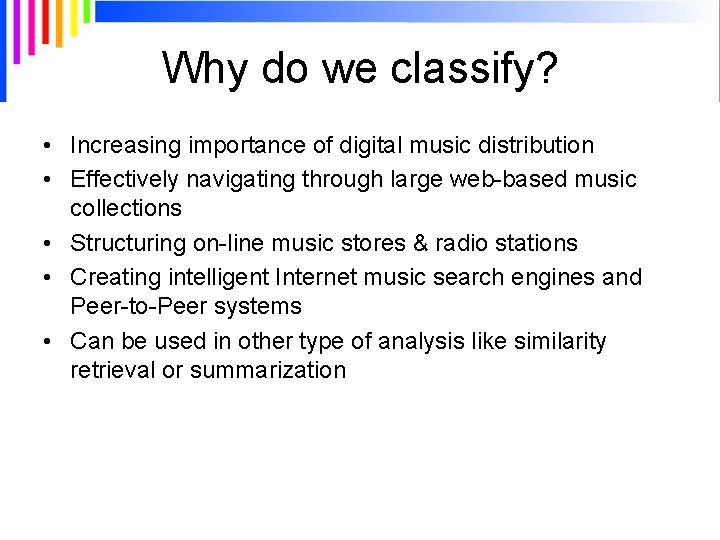
Why do we classify? • Increasing importance of digital music distribution • Effectively navigating through large web-based music collections • Structuring on-line music stores & radio stations • Creating intelligent Internet music search engines and Peer-to-Peer systems • Can be used in other type of analysis like similarity retrieval or summarization
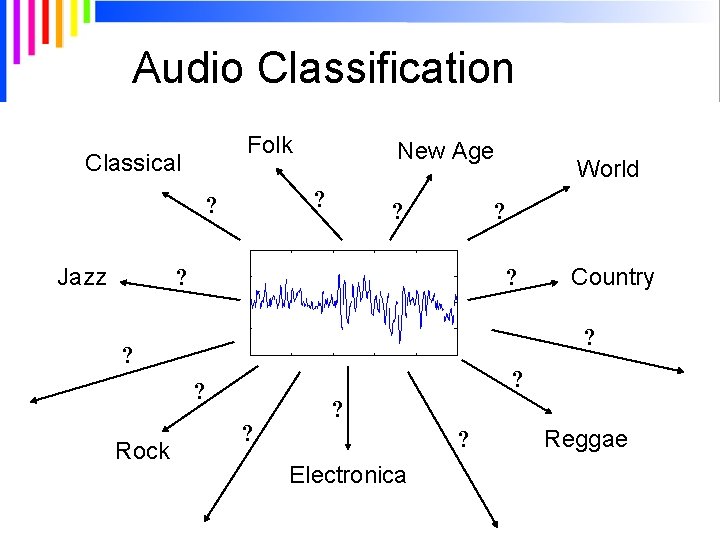
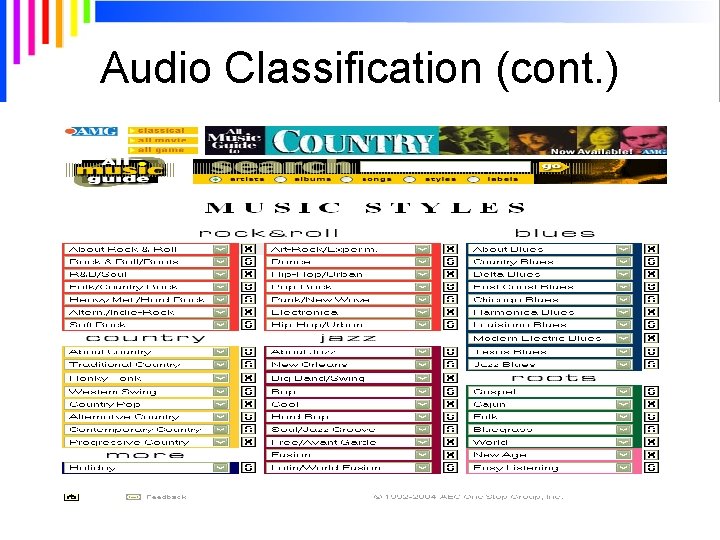
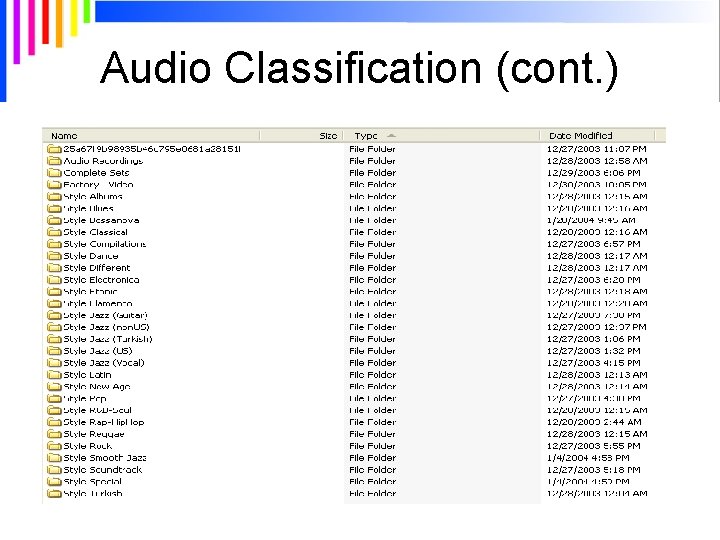
Audio Classification Folk Classical ? ? Jazz New Age ? ? Country ? ? Rock World ? ? ? Electronica Reggae
Audio Classification (cont. )
Audio Classification (cont. )
Music Information Retrieval (MIR) The process of indexing and searching music collections. • Symbolic MIR – Structured signals such as MIDI files are used. – Melodic information is typically utilized. • Two different approaches: Query-by-melody (manual) and Query-by-humming • Audio MIR – Arbitrary unstructured audio signals are used. – Timbral and rhythmic (beat) information is utilized.
What is MIDI? • • • Musical Instrument Digital Interface A music definition language Communication protocol supports 128 different voices includes 16 channels
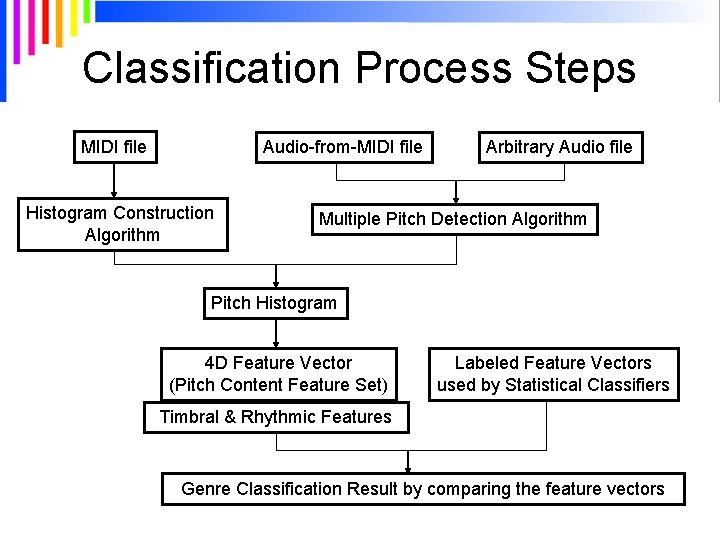
Classification Process Steps MIDI file Audio-from-MIDI file Histogram Construction Algorithm Arbitrary Audio file Multiple Pitch Detection Algorithm Pitch Histogram 4 D Feature Vector (Pitch Content Feature Set) Labeled Feature Vectors used by Statistical Classifiers Timbral & Rhythmic Features Genre Classification Result by comparing the feature vectors
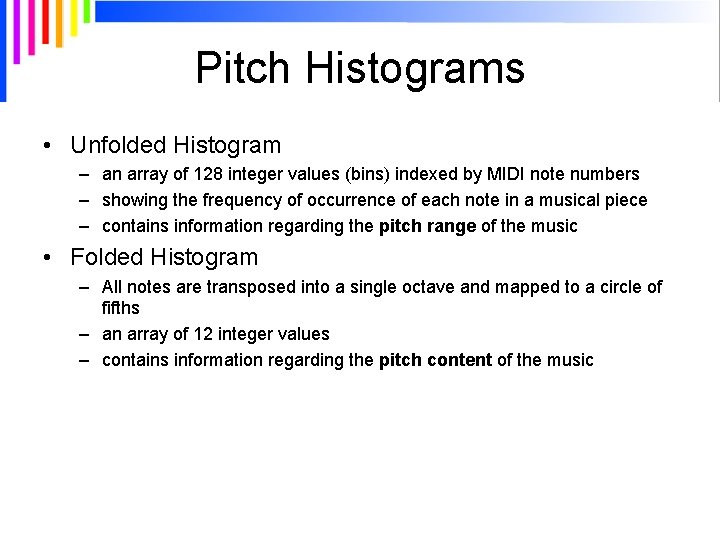
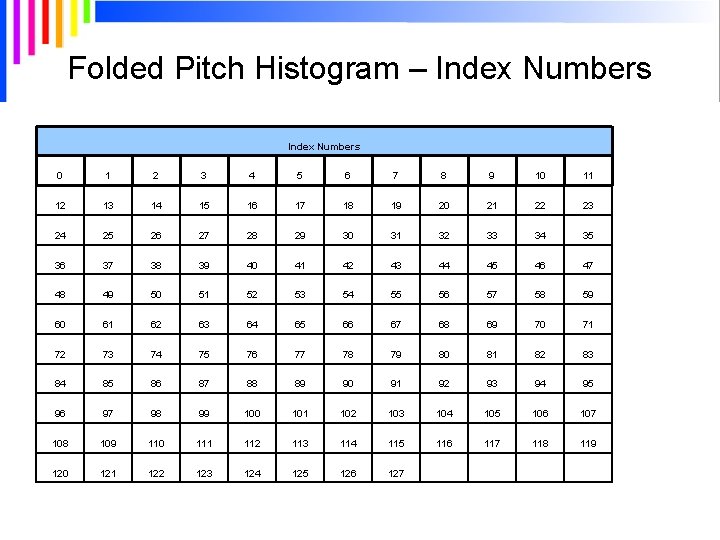
Pitch Histograms • Unfolded Histogram – an array of 128 integer values (bins) indexed by MIDI note numbers – showing the frequency of occurrence of each note in a musical piece – contains information regarding the pitch range of the music • Folded Histogram – All notes are transposed into a single octave and mapped to a circle of fifths – an array of 12 integer values – contains information regarding the pitch content of the music
Folded Pitch Histogram – Index Numbers 0 1 2 3 4 5 6 7 8 9 10 11 12 13 14 15 16 17 18 19 20 21 22 23 24 25 26 27 28 29 30 31 32 33 34 35 36 37 38 39 40 41 42 43 44 45 46 47 48 49 50 51 52 53 54 55 56 57 58 59 60 61 62 63 64 65 66 67 68 69 70 71 72 73 74 75 76 77 78 79 80 81 82 83 84 85 86 87 88 89 90 91 92 93 94 95 96 97 98 99 100 101 102 103 104 105 106 107 108 109 110 111 112 113 114 115 116 117 118 119 120 121 122 123 124 125 126 127
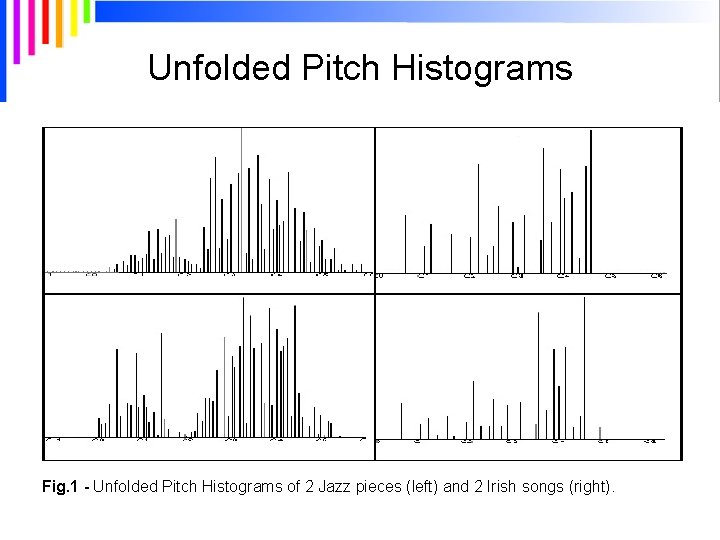
Unfolded Pitch Histograms Fig. 1 - Unfolded Pitch Histograms of 2 Jazz pieces (left) and 2 Irish songs (right).
Pitch Histogram features • Four dimensional feature vector – PITCH-Fold – AMPL-Fold – PITCH-Unfold – DIST-Fold
Pitch Histogram Calculation • For MIDI files: – The algorithm increments the corresponding note’s frequency counter while using linear traversal over all MIDI events in the file. – Normalization • For arbitrary audio files: – Multiple Pitch Detection Algorithm
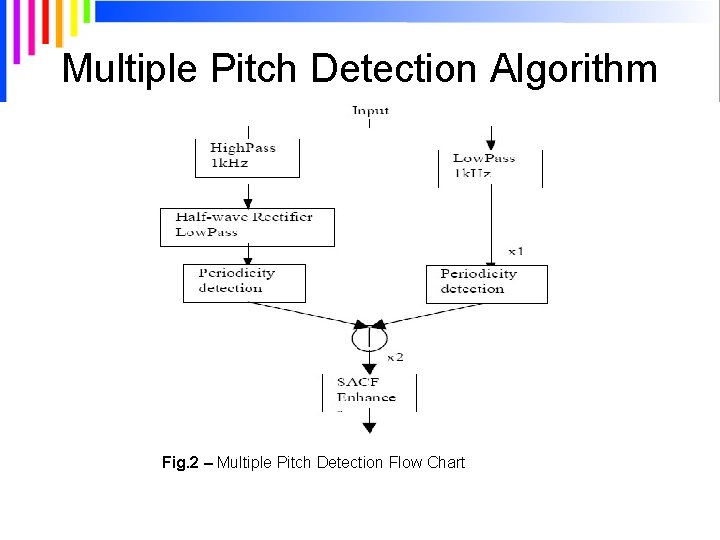
Multiple Pitch Detection Algorithm Fig. 2 – Multiple Pitch Detection Flow Chart
Experiment Details • Types of music contents: – symbolic (refers to MIDI) – audio-from-MIDI (generated using a synthesizer playing a MIDI file) – audio (digital audio files like mp 3’s found on the web) • Five musical genres are used: – Electronica, Classical, Jazz, Irish Folk and Rock • Experiment Set: – A set of 100 musical pieces in MIDI format for each genre – A set of 100 audio-from-MIDI pieces for each genre – A set of 100 general audio files • KNN(3) Classifier
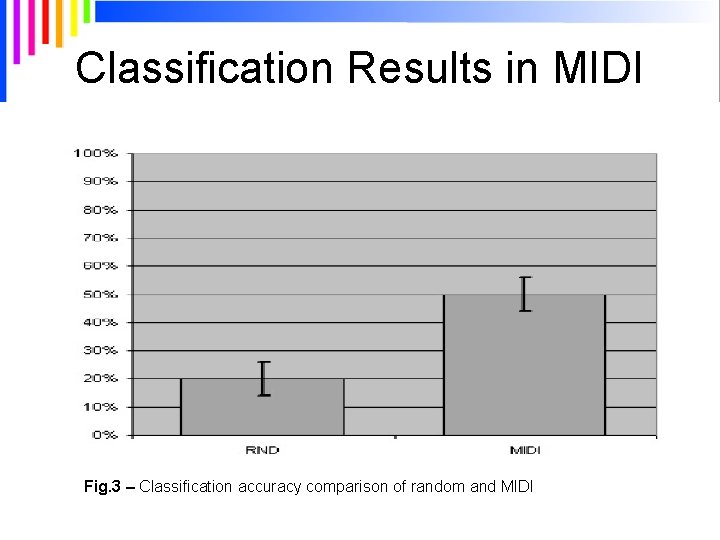
Classification Results in MIDI Fig. 3 – Classification accuracy comparison of random and MIDI
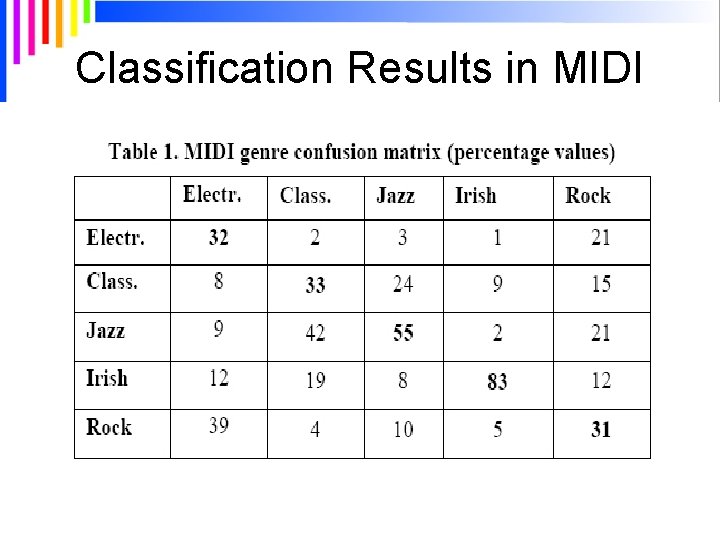
Classification Results in MIDI
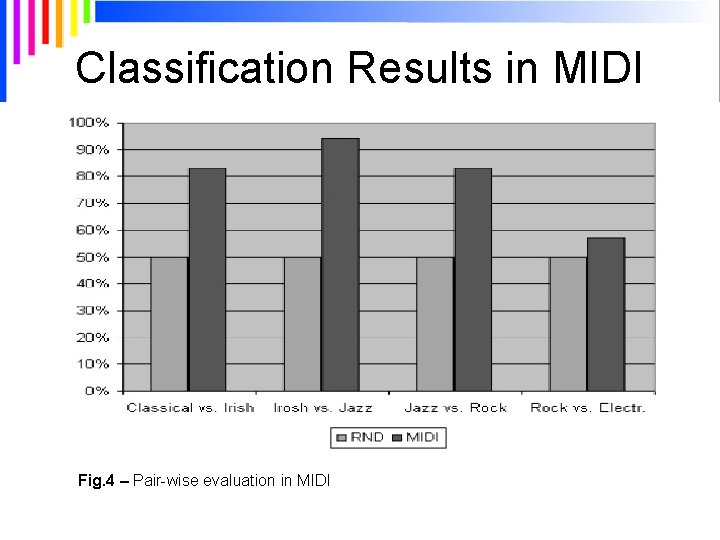
Classification Results in MIDI Fig. 4 – Pair-wise evaluation in MIDI
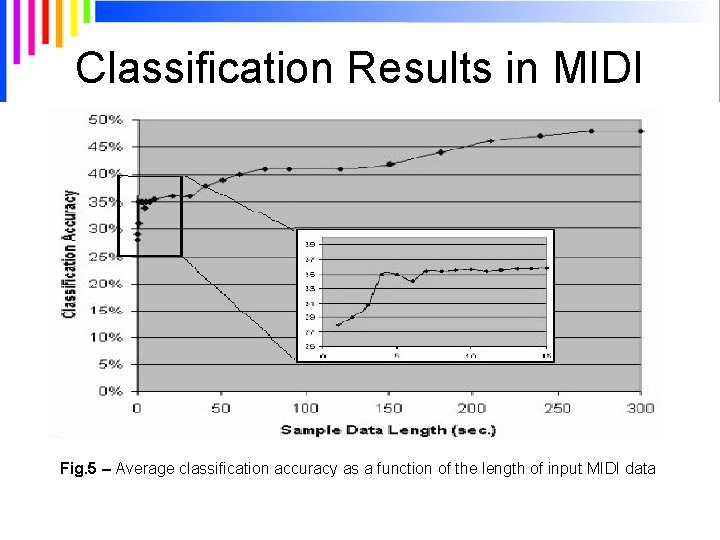
Classification Results in MIDI Fig. 5 – Average classification accuracy as a function of the length of input MIDI data
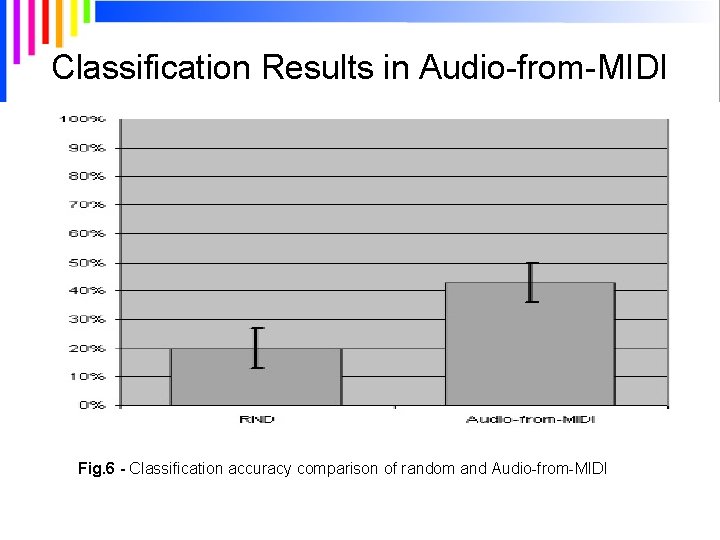
Classification Results in Audio-from-MIDI Fig. 6 - Classification accuracy comparison of random and Audio-from-MIDI
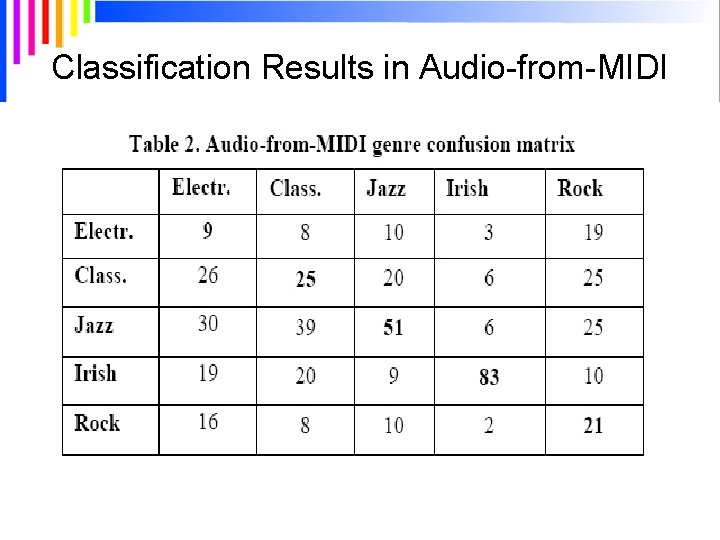
Classification Results in Audio-from-MIDI
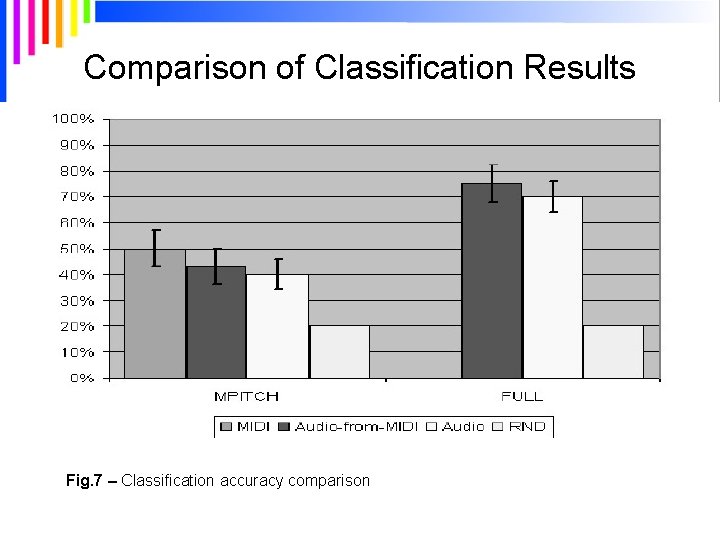
Comparison of Classification Results Fig. 7 – Classification accuracy comparison
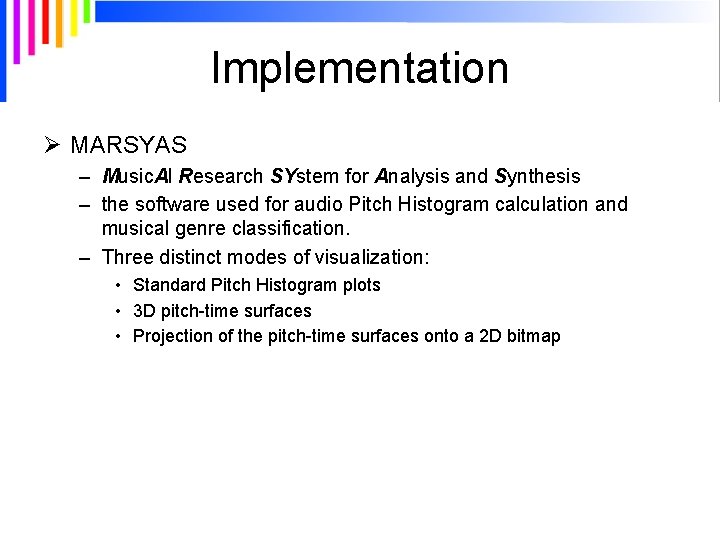
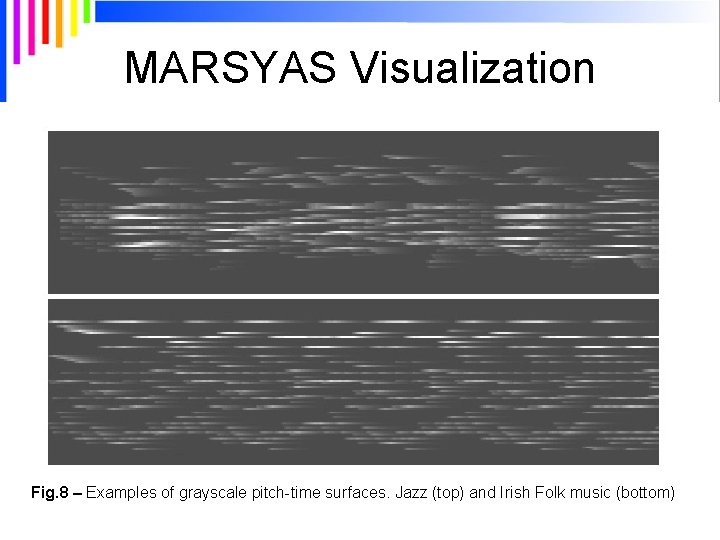
Implementation Ø MARSYAS – Music. Al Research SYstem for Analysis and Synthesis – the software used for audio Pitch Histogram calculation and musical genre classification. – Three distinct modes of visualization: • Standard Pitch Histogram plots • 3 D pitch-time surfaces • Projection of the pitch-time surfaces onto a 2 D bitmap
MARSYAS Visualization Fig. 8 – Examples of grayscale pitch-time surfaces. Jazz (top) and Irish Folk music (bottom)
Summary • Symbolic representation is more preferable in the sense of computing Pitch Information. • This work can be viewed as an attempt to bridge the two distinct MIR approaches by using Pitch Histograms. • Pitch Histograms do carry a certain amount of genreidentifying information. • Multiple Pitch Detection Algorithm is not perfect, but it works by a certain degree.
Future Work • Real-time running version of Pitch Histogram. – for better classification performance. – to conduct more detailed harmonic analysis such as figured bass extraction, tonality recognition, and chord detection. • The features derived from Pitch Histograms might be applicable to the problem of content-based audio identification or audio fingerprinting. • Alternative feature sets are needed. • Query-based retrieval mechanism for audio music signals.
Thanks • Cosku Turhan for the art work on my slides… • 4 Non Blondes for their song, “What's Up? ” : )