
Outline Introduction Different Scratch Pad Memories Cache and

![Static Approach Internal SRAM int a[100]; int b[100]; … while(i<100) …. . a…… while(i<100)](https://slidetodoc.com/presentation_image_h2/e5d1fd2fc6b2ce1e68ed9b53ca1de366/image-29.jpg "Static Approach Internal SRAM int a[100]; int b[100]; … while(i<100) …. . a…… while(i<100)")
![Static Approach Internal SRAM Int a[100] int a[100]; int b[100]; … while(i<100) …. .](https://slidetodoc.com/presentation_image_h2/e5d1fd2fc6b2ce1e68ed9b53ca1de366/image-30.jpg "Static Approach Internal SRAM Int a[100] int a[100]; int b[100]; … while(i<100) …. .")
![Dynamic Approach Internal SRAM Int a[100] int a[100]; int b[100]; … while(i<100) …. .](https://slidetodoc.com/presentation_image_h2/e5d1fd2fc6b2ce1e68ed9b53ca1de366/image-31.jpg "Dynamic Approach Internal SRAM Int a[100] int a[100]; int b[100]; … while(i<100) …. .")
![Dynamic Approach Internal SRAM int b[100] int a[100]; int b[100]; while(i<100) ……a…. . .](https://slidetodoc.com/presentation_image_h2/e5d1fd2fc6b2ce1e68ed9b53ca1de366/image-32.jpg "Dynamic Approach Internal SRAM int b[100] int a[100]; int b[100]; while(i<100) ……a…. . .")
![Compiler-Decided Dynamic Approach int a[100]; int b[100]; … // a is in SRAM while(i<100)](https://slidetodoc.com/presentation_image_h2/e5d1fd2fc6b2ce1e68ed9b53ca1de366/image-33.jpg "Compiler-Decided Dynamic Approach int a[100]; int b[100]; … // a is in SRAM while(i<100)")

- Slides: 54
Outline • Introduction • Different Scratch Pad Memories • Cache and Scratch Pad for embedded applications
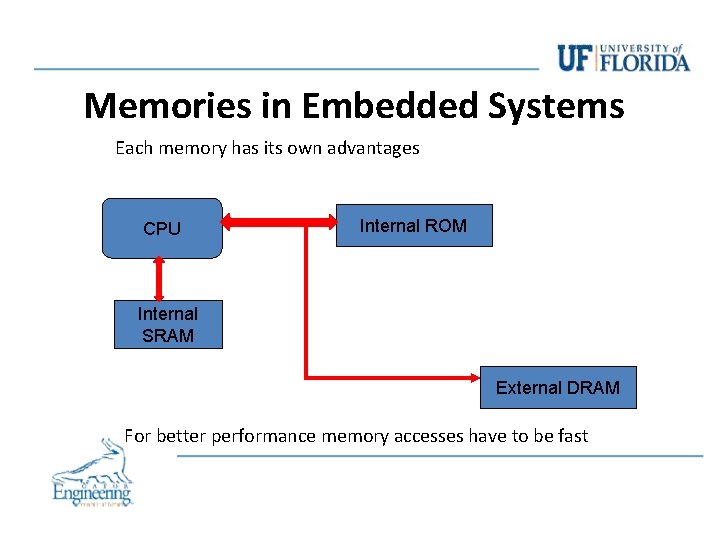
Memories in Embedded Systems Each memory has its own advantages CPU Internal ROM Internal SRAM External DRAM For better performance memory accesses have to be fast
Efficient Utilization of Scratch-Pad Memory in Embedded Processor Applications
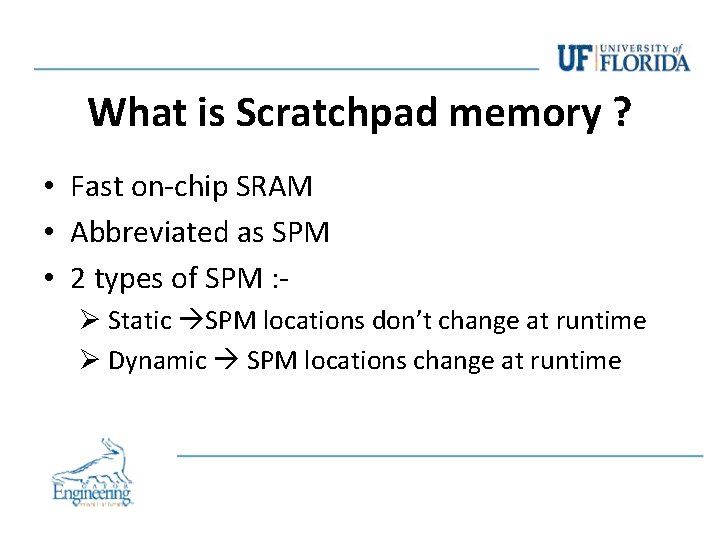
What is Scratchpad memory ? • Fast on-chip SRAM • Abbreviated as SPM • 2 types of SPM : Ø Static SPM locations don’t change at runtime Ø Dynamic SPM locations change at runtime
Objective • Find a technique for efficiently exploiting onchip SPM by partitioning the application’s scalar and array variables into off-chip DRAM and on-chip SPM. • Minimize the total execution time of the application.
SPM and Cache • Similarities ØConnected to the same address and data buses. Ø Access latency of 1 processor cycle. • Difference Ø SPM guarantees single cycle access time while an access to cache is subject to a miss.
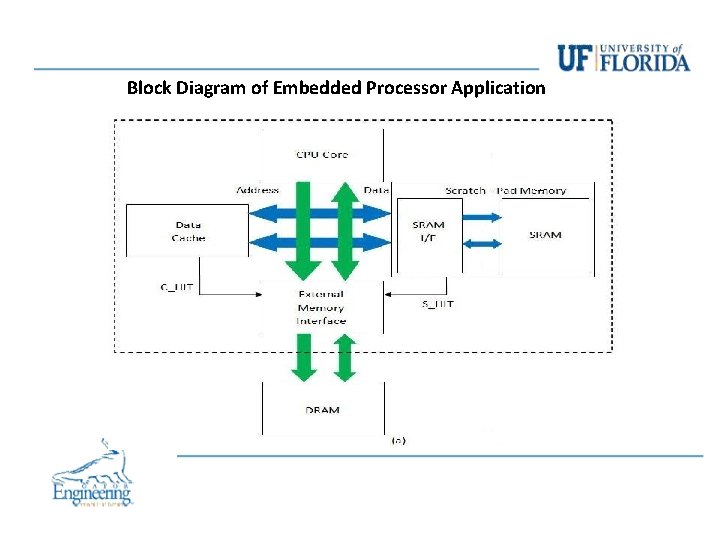
Block Diagram of Embedded Processor Application
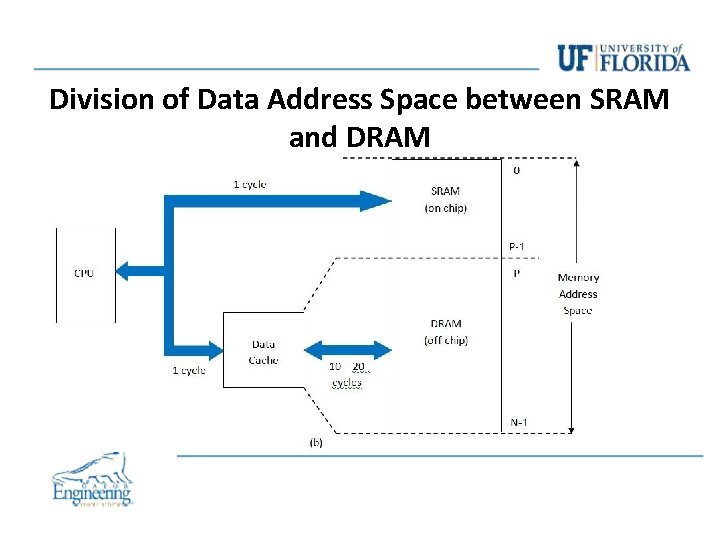
Division of Data Address Space between SRAM and DRAM
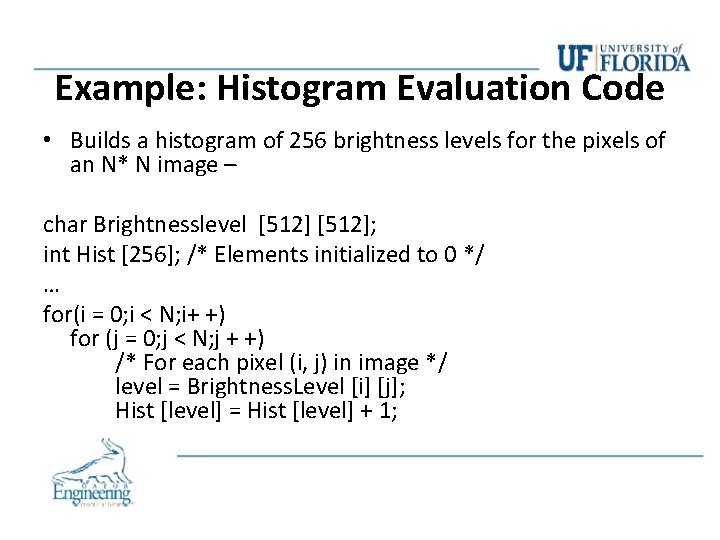
Example: Histogram Evaluation Code • Builds a histogram of 256 brightness levels for the pixels of an N* N image – char Brightnesslevel [512]; int Hist [256]; /* Elements initialized to 0 */ … for(i = 0; i < N; i+ +) for (j = 0; j < N; j + +) /* For each pixel (i, j) in image */ level = Brightness. Level [i] [j]; Hist [level] = Hist [level] + 1;
Problem Description • If the code is executed on a processor configured with a data cache of size 1 Kb – performance will be degraded by conflict misses in the cache between elements of the 2 arrays Hist and Brightness. Level. • Solution: - Selectively map to SPM those variables that cause maximum number of conflicts in the data cache.
Partitioning Strategy • Features affecting partitioning ØScalar variables and constants ØSize of arrays ØLife-times of array variables ØAccess frequency of array variables ØConflicts in loops • Partitioning Algorithm
Features affecting partitioning • Scalar variables and constants Ø All scalar variables and scalar constants are mapped onto SPM. • Size of Arrays Ø Arrays that are larger than SRAM are mapped onto off-chip memory.
Features affecting partitioning • Lifetime of an Array Variable ØDefinition : - period between its definition and its last use. Ø Variables with disjoint lifetimes can be stored in the same processor register. Ø Arrays with different lifetimes can share the same memory space.
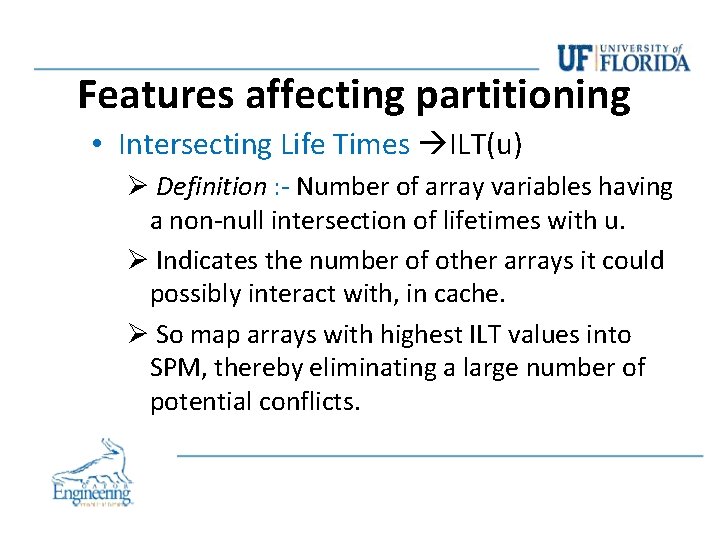
Features affecting partitioning • Intersecting Life Times ILT(u) Ø Definition : - Number of array variables having a non-null intersection of lifetimes with u. Ø Indicates the number of other arrays it could possibly interact with, in cache. Ø So map arrays with highest ILT values into SPM, thereby eliminating a large number of potential conflicts.
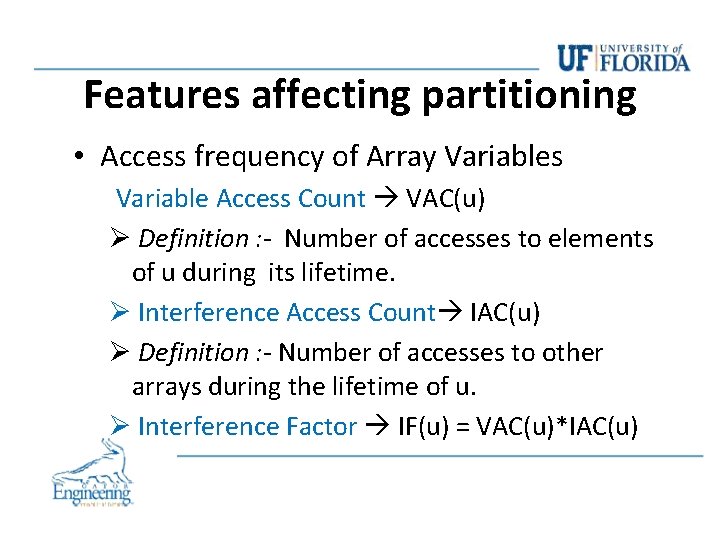
Features affecting partitioning • Access frequency of Array Variables Variable Access Count VAC(u) Ø Definition : - Number of accesses to elements of u during its lifetime. Ø Interference Access Count IAC(u) Ø Definition : - Number of accesses to other arrays during the lifetime of u. Ø Interference Factor IF(u) = VAC(u)*IAC(u)
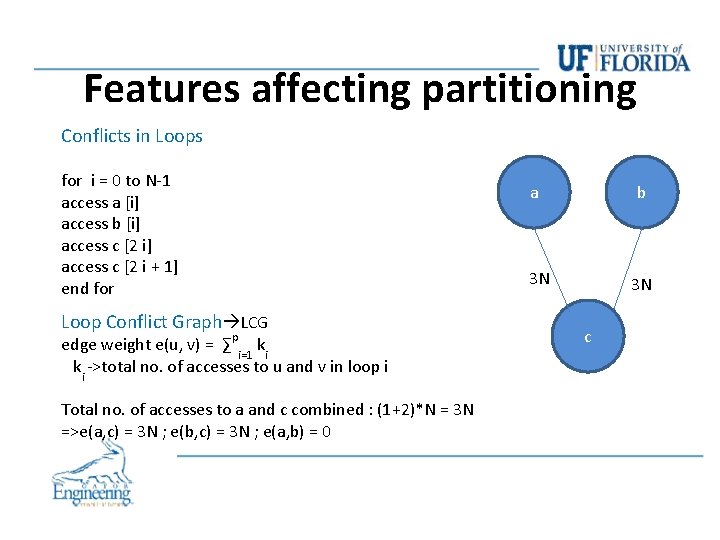
Features affecting partitioning Conflicts in Loops for i = 0 to N-1 access a [i] access b [i] access c [2 i + 1] end for Loop Conflict Graph LCG edge weight e(u, v) = ∑pi=1 ki k ->total no. of accesses to u and v in loop i i Total no. of accesses to a and c combined : (1+2)*N = 3 N =>e(a, c) = 3 N ; e(b, c) = 3 N ; e(a, b) = 0 a b 3 N 3 N c
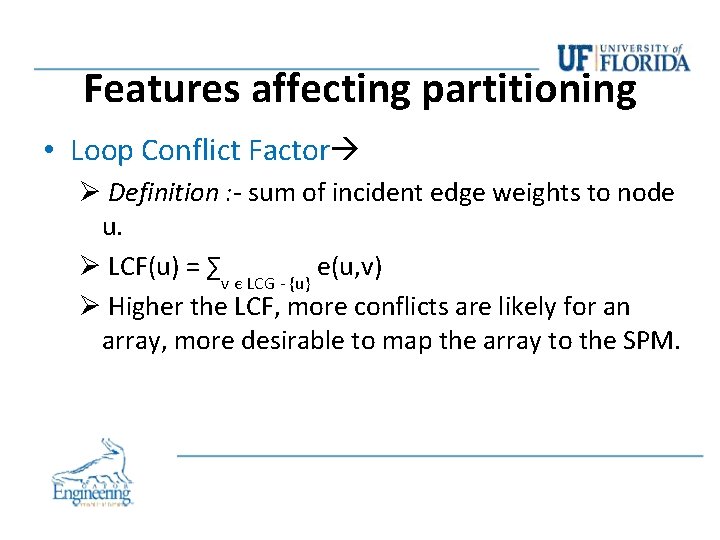
Features affecting partitioning • Loop Conflict Factor Ø Definition : - sum of incident edge weights to node u. Ø LCF(u) = ∑v є LCG - {u} e(u, v) Ø Higher the LCF, more conflicts are likely for an array, more desirable to map the array to the SPM.
Partitioning Strategy • Features affecting partitioning ØScalar variables and constants ØSize of arrays ØLife-times of array variables ØAccess frequency of array variables ØConflicts in loops • Partitioning Algorithm
Partitioning Algorithm • Algorithm for determining the mapping decision of each(scalar and array) program variable to SPM or DRAM/cache. • First assigns scalar constants and variables to SPM. • Arrays that are larger than SPM are mapped onto DRAM.
Partitioning Algorithm • For remaining (n) arrays, generates lifetime intervals and computes LCF and IF values. • Sorts the 2 n interval points thus generated and traverses them in increasing order. • For each array u encountered, if there is sufficient SRAM space for u and all arrays with lifetimes intersecting the lifetime interval of u, with more critical LCF and IF nos. , then maps u to SPM else to DRAM/cache.
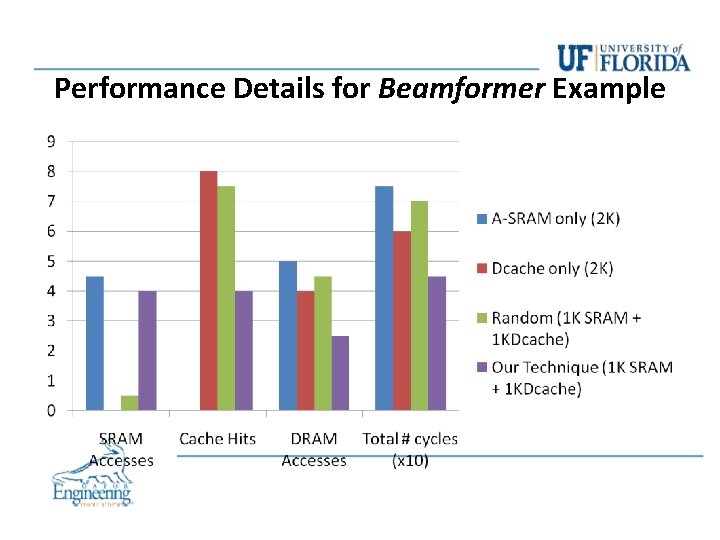
Performance Details for Beamformer Example
Typical Applications • Dequant de-quantization routine in MPEG decoder application • IDCT Inverse Discrete Cosine Transform • SOR Successive Over Relaxation Algorithm • Matrix. Mult Matrix multiplication • FFT Fast Fourier Transform • DHRC Differential Heat Release Computation Algorithm
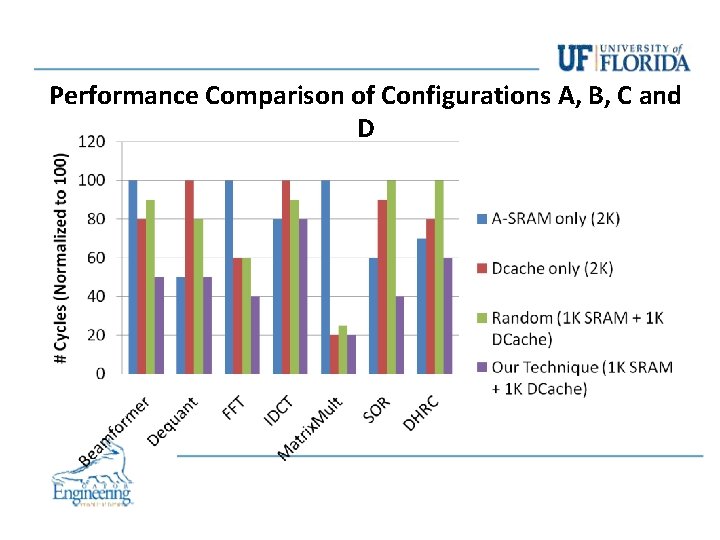
Performance Comparison of Configurations A, B, C and D
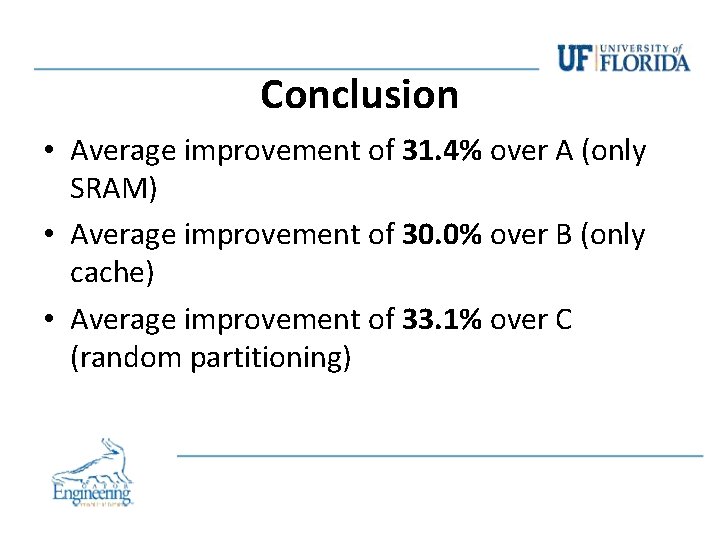
Conclusion • Average improvement of 31. 4% over A (only SRAM) • Average improvement of 30. 0% over B (only cache) • Average improvement of 33. 1% over C (random partitioning)
Compiler Decided Dynamic Memory allocation for Scratch Pad Based Embedded Systems.
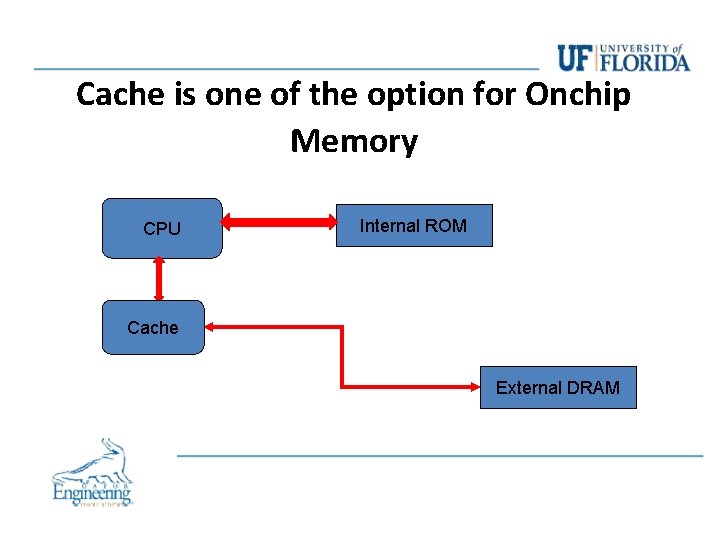
Cache is one of the option for Onchip Memory CPU Internal ROM Cache External DRAM
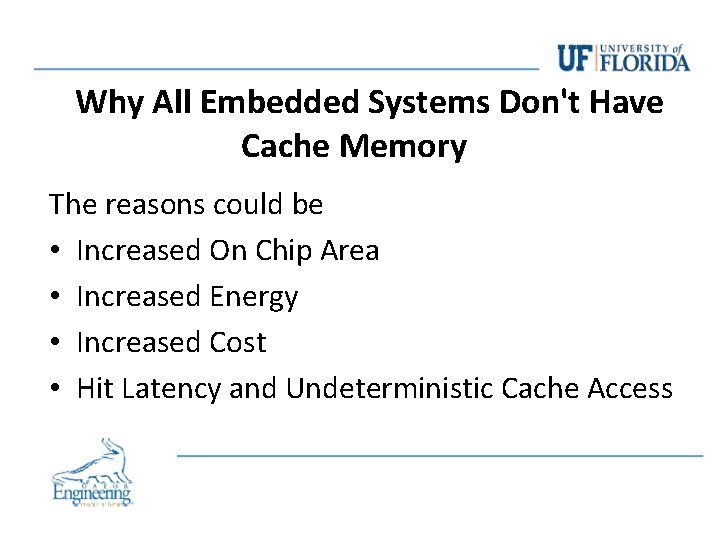
Why All Embedded Systems Don't Have Cache Memory The reasons could be • Increased On Chip Area • Increased Energy • Increased Cost • Hit Latency and Undeterministic Cache Access
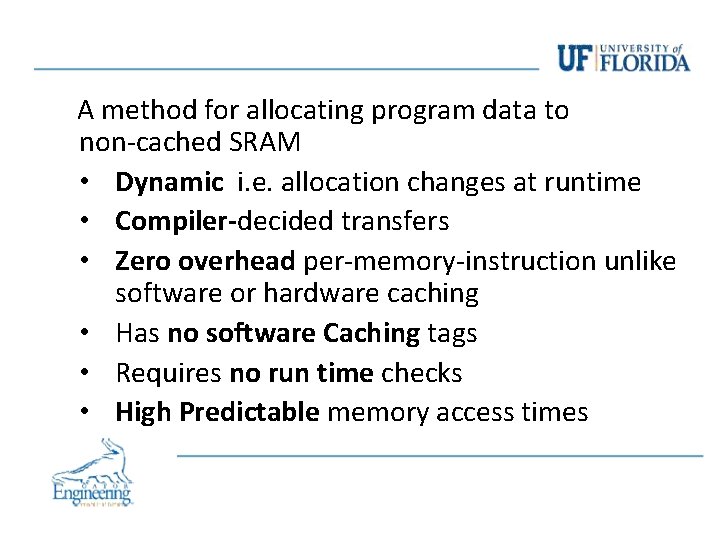
A method for allocating program data to non-cached SRAM • Dynamic i. e. allocation changes at runtime • Compiler-decided transfers • Zero overhead per-memory-instruction unlike software or hardware caching • Has no software Caching tags • Requires no run time checks • High Predictable memory access times
Static Approach Internal SRAM int a[100]; int b[100]; … while(i<100) …. . a…… while(i<100) ……b…. . . Allocator External DRAM Int b[100]
Static Approach Internal SRAM Int a[100] int a[100]; int b[100]; … while(i<100) …. . a…… while(i<100) ……b…. . . Allocator External DRAM Int b[100]
Dynamic Approach Internal SRAM Int a[100] int a[100]; int b[100]; … while(i<100) …. . a…… while(i<100) ……b…. . . Allocator External DRAM Int b[100]
Dynamic Approach Internal SRAM int b[100] int a[100]; int b[100]; while(i<100) ……a…. . . while(i<100) ……b…… Allocator External DRAM int a[100] It is similar to caching, but under compiler control
Compiler-Decided Dynamic Approach int a[100]; int b[100]; … // a is in SRAM while(i<100) ……a……. // Copy a out to DRAM // Copy b in to SRAM while(i<100) ……. . b…. . … • Need to minimize costs for greater benefit Decide on dynamic • Accounts for changing program behavioratstatically Requirements run time • Compiler manages and decides the transfers between sram and dram Transfer cost
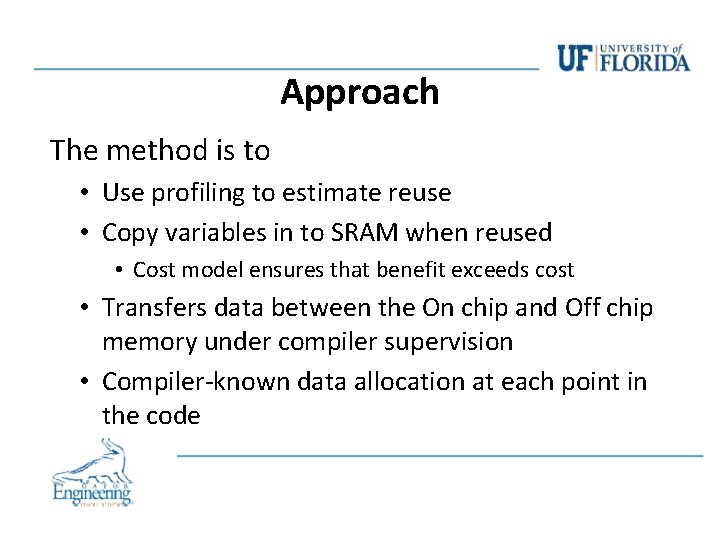
Approach The method is to • Use profiling to estimate reuse • Copy variables in to SRAM when reused • Cost model ensures that benefit exceeds cost • Transfers data between the On chip and Off chip memory under compiler supervision • Compiler-known data allocation at each point in the code
Advantages • Benefits with no software translation overhead • Predictable SRAM accesses ensuring better realtime guarantees than Hardware or Software caching • No more data transfers than caching
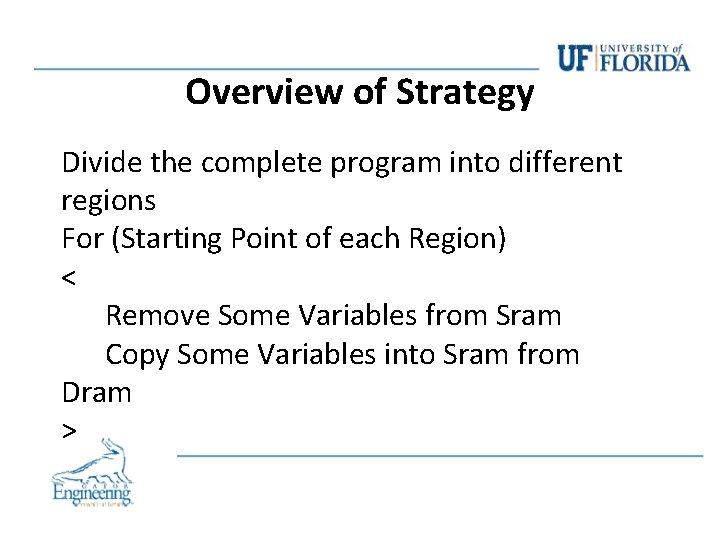
Overview of Strategy Divide the complete program into different regions For (Starting Point of each Region) < Remove Some Variables from Sram Copy Some Variables into Sram from Dram >
Some Imp Questions What are regions ? What to bring in to SRAM ? What to evict from SRAM ? The Problem has an exponential number of Solutions (NP Complete)
Regions • It is the code between successive program points • Coincide with changes in program behavior • New regions start at: • Start of each procedure • Before start of each loop • Before conditional statements containing loops, procedures
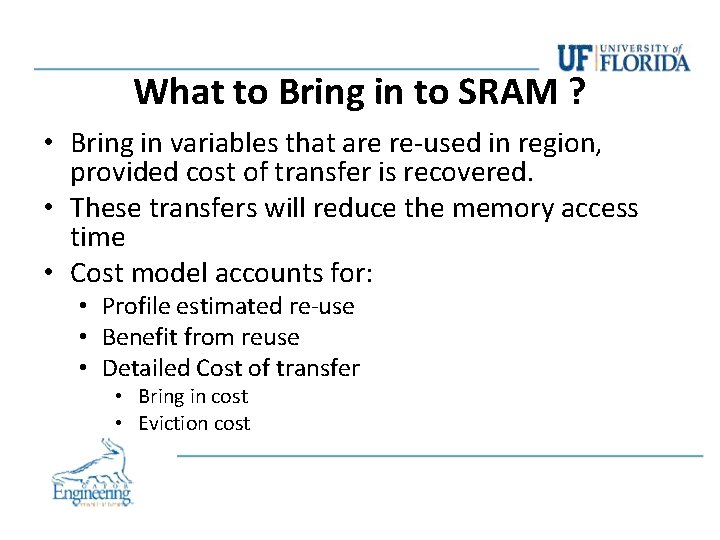
What to Bring in to SRAM ? • Bring in variables that are re-used in region, provided cost of transfer is recovered. • These transfers will reduce the memory access time • Cost model accounts for: • Profile estimated re-use • Benefit from reuse • Detailed Cost of transfer • Bring in cost • Eviction cost
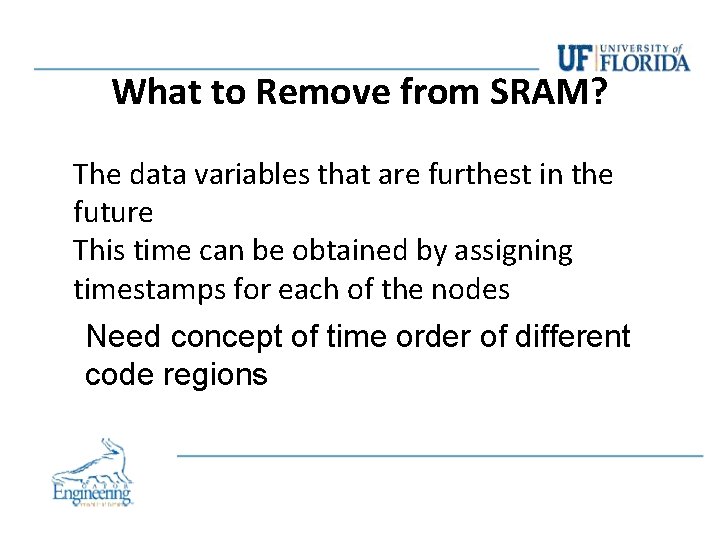
What to Remove from SRAM? in the future. The data variables that are furthest in the future This time can be obtained by assigning timestamps for each of the nodes Need concept of time order of different code regions
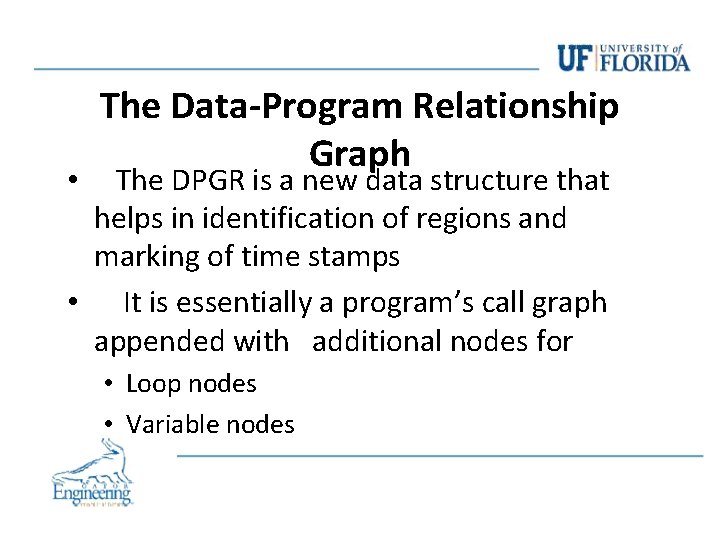
The Data-Program Relationship Graph The DPGR is a new data structure that helps in identification of regions and marking of time stamps • It is essentially a program’s call graph appended with additional nodes for • • Loop nodes • Variable nodes
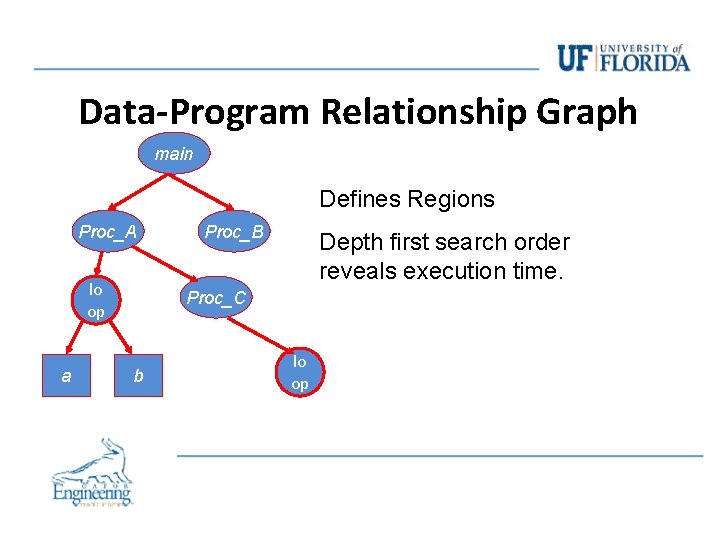
Data-Program Relationship Graph 1 • Defines regions main 2 5 Proc_A 3 4 lo op a 6 Defines Regions 7 Proc_B Depth first search order reveals execution time. Proc_C b lo op • order “Allocation-change points” at region changes
Time Stamps • A method associates a time stamp with every program point • The time stamp forms a total order among themselves • The program points are reached during the runtime in time stamp order.
Optimizations • The is no need to write back unmodified or dead SRAM variables into DRAM • Optimize data transfer code using DMA when it is available • Data transfer code can be placed in special memory block copy procedures
Multiple Allocations due to Multiple • Paths • Contents of SRAM could be different on different incoming paths to a node in DPRG • Problem can happen in • Loops • Conditional execution • Multiple calls to same procedure
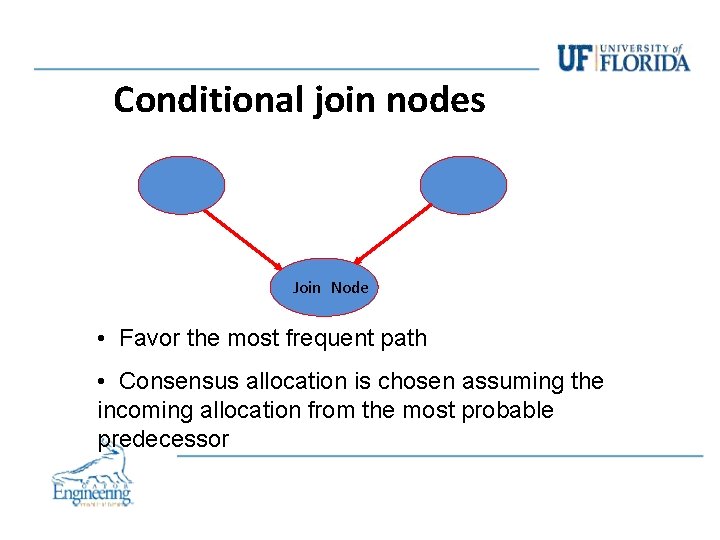
Conditional join nodes Join Node • Favor the most frequent path • Consensus allocation is chosen assuming the incoming allocation from the most probable predecessor
Procedure join nodes • Few program points have multiple timestamps • The nodes with multiple timestamps are called join nodes as they join multiple paths from main() • A strategy is used that adopts different allocation strategies for different paths but with same code
Offsets in SRAM • SRAM can get fragmented when variables are swapped out • • In this method • • Intelligent offset mechanism required Place memory variables with similar lifetimes together larger fragments when evicted together
Experimental Setup • Architecture: Motorola MCORE • Memory architecture : 2 levels of memory • SRAM size: Estimated as 25% of the total data requirement • DRAM latency 10 cycles • Compiler : Gcc
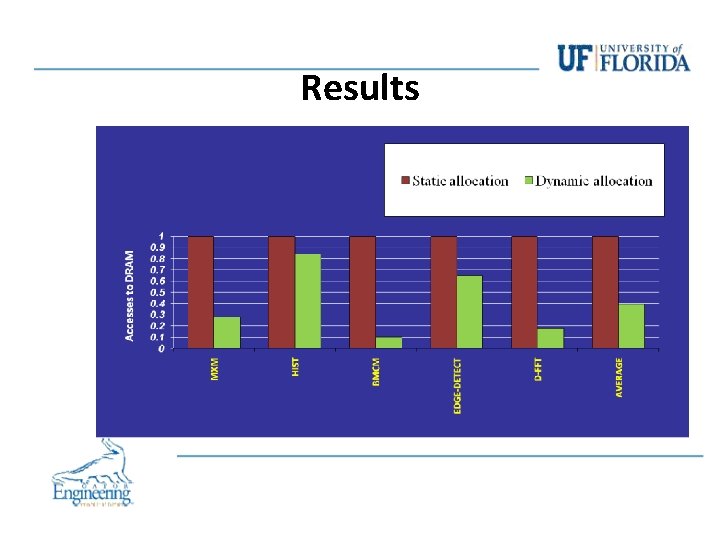
Results
Conclusion The designer has to choose the right mix of Scratch pad and Cache for performance advantages.
References • Sumesh U , Rajeev B. Compiler Decided Dynamic Memory Allocation for Scratch Pad Based Embedded Systems. • Alexandru N , Preeti P, N Dutt. Efficient Use of Scratch Pads in Embedded Applications • Josh Pfrimmer, Kin F. Li, and Daler Rakhmatov Balancing Scratch Pad and Cache in Embedded Systems for Power and Speed Performance
Questions
Thank you