
Outline ILP Compiler techniques to increase ILP Loop


- Slides: 39
Outline • • • ILP Compiler techniques to increase ILP Loop Unrolling Static Branch Prediction Dynamic Branch Prediction Conclusion 11/28/2020 ΗΥ 425 - Διάλεξη 06 2
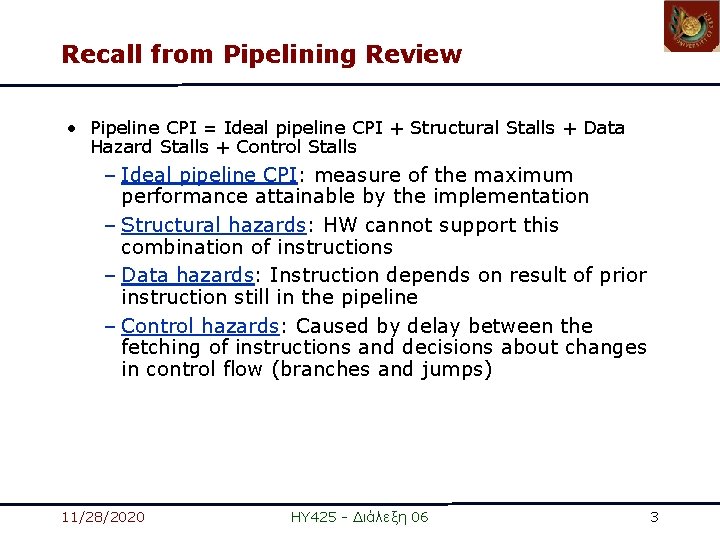
Recall from Pipelining Review • Pipeline CPI = Ideal pipeline CPI + Structural Stalls + Data Hazard Stalls + Control Stalls – Ideal pipeline CPI: measure of the maximum performance attainable by the implementation – Structural hazards: HW cannot support this combination of instructions – Data hazards: Instruction depends on result of prior instruction still in the pipeline – Control hazards: Caused by delay between the fetching of instructions and decisions about changes in control flow (branches and jumps) 11/28/2020 ΗΥ 425 - Διάλεξη 06 3
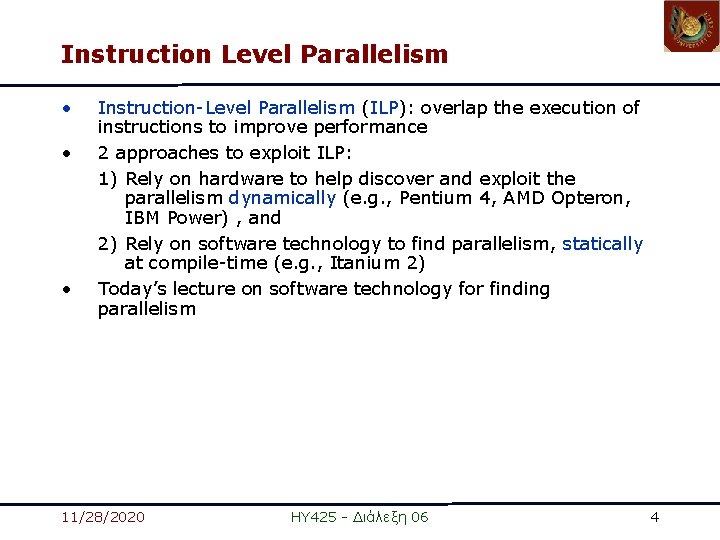
Instruction Level Parallelism • • • Instruction-Level Parallelism (ILP): overlap the execution of instructions to improve performance 2 approaches to exploit ILP: 1) Rely on hardware to help discover and exploit the parallelism dynamically (e. g. , Pentium 4, AMD Opteron, IBM Power) , and 2) Rely on software technology to find parallelism, statically at compile-time (e. g. , Itanium 2) Today’s lecture on software technology for finding parallelism 11/28/2020 ΗΥ 425 - Διάλεξη 06 4
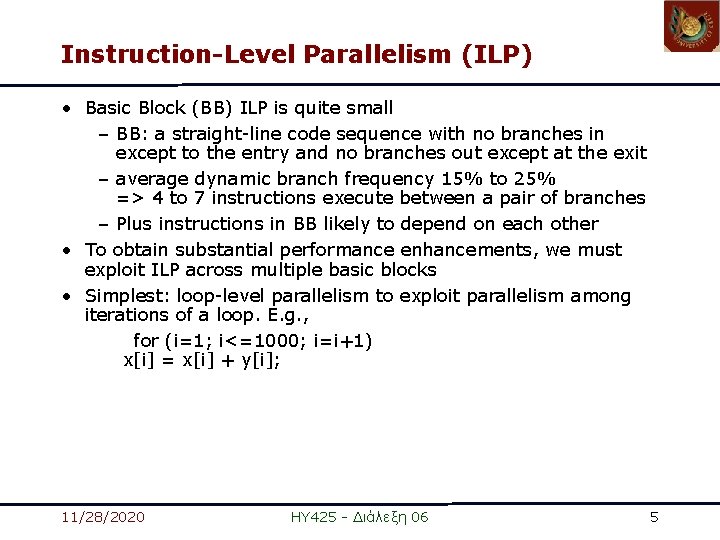
Instruction-Level Parallelism (ILP) • Basic Block (BB) ILP is quite small – BB: a straight-line code sequence with no branches in except to the entry and no branches out except at the exit – average dynamic branch frequency 15% to 25% => 4 to 7 instructions execute between a pair of branches – Plus instructions in BB likely to depend on each other • To obtain substantial performance enhancements, we must exploit ILP across multiple basic blocks • Simplest: loop-level parallelism to exploit parallelism among iterations of a loop. E. g. , for (i=1; i<=1000; i=i+1) x[i] = x[i] + y[i]; 11/28/2020 ΗΥ 425 - Διάλεξη 06 5
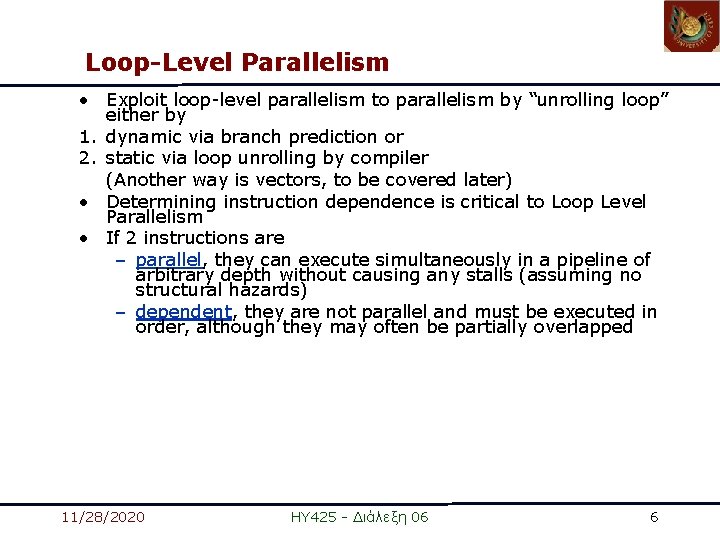
Loop-Level Parallelism • Exploit loop-level parallelism to parallelism by “unrolling loop” either by 1. dynamic via branch prediction or 2. static via loop unrolling by compiler (Another way is vectors, to be covered later) • Determining instruction dependence is critical to Loop Level Parallelism • If 2 instructions are – parallel, they can execute simultaneously in a pipeline of arbitrary depth without causing any stalls (assuming no structural hazards) – dependent, they are not parallel and must be executed in order, although they may often be partially overlapped 11/28/2020 ΗΥ 425 - Διάλεξη 06 6
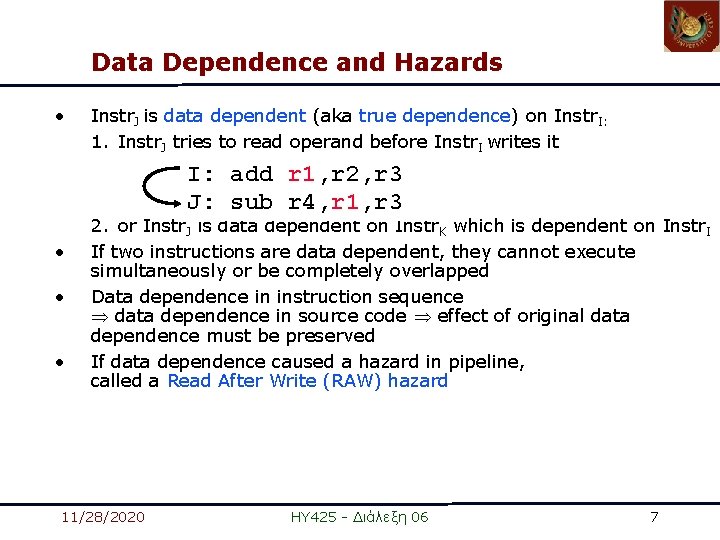
Data Dependence and Hazards • Instr. J is data dependent (aka true dependence) on Instr. I: 1. Instr. J tries to read operand before Instr. I writes it I: add r 1, r 2, r 3 J: sub r 4, r 1, r 3 • • • 2. or Instr. J is data dependent on Instr. K which is dependent on Instr. I If two instructions are data dependent, they cannot execute simultaneously or be completely overlapped Data dependence in instruction sequence data dependence in source code effect of original data dependence must be preserved If data dependence caused a hazard in pipeline, called a Read After Write (RAW) hazard 11/28/2020 ΗΥ 425 - Διάλεξη 06 7
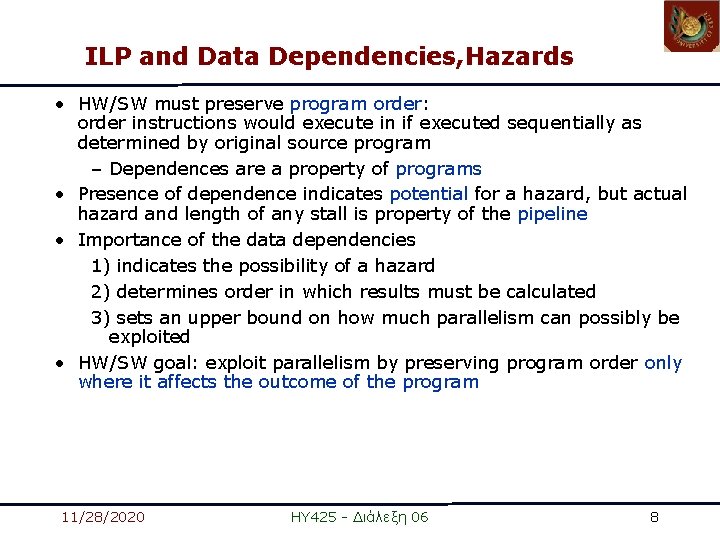
ILP and Data Dependencies, Hazards • HW/SW must preserve program order: order instructions would execute in if executed sequentially as determined by original source program – Dependences are a property of programs • Presence of dependence indicates potential for a hazard, but actual hazard and length of any stall is property of the pipeline • Importance of the data dependencies 1) indicates the possibility of a hazard 2) determines order in which results must be calculated 3) sets an upper bound on how much parallelism can possibly be exploited • HW/SW goal: exploit parallelism by preserving program order only where it affects the outcome of the program 11/28/2020 ΗΥ 425 - Διάλεξη 06 8
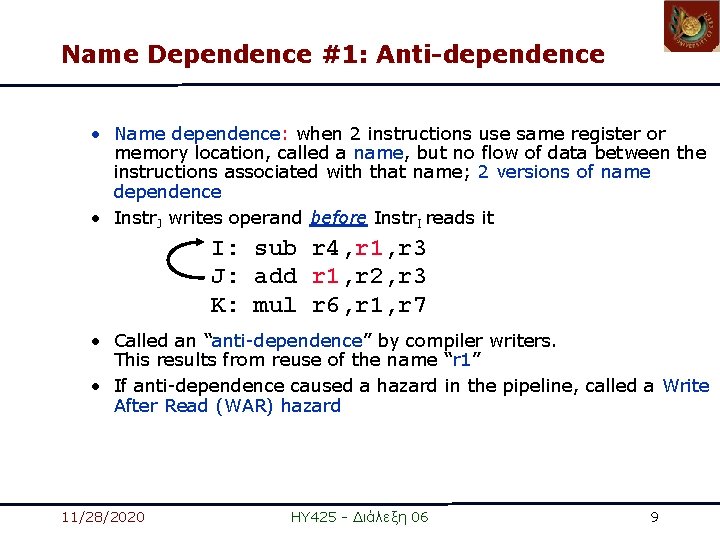
Name Dependence #1: Anti-dependence • Name dependence: when 2 instructions use same register or memory location, called a name, but no flow of data between the instructions associated with that name; 2 versions of name dependence • Instr. J writes operand before Instr. I reads it I: sub r 4, r 1, r 3 J: add r 1, r 2, r 3 K: mul r 6, r 1, r 7 • Called an “anti-dependence” by compiler writers. This results from reuse of the name “r 1” • If anti-dependence caused a hazard in the pipeline, called a Write After Read (WAR) hazard 11/28/2020 ΗΥ 425 - Διάλεξη 06 9
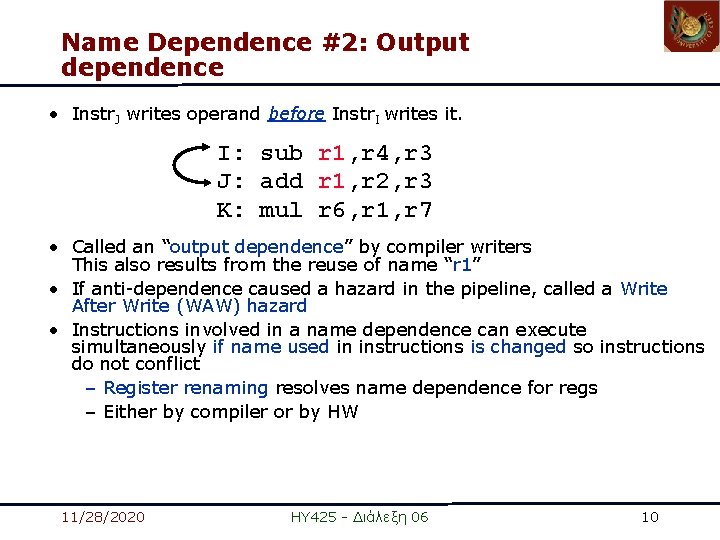
Name Dependence #2: Output dependence • Instr. J writes operand before Instr. I writes it. I: sub r 1, r 4, r 3 J: add r 1, r 2, r 3 K: mul r 6, r 1, r 7 • Called an “output dependence” by compiler writers This also results from the reuse of name “r 1” • If anti-dependence caused a hazard in the pipeline, called a Write After Write (WAW) hazard • Instructions involved in a name dependence can execute simultaneously if name used in instructions is changed so instructions do not conflict – Register renaming resolves name dependence for regs – Either by compiler or by HW 11/28/2020 ΗΥ 425 - Διάλεξη 06 10
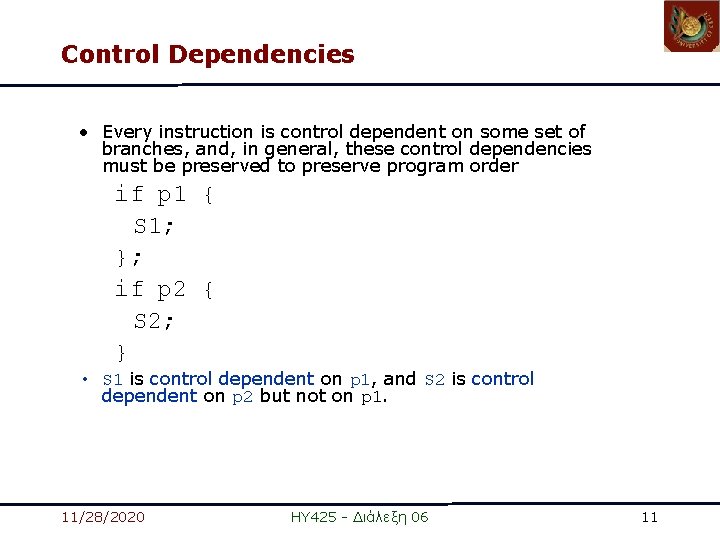
Control Dependencies • Every instruction is control dependent on some set of branches, and, in general, these control dependencies must be preserved to preserve program order if p 1 { S 1; }; if p 2 { S 2; } • S 1 is control dependent on p 1, and S 2 is control dependent on p 2 but not on p 1. 11/28/2020 ΗΥ 425 - Διάλεξη 06 11
Control Dependence Ignored • Control dependence need not be preserved – willing to execute instructions that should not have been executed, thereby violating the control dependences, if can do so without affecting correctness of the program • Instead, 2 properties critical to program correctness are 1) exception behavior and 2) data flow 11/28/2020 ΗΥ 425 - Διάλεξη 06 12
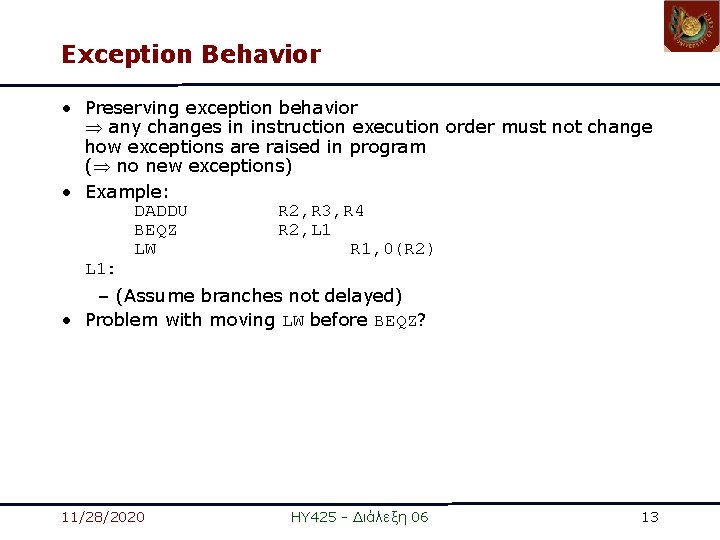
Exception Behavior • Preserving exception behavior any changes in instruction execution order must not change how exceptions are raised in program ( no new exceptions) • Example: DADDU R 2, R 3, R 4 BEQZ R 2, L 1 LW R 1, 0(R 2) L 1: – (Assume branches not delayed) • Problem with moving LW before BEQZ? 11/28/2020 ΗΥ 425 - Διάλεξη 06 13
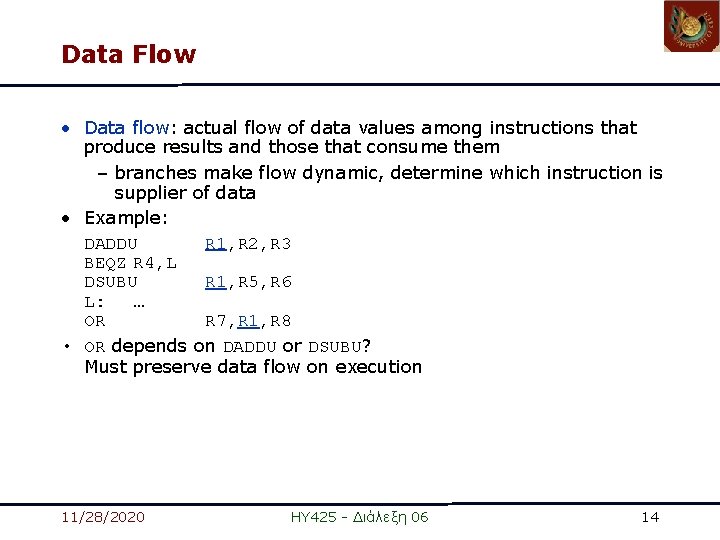
Data Flow • Data flow: actual flow of data values among instructions that produce results and those that consume them – branches make flow dynamic, determine which instruction is supplier of data • Example: DADDU R 1, R 2, R 3 BEQZ R 4, L DSUBU R 1, R 5, R 6 L: … OR R 7, R 1, R 8 • OR depends on DADDU or DSUBU? Must preserve data flow on execution 11/28/2020 ΗΥ 425 - Διάλεξη 06 14
Outline • • • ILP Compiler techniques to increase ILP Loop Unrolling Static Branch Prediction Dynamic Branch Prediction Conclusion 11/28/2020 ΗΥ 425 - Διάλεξη 06 15
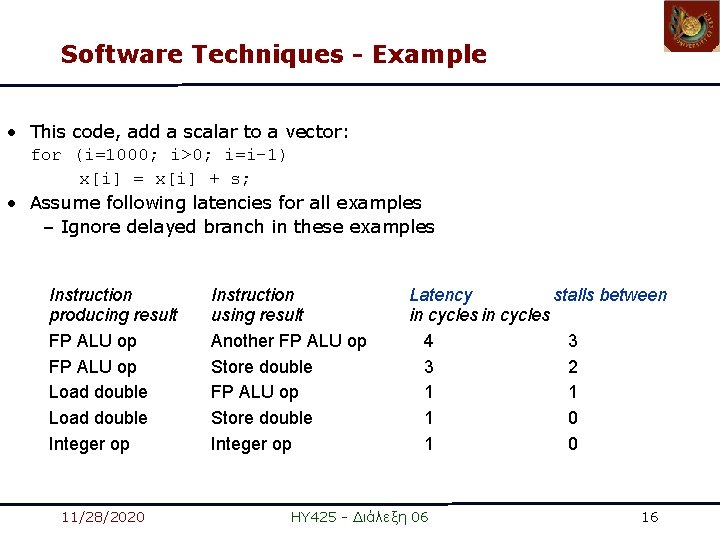
Software Techniques - Example • This code, add a scalar to a vector: for (i=1000; i>0; i=i– 1) x[i] = x[i] + s; • Assume following latencies for all examples – Ignore delayed branch in these examples Instruction producing result FP ALU op Load double Integer op 11/28/2020 Instruction using result Another FP ALU op Store double Integer op Latency stalls between in cycles 4 3 3 2 1 1 1 0 ΗΥ 425 - Διάλεξη 06 16
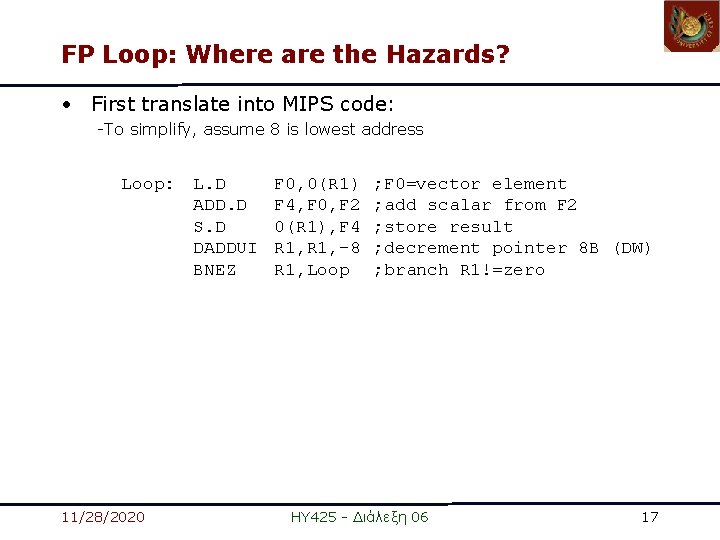
FP Loop: Where are the Hazards? • First translate into MIPS code: -To simplify, assume 8 is lowest address Loop: L. D ADD. D S. D DADDUI BNEZ 11/28/2020 F 0, 0(R 1) F 4, F 0, F 2 0(R 1), F 4 R 1, -8 R 1, Loop ; F 0=vector element ; add scalar from F 2 ; store result ; decrement pointer 8 B (DW) ; branch R 1!=zero ΗΥ 425 - Διάλεξη 06 17
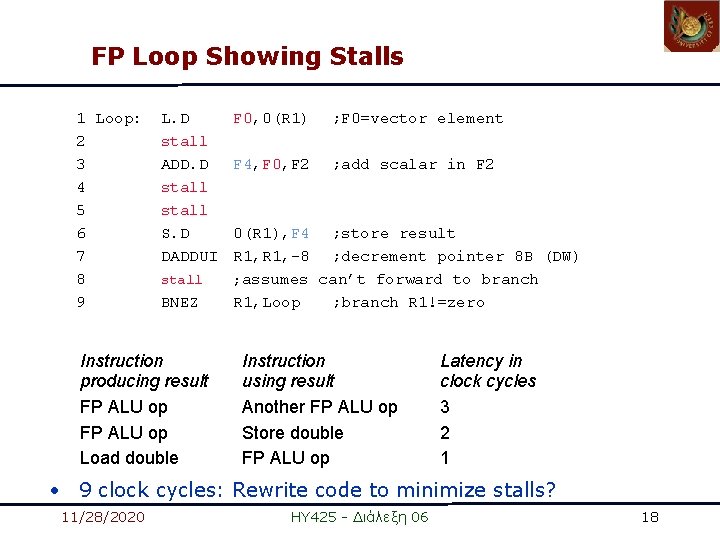
FP Loop Showing Stalls 1 Loop: 2 3 4 5 6 7 8 9 L. D stall ADD. D stall S. D DADDUI stall BNEZ Instruction producing result FP ALU op Load double F 0, 0(R 1) ; F 0=vector element F 4, F 0, F 2 ; add scalar in F 2 0(R 1), F 4 ; store result R 1, -8 ; decrement pointer 8 B (DW) ; assumes can’t forward to branch R 1, Loop ; branch R 1!=zero Instruction using result Another FP ALU op Store double FP ALU op Latency in clock cycles 3 2 1 • 9 clock cycles: Rewrite code to minimize stalls? 11/28/2020 ΗΥ 425 - Διάλεξη 06 18
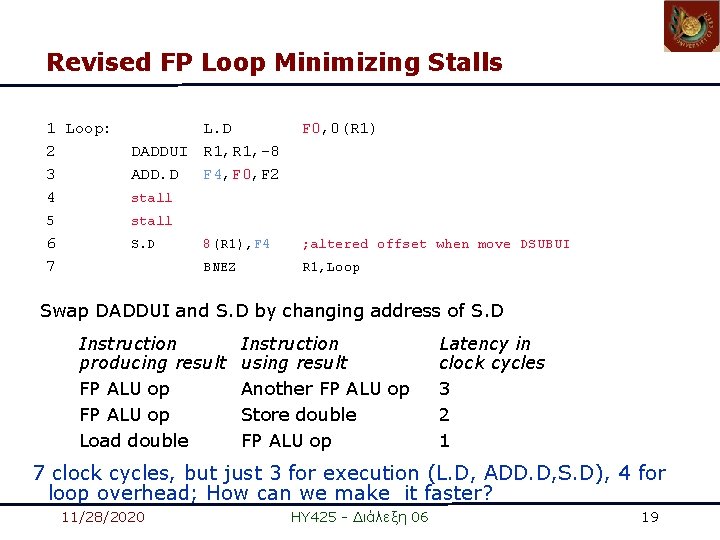
Revised FP Loop Minimizing Stalls 1 Loop: 2 3 4 L. D DADDUI R 1, -8 ADD. D F 4, F 0, F 2 5 stall 6 7 S. D F 0, 0(R 1) stall 8(R 1), F 4 ; altered offset when move DSUBUI BNEZ R 1, Loop Swap DADDUI and S. D by changing address of S. D Instruction producing result FP ALU op Load double Instruction using result Another FP ALU op Store double FP ALU op Latency in clock cycles 3 2 1 7 clock cycles, but just 3 for execution (L. D, ADD. D, S. D), 4 for loop overhead; How can we make it faster? 11/28/2020 ΗΥ 425 - Διάλεξη 06 19
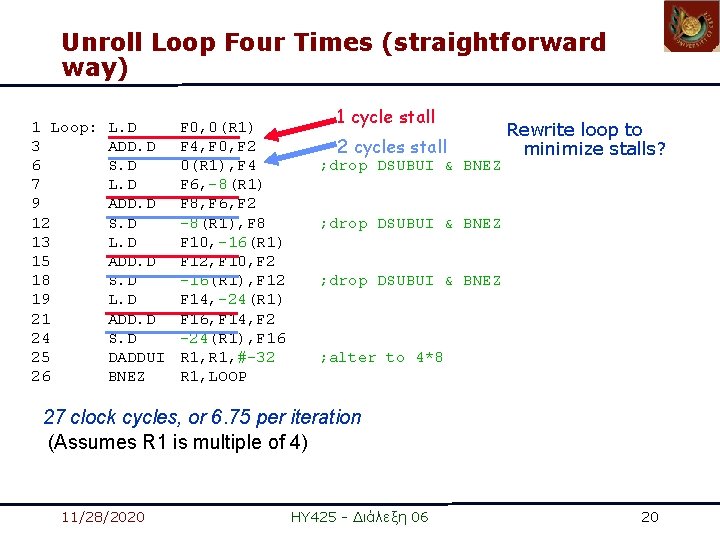
Unroll Loop Four Times (straightforward way) 1 Loop: 3 6 7 9 12 13 15 18 19 21 24 25 26 L. D ADD. D S. D DADDUI BNEZ F 0, 0(R 1) F 4, F 0, F 2 0(R 1), F 4 F 6, -8(R 1) F 8, F 6, F 2 -8(R 1), F 8 F 10, -16(R 1) F 12, F 10, F 2 -16(R 1), F 12 F 14, -24(R 1) F 16, F 14, F 2 -24(R 1), F 16 R 1, #-32 R 1, LOOP 1 cycle stall 2 cycles stall Rewrite loop to minimize stalls? ; drop DSUBUI & BNEZ ; alter to 4*8 27 clock cycles, or 6. 75 per iteration (Assumes R 1 is multiple of 4) 11/28/2020 ΗΥ 425 - Διάλεξη 06 20
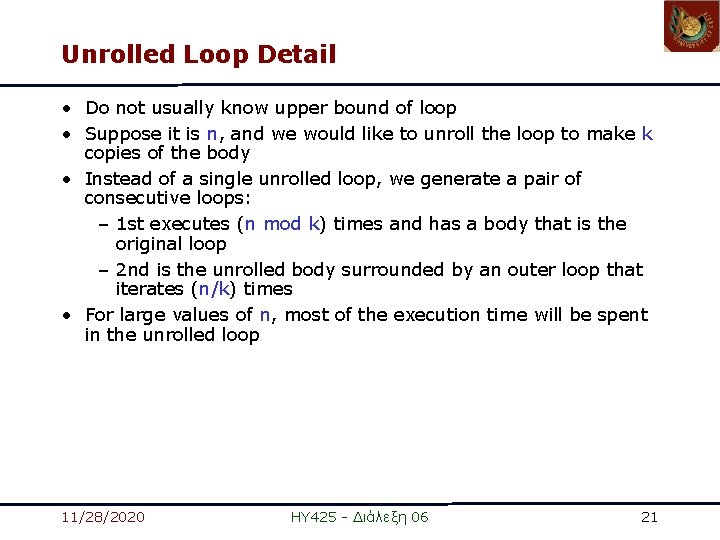
Unrolled Loop Detail • Do not usually know upper bound of loop • Suppose it is n, and we would like to unroll the loop to make k copies of the body • Instead of a single unrolled loop, we generate a pair of consecutive loops: – 1 st executes (n mod k) times and has a body that is the original loop – 2 nd is the unrolled body surrounded by an outer loop that iterates (n/k) times • For large values of n, most of the execution time will be spent in the unrolled loop 11/28/2020 ΗΥ 425 - Διάλεξη 06 21
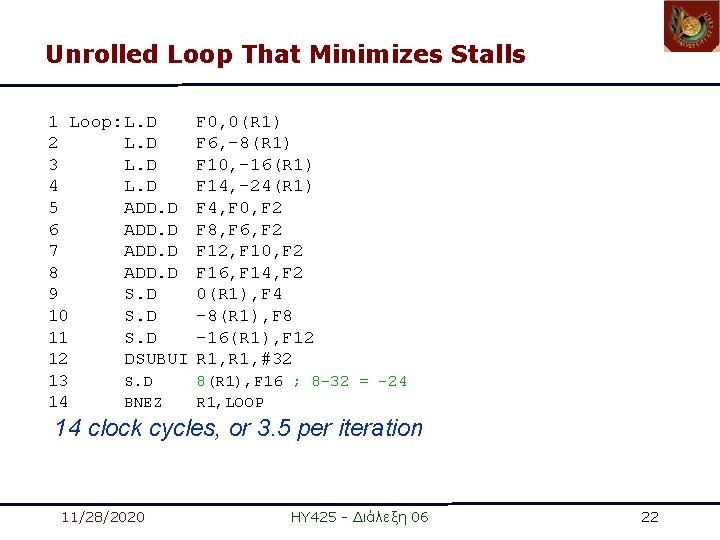
Unrolled Loop That Minimizes Stalls 1 Loop: L. D 2 L. D 3 L. D 4 L. D 5 ADD. D 6 ADD. D 7 ADD. D 8 ADD. D 9 S. D 10 S. D 11 S. D 12 DSUBUI 13 S. D 14 BNEZ F 0, 0(R 1) F 6, -8(R 1) F 10, -16(R 1) F 14, -24(R 1) F 4, F 0, F 2 F 8, F 6, F 2 F 12, F 10, F 2 F 16, F 14, F 2 0(R 1), F 4 -8(R 1), F 8 -16(R 1), F 12 R 1, #32 8(R 1), F 16 ; 8 -32 = -24 R 1, LOOP 14 clock cycles, or 3. 5 per iteration 11/28/2020 ΗΥ 425 - Διάλεξη 06 22
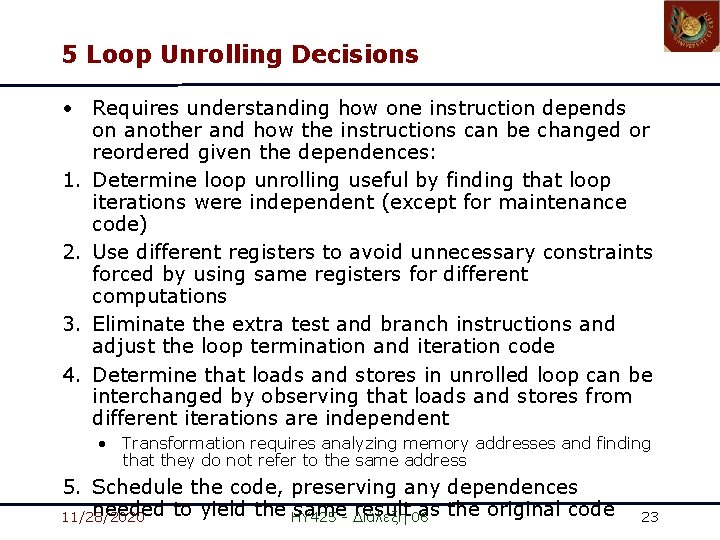
5 Loop Unrolling Decisions • Requires understanding how one instruction depends on another and how the instructions can be changed or reordered given the dependences: 1. Determine loop unrolling useful by finding that loop iterations were independent (except for maintenance code) 2. Use different registers to avoid unnecessary constraints forced by using same registers for different computations 3. Eliminate the extra test and branch instructions and adjust the loop termination and iteration code 4. Determine that loads and stores in unrolled loop can be interchanged by observing that loads and stores from different iterations are independent • Transformation requires analyzing memory addresses and finding that they do not refer to the same address 5. Schedule the code, preserving any dependences needed to yield the same result as the original code 11/28/2020 ΗΥ 425 - Διάλεξη 06 23
3 Limits to Loop Unrolling 1. Decrease in amount of overhead amortized with each extra unrolling • Amdahl’s Law 2. Growth in code size • For larger loops, concern it increases the instruction cache miss rate 3. Register pressure: potential shortfall in registers created by aggressive unrolling and scheduling – If not be possible to allocate all live values to registers, may lose some or all of its advantage – Loop unrolling reduces impact of branches on pipeline; another way is branch prediction 11/28/2020 ΗΥ 425 - Διάλεξη 06 24
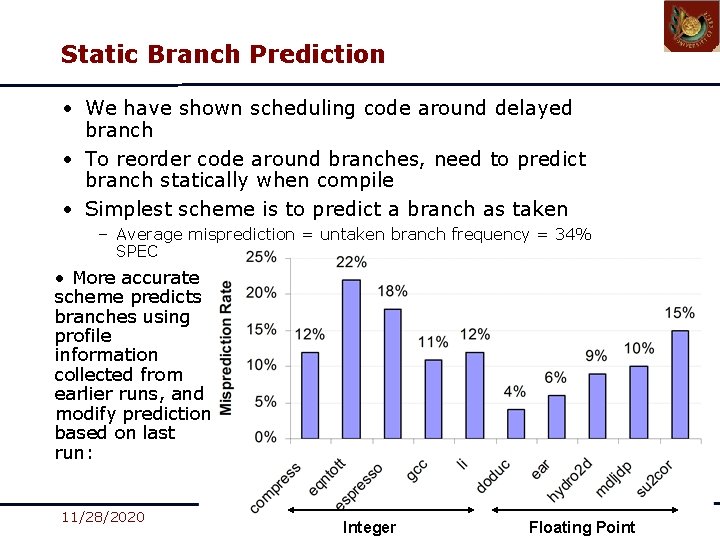
Static Branch Prediction • We have shown scheduling code around delayed branch • To reorder code around branches, need to predict branch statically when compile • Simplest scheme is to predict a branch as taken – Average misprediction = untaken branch frequency = 34% SPEC • More accurate scheme predicts branches using profile information collected from earlier runs, and modify prediction based on last run: 11/28/2020 ΗΥ 425 - Διάλεξη 06 Integer Floating Point 25
Dynamic Branch Prediction • Why does prediction work? – Underlying algorithm has regularities – Data that is being operated on has regularities – Instruction sequence has redundancies that are artifacts of way that humans/compilers think about problems • Is dynamic branch prediction better than static branch prediction? – Seems to be – There a small number of important branches in programs which have dynamic behavior 11/28/2020 ΗΥ 425 - Διάλεξη 06 26
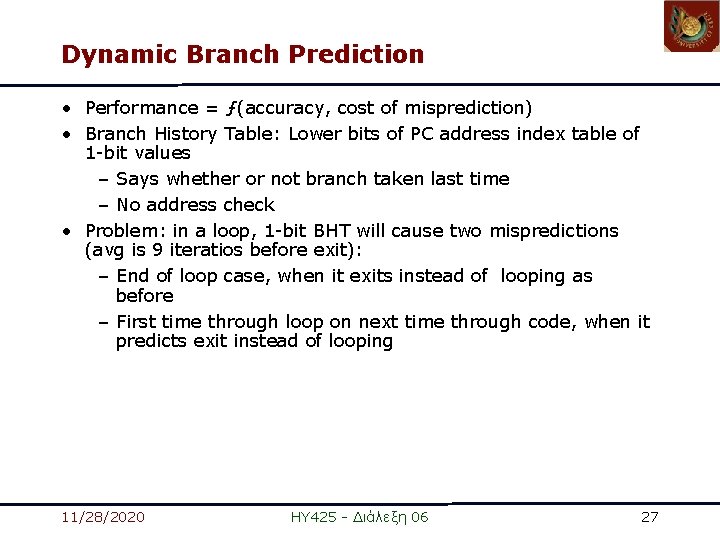
Dynamic Branch Prediction • Performance = ƒ(accuracy, cost of misprediction) • Branch History Table: Lower bits of PC address index table of 1 -bit values – Says whether or not branch taken last time – No address check • Problem: in a loop, 1 -bit BHT will cause two mispredictions (avg is 9 iteratios before exit): – End of loop case, when it exits instead of looping as before – First time through loop on next time through code, when it predicts exit instead of looping 11/28/2020 ΗΥ 425 - Διάλεξη 06 27
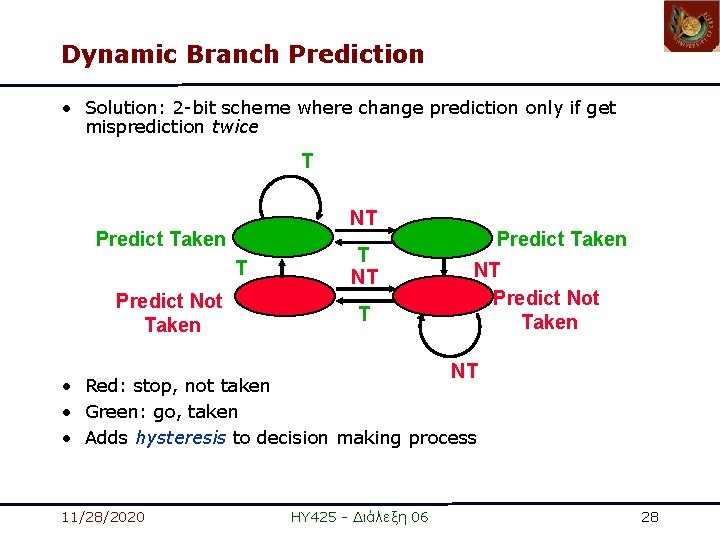
Dynamic Branch Prediction • Solution: 2 -bit scheme where change prediction only if get misprediction twice T NT Predict Taken T Predict Not Taken T NT T Predict Taken NT Predict Not Taken NT • Red: stop, not taken • Green: go, taken • Adds hysteresis to decision making process 11/28/2020 ΗΥ 425 - Διάλεξη 06 28
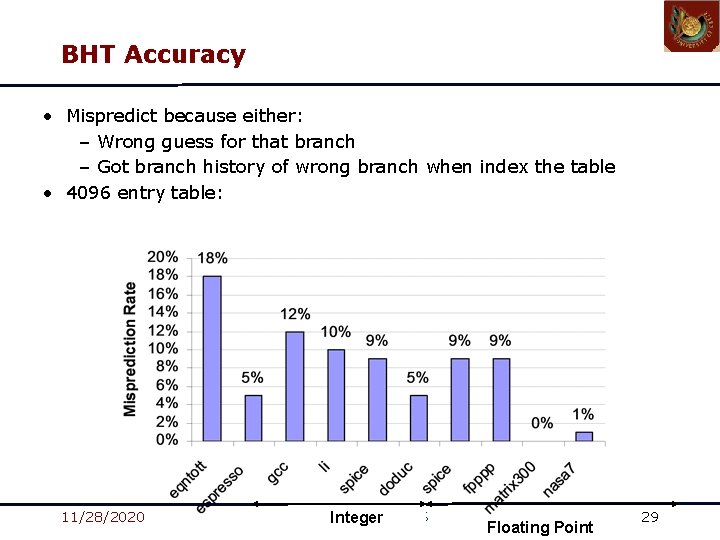
BHT Accuracy • Mispredict because either: – Wrong guess for that branch – Got branch history of wrong branch when index the table • 4096 entry table: 11/28/2020 ΗΥ 425 - Διάλεξη 06 Integer Floating Point 29
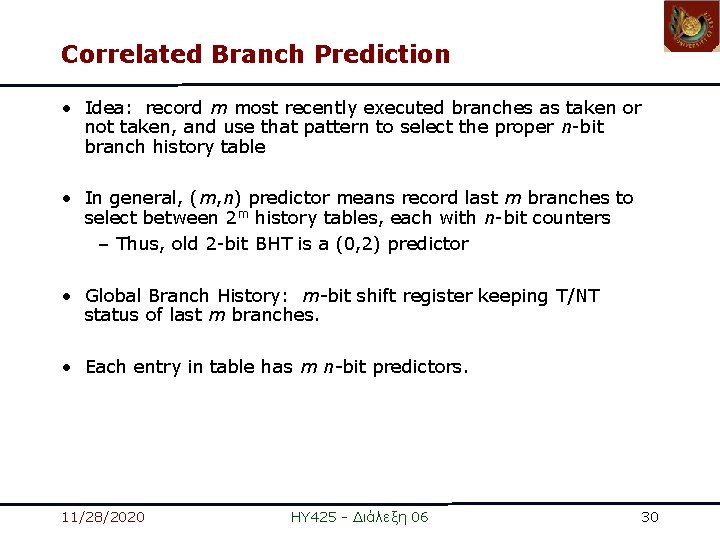
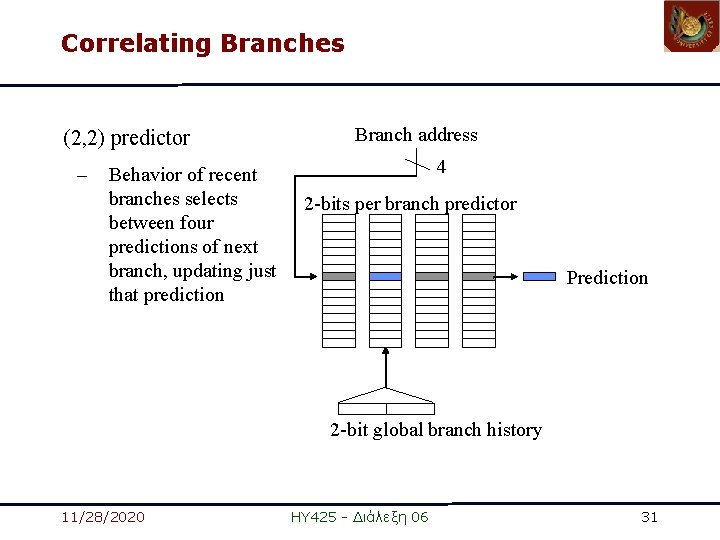
Correlated Branch Prediction • Idea: record m most recently executed branches as taken or not taken, and use that pattern to select the proper n-bit branch history table • In general, (m, n) predictor means record last m branches to select between 2 m history tables, each with n-bit counters – Thus, old 2 -bit BHT is a (0, 2) predictor • Global Branch History: m-bit shift register keeping T/NT status of last m branches. • Each entry in table has m n-bit predictors. 11/28/2020 ΗΥ 425 - Διάλεξη 06 30
Correlating Branches (2, 2) predictor – Behavior of recent branches selects between four predictions of next branch, updating just that prediction Branch address 4 2 -bits per branch predictor Prediction 2 -bit global branch history 11/28/2020 ΗΥ 425 - Διάλεξη 06 31
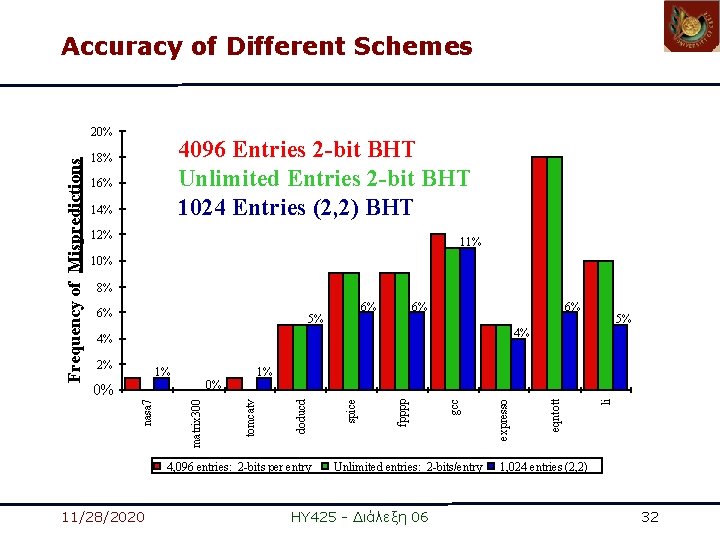
Accuracy of Different Schemes 4096 Entries 2 -bit BHT Unlimited Entries 2 -bit BHT 1024 Entries (2, 2) BHT 18% 16% 14% 12% 11% 10% 8% 6% 6% 5% 6% 6% 4, 096 entries: 2 -bits per entry 11/28/2020 Unlimited entries: 2 -bits/entry ΗΥ 425 - Διάλεξη 06 li eqntott expresso gcc fpppp matrix 300 0% spice 1% doducd 1% tomcatv 2% 0% 5% 4% 4% nasa 7 Frequency of Mispredictions 20% 1, 024 entries (2, 2) 32
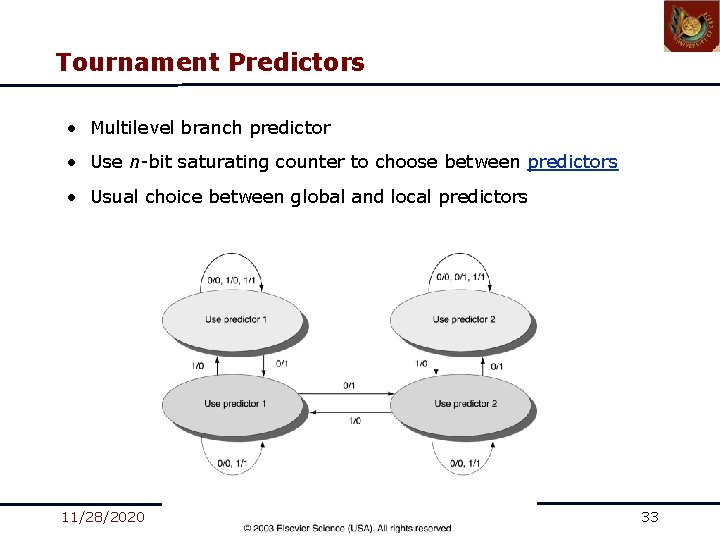
Tournament Predictors • Multilevel branch predictor • Use n-bit saturating counter to choose between predictors • Usual choice between global and local predictors 11/28/2020 ΗΥ 425 - Διάλεξη 06 33
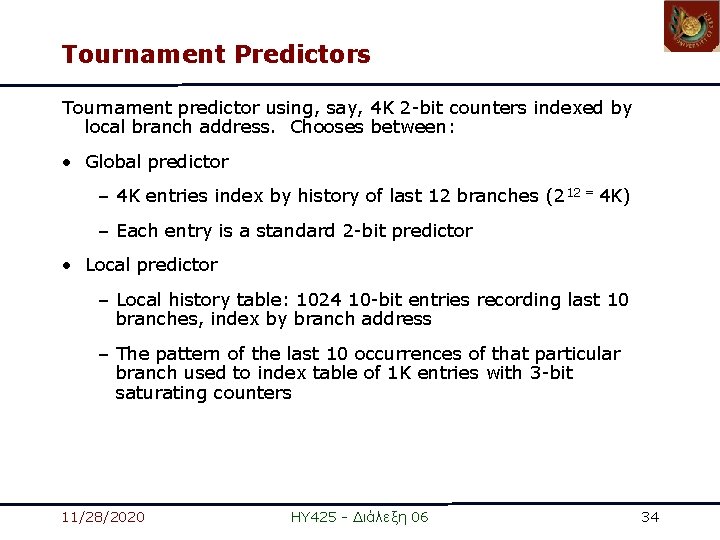
Tournament Predictors Tournament predictor using, say, 4 K 2 -bit counters indexed by local branch address. Chooses between: • Global predictor – 4 K entries index by history of last 12 branches (2 12 = 4 K) – Each entry is a standard 2 -bit predictor • Local predictor – Local history table: 1024 10 -bit entries recording last 10 branches, index by branch address – The pattern of the last 10 occurrences of that particular branch used to index table of 1 K entries with 3 -bit saturating counters 11/28/2020 ΗΥ 425 - Διάλεξη 06 34
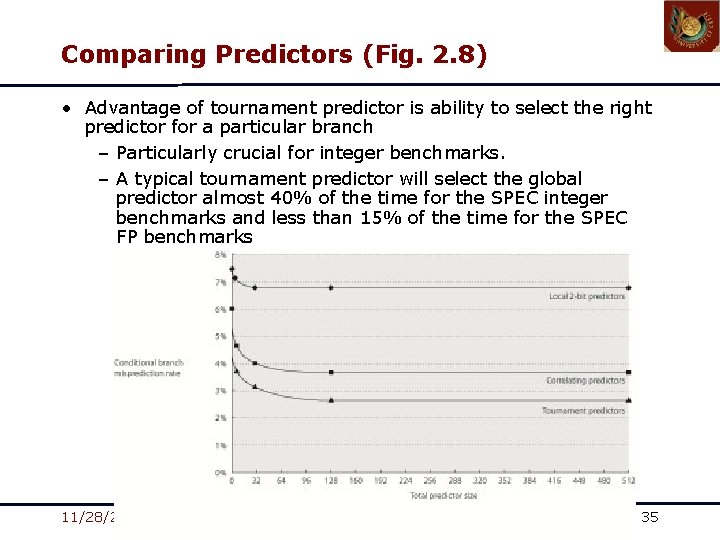
Comparing Predictors (Fig. 2. 8) • Advantage of tournament predictor is ability to select the right predictor for a particular branch – Particularly crucial for integer benchmarks. – A typical tournament predictor will select the global predictor almost 40% of the time for the SPEC integer benchmarks and less than 15% of the time for the SPEC FP benchmarks 11/28/2020 ΗΥ 425 - Διάλεξη 06 35
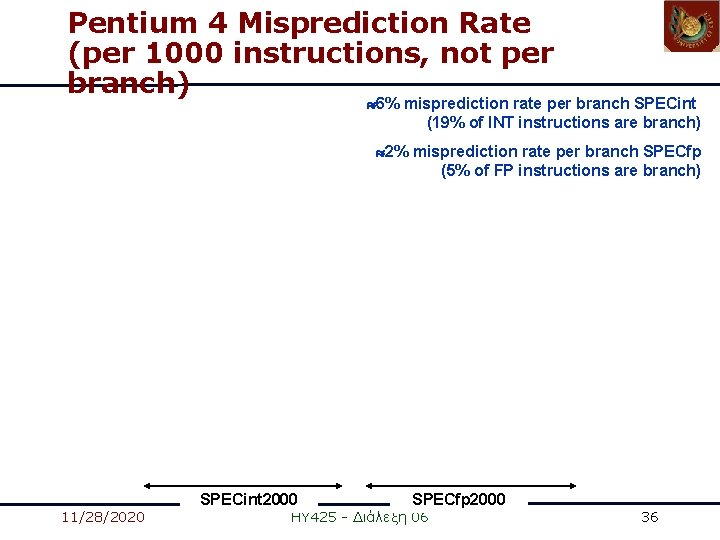
Pentium 4 Misprediction Rate (per 1000 instructions, not per branch) 6% misprediction rate per branch SPECint (19% of INT instructions are branch) 2% misprediction rate per branch SPECfp (5% of FP instructions are branch) 11/28/2020 SPECint 2000 SPECfp 2000 ΗΥ 425 - Διάλεξη 06 36
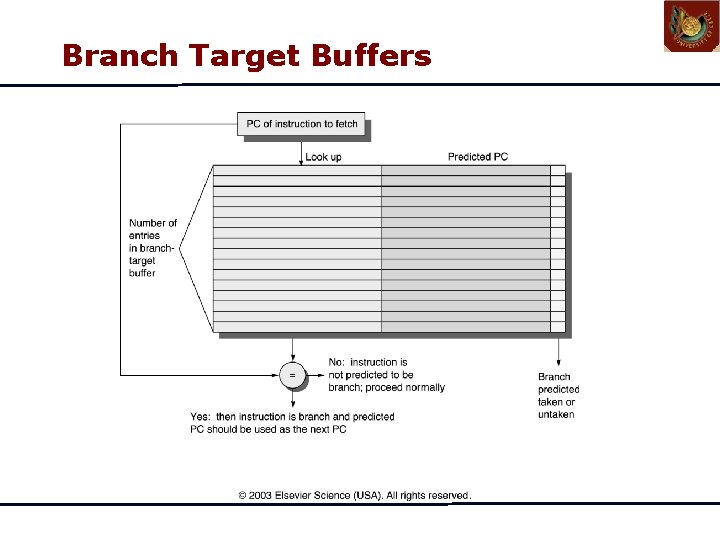
Branch Target Buffers (BTB) • Branch target calculation is costly and stalls the instruction fetch. • BTB stores PCs the same way as caches • The PC of a branch is sent to the BTB • When a match is found the corresponding Predicted PC is returned • If the branch was predicted taken, instruction fetch continues at the returned predicted PC
Branch Target Buffers
Dynamic Branch Prediction Summary • Prediction becoming important part of execution • Branch History Table: 2 bits for loop accuracy • Correlation: Recently executed branches correlated with next branch – Either different branches (GA) – Or different executions of same branches (PA) • Tournament predictors take insight to next level, by using multiple predictors – usually one based on global information and one based on local information, and combining them with a selector – In 2006, tournament predictors using 30 K bits are in processors like the Power 5 and Pentium 4 • Branch Target Buffer: include branch address & prediction 11/28/2020 ΗΥ 425 - Διάλεξη 06 39