
Outline Human Eye The main types of microscopes
- Slides: 27
Outline Ø Human Eye Ø The main types of microscopes Ø Light microscope Ø Parts of light microscope Ø How does the light microscope work? Ø The resolution and magnification Ø Defects in lenses Ø Advantages & Disadvantages
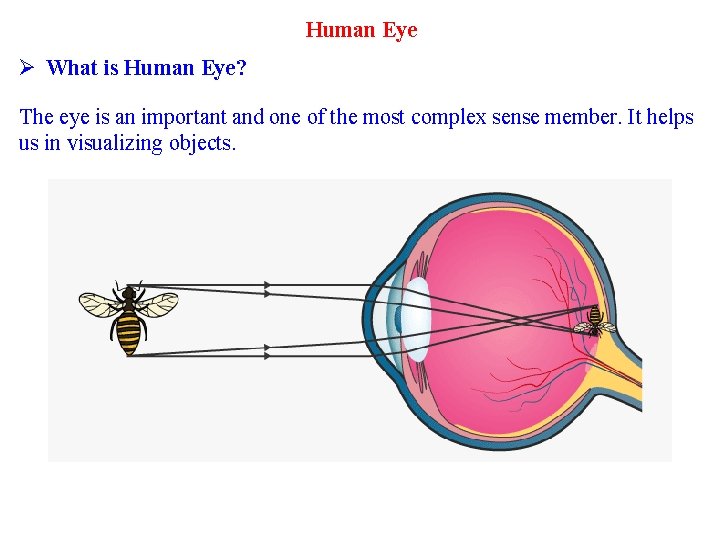
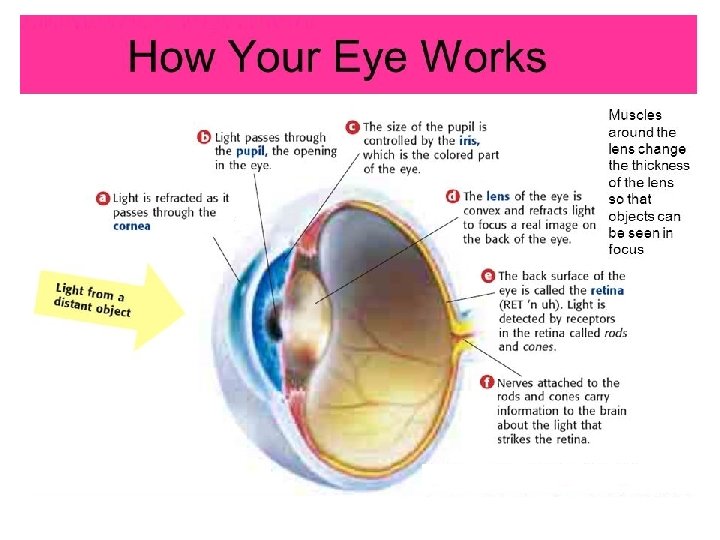
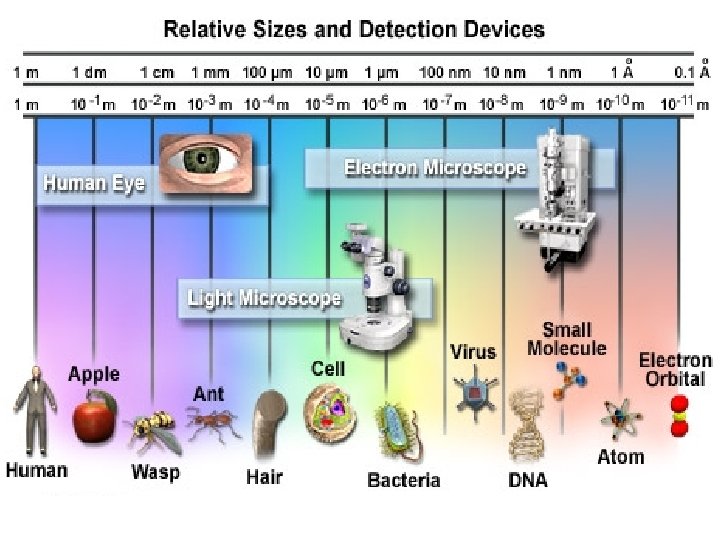
Human Eye Ø What is Human Eye? The eye is an important and one of the most complex sense member. It helps us in visualizing objects.
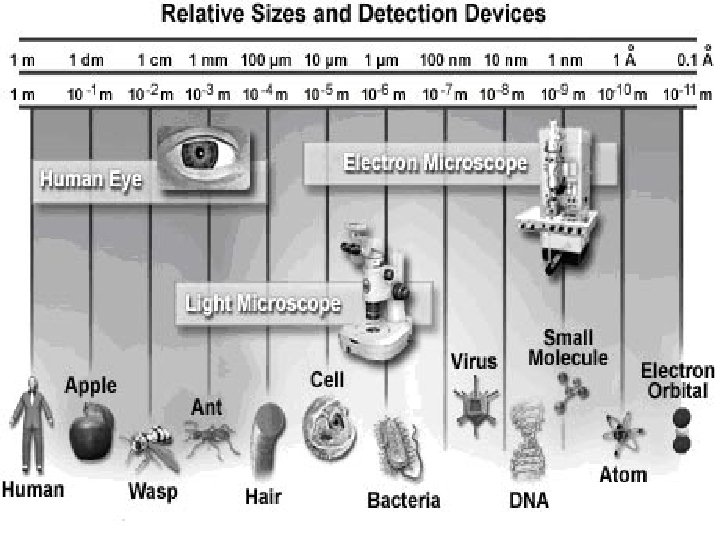
Resolution of Human Eye The resolution of human eyes is of the order of 0. 1 mm
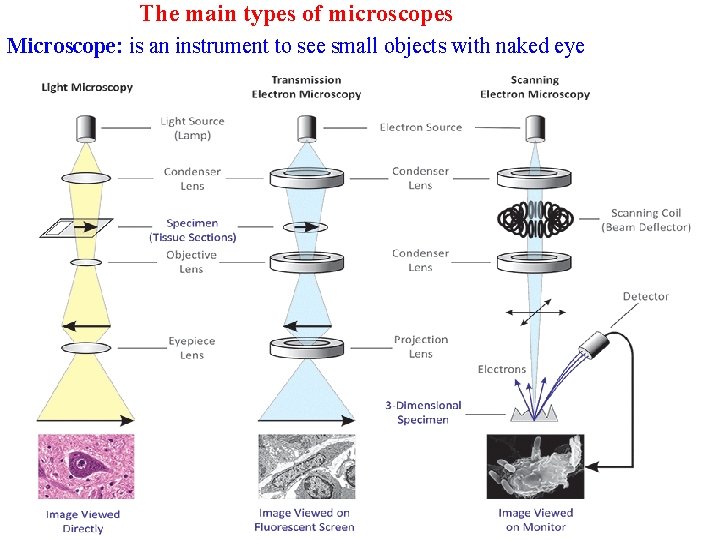
The main types of microscopes Microscope: is an instrument to see small objects with naked eye
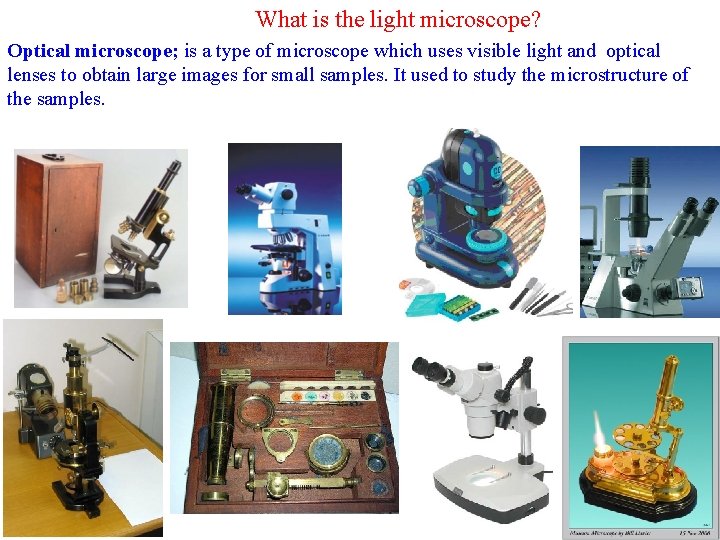
What is the light microscope? Optical microscope; is a type of microscope which uses visible light and optical lenses to obtain large images for small samples. It used to study the microstructure of the samples.
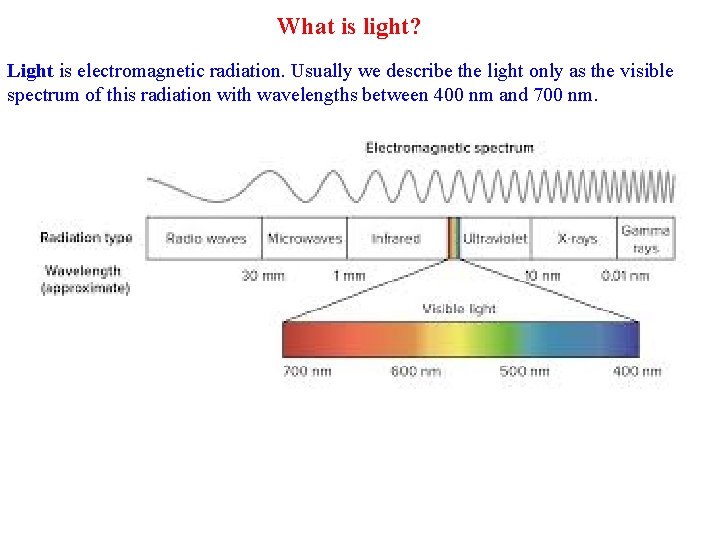
What is light? Light is electromagnetic radiation. Usually we describe the light only as the visible spectrum of this radiation with wavelengths between 400 nm and 700 nm.
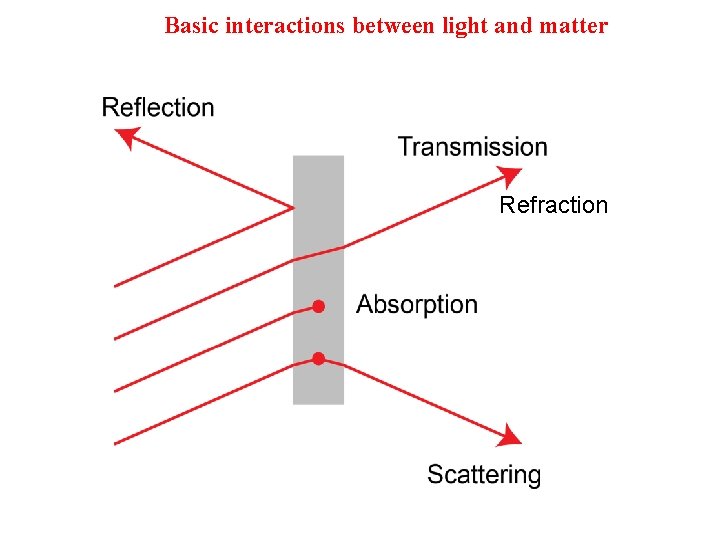
Basic interactions between light and matter Refraction
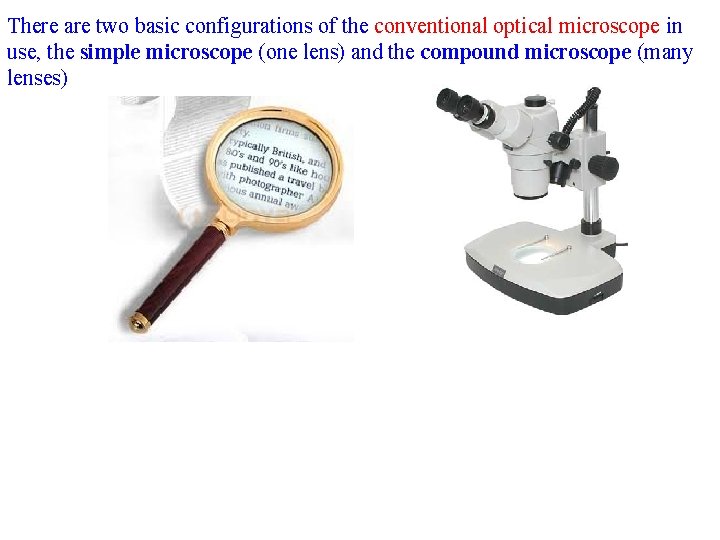
There are two basic configurations of the conventional optical microscope in use, the simple microscope (one lens) and the compound microscope (many lenses)
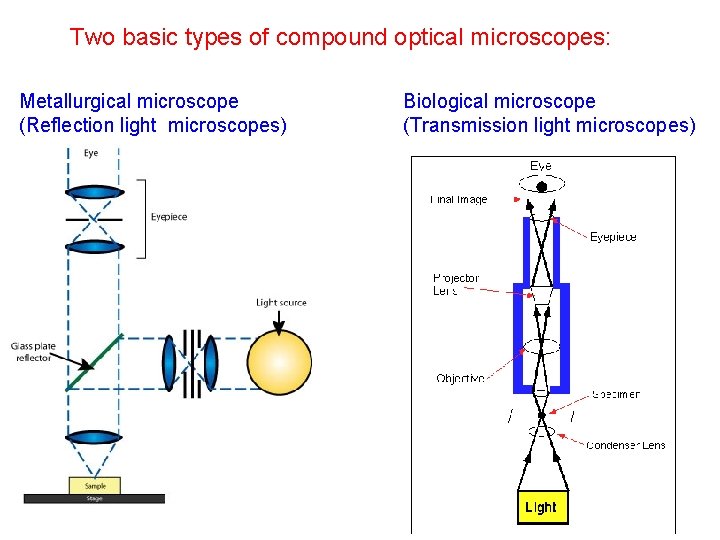
Two basic types of compound optical microscopes: Metallurgical microscope (Reflection light microscopes) Biological microscope (Transmission light microscopes)
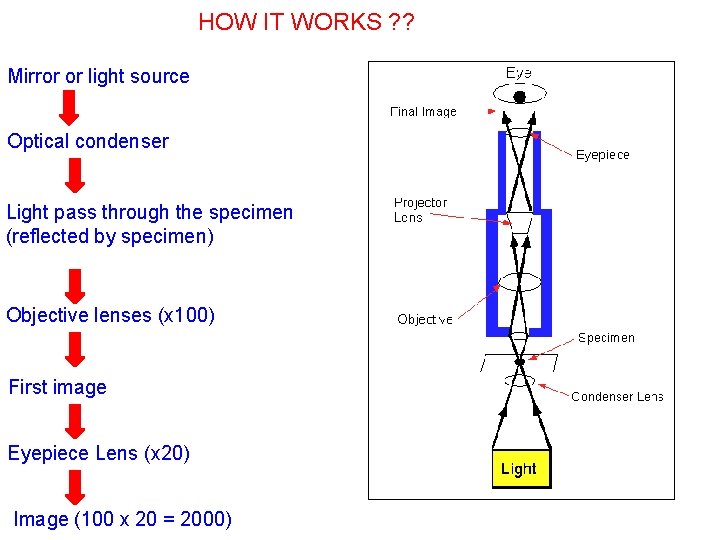
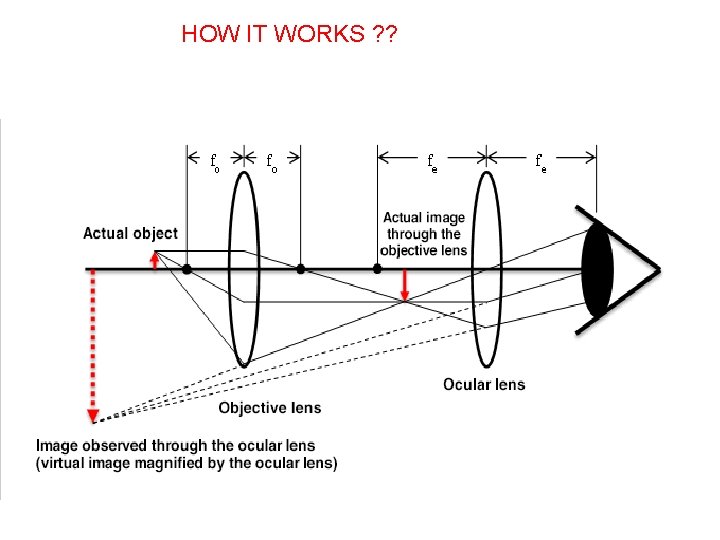
HOW IT WORKS ? ? Mirror or light source Optical condenser Light pass through the specimen (reflected by specimen) Objective lenses (x 100) First image Eyepiece Lens (x 20) Image (100 x 20 = 2000)
HOW IT WORKS ? ?
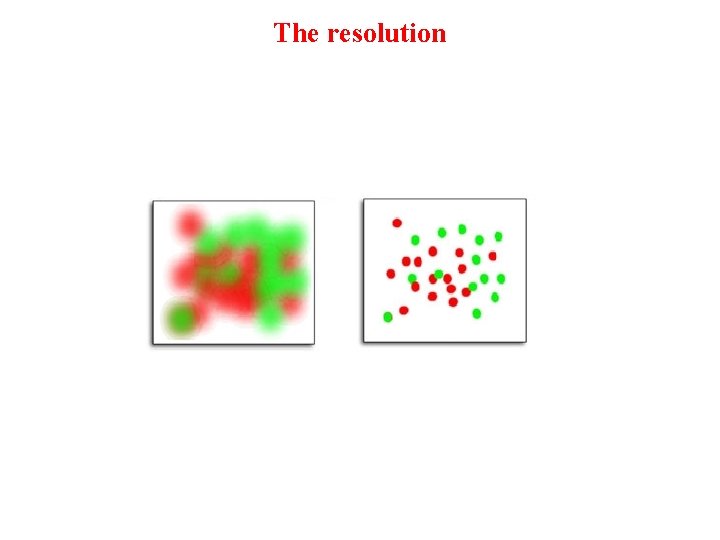
The resolution
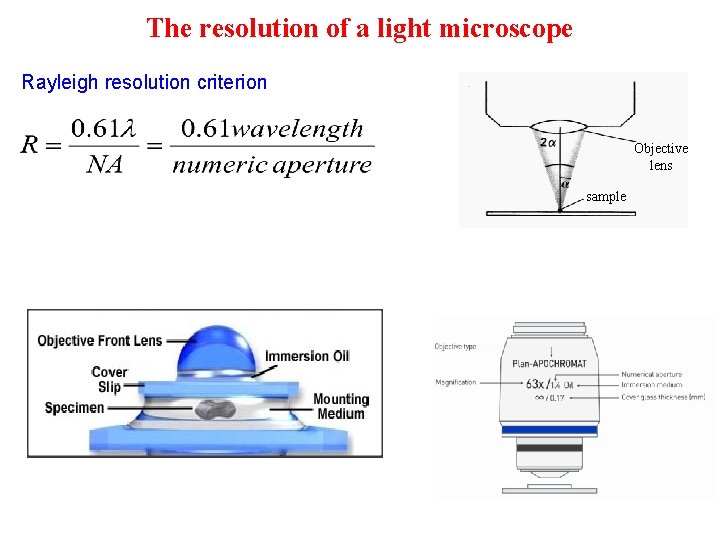
The resolution of a light microscope Rayleigh resolution criterion Objective lens sample
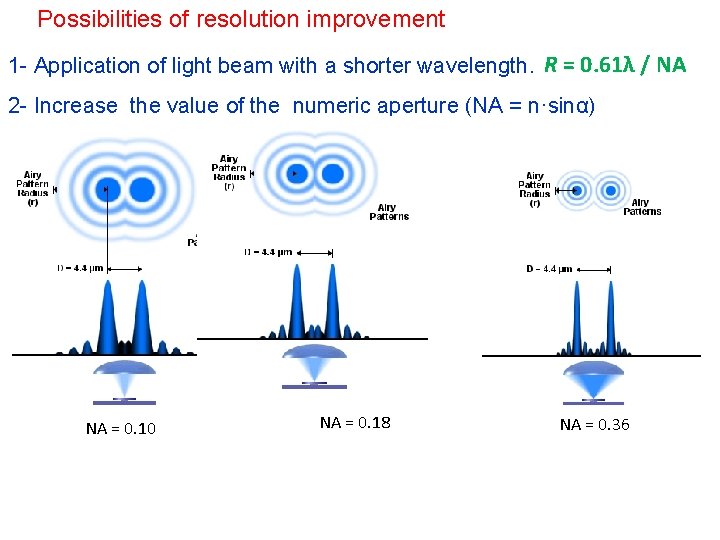
Possibilities of resolution improvement 1 - Application of light beam with a shorter wavelength. R = 0. 61λ / NA 2 - Increase the value of the numeric aperture (NA = n·sinα) NA = 0. 10 NA = 0. 18 NA = 0. 36
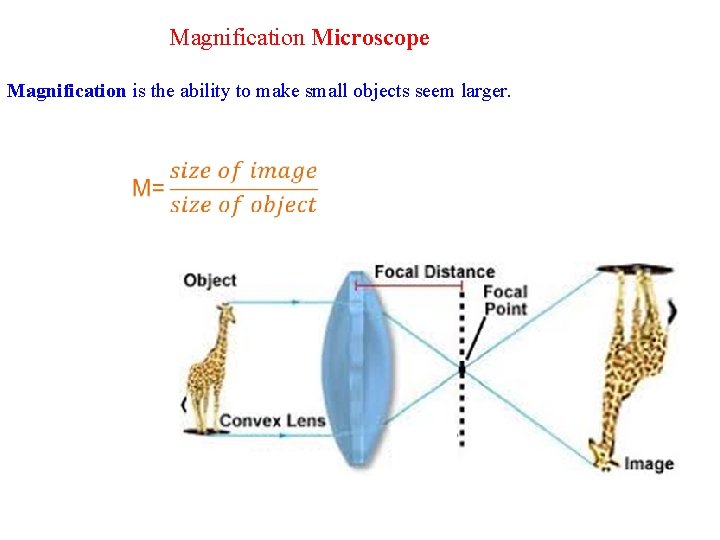
Magnification Microscope Magnification is the ability to make small objects seem larger.
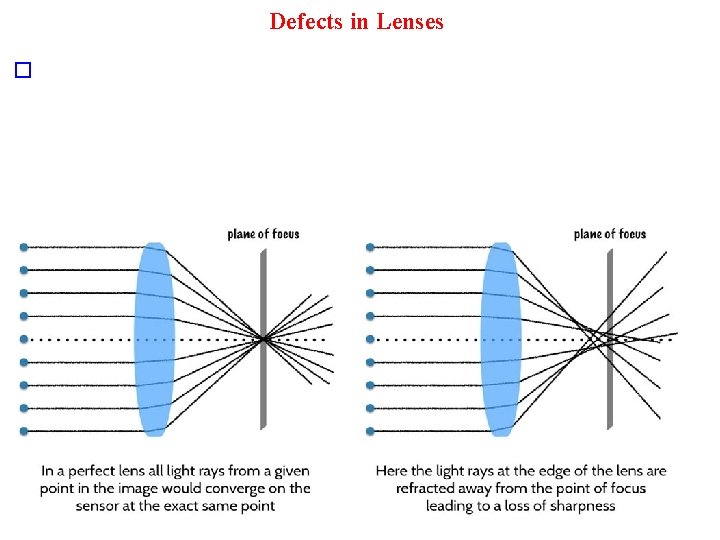
Defects in Lenses �
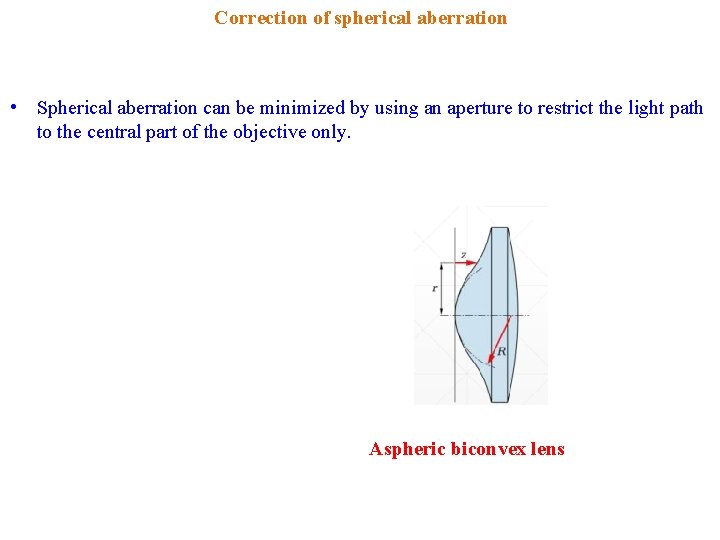
Correction of spherical aberration • Spherical aberration can be minimized by using an aperture to restrict the light path to the central part of the objective only. Aspheric biconvex lens
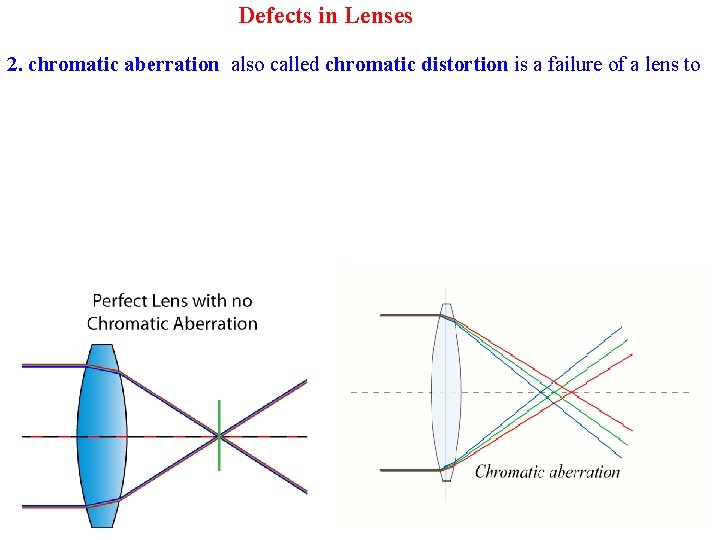
Defects in Lenses 2. chromatic aberration also called chromatic distortion is a failure of a lens to
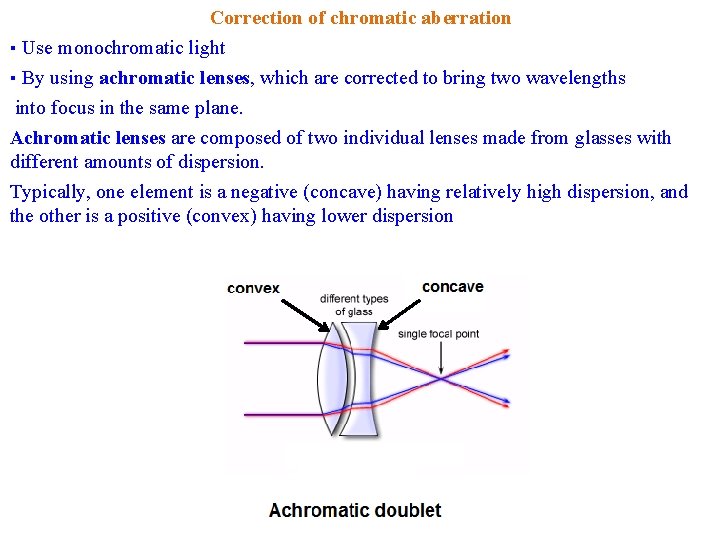
Correction of chromatic aberration ▪ Use monochromatic light ▪ By using achromatic lenses, which are corrected to bring two wavelengths into focus in the same plane. Achromatic lenses are composed of two individual lenses made from glasses with different amounts of dispersion. Typically, one element is a negative (concave) having relatively high dispersion, and the other is a positive (convex) having lower dispersion
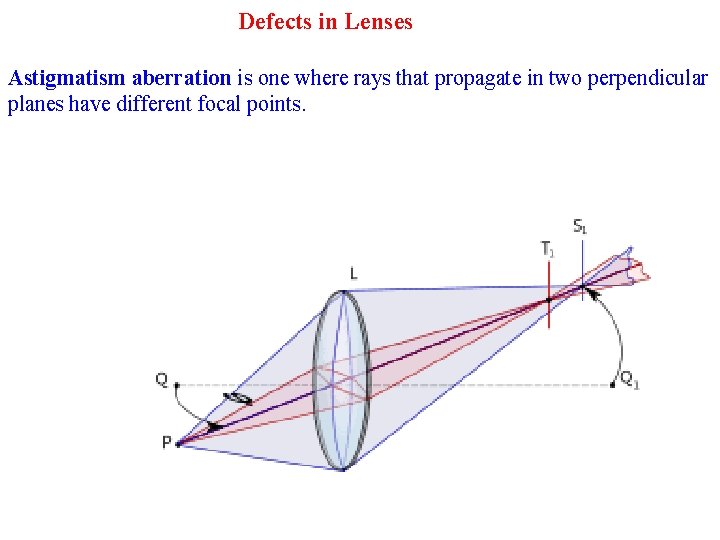
Defects in Lenses Astigmatism aberration is one where rays that propagate in two perpendicular planes have different focal points.
Correction of astigmatism aberration Astigmatism may arise due to imperfect lens surfaces or misalignments. So using lens with perfect surface and proper alignment reduces astigmatism
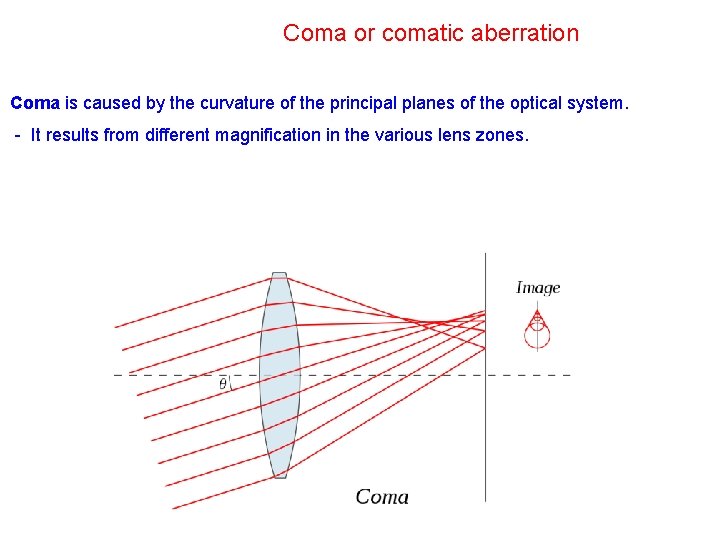
Coma or comatic aberration Coma is caused by the curvature of the principal planes of the optical system. - It results from different magnification in the various lens zones.
Correction of coma ▪ Since it is due to off-axis points, proper alignment of optical axis is must to be. ▪ The degree of coma aberration is greater for lenses with wider apertures, and can be corrected (partially) by reducing aperture size ▪ By designing lens of different shapes.
Light microscope • Advantages – Live image can be viewed – Natural color of object observed – It’s working principle is very simple to understand – It is easy to use – Small size and portable – Preparation of material is quick and simple – Cheap to purchase • Disadvantages – Limit of resolution – Limit magnification Optical microscope has extremely important in science and technology. Until these days, optical microscope is still used and developed