
Outline Extraterrestrial life Drake equation Close encounters UFOs

- Slides: 37
Outline • Extraterrestrial life • Drake equation • Close encounters– UFOs • Would aliens be good or bad? • Are we sure we want to find out? • How hard is it to define life? • Extremophiles • Astrobiology Nov 17, 2003 Astronomy 100 Fall 2003
Extraterrestrial Life What do people who look for extraterrestrial life search for? What is extraterrestrial life? Nov 17, 2003 Astronomy 100 Fall 2003
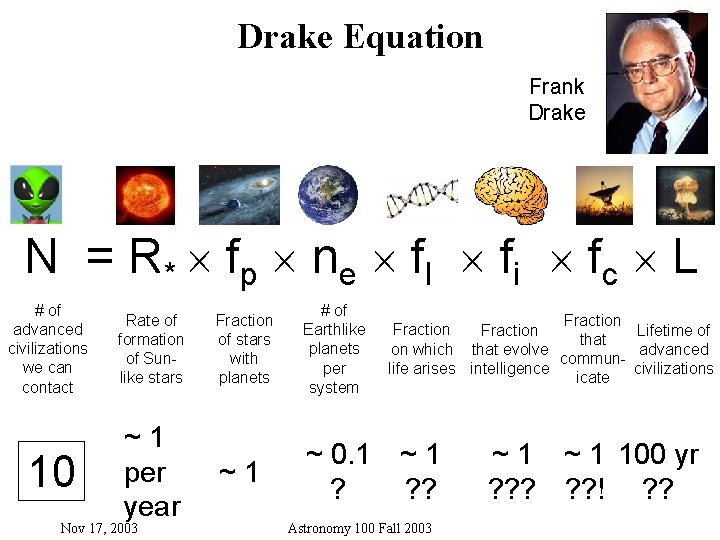
Drake Equation Frank Drake N = R * f p ne f l f i f c L # of advanced civilizations we can contact Rate of formation of Sunlike stars 10 ~1 per year Nov 17, 2003 Fraction of stars with planets # of Earthlike planets per system ~1 ~ 0. 1 ? Fraction Lifetime of that on which that evolve advanced communlife arises intelligence civilizations icate ~1 ? ? Astronomy 100 Fall 2003 ~ 1 100 yr ? ? ? ! ? ?
Questions • How many believe that we have been visited by ETs? • Are governments hiding it? Nov 17, 2003 Astronomy 100 Fall 2003
Have we been visited by ETs? “Extraordinary Claims Require Extraordinary Evidence” Nov 17, 2003 Astronomy 100 Fall 2003
What about all the UFO hype? • Sure, UFOs exist. But when they are identified, they are normally weather balloons, 747 s, Venus, whatever. • Even after all you’ve heard and all you’ve read in the Enquirer, there is has been no reliable proof of any UFOs being ETs. • What’s the point? What’s the gain? • Remember that the nearest star is around 4 light years. Who pays for the gas money? Nov 17, 2003 Astronomy 100 Fall 2003
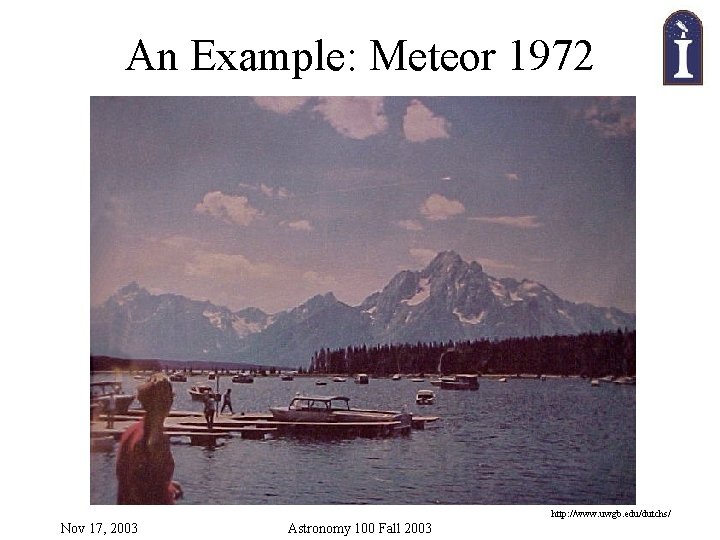
An Example: Meteor 1972 http: //www. uwgb. edu/dutchs/ Nov 17, 2003 Astronomy 100 Fall 2003
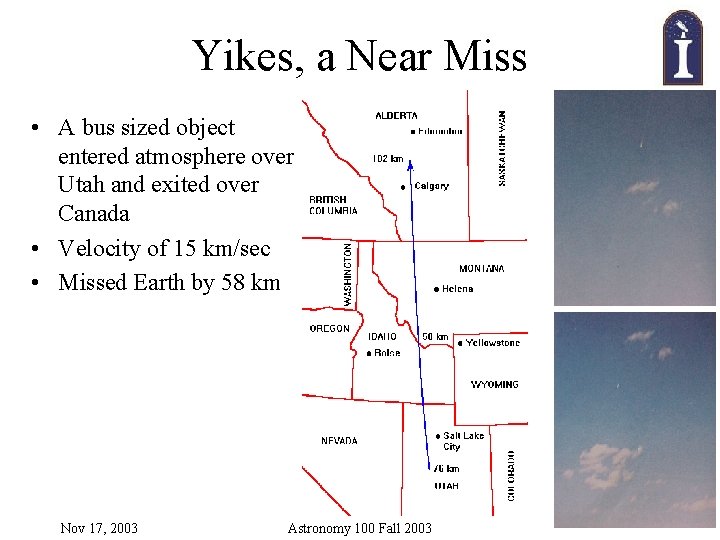
Yikes, a Near Miss • A bus sized object entered atmosphere over Utah and exited over Canada • Velocity of 15 km/sec • Missed Earth by 58 km Nov 17, 2003 Astronomy 100 Fall 2003
But… • • Event was completely unexpected Crossed relatively sparsely-inhabited region Only visible for a total of 101 seconds Visible for no more than 30 seconds at any one spot • Nonetheless, we have dozens of clear photographs of this event • And still we have no comparable images of UFOs Nov 17, 2003 Astronomy 100 Fall 2003
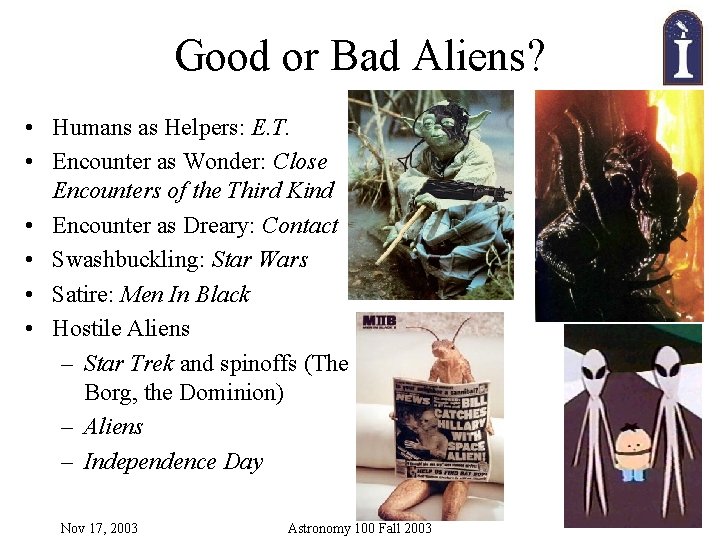
Good or Bad Aliens? • Humans as Helpers: E. T. • Encounter as Wonder: Close Encounters of the Third Kind • Encounter as Dreary: Contact • Swashbuckling: Star Wars • Satire: Men In Black • Hostile Aliens – Star Trek and spinoffs (The Borg, the Dominion) – Aliens – Independence Day Nov 17, 2003 Astronomy 100 Fall 2003
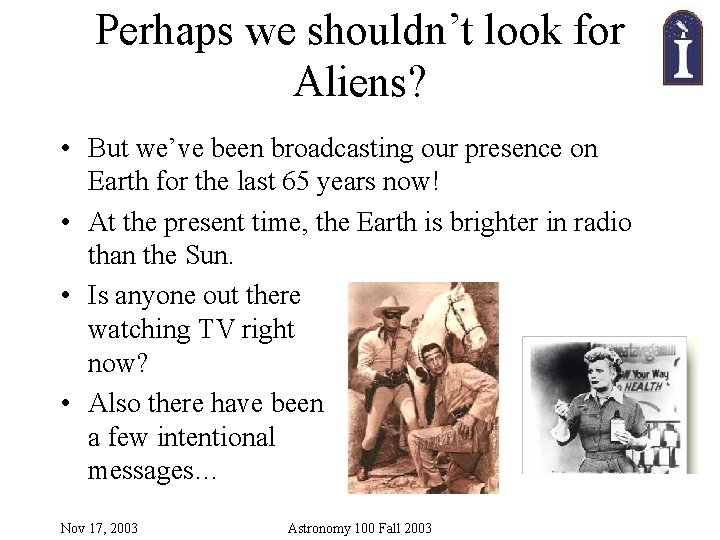
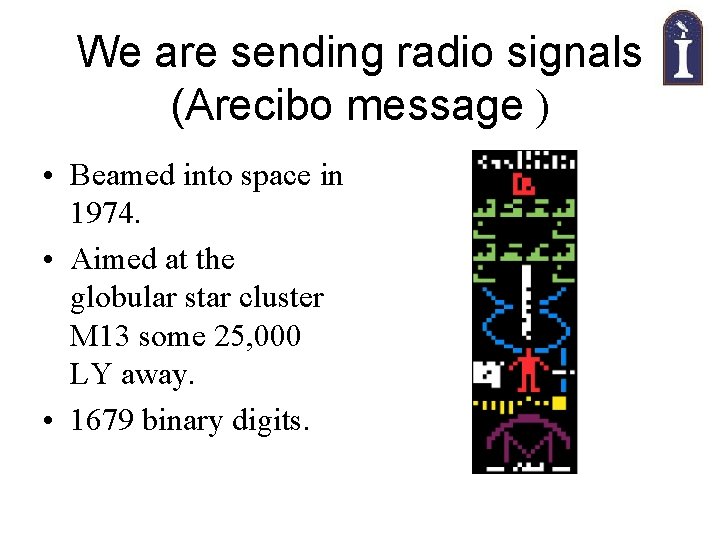
Perhaps we shouldn’t look for Aliens? • But we’ve been broadcasting our presence on Earth for the last 65 years now! • At the present time, the Earth is brighter in radio than the Sun. • Is anyone out there watching TV right now? • Also there have been a few intentional messages… Nov 17, 2003 Astronomy 100 Fall 2003
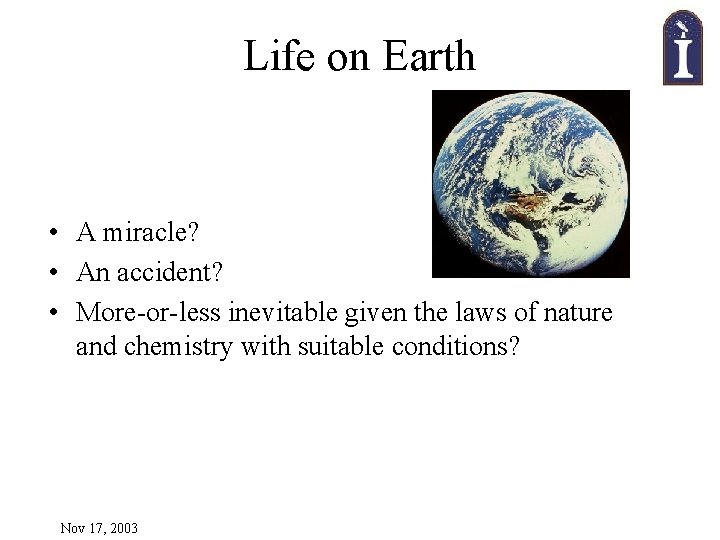
Life on Earth • A miracle? • An accident? • More-or-less inevitable given the laws of nature and chemistry with suitable conditions? Nov 17, 2003
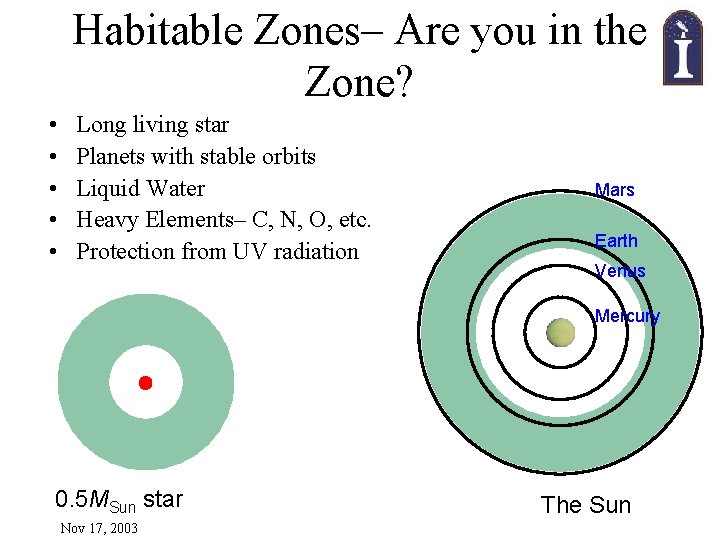
Habitable Zones– Are you in the Zone? • • • Long living star Planets with stable orbits Liquid Water Heavy Elements– C, N, O, etc. Protection from UV radiation Mars Earth Venus Mercury 0. 5 MSun star Nov 17, 2003 The Sun
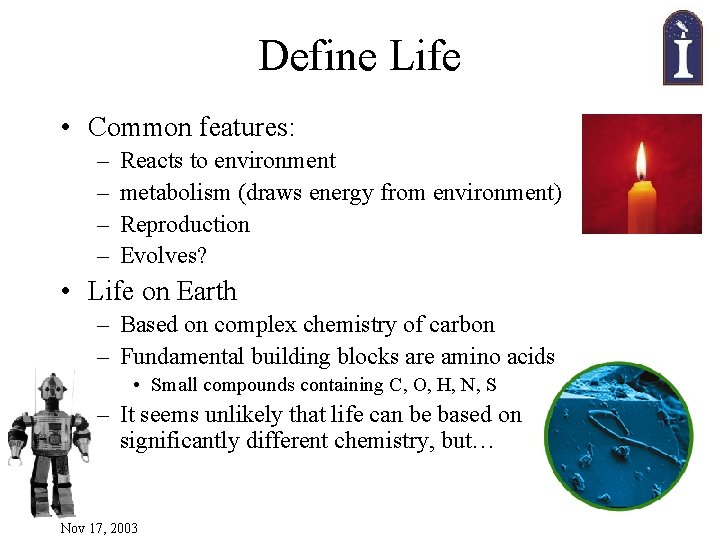
Define Life • Common features: – – Reacts to environment metabolism (draws energy from environment) Reproduction Evolves? • Life on Earth – Based on complex chemistry of carbon – Fundamental building blocks are amino acids • Small compounds containing C, O, H, N, S – It seems unlikely that life can be based on significantly different chemistry, but… Nov 17, 2003
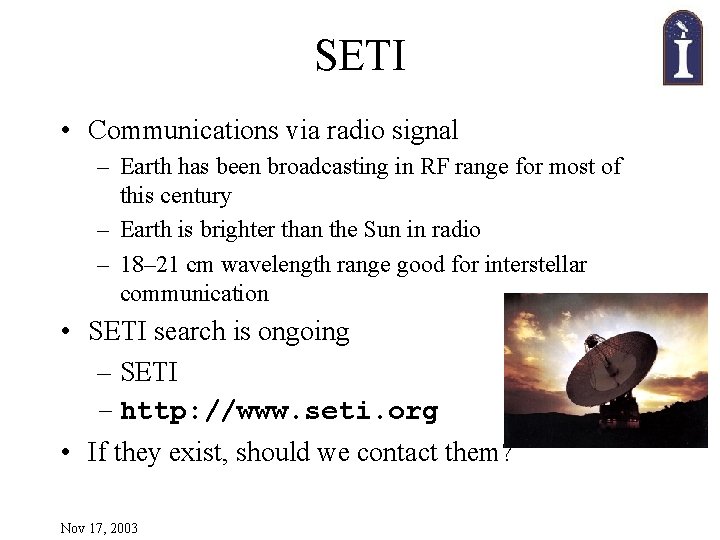
SETI • Communications via radio signal – Earth has been broadcasting in RF range for most of this century – Earth is brighter than the Sun in radio – 18– 21 cm wavelength range good for interstellar communication • SETI search is ongoing – SETI – http: //www. seti. org • If they exist, should we contact them? Nov 17, 2003
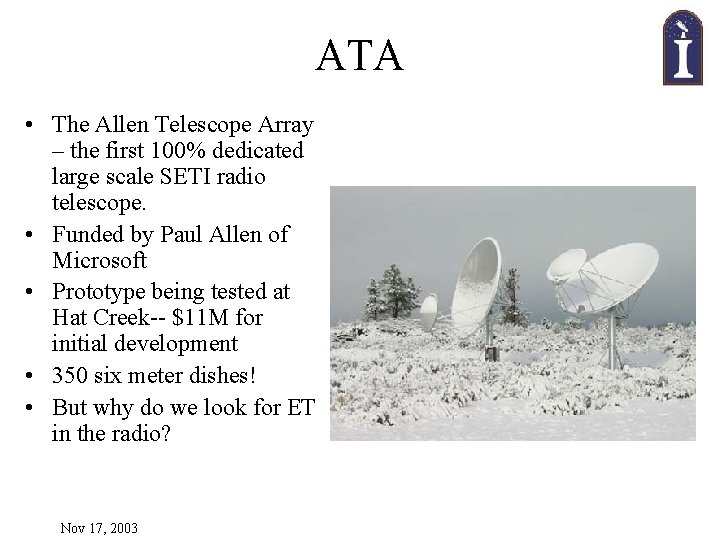
ATA • The Allen Telescope Array – the first 100% dedicated large scale SETI radio telescope. • Funded by Paul Allen of Microsoft • Prototype being tested at Hat Creek-- $11 M for initial development • 350 six meter dishes! • But why do we look for ET in the radio? Nov 17, 2003
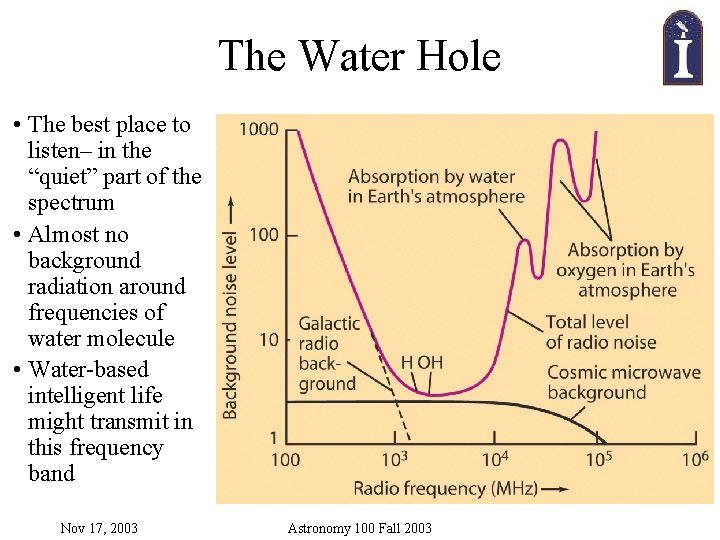
The Water Hole • The best place to listen– in the “quiet” part of the spectrum • Almost no background radiation around frequencies of water molecule • Water-based intelligent life might transmit in this frequency band Nov 17, 2003 Astronomy 100 Fall 2003
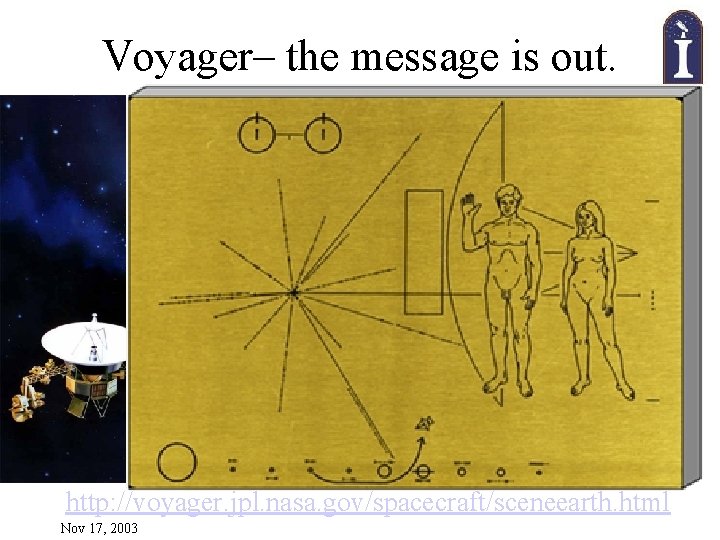
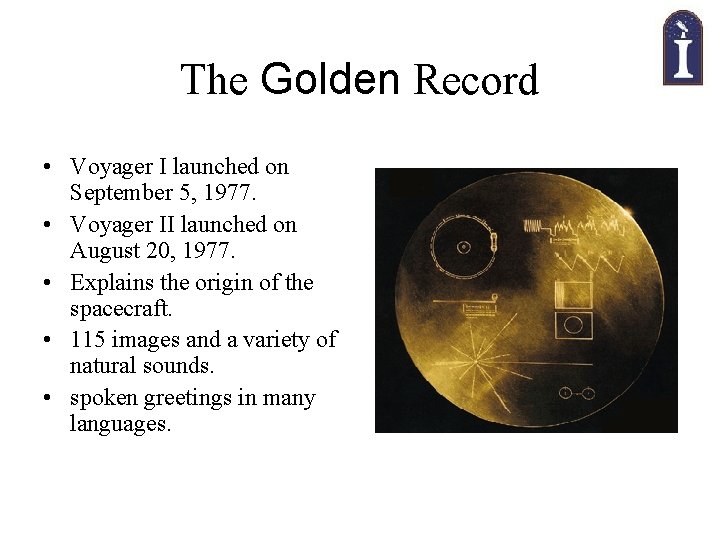
Voyager– the message is out. http: //voyager. jpl. nasa. gov/spacecraft/sceneearth. html Nov 17, 2003
What type of Aliens? If we took all the biomass of all the animals, and all the biomass of all the viruses, bacteria, protozoa, and fungi– who weighs more? Around 90% of all biomass on the Earth is in the smallest and simplest lifeforms. Nov 17, 2003
So are we looking for the wrong type of life? • In your body, there are more microbes cells than you-cells. • The first life on Earth was a microbe • They existed for billions of years on Earth– only life for the first 3 billion years • Microbes can live in more harsh environments– more life in the ground than on top of the ground • So most likely ET will be microbes too! Nov 17, 2003
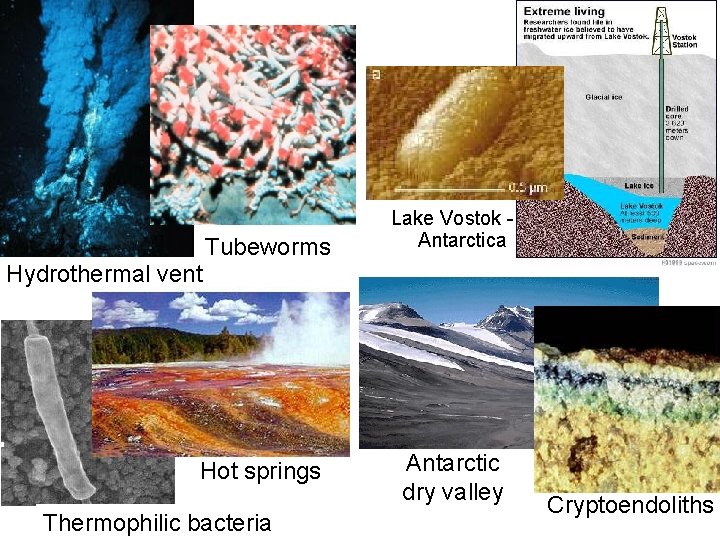
Not your Parent's ET-Extremophiles • These are microbes that life in the most extreme places on Earth. • Temperature extremes – boiling or freezing, 1000 C to -10 C (212 F to 30 F) • Chemical extremes – vinegar or ammonia (<5 p. H or >9 p. H) – highly salty, up to ten times sea water • They are exciting because they are the most likely candidate for extraterrestrial life. Nov 17, 2003
Hydrothermal vent Tubeworms Hot springs Thermophilic bacteria Nov 17, 2003 Lake Vostok Antarctica Antarctic dry valley Cryptoendoliths
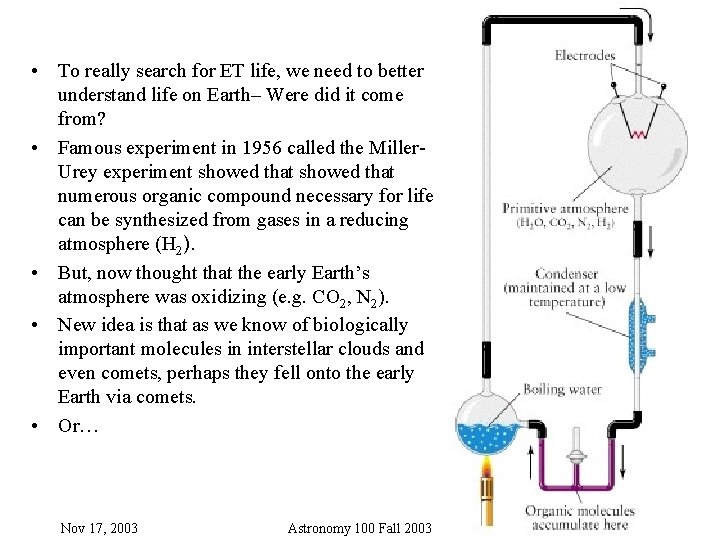
• To really search for ET life, we need to better understand life on Earth– Were did it come from? • Famous experiment in 1956 called the Miller. Urey experiment showed that numerous organic compound necessary for life can be synthesized from gases in a reducing atmosphere (H 2). • But, now thought that the early Earth’s atmosphere was oxidizing (e. g. CO 2, N 2). • New idea is that as we know of biologically important molecules in interstellar clouds and even comets, perhaps they fell onto the early Earth via comets. • Or… Nov 17, 2003 Astronomy 100 Fall 2003
This has become even more important in the last few years. • We have found planets. • We are building bigger instruments to look for Earth-like planets. • Can answer the fundamental question: Are we alone? • New initiative – Astrobiology – How life arose on Earth? – Conditions necessary for life to arise elsewhere in the Universe? – Methods to detect the existence of life elsewhere? Nov 17, 2003 Astronomy 100 Fall 2003
We are looking for them! • • Searching is limited by great distances. The dangers of anthropomorphism. We look for radio emissions (SETI). We look for direct planetary observations (exoplanet hunters). • We look for alien constructs (probes, colonies, or artifacts (Dyson spheres). • What have we found? • NOTHING !
Nov 17, 2003 Astronomy 100 Fall 2003
Nov 17, 2003 Astronomy 100 Fall 2003
Nov 17, 2003 Astronomy 100 Fall 2003
Nov 17, 2003 Astronomy 100 Fall 2003
Nov 17, 2003 Astronomy 100 Fall 2003
Nov 17, 2003 Astronomy 100 Fall 2003
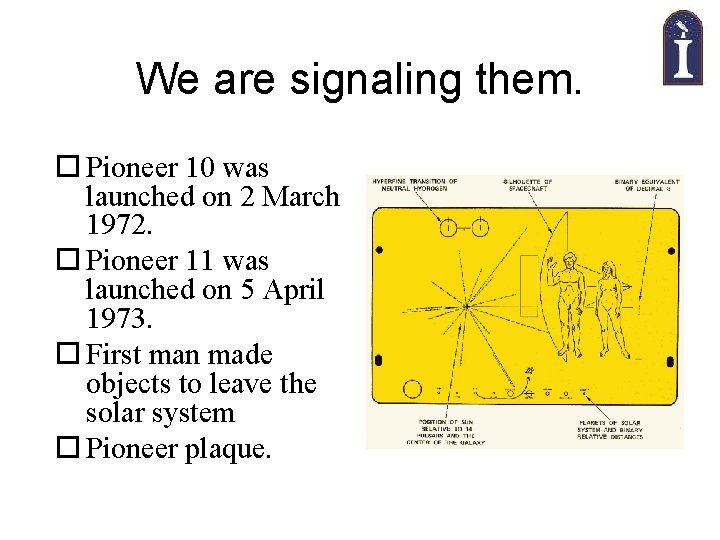
We are signaling them. Pioneer 10 was launched on 2 March 1972. Pioneer 11 was launched on 5 April 1973. First man made objects to leave the solar system Pioneer plaque.
The Golden Record • Voyager I launched on September 5, 1977. • Voyager II launched on August 20, 1977. • Explains the origin of the spacecraft. • 115 images and a variety of natural sounds. • spoken greetings in many languages.
We are sending radio signals (Arecibo message ) • Beamed into space in 1974. • Aimed at the globular star cluster M 13 some 25, 000 LY away. • 1679 binary digits.
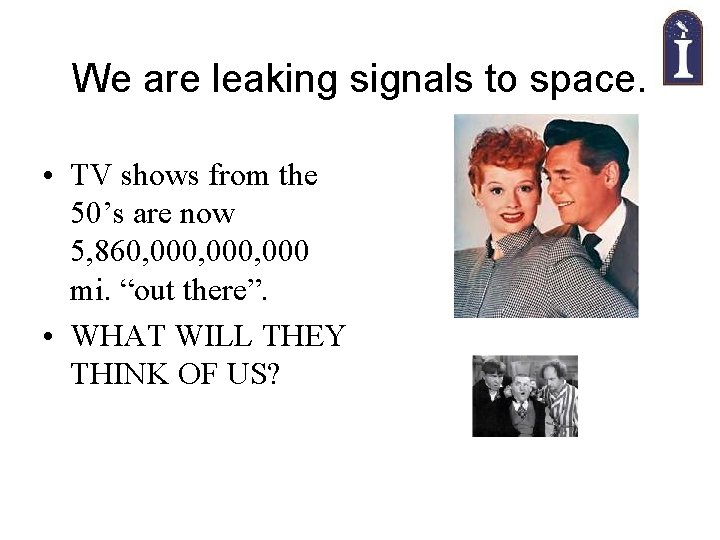
We are leaking signals to space. • TV shows from the 50’s are now 5, 860, 000, 000 mi. “out there”. • WHAT WILL THEY THINK OF US?
Can They See Our Lights?
WHAT DO YOU THINK? • PBS Nova Poll results: • 16% think that we are alone in the universe. • 77% think that there is other intelligent life somewhere in the universe. • 7% undecided.