
Outline Control structure design plantwide control A procedure
- Slides: 35
Outline • Control structure design (plantwide control) • A procedure for control structure design I Top Down • • Step 1: Degrees of freedom Step 2: Operational objectives (optimal operation) Step 3: What to control ? (self- optimzing control) Step 4: Where set production rate? II Bottom Up • Step 5: Regulatory control: What more to control ? • Step 6: Supervisory control • Step 7: Real-time optimization • Case studies 1
Step 4. Where set production rate? • • • 2 Where locale the TPM (throughput manipulator)? Very important! Determines structure of remaining inventory (level) control system Set production rate at (dynamic) bottleneck Link between Top-down and Bottom-up parts
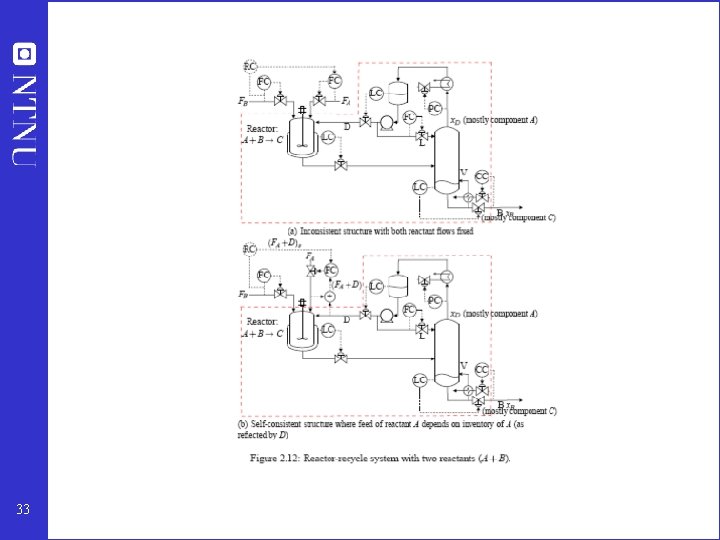
TPM (Throughput manipulator) • • TPM (Throughput manipulator) = ”Unused” degree of freedom that affects the throughput. Definition ( Aske and Skogestad, 2009). A TPM is a degree of freedom that affects the network flow and which is not directly or indirectly determined by the control of the individual units, including their inventory control. Usually set by the operator (manual control), often the main feedrate The TPM is usually a flow (or closely related to a flow) but not always. – • One exception is for a reactor where the reactor temperature can be a TPM, because this changes the reactor conversion, which changes the production rate and thus the throughput Usually, only one TPM for a plant, but there can be more if there are – – parallel units or splits into alternative processing routes multiple feeds that do not need to be set in a fixed ratio • • • 3 The feeds usually need to be set in a fixed ratio. For example, for the reaction A+B-> product we need to have the ratio FA/FB close to 1 to have good operation with small loss of reactants, so there is only one TPM even if there are two feeds, FA and FB. If we consider only part of the plant then the TPM may be outside our control. The throughput is then a disturbance which is typically a given feedrate (if our plant is a postprocessing plant) or a given product rate (preprocessing or utility plant) If the TPM becomes unavailable because of saturation as we enter a new region, then a potential new TPM is a variable that is no linger self-optimizing.
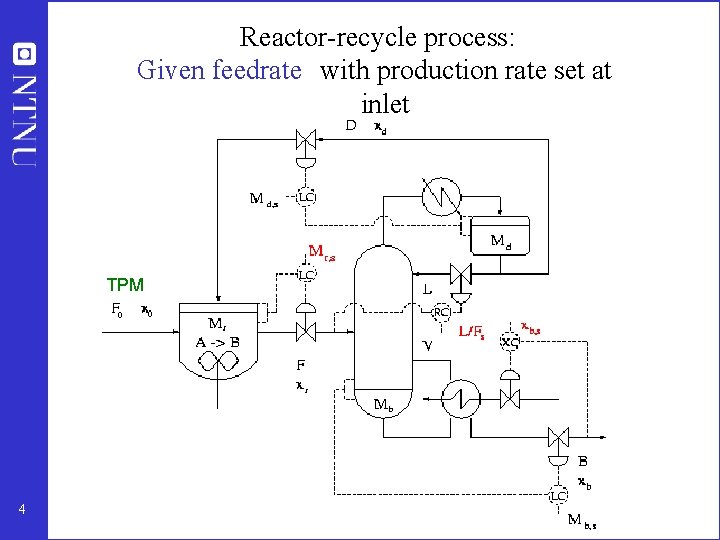
Reactor-recycle process: Given feedrate with production rate set at inlet TPM 4
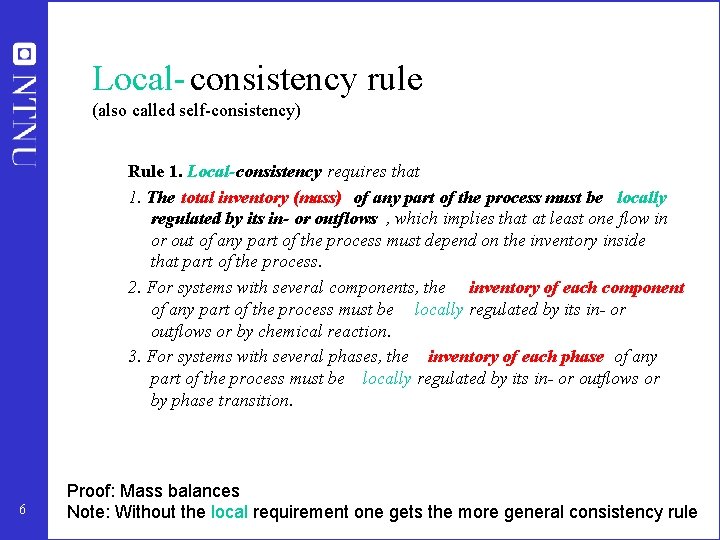
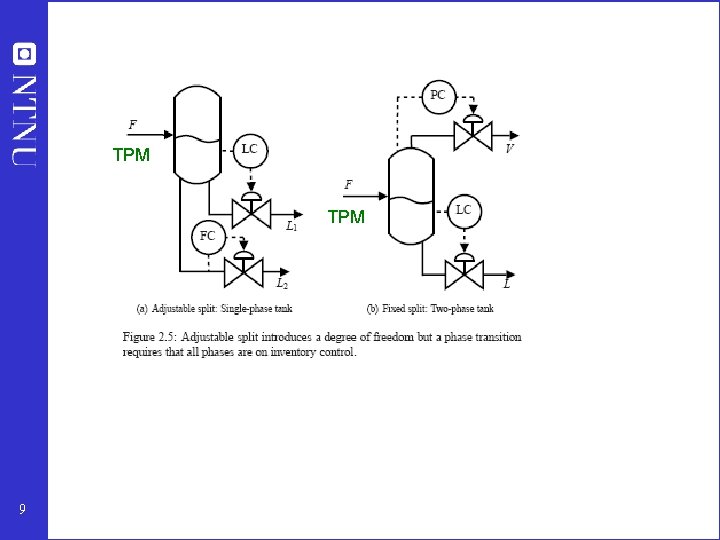
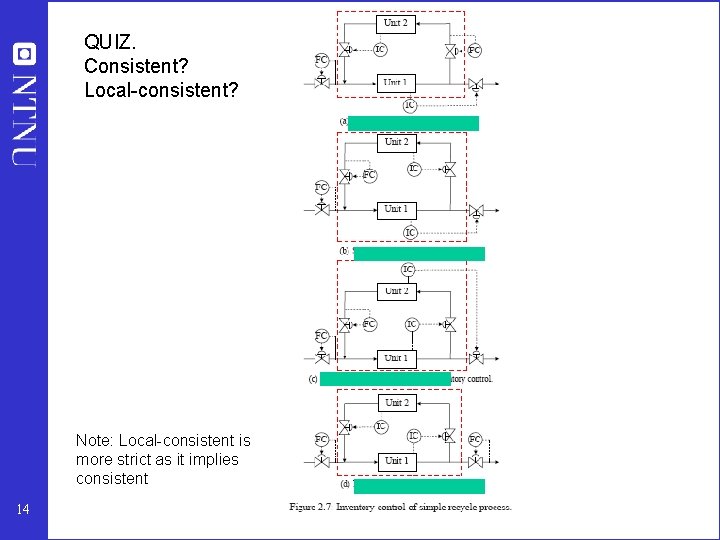
Consistency of inventory control • Consistency (required property): An inventory control system is said to be consistent if the steadystate mass balances (total, components and phases) are satisfied for any part of the process, including the individual units and the overall plant. • Local*-consistency ( desired property): A consistent inventory control system is said to be localconsistent if for any part/unit the local inventory control loops by themselves are sufficient to achieve steady-state mass balance consistency for that unit (without relying on other loops being closed). 5 * Previously called self-consistency
Local- consistency rule (also called self-consistency) Rule 1. Local-consistency requires that 1. The total inventory (mass) of any part of the process must be locally regulated by its in- or outflows , which implies that at least one flow in or out of any part of the process must depend on the inventory inside that part of the process. 2. For systems with several components, the inventory of each component of any part of the process must be locally regulated by its in- or outflows or by chemical reaction. 3. For systems with several phases, the inventory of each phase of any part of the process must be locally regulated by its in- or outflows or by phase transition. 6 Proof: Mass balances Note: Without the local requirement one gets the more general consistency rule
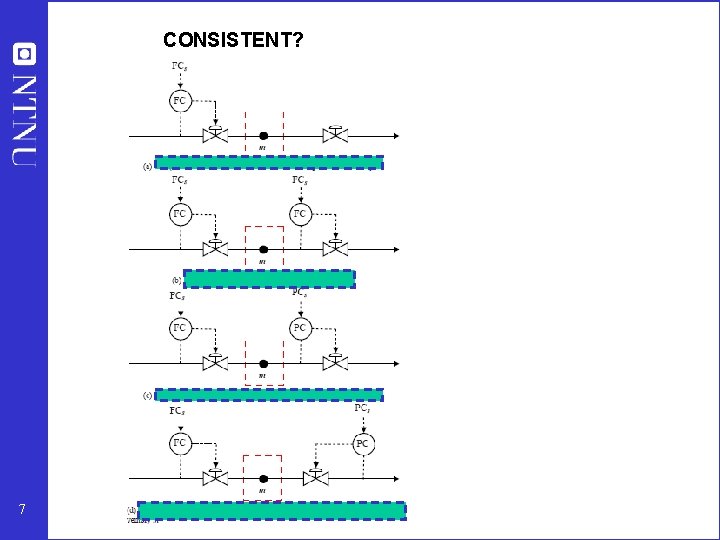
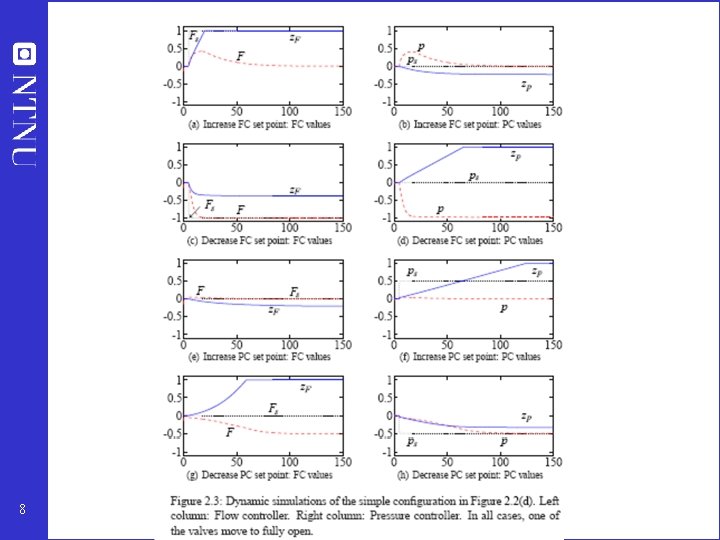
CONSISTENT? 7
8
TPM 9
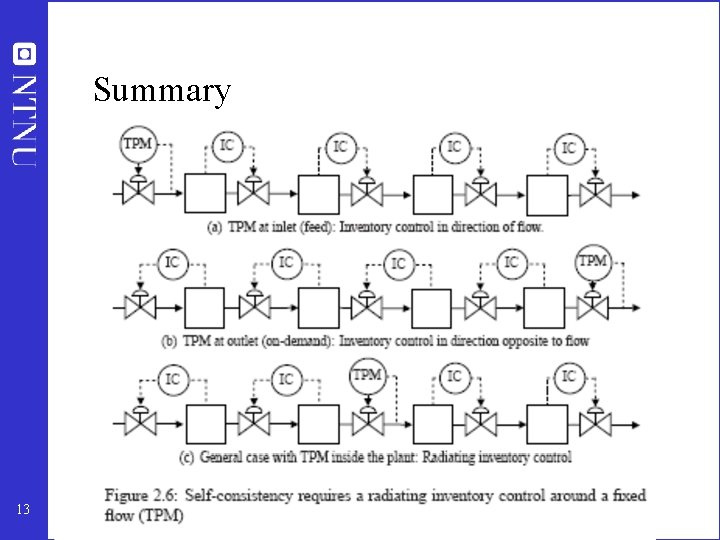
Production rate set at inlet : Inventory control in direction of flow* TPM * Required to get “local-consistent” inventory control 10
Production rate set at outlet: Inventory control opposite flow TPM 11
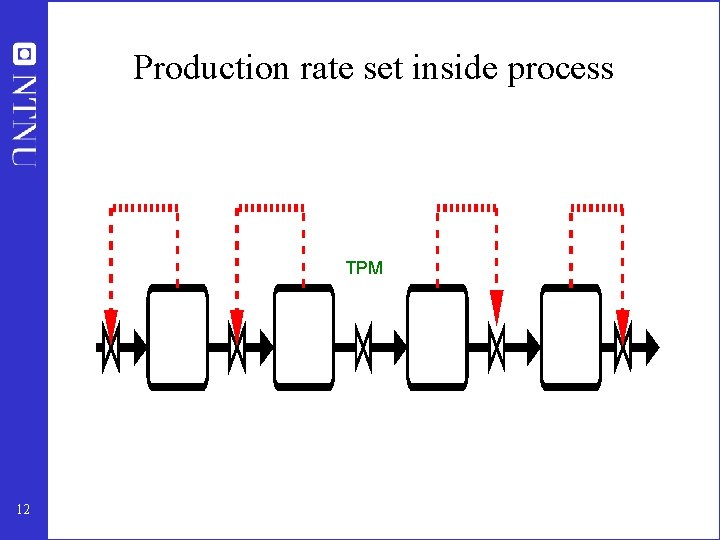
Production rate set inside process TPM 12
Summary 13
QUIZ. Consistent? Local-consistent? Note: Local-consistent is more strict as it implies consistent 14
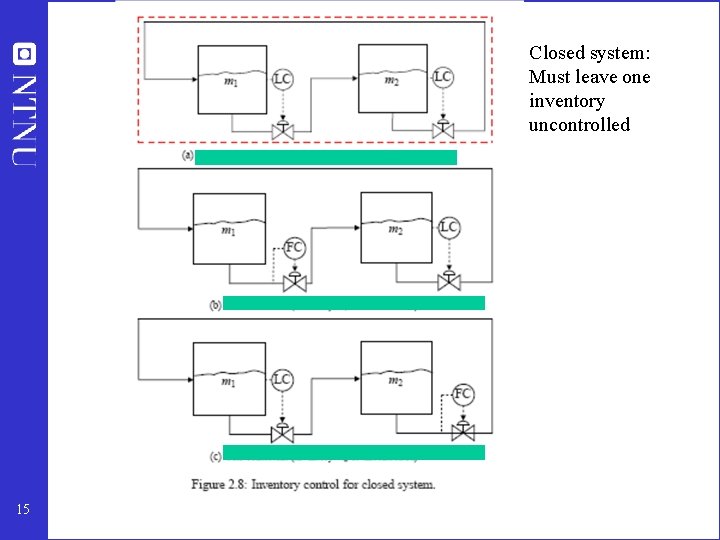
Closed system: Must leave one inventory uncontrolled 15
Where set the production rate? • Very important decision that determines the structure of the rest of the control system! • May also have important economic implications 16
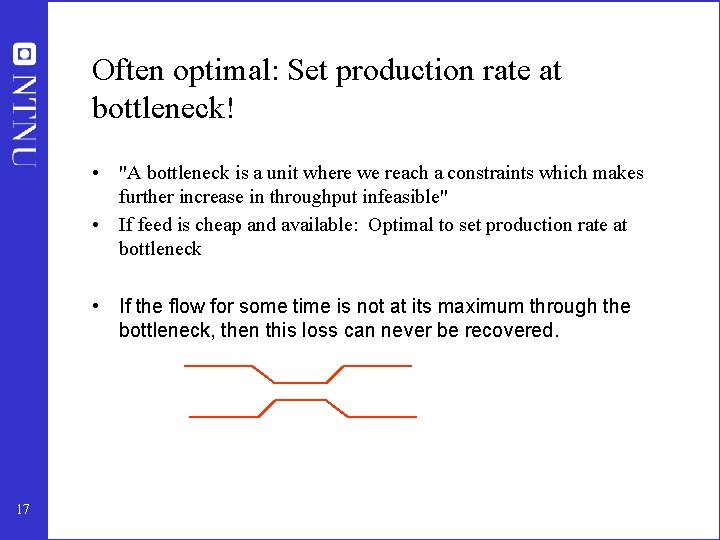
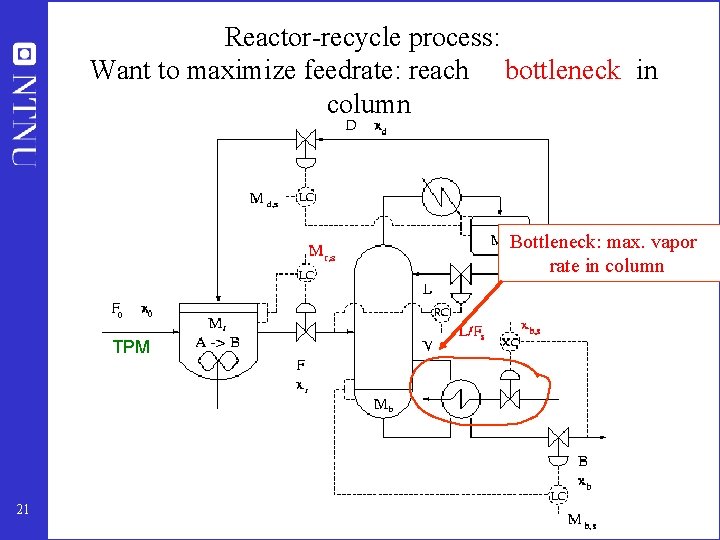
Often optimal: Set production rate at bottleneck! • "A bottleneck is a unit where we reach a constraints which makes further increase in throughput infeasible" • If feed is cheap and available: Optimal to set production rate at bottleneck • If the flow for some time is not at its maximum through the bottleneck, then this loss can never be recovered. 17
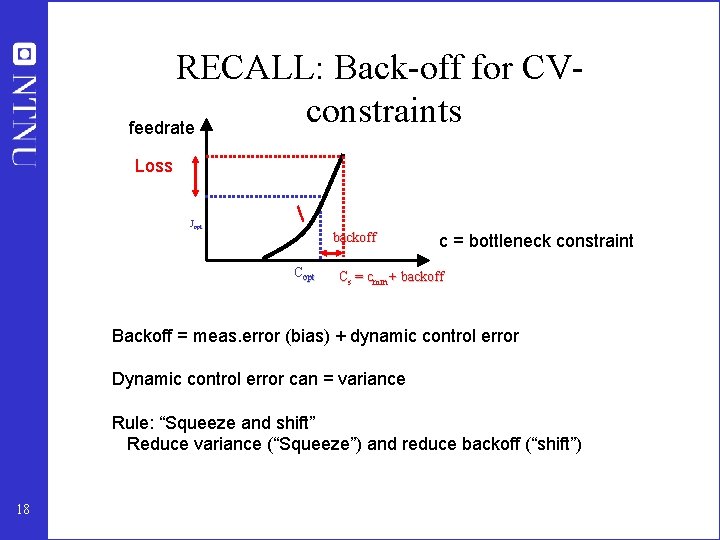
RECALL: Back-off for CVconstraints feedrate Loss Jopt backoff Copt c = bottleneck constraint Cs = cmin + backoff Backoff = meas. error (bias) + dynamic control error Dynamic control error can = variance Rule: “Squeeze and shift” Reduce variance (“Squeeze”) and reduce backoff (“shift”) 18
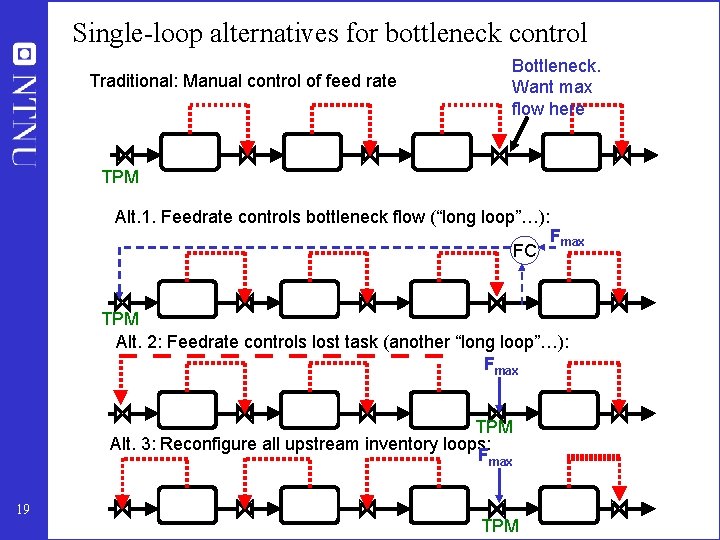
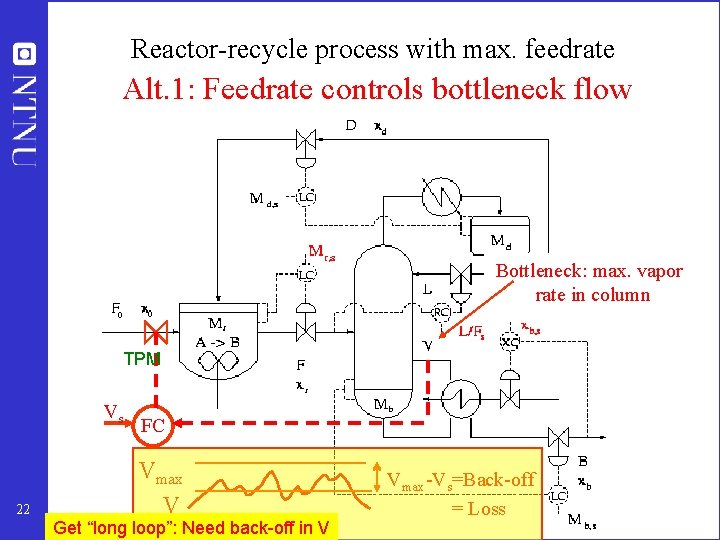
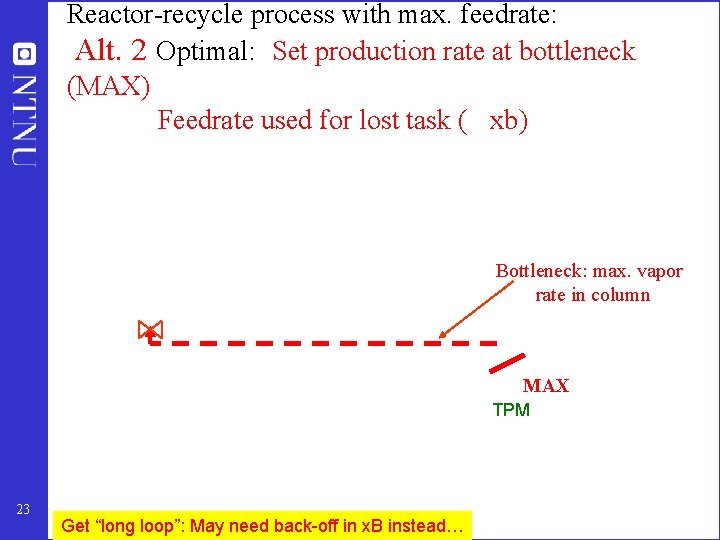
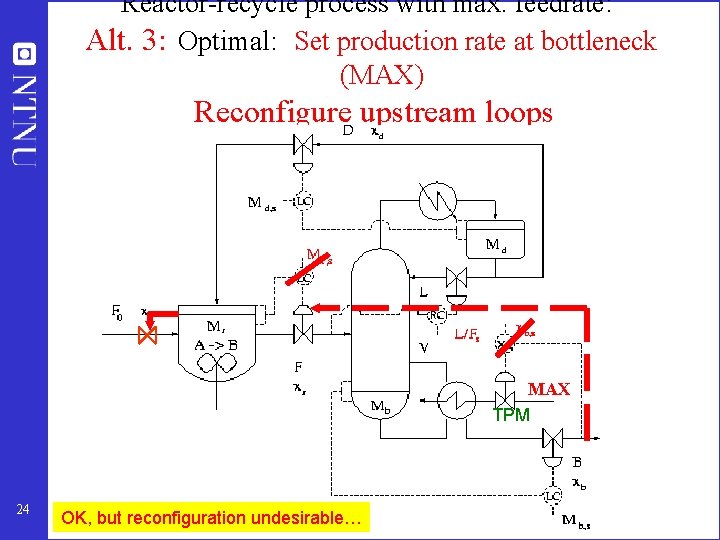
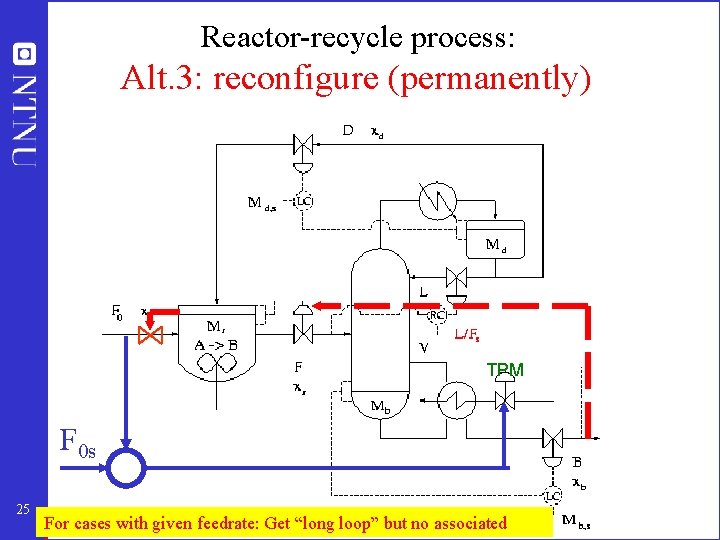
Single-loop alternatives for bottleneck control Traditional: Manual control of feed rate Bottleneck. Want max flow here TPM Alt. 1. Feedrate controls bottleneck flow (“long loop”…): FC Fmax TPM Alt. 2: Feedrate controls lost task (another “long loop”…): Fmax TPM Alt. 3: Reconfigure all upstream inventory loops: Fmax 19 TPM
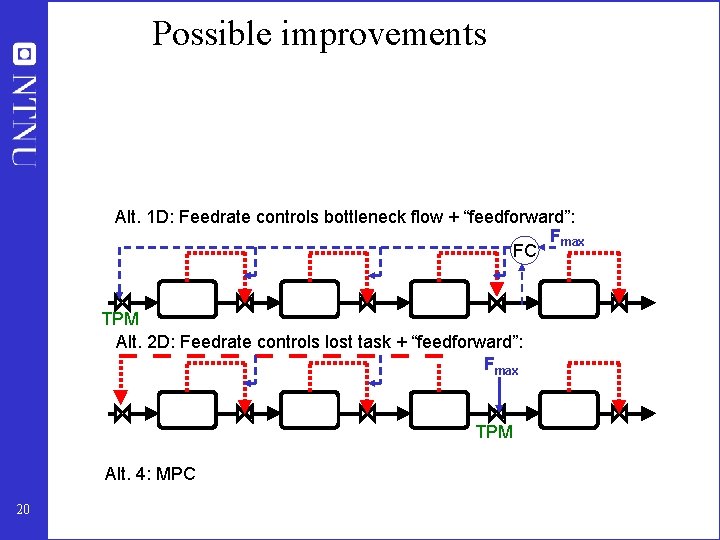
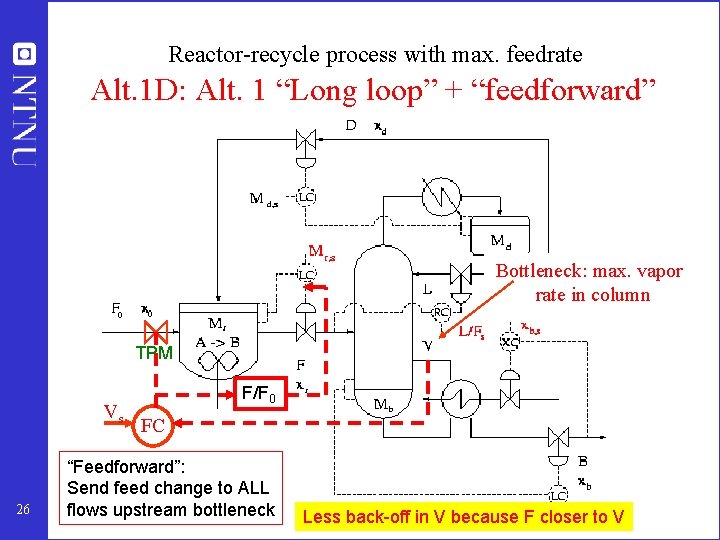
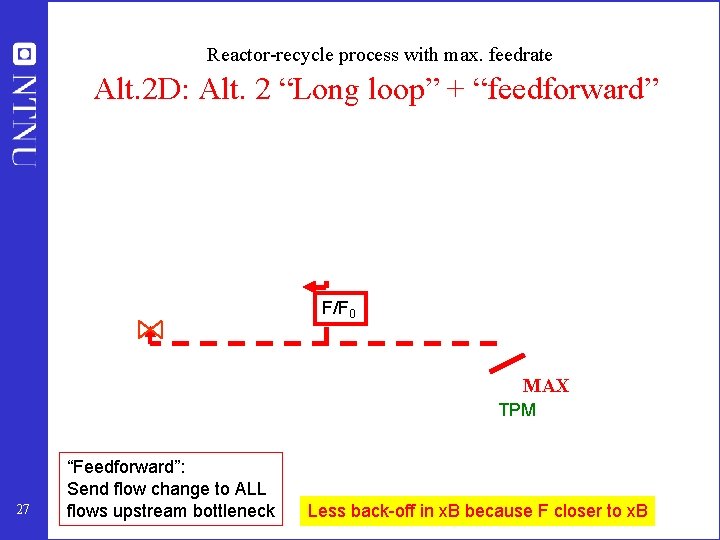
Possible improvements Alt. 1 D: Feedrate controls bottleneck flow + “feedforward”: Fmax FC TPM Alt. 2 D: Feedrate controls lost task + “feedforward”: Fmax TPM Alt. 4: MPC 20
Reactor-recycle process: Want to maximize feedrate: reach bottleneck in column Bottleneck: max. vapor rate in column TPM 21
Reactor-recycle process with max. feedrate Alt. 1: Feedrate controls bottleneck flow Bottleneck: max. vapor rate in column TPM Vs 22 FC Vmax V Get “long loop”: Need back-off in V Vmax -Vs=Back-off = Loss
Reactor-recycle process with max. feedrate: Alt. 2 Optimal: Set production rate at bottleneck (MAX) Feedrate used for lost task ( xb) Bottleneck: max. vapor rate in column MAX TPM 23 Get “long loop”: May need back-off in x. B instead…
Reactor-recycle process with max. feedrate: Alt. 3: Optimal: Set production rate at bottleneck (MAX) Reconfigure upstream loops MAX TPM 24 OK, but reconfiguration undesirable…
Reactor-recycle process: Alt. 3: reconfigure (permanently) TPM F 0 s 25 For cases with given feedrate: Get “long loop” but no associated
Reactor-recycle process with max. feedrate Alt. 1 D: Alt. 1 “Long loop” + “feedforward” Bottleneck: max. vapor rate in column TPM Vs 26 F/F 0 FC “Feedforward”: Send feed change to ALL flows upstream bottleneck Less back-off in V because F closer to V
Reactor-recycle process with max. feedrate Alt. 2 D: Alt. 2 “Long loop” + “feedforward” F/F 0 MAX TPM 27 “Feedforward”: Send flow change to ALL flows upstream bottleneck Less back-off in x. B because F closer to x. B
Alt. 4: Multivariable control (MPC) • Can reduce loss • BUT: Is generally placed on top of the regulatory control system (including level loops), so it still important where the production rate is set! 28
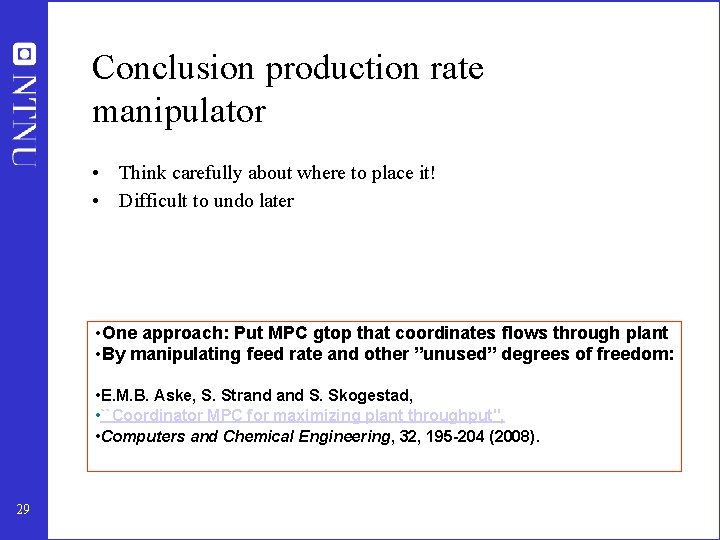
Conclusion production rate manipulator • Think carefully about where to place it! • Difficult to undo later • One approach: Put MPC gtop that coordinates flows through plant • By manipulating feed rate and other ”unused” degrees of freedom: • E. M. B. Aske, S. Strand S. Skogestad, • ``Coordinator MPC for maximizing plant throughput'', • Computers and Chemical Engineering, 32, 195 -204 (2008). 29
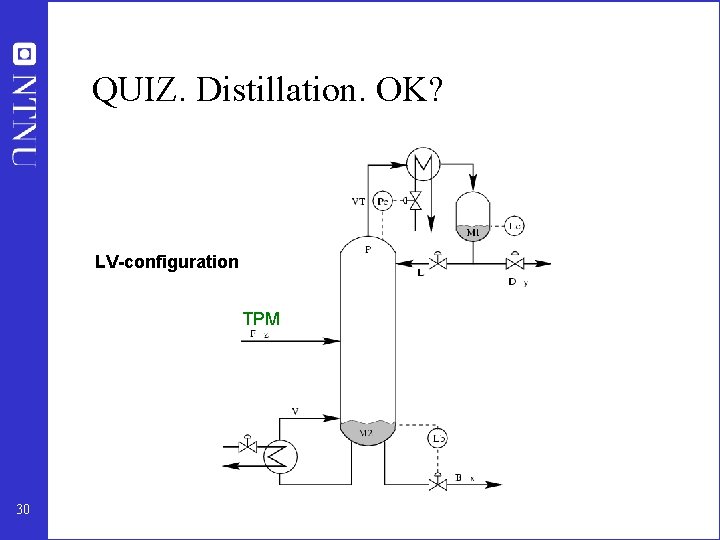
QUIZ. Distillation. OK? LV-configuration TPM 30
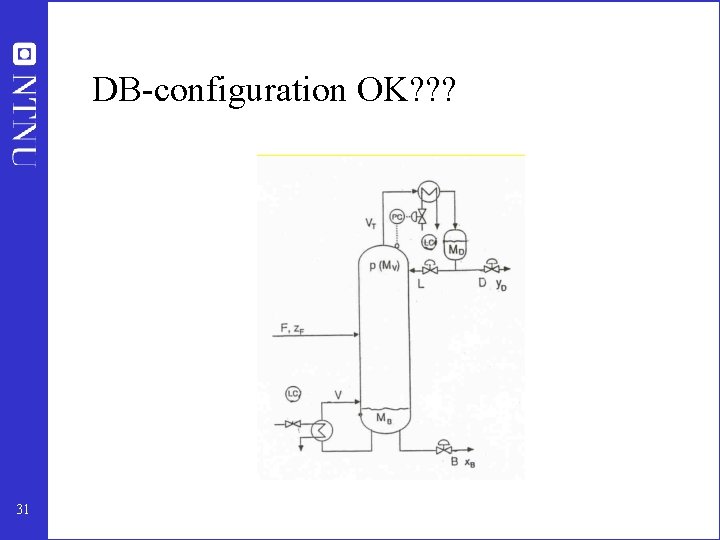
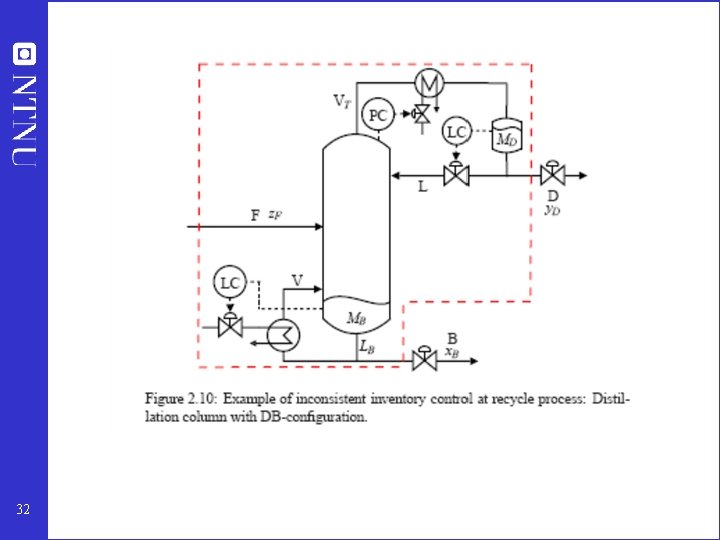
DB-configuration OK? ? ? 31
32
33
QUIZ • Cases 7– 13, 15 -23 • Will it work? Where is throughput set ( 34 TPM )?
LOCATE TPM? • • • For step 4, locate TPM, the procedure is: As the default choice place the TPM at the feed Consider moving if there is an important active constraint that could otherwise not be well controlled. That is, if the feedrate must be used for some other task in order to get a local-consistent system with tight control of the constraint. To avoid the need to move (reassign) the TPM, avoid variables that may saturate. Exception to (c): The last constraint to become active when we reach optimum or maximum throughput* is a good candidate TPM, because the bottleneck situation is generally where the backoff losses are largest. Also, this TPM will only saturate when it no longer can be increased, so no change in TPM-variable is ever needed. *At optimum/maximum throughput , the throughput can no longer be set (because it is used a degree of freedom for optimal operation ) 35