
Outline Brain structure Brain development Nature and nurture


Outline • • Brain structure Brain development Nature and nurture Gender differences in brain structure Gender differences in brain development Gender differences in cognitive ability Hemisphere specialization Left-brain and right-brain teaching strategies
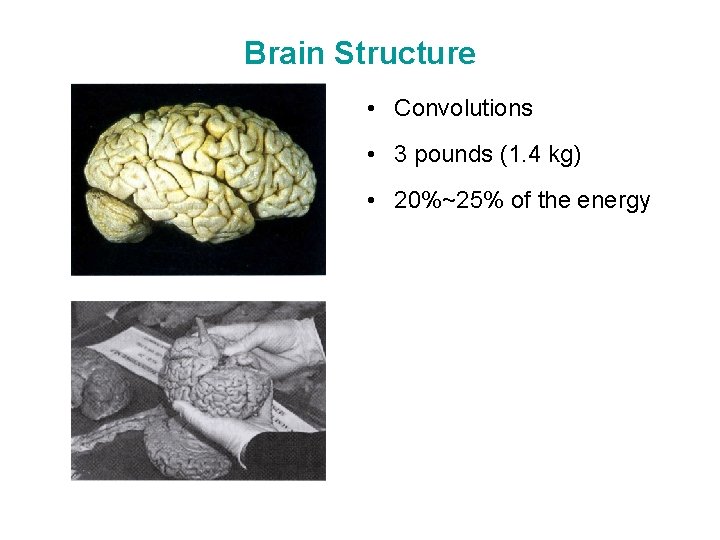
Brain Structure • Convolutions • 3 pounds (1. 4 kg) • 20%~25% of the energy
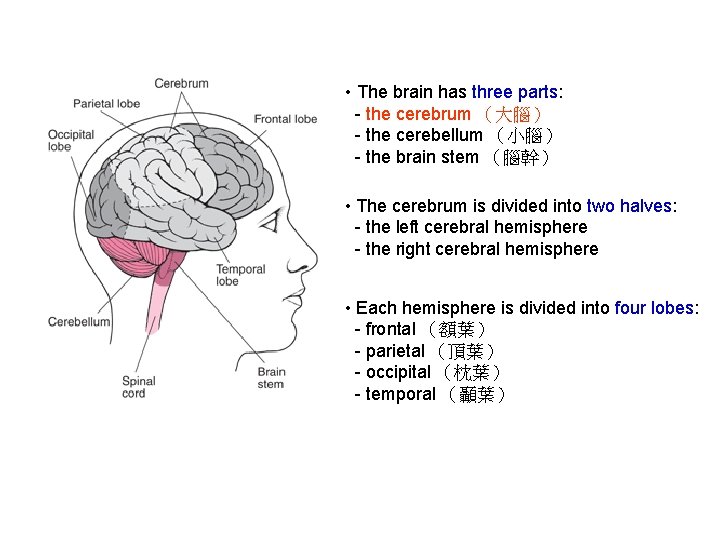
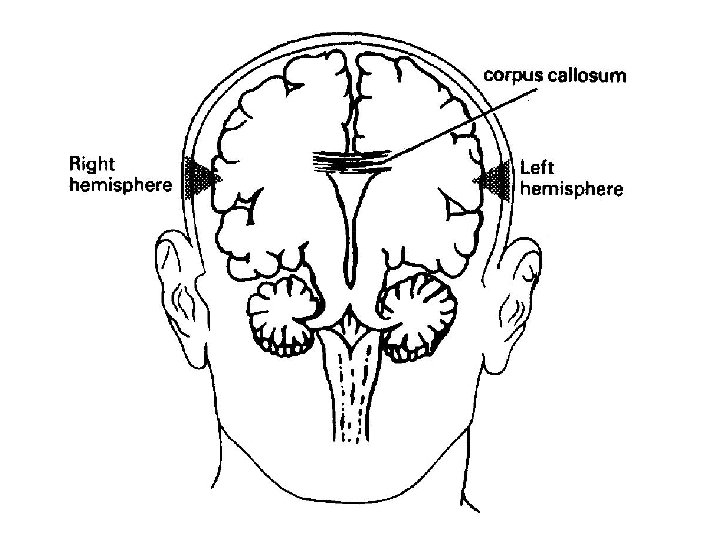
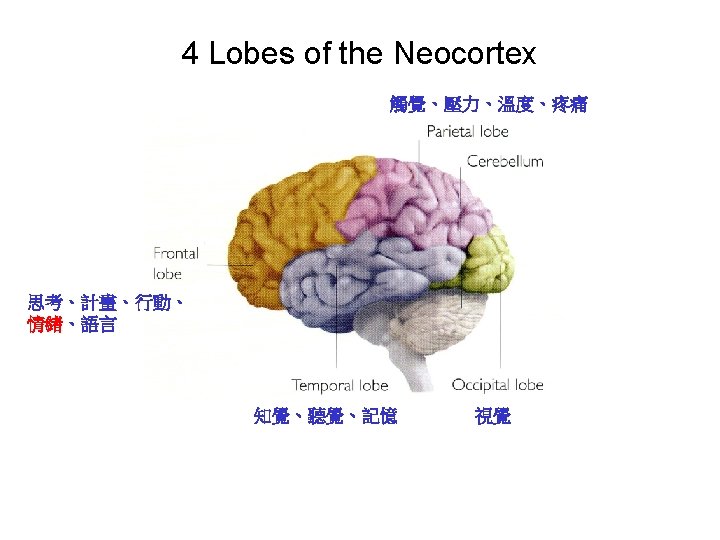
• The brain has three parts: - the cerebrum (大腦) - the cerebellum (小腦) - the brain stem (腦幹) • The cerebrum is divided into two halves: - the left cerebral hemisphere - the right cerebral hemisphere • Each hemisphere is divided into four lobes: - frontal (額葉) - parietal (頂葉) - occipital (枕葉) - temporal (顳葉)
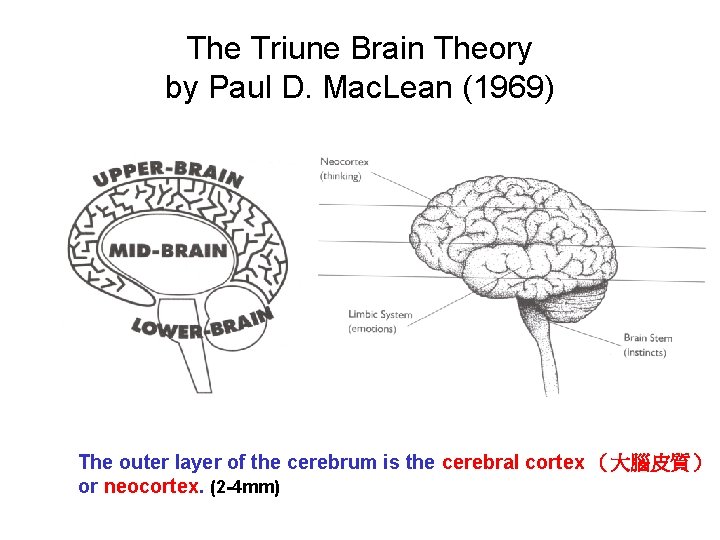
The Triune Brain Theory by Paul D. Mac. Lean (1969) The outer layer of the cerebrum is the cerebral cortex (大腦皮質) or neocortex. (2 -4 mm)
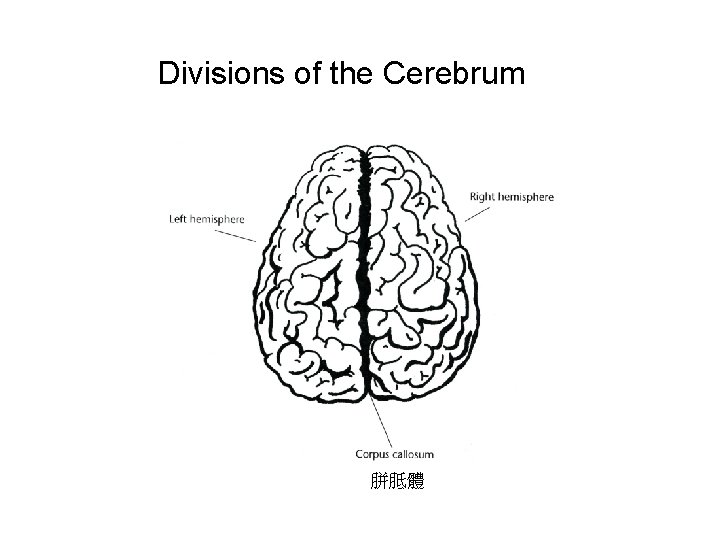
Divisions of the Cerebrum 胼胝體
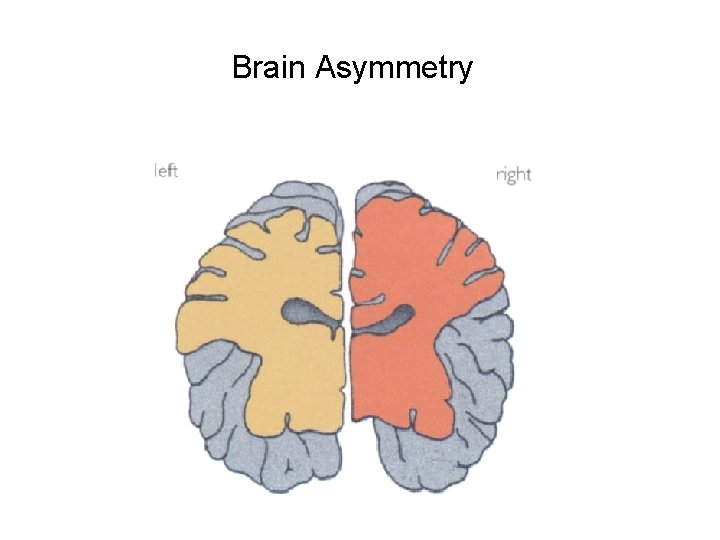
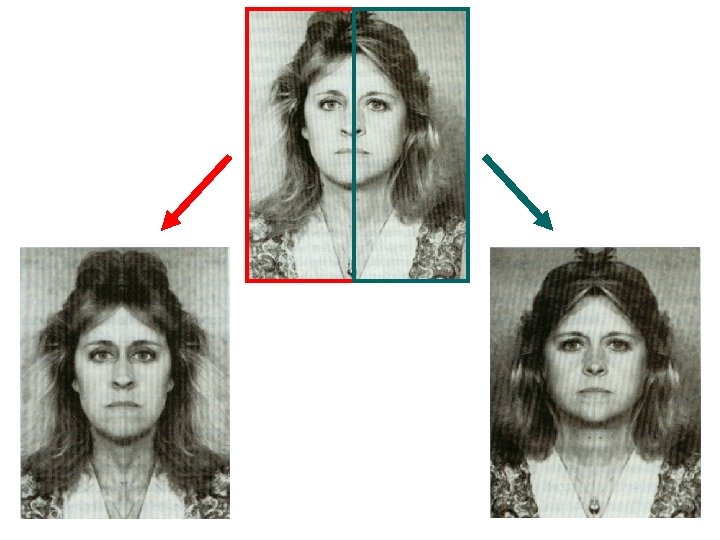
Brain Asymmetry
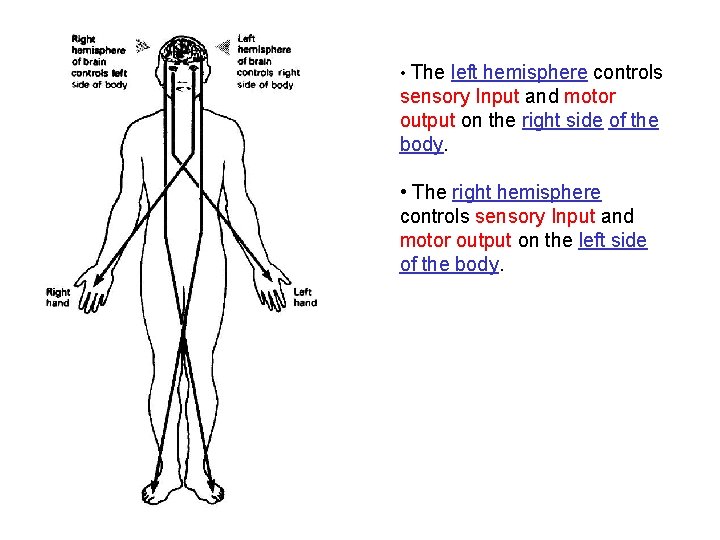
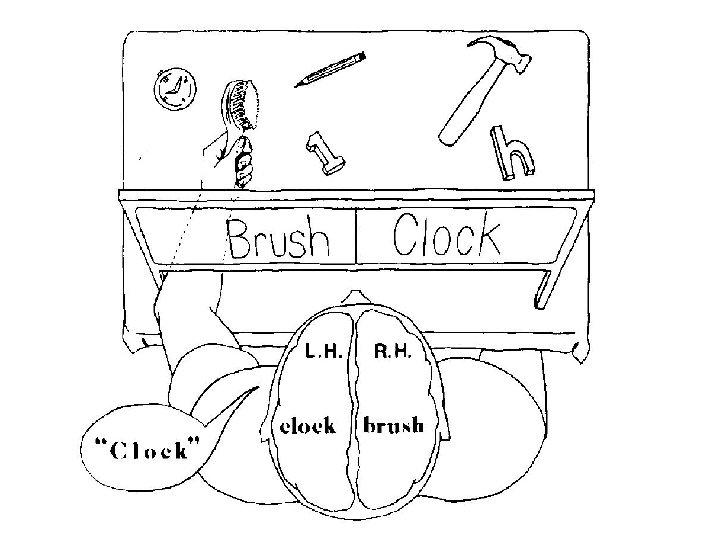
• The left hemisphere controls sensory Input and motor output on the right side of the body. • The right hemisphere controls sensory Input and motor output on the left side of the body.
Brain cells • The brain is made up of many cells, including neurons(神經元/神經細胞)(10%) and glial cells(神經膠細胞)(90%). • There about 100 billion (千億) neurons in the brain. • There are many more glial cells. • Neurons send and receive electrical-chemical signals to and from the brain and nerve system. • Glial cells provide support, protection, nutrition for the neurons.
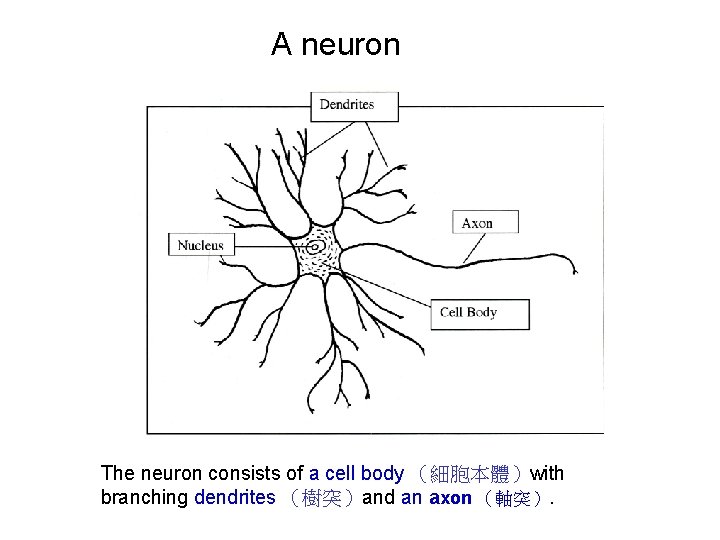
A neuron The neuron consists of a cell body (細胞本體)with branching dendrites (樹突)and an axon (軸突).
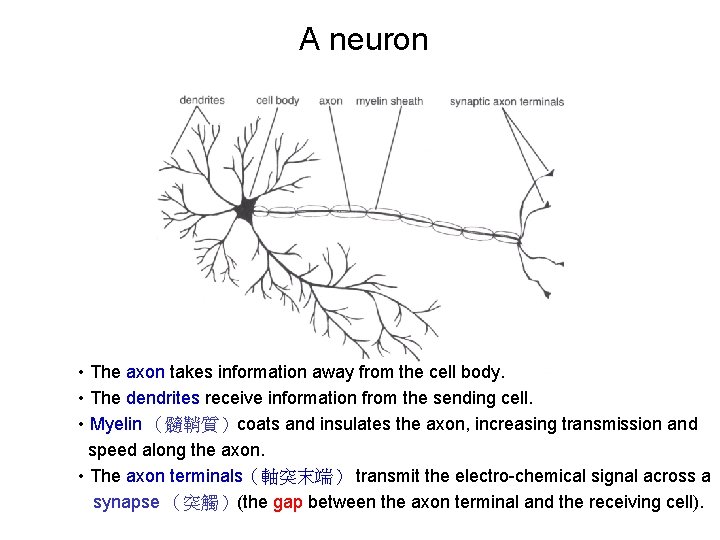
A neuron • The axon takes information away from the cell body. • The dendrites receive information from the sending cell. • Myelin (髓鞘質)coats and insulates the axon, increasing transmission and speed along the axon. • The axon terminals(軸突末端) transmit the electro-chemical signal across a synapse (突觸)(the gap between the axon terminal and the receiving cell).
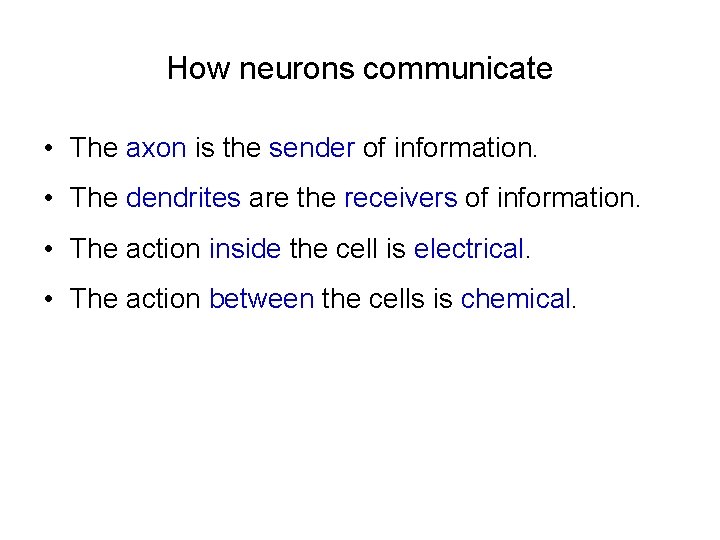
How neurons communicate • The axon is the sender of information. • The dendrites are the receivers of information. • The action inside the cell is electrical. • The action between the cells is chemical.
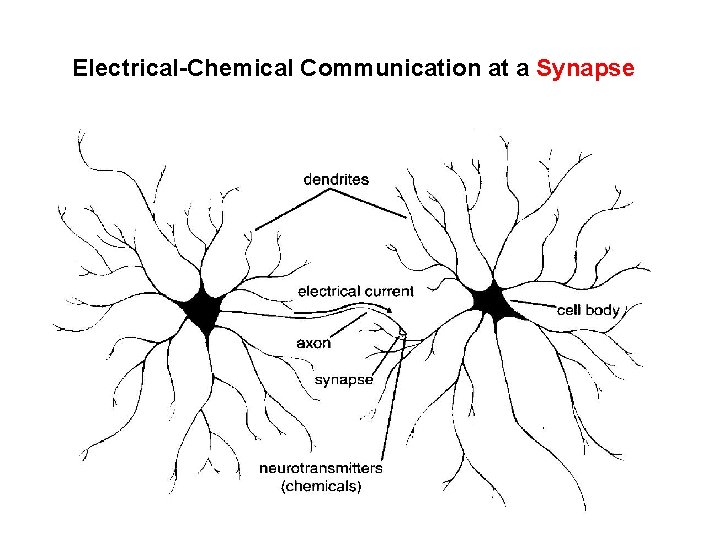
Electrical-Chemical Communication at a Synapse
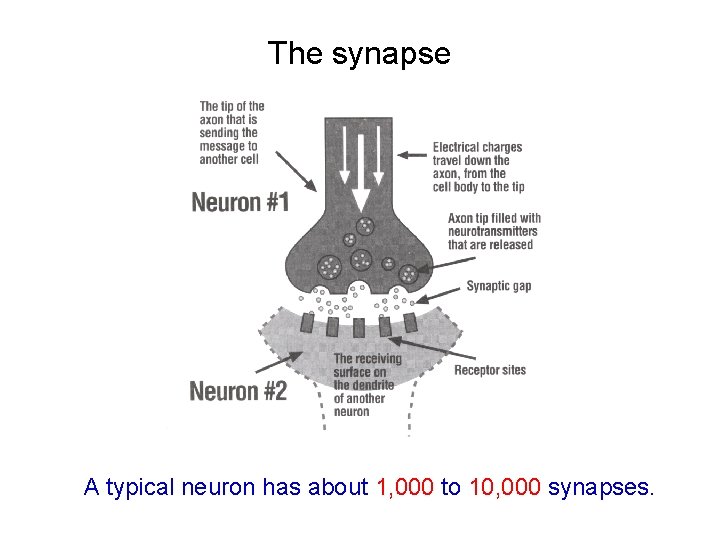
The synapse A typical neuron has about 1, 000 to 10, 000 synapses.
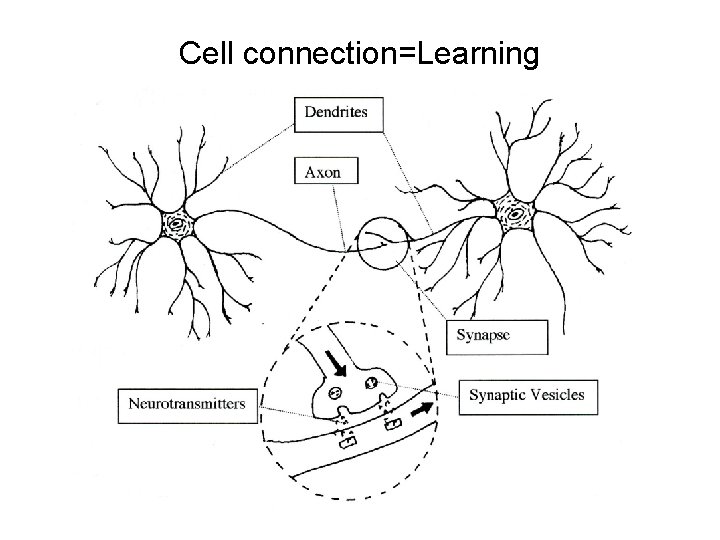
Cell connection=Learning
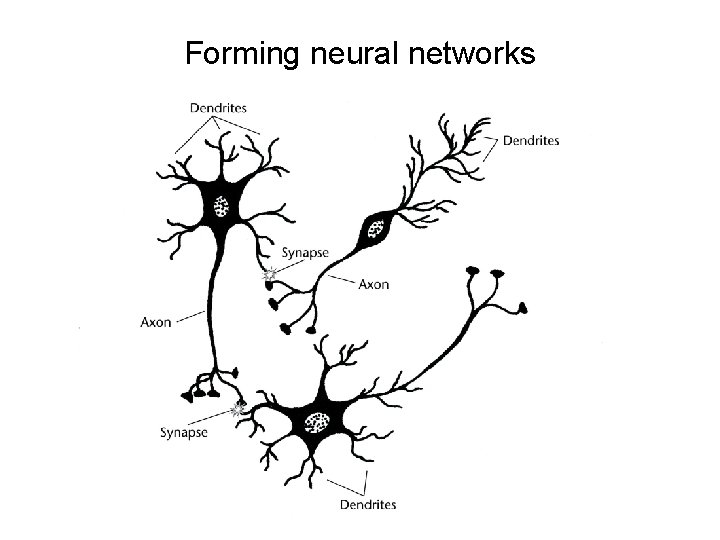
Forming neural networks
Brain development • An adult brain contains about 100 billion neurons. • At birth, a child’s brain has almost 100 billion neurons. • During the first year of life, the brain forms new synapses (connections between neurons) at a high rate of speed. • By age 2, children’s brains contain twice as many synapses as the brains of normal adults.
• While these new synapses between neurons continue to form throughout life, they reach their highest synapses at around the age of 2 and the number of synapses remains relatively stable until the age of 10 or 11. • After this age, the number of synapses begins to drop and continues to decline slowly into adult level. By late adolescence, half of all the synapses have been pruned which leaves about 500 trillion (五百兆) synapses. • This number remains relatively constant throughout life although new connections continue to be formed. • Brain development is a dynamic process of growth and pruning.
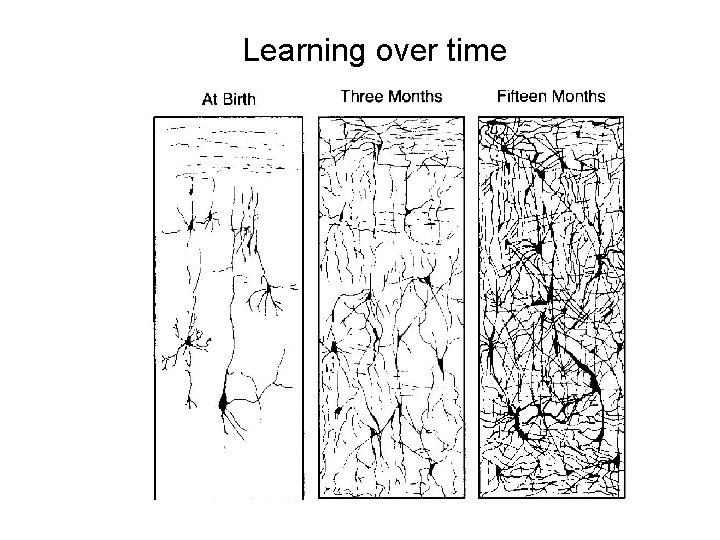
Learning over time
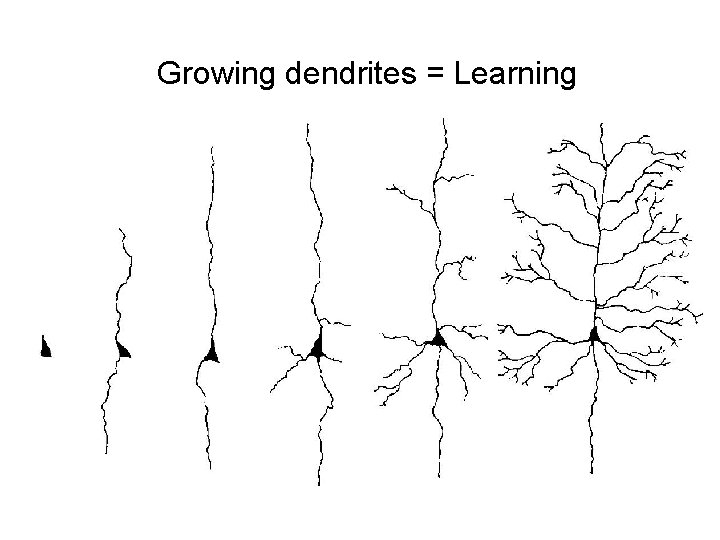
Growing dendrites = Learning
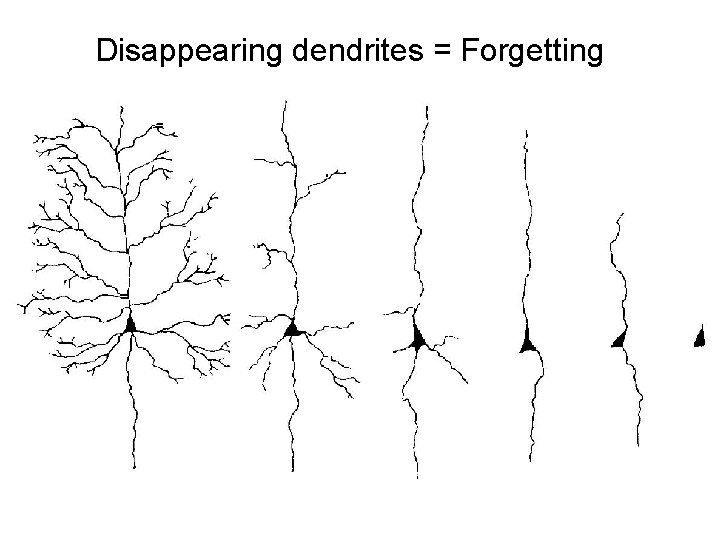
Disappearing dendrites = Forgetting
Nature and nurture In 1960 s, Marian Diamond conducted experiments with rats on the effects of environmental stimulation and deprivation on the development of the cerebral cortex.
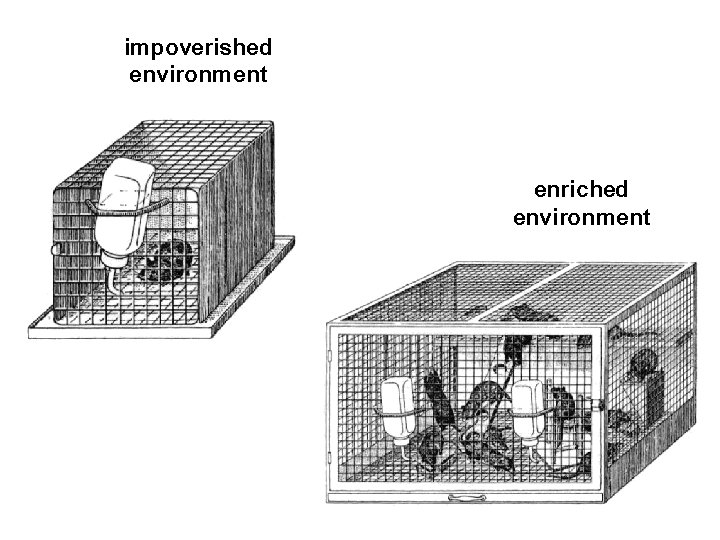
impoverished environment enriched environment
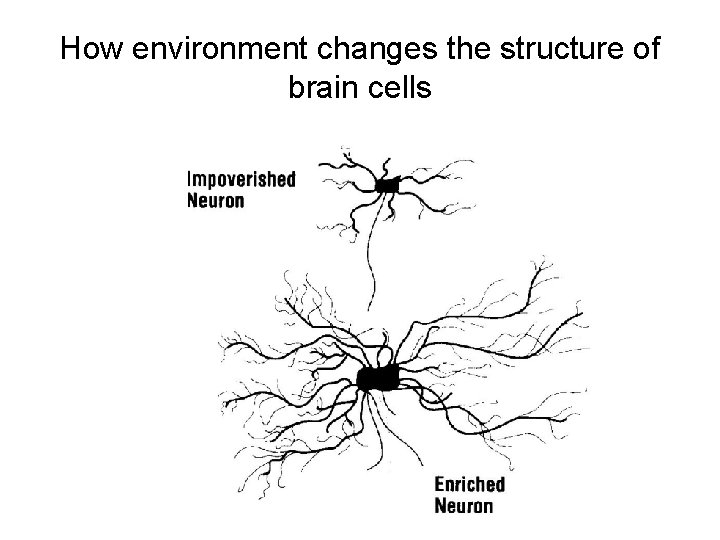
How environment changes the structure of brain cells
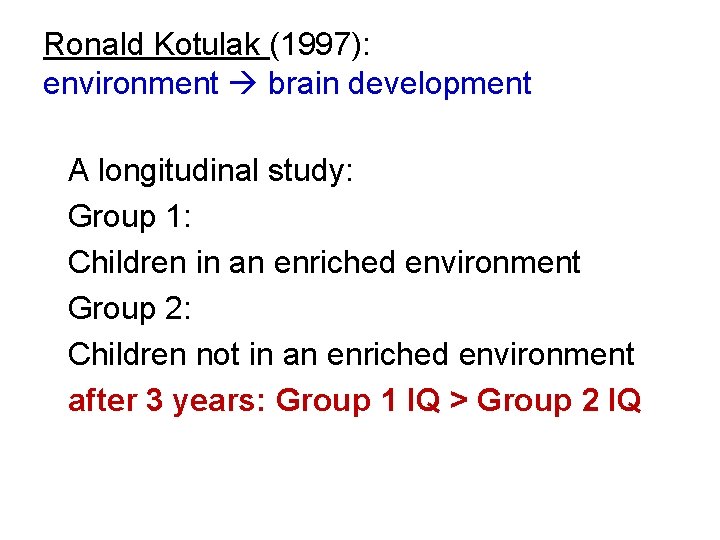
Ronald Kotulak (1997): environment brain development A longitudinal study: Group 1: Children in an enriched environment Group 2: Children not in an enriched environment after 3 years: Group 1 IQ > Group 2 IQ
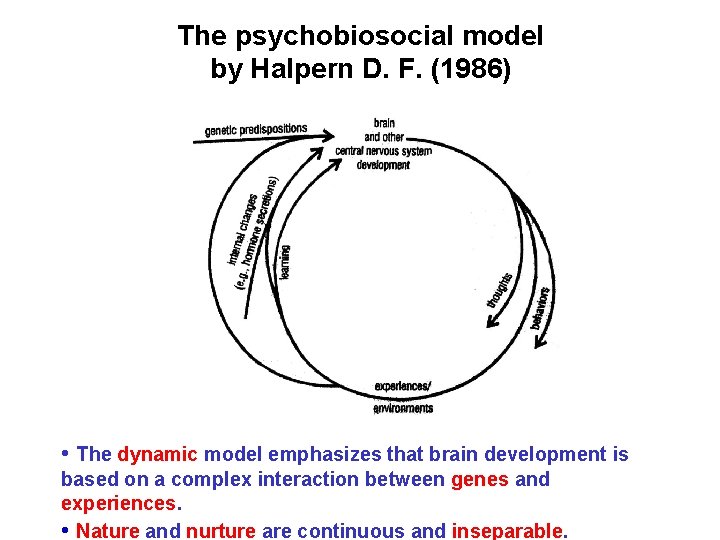
The psychobiosocial model by Halpern D. F. (1986) • The dynamic model emphasizes that brain development is based on a complex interaction between genes and experiences. • Nature and nurture are continuous and inseparable.
Hemispheric specialization
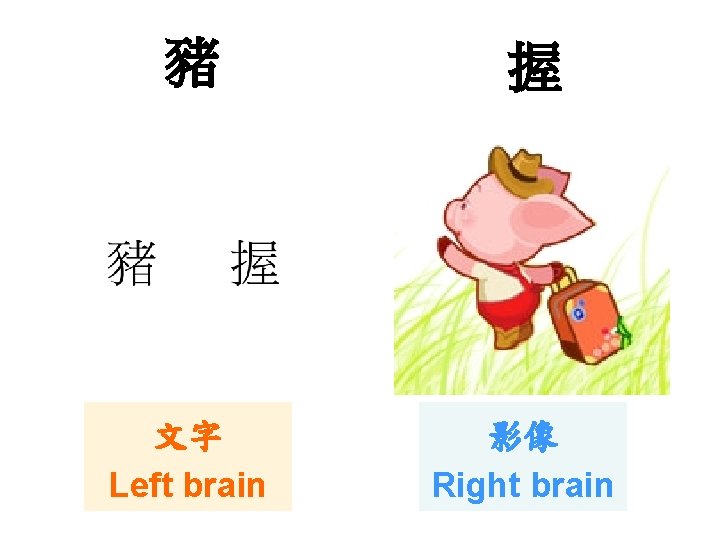
豬 文字 Left brain 握 影像 Right brain
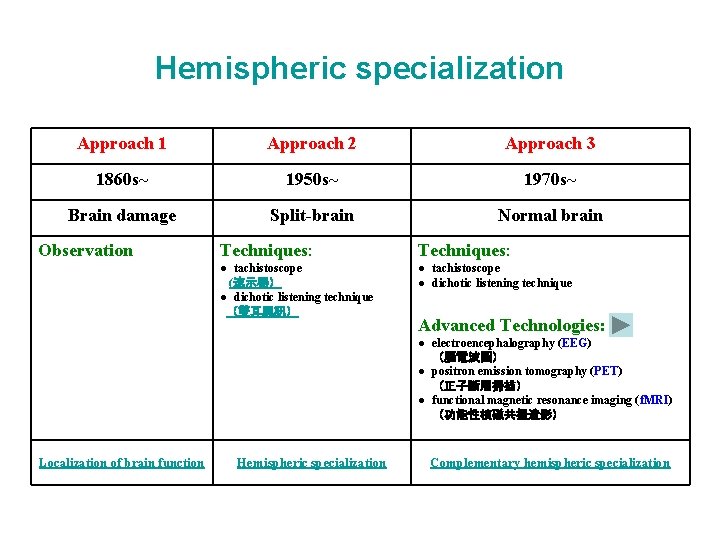
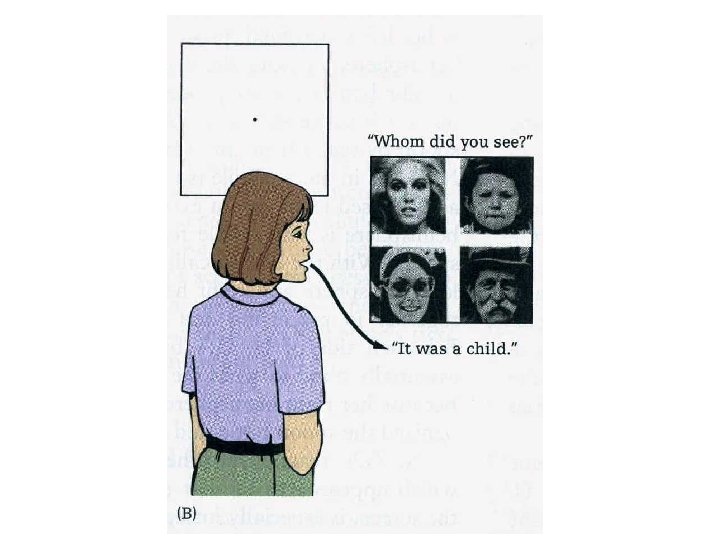
Hemispheric specialization Approach 1 Approach 2 Approach 3 1860 s~ 1950 s~ 1970 s~ Brain damage Split-brain Normal brain Observation Techniques: tachistoscope (速示器) l dichotic listening technique (雙耳異訊) l l l Advanced Technologies: l l l Localization of brain function Hemispheric specialization tachistoscope dichotic listening technique electroencephalography (EEG) (腦電波圖) positron emission tomography (PET) (正子斷層掃描) functional magnetic resonance imaging (f. MRI) (功能性核磁共振造影) Complementary hemispheric specialization
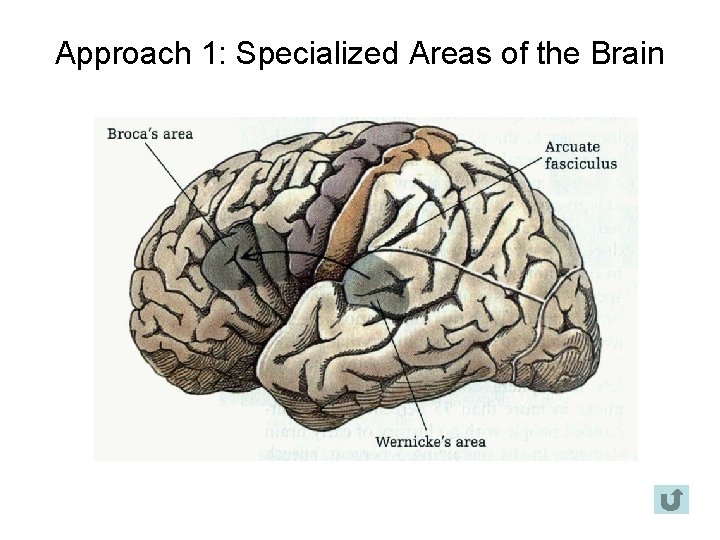
Approach 1: Specialized Areas of the Brain
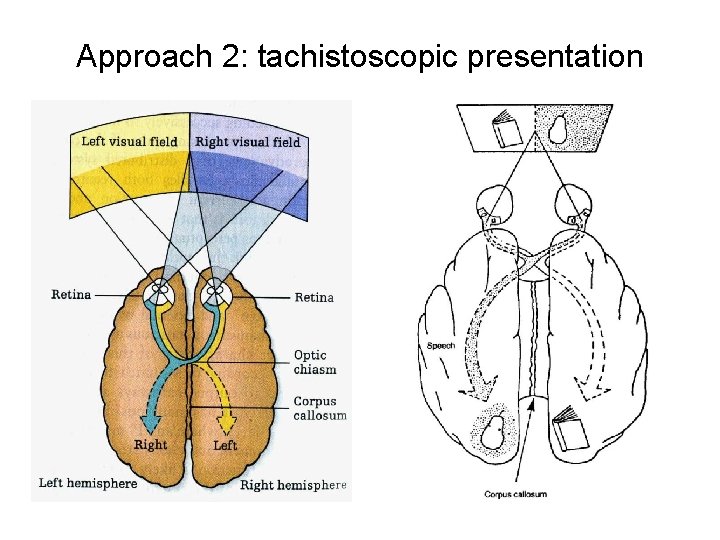
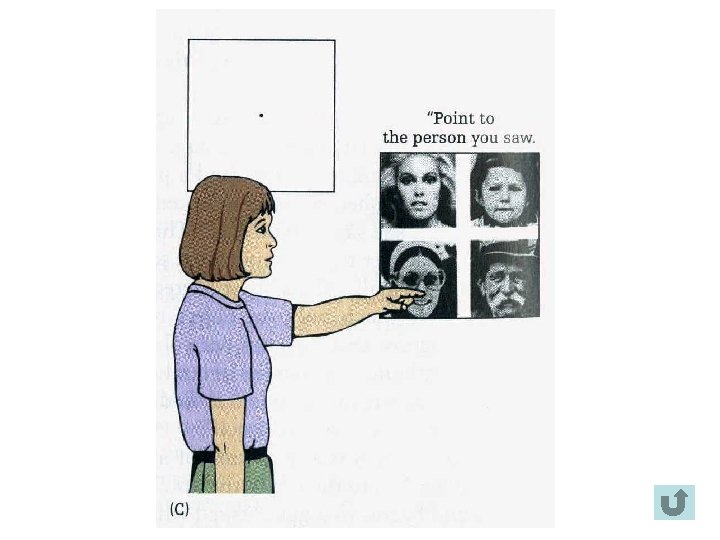
Approach 2: tachistoscopic presentation
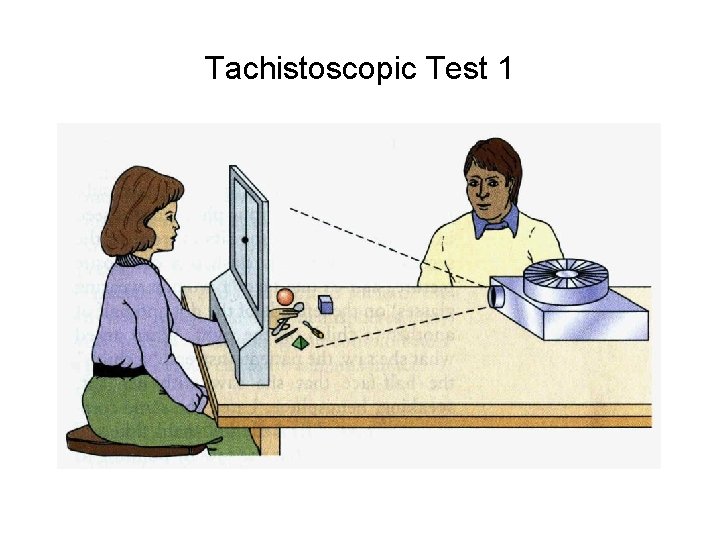
Tachistoscopic Test 1
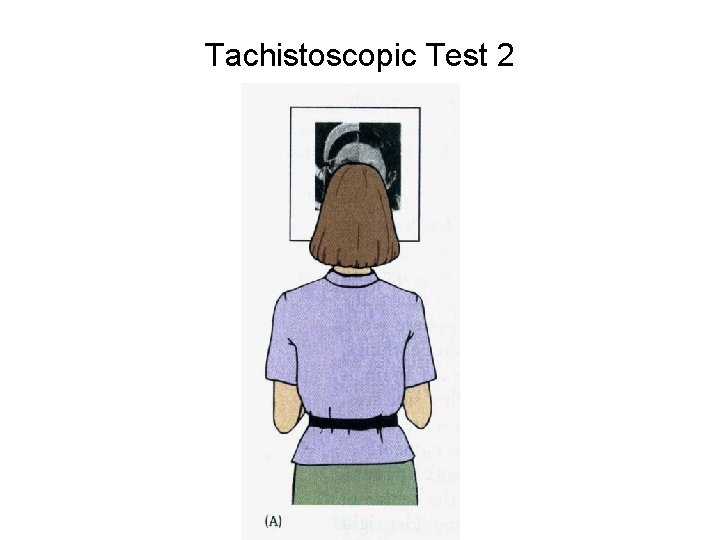
Tachistoscopic Test 2
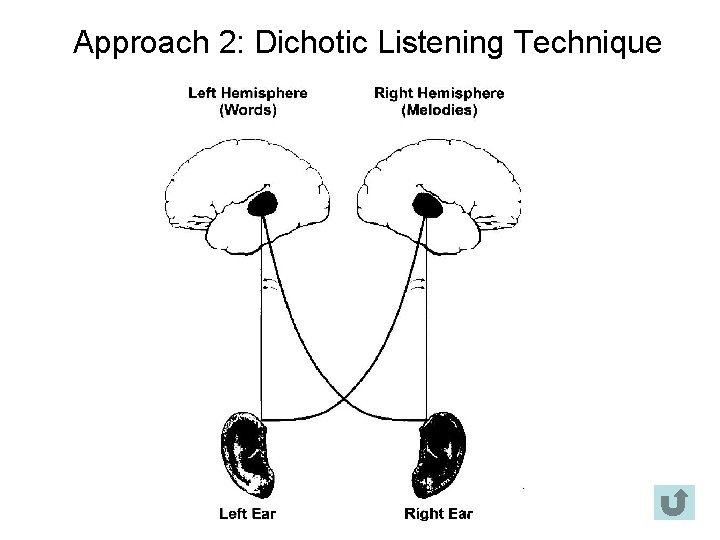
Approach 2: Dichotic Listening Technique
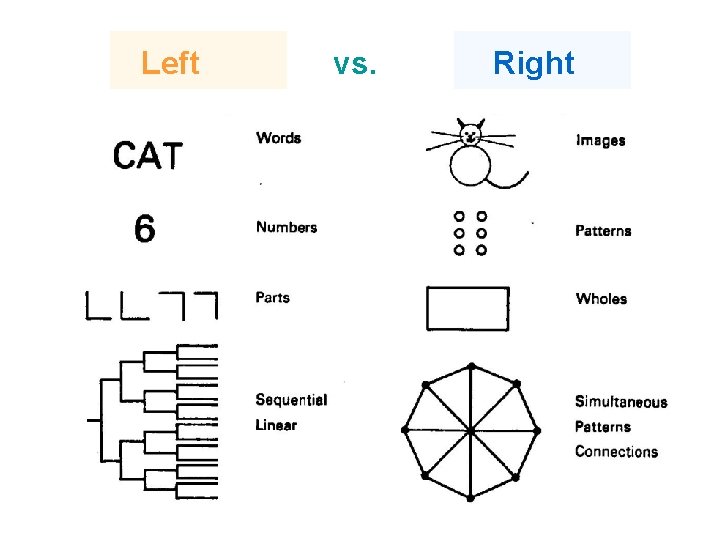
Left vs. Right
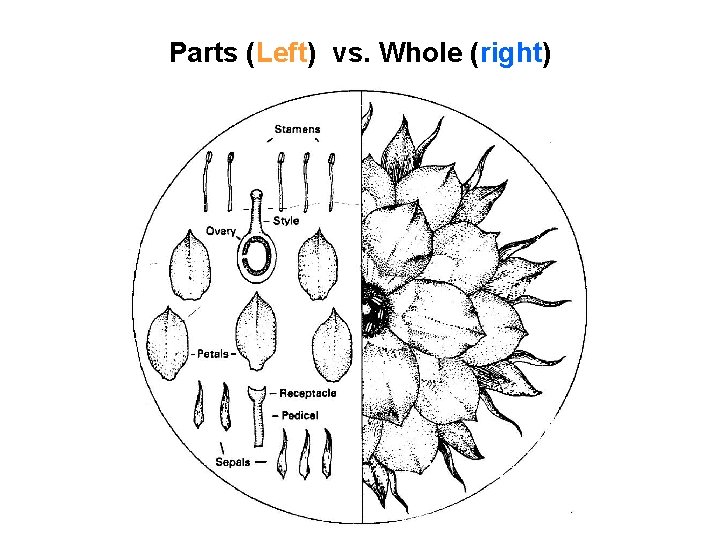
Parts (Left) vs. Whole (right)
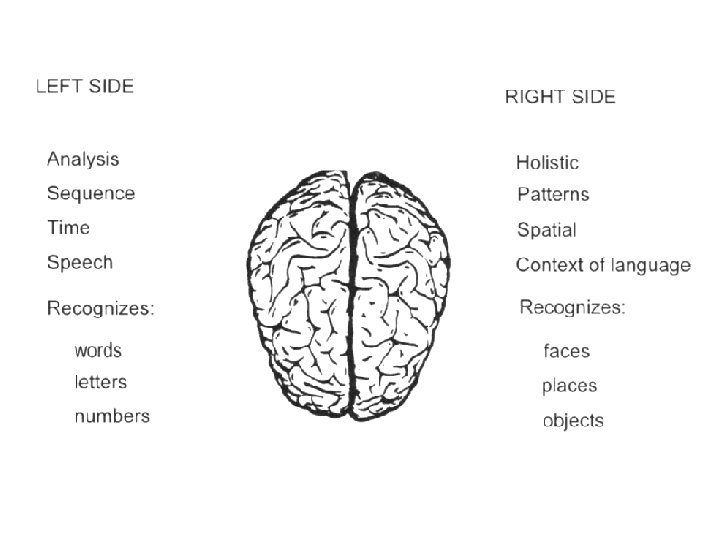
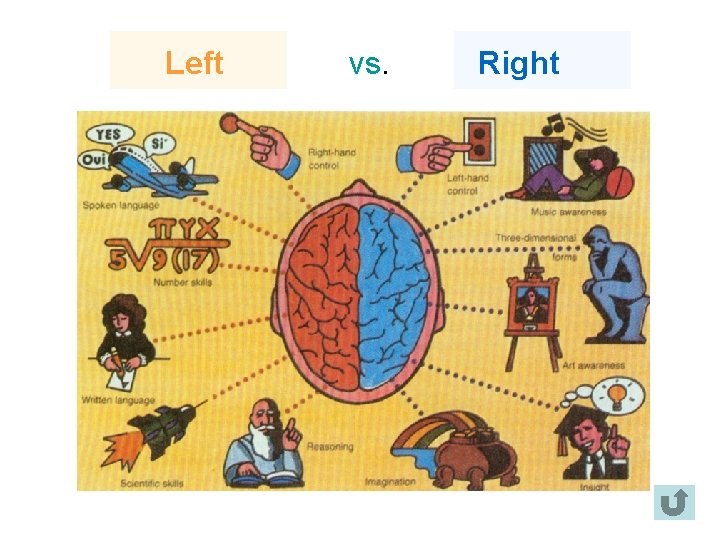
Left vs. Right
Approach 3: Advanced technologies • Electroencephalography (EEG) recordings of brain electrical activity • Positron emission tomography (PET) mapping the blood-flow patterns or glucose metabolism patterns in the brain • Functional magnetic resonance imaging (f. MRI) mapping the blood-flow patterns in the brain
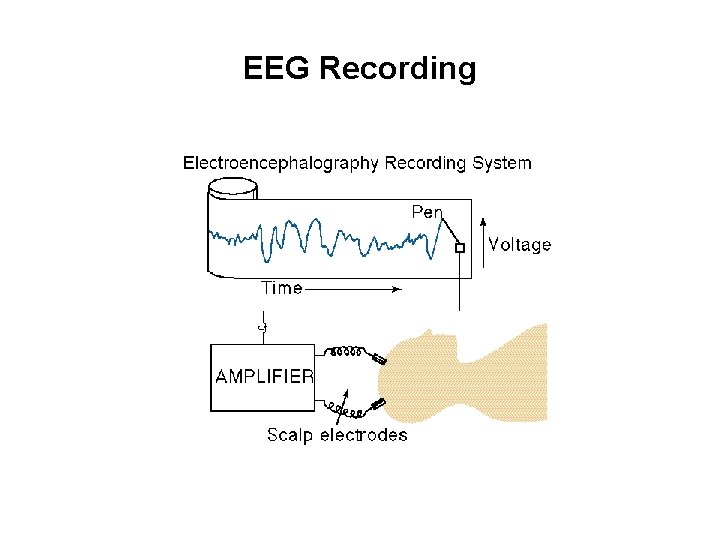
EEG Recording
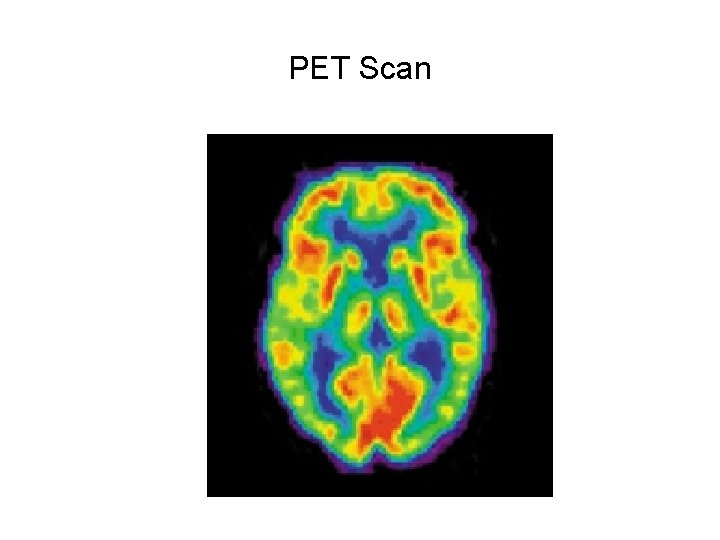
PET Scan
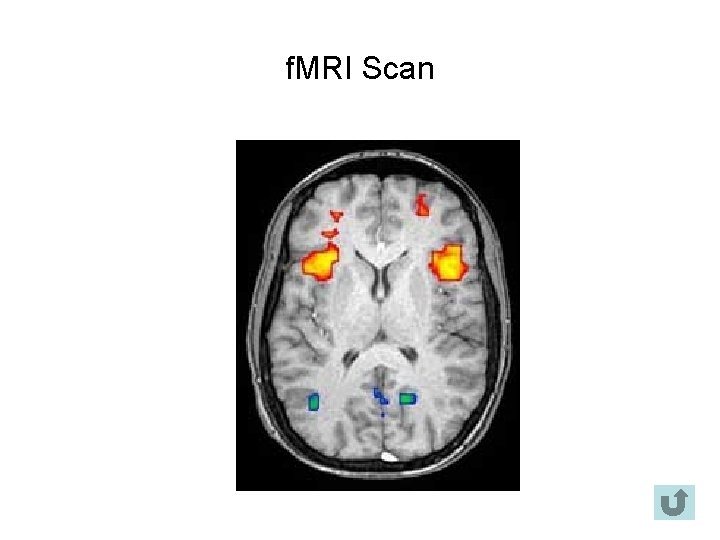
f. MRI Scan
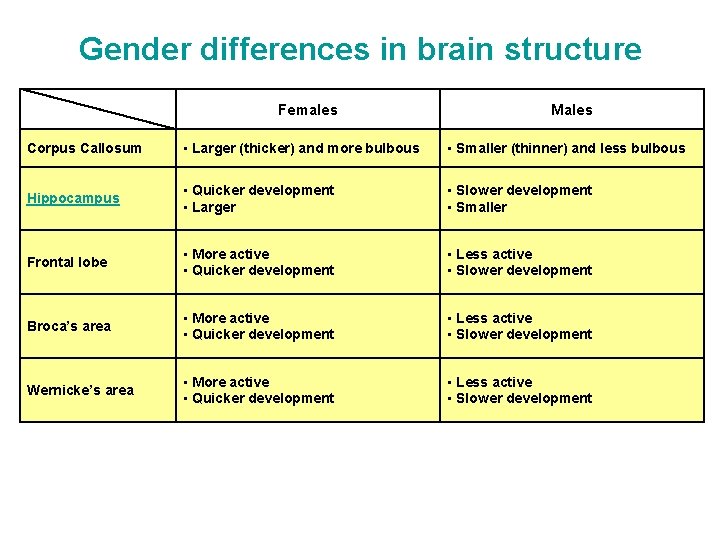
Gender differences in brain structure Females Males Corpus Callosum ▪ Larger (thicker) and more bulbous ▪ Smaller (thinner) and less bulbous Hippocampus ▪ Quicker development ▪ Larger ▪ Slower development ▪ Smaller Frontal lobe ▪ More active ▪ Quicker development ▪ Less active ▪ Slower development Broca’s area ▪ More active ▪ Quicker development ▪ Less active ▪ Slower development Wernicke’s area ▪ More active ▪ Quicker development ▪ Less active ▪ Slower development
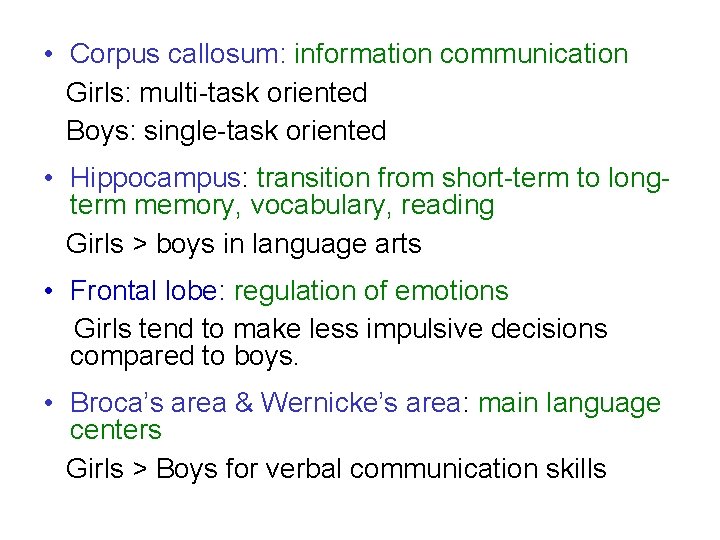
• Corpus callosum: information communication Girls: multi-task oriented Boys: single-task oriented • Hippocampus: transition from short-term to longterm memory, vocabulary, reading Girls > boys in language arts • Frontal lobe: regulation of emotions Girls tend to make less impulsive decisions compared to boys. • Broca’s area & Wernicke’s area: main language centers Girls > Boys for verbal communication skills
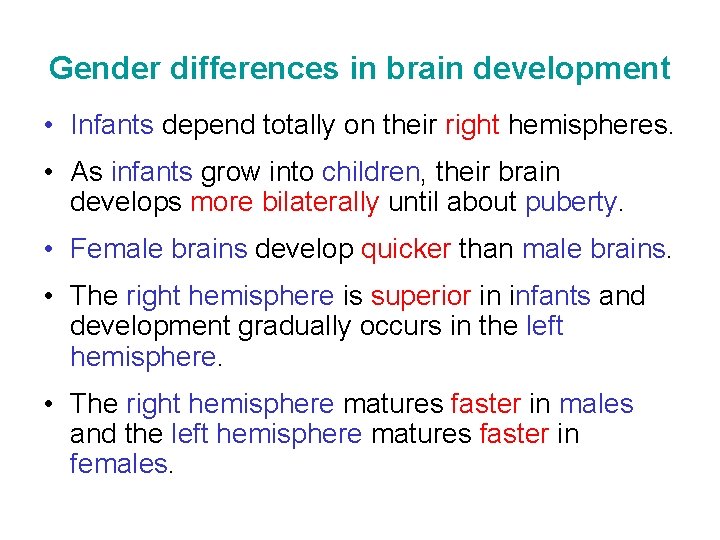
Gender differences in brain development • Infants depend totally on their right hemispheres. • As infants grow into children, their brain develops more bilaterally until about puberty. • Female brains develop quicker than male brains. • The right hemisphere is superior in infants and development gradually occurs in the left hemisphere. • The right hemisphere matures faster in males and the left hemisphere matures faster in females.
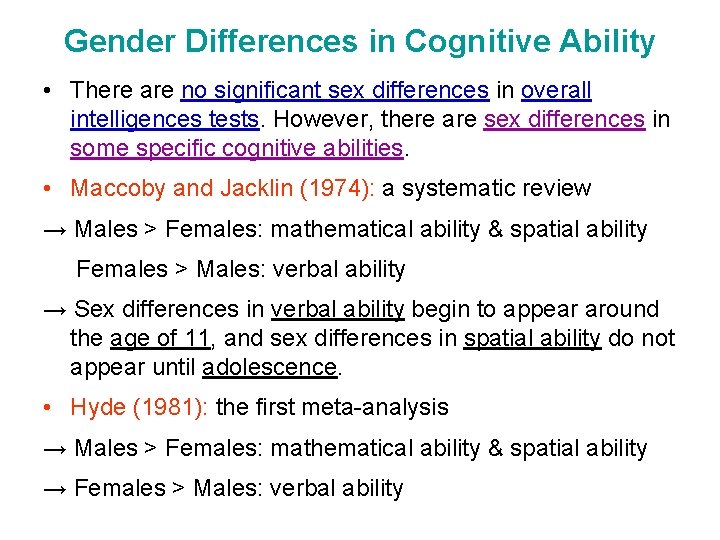
Gender Differences in Cognitive Ability • There are no significant sex differences in overall intelligences tests. However, there are sex differences in some specific cognitive abilities. • Maccoby and Jacklin (1974): a systematic review → Males > Females: mathematical ability & spatial ability Females > Males: verbal ability → Sex differences in verbal ability begin to appear around the age of 11, and sex differences in spatial ability do not appear until adolescence. • Hyde (1981): the first meta-analysis → Males > Females: mathematical ability & spatial ability → Females > Males: verbal ability
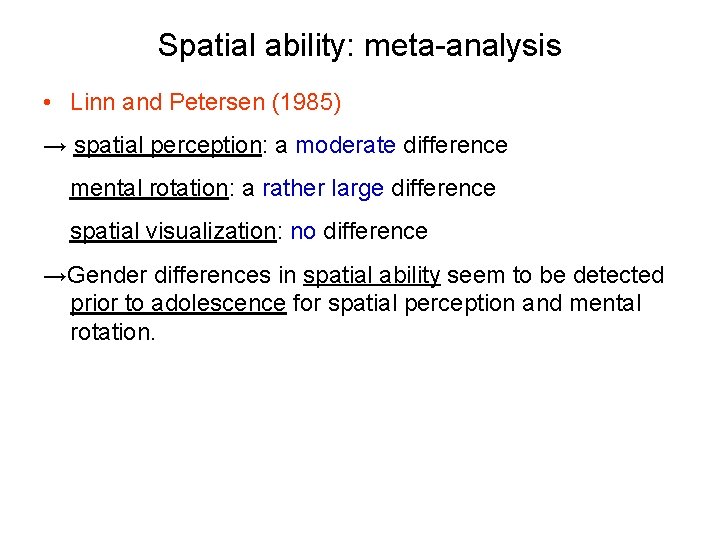
Spatial ability: meta-analysis • Linn and Petersen (1985) → spatial perception: a moderate difference mental rotation: a rather large difference spatial visualization: no difference →Gender differences in spatial ability seem to be detected prior to adolescence for spatial perception and mental rotation.
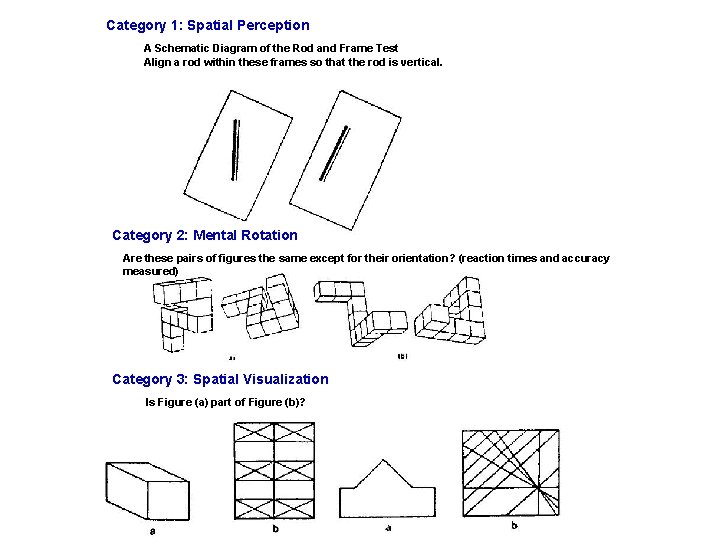
Category 1: Spatial Perception A Schematic Diagram of the Rod and Frame Test Align a rod within these frames so that the rod is vertical. Category 2: Mental Rotation Are these pairs of figures the same except for their orientation? (reaction times and accuracy measured) Category 3: Spatial Visualization Is Figure (a) part of Figure (b)?
Spatial ability: meta-analysis (continued) • Voyer et al. (1995) →sex differences were largest and consistent in the mental rotation category →sex differences were large but inconsistent for tests in the spatial perception category →sex differences were highly changeable and frequently not significant for tests in the spatial visualization →The age of emergence of sex differences was related to the test used
Verbal ability: meta-analysis • Hyde and Linn (1988) →There does not appear to be substantial evidence for sex differences related to most types of verbal ability. (vocabulary, analogies, reading comprehension, speech production, essay writing, anagrams) →There were no sex differences at all ages from childhood to adult.
Left-Brain and Right-Brain Teaching Strategies • Many researchers believe that most contemporary schools are dominated by a left-brain curriculum, and teaching strategies and learning activities are based primarily on a linear, sequential, and analytic way of thinking. • Matching teaching strategies to hemispheric preferences will help students gain higher test scores. • There is a need to close the gap between left-brain teaching strategies and right-brain learning styles because the left-brain educational system handicaps many children who prefer right-brain processing strategies.
• Two hemispheres work together and complement each other, people reach their highest achievement. • In order for all students to have the maximum opportunity to learn, educators must incorporate left-brain and rightbrain teaching strategies. • Teachers should select appropriate strategies to meet diverse students’ hemispheric preferences as well as stimulate both hemispheres to develop the whole brain.
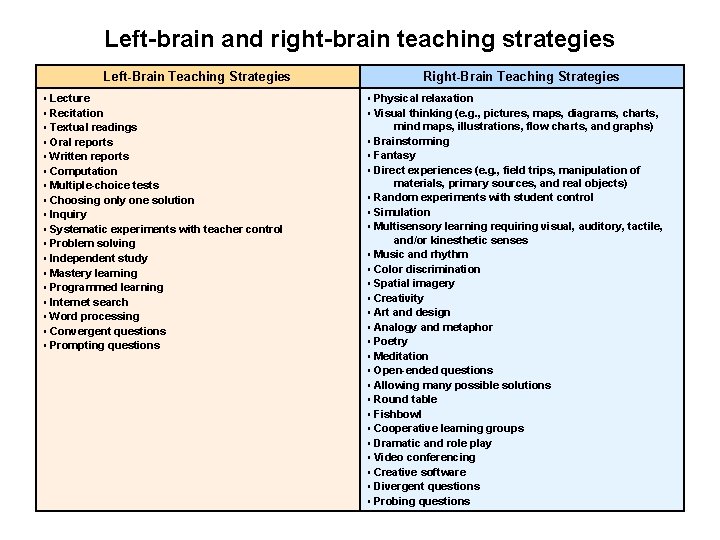
Left-brain and right-brain teaching strategies Left-Brain Teaching Strategies ▪ Lecture ▪ Recitation ▪ Textual readings ▪ Oral reports ▪ Written reports ▪ Computation ▪ Multiple-choice tests ▪ Choosing only one solution ▪ Inquiry ▪ Systematic experiments with teacher control ▪ Problem solving ▪ Independent study ▪ Mastery learning ▪ Programmed learning ▪ Internet search ▪ Word processing ▪ Convergent questions ▪ Prompting questions Right-Brain Teaching Strategies ▪ Physical relaxation ▪ Visual thinking (e. g. , pictures, maps, diagrams, charts, mind maps, illustrations, flow charts, and graphs) ▪ Brainstorming ▪ Fantasy ▪ Direct experiences (e. g. , field trips, manipulation of materials, primary sources, and real objects) ▪ Random experiments with student control ▪ Simulation ▪ Multisensory learning requiring visual, auditory, tactile, and/or kinesthetic senses ▪ Music and rhythm ▪ Color discrimination ▪ Spatial imagery ▪ Creativity ▪ Art and design ▪ Analogy and metaphor ▪ Poetry ▪ Meditation ▪ Open-ended questions ▪ Allowing many possible solutions ▪ Round table ▪ Fishbowl ▪ Cooperative learning groups ▪ Dramatic and role play ▪ Video conferencing ▪ Creative software ▪ Divergent questions ▪ Probing questions
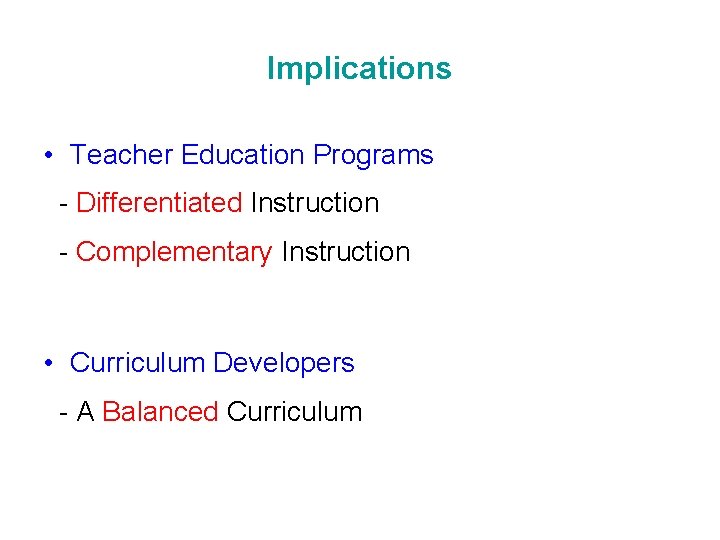
Implications • Teacher Education Programs - Differentiated Instruction - Complementary Instruction • Curriculum Developers - A Balanced Curriculum

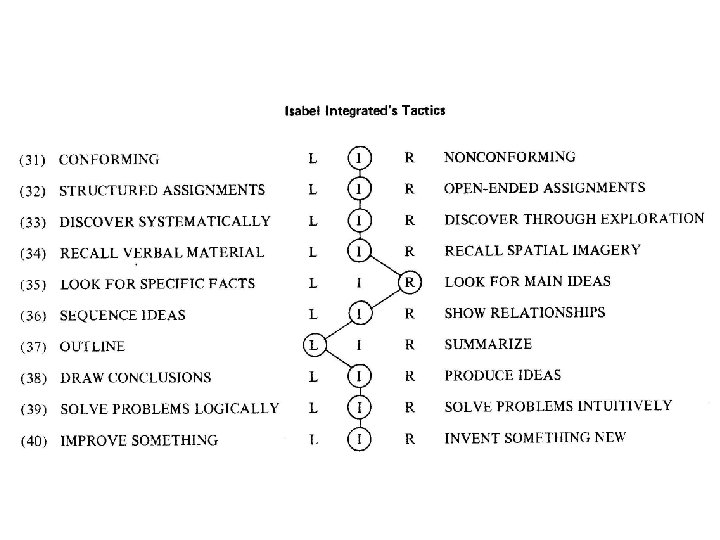
Identify your hemispheric preference • Human Information Processing (HIP) Survey • Profile Form • Scoring Key
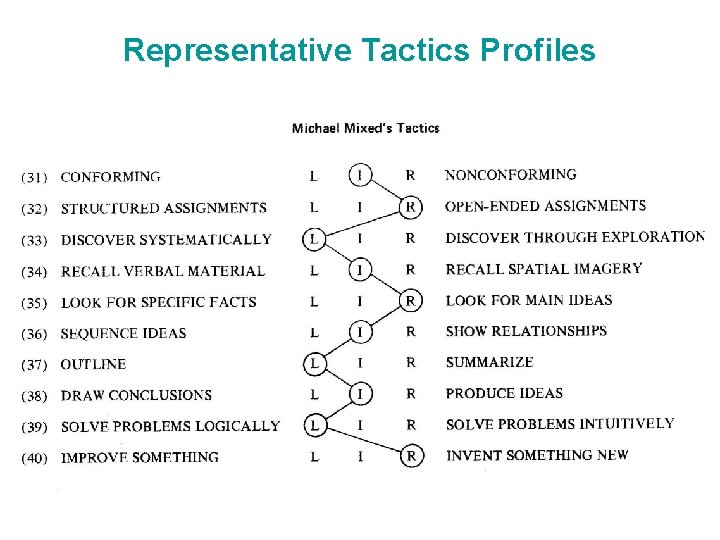
Representative Tactics Profiles

Thank you for your attention!




- Slides: 70