
Outline Background Research Question Stance and Persuasion Methodology

Outline • • • Background Research Question Stance and Persuasion Methodology Result and Discussion Q&A
Background of this study • “Social media have become a fact of life for civil society worldwide, involving many actors– regular citizens, activists, nongovernmental organizations, telecommunications firms, software providers, governments. ” (Shirky, 2015) • “Public debate functions as a forum for both expressing and forming opinions. ” (Walker et al. , 2012) • Development of technology and social media have enable citizens more control over the information they get and the opinions being shared and being formed.
Research Goals • Establish lexical resources for arguing and subjective language • Utilizing these resources in classifying opinionated texts online
Stance and Persuasion

Stance • Stance, subjectivity, and evaluation may refer to the same concept • (Englebretson, 2007) • “the lexical and grammatical expression of attitudes, feelings, judgments, or commitment concerning the propositional content of a message” • (Biber and Finegan, 1989) • “personal feelings, attitudes, value judgments, or assessments” • (Biber et al. , 1999)
Evaluation • “evaluation is the broad cover term for the expression of the speaker or writer’s attitude or stance towards, viewpoint on, or feelings about the entities or propositions that he or she is talking about. That attitude may relate to certainty or obligation or desirability or any of a number of other sets of values. ” • (Thompson and Hunston, 2000)
Persuasion • Conscious behavior that involves two parties (Tidwell, 1994) • A successful intentional effort at influencing another’s mental state through communication in a circumstance in which the persuade has some measure of freedom (O’Keefe, 1990) • A symbolic activity whose purpose is to effect the internalization or voluntary acceptance of new cognitive states or patterns of overt behavior through the exchange of messages (Smith, 1982)
Argument • Two opposing parties, each asserting themselves to be right and often pointing out the wrongness of the opposing view (Cobb and Kulklinski, 1997; Kuhn, 1991) • Involves managing competing claims (Antaki, 1994; Coulter, 1990; Goodwin, 1983) • Justifying an opinion or refuting an opinion Although in practice could be a monologue, but should be interpreted dialogically (Eemeren and Grootendorst, 1980)
• Stance: “an overall position held by a person toward an object, idea, or proposition” • (Somasundaran and Wiebe, 2009) • Arguing: “where a person is arguing for or against something or expressing a belief about what is true, should be true or should be done is his or her view of the world” • (Wilson and Wiebe, 2005; Wilson, 2007; Somasundaran et al. , 2008)
Methodology • Extracting PTT comments • Manual annotation on subjective elements • Adding the new lexicon as features to train the classifier, and use relative frequency of the words in the dataset as features • Classifying the texts using an SVM classifier
PTT Corpus
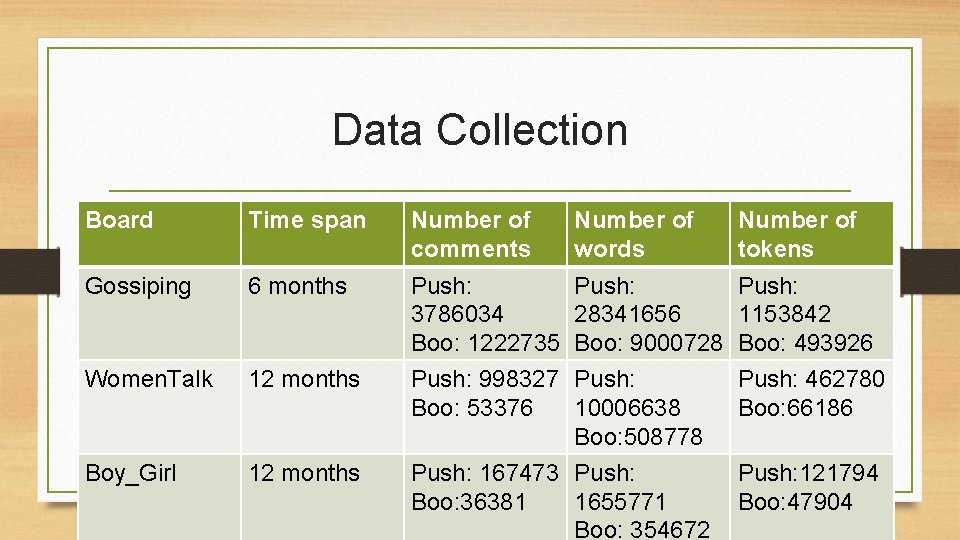
Data Collection Board Time span Number of comments Number of words Number of tokens Gossiping 6 months Push: 3786034 28341656 1153842 Boo: 1222735 Boo: 9000728 Boo: 493926 Women. Talk 12 months Boy_Girl 12 months Push: 998327 Push: Boo: 53376 10006638 Boo: 508778 Push: 167473 Push: Boo: 36381 1655771 Boo: 354672 Push: 462780 Boo: 66186 Push: 121794 Boo: 47904
![Types of articles • Feelings/ experience- sharing articles [心情] 我做了椰子雪花糕 (Women. Talk) • Discussion](http://slidetodoc.com/presentation_image_h2/c6f5cb23c2cd814b78075a2c0dd50139/image-14.jpg "Types of articles • Feelings/ experience- sharing articles [心情] 我做了椰子雪花糕 (Women. Talk) • Discussion")
Types of articles • Feelings/ experience- sharing articles [心情] 我做了椰子雪花糕 (Women. Talk) • Discussion oriented articles [問題] 食物掉在桌上,會拿起來吃嗎? (Women. Talk) [問卦] 老師薪水真的很高嗎?(Gossiping) • Advice-seeking articles [討論] 分手後聽甚麼歌最療傷?(Boy_Girl) [求助] 對女生來說甚麼才算幽默?(Boy_Girl) • Advice-giving articles Re: [求助] 很想一起出國但女友不行(Boy_Girl)
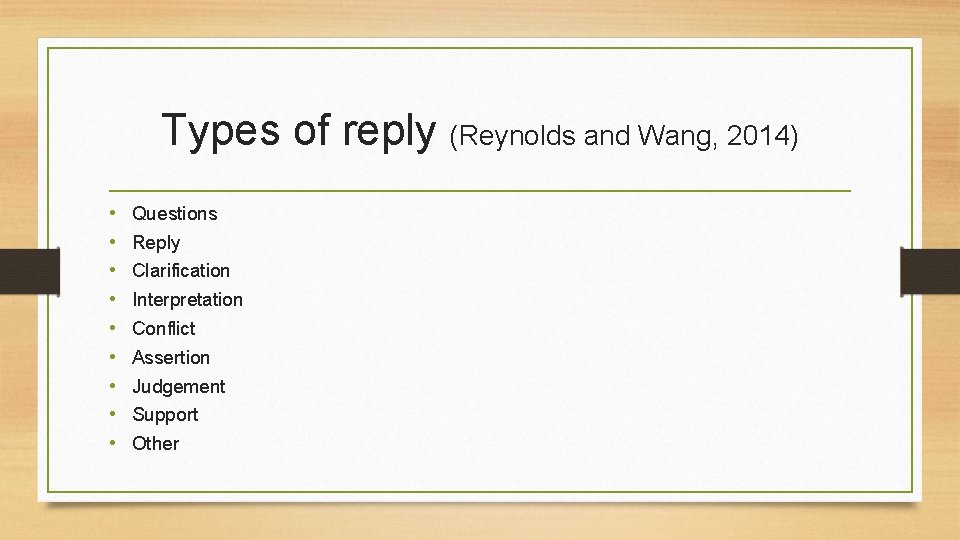
Types of reply (Reynolds and Wang, 2014) • • • Questions Reply Clarification Interpretation Conflict Assertion Judgement Support Other
Annotation Scheme • Private state is a general term that covers mental and emotional states, which cannot be directly observed or verified (Quirk et al. , 1985) • In natural language, opinions, emotions and other private states are expressed using subjective language (Banfield, 1982; Wiebe, 1994)
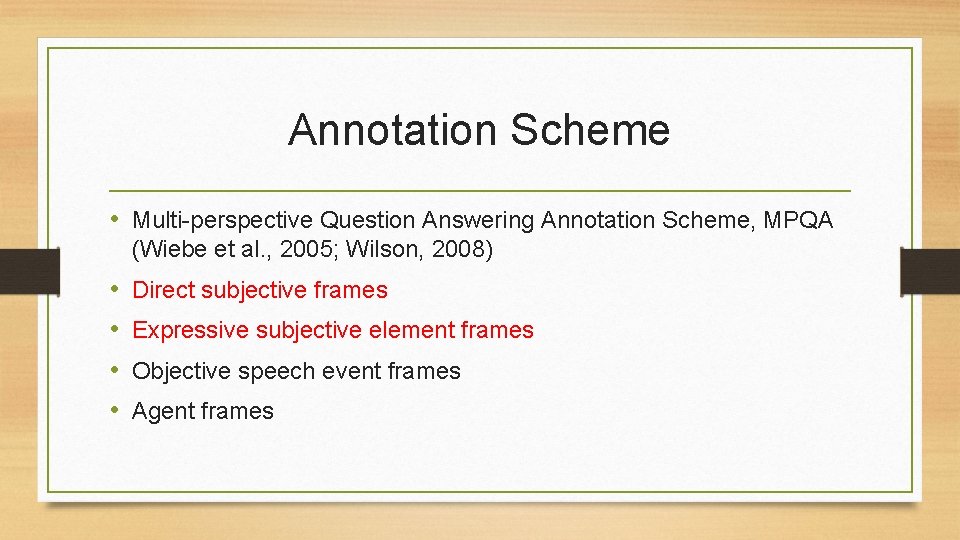
Annotation Scheme • Multi-perspective Question Answering Annotation Scheme, MPQA (Wiebe et al. , 2005; Wilson, 2008) • • Direct subjective frames Expressive subjective element frames Objective speech event frames Agent frames
![Tagging set • Subjective (Expressive subjective element): • 1. Positive evaluation [想認識樓上] [一樓神回 我也有想過]](http://slidetodoc.com/presentation_image_h2/c6f5cb23c2cd814b78075a2c0dd50139/image-20.jpg "Tagging set • Subjective (Expressive subjective element): • 1. Positive evaluation [想認識樓上] [一樓神回 我也有想過]")
Tagging set • Subjective (Expressive subjective element): • 1. Positive evaluation [想認識樓上] [一樓神回 我也有想過] • 2. Negative evaluation [火星人請快回火星比較好~] [H&M破布等級]
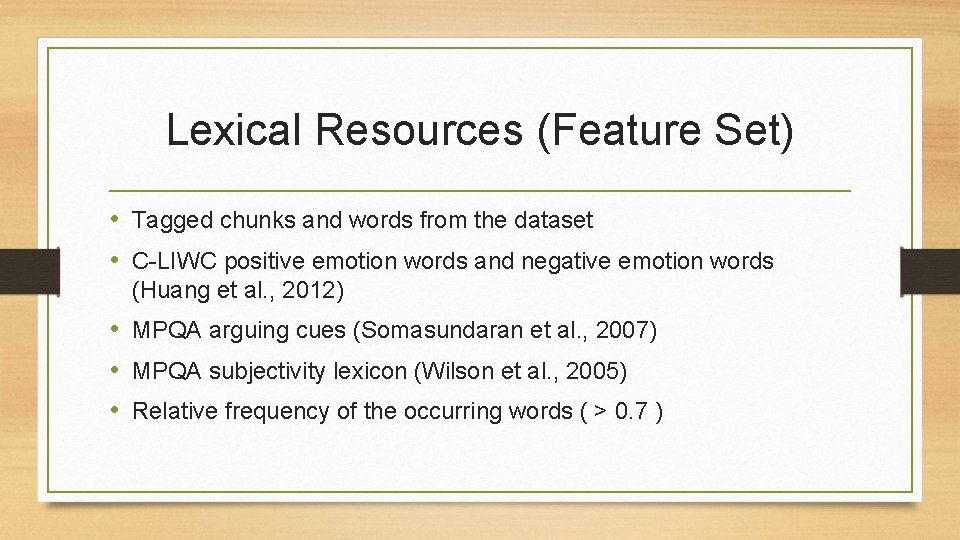
Lexical Resources (Feature Set) • Tagged chunks and words from the dataset • C-LIWC positive emotion words and negative emotion words (Huang et al. , 2012) • MPQA arguing cues (Somasundaran et al. , 2007) • MPQA subjectivity lexicon (Wilson et al. , 2005) • Relative frequency of the occurring words ( > 0. 7 )
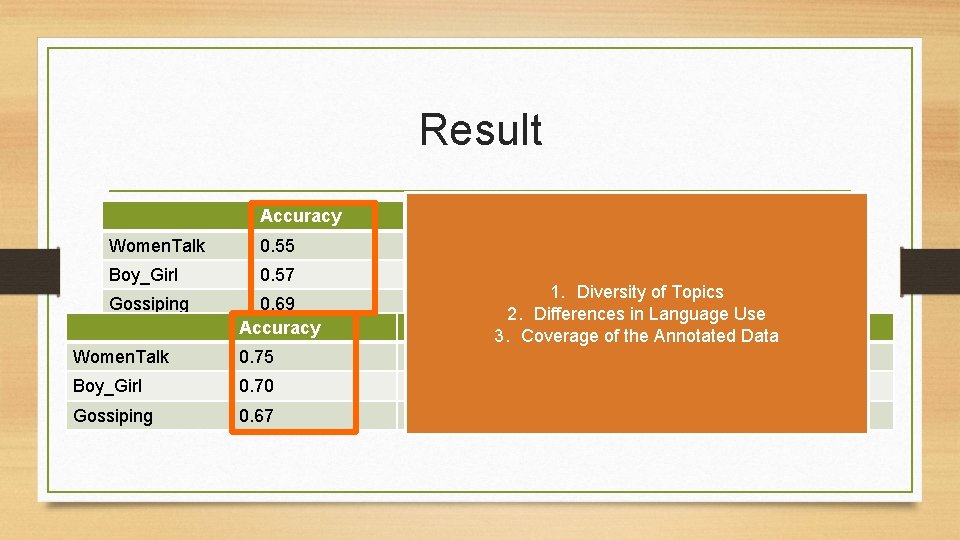
Result Accuracy Women. Talk 0. 55 0. 75 Boy_Girl 0. 57 0. 73 0. 69 Accuracy 0. 69 Gossiping 0. 55 0. 63 0. 57 0. 64 1. Diversity of Topics 0. 69 2. Differences in Language Use 3. Coverage of the Annotated Data 0. 75 Women. Talk 0. 75 Boy_Girl 0. 70 Gossiping 0. 67
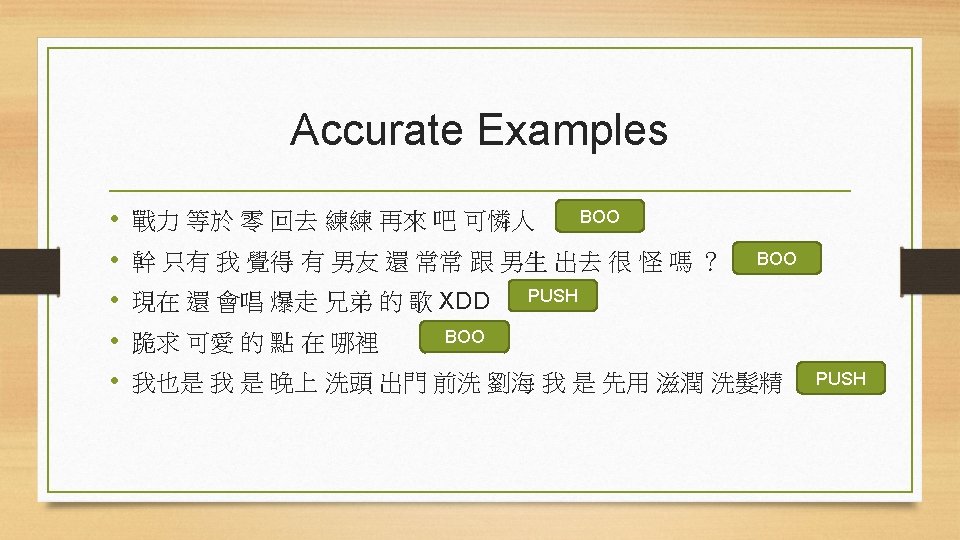
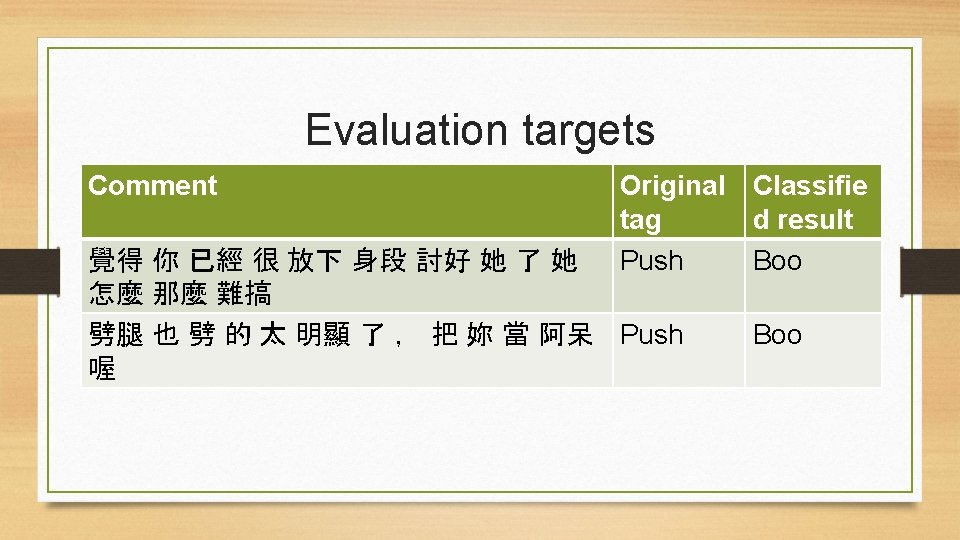
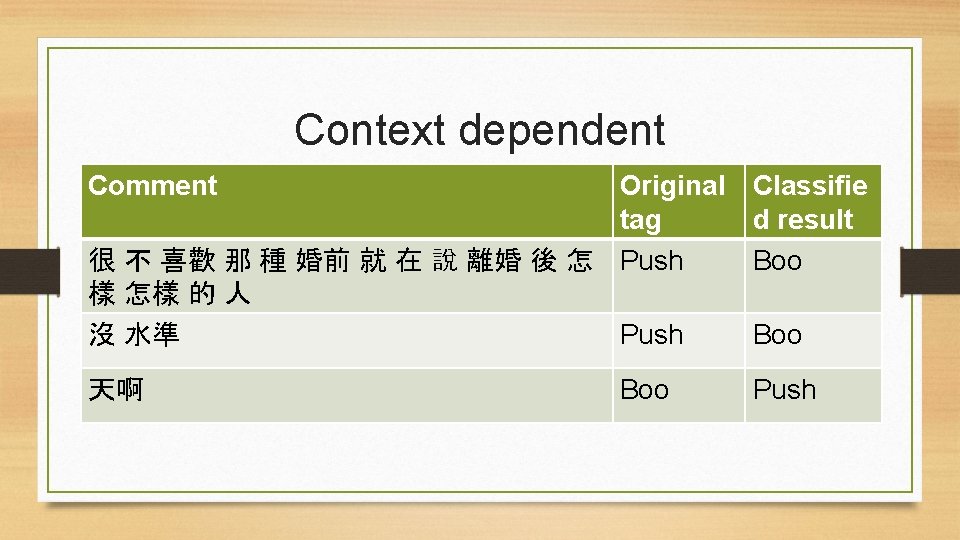
Context dependent Comment Original Classifie tag d result 很 不 喜歡 那 種 婚前 就 在 說 離婚 後 怎 Push Boo 樣 怎樣 的 人 沒 水準 Push Boo 天啊 Boo Push
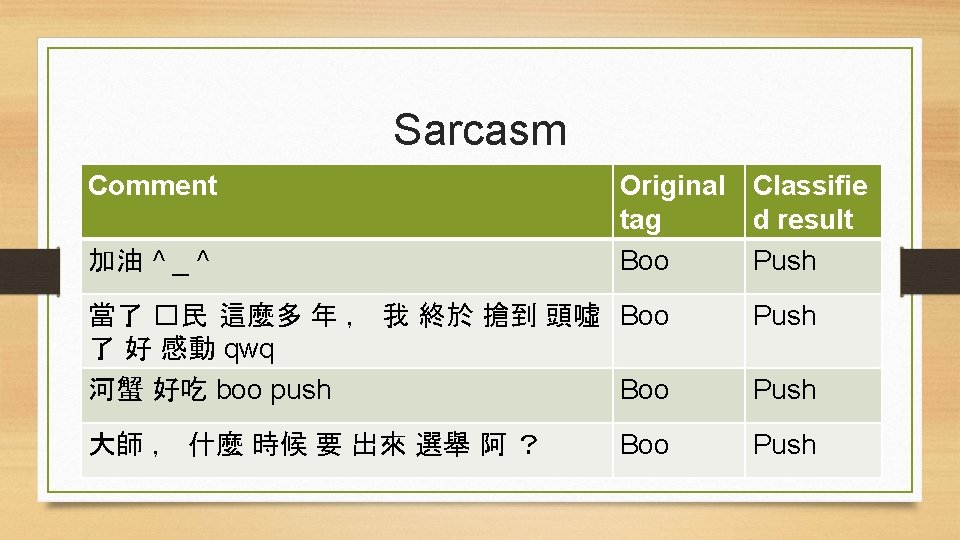
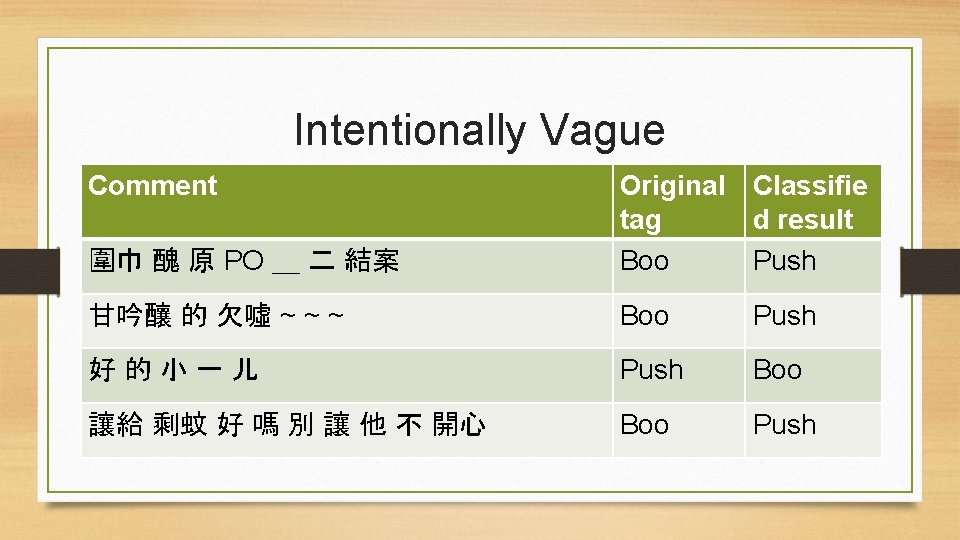
Intentionally Vague Comment 圍巾 醜 原 PO _ 二 結案 Original Classifie tag d result Boo Push 甘吟釀 的 欠噓 ~ ~ ~ Boo Push 好的小一儿 Push Boo 讓給 剩蚊 好 嗎 別 讓 他 不 開心 Boo Push
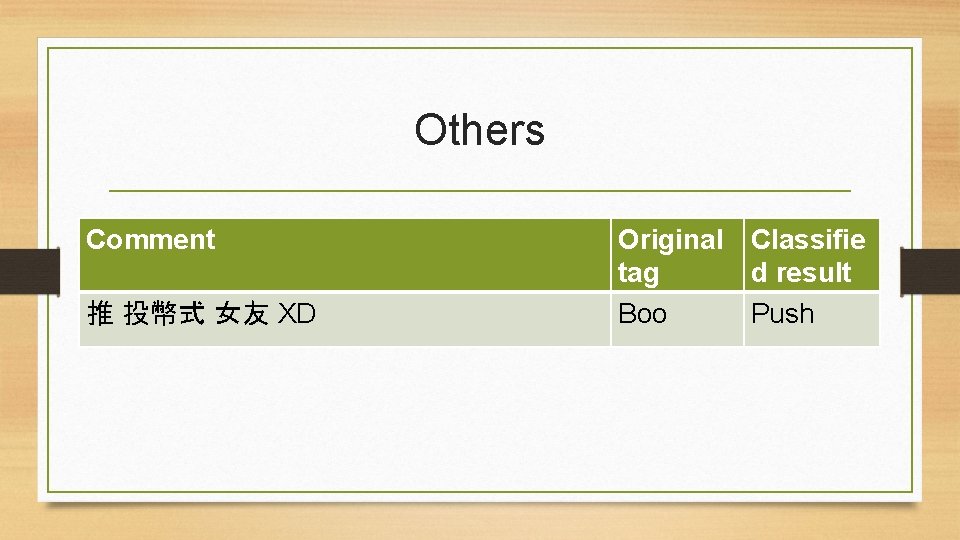
Others Comment 推 投幣式 女友 XD Original Classifie tag d result Boo Push
Conclusion
Thank You!!!!
- Slides: 30