
Outline B F Skinner Biography Theoretical notions Respondent
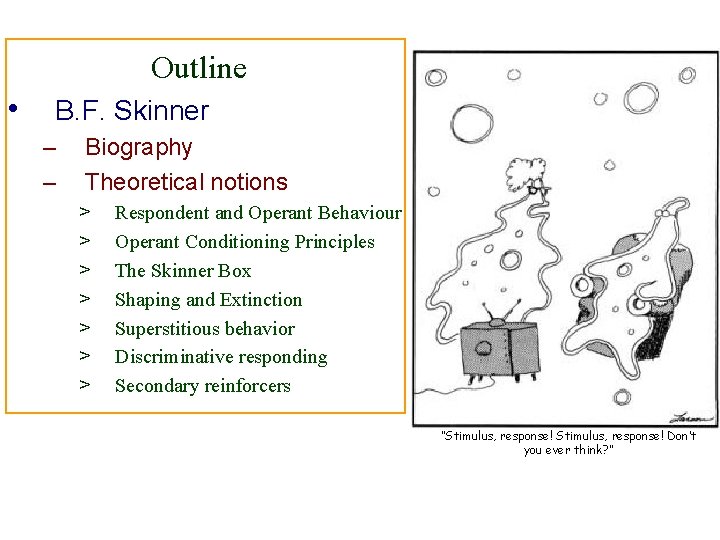
Outline • B. F. Skinner – – Biography Theoretical notions > > > > Respondent and Operant Behaviour Operant Conditioning Principles The Skinner Box Shaping and Extinction Superstitious behavior Discriminative responding Secondary reinforcers “Stimulus, response! Don’t you ever think? ”
B. F. Skinner • Biography B. F. Skinner (1904 -1990) – Wanted to be writer > B. A. in English Literature (1926) – Entered graduate school at Havard (1928) > Mentored by the Chair of Physiology (W. Crozier) § Who studied the “animal as a whole” without appealing to internal processes. > Obtained his Ph. D. in 1931 – Taught at University of Minnesota (1936 - 1945) > Published “The Behaviour of Organisms” (1938) – Affiliated with Havard until he died (1990)
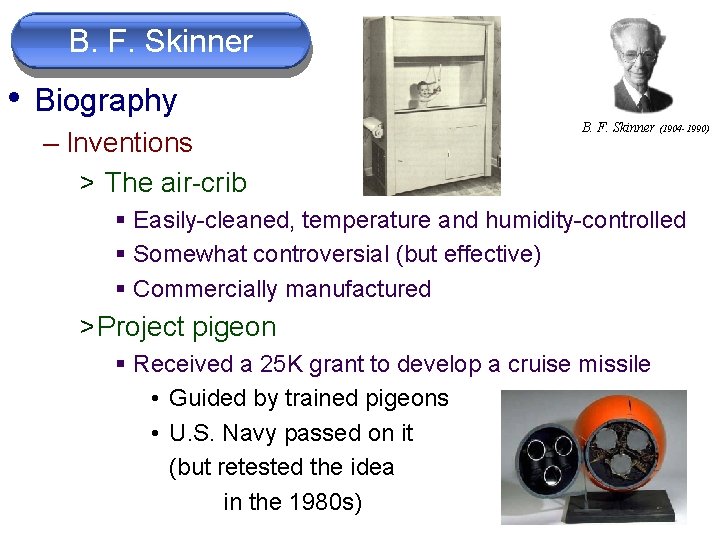
B. F. Skinner • Biography – Inventions > The air-crib B. F. Skinner (1904 -1990) § Easily-cleaned, temperature and humidity-controlled § Somewhat controversial (but effective) § Commercially manufactured > Project pigeon § Received a 25 K grant to develop a cruise missile • Guided by trained pigeons • U. S. Navy passed on it (but retested the idea in the 1980 s)
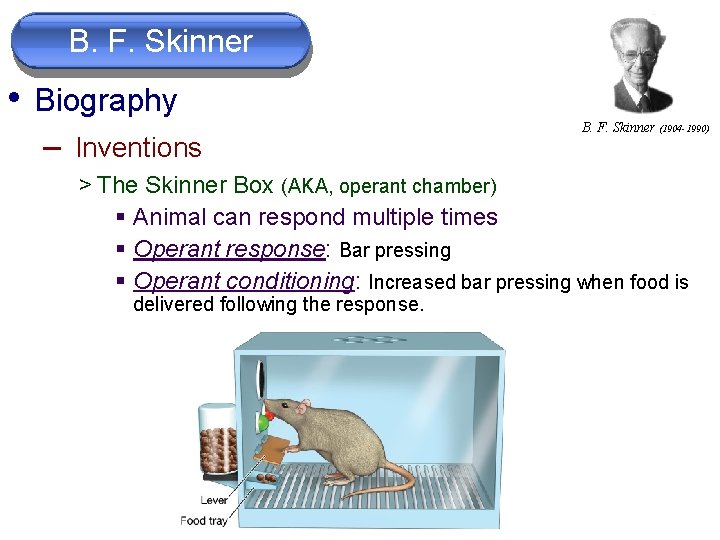
B. F. Skinner • Biography – Inventions B. F. Skinner (1904 -1990) > The Skinner Box (AKA, operant chamber) § Animal can respond multiple times § Operant response: Bar pressing § Operant conditioning: Increased bar pressing when food is delivered following the response.
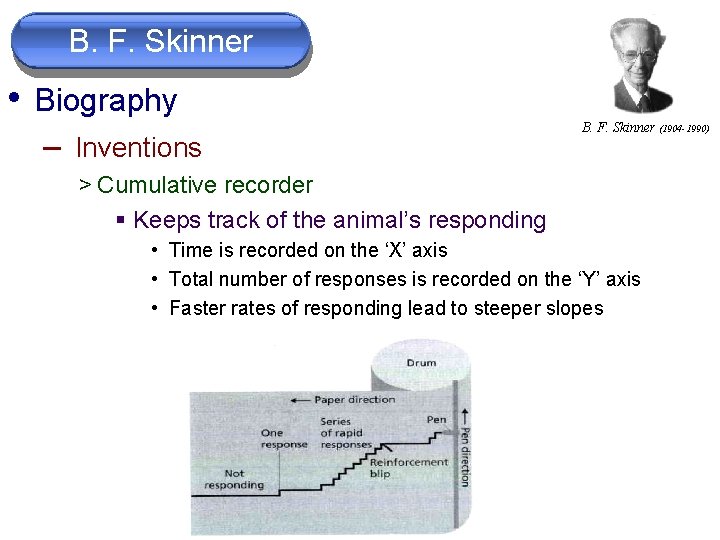
B. F. Skinner • Biography – Inventions B. F. Skinner (1904 -1990) > Cumulative recorder § Keeps track of the animal’s responding • Time is recorded on the ‘X’ axis • Total number of responses is recorded on the ‘Y’ axis • Faster rates of responding lead to steeper slopes
B. F. Skinner • Major Theoretical Notions – Respondent and operant behaviour B. F. Skinner (1904 -1990) > Respondent behaviour - Behaviour elicited by a known stimulus § E. g. , Unconditioned responses • Elicited by unconditioned stimuli • Reflexive > Operant behaviour - Behaviour not elicited by a known stimulus § E. g. , Most of our everyday behaviour • Occurs spontaneously
B. F. Skinner • Major Theoretical Notions – Type S and Type R conditioning > Two kinds of conditioning B. F. Skinner (1904 -1990) § Type S (respondent conditioning) - classical (Pavlovian) conditioning • ‘S’ to emphasize the role of the eliciting Stimulus • Strength is measured by the magnitude of the CR § Type R (operant conditioning) - learning that involves operant behaviour • ‘R’ to emphasize Response • Strength is measured by the response rate
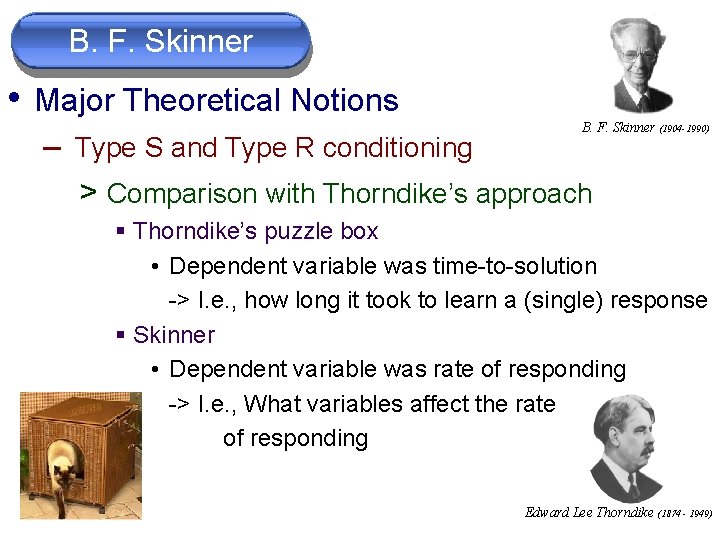
B. F. Skinner • Major Theoretical Notions B. F. Skinner (1904 -1990) – Type S and Type R conditioning > Comparison with Thorndike’s approach § Thorndike’s puzzle box • Dependent variable was time-to-solution -> I. e. , how long it took to learn a (single) response § Skinner • Dependent variable was rate of responding -> I. e. , What variables affect the rate of responding Edward Lee Thorndike (1874 - 1949)
B. F. Skinner • Major Theoretical Notions – Operant conditioning principles B. F. Skinner (1904 -1990) > Two general principles § Any response that is followed by a reinforcing stimulus tends to be repeated § A reinforcing stimulus is anything that increases the rate with which an operant response occurs • I. e. , anything that increases the probability of a response’s re-occurring
B. F. Skinner • Major Theoretical Notions – Operant conditioning principles B. F. Skinner (1904 -1990) > Contingent reinforcement § Emphasis on behaviour and its consequences • Gaining reinforcement depends (i. e. , is contigent) on making the appropriate response § Culture as a set of reinforcement contigencies • Different cultures reinforce different behaviour patterns § Controlling reinforcement -> controls behaviour • E. g, child rearing
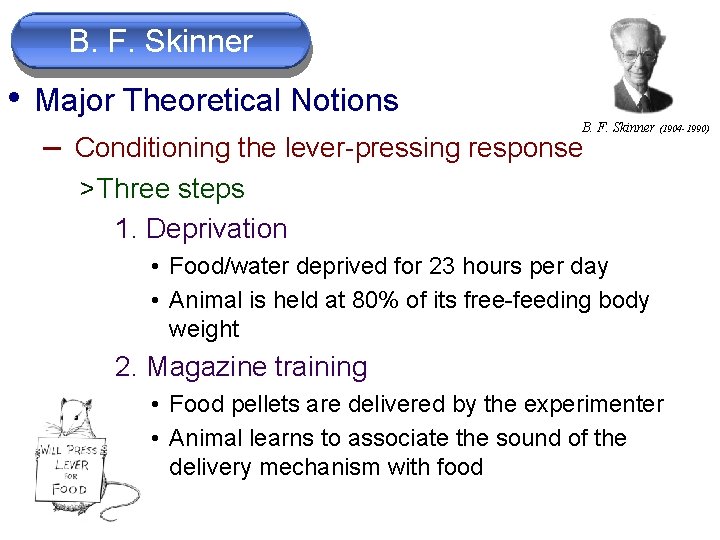
B. F. Skinner • Major Theoretical Notions B. F. Skinner (1904 -1990) – Conditioning the lever-pressing response > Three steps 1. Deprivation • Food/water deprived for 23 hours per day • Animal is held at 80% of its free-feeding body weight 2. Magazine training • Food pellets are delivered by the experimenter • Animal learns to associate the sound of the delivery mechanism with food
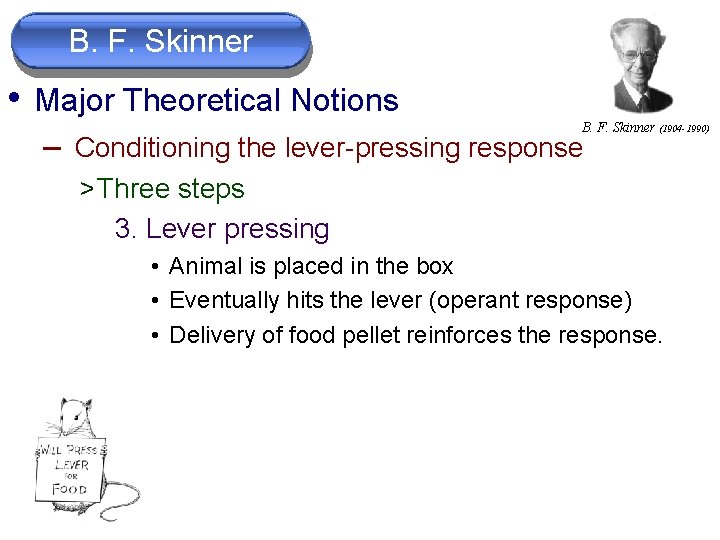
B. F. Skinner • Major Theoretical Notions B. F. Skinner (1904 -1990) – Conditioning the lever-pressing response > Three steps 3. Lever pressing • Animal is placed in the box • Eventually hits the lever (operant response) • Delivery of food pellet reinforces the response.
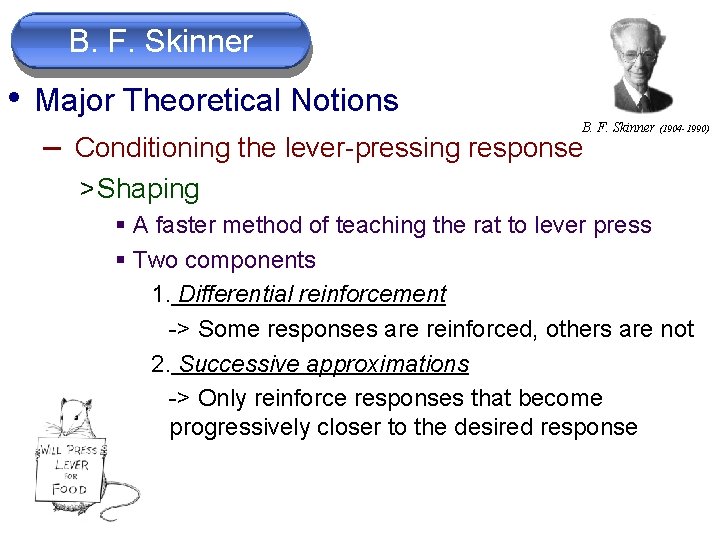
B. F. Skinner • Major Theoretical Notions B. F. Skinner (1904 -1990) – Conditioning the lever-pressing response > Shaping § A faster method of teaching the rat to lever press § Two components 1. Differential reinforcement -> Some responses are reinforced, others are not 2. Successive approximations -> Only reinforce responses that become progressively closer to the desired response
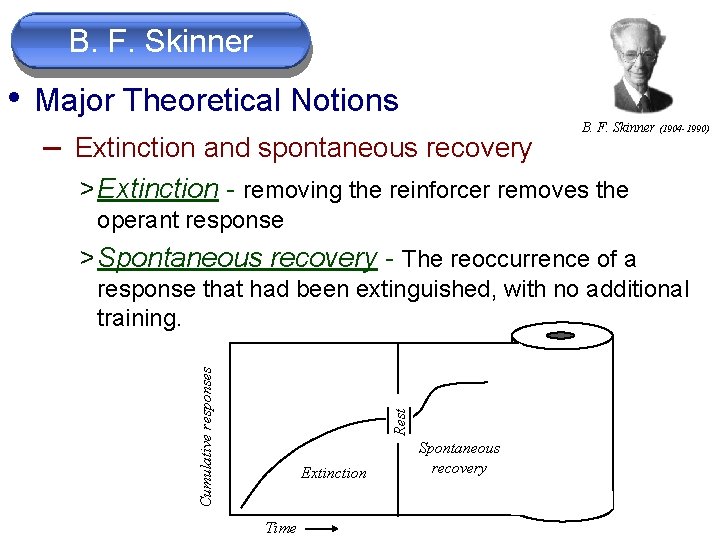
B. F. Skinner • Major Theoretical Notions – Extinction and spontaneous recovery B. F. Skinner (1904 -1990) > Extinction - removing the reinforcer removes the operant response > Spontaneous recovery - The reoccurrence of a Rest Cumulative responses response that had been extinguished, with no additional training. Extinction Time Spontaneous recovery
B. F. Skinner • Major Theoretical Notions – Superstitious behavior B. F. Skinner (1904 -1990) > What if we delivered pellets noncontingently? § Random behaviour would get reinforced • E. g. , Dog running in circles while waiting to get fed § Humans are susceptible to similar conditioning • E. g. , Athletes/ coaches’ game rituals
B. F. Skinner • Major Theoretical Notions – Discriminative operant B. F. Skinner (1904 -1990) > Skinner box is set so that reinforcement is only available when the light is on. § The light is the discriminative stimulus • I. e. , indicates that reinforcement is available § SD = light on, SD = light off, SR = reinforcing stimulus • A discriminative operant is symbolized as: SD -> R -> SR • Skinner was interested in the SD -> R association -> Cf. respondent conditioning § Stimulus control of behaviour
B. F. Skinner • Major Theoretical Notions – Secondary reinforcement B. F. Skinner (1904 -1990) > A neutral stimulus paired with a reinforcer can take on reinforcing qualities of its own > To test this notion § Lever press -> light -> food § Extinguish the response • Neither light nor food is delivered § Allow lever - press to deliver light (not food) • Response rate increases
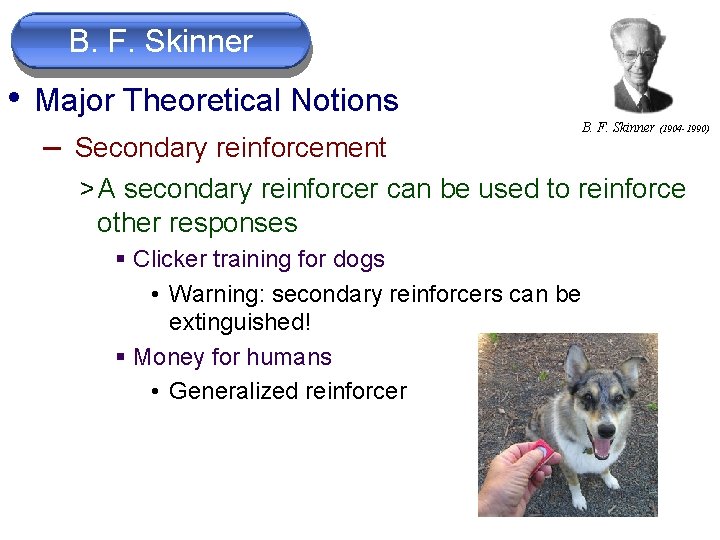
B. F. Skinner • Major Theoretical Notions – Secondary reinforcement B. F. Skinner (1904 -1990) > A secondary reinforcer can be used to reinforce other responses § Clicker training for dogs • Warning: secondary reinforcers can be extinguished! § Money for humans • Generalized reinforcer
- Slides: 18