
Outline Authentication in Distributed Systems Theory and Practice
Outline • Authentication in Distributed Systems: Theory and Practice, Butler Lampson, Martin Abadi, Michael Burrows, Edward Wobber – Butler Lampson (MSR) - He was one of the designers of the SDS 940 time-sharing system, the Alto personal distributed computing system, the Xerox 9700 laser printer, two-phase commit protocols, the Autonet LAN, and several programming languages. – Martin Abadi (Bell Labs) – Michael Burrows, Edward Wobber (Compaq SRC) Ubiquitous Computing
Authentication • Method for obtaining the source of the request – Who said this? • Interpreting the access rule – authorization – Who is trusted to access this? – Access control list (ACL) • Easier in central servers because the server knows all the sources Ubiquitous Computing
Distributed authentication (ala searchget) • Autonomy: Request might come through a number of untrusted nodes. So “Surendar” is not the same as “Surendar working through @Home network” • Size: Multiple authentication sources • Heterogeneity: Different methods of connecting • Fault-tolerance: Parts of the system may be broken Ubiquitous Computing
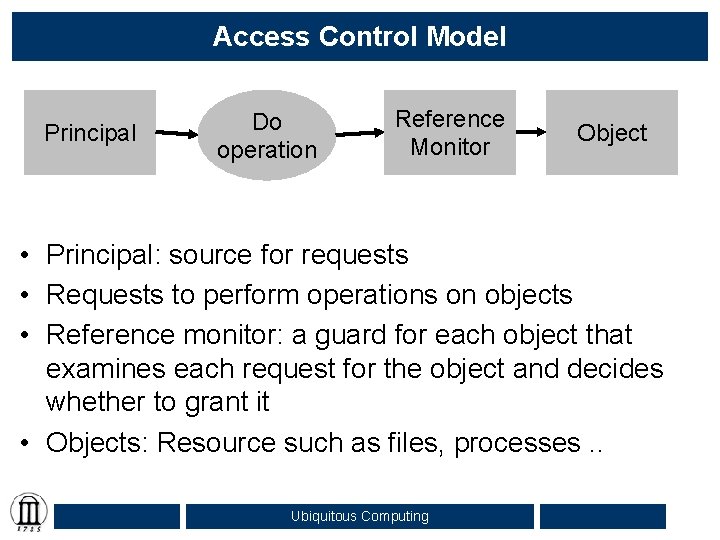
Access Control Model Principal Do operation Reference Monitor Object • Principal: source for requests • Requests to perform operations on objects • Reference monitor: a guard for each object that examines each request for the object and decides whether to grant it • Objects: Resource such as files, processes. . Ubiquitous Computing
Trusted Computing Base • A small amount of software and hardware that security depends upon – You have to trust something • Possible to obtain trusted statements from untrusted source – end-to-end argument • TCB typically includes: – – Operating system Hardware Encryption mechanisms Algorithms for authentication and authorization Ubiquitous Computing
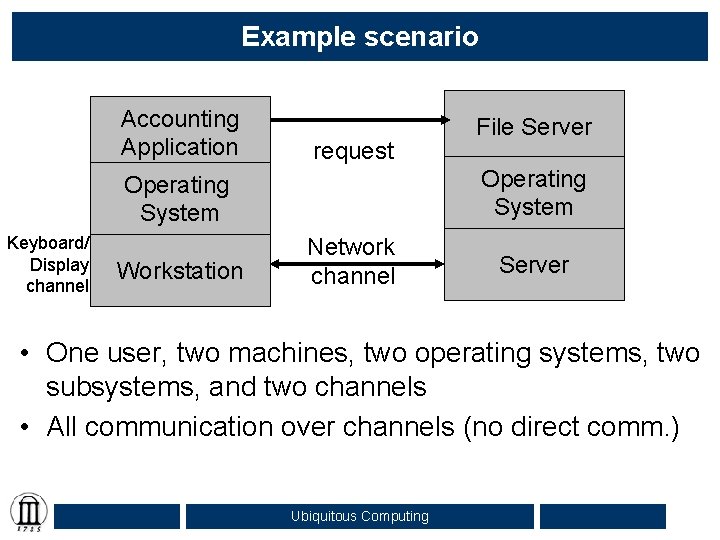
Example scenario Accounting Application request Operating System Keyboard/ Display channel Workstation File Server Network channel Server • One user, two machines, two operating systems, two subsystems, and two channels • All communication over channels (no direct comm. ) Ubiquitous Computing
Encryption channels • Shared vs public key cryptography – Shared is fast – Public key systems are easy to manage – Hybrids offer best of both worlds (e. g. SSL) • Broadcast encryption channels – Public key channel is broadcast channel: you can send a message without knowing who will receive it – Shows how you can implement broadcast channel using shared keys • Node-to-node secure channels Ubiquitous Computing
Principals with names • When requests arrive on a channel it is granted only if the channel speaks for one of the principals on the ACL – Push: sender collects A’s credentials and presents them when needed – Pull: receiver looks up A in some database to get credentials for A Ubiquitous Computing
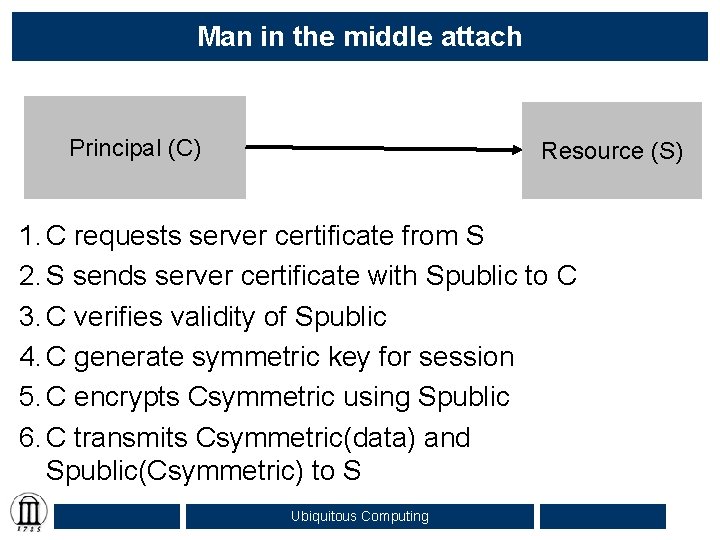
Man in the middle attach Principal (C) Resource (S) 1. C requests server certificate from S 2. S sends server certificate with Spublic to C 3. C verifies validity of Spublic 4. C generate symmetric key for session 5. C encrypts Csymmetric using Spublic 6. C transmits Csymmetric(data) and Spublic(Csymmetric) to S Ubiquitous Computing
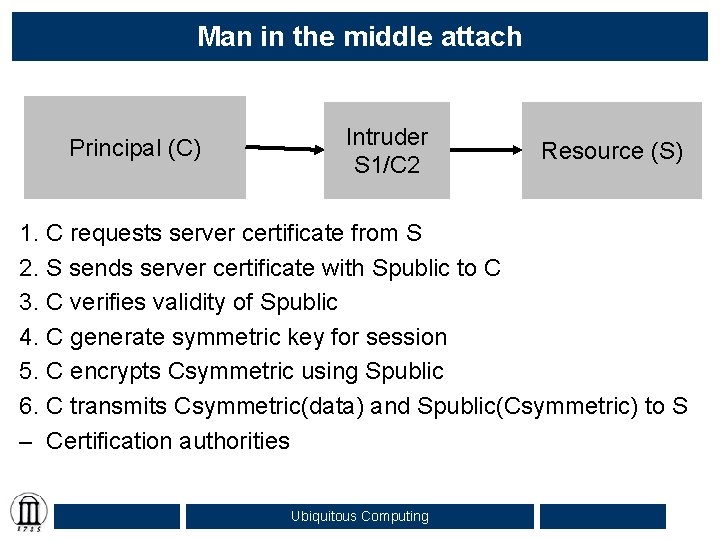
Man in the middle attach Principal (C) Intruder S 1/C 2 Resource (S) 1. C requests server certificate from S 2. S sends server certificate with Spublic to C 3. C verifies validity of Spublic 4. C generate symmetric key for session 5. C encrypts Csymmetric using Spublic 6. C transmits Csymmetric(data) and Spublic(Csymmetric) to S – Certification authorities Ubiquitous Computing
Certification Authority • Difficult to make system highly available and highly secure – – Leave CA offline, endorse certificates with long timeout Online agent highly available, countersign with shorter timeout Cache while both timeouts fresh Invalidation at cache granularity • Simple Certification Authority – CA speaks for A and is trusted when it says that C speaks for A • Everyone trusts CA to speak for named principal • Everyone knows public key of CA • Pathnames and Multiple authorities – Decentralized authority, Parents cannot unconditionally speak for children Ubiquitous Computing
Groups • Each principal speaks for the group • Group membership certificates – Impossible to tell the membership • Alternate approach is to distribute certificates to all principals – Revocation? Ubiquitous Computing
Roles and programs • Role that a user play; a normal user or sysadmin? • ACL may distinguish the role • Delegation: – Users delegate to compute server Ubiquitous Computing
Auditing • Formal proof for every access control decision Ubiquitous Computing
Discussion Ubiquitous Computing
- Slides: 15