
Outline Announcements Process Management continued Process Scheduling Nonpreemptive
- Slides: 66
Outline • • Announcements Process Management – continued Process Scheduling Non-preemptive scheduling algorithms – FCFS – SJN – Priority scheduling – Deadline scheduling 9/26/2020 COP 4610 1
Announcements • We will have recitation session tomorrow – We will go over the first quiz – We will discuss thread creation and thread synchronization through mutex • On Oct. 2, Dr. Andy Wang will give a lecture – I will be attending a symposium on that day • On Oct. 16 – I need to attend a conference – I will use Oct. 15 to make up the lecture and use Oct. 16 class time for demonstration purpose of the first lab 9/26/2020 COP 4610 2
Announcements – cont. • The midterm exam will be on Oct. 23, 2003 – During the regular class time – We will have a review on Tuesday, Oct. 21, 2003 – I will answer questions on Wed. , Oct. 22, 2003 during the recitation sessions 9/26/2020 COP 4610 3
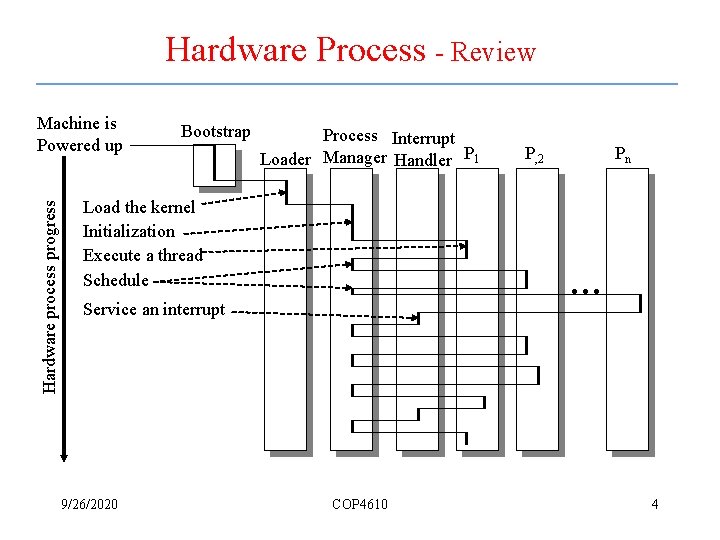
Hardware Process - Review Hardware process progress Machine is Powered up Bootstrap Process Interrupt Loader Manager Handler P 1 Load the kernel Initialization Execute a thread Schedule Pn … Service an interrupt 9/26/2020 P, 2 COP 4610 4
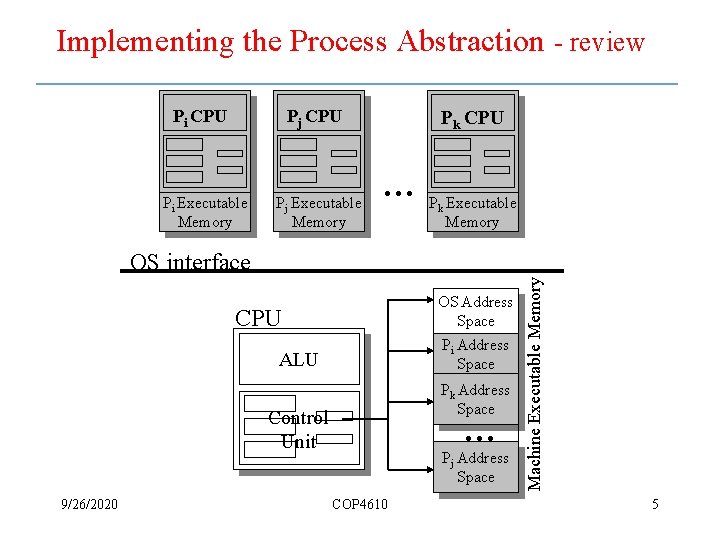
Implementing the Process Abstraction - review Pi CPU Pj CPU Pi Executable Memory Pj Executable Memory Pk CPU … Pk Executable Memory OS Address Space Pi Address Space CPU ALU Pk Address Space Control Unit 9/26/2020 … Pj Address Space COP 4610 Machine Executable Memory OS interface 5
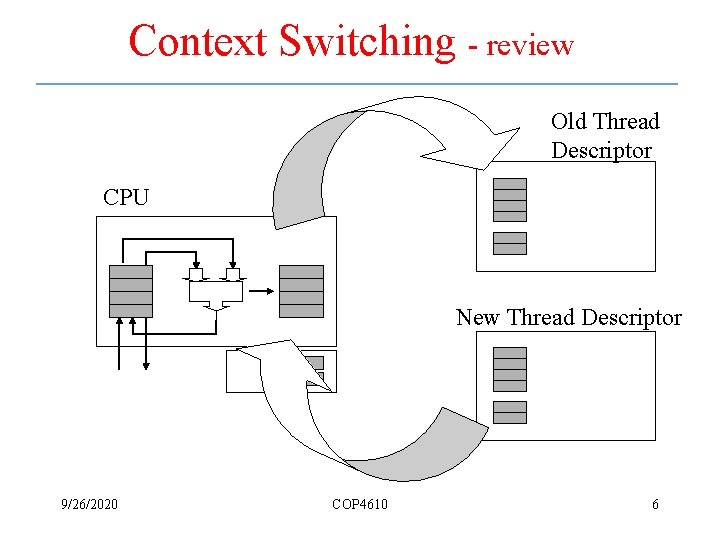
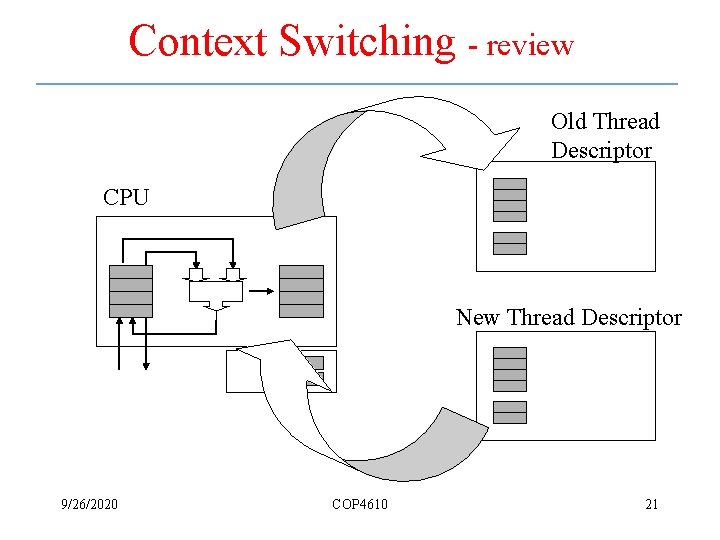
Context Switching - review Old Thread Descriptor CPU New Thread Descriptor 9/26/2020 COP 4610 6
Process Descriptors • OS creates/manages process abstraction • Descriptor is data structure for each process – Type & location of resources it holds – List of resources it needs – List of threads – List of child processes – Security keys 9/26/2020 COP 4610 7
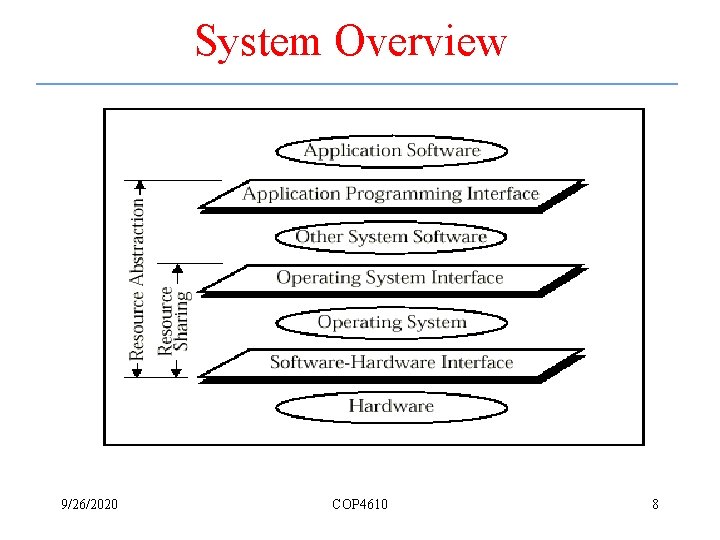
System Overview 9/26/2020 COP 4610 8
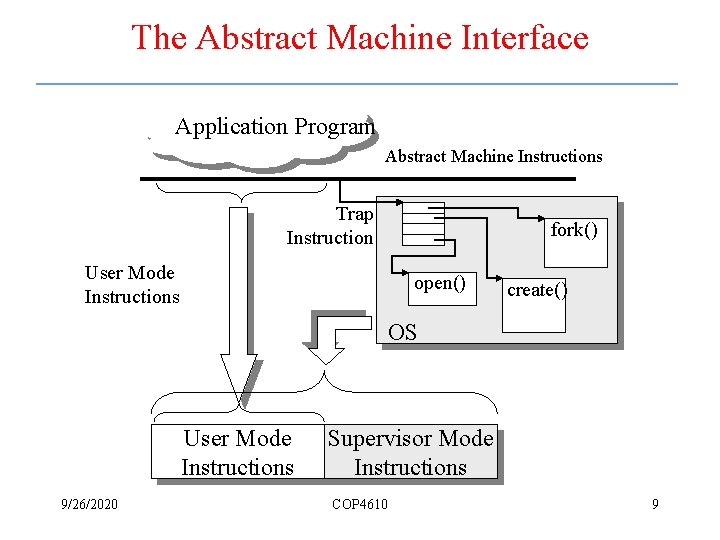
The Abstract Machine Interface Application Program Abstract Machine Instructions Trap Instruction User Mode Instructions fork() open() create() OS User Mode Instructions 9/26/2020 Supervisor Mode Instructions COP 4610 9
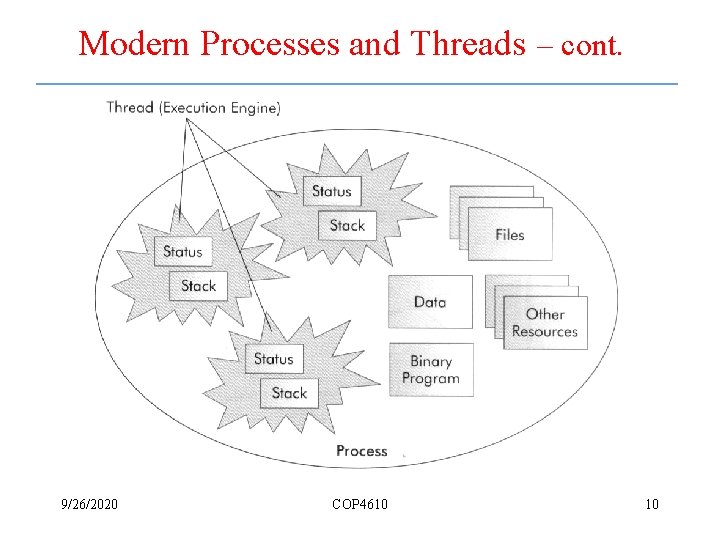
Modern Processes and Threads – cont. 9/26/2020 COP 4610 10
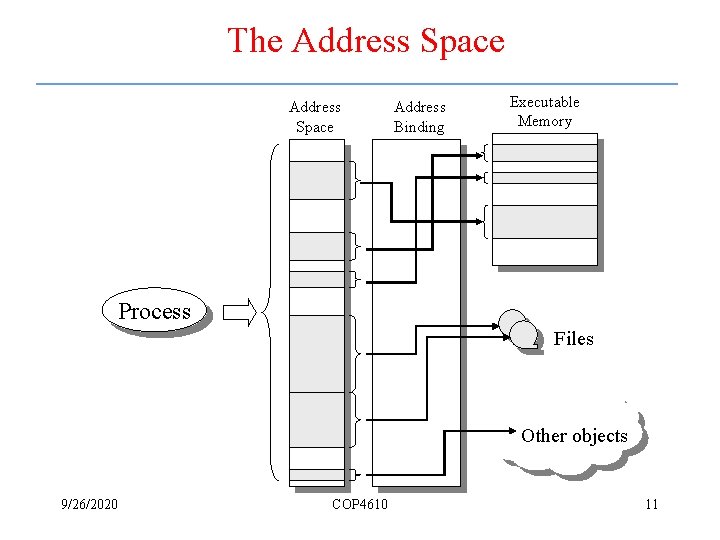
The Address Space Address Binding Executable Memory Process Files Other objects 9/26/2020 COP 4610 11
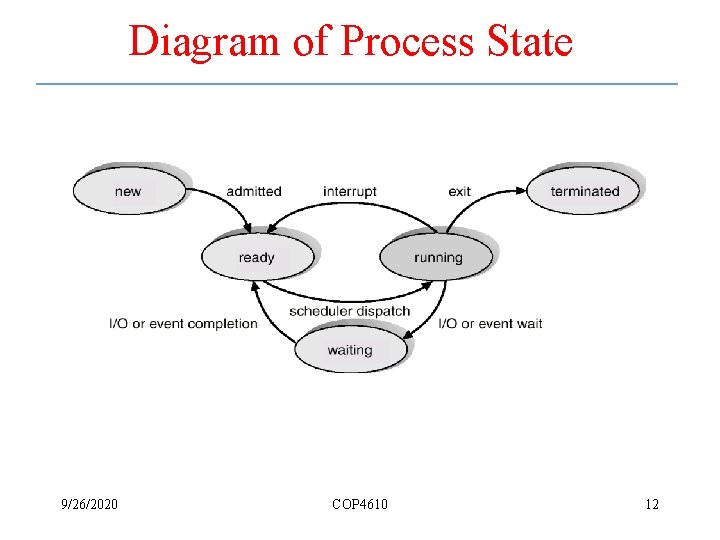
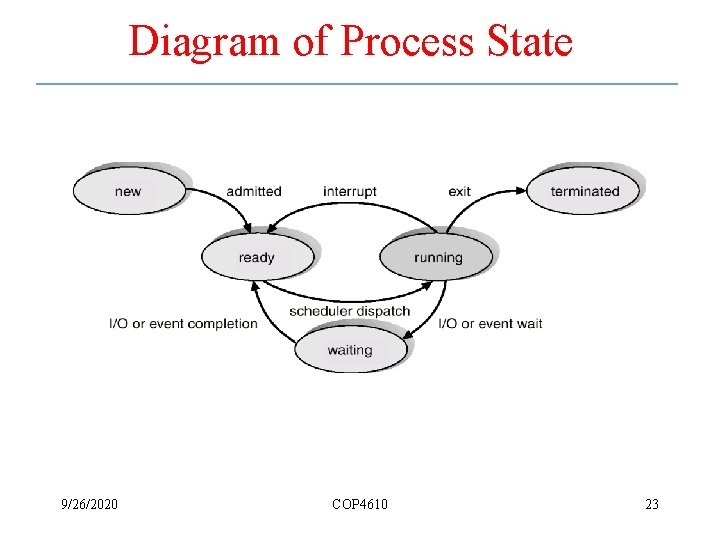
Diagram of Process State 9/26/2020 COP 4610 12
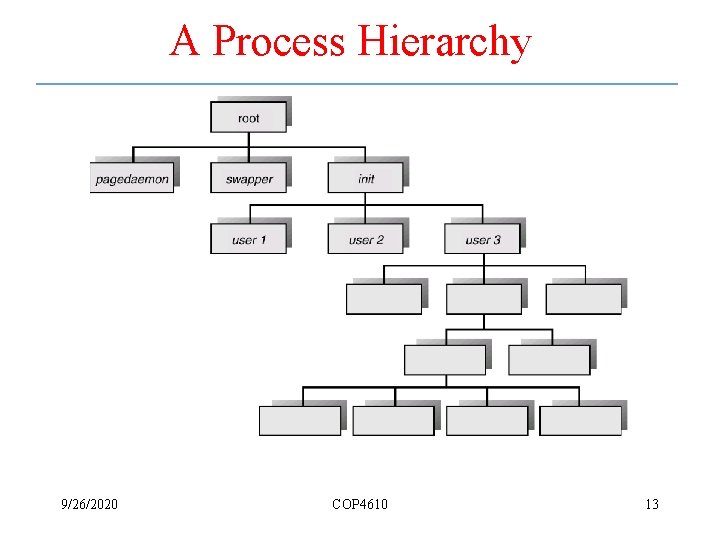
A Process Hierarchy 9/26/2020 COP 4610 13
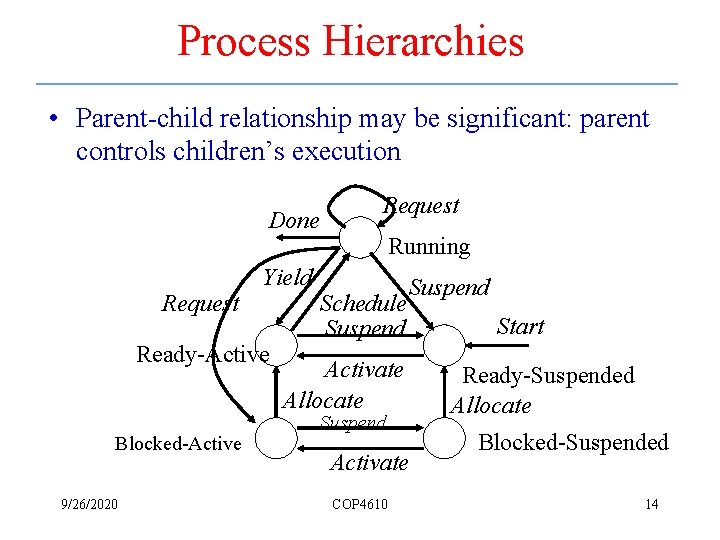
Process Hierarchies • Parent-child relationship may be significant: parent controls children’s execution Done Request Yield Ready-Active Blocked-Active 9/26/2020 Request Running Schedule Suspend Activate Allocate Suspend Activate COP 4610 Suspend Start Ready-Suspended Allocate Blocked-Suspended 14
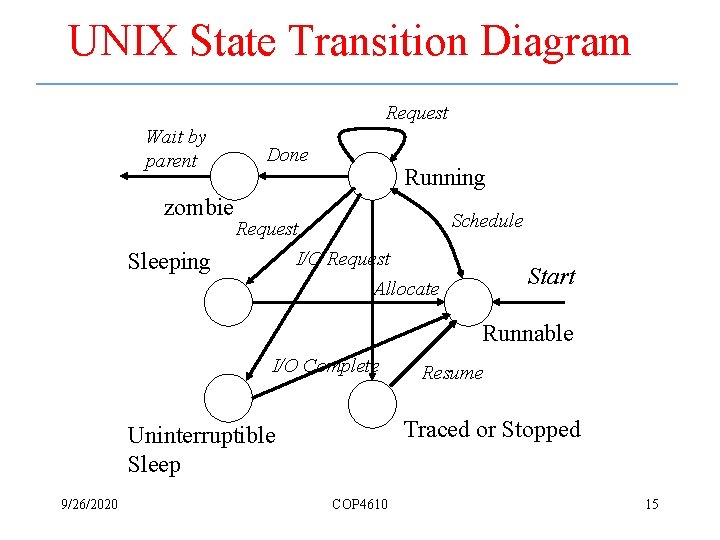
UNIX State Transition Diagram Request Wait by parent zombie Sleeping Done Running Schedule Request I/O Request Start Allocate Runnable I/O Complete Traced or Stopped Uninterruptible Sleep 9/26/2020 Resume COP 4610 15
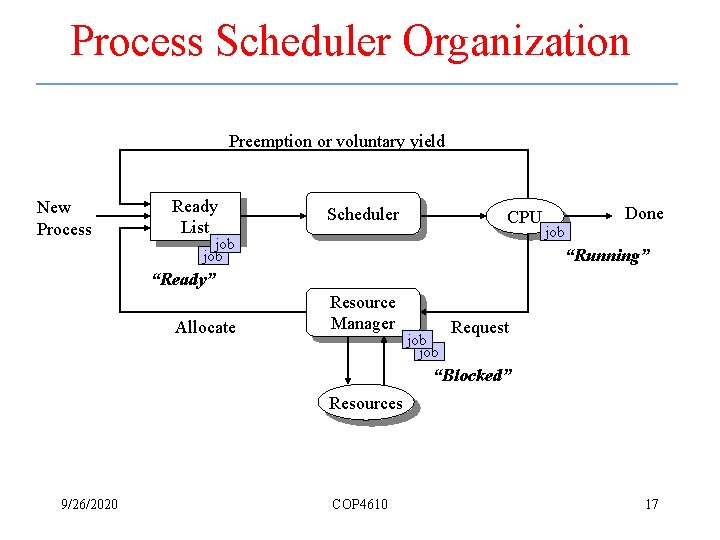
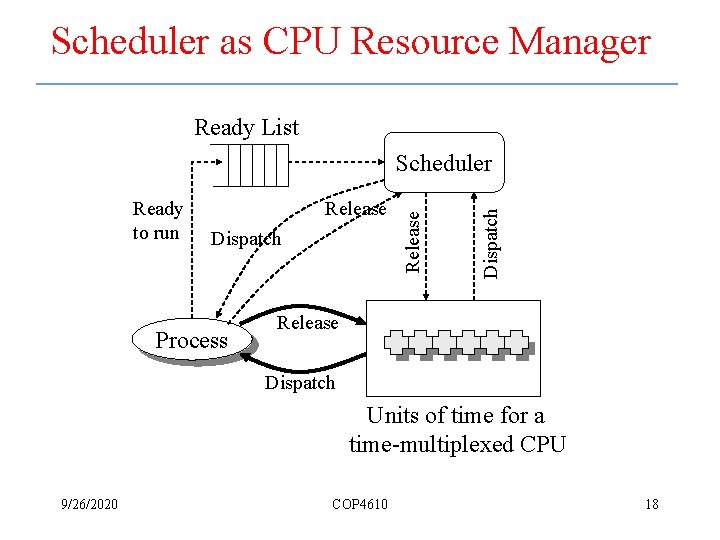
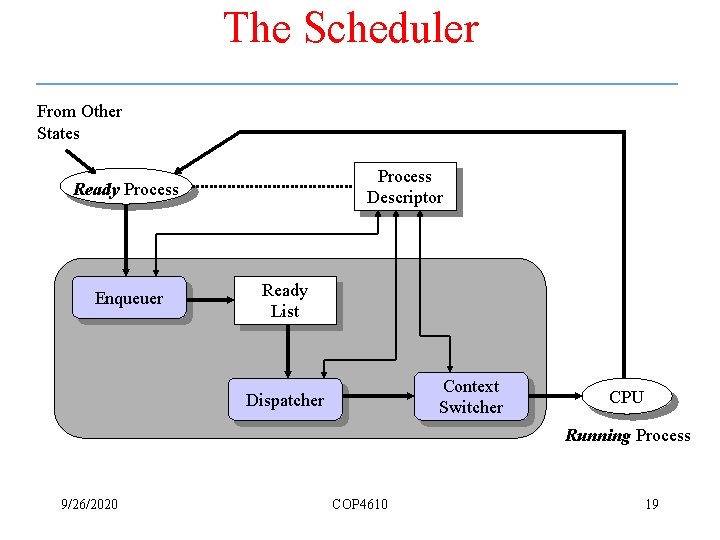
Scheduling • Scheduling mechanism is the part of the process manager that handles the removal of the running process of CPU and the selection of another process on the basis of a particular strategy – Scheduler chooses one from the ready threads to use the CPU when it is available – Scheduling policy determines when it is time for a thread to be removed from the CPU and which ready thread should be allocated the CPU next 9/26/2020 COP 4610 16
Process Scheduler Organization Preemption or voluntary yield New Process Ready List Scheduler CPU job job Done “Running” “Ready” Allocate Resource Manager job Request “Blocked” Resources 9/26/2020 COP 4610 17
Scheduler as CPU Resource Manager Ready List Release Dispatch Process Dispatch Ready to run Release Scheduler Release Dispatch Units of time for a time-multiplexed CPU 9/26/2020 COP 4610 18
The Scheduler From Other States Process Descriptor Ready Process Enqueuer Ready List Context Switcher Dispatcher CPU Running Process 9/26/2020 COP 4610 19
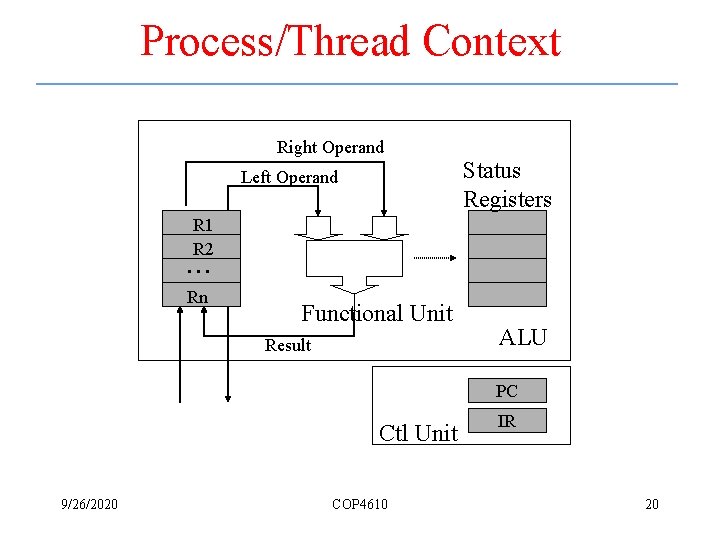
Process/Thread Context Right Operand Left Operand Status Registers R 1 R 2. . . Rn Functional Unit Result ALU PC Ctl Unit 9/26/2020 COP 4610 IR 20
Context Switching - review Old Thread Descriptor CPU New Thread Descriptor 9/26/2020 COP 4610 21
Dispatcher • Dispatcher module gives control of the CPU to the process selected by the scheduler; this involves: – switching context – switching to user mode – jumping to the proper location in the user program to restart that program 9/26/2020 COP 4610 22
Diagram of Process State 9/26/2020 COP 4610 23
CPU Scheduler • Selects from among the processes in memory that are ready to execute, and allocates the CPU to one of them. • CPU scheduling decisions may take place when a process: 1. 2. 3. 4. Switches from running to waiting state. Switches from running to ready state. Switches from waiting/new to ready. Terminates. 9/26/2020 COP 4610 24
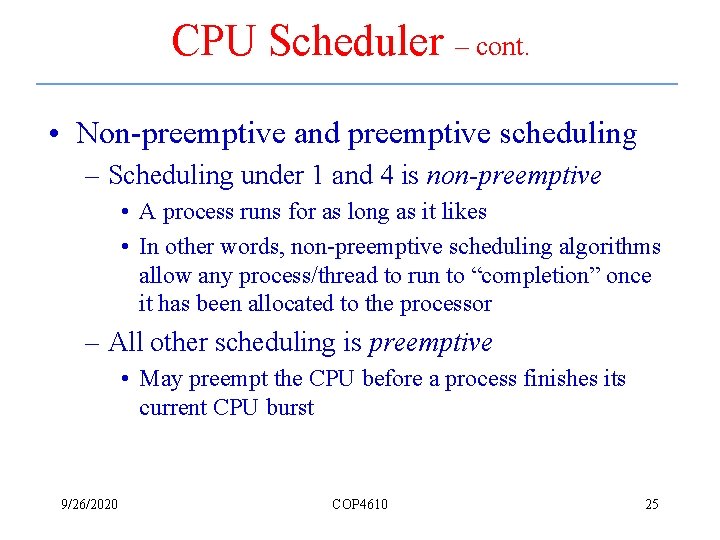
CPU Scheduler – cont. • Non-preemptive and preemptive scheduling – Scheduling under 1 and 4 is non-preemptive • A process runs for as long as it likes • In other words, non-preemptive scheduling algorithms allow any process/thread to run to “completion” once it has been allocated to the processor – All other scheduling is preemptive • May preempt the CPU before a process finishes its current CPU burst 9/26/2020 COP 4610 25
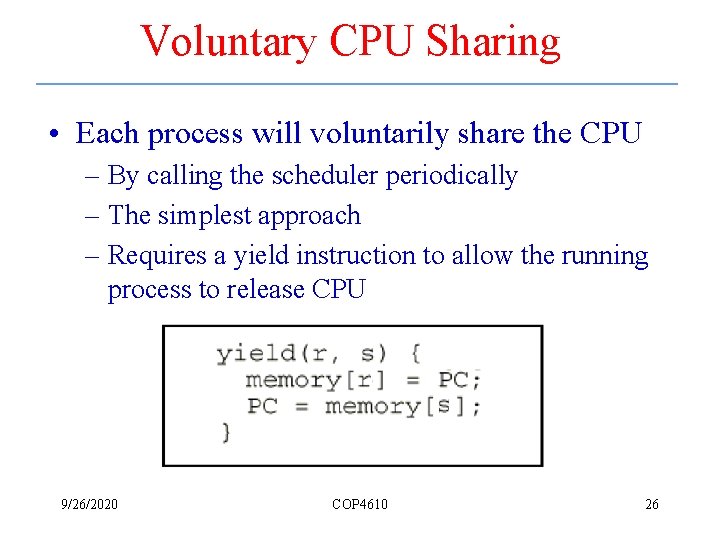
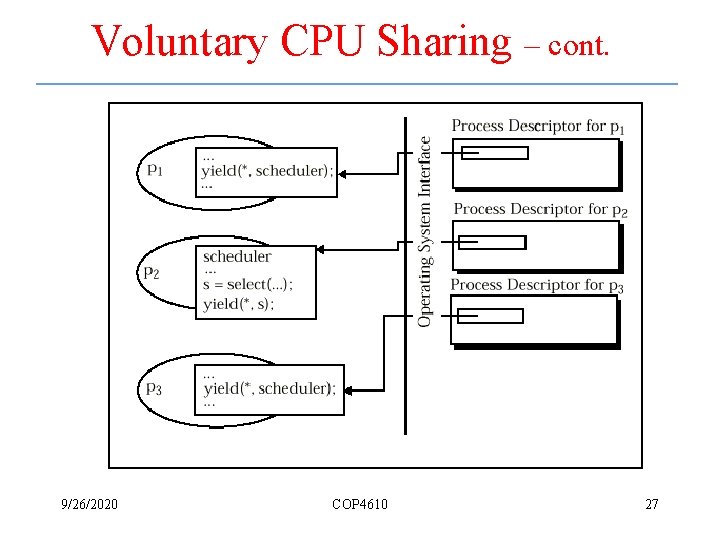
Voluntary CPU Sharing • Each process will voluntarily share the CPU – By calling the scheduler periodically – The simplest approach – Requires a yield instruction to allow the running process to release CPU 9/26/2020 COP 4610 26
Voluntary CPU Sharing – cont. 9/26/2020 COP 4610 27
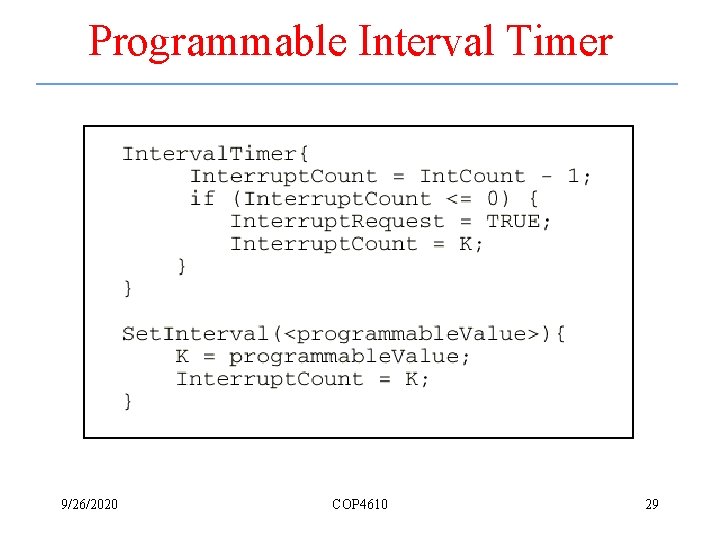
Involuntary CPU Sharing • Periodic involuntary interruption – Through an interrupt from an interval timer device • Which generates an interrupt whenever the timer expires – The scheduler will be called in the interrupt handler – A scheduler that uses involuntary CPU sharing is called a preemptive scheduler 9/26/2020 COP 4610 28
Programmable Interval Timer 9/26/2020 COP 4610 29
Strategy Selection • The scheduling criteria will depend in part on the goals of the OS and on priorities of processes, fairness, overall resource utilization, throughput, turnaround time, response time, and deadlines 9/26/2020 COP 4610 30
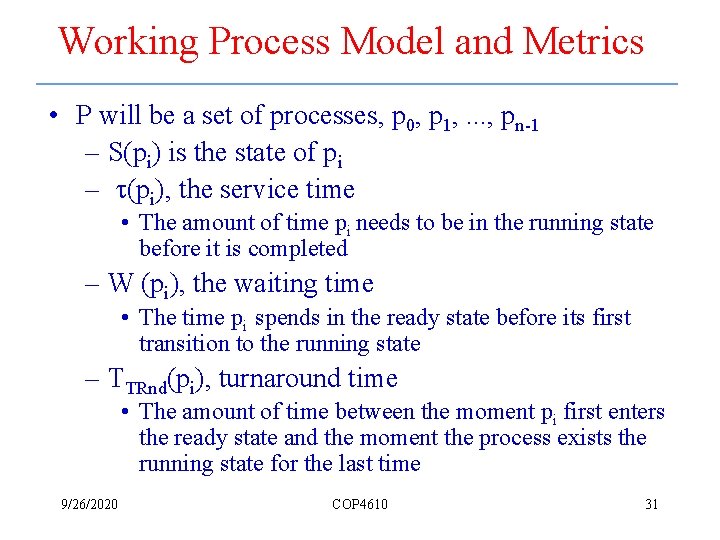
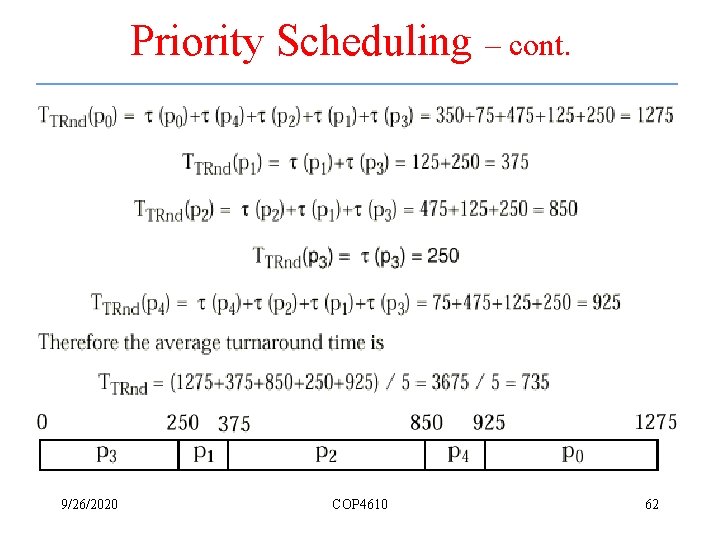
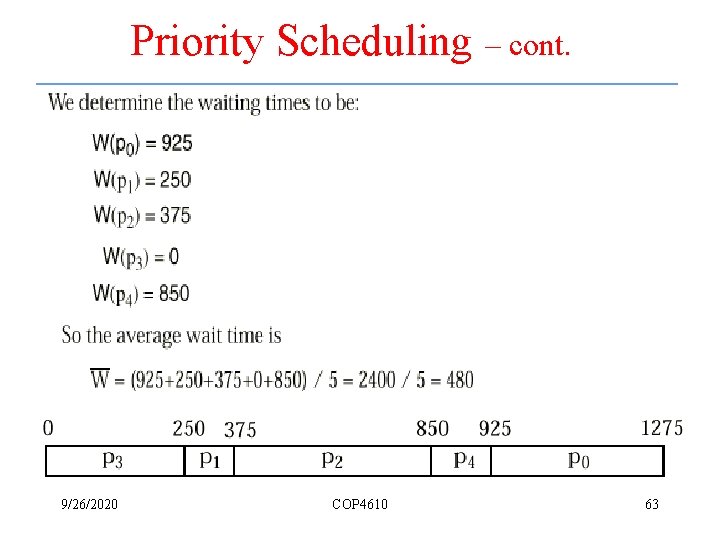
Working Process Model and Metrics • P will be a set of processes, p 0, p 1, . . . , pn-1 – S(pi) is the state of pi – t(pi), the service time • The amount of time pi needs to be in the running state before it is completed – W (pi), the waiting time • The time pi spends in the ready state before its first transition to the running state – TTRnd(pi), turnaround time • The amount of time between the moment pi first enters the ready state and the moment the process exists the running state for the last time 9/26/2020 COP 4610 31
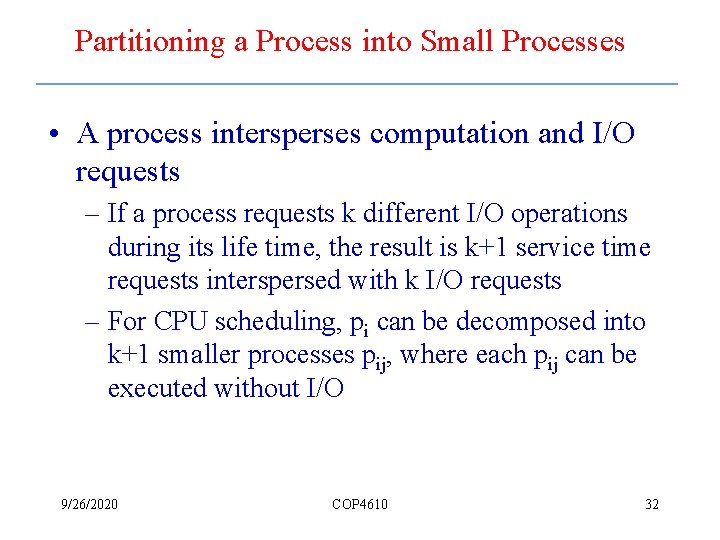
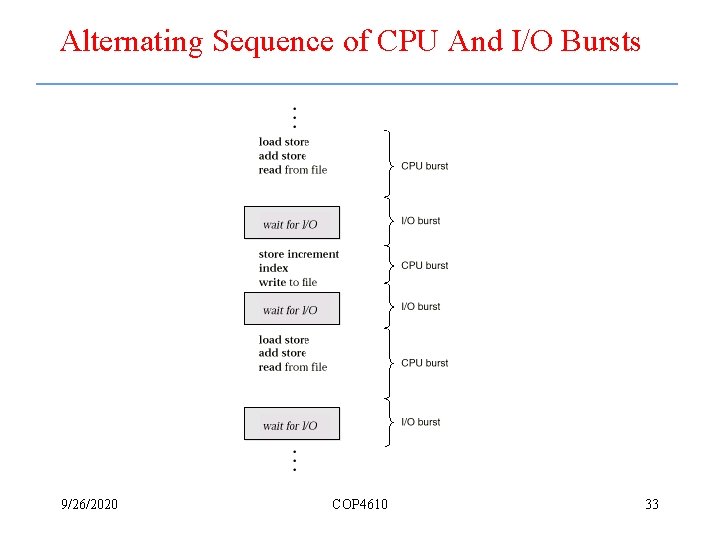
Partitioning a Process into Small Processes • A process intersperses computation and I/O requests – If a process requests k different I/O operations during its life time, the result is k+1 service time requests interspersed with k I/O requests – For CPU scheduling, pi can be decomposed into k+1 smaller processes pij, where each pij can be executed without I/O 9/26/2020 COP 4610 32
Alternating Sequence of CPU And I/O Bursts 9/26/2020 COP 4610 33
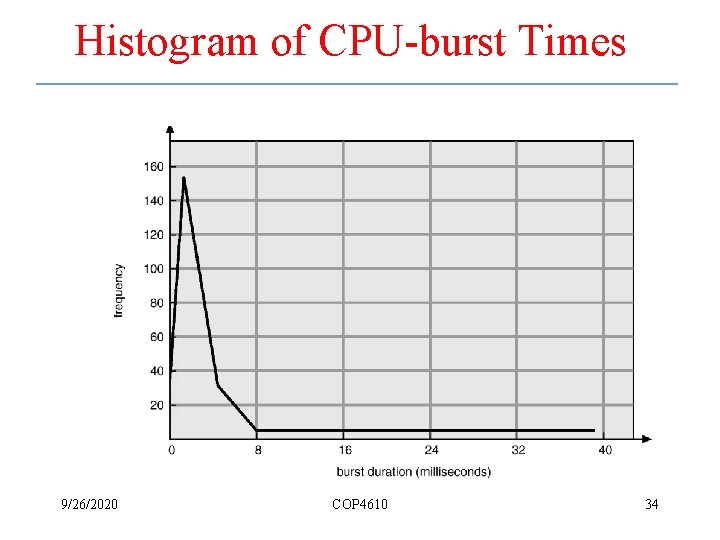
Histogram of CPU-burst Times 9/26/2020 COP 4610 34
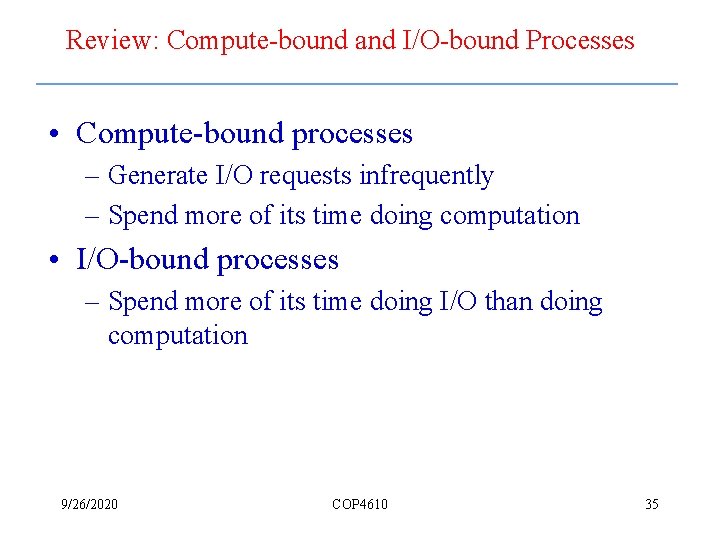
Review: Compute-bound and I/O-bound Processes • Compute-bound processes – Generate I/O requests infrequently – Spend more of its time doing computation • I/O-bound processes – Spend more of its time doing I/O than doing computation 9/26/2020 COP 4610 35
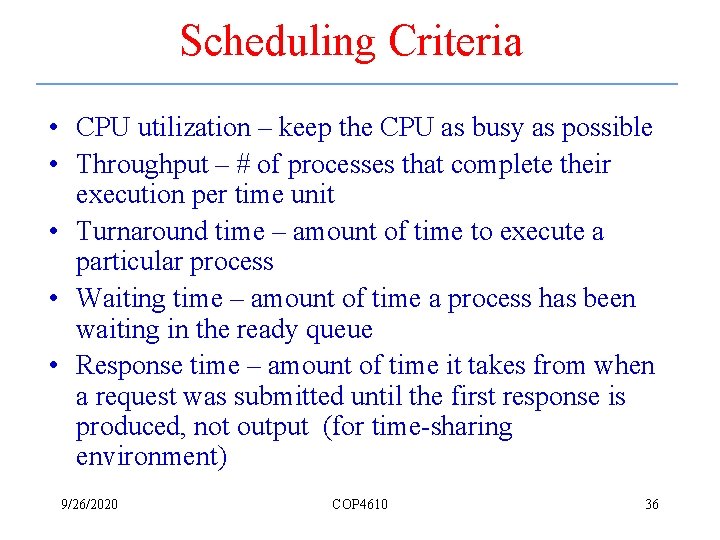
Scheduling Criteria • CPU utilization – keep the CPU as busy as possible • Throughput – # of processes that complete their execution per time unit • Turnaround time – amount of time to execute a particular process • Waiting time – amount of time a process has been waiting in the ready queue • Response time – amount of time it takes from when a request was submitted until the first response is produced, not output (for time-sharing environment) 9/26/2020 COP 4610 36
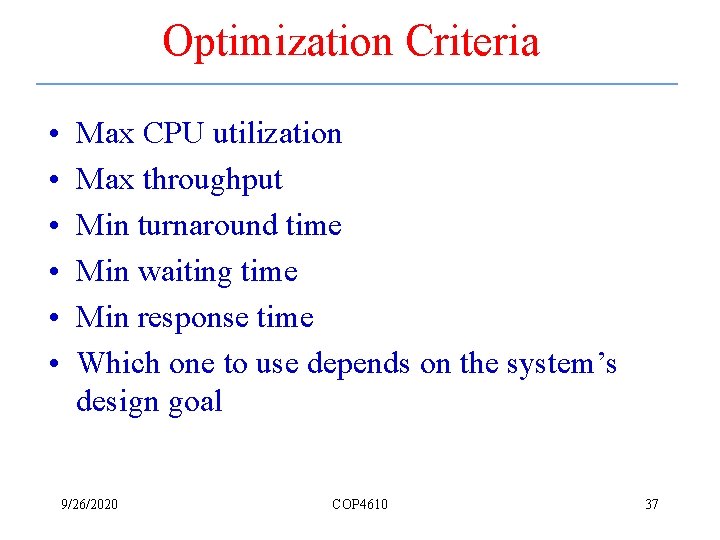
Optimization Criteria • • • Max CPU utilization Max throughput Min turnaround time Min waiting time Min response time Which one to use depends on the system’s design goal 9/26/2020 COP 4610 37
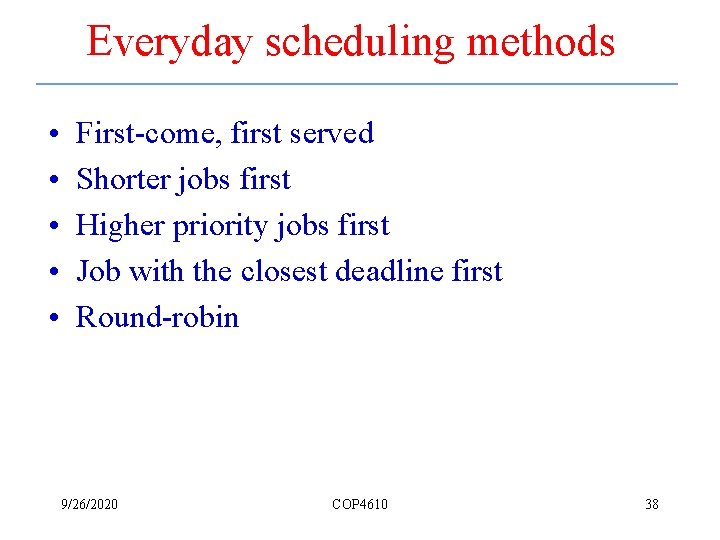
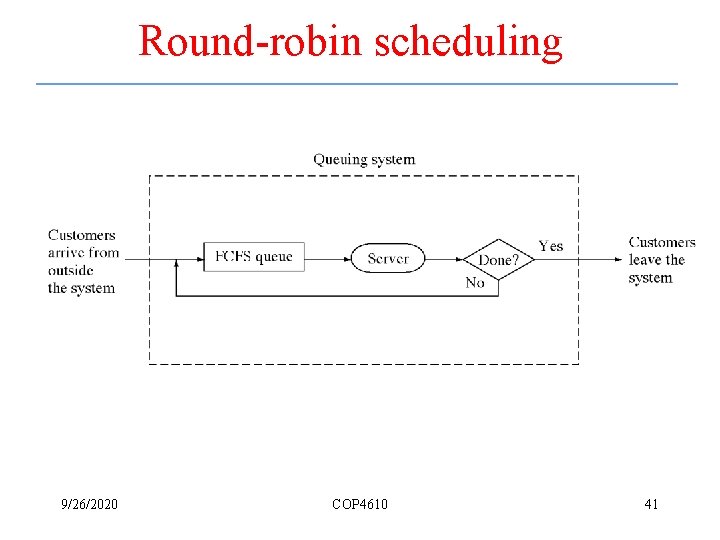
Everyday scheduling methods • • • First-come, first served Shorter jobs first Higher priority jobs first Job with the closest deadline first Round-robin 9/26/2020 COP 4610 38
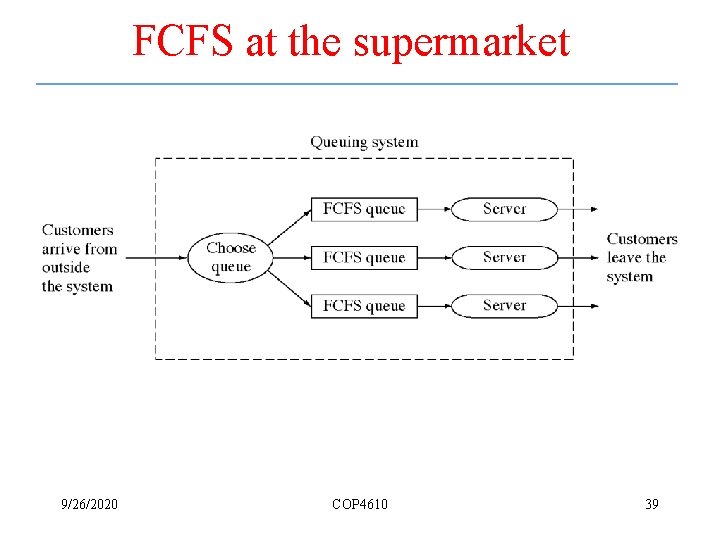
FCFS at the supermarket 9/26/2020 COP 4610 39
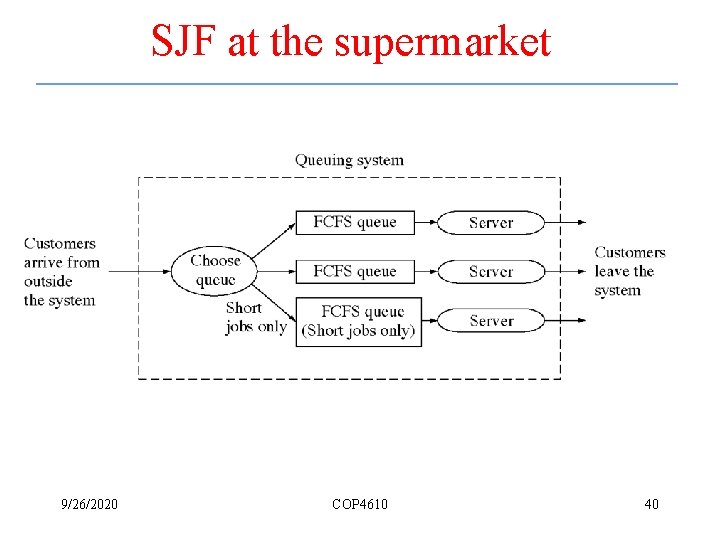
SJF at the supermarket 9/26/2020 COP 4610 40
Round-robin scheduling 9/26/2020 COP 4610 41
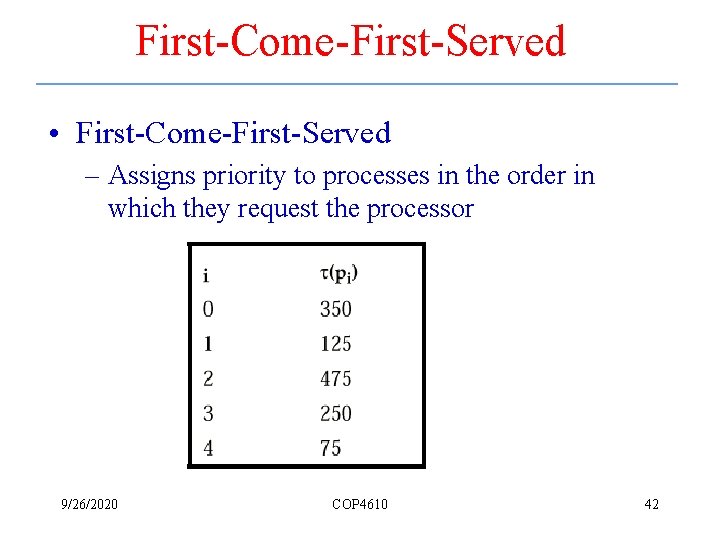
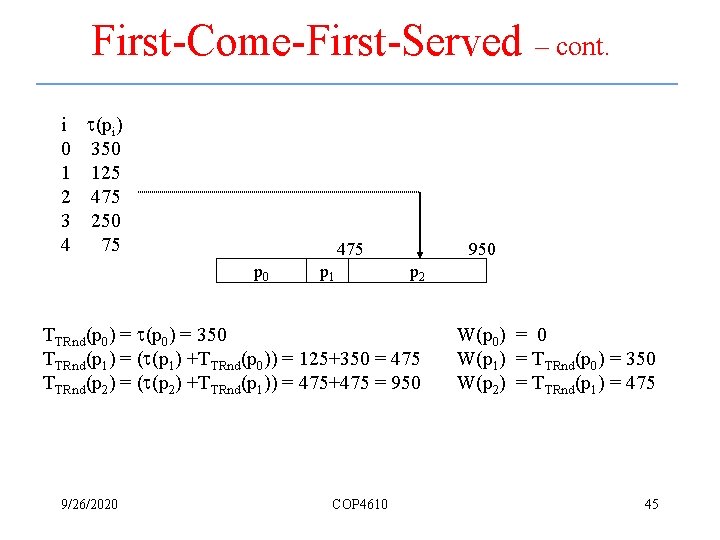
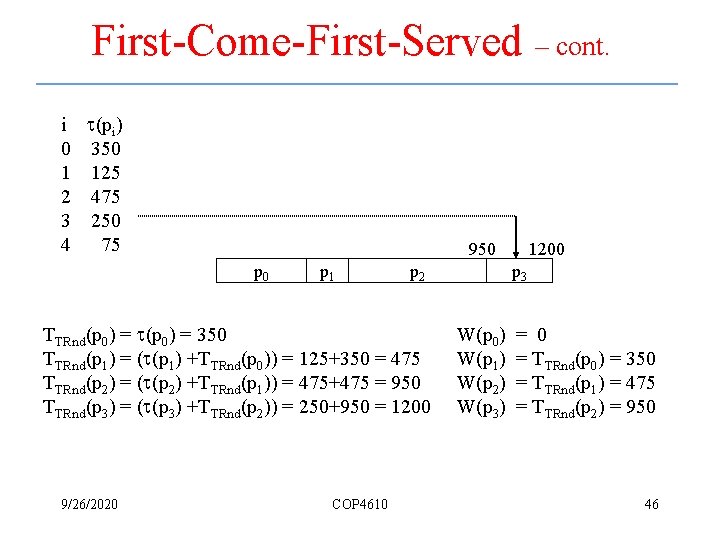
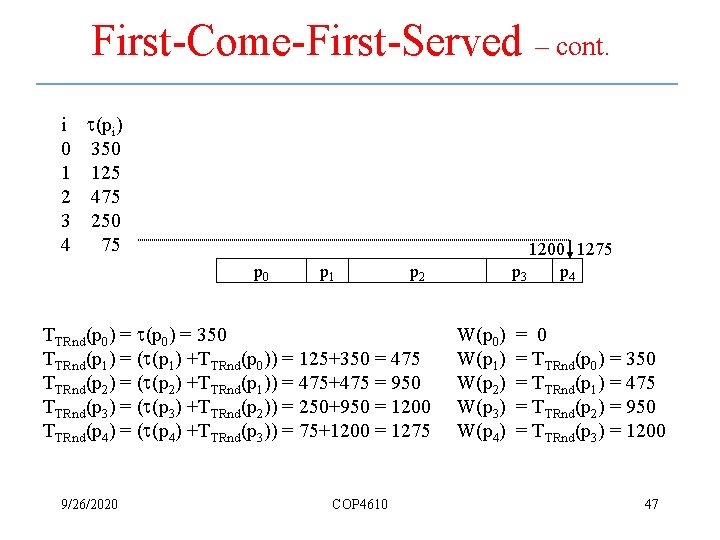
First-Come-First-Served • First-Come-First-Served – Assigns priority to processes in the order in which they request the processor 9/26/2020 COP 4610 42
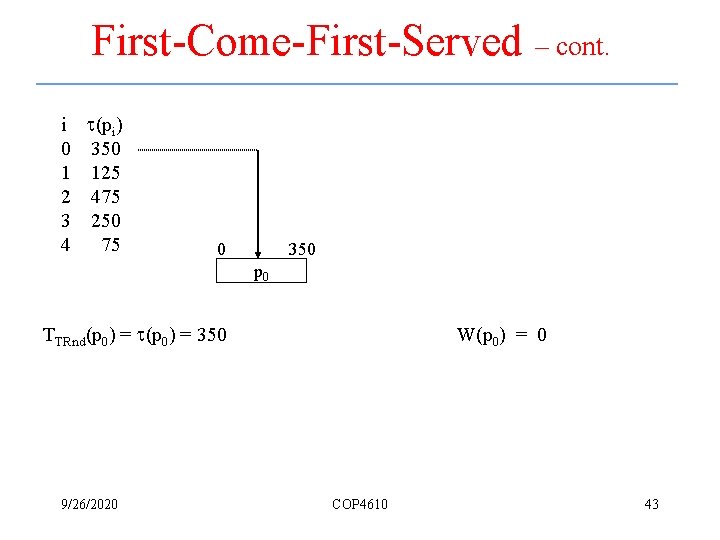
First-Come-First-Served – cont. i t(pi) 0 350 1 125 2 475 3 250 4 75 0 350 p 0 TTRnd(p 0) = t(p 0) = 350 9/26/2020 W(p 0) = 0 COP 4610 43
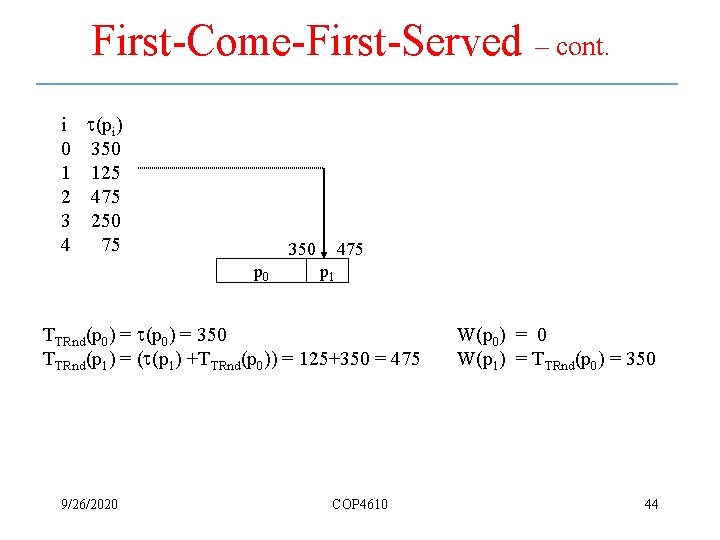
First-Come-First-Served – cont. i t(pi) 0 350 1 125 2 475 3 250 4 75 350 p 0 475 p 1 TTRnd(p 0) = t(p 0) = 350 TTRnd(p 1) = (t(p 1) +TTRnd(p 0)) = 125+350 = 475 9/26/2020 COP 4610 W(p 0) = 0 W(p 1) = TTRnd(p 0) = 350 44
First-Come-First-Served – cont. i t(pi) 0 350 1 125 2 475 3 250 4 75 475 p 0 p 1 950 p 2 TTRnd(p 0) = t(p 0) = 350 TTRnd(p 1) = (t(p 1) +TTRnd(p 0)) = 125+350 = 475 TTRnd(p 2) = (t(p 2) +TTRnd(p 1)) = 475+475 = 950 9/26/2020 COP 4610 W(p 0) = 0 W(p 1) = TTRnd(p 0) = 350 W(p 2) = TTRnd(p 1) = 475 45
First-Come-First-Served – cont. i t(pi) 0 350 1 125 2 475 3 250 4 75 950 p 1 p 2 TTRnd(p 0) = t(p 0) = 350 TTRnd(p 1) = (t(p 1) +TTRnd(p 0)) = 125+350 = 475 TTRnd(p 2) = (t(p 2) +TTRnd(p 1)) = 475+475 = 950 TTRnd(p 3) = (t(p 3) +TTRnd(p 2)) = 250+950 = 1200 9/26/2020 COP 4610 1200 p 3 W(p 0) W(p 1) W(p 2) W(p 3) = 0 = TTRnd(p 0) = 350 = TTRnd(p 1) = 475 = TTRnd(p 2) = 950 46
First-Come-First-Served – cont. i t(pi) 0 350 1 125 2 475 3 250 4 75 p 0 p 1 p 2 TTRnd(p 0) = t(p 0) = 350 TTRnd(p 1) = (t(p 1) +TTRnd(p 0)) = 125+350 = 475 TTRnd(p 2) = (t(p 2) +TTRnd(p 1)) = 475+475 = 950 TTRnd(p 3) = (t(p 3) +TTRnd(p 2)) = 250+950 = 1200 TTRnd(p 4) = (t(p 4) +TTRnd(p 3)) = 75+1200 = 1275 9/26/2020 COP 4610 1200 1275 p 3 p 4 W(p 0) W(p 1) W(p 2) W(p 3) W(p 4) = 0 = TTRnd(p 0) = 350 = TTRnd(p 1) = 475 = TTRnd(p 2) = 950 = TTRnd(p 3) = 1200 47
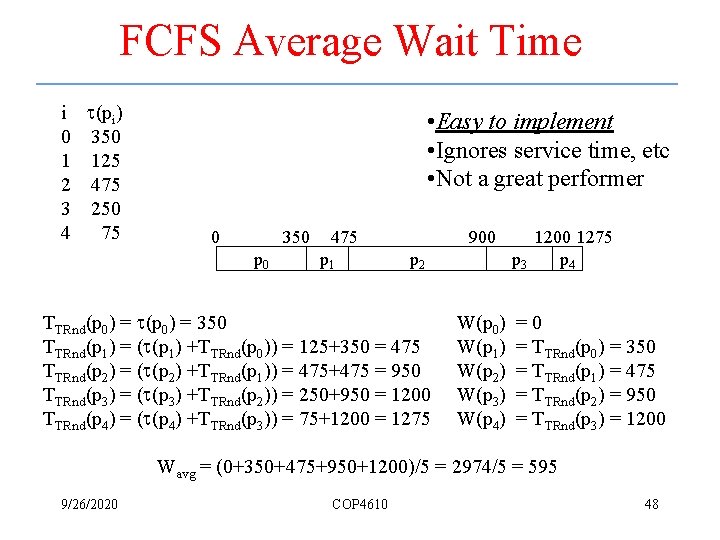
FCFS Average Wait Time i t(pi) 0 350 1 125 2 475 3 250 4 75 • Easy to implement • Ignores service time, etc • Not a great performer 0 350 p 0 475 p 1 900 p 2 TTRnd(p 0) = t(p 0) = 350 TTRnd(p 1) = (t(p 1) +TTRnd(p 0)) = 125+350 = 475 TTRnd(p 2) = (t(p 2) +TTRnd(p 1)) = 475+475 = 950 TTRnd(p 3) = (t(p 3) +TTRnd(p 2)) = 250+950 = 1200 TTRnd(p 4) = (t(p 4) +TTRnd(p 3)) = 75+1200 = 1275 W(p 0) W(p 1) W(p 2) W(p 3) W(p 4) 1200 1275 p 3 p 4 =0 = TTRnd(p 0) = 350 = TTRnd(p 1) = 475 = TTRnd(p 2) = 950 = TTRnd(p 3) = 1200 Wavg = (0+350+475+950+1200)/5 = 2974/5 = 595 9/26/2020 COP 4610 48
Predicting Wait Time in FCFS • In FCFS, when a process arrives, all in ready list will be processed before this job • Let m be the service rate • Let L be the ready list length • Wavg(p) = L*1/m + 0. 5* 1/m = L/m+1/(2 m) • Compare predicted wait with actual in earlier examples 9/26/2020 COP 4610 49
Shortest-Job-Next Scheduling • Associate with each process the length of its next CPU burst. – Use these lengths to schedule the process with the shortest time. • SJN is optimal – gives minimum average waiting time for a given set of processes. 9/26/2020 COP 4610 50
Shortest-Job-Next Scheduling – cont. • Two schemes: – non-preemptive – once CPU given to the process it cannot be preempted until completes its CPU burst. – Preemptive – if a new process arrives with CPU burst length less than remaining time of current executing process, preempt. This scheme is know as the Shortest-Remaining-Time-Next (SRTN). 9/26/2020 COP 4610 51
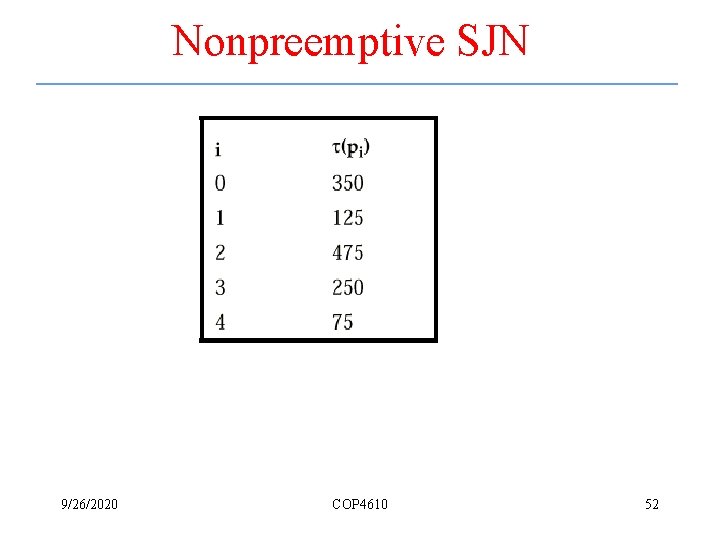
Nonpreemptive SJN 9/26/2020 COP 4610 52
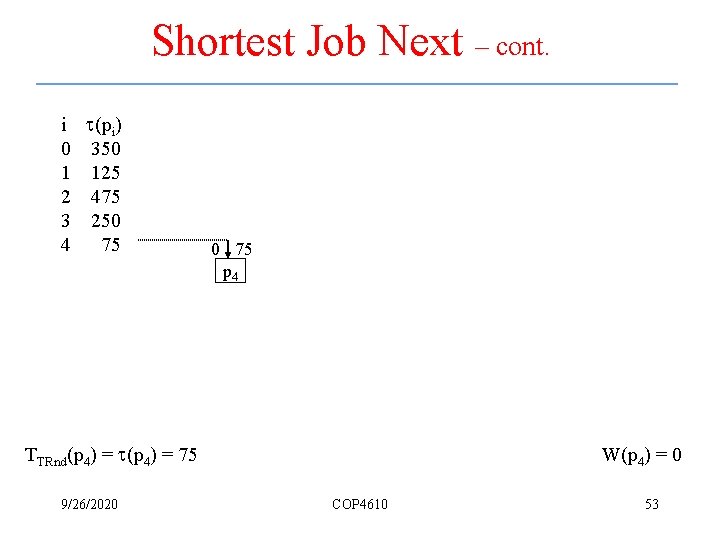
Shortest Job Next – cont. i t(pi) 0 350 1 125 2 475 3 250 4 75 0 75 p 4 TTRnd(p 4) = t(p 4) = 75 9/26/2020 W(p 4) = 0 COP 4610 53
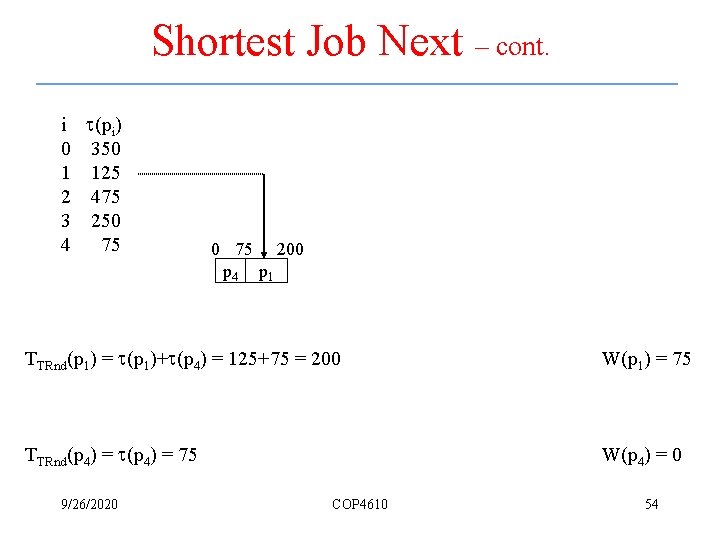
Shortest Job Next – cont. i t(pi) 0 350 1 125 2 475 3 250 4 75 0 75 200 p 4 p 1 TTRnd(p 1) = t(p 1)+t(p 4) = 125+75 = 200 W(p 1) = 75 TTRnd(p 4) = t(p 4) = 75 W(p 4) = 0 9/26/2020 COP 4610 54
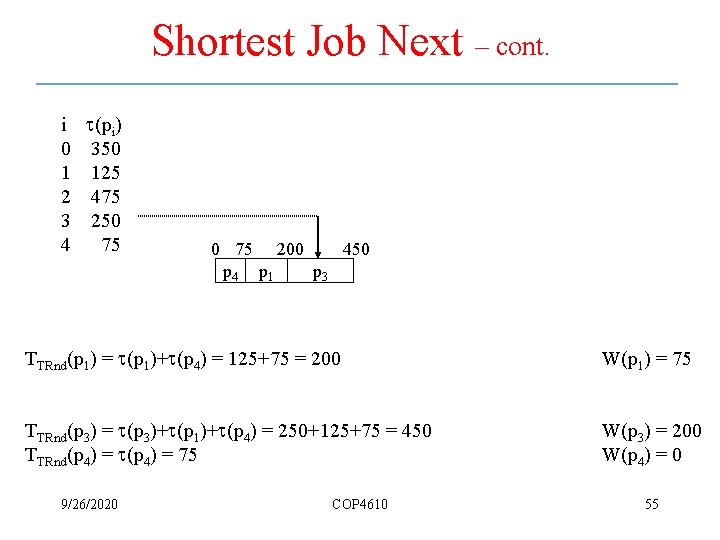
Shortest Job Next – cont. i t(pi) 0 350 1 125 2 475 3 250 4 75 0 75 200 450 p 4 p 1 p 3 TTRnd(p 1) = t(p 1)+t(p 4) = 125+75 = 200 W(p 1) = 75 TTRnd(p 3) = t(p 3)+t(p 1)+t(p 4) = 250+125+75 = 450 TTRnd(p 4) = t(p 4) = 75 W(p 3) = 200 W(p 4) = 0 9/26/2020 COP 4610 55
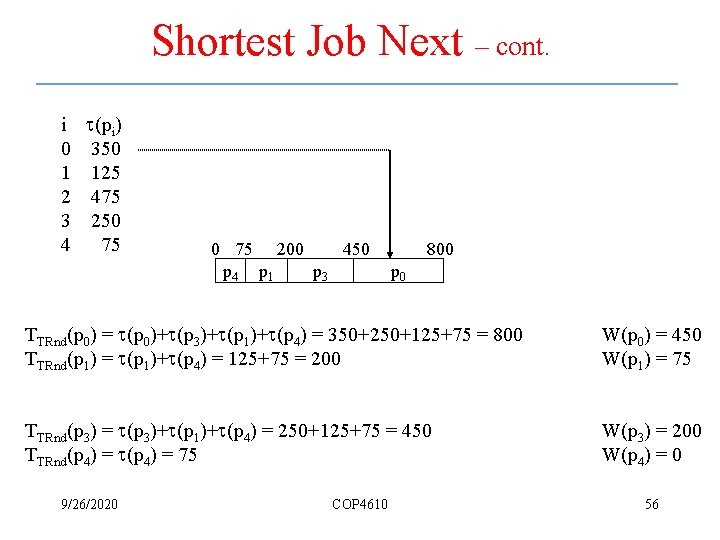
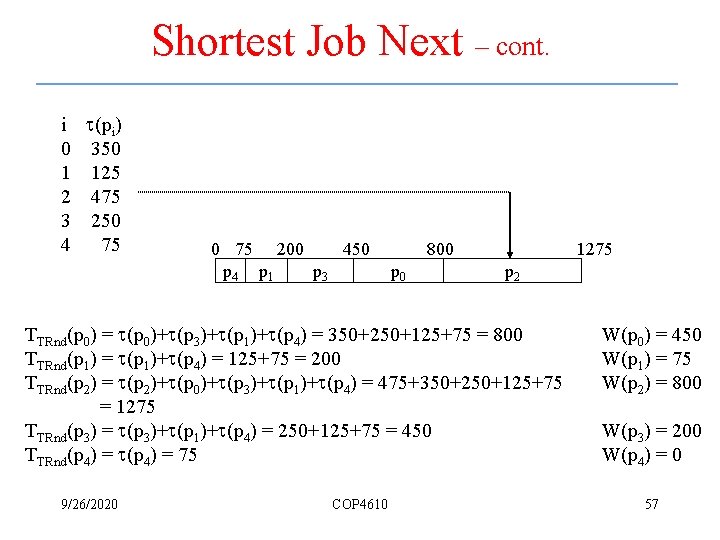
Shortest Job Next – cont. i t(pi) 0 350 1 125 2 475 3 250 4 75 0 75 200 450 p 4 p 1 p 3 800 p 0 TTRnd(p 0) = t(p 0)+t(p 3)+t(p 1)+t(p 4) = 350+250+125+75 = 800 TTRnd(p 1) = t(p 1)+t(p 4) = 125+75 = 200 W(p 0) = 450 W(p 1) = 75 TTRnd(p 3) = t(p 3)+t(p 1)+t(p 4) = 250+125+75 = 450 TTRnd(p 4) = t(p 4) = 75 W(p 3) = 200 W(p 4) = 0 9/26/2020 COP 4610 56
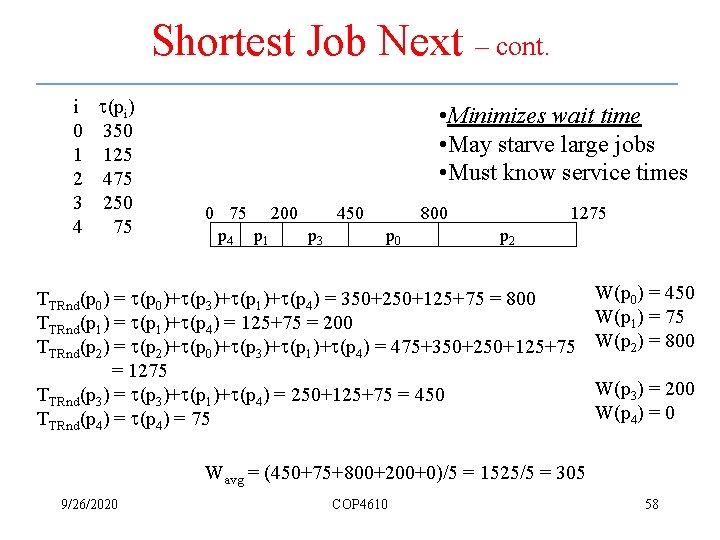
Shortest Job Next – cont. i t(pi) 0 350 1 125 2 475 3 250 4 75 0 75 200 450 p 4 p 1 p 3 800 p 0 1275 p 2 TTRnd(p 0) = t(p 0)+t(p 3)+t(p 1)+t(p 4) = 350+250+125+75 = 800 TTRnd(p 1) = t(p 1)+t(p 4) = 125+75 = 200 TTRnd(p 2) = t(p 2)+t(p 0)+t(p 3)+t(p 1)+t(p 4) = 475+350+250+125+75 = 1275 TTRnd(p 3) = t(p 3)+t(p 1)+t(p 4) = 250+125+75 = 450 TTRnd(p 4) = t(p 4) = 75 9/26/2020 COP 4610 W(p 0) = 450 W(p 1) = 75 W(p 2) = 800 W(p 3) = 200 W(p 4) = 0 57
Shortest Job Next – cont. i t(pi) 0 350 1 125 2 475 3 250 4 75 • Minimizes wait time • May starve large jobs • Must know service times 0 75 200 450 p 4 p 1 p 3 800 p 0 1275 p 2 TTRnd(p 0) = t(p 0)+t(p 3)+t(p 1)+t(p 4) = 350+250+125+75 = 800 TTRnd(p 1) = t(p 1)+t(p 4) = 125+75 = 200 TTRnd(p 2) = t(p 2)+t(p 0)+t(p 3)+t(p 1)+t(p 4) = 475+350+250+125+75 = 1275 TTRnd(p 3) = t(p 3)+t(p 1)+t(p 4) = 250+125+75 = 450 TTRnd(p 4) = t(p 4) = 75 W(p 0) = 450 W(p 1) = 75 W(p 2) = 800 W(p 3) = 200 W(p 4) = 0 Wavg = (450+75+800+200+0)/5 = 1525/5 = 305 9/26/2020 COP 4610 58
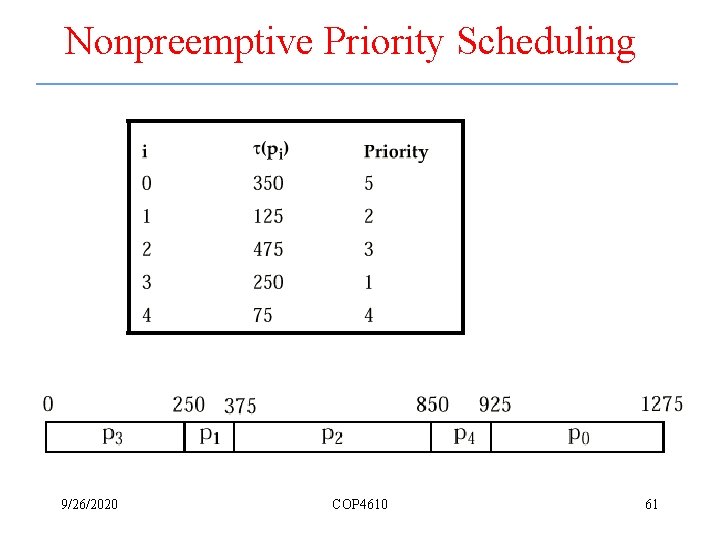
Priority Scheduling • In priority scheduling, processes/threads are allocated to the CPU based on the basis of an externally assigned priority – A commonly used convention is that lower numbers have higher priority – Static priorities vs. dynamic priorities • Static priorities are computed once at the beginning and are not changed • Dynamic priorities allow the threads to become more or less important depending on how much service it has recently received 9/26/2020 COP 4610 59
Priority Scheduling – cont. • There are non-preemptive and preemptive priority scheduling algorithms – Preemptive – nonpreemptive • SJN is a priority scheduling where priority is the predicted next CPU burst time. • FCFS is a priority scheduling where priority is the arrival time 9/26/2020 COP 4610 60
Nonpreemptive Priority Scheduling 9/26/2020 COP 4610 61
Priority Scheduling – cont. 9/26/2020 COP 4610 62
Priority Scheduling – cont. 9/26/2020 COP 4610 63
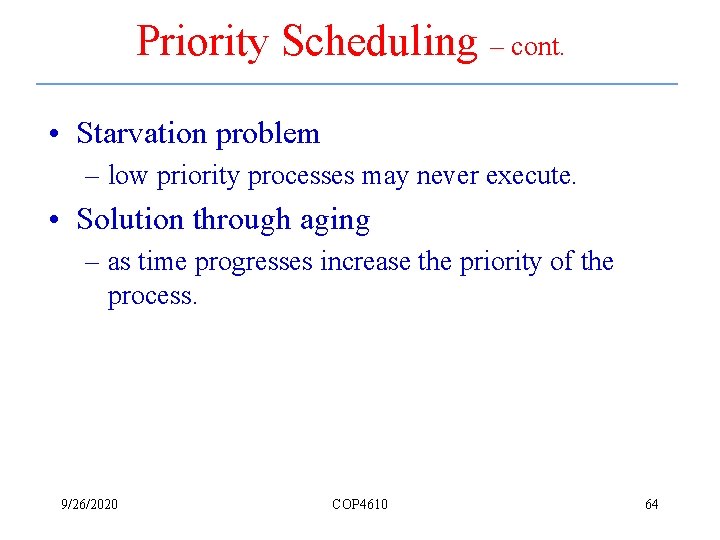
Priority Scheduling – cont. • Starvation problem – low priority processes may never execute. • Solution through aging – as time progresses increase the priority of the process. 9/26/2020 COP 4610 64
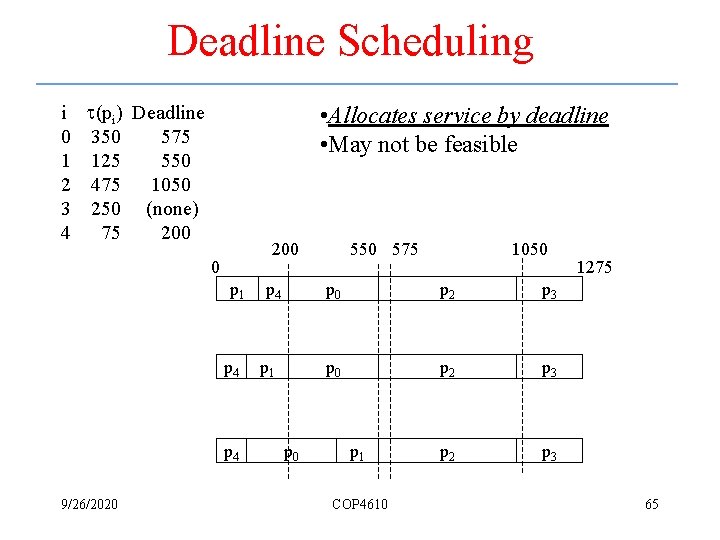
Deadline Scheduling i t(pi) Deadline 0 350 575 1 125 550 2 475 1050 3 250 (none) 4 75 200 • Allocates service by deadline • May not be feasible 200 0 p 1 p 4 9/26/2020 p 4 p 1 p 0 550 575 1050 p 2 p 3 p 1 COP 4610 1275 65
Summary • Processes/threads scheduler organization • Non-preemptive scheduling algorithms – FCFS – SJN – Priority – Deadline 9/26/2020 COP 4610 66