
Outline 1 Properties of Planar Graphs 2232021 Ch




- Slides: 30
Outline 1 Properties of Planar Graphs 2/23/2021 Ch 9 -1
1 Properties of Planar Graphs Definition: A graph that can be drawn in the plane without any of its edges intersecting is called a planar graph. A graph that is so drawn in the plane is also said to be embedded (or imbedded) in the plane. Applications: (1) circuit layout problems (2) Three house and three utilities problem 2/23/2021
Definition: A planar graph G that is drawn in the plane so that no two edges intersect (that is, G is embedded in the plane) is called a plane graph. Fig 1 (a) planar, not a 2/23/2021 plane graph (b) a plane graph (c) another plane graph Ch 9 -3
Note. A given planar graph can give rise to several different plane graph. Definition: Let G be a plane graph. The connected pieces of the plane that remain when the vertices and edges of G are removed are called the regions of G. Fig 2 G 1 R 3: exterior R 1 R 2 G 1 has 3 regions. 2/23/2021 Ch 9 -4
Definition: Every plane graph has exactly one unbounded region, called the exterior region. The vertices and edges of G that are incident with a region R form a subgraph of G called the boundary of R. Fig 2 G 2 has only 1 region. 2/23/2021 Ch 9 -5
Fig 2 Boundary of R 1: v 1 G 3 v 1 v 2 v 3 R 1 v 3 v 5 v 4 v 6 v 8 v 2 v 1 v 7 R 2 R 3 R 4 R 5 Boundary of R 5: v 3 v 5 v 9 v 2 v 4 v 6 v 7 G 3 has 5 regions. 2/23/2021 v 9 Ch 9 -6
Observe: (1) Each cycle edge belongs to the boundary of two regions. (2) Each bridge is on the boundary of only one region. (exterior) 2/23/2021 Ch 9 -7
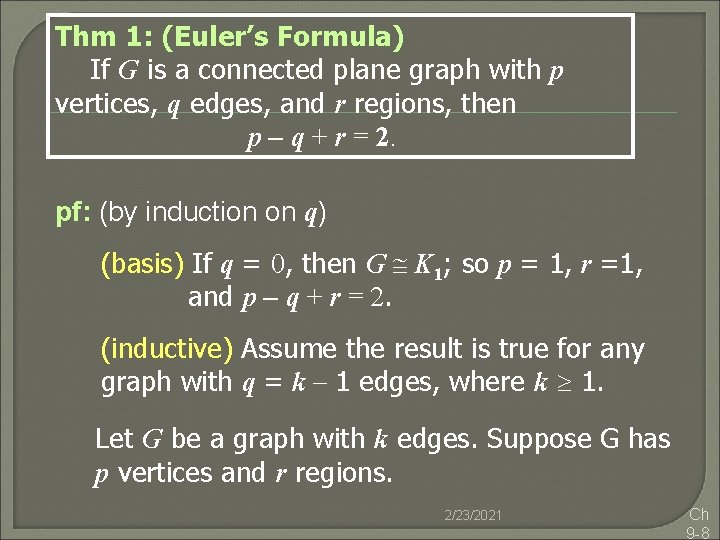
Thm 1: (Euler’s Formula) If G is a connected plane graph with p vertices, q edges, and r regions, then p - q + r = 2. pf: (by induction on q) (basis) If q = 0, then G K 1; so p = 1, r =1, and p - q + r = 2. 2 (inductive) Assume the result is true for any graph with q = k - 1 edges, where k 1. Let G be a graph with k edges. Suppose G has p vertices and r regions. 2/23/2021 Ch 9 -8
If G is a tree, then G has p vertices, p-1 edges and 1 region. p - q + r = p – (p-1) + 1 = 2. 2 If G is not a tree, then some edge e of G is on a cycle. Hence G-e is a connected plane graph having order p and size k-1, and r-1 regions. p - (k-1) + (r-1) = 2 (by assumption) p-k+r=2 # 2/23/2021 Ch 9 -9
Theorem : Euler’s Formula If G is a connected planar graph, then any plane graph depiction of G has r = e - v + 2 regions. • Recall: Connected planar graphs have paths between each pair of vertices. • v = number of vertices • e = number of edges • r = number of regions This is important because there are many different plane graph depictions that can be drawn for a planar graph, however, the number of regions will not change. 2/23/2021 Ch 9 -
Proof of Euler’s Formula Let’s draw a plane graph depiction of G, edge by edge. Let denote the connected plane graph after n edges have been added. Let denote the number of vertices in Let denote the number of edges in Let denote the number of regions in 2/23/2021 Ch 9 -
Proof of Euler’s Formula (cont’d) Let’s start by drawing Euler’s formula is valid for r=e-v+2 1=1 -2+2 We obtain 2/23/2021 , since by adding an edge at one of from the vertices of.
Proof of Euler’s Formula (cont’d) In general, we can obtain from by adding an edge to one of the vertices of. The new edge might link two vertices already in. Or, the new edge might add another vertex to. We will use the method of induction to complete the proof: We have shown that theorem is true for. Next, let’s assume that it is true for any n>1, and prove it is true for. Let (x, y) be the edge that is added to There are two cases to consider. 2/23/2021 to get .
Proof of Euler’s Formula (cont’d) In the first case, x and y are both in. Then they are on the boundary of a common region K , possibly an unbounded region. y Edge (x, y) splits K into two regions. Then, K Each side of Euler’s formula grows by one. So, if the formula was true for , it will also bextrue for. 2/23/2021
Proof of Euler’s Formula (cont’d) In the second case, one of the vertices x, y is not in that it is x. . Let’s say Then, adding (x, y) implies that x is also added, but that no new regions are formed (no existing regions are split). y x K So, the value on each side of Euler’s equation is unchanged. The validity of Euler’s formula for implies its validity for. By induction, Euler’s formula is true for all ’s and the full graph G. 2/23/2021
Example of Euler’s Formula How many regions would there be in a plane graph with 10 vertices each of degree 3? 2/23/2021 Ch 9 -
Corollary If G is a connected planar graph with e > 1, then e ≤ 3 v – 6 Proof: • Define the degree of a region as the number of edges on its boundary. If an edge occurs twice along the boundary, then count it twice. The region K has degree 12. K 2/23/2021
Proof of Corollary continued Note that no region can be less than degree 3. • A region of degree 2 would be bounded by two edges joining the same pair of vertices (parallel edges) • A region of degree 1 would be bounded by a loop edge. Neither of these is allowed, and so a region must have at least degree 3. 2/23/2021
Proof of Corollary continued 2/23/2021 Ch 9 -
Fig 4 Two embeddings of a planar graph (a) (b) 2/23/2021 Ch 9 -
Definition: A plane graph G is called maximal planar if, for every pair u, v of nonadjacent vertices of G, the graph G+uv is nonplanar. Thus, in any embedding of a maximal planar graph G of order at least 3, the boundary of every region of G is a triangle. 2/23/2021 Ch 9 -
Thm 2: If G is a maximal planar graph with p 3 vertices and q edges, then q = 3 p - 6. pf: Embed the graph G in the plane, resulting in r regions. p - q + r = 2. Since the boundary of every region of G is a triangle, every edge lies on the boundary of two regions. p - q + 2 q / 3 = 2. q = 3 p - 6 2/23/2021 Ch 9 -22
Cor. 2(a): If G is a maximal planar bipartite graph with p 3 vertices and q edges, then q = 2 p - 4. pf: The boundary of every region is a 4 -cycle. 4 r = 2 q p - q + q / 2 = 2 q = 2 p - 4. Cor. 2(b): If G is a planar graph with p 3 vertices and q edges, then q 3 p - 6. pf: If G is not maximal planar, we can add edges to G to produce a maximal planar graph. By Thm. 9. 2 得證. 2/23/2021 Ch 9 -23
Thm 3: Every planar graph contains a vertex of degree 5 or less. pf: Let G be a planar graph of p vertices and q edges If deg(v) 6 for every v V(G) 2 q 6 p 2/23/2021 Ch 9 -24
Fig 5 Two important nonplanar graph K 5 K 3, 3 2/23/2021 Ch 9 -
Thm 4: The graphs K 5 and K 3, 3 are nonplanar. pf: (1) K 5 has p = 5 vertices and q = 10 edges q > 3 p - 6 K 5 is nonplanar. (2) Suppose K 3, 3 is planar, and consider any embedding of K 3, 3 in the plane. Suppose the embedding has r regions. p-q+r=2 r=5 K 3, 3 is bipartite The boundary of every region has 4 edges. 2/23/2021 Ch 9 -26
Definition: A subdivision of a graph G is a graph obtained by inserting vertices (of degree 2) into the edges of G. 2/23/2021 Ch 9 -
Fig 6 Subdivisions of graphs. H G H is a subdivision of G. F F is not a subdivision of G. 2/23/2021 -
Thm 5: (Kuratowski’s Theorem) A graph is planar if and only if it contains no subgraph that is isomorphic to or is a subdivision of K 5 or K 3, 3. Fig 7 The Petersen graph is nonplanar. 1 4 5 7 3 8 (a) Petersen 2 3 4 5 6 6 10 2 1 9 (b) Subdivision of K 3, 3 2/23/2021
2/23/2021 Ch 9 -