
Outline 1 2 3 4 5 6 Manufacturing
- Slides: 37
Outline : 1. 2. 3. 4. 5. 6. Manufacturing Engineering Definition Categories of Manufacturers Manufacturing System Cycle Categories of Manufacturing System Manufacturing Process Responsibility of a Manufacturing Engineer
Manufacturing Engineering Definition: Manufacturing: The making of products from raw materials using various processes, operations and detailed plan. manpower equipment, according to a
Manufacturing Engineering: “Designing the production process for a product” Includes such function: ü ü ü Evaluating Manufacturing Process Selecting Processes Designing work holding devices Estimating the cost of manufacturing the part Assuring the quality of the part produced
Manufacturing Engineering Categories of manufacturing industries: 1. Primary Industry 2. Secondary Industry 3. Tertiary Industry
1. Primary Industries Manufacturing Engineering The basic producers take the natural resources and transform these into the raw materials used by other industrial manufacturing firms. ØExample: Latex to Rubber to Tire Logs into Wooden Blocks
2. Secondary Industry Consists of manufacturer converter Manufacturing Engineering and fabricator type The converter represents the intermediate link. The converter takes the output of the basic producer and transforms these raw materials into various industrial products and some consumer items. Ø Examples: Steel ingot is convering into bar stock or sheet metal. Chemical firms transform petroleum products into plastics for molding.
Ø The fabricator firms fabricate and assemble final products. Ø Example: 1. The plastics are molded into various shapes. These parts are assembled into final products, such as trucks, automobiles, appliances, garments, and machine tools. 2. The bar stock and sheet metal are transform into machined engine components and automobile body panels.
Tertiary Industry Manufacturing Engineering Constitute the service sector of economy (provider) For example : Hospital, banks, universities etc.
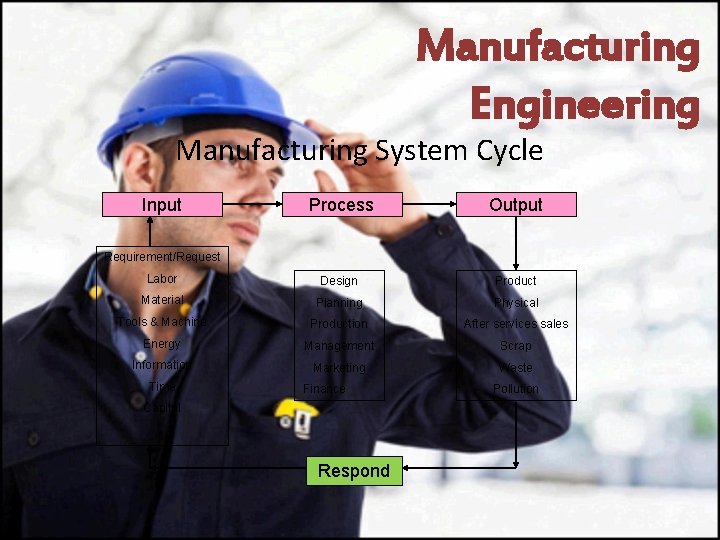
Manufacturing Engineering Manufacturing System Cycle Input Process Output Labor Design Product Material Planning Physical Tools & Machine Production After services sales Energy Management Scrap Information Marketing Waste Requirement/Request Time Finance Capital Respond Pollution
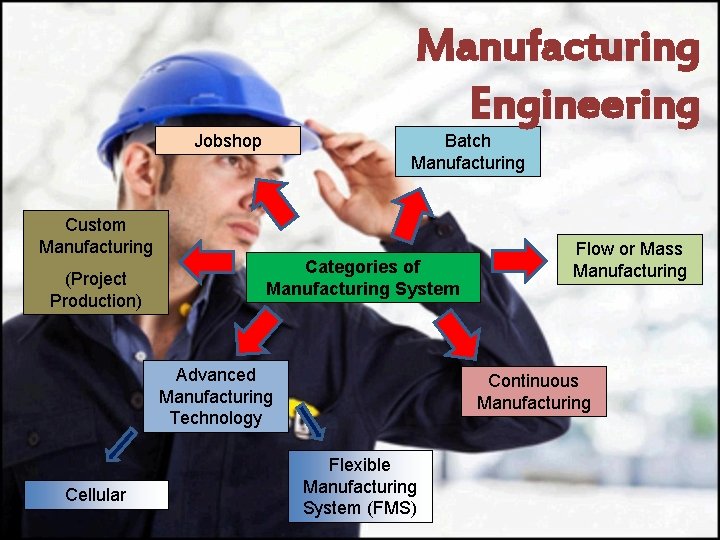
Manufacturing Engineering Jobshop Batch Manufacturing Custom Manufacturing (Project Production) Categories of Manufacturing System Advanced Manufacturing Technology Cellular Flow or Mass Manufacturing Continuous Manufacturing Flexible Manufacturing System (FMS)
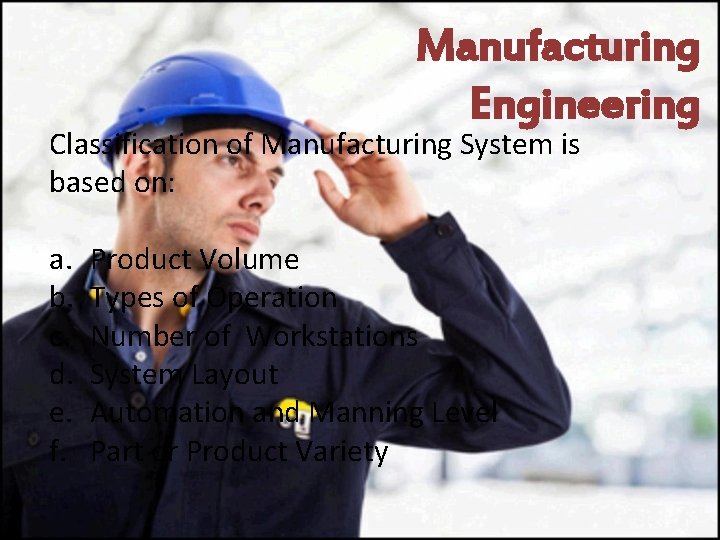
Manufacturing Engineering Classification of Manufacturing System is based on: a. b. c. d. e. f. Product Volume Types of Operation Number of Workstations System Layout Automation and Manning Level Part or Product Variety
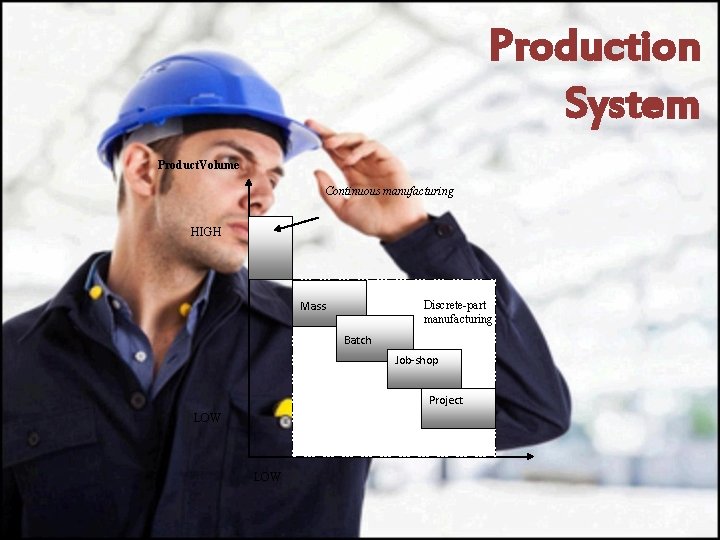
Production System Product. Volume Continuous manufacturing HIGH Discrete-part manufacturing Mass Batch Job-shop Project LOW
Manufacturing Engineering Custom Manufacturing o Oldest types, project production o One Off's. Examples: _______ o Product based on order o Small quantity and variety o High cost and long duration production o General types of machines and tools o Need for fixed position layout. o Need For skilled labour. o Advantages/disadvantages : ____________
Manufacturing Engineering Job Shop • Custom or semi-custom manufacturing processes such as small to medium-size customer orders or batch jobs • Need For process/ functional Layout. • Need For skilled Labour. • Equipment : general purpose
Job Shop Manufacturing Engineering Advantages Ø High production mix flexibility Ø High flexibility in product engineering Ø High expansion flexibility (machines are easily added or substituted) Ø High production volume elasticity Ø Low obsolence Disadvantages Ø Very hard scheduling Ø Low capacity utilization
Manufacturing Engineering Batch Manufacturing • Productions lots, one lots of same product at one time based on order • manufacture of a variety of discrete products in batches. • Job distribute among workers • No needs for skillful workers • Produce variety types of product & based on season • General and flexible machine; same facilities used to manufacture all the different items. • large amounts of work in progress. • Example of products: _________
Manufacturing Engineering Flow/Mass Production • repetitive manufacture of the standardized items in large quantities. • high demand expected for the items in the long term. • suitable for assembly line layout. • special purpose machine • Examples: _________
Manufacturing Engineering Continuous Manufacturing • This system also known as repetitive production • Same product type in large quantity • Same operation along the assembly line • Product produce continuously and fast • Workers specialized on their area • Fixed production line • high level automation involving mini and micro computers. • on line quality control and direct monitoring of operations • need for skilled technicians to operate machines. • Examples: _____________
Manufacturing Engineering Flexible Manufacturing System (FMS) § Combination of continuous and batch manufacturing § Involving computerized and automatic control system § Ideal with criteria : Ø low operation cost Ø consistent quality Ø long time machine utilization Ø less set-up time and job change Ø less work in process Ø predictable manufacturing time
Manufacturing Engineering Flexible Manufacturing System (FMS) Four basic components: 1. Processing station CNC Testing Assembly 2. Material handling & Storage Material handling tools & equipment Storage function 3. Computer Control System Coordinate process station activity and material handling system 4. Operator Manage and supervise operation system
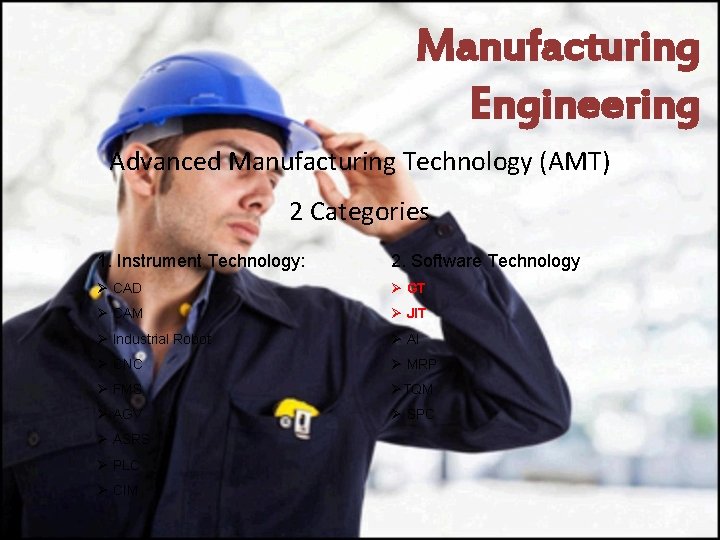
Manufacturing Engineering Advanced Manufacturing Technology (AMT) 2 Categories 1. Instrument Technology: 2. Software Technology Ø CAD Ø GT Ø CAM Ø JIT Ø Industrial Robot Ø AI Ø CNC Ø MRP Ø FMS ØTQM Ø AGV Ø SPC Ø ASRS Ø PLC Ø CIM
Manufacturing Engineering Cellular Manufacturing (Linked Cells) • newest manufacturing system, consists of manufacturing cell and assembly cell. • Based on group technology (GT) concept • Each cell is designed to produce a part family • the cell layout is often clustered • the cycle time for the system dictates the production rate for the cell
Manufacturing Engineering Just In Time (JIT) § strategy that strives to improve a business return on investment by reducing in-process inventory and associated carrying costs § Parts and materials are supplied in time they are needed. § The supplying process relies on signal or Kanban between different points in the process, which tell production when to make the next part. § Kanban are usually 'tickets' but can be simple visual signals, such as the presence or absence of a part on a shelf § Improves return on investment, quality, and efficiency.
• Benefits of JIT Manufacturing Engineering Ø Reduce or eliminate setup times: Ø Reduce lot sizes: Ø Reduce lead times: Ø Preventive maintenance Ø Flexible work force Ø Require supplier quality assurance and implement a zero defects quality program Ø Small‑lot (single unit) conveyance: Ø reducing inventory levels Ø improving product quality
Class Activity 1. List the three categories of manufacturers. Give examples of industries on each category 2. What are the criteria to classify a manufacturing system? 3. List the categories of manufacturing system according to production volume 4. Select four of the manufacturing system described previously in the lecture. Describe the characteristics of each system and give examples of industries 5. Describe the Just In Time phylosophy. List the benefits of implementing JIT
Process Engineering Concerned: Design of the actual process to be used in the manufacturing of the product Six steps sequence should be taken: 1. Defining the product structure & specification 2. Assessing each component manufacturability 3. Listing the different process capable to manufacturing the component 4. Evaluating the cost of each the alternative 5. Determining the sequence in which operation to be performed 6. Documenting the process
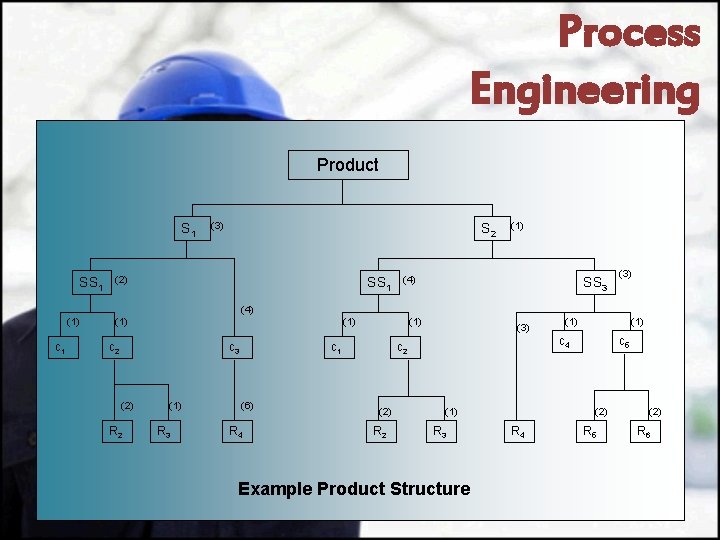
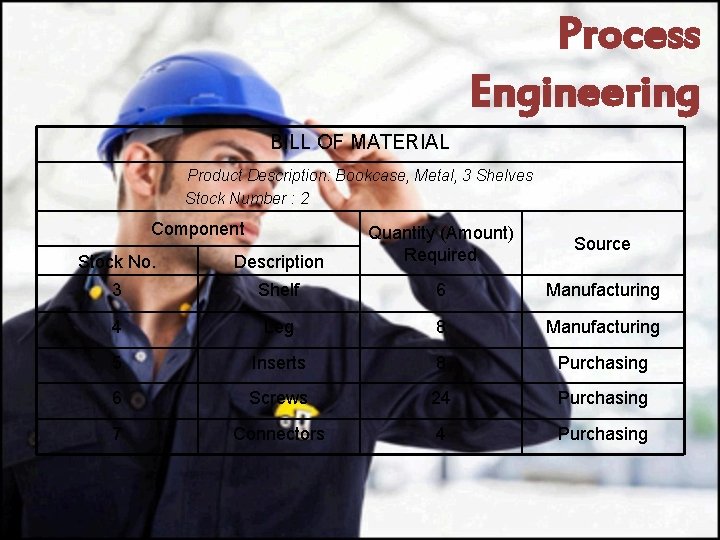
Process Engineering 1. Defining the product structure & specification Product structure: Shown in hierarchical chart subassembly, sub-subassembly, components and raw materials that comprise the product. Details shown in Bills of Materials (BOM) Product Specification: Specification is details of design component either buy/make. Example of specification is: Size, height, width, length, desired material, diameter, material, surface finish and tolerances Information of specification of design product comes from: i. Production drawing ii. List of component iii. Prototype iv. Assembly drawing
Process Engineering Product S 1 SS 1 (3) S 2 (2) SS 1 (1) (4) SS 3 (3) (4) (1) c 1 (1) c 2 c 3 (2) R 2 (1) R 3 (1) c 1 (6) R 4 (3) R 2 (1) c 4 c 2 (2) (1) R 3 Example Product Structure c 5 (2) R 4 R 5 (2) R 6
Process Engineering BILL OF MATERIAL Product Description: Bookcase, Metal, 3 Shelves Stock Number : 2 Component Stock No. Description Quantity (Amount) Required 3 Shelf 6 Manufacturing 4 Leg 8 Manufacturing 5 Inserts 8 Purchasing 6 Screws 24 Purchasing 7 Connectors 4 Purchasing Source
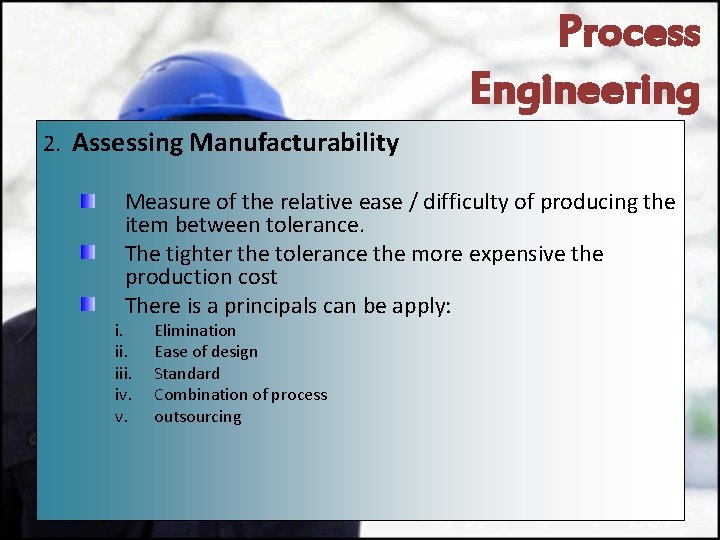
Process Engineering 2. Assessing Manufacturability Measure of the relative ease / difficulty of producing the item between tolerance. The tighter the tolerance the more expensive the production cost There is a principals can be apply: i. iii. iv. v. Elimination Ease of design Standard Combination of process outsourcing
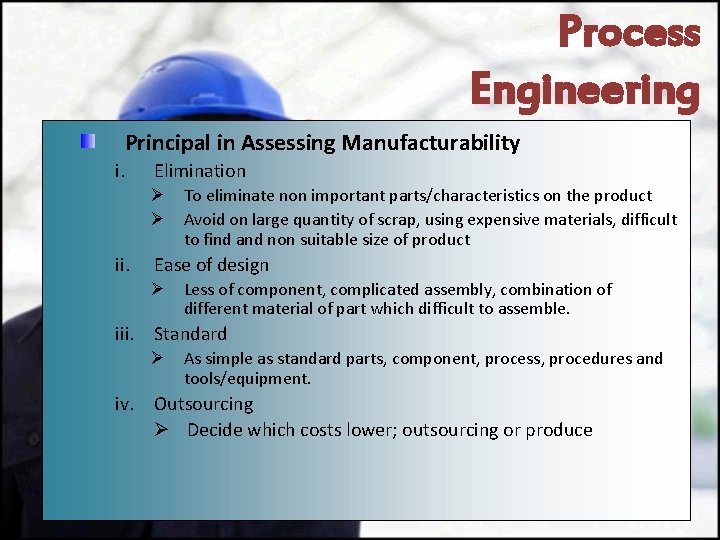
Process Engineering Principal in Assessing Manufacturability i. Elimination Ø To eliminate non important parts/characteristics on the product Ø Avoid on large quantity of scrap, using expensive materials, difficult to find and non suitable size of product ii. Ease of design Ø Less of component, complicated assembly, combination of different material of part which difficult to assemble. iii. Standard Ø As simple as standard parts, component, process, procedures and tools/equipment. iv. Outsourcing Ø Decide which costs lower; outsourcing or produce
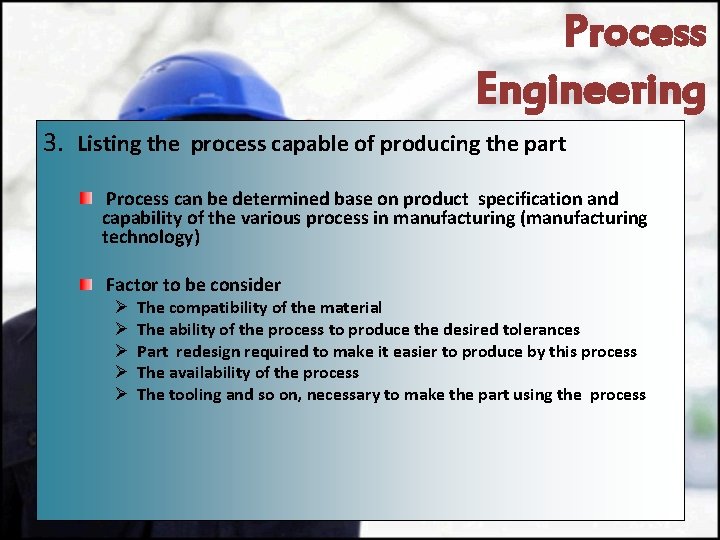
Process Engineering 3. Listing the process capable of producing the part Process can be determined base on product specification and capability of the various process in manufacturing (manufacturing technology) Factor to be consider Ø Ø Ø The compatibility of the material The ability of the process to produce the desired tolerances Part redesign required to make it easier to produce by this process The availability of the process The tooling and so on, necessary to make the part using the process
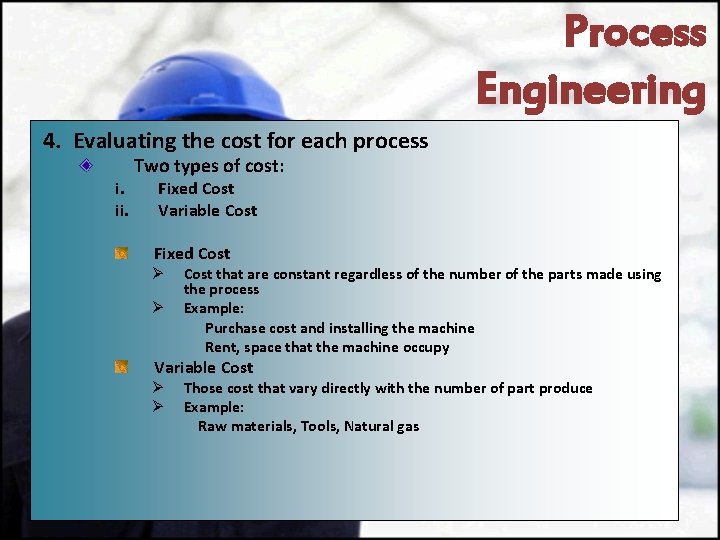
Process Engineering 4. Evaluating the cost for each process i. ii. Two types of cost: Fixed Cost Variable Cost Fixed Cost Ø Ø Cost that are constant regardless of the number of the parts made using the process Example: Purchase cost and installing the machine Rent, space that the machine occupy Variable Cost Ø Ø Those cost that vary directly with the number of part produce Example: Raw materials, Tools, Natural gas
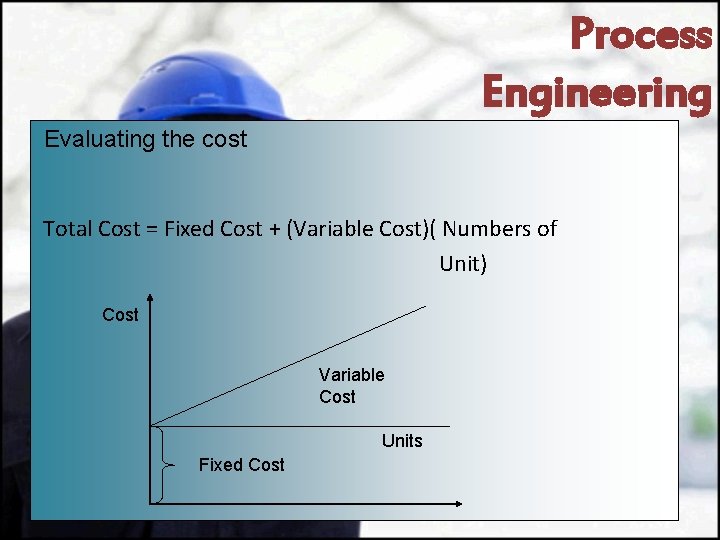
Process Engineering Evaluating the cost Total Cost = Fixed Cost + (Variable Cost)( Numbers of Unit) Cost Variable Cost Units Fixed Cost
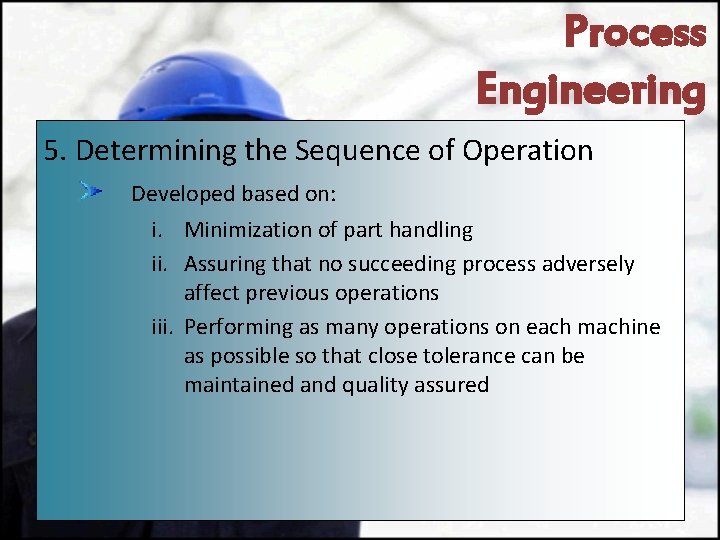
Process Engineering 5. Determining the Sequence of Operation Developed based on: i. Minimization of part handling ii. Assuring that no succeeding process adversely affect previous operations iii. Performing as many operations on each machine as possible so that close tolerance can be maintained and quality assured
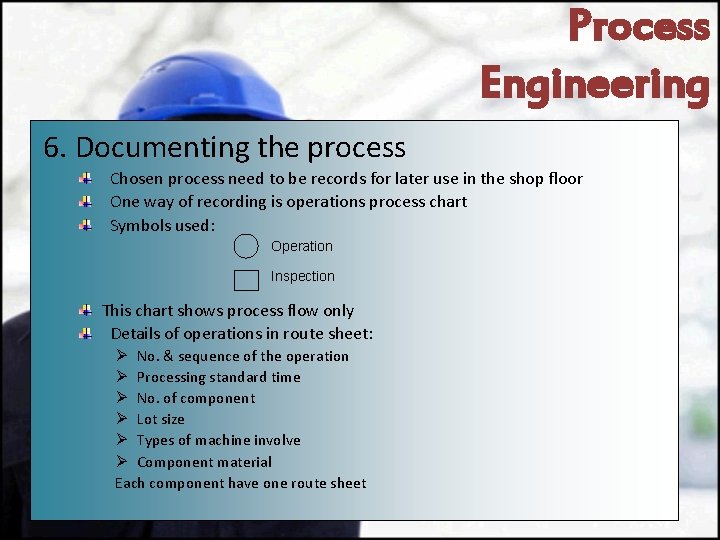
Process Engineering 6. Documenting the process Chosen process need to be records for later use in the shop floor One way of recording is operations process chart Symbols used: Operation Inspection This chart shows process flow only Details of operations in route sheet: Ø No. & sequence of the operation Ø Processing standard time Ø No. of component Ø Lot size Ø Types of machine involve Ø Component material Each component have one route sheet
Responsibility of Manufacturing Engineer Planning product manufacturing & process Identified machine, equipment, tools and personal planning success Interaction between design and material engineer for productivity optimization and low cost production Cooperate with the industrial engineer for activity planning