
Outlin es Chapter 1 Information System in Business
Outlin es Chapter 1: Information System in Business üIntroduction to System § Cybernetic system § Business as a system üFundamentals of Information System Dr. Rahman Ali, University of Peshawar. rahmanac 1@gmail. com Mr. Asmat Ali, GHSS Mingora Swat. aasmat 76@gmail. com § § Information System (IS) Components of IS Activities of IS Importance of IS üBrief Overview of Information System § Operation Support System § Management Support System § Others
Introduction to System Ø What is System • Originated from the Greek term systēma, which means to “place together. ” • System is a set of interrelated components with a clearly defined boundary working together to achieve a common set of objectives. • For example, human digestive and respiratory systems etc. Ø Cybernetic System • A self-monitoring, self-regulating system that adds feedback and control to itself to improve its performance. § Feedback is data about the performance of a system and § Control involves monitoring and evaluating feedback to determine whether a system is moving towards the achievement of its goal. Management Information System (MIS) – by Dr. Rahman Ali & Asmat Ali 3
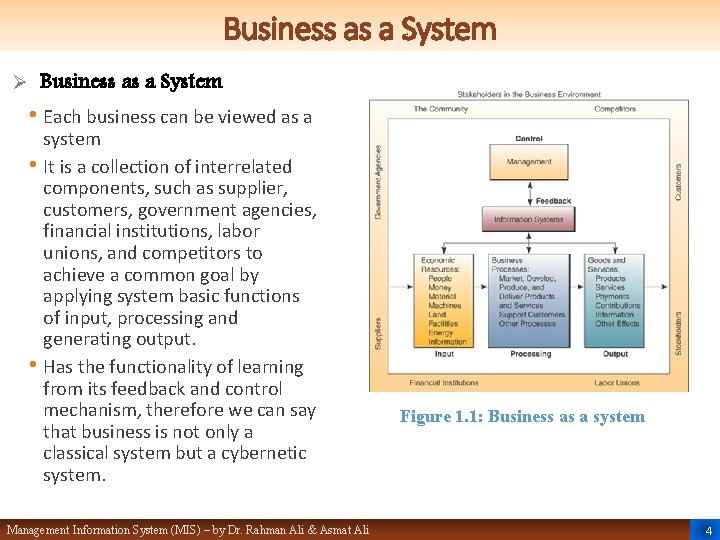
Business as a System Ø Business as a System • Each business can be viewed as a system • It is a collection of interrelated components, such as supplier, customers, government agencies, financial institutions, labor unions, and competitors to achieve a common goal by applying system basic functions of input, processing and generating output. • Has the functionality of learning from its feedback and control mechanism, therefore we can say that business is not only a classical system but a cybernetic system. Management Information System (MIS) – by Dr. Rahman Ali & Asmat Ali Figure 1. 1: Business as a system 4
Information System Ø Information System • An organized combination of § hardware, software, personnel, infrastructure, data resources, policies and procedures to facilitate planning, control, coordination, and decision making is called information system. • An information system § stores, retrieves, transforms, and disseminates information in an organization. Management Information System (MIS) – by Dr. Rahman Ali & Asmat Ali 5
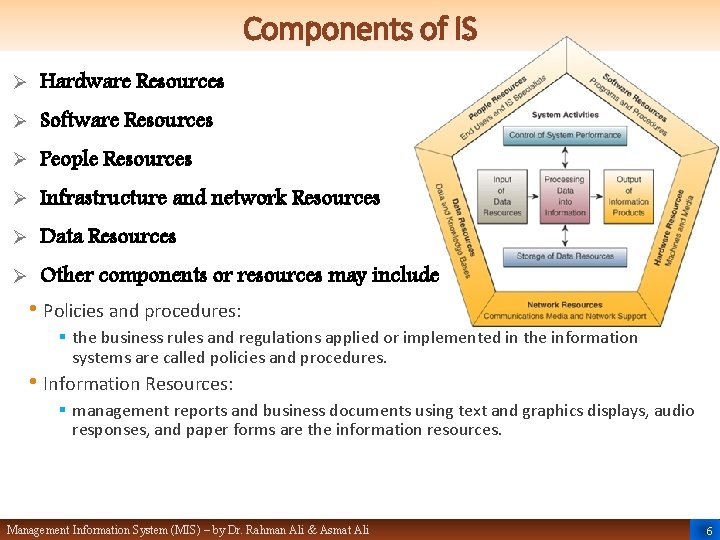
Components of IS Ø Hardware Resources Ø Software Resources Ø People Resources Ø Infrastructure and network Resources Ø Data Resources Ø Other components or resources may include • Policies and procedures: § the business rules and regulations applied or implemented in the information systems are called policies and procedures. • Information Resources: § management reports and business documents using text and graphics displays, audio responses, and paper forms are the information resources. Management Information System (MIS) – by Dr. Rahman Ali & Asmat Ali 6
Information System Activities or functions Ø Input: § involves capturing and assembling elements that enter the system to be processed Ø Processing: § involves transformation process that convert input into output. It includes messages, reports, forms, graphic images etc. Ø Output: § involves transferring elements that have been produced by the transformation process to their ultimate destination Ø Storage of data resources: § it includes data elements and databases. Ø Control of system performance: § it includes monitoring and evaluating feedback. Management Information System (MIS) – by Dr. Rahman Ali & Asmat Ali 7
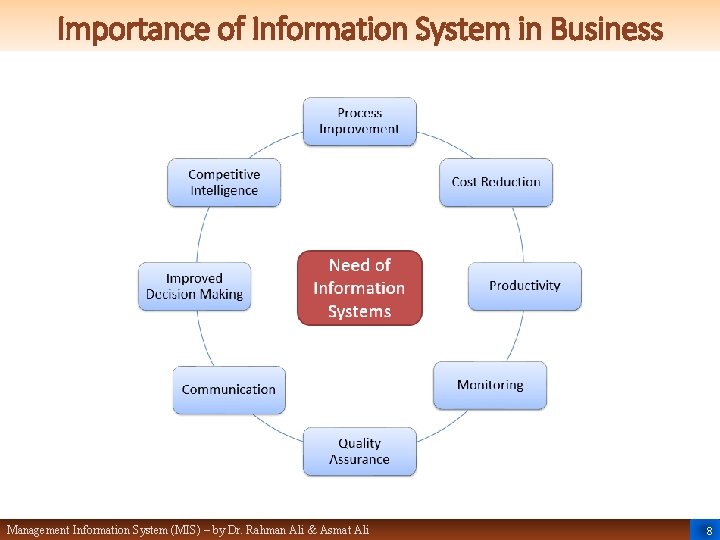
Importance of Information System in Business Management Information System (MIS) – by Dr. Rahman Ali & Asmat Ali 8
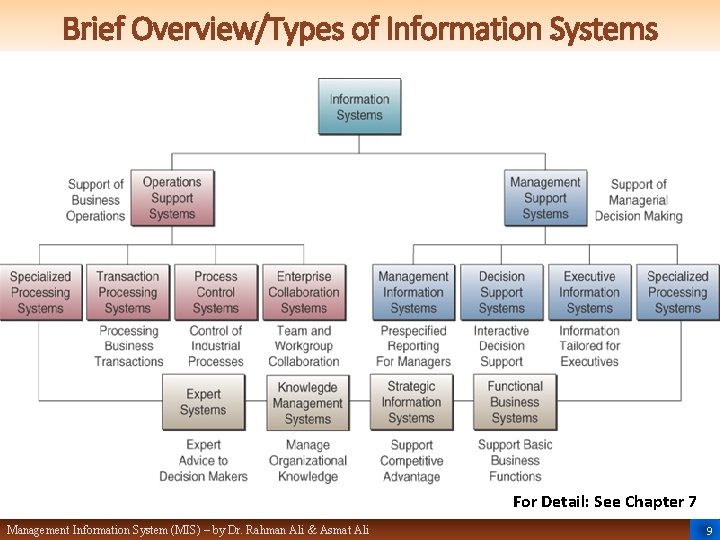
Brief Overview/Types of Information Systems For Detail: See Chapter 7 Management Information System (MIS) – by Dr. Rahman Ali & Asmat Ali 9
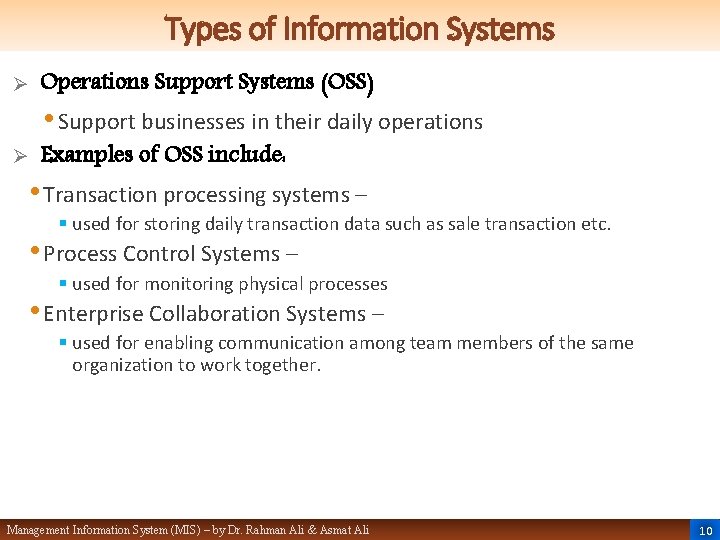
Types of Information Systems Ø Operations Support Systems (OSS) • Support businesses in their daily operations Ø Examples of OSS include: • Transaction processing systems – § used for storing daily transaction data such as sale transaction etc. • Process Control Systems – § used for monitoring physical processes • Enterprise Collaboration Systems – § used for enabling communication among team members of the same organization to work together. Management Information System (MIS) – by Dr. Rahman Ali & Asmat Ali 10
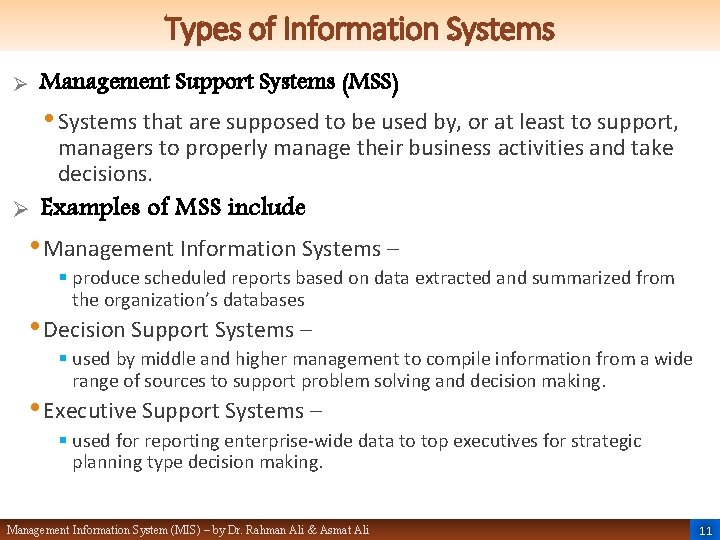
Types of Information Systems Ø Management Support Systems (MSS) • Systems that are supposed to be used by, or at least to support, managers to properly manage their business activities and take decisions. Ø Examples of MSS include • Management Information Systems – § produce scheduled reports based on data extracted and summarized from the organization’s databases • Decision Support Systems – § used by middle and higher management to compile information from a wide range of sources to support problem solving and decision making. • Executive Support Systems – § used for reporting enterprise-wide data to top executives for strategic planning type decision making. Management Information System (MIS) – by Dr. Rahman Ali & Asmat Ali 11
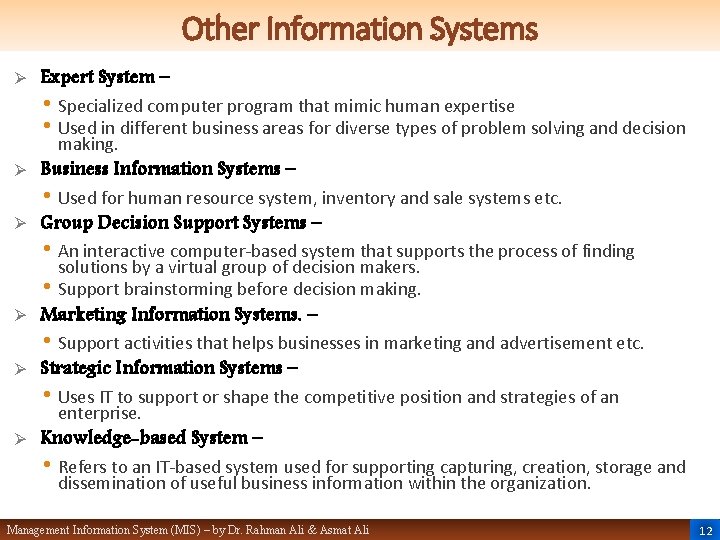
Other Information Systems Ø Expert System – • Specialized computer program that mimic human expertise • Used in different business areas for diverse types of problem solving and decision making. Ø Business Information Systems – • Used for human resource system, inventory and sale systems etc. Ø Group Decision Support Systems – • An interactive computer-based system that supports the process of finding solutions by a virtual group of decision makers. • Support brainstorming before decision making. Ø Marketing Information Systems. – • Support activities that helps businesses in marketing and advertisement etc. Ø Strategic Information Systems – • Uses IT to support or shape the competitive position and strategies of an enterprise. Ø Knowledge-based System – • Refers to an IT-based system used for supporting capturing, creation, storage and dissemination of useful business information within the organization. Management Information System (MIS) – by Dr. Rahman Ali & Asmat Ali 12
References § Ali, R. & Ali, A. (2018). Chapter 1: Information System in Business. Management Information System – 1 st Edition (pp. 1 -13). Mahla Jangi, Qissa Khawani, Peshawar, Pakistan: Al-ilum Publications.
Thanks! Any Questions ?
- Slides: 14