
Outlet Branch Circuit Arc Fault Circuit Interrupter OBC
Outlet Branch Circuit Arc Fault Circuit Interrupter (OBC AFCI) The Association of Electrical and Medical Imaging Equipment Manufacturers
The Association of Electrical and Medical Imaging Equipment Manufacturers AFCI Receptacles – Codes, Products, Usage Guide • • How it works. Guidelines on usage in existing circuits. What products are available NEMA generated white paper: • Guide to Prevention of Arcing Ignited Fires in Homes
The Association of Electrical and Medical Imaging Equipment Manufacturers What’s going on? U. S. Fire Administration (USFA) reported in 2011, an estimated 47, 700 home structure fires reported to fire departments involved some type of electrical failure or malfunction as factor in fire’s ignition • Resulted in 418 civilian deaths • 1, 570 civilian injuries • $1. 4 billion in direct property damage According to the National Fire Protection Association (NFPA), arc-faults are one of “the principle electrical failure mode resulting in fire”.
The Association of Electrical and Medical Imaging Equipment Manufacturers Danger of Electrical Faults 13% home fires in the U. S. were electrical in origin • 50% of those electrical fires resulted from arcing *National Fire Protection Association (NFPA) Annually, an estimated 28, 300 residential building electrical fires cause 360 deaths, 1, 000 injuries, and $995 million in direct loss *Topical Fire Report Series, Volume 8, Issue 2 / March 2008, U. S. Fire Administration 15% of residential building electrical fires start in bedrooms *Topical Fire Report Series, Volume 8, Issue 2 / March 2008, U. S. Fire Administration 47% of residential building electrical fires where equipment was involved were caused by wiring *Topical Fire Report Series, Volume 8, Issue 2 / March 2008, U. S. Fire Administration Electrical fire data is most likely underreported
The Association of Electrical and Medical Imaging Equipment Manufacturers What is an “arc fault”? When electric current unintentionally “arcs” outside of the conductor without proper insulation Concentrated temperatures from the exposed current can exceed 10, 000 degrees Fahrenheit and ignite surrounding material Arc faults can be low level in terms of current BUT high level of heat and therefore, difficult for conventional overcurrent devices to detect Two general types of arc faults: 1. Series Arc • “In-line fault”- Break or gap in a single conductor connecting a load where a “jump” occurs in the line 2. Parallel Arc • Arc fault that occurs Line-to-Ground or Line-to-Neutral

The Association of Electrical and Medical Imaging Equipment Manufacturers Parallel vs. Series Arcing Parallel • Line-to-neutral OR Line-to-ground Series • In-Line
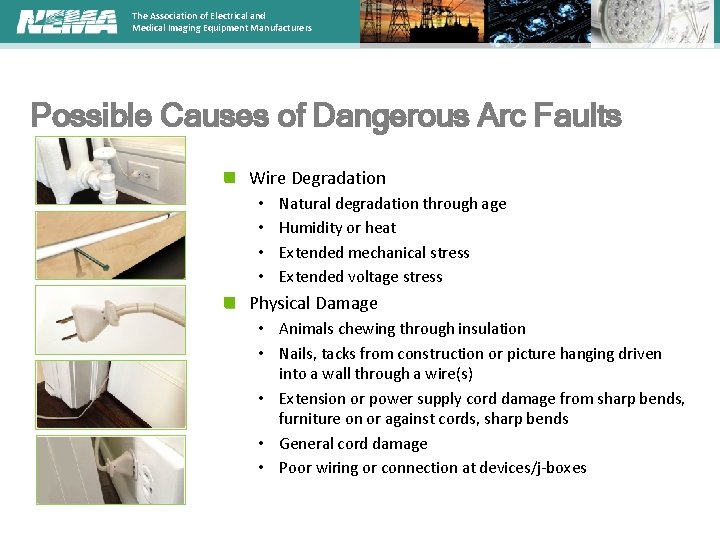
The Association of Electrical and Medical Imaging Equipment Manufacturers Possible Causes of Dangerous Arc Faults Wire Degradation • • Natural degradation through age Humidity or heat Extended mechanical stress Extended voltage stress Physical Damage • Animals chewing through insulation • Nails, tacks from construction or picture hanging driven into a wall through a wire(s) • Extension or power supply cord damage from sharp bends, furniture on or against cords, sharp bends • General cord damage • Poor wiring or connection at devices/j-boxes
The Association of Electrical and Medical Imaging Equipment Manufacturers What is an AFCI? AFCI detects arc faults (an unintentional arcing condition in a circuit) that standard circuit breakers and receptacles (GFCI’s, etc. ) are not designed to detect Intended to mitigate the effects of arc faults by functioning to de-energize the circuit when an arc fault is detected AFCI detects both types of arc faults: • Parallel (Line-to-neutral or Line-to-ground) • Series (In-line) arcing AFCI’s reduce chances of electrical system BECOMING an ignition source • Smoke alarms, fire extinguishers, and escape ladders are emergency equipment used to take action AFTER fire occurs
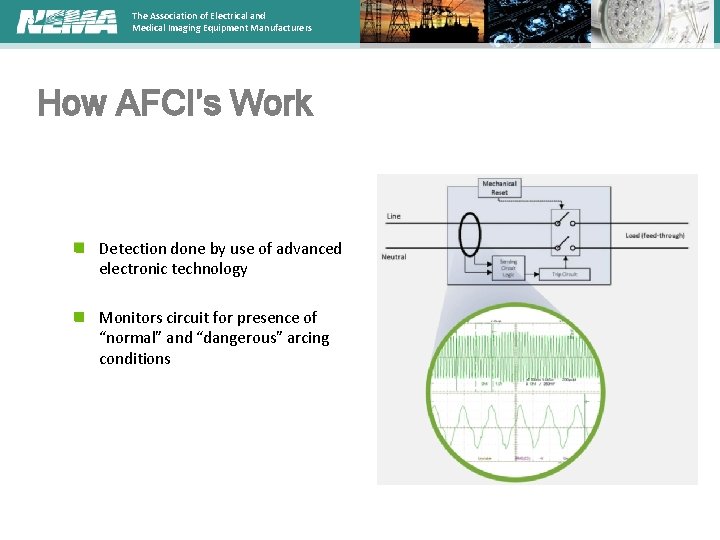
The Association of Electrical and Medical Imaging Equipment Manufacturers How AFCI’s Work Detection done by use of advanced electronic technology Monitors circuit for presence of “normal” and “dangerous” arcing conditions
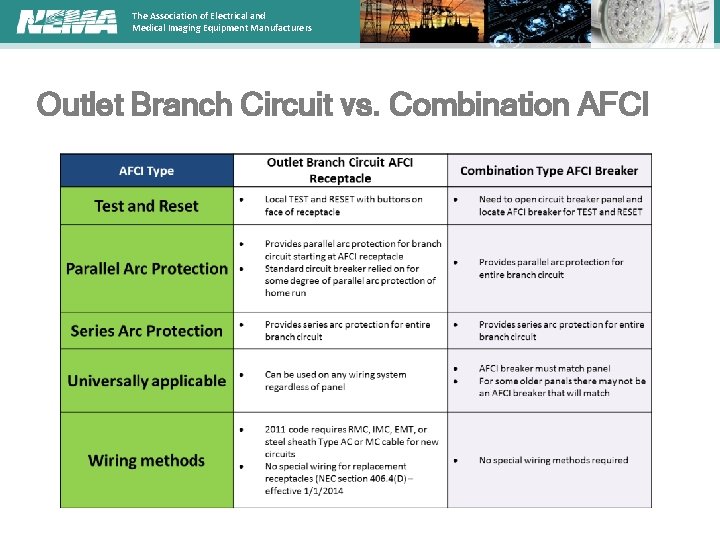
The Association of Electrical and Medical Imaging Equipment Manufacturers Outlet Branch Circuit vs. Combination AFCI
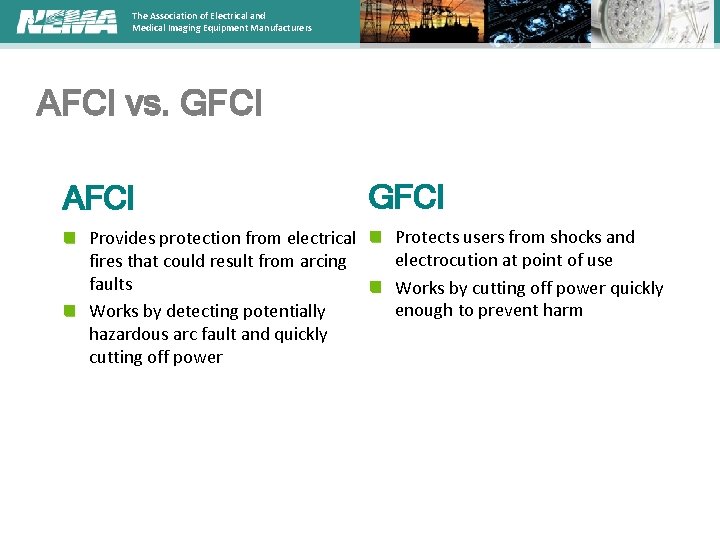
The Association of Electrical and Medical Imaging Equipment Manufacturers AFCI vs. GFCI AFCI Provides protection from electrical fires that could result from arcing faults Works by detecting potentially hazardous arc fault and quickly cutting off power GFCI Protects users from shocks and electrocution at point of use Works by cutting off power quickly enough to prevent harm
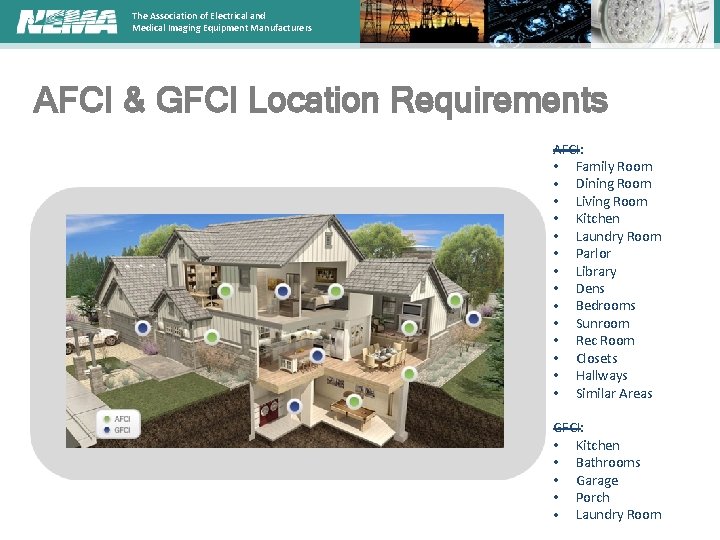
The Association of Electrical and Medical Imaging Equipment Manufacturers AFCI & GFCI Location Requirements AFCI: • Family Room • Dining Room • Living Room • Kitchen • Laundry Room • Parlor • Library • Dens • Bedrooms • Sunroom • Rec Room • Closets • Hallways • Similar Areas GFCI: • Kitchen • Bathrooms • Garage • Porch • Laundry Room
The Association of Electrical and Medical Imaging Equipment Manufacturers Overlapping Applications with GFCI’s Kitchen • GFCIs- Countertops, islands, and within 6 -ft of sinks • AFCIs- All other outlets Laundry Rooms • GFCIs- Within 6 -ft of sinks There are NO compatibility issues or concerns using AFCIs and GFCIs on the same circuit! Devices that include both types of protection are being introduced
The Association of Electrical and Medical Imaging Equipment Manufacturers National Electrical Code® on Arcing 2014 NEC • New Branch Circuits: Section 210. 12(A) • Modifications/Extensions: Section 210. 12(B) – Combination-type AFCI at the origin of the branch circuit or OBC AFCI at the first receptacle outlet • Replacement Receptacles: Section 406. 4(D)(4) – Replacement receptacles must be either OBC AFCI Receptacle, or protected by Combination-type AFCI breaker or OBC AFCI receptacle
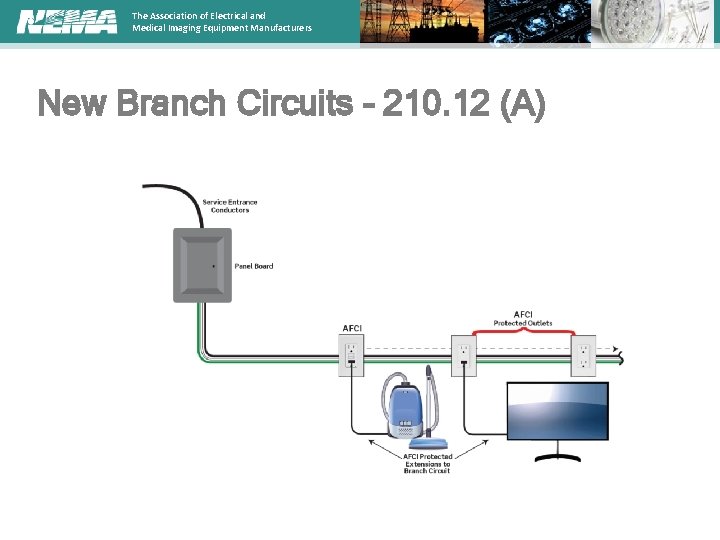
The Association of Electrical and Medical Imaging Equipment Manufacturers New Branch Circuits - 210. 12 (A)
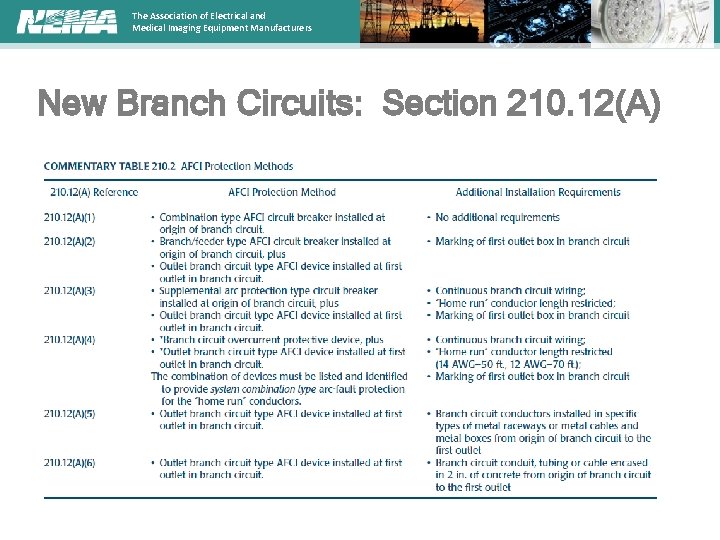
The Association of Electrical and Medical Imaging Equipment Manufacturers New Branch Circuits: Section 210. 12(A)
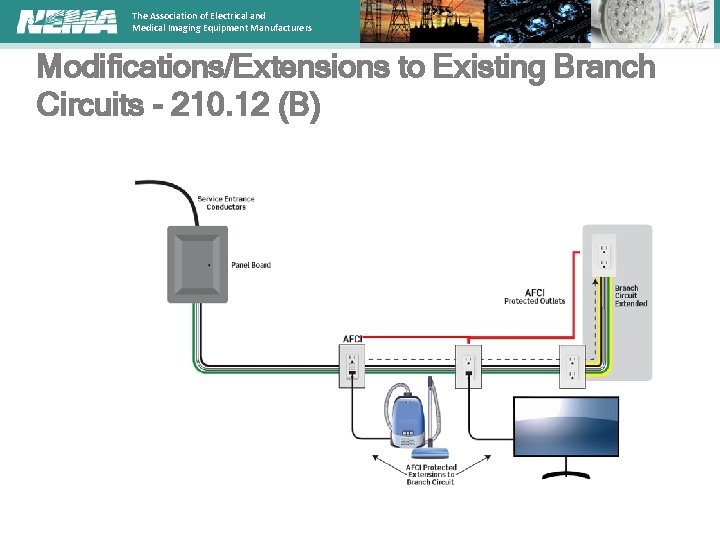
The Association of Electrical and Medical Imaging Equipment Manufacturers Modifications/Extensions to Existing Branch Circuits - 210. 12 (B)
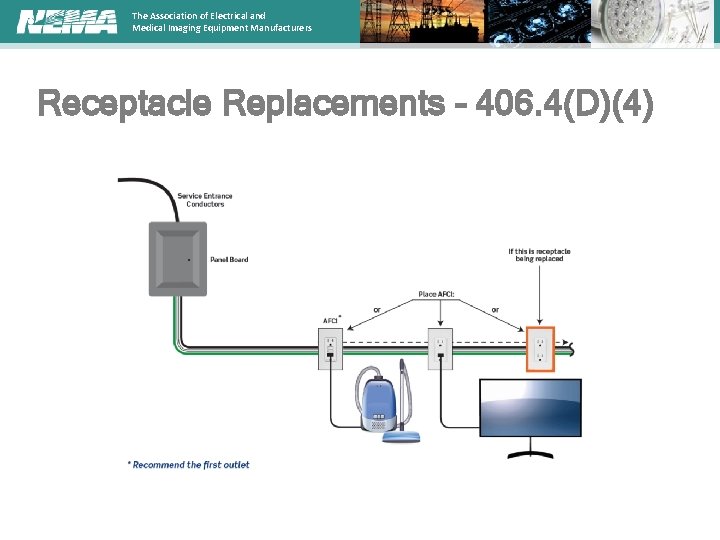
The Association of Electrical and Medical Imaging Equipment Manufacturers Receptacle Replacements - 406. 4(D)(4)
The Association of Electrical and Medical Imaging Equipment Manufacturers Summary of AFCI Requirements by NEC* New Circuits • • Where a new circuit is being run from a circuit breaker panel or sub-panel Applies to all types of circuits – receptacles, lighting, and smoke detectors If using an OBC AFCI, it must be installed at the first outlet AFCI circuit breaker is also acceptable Modifications and Extensions to Branch Circuits • Includes adding additional receptacles or outlets on an existing branch circuit or moving existing outlets • Typically occurs during renovations to specific spaces or room additions • Applies to all outlets - receptacles, lighting and smoke detectors * See slide 16 for details
- Slides: 19